
Opposition has intensified in Mysuru against the proposed cutting of trees for the construction of a flyover at Devalapura Cross on the city’s ring road, with residents, environmental activists, and citizen groups voicing strong resistance to what they describe as “avoidable ecological damage.” The issue has sparked a wider debate on urban planning priorities, environmental responsibility, and the cost at which infrastructure development is being pursued in one of Karnataka’s greenest cities.
Devalapura Cross, located along the outer ring road, is lined with mature avenue trees that have stood for decades, offering shade, regulating temperature, and serving as a natural buffer against pollution. The proposed flyover project, aimed at easing traffic congestion at the busy junction, is expected to require the removal of a significant number of these trees. This has triggered protests and petitions from local residents who argue that the project prioritises speed over sustainability.
Urban planners have pointed out that Mysuru’s ring road was originally designed to distribute traffic evenly and reduce pressure on the city core. They argue that repeated additions of flyovers along the ring road could gradually convert it into a high-speed corridor, undermining its original purpose. Such transformations, they warn, often marginalise pedestrians, cyclists, and local traffic, making roads less inclusive. At Devalapura Cross, residents fear that a flyover could physically divide neighbourhoods and reduce accessibility for nearby villages that depend on the junction for daily movement.
Environmental scientists have also flagged the microclimatic impact of tree removal in this zone. The Devalapura Cross stretch is known to remain relatively cooler due to dense tree cover, especially during peak summer months. Removing these trees, experts say, could increase surface temperatures and worsen the urban heat island effect. This would not only affect commuters but also nearby residential areas, schools, and small businesses that rely on natural shade to cope with rising temperatures.
There is growing concern that the flyover proposal reflects a larger pattern of infrastructure-first planning without adequate environmental assessment. Activists argue that environmental impact assessments are often treated as procedural formalities rather than meaningful evaluations. In the case of Devalapura Cross, they demand a detailed, publicly accessible study outlining traffic data, environmental costs, and alternative solutions. Without such transparency, they say, public trust in planning authorities will continue to erode.
Several former city planners have recalled that Mysuru once prioritised tree-lined boulevards and human-scale roads as part of its planning philosophy. They warn that abandoning these principles could strip the city of its distinct identity. Unlike megacities where flyovers dominate the skyline, Mysuru has traditionally balanced mobility with aesthetics and ecology. The current opposition, they say, reflects citizens’ desire to protect this legacy rather than resist development outright.
Local traders operating near Devalapura Cross have expressed mixed reactions. While some hope a flyover might ease congestion and improve access, others worry about long-term disruption during construction. Past infrastructure projects in the city have led to prolonged road closures, reduced footfall, and loss of business. Shop owners fear that extended construction activity could hurt livelihoods, especially if the benefits of the flyover are not immediately visible.
Traffic experts have suggested that congestion at Devalapura Cross may be more episodic than structural. According to them, peak-hour traffic spikes are often linked to school timings, office hours, or festival seasons. Targeted measures such as staggered timings, better signal coordination, and enforcement against illegal parking could address these spikes effectively. They caution that building a flyover for intermittent congestion risks overengineering the problem.
Citizen groups have also raised questions about financial priorities. They argue that funds allocated for flyover construction could instead be invested in improving public transport, pedestrian infrastructure, and cycling networks. Mysuru’s bus connectivity, they say, still has scope for improvement, particularly in outer areas. Strengthening public transport could reduce private vehicle dependence, easing congestion without major ecological costs.
The issue has begun to attract political attention, with some local representatives expressing support for citizens’ concerns. While avoiding outright opposition to the flyover, they have called for dialogue and reconsideration of tree felling. Political observers note that environmental issues increasingly influence urban voters, particularly in cities like Mysuru where quality of life is a key concern. How leaders respond could have electoral implications in the future.
Legal experts point out that tree felling for infrastructure projects often invites scrutiny under existing environmental and municipal laws. If proper permissions, public hearings, or compensatory measures are found lacking, projects can face legal challenges. Activists have hinted that they may explore legal options if authorities proceed without addressing concerns. Such litigation, they warn, could delay the project and increase costs, making early consultation a more pragmatic approach.
As the debate continues, Devalapura Cross has become a symbol of a larger question facing Mysuru: what kind of growth does the city want to pursue. The outcome will likely influence future infrastructure decisions and citizen engagement across the city. For now, residents remain determined to make their voices heard, insisting that development must respect both people and nature. Whether the flyover plan is modified, delayed, or implemented unchanged will reveal how Mysuru balances progress with preservation.
Citizens opposing the move say they were neither adequately consulted nor provided with transparent details about the number of trees to be felled or the alternatives explored. Several resident welfare associations have demanded that authorities place the project details in the public domain and hold consultations before proceeding with any tree cutting. For many locals, the trees are not merely part of the landscape but integral to Mysuru’s identity as a heritage city.
Environmental groups have also raised concerns that repeated infrastructure projects are steadily eroding Mysuru’s green cover. They warn that incremental losses, when viewed collectively, could have long-term consequences for the city’s climate resilience, groundwater levels, and overall livability.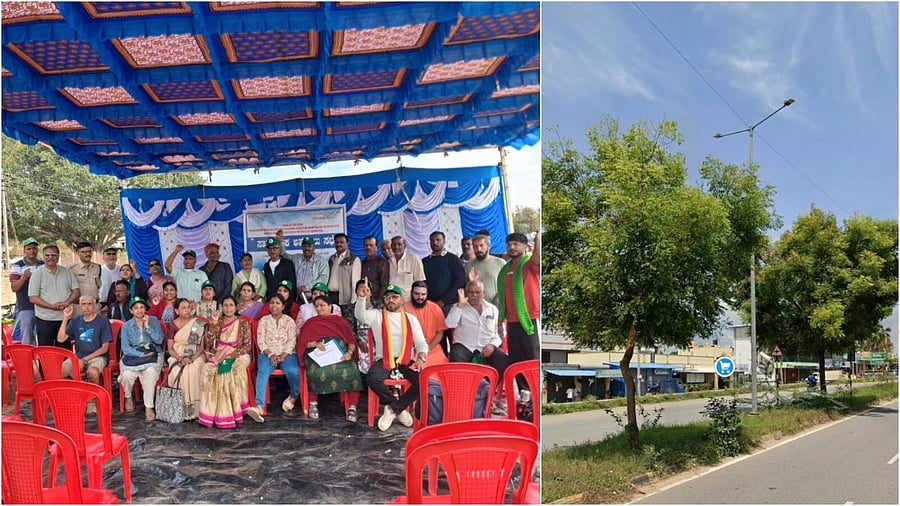
CITIZEN PROTESTS AND ENVIRONMENTAL CONCERNS
Protests near Devalapura Cross have seen participation from students, senior citizens, environmentalists, and daily commuters. Demonstrators held placards calling for “development without destruction” and demanded that the flyover plan be reconsidered. Some protesters tied ribbons around trees as a symbolic gesture, appealing to authorities to treat them as living assets rather than obstacles.
Activists argue that flyovers often offer only temporary relief from congestion and encourage more vehicular traffic in the long run. They claim that alternative solutions such as better traffic management, signal optimisation, and improved public transport could reduce congestion without sacrificing trees. Mysuru, they point out, has historically adopted more measured urban growth compared to larger cities, and residents fear that uncritical adoption of flyover-centric planning could change that character.
Environmental experts have emphasised the ecological role of mature trees, noting that saplings planted as compensatory afforestation cannot replace the benefits of decades-old trees for many years. They stress that tree transplantation, often cited as a mitigation measure, has limited success rates and should not be treated as a guaranteed solution.
Several citizens have also questioned the choice of location for the flyover, arguing that traffic congestion at Devalapura Cross is not severe enough to justify such a large intervention. They claim peak-hour congestion could be addressed through better enforcement and minor road redesigns rather than major construction.
OFFICIAL STAND AND DEVELOPMENT ARGUMENTS
Officials associated with the project have defended the flyover, stating that traffic volume on the ring road has increased significantly due to urban expansion and growing vehicle ownership. According to them, Devalapura Cross has emerged as a bottleneck, particularly during peak hours, and the flyover is part of a long-term plan to ensure smoother traffic flow around the city.
Authorities have maintained that all required permissions will be obtained and that environmental norms will be followed. They have assured that compensatory afforestation will be undertaken in accordance with existing guidelines. However, critics argue that such assurances have become routine and rarely address the deeper ecological impact of losing mature trees within city limits.
Some officials have suggested that delaying infrastructure projects due to environmental concerns could hamper economic growth and increase traffic-related pollution caused by idling vehicles. They contend that well-planned flyovers can reduce travel time and fuel consumption. This argument, however, has not convinced protesters, who counter that induced demand often negates such benefits over time.
A BROADER DEBATE ON URBAN FUTURE
The Devalapura Cross controversy has reignited a broader conversation in Mysuru about the city’s development trajectory. Urban planners note that Mysuru stands at a crossroads, balancing its heritage and green legacy with pressures of modernisation. Decisions taken now, they say, will shape the city’s character for decades to come.
Many citizens have urged the government to adopt participatory planning processes that involve residents from the earliest stages of project design. They argue that inclusive decision-making could help identify solutions that meet mobility needs while preserving environmental assets. Suggestions such as redesigning junctions, restricting heavy vehicles during peak hours, and enhancing public transport connectivity have gained traction during discussions.
The issue has also found resonance on social platforms, with many Mysuru residents expressing emotional attachment to the trees at Devalapura Cross. For them, the opposition is not just about one flyover but about preserving a way of life that values balance over unchecked growth.
As authorities weigh their next steps, the standoff reflects a deeper tension between development and conservation that many Indian cities face. Whether the flyover project proceeds as planned or is modified will serve as a signal of how Mysuru chooses to define progress. For now, the trees at Devalapura Cross stand as silent witnesses to a city grappling with the cost of development and the value of its green heritage.
Follow: Karnataka Government
Also read: Home | Channel 6 Network – Latest News, Breaking Updates: Politics, Business, Tech & More
