
The Vice President of India recently emphasised the transformative potential of Indian start-ups in addressing pressing global challenges, highlighting innovation, entrepreneurship, and technology as key drivers for sustainable solutions. Speaking at a high-profile industry and innovation summit, he noted that Indian, with their agility, cost-effectiveness, and problem-solving approach, are uniquely positioned to contribute to solving global issues ranging from climate change and renewable energy to healthcare, urban infrastructure, and digital inclusion. According to the Vice President, leveraging creativity can accelerate development goals both domestically and internationally.
The Vice President underlined that India’s ecosystem has grown rapidly over the past decade, fueled by government initiatives like Startup India, increased access to venture capital, and a robust talent pool of engineers, scientists, and entrepreneurs. He noted that the sector’s dynamism allows it to respond faster than traditional institutions to emerging problems, offering solutions that are scalable and adaptable across diverse contexts. Highlighting examples of innovative products and services already making an impact globally, he called upon start-ups to aim for solutions that address both local and international challenges.
PROMOTING SUSTAINABLE INNOVATION
The Vice President stressed that sustainability should be at the heart of every start-up initiative. Indian entrepreneurs are increasingly focusing on eco-friendly solutions, from biodegradable packaging and renewable energy systems to water conservation technologies and low-emission transportation. Such innovations not only address environmental concerns domestically but also create exportable solutions for countries facing similar ecological challenges. By embedding sustainability into their business models, start-ups can ensure long-term relevance, attract socially conscious investors, and contribute meaningfully to global environmental goals.
BUILDING GLOBAL COLLABORATIONS
International collaboration was highlighted as a key driver for scaling Indian solutions. The Vice President encouraged to engage in cross-border partnerships, research collaborations, and participation in global accelerators. Collaborating with international organisations allows Indian innovators to test solutions under diverse conditions, adapt to global standards, and access wider markets. Such interactions also foster knowledge exchange, exposing Indian entrepreneurs to best practices and technological advances from around the world, which can further enhance the impact of their innovations.
FOCUS ON HEALTHCARE AND DIGITAL EDUCATION
The Vice President drew attention to sectors where Indian start-ups have already made a visible global impact, particularly healthcare and education. Affordable diagnostic devices, telemedicine platforms, and AI-driven patient management systems are helping bridge healthcare gaps in underserved regions. Similarly, digital learning platforms are providing quality education to students across remote geographies, ensuring that access is not limited by location or socio-economic status. He noted that these sectors represent opportunities where Indian solutions can be scaled globally, improving lives while creating business growth.
CALL FOR ENTREPRENEURIAL RESPONSIBILITY
Finally, the Vice President urged entrepreneurs to balance ambition with responsibility. Start-ups, he said, should aim not just for profits but for societal impact, ensuring their innovations are inclusive, ethical, and sustainable. He encouraged founders to engage with communities, understand real-world problems, and design solutions that empower citizens. By combining technology, creativity, and a commitment to social good, Indian start-ups can become global leaders in innovation, setting examples for other nations while contributing to a more sustainable and equitable world.
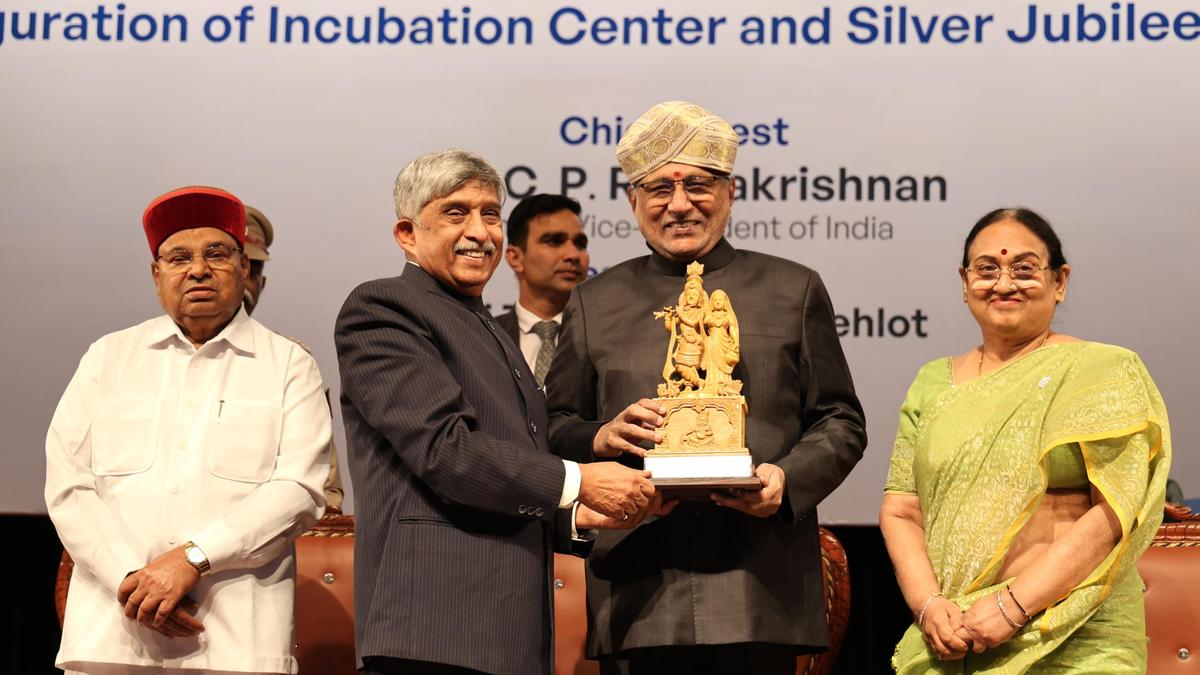
He further stressed the importance of fostering innovation that is inclusive and sustainable. Start-ups, he said, should focus on solutions that not only create economic value but also promote social good. Sectors such as renewable energy, affordable healthcare, sustainable agriculture, and digital education are areas where Indian start-ups can provide globally replicable models. The Vice President encouraged entrepreneurs to harness technology for environmental conservation, energy efficiency, and equitable access to resources, reinforcing the idea that profit and social impact can coexist.
INDIA’S START-UP ECOSYSTEM: A GLOBAL PLAYGROUND
India’s start-up ecosystem has emerged as one of the largest in the world, with thousands of registered ventures across multiple sectors. According to recent data, the country hosts more than 120 unicorns—start-ups valued at over $1 billion—with several making a mark in sectors such as fintech, healthtech, edtech, and clean technology. The Vice President highlighted that this growth demonstrates India’s ability to innovate at scale and impact both domestic markets and global solutions. Start-ups in India, he noted, are leveraging mobile connectivity, AI, and data analytics to address challenges that resonate worldwide.
Start-ups’ ability to combine low-cost models with high-impact solutions was emphasised as a critical advantage. For instance, affordable health monitoring devices and telemedicine platforms developed by Indian start-ups are now being considered for deployment in other developing nations facing similar healthcare challenges. Likewise, agricultural innovations such as precision farming solutions, water-efficient irrigation systems, and AI-driven crop forecasting have the potential to help farmers globally mitigate climate-related risks. The Vice President urged start-ups to expand beyond national borders with such scalable technologies.
He also pointed out the crucial role of collaboration between government, academia, and industry. Start-ups, he said, can greatly benefit from partnerships with universities, research institutions, and multinational organisations to validate their solutions, improve scalability, and ensure compliance with international standards. By working together, Indian innovators can develop solutions that are not only cutting-edge but also adaptable for varied geographies and socio-economic conditions, reinforcing India’s global leadership in innovation.
TECHNOLOGY AND ENTREPRENEURSHIP AS TOOLS FOR IMPACT
Technology was described as the central enabler of start-up-driven solutions. The Vice President emphasised that emerging technologies such as artificial intelligence, blockchain, machine learning, and IoT can help tackle complex global challenges efficiently. For example, AI-driven diagnostic tools and blockchain-based supply chain management systems have already started transforming sectors such as healthcare and agriculture, ensuring transparency, efficiency, and accessibility. Indian start-ups, with their expertise in developing cost-effective technology solutions, can lead global markets in such applications.
Entrepreneurship, he said, plays a complementary role, as start-ups bring agility, risk-taking capacity, and customer-focused innovation to the table. Unlike large corporations, start-ups can experiment rapidly, pivot when necessary, and develop context-specific solutions. By nurturing entrepreneurial culture, India can not only create domestic job opportunities but also export innovation models and solutions to countries facing similar challenges. He called upon policymakers and investors to continue supporting start-ups with funding, mentorship, and infrastructure to strengthen this ecosystem.
The Vice President also highlighted the importance of sustainable business models. Start-ups must ensure that their solutions address global challenges without creating unintended social or environmental consequences. Companies focusing on renewable energy, circular economy practices, and low-carbon solutions were cited as examples of ventures that combine profitability with societal benefits. He encouraged young entrepreneurs to view sustainability as an integral part of business strategy, rather than an optional consideration.
LEVERAGING INDIA’S TALENT AND KNOWLEDGE BASE
India’s large pool of skilled professionals, engineers, and researchers offers a unique advantage to the start-up ecosystem. The Vice President said this talent, combined with growing access to capital and mentorship networks, provides fertile ground for innovation. He encouraged start-ups to leverage local expertise to create solutions that can be tested and perfected domestically before scaling internationally. Knowledge-sharing initiatives, hackathons, and global collaboration platforms were cited as effective tools to enhance problem-solving and innovation.
The Vice President also urged start-ups to focus on solutions that are inclusive. He highlighted areas such as affordable healthcare, digital education for underserved communities, and accessible financial services as domains where Indian innovations can bridge global inequalities. By designing products and services that are economically and socially inclusive, start-ups can ensure that their impact reaches the most vulnerable populations, enhancing both reach and relevance.
SUPPORTING START-UPS THROUGH POLICY AND INVESTMENT
Government support has been instrumental in the growth of the Indian start-up ecosystem. The Vice President lauded initiatives such as simplified registration processes, tax incentives, incubation programs, and seed funding support as key enablers. He stressed the importance of continued policy support to reduce regulatory burdens, facilitate global market access, and ensure intellectual property protection. Investor confidence, he added, is critical for scaling innovation and enabling Indian start-ups to compete on the international stage.
The Vice President encouraged venture capitalists, angel investors, and global funding agencies to look beyond domestic returns and focus on the potential of Indian solutions to address global challenges. Strategic funding, mentorship, and international exposure can help start-ups refine products, meet global standards, and expand their reach. Public-private partnerships were cited as a model that can strengthen start-up capabilities while addressing social and environmental challenges.
START-UPS AS SOLVERS OF GLOBAL CHALLENGES
Highlighting concrete examples, the Vice President spoke about start-ups addressing renewable energy solutions, sustainable urban mobility, water conservation, and precision agriculture. For instance, solar-powered microgrids developed by Indian start-ups are being adapted for deployment in Africa and Southeast Asia. AI-based educational platforms are providing affordable learning solutions for students worldwide. Similarly, innovations in low-cost healthcare devices are making quality diagnostics accessible in rural and underserved regions. These examples demonstrate how Indian start-ups can combine affordability with global applicability.
He also urged start-ups to focus on collaborative solutions, combining expertise from multiple sectors and geographies. Addressing global problems requires interdisciplinary approaches, and start-ups can lead by integrating technology, social insight, and business strategy. Initiatives such as joint research with international universities, cross-border incubators, and participation in global innovation challenges were suggested as avenues to strengthen India’s footprint in global problem-solving.
A CALL TO ACTION
In conclusion, the Vice President called upon Indian start-ups to embrace their role as global problem-solvers. He emphasised that India’s innovation ecosystem has matured to a point where domestic solutions can be replicated internationally, driving progress on sustainable development goals. With the right blend of technology, entrepreneurship, talent, and policy support, Indian can lead the way in solving some of the world’s most pressing challenges.
He urged entrepreneurs to be bold, think globally, and act locally—addressing immediate domestic challenges while ensuring scalability for international impact. The Vice President also stressed that collaboration, ethical innovation, and sustainability must remain guiding principles. By taking responsibility for both profit and purpose, Indian start-ups can emerge as a global force for positive change, demonstrating that innovation is not just a business tool but a pathway to solving critical societal and environmental problems.
The address concluded with a call for continued engagement between government, investors, academia, and industry to nurture a start-up ecosystem capable of delivering scalable, sustainable, and globally relevant solutions. Indian , he said, are uniquely positioned to transform challenges into opportunities, making the nation a hub of innovation with impact beyond borders.
Follow: Karnataka Government
Also read: Home | Channel 6 Network – Latest News, Breaking Updates: Politics, Business, Tech & More
