
The discovery of a 12th century multi-lingual inscription from the Hoysala period at Pandavapura in Mandya district has opened a rare window into Karnataka’s medieval past. Found during a recent survey by historians and archaeology enthusiasts, the inscription is being hailed as a significant cultural and historical find, not merely for its age but for its linguistic richness. Scholars believe the inscription dates back nearly 800 years and reflects the political, administrative, and social complexity of the Hoysala era, a period known for its artistic brilliance and cultural plurality.
The stone inscription, reportedly well preserved despite centuries of exposure, bears text engraved in more than one language, indicating a society that functioned across linguistic boundaries. Preliminary readings suggest the presence of Old Kannada along with elements of Sanskrit, a combination frequently used in royal proclamations of the time. Experts say such inscriptions were not only markers of authority but also instruments of governance, meant to communicate with diverse sections of society.
Pandavapura, though not as prominent as Belur or Halebidu in popular Hoysala narratives, appears to have been an important administrative or cultural node during the 12th century. The location of the inscription near a temple site strengthens this assumption, as temples often functioned as centres of administration, education, and record-keeping during the Hoysala period. The find challenges existing assumptions about the geographic spread of Hoysala influence and suggests a more nuanced political landscape.
Archaeologists involved in the documentation process noted that the script style and orthography closely match inscriptions attributed to the reigns of early Hoysala rulers. The use of honorific titles and references to land grants indicate royal sanction, though the exact ruler mentioned is still under scholarly examination. The inscription is expected to provide valuable clues about local governance structures, taxation systems, and religious patronage.
What makes this discovery particularly significant is its multi-lingual nature. While bilingual inscriptions are not uncommon in South Indian history, each new example adds depth to understanding how language functioned as a tool of power and inclusion. The use of Kannada likely addressed local populations, while Sanskrit lent legitimacy and ritual authority, reflecting a deliberate administrative strategy.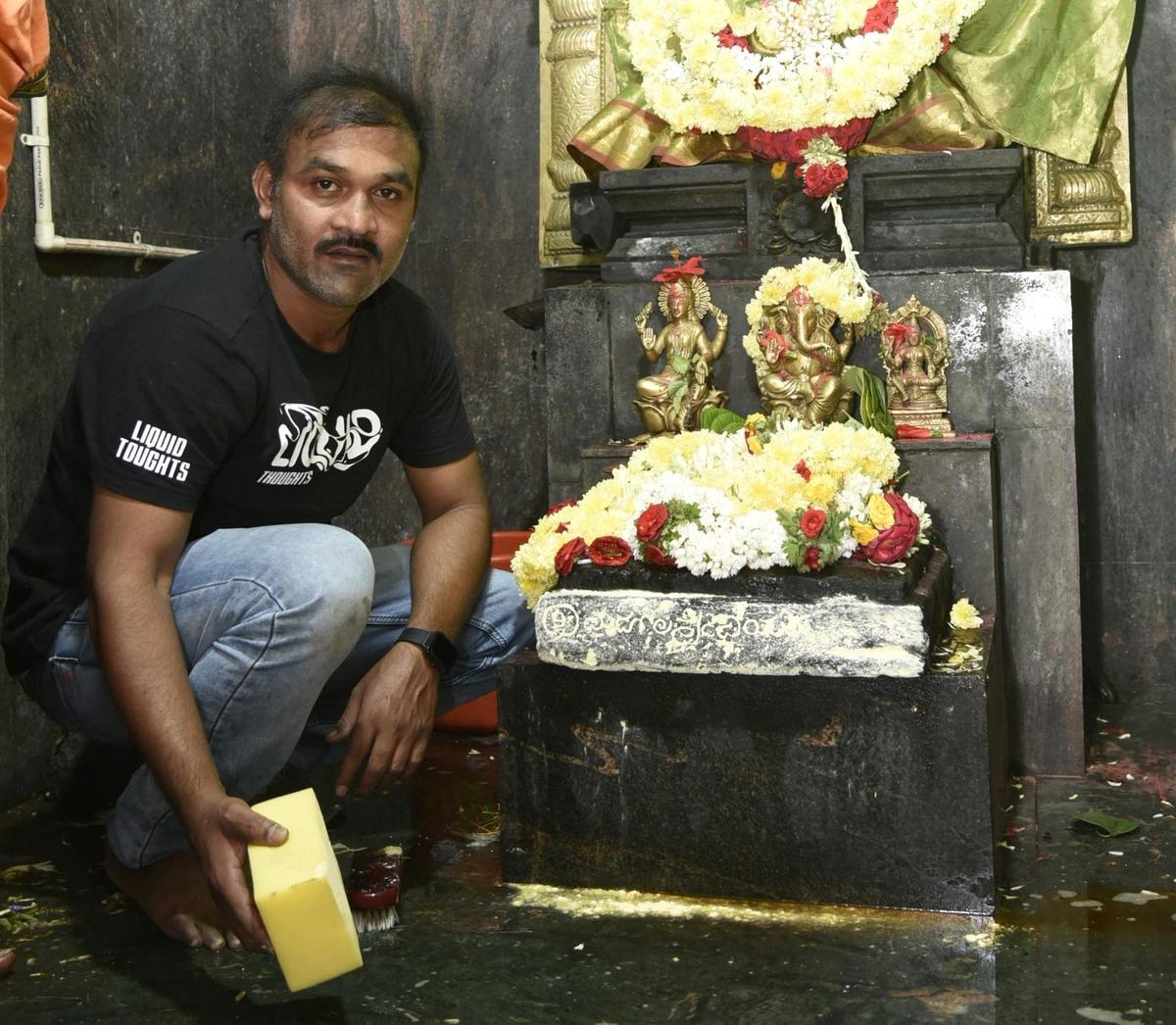
Local residents who stumbled upon the inscription were initially unaware of its importance. The stone, partially embedded in the ground, had long been treated as an ordinary slab. It was only after historians examined the engravings that its historical value became clear. This underscores the extent to which Karnataka’s landscape continues to hold untapped archaeological wealth, often hidden in plain sight.
The inscription has also prompted renewed interest among epigraphists in re-examining previously catalogued Hoysala records from surrounding regions. Scholars believe that comparative analysis could reveal patterns in language use, administrative terminology, and royal symbolism that evolved over time. By placing the Pandavapura inscription alongside similar records, historians hope to trace shifts in governance priorities and cultural influences, offering a more layered understanding of how the Hoysala state adapted to changing social realities.
Another aspect gaining attention is the craftsmanship behind the inscription. The quality of stone selection, depth of engraving, and stylistic flourishes suggest patronage that valued durability and aesthetic precision. Such craftsmanship points to an ecosystem of skilled artisans supported by the State or religious institutions. This reinforces the idea that inscription-making was not a peripheral activity but a central component of how authority and memory were constructed in medieval Karnataka.
The discovery has also revived discussions on decentralised power during the Hoysala period. References within the inscription appear to acknowledge local administrators and community figures, indicating a governance structure that relied on regional intermediaries. This challenges simplistic views of medieval kingdoms as entirely centralised and highlights a more negotiated form of rule, where local elites played a role in implementing royal directives.
Ultimately, the Pandavapura inscription stands as more than an archaeological find. It is a reminder that Karnataka’s history is written not only in grand monuments but also in modest stones scattered across its towns and villages. Each discovery adds a fragment to a larger story of cultural exchange, linguistic coexistence, and administrative ingenuity. Preserving and studying these fragments ensures that the voices of the past continue to inform present and future generations.
HOYSALA ERA AND THE LANGUAGE OF POWER
The Hoysala dynasty, which rose to prominence in the 11th and 12th centuries, is widely celebrated for its architectural achievements and patronage of art and learning. However, inscriptions remain one of the most reliable sources for understanding how the kingdom actually functioned. The Pandavapura inscription adds a crucial piece to this puzzle, revealing how language was strategically used to administer a diverse population.
During the Hoysala period, Kannada emerged as a strong administrative language, marking a departure from earlier eras dominated by Sanskrit alone. This shift reflected a broader cultural movement that sought to legitimise regional languages in governance and literature. The inclusion of Sanskrit alongside Kannada in the Pandavapura inscription suggests a transitional phase where both linguistic traditions coexisted, each serving a specific purpose.
Historians point out that such inscriptions often recorded land grants to temples, tax exemptions, or military victories. They were meant to be publicly visible declarations of authority, etched in stone to ensure permanence. The choice of multiple languages ensured that the message reached priests, administrators, merchants, and villagers alike. In this sense, inscriptions were instruments of both communication and control.
The stylistic elements of the engraving also offer clues about the socio-political climate of the time. The precision of the lettering and the layout suggest the involvement of skilled artisans, possibly attached to royal courts or major temples. This indicates that inscription-making was a specialised profession, valued for its role in preserving royal decrees and religious endowments.
Scholars studying the Pandavapura inscription have noted references to administrative units that may correspond to historical territorial divisions. Such details can help reconstruct medieval maps of Karnataka, shedding light on how regions were organised and governed. Over time, this could lead to a reassessment of Pandavapura’s importance within the Hoysala domain.
The discovery also reinforces the idea that the Hoysala rulers actively engaged with local cultures rather than imposing uniform practices. By acknowledging multiple languages, they demonstrated political pragmatism and cultural sensitivity. This approach may have contributed to the relative stability and longevity of the dynasty during a period marked by frequent conflicts elsewhere in the subcontinent.
Importantly, the inscription reflects a society where literacy and public record-keeping were taken seriously. Even though literacy rates were limited, the presence of inscriptions in communal spaces meant that information could be orally transmitted and collectively remembered. Stone inscriptions thus served as anchors of shared historical memory.
PRESERVATION, SCHOLARSHIP, AND MODERN SIGNIFICANCE
The unearthing of the Pandavapura inscription has renewed calls for stronger heritage protection mechanisms in Karnataka. Archaeologists have stressed the need for immediate documentation, conservation, and, if necessary, relocation to prevent damage. Exposure to weather, human activity, and neglect poses serious risks to such artefacts, many of which have already been lost to time.
The State Department of Archaeology has reportedly taken note of the discovery, and experts expect a detailed epigraphical study to follow. Such studies involve careful transcription, translation, and contextual analysis, a process that can take months or even years. Once completed, the findings are likely to contribute significantly to academic research on medieval South India.
For historians, the inscription is not merely a relic but a text that speaks across centuries. It offers insights into governance, religion, economy, and social hierarchy during the Hoysala period. Each word engraved on the stone represents a conscious choice, reflecting the priorities and values of those in power at the time.
The discovery also holds educational value. Scholars believe that integrating such findings into school and university curricula can help foster a deeper appreciation of Karnataka’s regional history. Often overshadowed by pan-Indian narratives, local histories like those of the Hoysalas provide tangible connections to the past, rooted in specific landscapes and communities.
From a cultural perspective, the inscription reinforces Karnataka’s long-standing tradition of linguistic plurality. In a contemporary context where language often becomes a subject of political debate, the Pandavapura find serves as a reminder that multilingualism has been an intrinsic part of the region’s identity for centuries.
Local communities, too, have a role to play in preservation. Historians emphasise that awareness and participation at the grassroots level are essential to safeguarding heritage. When residents recognise the value of artefacts in their surroundings, they become custodians of history rather than passive observers.
The inscription’s discovery may also encourage further exploration in and around Pandavapura. Archaeologists believe that inscriptions rarely exist in isolation and are often part of larger complexes that include temples, settlements, or water structures. Future surveys could reveal additional artefacts, deepening understanding of the region’s historical significance.
In a broader sense, the find highlights the importance of interdisciplinary collaboration. Archaeology, epigraphy, linguistics, and history must work together to decode the full meaning of such inscriptions. Each discipline adds a layer of interpretation, transforming a stone slab into a narrative of human experience.
As Karnataka continues to balance development with heritage conservation, discoveries like the Pandavapura inscription underline what is at stake. Beneath roads, fields, and buildings lie traces of civilisations that shaped the present. Protecting these remnants is not merely about preserving the past but about understanding identity and continuity.
The 12th century multi-lingual Hoysala inscription from Pandavapura stands as a testament to a time when governance, culture, and language intersected with remarkable sophistication. Nearly 800 years later, its voice has resurfaced, urging contemporary society to listen, learn, and preserve. In doing so, Karnataka not only honours its history but also strengthens its connection to a richly layered cultural legacy that continues to inform its future.
Follow: Karnataka Government
Also read: Home | Channel 6 Network – Latest News, Breaking Updates: Politics, Business, Tech & More
