
What’s the dispute about
Earlier in 2025 the ECI ordered a Special Intensive Revision (SIR) of electoral rolls in West Bengal, a process meant to update and clean voter-lists. The exercise, now being challenged in court by Dola Sen (a Member of Parliament), has sparked fierce debate. Supporters of the petition argue that SIR could lead to widespread disenfranchisement — genuine voters, they fear, might be removed from the rolls. On 1 December 2025 the Supreme Court began hearing the case, giving national attention to the controversy.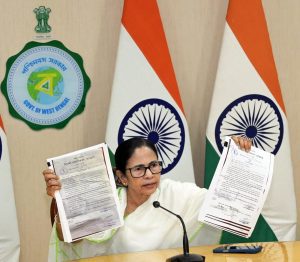
ECI’s defense: no mass disenfranchisement
In a detailed counter-affidavit submitted to the court, the ECI pushed back strongly. It described the claims of mass deletion or disenfranchisement as “highly exaggerated” and said they were being amplified by actors with “vested political interests.” The commission stressed that SIR is not a new or arbitrary measure — better-known revisions under similar legal framework have happened repeatedly since the 1950s. This time too, ECI said, the process is rooted in constitutional obligation (Article 324) and statutory provisions (Sections 15, 21, 23 of the Representation of the People Act, 1950).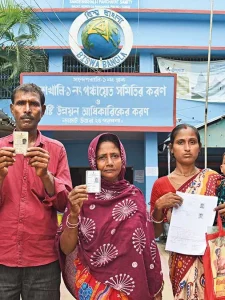
ECI also emphasized that the procedures built into SIR protect voters’ rights. It claims that nearly 99.77 percent of existing electors in West Bengal were supplied pre-filled enumeration forms and that 70.14 percent of these have already been returned. According to the commission those numbers — very high by any measure — undermine the argument that significant numbers of voters will be wrongly excluded.
It explained that if a house is locked, the designated Booth Level Officer (BLO) must leave repeated notices and attempt contact at least three times. The revised SIR order prohibits BLOs from collecting any documents from electors during enumeration. And for people temporarily away from home, family members can submit forms on their behalf, or one may submit online through ECI’s portal or mobile app. According to ECI, special attention is being given to vulnerable groups — the elderly, people with disabilities — to make sure they are not left out.
What petitioners argue
On the other side, petitioners like Dola Sen argue that the SIR orders — issued on 24 June and 27 October 2025 — are arbitrary and unconstitutional. They claim that such large-scale revision close to elections threatens the voting rights of many genuine electors. The fear is especially acute among minority communities and those with uncertain documentation or residency status. Critics worry that the digital process or enumeration procedures may disproportionately harm migrants, refugees or people from marginalized backgrounds.
There is also concern that mass deletion of names — even if unintentional — could result in disenfranchisement of large swathes of voters just before an election. Such a shift could reshape electoral outcomes in a state that is politically volatile.
Where things stand now
The legal challenge is now before a bench of the Supreme Court of India, comprising Surya Kant (Chief Justice of India) and Joymalya Bagchi. The court is expected to hear further arguments on December 9, 2025. The ECI insists that the SIR is an important step to ensure integrity of electoral rolls and prevent fraud, duplication or ineligible votes. The petitioners counter that the timing and scale of SIR risk disenfranchising legitimate voters — especially those from vulnerable communities.
Why this matters
In a democracy, accuracy and fairness of voter lists are crucial. On one hand, a clean, updated roll ensures only eligible voters vote; on the other hand, any systematic error or mismanagement may deny valid voters their voice. The SIR in West Bengal — a politically charged state — becomes especially sensitive when cast as a risk to the voting rights of large groups.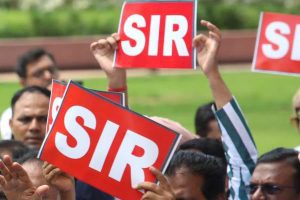
If the court sides with ECI, it will reinforce the acceptability of SIR as a tool for maintaining electoral integrity. But if the petitioners get relief, it could stall or reshape the ongoing revision, and prompt questions about how electoral updates are managed across the country.
For voters in West Bengal and beyond the stakes are high: the outcome may determine who gets to vote — and who doesn’t — in the next elections.
Also read: https://channel6network.com/siddhant/
