
What is Sanchar Saathi — and what’s changed
The Indian government has directed all smartphone manufacturers and importers to pre‑install the Sanchar Saathi cybersecurity app on every handset sold in India. For phones already in use the government has asked companies to push the app via software updates. Once installed the app cannot be disabled or removed by users. The stated objective is to combat telecom fraud, prevent the sale and use of counterfeit or stolen devices, and offer users a way to verify their devices and block suspicious telecom activity.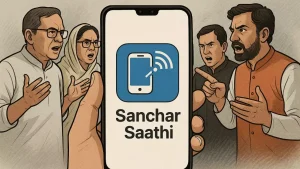
Sanchar Saathi provides tools like IMEI verification, a fraud‑reporting facility, detection of suspicious connections, blocking or tracing lost or stolen phones, and reporting scam calls or messages. Under this mandate the app must be visible at first use — users cannot choose to skip or remove it. The government argues the move will help enhance mobile security for millions of users nationwide.
Opposition outcry: “Snooping App” and threats to privacy
The move has triggered sharp backlash from opposition politicians and digital‑rights activists. Priyanka Gandhi slammed the directive as tantamount to state surveillance calling Sanchar Saathi a “snooping app.” She warned that mandatory pre‑installation and non‑removability strips citizens of their right to privacy and unconstrained communication.
Critics draw parallels with dystopian surveillance regimes, arguing that once such an app is embedded in every phone, there’s potential for misuse — constant monitoring of calls messages location and device activity. They say the line between legitimate security and invasive oversight blurs dangerously when citizens lose control over what runs on their personal devices.
Concerns have been echoed by other voices as well describing the move as a threat to fundamental rights and individual freedoms. Many believe this push sets a troubling precedent — that security may be used as justification for surveillance without consent or transparency.
Government response: “Ready to discuss all issues”
Faced with mounting criticism the government has tried to reassure the public. Kiren Rijiju responded by saying that the government is open to debate and will engage with the opposition on all raised concerns. He insisted that while the issues matter the purpose is to enhance telecom security and protect citizens from fraud and stolen devices.
Rijiju urged opponents not to stall Parliament over the matter, offering to discuss concerns through dialogue rather than disruption. He emphasized that Sanchar Saathi is a part of larger efforts to curb telecom misuse and cyber‑fraud.
Government officials maintain that the app’s functionalities are intended for legitimate public good — reclaiming stolen phones, cutting down fake connections, preventing IMEI fraud — not to track or surveil personal communications or behavior.
Why the dispute matters beyond apps and phones
This controversy isn’t just about one app or a single government directive. It raises broader questions about privacy consent state‑citizen trust and the boundaries of digital governance. In an age when most people carry their private lives on their smartphones such mandates affect personal space more than ever.
The debate puts into sharp focus what constitutes reasonable security measures and where intrusion begins. If citizens can be forced to carry government software with sweeping permissions on their personal devices it may set the stage for future overreach. For a democracy, balancing security and civil liberties becomes more delicate when the device in your pocket becomes a tool of the state.
What’s next: Debate, dissent and digital rights at crossroads
The conflicting views mean the issue is unlikely to die down soon. Opposition pressures may force the government to provide clarity on data‑collection rules, consent mechanisms, data retention, and oversight. Privacy advocates may push for legislation or judicial review to ensure citizens’ rights are protected.
Meanwhile many smartphone users may be left wondering: does a “security app” really safeguard me — or does it make me vulnerable to surveillance?
Ultimately, how this plays out will shape not just telecom security but the broader environment of trust in digital governance in India.
Also read: https://channel6network.com/gotham-awards-2025-win-by-jafar-panahi/
