
Kerala politics has spilled decisively into Karnataka following the controversial eviction drive in Bengaluru, triggering a sharp political exchange that has expanded far beyond urban governance into the realm of inter-State ideological confrontation. What began as a civic action aimed at clearing alleged encroachments in parts of Bengaluru has now transformed into a politically charged debate, with Kerala’s leadership openly criticising Karnataka’s approach and framing it as emblematic of coercive governance. The spillover has underlined how local administrative actions can quickly assume national political significance in a deeply interconnected federal system.
The controversy has also prompted renewed discussion on the political responsibility of States toward migrant populations, many of whom form the backbone of Bengaluru’s informal economy. Activists point out that a significant number of those affected by the eviction drive come from neighbouring States, including Kerala, Tamil Nadu, and Andhra Pradesh. The displacement of such workers, they argue, has ripple effects beyond Karnataka, affecting livelihoods, remittance-dependent families, and regional labour mobility, thereby giving neighbouring States a stake in the issue.
Academicians studying urban governance have observed that eviction drives often expose long-standing contradictions in city planning. Bengaluru’s rapid expansion, they note, has historically outpaced regulatory enforcement, allowing informal settlements and commercial structures to flourish with tacit administrative approval. When corrective action finally arrives in the form of demolitions, it disproportionately targets those with the least capacity to resist or recover, raising questions about delayed governance and selective enforcement.
The episode has also intensified debates within policy circles on the politicisation of urban space. Analysts argue that cities have increasingly become arenas for ideological signalling, where actions like eviction drives are framed either as symbols of strong governance or as markers of authoritarian tendencies. The Bengaluru case, magnified by Kerala’s intervention, illustrates how urban policy decisions are no longer judged solely on technical merit but on the narratives they generate across political boundaries.
Observers further caution that prolonged political sparring between States could distract from the urgent need for practical solutions. While debates over ethics and legality continue, affected families and traders remain focused on immediate concerns such as shelter, income loss, and uncertainty about rehabilitation. Experts stress that sustained political attention should translate into concrete policy responses, including temporary relief measures, transparent compensation frameworks, and long-term housing solutions.
The eviction drive, carried out by Karnataka authorities as part of an infrastructure and urban rejuvenation effort, involved the demolition of structures identified as illegal encroachments on public land. State officials justified the action as long overdue, arguing that encroachments had choked roads, obstructed stormwater drains, and worsened flooding and traffic congestion. However, images of bulldozers razing shops and homes, many belonging to small traders and migrant families, sparked widespread criticism and emotional reactions across States.
Kerala’s Chief Minister emerged as the most vocal critic, condemning the Bengaluru drive and describing it as a disturbing example of “bulldozer politics.” His remarks resonated strongly in Kerala’s political discourse, where welfare-oriented governance and social justice narratives hold significant weight. By questioning the moral legitimacy of the eviction process, Kerala’s leadership elevated the issue from a municipal matter to a debate on democratic values, governance ethics, and the use of state power.
Karnataka’s political leadership responded swiftly, accusing Kerala of politicising an administrative action and interfering in matters outside its jurisdiction. Senior ministers defended the eviction drive as lawful and necessary, stressing that development cannot be indefinitely stalled by illegal occupations. They argued that governance requires tough decisions and accused critics of romanticising encroachments while ignoring the broader public interest.
As statements and counter-statements multiplied, the eviction drive became a flashpoint for ideological positioning. The confrontation revealed contrasting political philosophies between the two States, with Karnataka projecting administrative decisiveness and Kerala emphasising humane governance. The spillover has since drawn attention from political analysts, civil society groups, and opposition parties, all of whom see the episode as reflective of deeper tensions in contemporary Indian politics.

Evictions, Ethics, and Competing Models of Governance
At the core of the controversy lies a clash between two competing visions of governance. Kerala’s leadership framed the Bengaluru eviction drive as a warning sign of governance that prioritises speed and spectacle over compassion and due process. By invoking the term “bulldozer politics,” Kerala’s Chief Minister tapped into a broader national critique of demolition-led governance, arguing that such actions intimidate the poor and normalise excessive use of state power.
He asserted that development must be inclusive and that governments have a responsibility to rehabilitate and protect vulnerable populations affected by redevelopment projects. Drawing implicit comparisons, Kerala leaders pointed to their State’s emphasis on consultation, compensation, and resettlement in urban projects. According to them, democratic governance is measured not by how quickly structures are demolished but by how sensitively people are treated.
Karnataka, however, rejected these moral judgments as selective and politically motivated. Officials maintained that the eviction drive followed legal procedures, including advance notices and opportunities for occupants to present ownership documents. They emphasised that many structures stood on stormwater drains, road margins, and footpaths, creating hazards for the wider public and exacerbating urban flooding during monsoons.
The Karnataka government argued that decades of inaction had emboldened encroachments and that decisive intervention was essential to restore civic order. Ministers stressed that governance involves balancing individual hardships against collective welfare, particularly in a city struggling with infrastructure stress. From their perspective, failing to act would have been a dereliction of duty toward millions of residents affected by congestion and poor urban planning.
Despite official assurances, reports of families losing livelihoods overnight and shopkeepers watching years of investment reduced to rubble intensified criticism. Civil society groups within Karnataka questioned whether legal compliance alone was sufficient justification, especially when rehabilitation measures appeared inadequate or unclear. These concerns echoed Kerala’s criticism, giving the inter-State remarks added traction within Karnataka’s own political discourse.
The episode has thus become less about the legality of evictions and more about governance philosophy. It has forced a public reckoning on whether development-driven actions should be evaluated solely on administrative grounds or also on ethical and humanitarian considerations. The competing narratives from Kerala and Karnataka reflect broader ideological divides shaping Indian politics today.
Federal Sensitivities and Political Messaging
The spillover of Kerala politics into Karnataka has also raised questions about federal etiquette and inter-State relations. Karnataka leaders accused Kerala’s Chief Minister of breaching federal norms by commenting on another State’s administrative decisions. They argued that such interventions undermine cooperative federalism and risk turning governance issues into political battlegrounds.
Kerala’s leadership countered this criticism by asserting that constitutional values, human dignity, and democratic principles are universal and cannot be confined by State boundaries. According to them, speaking out against what they perceive as unjust governance is an exercise of moral responsibility rather than political interference. This stance has found support among rights groups and activists who view silence as complicity.
Political analysts note that the exchange reflects an evolving nature of Indian federalism, where States increasingly comment on each other’s policies, especially when ideological differences are stark. Such interventions can deepen democratic debate but also sharpen political polarisation. In this case, the eviction drive has become a symbolic issue through which States articulate their governance identities.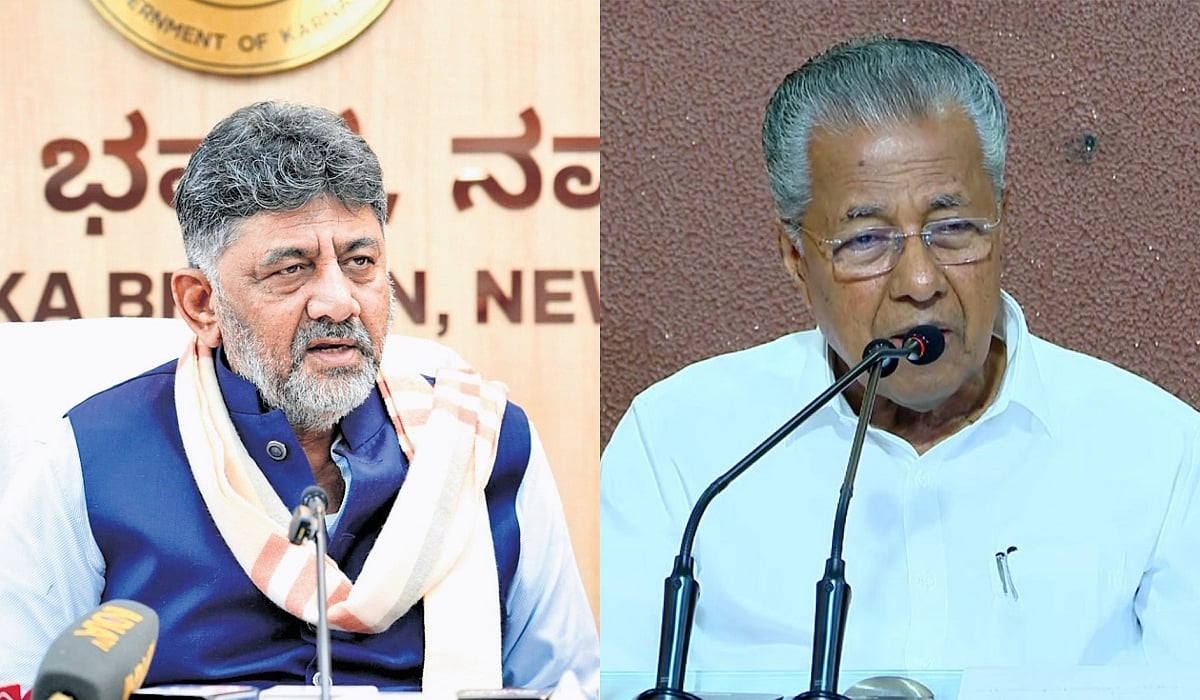
The language used in the confrontation has further intensified its impact. The phrase “bulldozer politics” has emerged as a powerful emotional and political metaphor, shaping public perception of the eviction drive far beyond its administrative context. Visuals of demolitions circulating widely have amplified the narrative, making the issue resonate strongly with audiences who associate bulldozers with coercion rather than planning.
Within Karnataka, the spillover has had tangible political consequences. Opposition parties have seized upon Kerala’s criticism to step up attacks on the ruling government, demanding a halt to demolitions and the formulation of a comprehensive rehabilitation policy. They argue that the State’s image as a technology and innovation hub risks being tarnished by perceptions of insensitivity.
In Kerala, meanwhile, the Chief Minister’s stance has reinforced his government’s ideological positioning ahead of future political contests. Supporters view his comments as consistent with Kerala’s welfare-oriented legacy, while critics accuse him of using an external issue to divert attention from local challenges. Regardless of motivation, the remarks have firmly placed Kerala within a national conversation on urban governance.
Experts have also highlighted the absence of a uniform national framework governing urban evictions. In the absence of clear guidelines, States adopt varied approaches, leaving room for political interpretation and controversy. Urban planners argue that without policies mandating rehabilitation, compensation, and stakeholder consultation, eviction drives will continue to provoke backlash and inter-State friction.
Legal scholars point out that courts have repeatedly emphasised the importance of proportionality and humane treatment in eviction cases. While governments have the authority to remove encroachments, they are also expected to ensure that actions do not violate the right to livelihood and shelter. The Bengaluru episode, now amplified by Kerala’s intervention, has renewed calls for clearer safeguards.
As the political exchange continues, neither State appears inclined to soften its stance. Karnataka remains committed to the eviction drive, framing it as essential for urban order, while Kerala’s leadership has stood by its criticism, asserting that development devoid of empathy is unacceptable. The Centre’s silence so far suggests reluctance to step into what has become an ideologically charged inter-State debate.
In conclusion, the spillover of Kerala politics into Karnataka following the Bengaluru eviction drive highlights the complex intersections of development, rights, and federalism in contemporary India. What started as a municipal action has evolved into a national-level debate on how power should be exercised in a democracy. As Indian cities continue to expand and confront challenges of encroachment and infrastructure stress, this episode underscores the urgent need for development models that combine efficiency with compassion, legality with legitimacy, and authority with accountability.
Follow: Karnataka Government
Also read: Home | Channel 6 Network – Latest News, Breaking Updates: Politics, Business, Tech & More
