
The completion of track electrification on the challenging Sakleshpur–Subramanya Road section marks a major milestone in Indian Railways’ efforts to modernise rail infrastructure through ecologically sensitive and technically demanding terrain. Cutting through the Western Ghats, one of the most fragile and picturesque landscapes in the country, this ghat section has long been considered an engineering marvel as well as an operational challenge. With electrification now complete, railway officials say the project represents not just a technological upgrade but a decisive step toward sustainable, efficient, and future-ready rail transport in Karnataka.
The Sakleshpur–Subramanya Road stretch, known for its steep gradients, sharp curves, deep valleys, and numerous tunnels, has historically relied on diesel traction. This dependence often led to operational limitations, including speed restrictions, additional banking locomotives, and higher fuel costs. The successful electrification of this section eliminates many of these constraints, enabling smoother train operations and improved reliability while significantly reducing carbon emissions.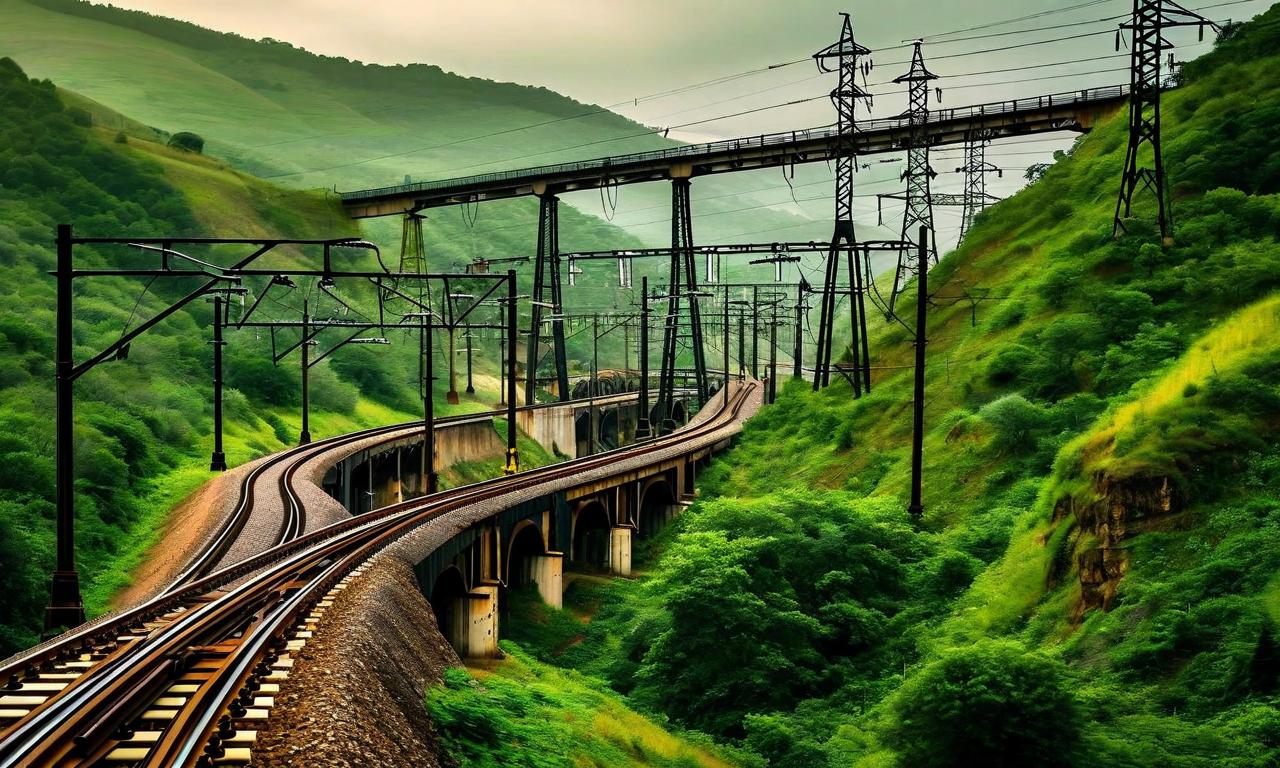
Railway authorities described the project as one of the most complex electrification efforts undertaken in recent years. Engineers and workers had to navigate difficult terrain, unpredictable weather, and dense forest cover while ensuring minimal environmental disturbance. The completion of the project is being hailed as a testament to meticulous planning, advanced engineering, and sustained coordination among multiple railway departments.
Beyond technical achievement, the electrification carries emotional and symbolic significance for passengers, railway staff, and local communities who have long viewed this ghat section as a lifeline connecting the coastal and Malnad regions of Karnataka. The development is expected to enhance passenger comfort, improve freight efficiency, and strengthen regional connectivity, reinforcing the railways’ role in balanced regional growth.
The project aligns with Indian Railways’ broader mission to achieve full electrification of its broad-gauge network, reduce dependence on fossil fuels, and move toward greener transport solutions. Officials emphasised that the Sakleshpur–Subramanya Road section stands out not only for its scenic beauty but also for the engineering precision required to electrify it safely and sustainably.
Engineering Through Nature and Complexity
Electrifying a railway line through the Western Ghats posed unique challenges that demanded innovative engineering solutions. The Sakleshpur–Subramanya Road section features steep gradients, some exceeding 1 in 60, along with over 50 tunnels and multiple high bridges. Installing overhead electric traction infrastructure in such conditions required careful alignment, precision drilling, and robust safety protocols to ensure long-term operational stability.
Engineers had to design and erect overhead equipment in narrow cuttings and tunnel approaches, often with limited working space. Special foundations were constructed to anchor masts securely in rocky and uneven terrain. In tunnel zones, clearances had to be recalculated and modified to accommodate electrification equipment without compromising safety. Railway officials noted that each tunnel presented its own set of challenges, requiring customised engineering solutions rather than standard templates.
Weather conditions added another layer of complexity. The region receives heavy monsoon rainfall, increasing the risk of landslides and work disruptions. Construction schedules were carefully planned to avoid peak monsoon periods, and additional slope stabilisation measures were implemented to protect both workers and infrastructure. Environmental safeguards were strictly enforced to prevent damage to forest cover and wildlife habitats.
Officials highlighted that coordination between civil, electrical, and signal departments was critical to the project’s success. Every stage of work required synchronisation to ensure that electrification did not interfere with existing track geometry, signalling systems, or drainage structures. Regular safety audits and inspections were conducted to maintain high standards throughout the execution phase.
The use of modern surveying tools, high-strength materials, and advanced installation techniques played a crucial role in overcoming the terrain’s constraints. Railway authorities emphasised that lessons learned from this project would serve as valuable reference points for future electrification efforts in other ghat sections across the country.
Beyond the technical dimension, the project also involved close engagement with local communities. Railway officials coordinated with district administrations and residents to minimise inconvenience during construction. Temporary disruptions were managed through advance communication and phased execution, helping maintain public trust and cooperation.
With electrification now complete, trial runs and safety checks have confirmed the readiness of the section for regular electric traction. Officials stated that the transition from diesel to electric locomotives would be gradual but steady, ensuring operational continuity while reaping the benefits of the upgraded infrastructure.
Transforming Connectivity and Sustainability
The electrification of the Sakleshpur–Subramanya Road section is expected to bring significant operational and environmental benefits. Electric locomotives offer higher hauling capacity, better acceleration, and lower maintenance requirements compared to diesel engines. This is particularly important on ghat sections, where gradients demand greater traction power and precise control.
Passenger services on this route are likely to become smoother and more punctual, with reduced reliance on multiple locomotives for banking operations. Railway officials noted that electric traction would also reduce noise levels, enhancing passenger comfort and minimising disturbance to wildlife in the surrounding forest areas.
In conclusion, the electrification of the Sakleshpur–Subramanya Road ghat section represents a powerful blend of engineering excellence, environmental responsibility, and visionary planning. It is a milestone that goes beyond wires and masts, symbolising progress powered by perseverance and respect for nature. As electric trains begin to glide through the misty Ghats, the project stands as a testament to Indian Railways’ commitment to sustainable growth and seamless connectivity, carrying both people and aspirations forward into a cleaner, more efficient future.
For freight operations, the impact is expected to be substantial. The section serves as a crucial link between the hinterland and coastal ports, facilitating the movement of commodities such as cement, food grains, and industrial goods. Electrification will allow longer and heavier freight trains to operate more efficiently, reducing transit times and logistics costs.
Environmental sustainability is a key outcome of the project. By eliminating diesel traction on this stretch, Indian Railways will significantly cut greenhouse gas emissions and reduce fuel consumption. Officials emphasised that electrification aligns with national climate goals and reinforces railways’ role as an eco-friendly mode of transport compared to road-based alternatives.
The project is also expected to boost tourism in the region. The Sakleshpur–Subramanya Road section is renowned for its scenic beauty, attracting rail enthusiasts and travellers alike. Improved reliability and efficiency of train services could encourage more visitors, benefiting local economies and promoting sustainable tourism.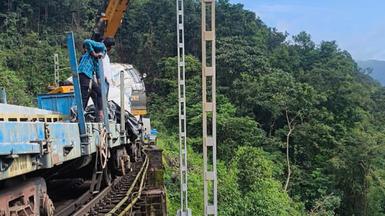
From a strategic perspective, the electrification strengthens network resilience. Electric locomotives can be deployed flexibly across the electrified network, reducing dependence on specific diesel fleets and enhancing operational planning. This integration supports Indian Railways’ long-term vision of a unified, electrified rail system.
Railway officials also highlighted the human aspect of the achievement. The dedication of engineers, technicians, and workers who laboured under demanding conditions has been widely acknowledged. Many spent months away from families, working long hours in remote locations to ensure the project’s timely completion.
Looking ahead, the completion of this electrification is expected to pave the way for further modernisation initiatives, including advanced signalling, higher speeds, and improved safety systems. Authorities indicated that the Sakleshpur–Subramanya Road section could serve as a model for integrating infrastructure development with environmental sensitivity.
In conclusion, the electrification of the Sakleshpur–Subramanya Road ghat section represents a powerful blend of engineering excellence, environmental responsibility, and visionary planning. It is a milestone that goes beyond wires and masts, symbolising progress powered by perseverance and respect for nature. As electric trains begin to glide through the misty Ghats, the project stands as a testament to Indian Railways’ commitment to sustainable growth and seamless connectivity, carrying both people and aspirations forward into a cleaner, more efficient future.
Follow: Karnataka Government
Also read: Home | Channel 6 Network – Latest News, Breaking Updates: Politics, Business, Tech & More
