
The Siddaramaiah-led Congress government in Karnataka has found itself in a frequent and visible collision course with the Union government, with disagreements spanning fiscal devolution, administrative autonomy, language policy, law and order, and infrastructure projects. What began as routine Centre–State differences has gradually evolved into sustained political confrontation, reflecting deeper tensions over federalism, resource sharing, and governance priorities. The Karnataka government has repeatedly accused the Centre of discrimination against opposition-ruled States, while the Union government maintains that its actions are rule-bound and non-partisan.
Looking ahead, experts believe that sustained confrontation will require careful calibration. While asserting State rights is constitutionally valid, long-term governance depends on cooperation. Both the Centre and Karnataka face the challenge of balancing political rivalry with administrative pragmatism. As welfare demands grow and infrastructure needs expand, effective Centre–State collaboration will be essential. Whether the current collision course evolves into constructive negotiation or deepens into prolonged conflict will significantly shape Karnataka’s governance trajectory in the coming years.
Since assuming office, Chief Minister Siddaramaiah has adopted a firm stance on what he describes as the erosion of States’ rights. The administration has framed its disagreements as a defence of constitutional federalism, positioning Karnataka as a vocal critic of centralised decision-making. This approach has resonated with sections of the electorate but has also intensified political friction, particularly as the State navigates fiscal stress and ambitious welfare commitments.
FISCAL FEDERALISM AT THE HEART OF THE DISPUTE
One of the most persistent flashpoints has been financial devolution and resource allocation. The Karnataka government has alleged that the Centre has reduced its share in tax devolution while increasing the State’s financial burden through centrally sponsored schemes. Siddaramaiah has publicly stated that Karnataka, despite being a major contributor to the national exchequer, has not received its “fair share” in return.
The State has repeatedly raised concerns over delays in the release of GST compensation, disaster relief funds, and grants for infrastructure projects. Ministers argue that these delays constrain Karnataka’s ability to fund welfare schemes such as free electricity, food distribution, and transport subsidies. The Centre, however, has countered that allocations follow Finance Commission recommendations and statutory norms, rejecting accusations of political bias.
POLICY AND ADMINISTRATIVE FRICTION
Beyond finances, policy implementation has emerged as another arena of conflict. The Karnataka government has objected to what it sees as unilateral decisions by the Centre on issues affecting States, including education policies, language matters, and administrative restructuring. Disagreements over the implementation of national education reforms and language-related directives have triggered sharp exchanges, with the State asserting its right to preserve regional priorities.
Administrative autonomy has also become contentious. The State government has criticised central agencies for what it calls selective intervention in matters involving opposition leaders and State officials. These allegations have added a political dimension to administrative disputes, further straining Centre–State relations.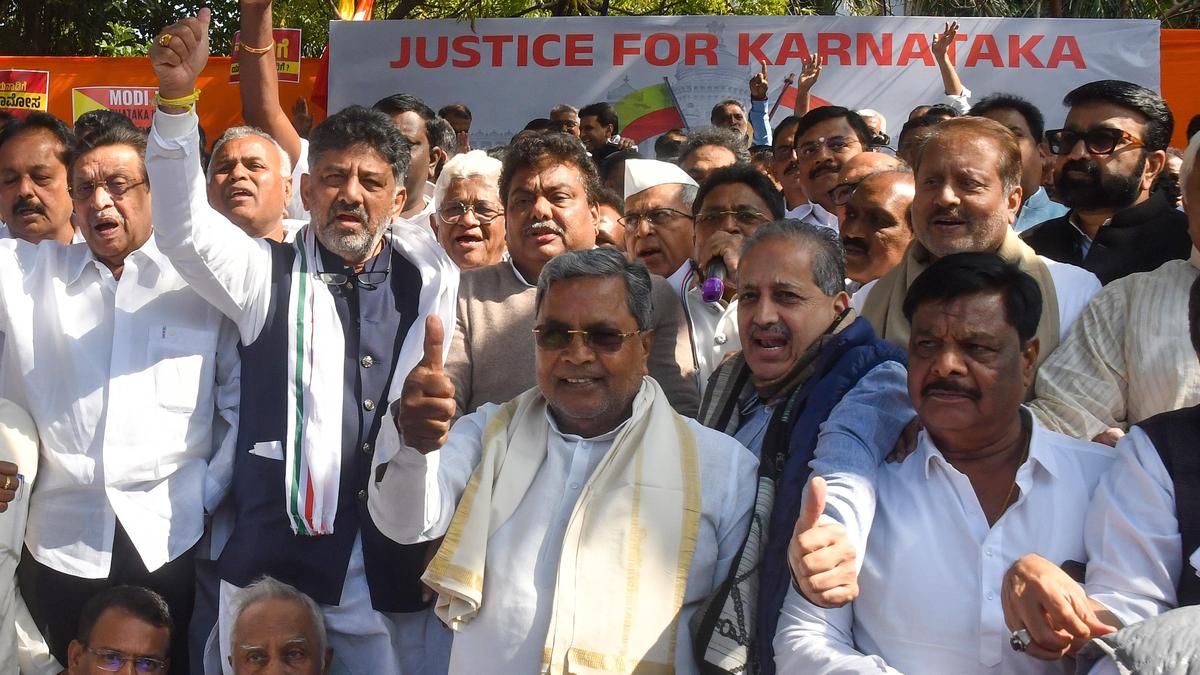
LAW, ORDER, AND GOVERNOR–GOVERNMENT TENSIONS
Another sensitive area has been the role of the Governor and constitutional offices. The Siddaramaiah government has, on multiple occasions, accused the Raj Bhavan of delaying assent to Bills and acting in a manner aligned with the Centre’s political interests. The government argues that such delays undermine the legislative authority of an elected State government.
The Centre has rejected these claims, asserting that Governors act within constitutional limits. However, the recurring friction has reinforced the perception of institutional strain, with Karnataka becoming one of several opposition-ruled States voicing concerns over the evolving role of constitutional authorities.
POLITICAL STRATEGY AND NATIONAL CONTEXT
Political analysts view the confrontational posture as part of a broader national pattern where opposition-ruled States challenge the Centre on federal principles. For the Congress, Karnataka holds strategic importance, and the Siddaramaiah government’s assertive stance helps project the party as a defender of States’ rights ahead of national political contests.
At the same time, critics argue that continuous confrontation risks slowing administrative coordination and policy execution. They caution that while political messaging may benefit the ruling party, prolonged conflict could affect investment sentiment and Centre–State collaboration on large infrastructure and development projects.
IMPACT ON GOVERNANCE AND PUBLIC DISCOURSE
The sustained clashes have shaped public discourse in Karnataka, with federalism emerging as a key political theme. Supporters of the State government see its resistance as necessary to protect constitutional balance, while opponents accuse it of politicising governance challenges to deflect attention from fiscal and administrative constraints.
Despite the confrontations, both governments continue to cooperate on essential services and national programs, underscoring the complexity of Centre–State relations. However, the repeated flashpoints indicate that cooperation often coexists uneasily with confrontation.
A CONTINUING TUG OF WAR
As Karnataka moves forward with its welfare agenda and development plans, the tug of war with the Centre shows little sign of easing. With fiscal pressures, political rivalries, and constitutional interpretations intersecting, the Siddaramaiah-led government’s relationship with the Union government is likely to remain tense.
The situation reflects a larger debate within Indian federalism—how to balance national coherence with State autonomy. For now, Karnataka stands at the centre of this debate, its government positioning itself as both a stakeholder in national governance and a challenger to what it perceives as excessive centralisation.
The ongoing confrontation has also extended into the arena of welfare policy, where the Karnataka government has accused the Centre of creating fiscal bottlenecks that indirectly affect flagship State schemes. Siddaramaiah has repeatedly stated that welfare guarantees were framed based on constitutional revenue-sharing principles, which he claims are being weakened. State ministers argue that reduced fiscal space forces Karnataka to rely more on borrowing, while the Centre enjoys greater control over resources. This narrative has been consistently used by the State government to justify its aggressive stance, portraying the conflict as one between social justice priorities and centralised fiscal control.
Infrastructure projects have emerged as another contentious front in Centre–State relations. Karnataka leaders have raised concerns over delays in approvals and funding for rail, metro, and highway projects, alleging uneven prioritisation. The State government claims that projects in opposition-ruled States often face procedural hurdles, while others receive faster clearances. The Centre has denied this, asserting that all projects are evaluated on technical and financial viability. However, repeated public statements by Karnataka ministers have kept the issue alive, reinforcing perceptions of strained coordination and political mistrust between the two governments.
The clash has also played out in language and cultural policy debates, where the State has asserted its right to protect regional linguistic identity. Karnataka leaders have opposed any perceived imposition of language policies, framing the issue as an attack on federal diversity. These disagreements have resonated strongly in public discourse, particularly among regional groups. The Centre has maintained that national policies are inclusive and flexible, but the State government continues to project itself as a guardian of linguistic and cultural autonomy, adding an emotional dimension to the political confrontation.
Administrative appointments and transfers have further deepened tensions, with the State accusing central agencies of interference. Karnataka ministers have alleged that investigations and administrative actions disproportionately target opposition-ruled States, undermining cooperative federalism. While the Centre insists that agencies function independently, the perception of selective action has fuelled political rhetoric. Analysts note that such disputes erode trust between institutions, making coordination difficult. The repeated public airing of these grievances suggests that the State government sees political value in highlighting administrative friction as part of its broader federalism narrative.
The judiciary has increasingly become an arena for resolving Centre–State disputes, with Karnataka approaching courts over fiscal and administrative disagreements. Legal challenges related to fund allocation, project approvals, and constitutional interpretation reflect the growing reliance on judicial intervention. Experts warn that excessive litigation between governments can delay policy outcomes and strain institutional relationships. However, the State government argues that legal recourse is necessary when dialogue fails, positioning court intervention as a constitutional safeguard rather than a breakdown of governance mechanisms.
Public opinion in Karnataka remains divided over the confrontational approach. Supporters believe the Siddaramaiah government is standing firm against unfair treatment, while critics argue that constant conflict diverts attention from governance and service delivery. Opposition parties within the State accuse the government of using the Centre as a scapegoat for fiscal challenges. Despite this, federalism has emerged as a strong political theme, shaping debates beyond immediate policy concerns and influencing how citizens perceive the balance of power between the State and the Union.
Political observers point out that the timing of these confrontations is significant, coinciding with broader national political realignments. Karnataka’s role as a major opposition-ruled State gives its leadership greater visibility in national debates. The State government’s assertive posture is seen as an attempt to shape a wider opposition narrative around decentralisation and States’ rights. This strategy may strengthen political positioning nationally, even as it complicates administrative coordination at the State level.
Looking ahead, experts believe that sustained confrontation will require careful calibration. While asserting State rights is constitutionally valid, long-term governance depends on cooperation. Both the Centre and Karnataka face the challenge of balancing political rivalry with administrative pragmatism. As welfare demands grow and infrastructure needs expand, effective Centre–State collaboration will be essential. Whether the current collision course evolves into constructive negotiation or deepens into prolonged conflict will significantly shape Karnataka’s governance trajectory in the coming years.
Follow: Karnataka Government
Also read: Home | Channel 6 Network – Latest News, Breaking Updates: Politics, Business, Tech & More
