
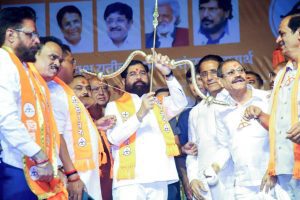
In a major rally ahead of the upcoming municipal corporation elections, Maharashtra Deputy Chief Minister Eknath Shinde launched a sharp critique of political rivals, asserting that voters are no longer swayed by political “brands” but instead support leaders who deliver development and growth. His comments, widely seen as a direct reference to the opposition alliance led by Uddhav Thackeray and Raj Thackeray, marked a significant development in the state’s heated civic poll campaign.
Speaking to a large gathering in Thane district, Shinde underscored the importance of performance politics over personality-driven campaigning, saying that voters have become discerning and will base their choices on tangible results rather than historical political identities. This stance comes as the civic polls approach, with key contests in urban centres such as Kalyan-Dombivli Municipal Corporation, Thane, Pune, and the Brihanmumbai Municipal Corporation capturing public attention.
Shinde’s Rally Message: Work Over Brand Identity
Addressing supporters, Shinde reiterated that the ruling Mahayuti alliance’s emphasis on development and governance distinguishes it from opposition parties that rely heavily on political legacy and branding. By emphasising infrastructure projects, service delivery, and visible improvements in public amenities, Shinde argued that his government has earned the trust of the electorate.
He pointed out that the Mahayuti alliance—comprising his faction of Shiv Sena, the Bharatiya Janata Party (BJP), and allies—has a track record of delivering on promises across urban and rural areas. In contrast, he said that political entities heavily focused on brand identity, such as the Uddhav Thackeray and Raj Thackeray factions, have struggled to present a compelling development agenda that resonates with voters’ everyday concerns.
The deputy chief minister also highlighted that in the Kalyan-Dombivli Municipal Corporation elections, 21 candidates aligned with the ruling coalition secured unopposed wins—an indication, he claimed, of strong public confidence in Mahayuti’s leadership and a lack of viable opposition alternatives.
Political Branding vs Development Focus
Shinde’s remarks about voters not being “influenced by brands” directly challenge the narrative presented by political rivals who have campaigned on lineage, legacy, and regional identity. The term “brand” in this context refers to established political names and alliances that have traditionally commanded loyalty based on historical support bases rather than current performance.
Political analysts suggest that this messaging is aimed at reframing the civic poll discourse around practical governance issues such as public infrastructure, sanitation, water supply, housing, and urban planning. By shifting the focus to these concerns, the ruling alliance hopes to appeal to a broader demographic of urban voters who prioritise delivery over rhetoric.
Reactions From Opposition Leaders
In response to Shinde’s remarks, opposition leaders have criticised the ruling coalition’s narrative, accusing Mahayuti of diverting attention from pressing civic issues by attacking political rivals’ identities. Leaders aligned with the Uddhav Thackeray and Raj Thackeray factions argue that their political heritage and influence remain deeply rooted in Maharashtra, especially among sections of the electorate with strong regional and cultural ties.
Opposition figures have also pointed to what they describe as gaps in urban governance, including issues related to housing shortages, traffic congestion, public health infrastructure, and equitable access to services. They contend that these matters are more relevant to voters’ daily lives than the debate over political branding. Independent observers have noted that the civic poll landscape is highly competitive, with both sides seeking to sway undecided voters through targeted local campaigning.
The Stakes in Municipal Elections
The municipal elections in Maharashtra are widely regarded as a bellwether for future state and national political trends. With 29 municipal corporations scheduled to go to polls, including major ones like Mumbai, Pune, and Navi Mumbai, the contests will determine control over significant administrative and financial resources.
Control of municipal bodies is seen as critical because these local governments play a direct role in public services and urban development initiatives that affect millions of residents. Winning these elections can provide a party or alliance with the leverage and visibility needed for broader political influence.
Focus on Urban Governance and Public Services
In his campaign speeches, Shinde has stressed the importance of urban governance, citing efforts to improve roads, enhance water infrastructure, modernise public transport, and expand social welfare schemes. Supporters of the Mahayuti alliance have echoed these themes, framing the local polls as a referendum on development and a rejection of what they call “brand politics.”
Additionally, civic infrastructure projects such as sustainable waste management, housing redevelopment, and digital service delivery have been highlighted as priorities for the next term. The ruling coalition asserts that its progress in these areas sets it apart from its political opponents and makes it a preferable choice for urban voters seeking practical solutions to rapidly evolving city challenges.
Municipal elections in Maharashtra are governed by a detailed legal and administrative framework that places responsibility for civic governance, public services and urban development on elected local bodies. These municipal corporations play a crucial role in managing essential services such as water supply, sanitation, roads and public health. The overall structure and functioning of urban local bodies are guided by state policies and constitutional provisions related to decentralised governance. More information on municipal governance in Maharashtra can be found on the official state government portal: https://www.maharashtra.gov.in
Opposition Strategy and Campaign Efforts
Opposition parties, meanwhile, are attempting to consolidate support by focusing on grassroots mobilisation and critiquing the ruling alliance’s performance in areas where challenges persist. Their campaign rhetoric often underscores social welfare concerns, community representation, and public accountability, appealing to segments of voters who feel underserved despite development claims.
Some opposition leaders have also accused Mahayuti of leveraging administrative advantages to influence election outcomes in certain constituencies, although these claims are contested and remain part of the broader political discourse leading up to polling day.
Looking Ahead: Poll Day and Beyond
As the civic elections draw nearer, all political parties are intensifying their campaigning efforts, organising rallies, door-to-door outreach, and community meetings to connect with voters. The debate over political branding versus performance politics is expected to persist as a central theme in public discussions.
Observers believe that voter turnout and engagement levels will offer insights into public sentiment, highlighting whether development-centric appeals resonate more strongly than traditional political loyalties. The results of these elections could influence strategic alignments and policy priorities ahead of future state and national contests.
Read More: https://channel6network.com/nitesh-rane-on-ram-navami-violence/
