
Four people lost their lives in a tragic road accident near Tirthahalli in Shivamogga district after two vehicles collided head-on while overtaking on a sharp curve. The accident, which occurred in the early hours of the day, has once again highlighted the dangers of reckless overtaking on narrow and winding roads in the Malnad region. The impact of the collision was severe, leaving both vehicles badly mangled and killing all four occupants on the spot.
According to police officials, the accident took place on a curving stretch of the road where visibility is limited due to the terrain. Preliminary investigations suggest that one of the vehicles attempted to overtake another vehicle at high speed despite the curve, leading to a direct collision with an oncoming car. The force of the crash was such that rescue teams faced difficulty extricating the victims from the wreckage.
Local residents who heard a loud crash rushed to the spot and alerted the police and emergency services. By the time help arrived, all four occupants had succumbed to their injuries. The bodies were later shifted to a government hospital for post-mortem examination. The identities of the deceased were confirmed after police contacted their families.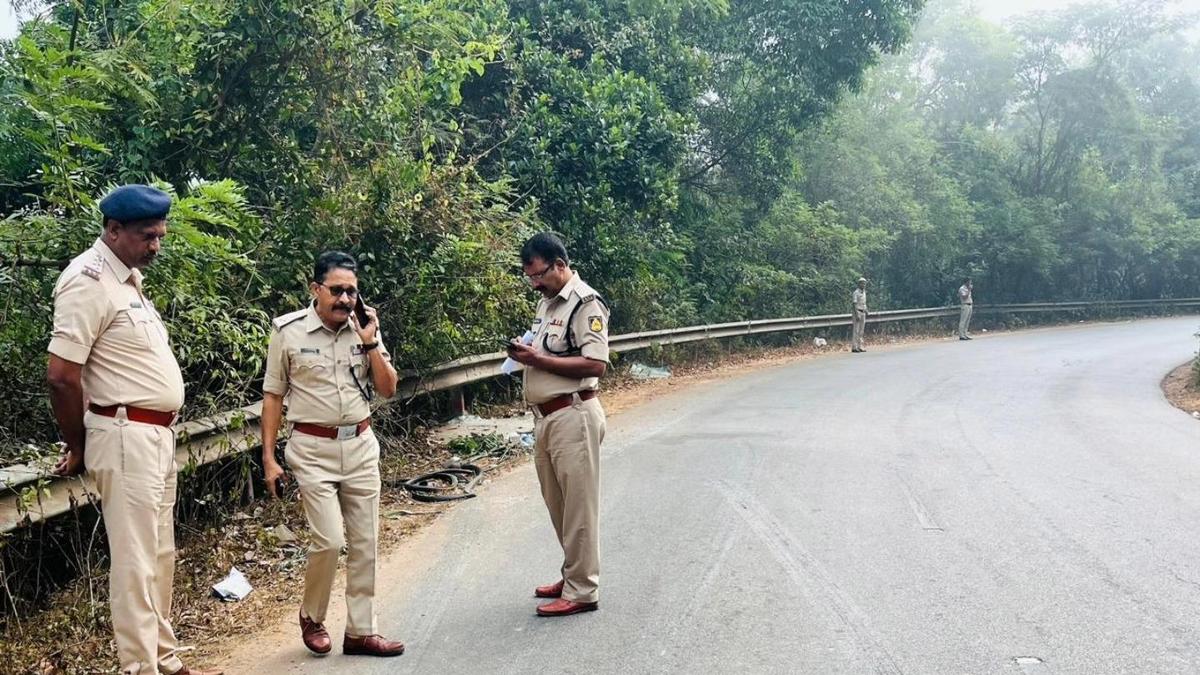
Officials said the victims included both drivers and passengers, and initial findings indicate that none of them had time to react or take evasive action. The accident site is known locally as a risky stretch, with multiple curves and frequent incidents reported in the past.
DANGEROUS ROADS AND RECURRING ACCIDENTS
The road where the accident occurred is part of a route frequently used by commuters, tourists, and transport vehicles connecting interior villages with Tirthahalli town. Despite moderate traffic volume, the stretch is considered hazardous due to sharp bends, uneven road width, and lack of adequate warning signage. Residents have repeatedly raised concerns about speeding and risky overtaking on this section of the road.
Police officials noted that overtaking on curves is one of the leading causes of fatal accidents in hilly regions of Karnataka. Drivers often underestimate oncoming traffic and overestimate their ability to complete overtaking manoeuvres in limited space. “Even a moment’s misjudgment on such roads can be fatal,” a senior police officer said, adding that excessive speed further reduces reaction time.
In this case, skid marks and vehicle damage patterns indicate that the collision happened at considerable speed. Investigators are also examining whether road conditions, lighting, or driver fatigue played a role in the accident. Mechanical inspection of the vehicles has been ordered to rule out technical failure.
The incident caused traffic disruption for several hours as police and emergency personnel cleared the debris and conducted preliminary spot inspection. Vehicles were diverted through alternative routes until normal movement was restored.
COMMUNITY GRIEF AND FAMILY DISTRESS
The sudden loss of four lives has plunged families and communities into grief. Relatives of the deceased gathered at the hospital, struggling to come to terms with the tragedy. Many described the victims as responsible individuals who were travelling for personal or work-related reasons. The shock was compounded by the fact that the accident occurred in broad daylight on a familiar route.
Local residents expressed anger and helplessness over repeated accidents in the area. “Every few months, we hear about someone dying on this curve. Nothing changes,” said a resident, urging authorities to take concrete safety measures. Villagers recalled earlier accidents at the same location and questioned why warning signs, speed breakers, or protective barriers had not been installed.
Community leaders demanded immediate intervention, including proper signage, rumble strips, and stricter enforcement of speed limits. They also called for awareness campaigns to educate drivers about the dangers of overtaking on curves and hill roads.
POLICE ACTION AND OFFICIAL RESPONSE
The police have registered a case and launched a detailed investigation into the accident. Officials said they will examine CCTV footage from nearby areas, if available, and record statements from witnesses. The exact sequence of events leading to the collision will be reconstructed to determine responsibility.
Senior officers have reiterated appeals to motorists to exercise caution, particularly on ghat roads and curving stretches. “Overtaking on curves is extremely risky. Drivers must wait for clear visibility and follow traffic rules strictly,” an official said. Police also warned that strict action would be taken against reckless driving, including speeding and dangerous overtaking.
The district administration has been informed about the accident, and officials are expected to review safety conditions on accident-prone stretches. However, residents remain sceptical, noting that similar assurances have followed past incidents without lasting improvement.
A RECURRING WARNING ON ROAD SAFETY
The Tirthahalli accident adds to Karnataka’s growing list of fatal road mishaps, many of which are caused by human error rather than unavoidable circumstances. Road safety experts stress that while infrastructure improvements are important, driver behaviour plays a decisive role in preventing accidents. Impatience, speed, and disregard for basic safety norms often turn ordinary journeys into irreversible tragedies.
As families mourn the loss of their loved ones, the incident serves as a grim reminder of how quickly lives can be lost on unsafe roads. For local communities, the hope is that this tragedy will finally prompt meaningful action to make the stretch safer. Until then, the curve near Tirthahalli stands as a silent witness to lives cut short by a single, fatal decision.
Road safety activists say the accident highlights a persistent gap between awareness and enforcement on rural and semi-urban roads. While traffic rules clearly prohibit overtaking on curves and blind spots, enforcement remains sporadic due to manpower constraints and the vast stretch of interior roads. Activists argue that regular patrols, speed monitoring, and surprise checks could act as deterrents. They stress that without visible enforcement, warning signs alone may not be sufficient to change driving behaviour on dangerous stretches.
Experts have also pointed to road design as a contributing factor in such accidents. Narrow carriageways, lack of proper banking on curves, and absence of crash barriers increase the severity of collisions. In hilly regions like Malnad, roads often cut through difficult terrain, but engineers say safety features must be prioritised during upgrades. Reflective markings, convex mirrors at curves, and rumble strips before sharp bends could significantly reduce accident risks.
The incident has renewed calls for identifying and officially notifying accident-prone “black spots” across Karnataka. Once notified, these locations are supposed to receive focused attention, including engineering improvements and enhanced enforcement. Residents near Tirthahalli claim that despite multiple fatal accidents, the curve where the collision occurred has not received adequate attention. They demand that authorities formally classify it as a black spot to ensure time-bound safety interventions.
Families of the victims have urged the government to look beyond compensation and address systemic issues. While ex-gratia payments may provide temporary relief, relatives say they do not prevent future loss of life. Some family members have called for stricter penalties for reckless driving, arguing that lenient enforcement emboldens risky behaviour. They believe accountability must extend beyond individual drivers to include institutional responsibility for unsafe road conditions.
Medical professionals note that head-on collisions are among the deadliest forms of road accidents due to the combined speed of both vehicles. Survivability is often low, especially when seatbelts are not worn or vehicles lack advanced safety features. Doctors emphasise that even small reductions in speed can drastically reduce fatality rates. They urge motorists to prioritise caution over haste, particularly on unfamiliar or winding roads.
The accident has also raised concerns about emergency response times in interior regions. Although locals rushed to help, professional medical assistance took time to reach the spot due to distance and terrain. Experts suggest strengthening emergency response networks, including better ambulance coverage and first-responder training for local communities. Faster medical intervention, they say, can sometimes make the difference between life and death in serious crashes.
Transport department officials have reiterated the need for continuous driver education. Awareness campaigns, they say, should not be limited to urban centres but extended to rural areas where driving habits are often shaped by familiarity rather than formal training. Officials believe refresher programmes, particularly for commercial and frequent drivers, could reinforce safe driving practices and reduce complacency.
The role of vehicle safety standards has also come under discussion. Road safety advocates argue that stronger enforcement of safety norms, including mandatory seatbelt use and vehicle fitness checks, could mitigate the impact of accidents. They note that older vehicles without modern safety features remain common on rural roads, increasing vulnerability during high-impact collisions.
For the local administration, the tragedy presents an opportunity to reassess priorities. Officials are expected to conduct a detailed safety audit of the stretch and recommend corrective measures. However, residents insist that audits must translate into visible action. They point out that repeated studies without implementation only deepen public frustration and erode trust in institutions.
As Karnataka continues to grapple with high road accident fatalities, the Tirthahalli collision stands as another stark reminder of the cost of inaction. Each accident leaves behind grieving families and unanswered questions. Unless enforcement, infrastructure, and awareness improve together, experts warn that such tragedies will continue to repeat themselves. For now, the curve near Tirthahalli remains a symbol of preventable loss and an urgent call for safer roads.
Follow: Karnataka Government
Also read: Home | Channel 6 Network – Latest News, Breaking Updates: Politics, Business, Tech & More
