
Karnataka’s start-up ecosystem is undergoing a nuanced transition, with overall funding volumes witnessing a dip even as investor interest in early-stage ventures shows a notable rise, according to a recent report on the State’s innovation landscape. The findings point to a cautious yet optimistic phase for entrepreneurship, where capital is flowing more selectively but curiosity and confidence in young, idea-driven enterprises remain strong. For founders, investors, and policymakers alike, the trend reflects a recalibration rather than a retreat, signalling a maturing ecosystem adapting to changing economic realities.
The report highlights that while large-ticket investments and late-stage funding rounds have slowed compared to previous years, early-stage start-ups in Karnataka are drawing increased attention from angel investors, seed funds, and venture capital firms. This shift suggests a renewed appetite for innovation at its inception, with investors preferring to engage earlier in the start-up lifecycle. Analysts describe this as a strategic response to global uncertainty, where backing smaller, agile teams with scalable ideas is seen as a way to manage risk while preserving growth potential.
The report attributes the dip in overall funding to a combination of global economic uncertainty, tighter monetary policies, and a more cautious investment climate. Venture capital firms, it notes, are taking longer to close deals and are subjecting proposals to deeper scrutiny than in previous years. Large late-stage rounds, which once accounted for a significant share of total funding volumes, have become fewer, pulling down aggregate figures despite steady activity at the seed and pre-seed levels.
At the same time, Karnataka continues to stand out as a preferred destination for early-stage innovation due to its mature ecosystem. Bengaluru’s dense network of accelerators, incubators, research institutions, and experienced founders has helped maintain investor confidence. Early-stage start-ups, particularly those emerging from university-linked incubators and sector-focused accelerators, are seen as better prepared and more adaptable to volatile market conditions.
Sector-wise analysis in the report highlights strong investor interest in deep tech, climate technology, health technology, and enterprise software. Start-ups working on artificial intelligence applications, clean energy solutions, and healthcare platforms have attracted attention despite smaller cheque sizes. Investors appear to be backing ideas with clear problem-solving potential and scalable models rather than growth-at-all-costs strategies that dominated earlier funding cycles.
Founders, meanwhile, are adjusting their expectations and business strategies in response to the changing funding environment. Many early-stage entrepreneurs are focusing on extending their financial runway, prioritising revenue generation, and building lean teams. The report observes that this shift has led to more realistic valuations and clearer articulation of business fundamentals, which in turn has made early-stage ventures more appealing to cautious investors.
Looking ahead, the report suggests that while funding volumes may remain subdued in the near term, the rise in early-stage investor interest could strengthen the long-term health of Karnataka’s start-up ecosystem. By encouraging disciplined growth and innovation-led entrepreneurship, the current phase may help create more resilient companies. Stakeholders believe that as global conditions stabilise, these early investments could form the foundation for the next wave of high-impact start-ups emerging from the State.
Bengaluru continues to anchor Karnataka’s start-up narrative, but the report notes growing activity in emerging hubs across the State. Cities beyond the capital are witnessing a rise in incubators, co-working spaces, and academic partnerships, creating fertile ground for early-stage ventures. This geographic spread is contributing to diversified deal flow, offering investors a wider range of sectors and problem statements to engage with.
The dip in overall funding is attributed to multiple factors, including tighter global liquidity, cautious valuations, and extended due diligence processes. Mega funding rounds that once inflated headline figures have become less frequent. However, the report emphasises that this decline should not be mistaken for diminished entrepreneurial energy. On the contrary, the rise in early-stage interest indicates sustained faith in Karnataka’s talent pool and innovation capacity.
Start-up founders quoted in the report describe the current environment as challenging but constructive. While access to large sums of capital may be limited, early-stage support is more deliberate and mentorship-driven. Investors are reportedly spending more time understanding business models, unit economics, and founder vision before committing funds. This, founders say, is fostering more disciplined growth and realistic expectations.
Policy support has also played a role in sustaining investor confidence. Karnataka’s long-standing emphasis on start-up facilitation, ease of doing business, and innovation infrastructure continues to provide a stable backdrop. The report notes that government-backed programmes, accelerators, and grants have helped bridge early funding gaps, particularly for technology-driven and impact-focused ventures.
Early-Stage Momentum Amid Funding Caution
One of the most striking observations in the report is the surge in seed and pre-seed investments, even as Series B and later-stage rounds become more selective. Investors appear keen to identify promising ideas early, when valuations are relatively modest and founders are more flexible in shaping their ventures. This trend has led to a rise in smaller ticket sizes spread across a larger number of start-ups, rather than concentrated bets on a few unicorn aspirants.
Sectors such as health technology, climate solutions, agritech, and deep tech are emerging as favourites among early-stage investors. These areas are seen as addressing fundamental challenges with long-term relevance, making them attractive despite short-term market volatility. The report suggests that Karnataka’s strong academic institutions and research ecosystem give it an edge in nurturing such innovation-driven start-ups.
Angel networks and first-time investors are playing an increasingly visible role. With experienced entrepreneurs reinvesting their exits into new ventures, the ecosystem is benefiting from a cycle of capital and mentorship. This peer-driven investment culture is particularly influential at the early stage, where guidance can be as valuable as funding. The report notes that such involvement often helps start-ups avoid early missteps and refine their strategies.
Incubators and accelerators linked to universities and industry bodies have also gained prominence. These platforms are acting as bridges between ideas and investment, helping founders prepare for fundraising through structured programmes. By improving pitch readiness and business clarity, they are increasing the success rate of early-stage funding rounds. Investors, in turn, see these platforms as reliable filters for quality ventures.
Despite the positive momentum, challenges persist. Founders report longer fundraising timelines and more rigorous scrutiny, even at early stages. Investors are demanding clearer paths to revenue and scalability, moving away from purely growth-driven narratives. While this raises the bar for entrepreneurs, many see it as a healthy correction that encourages sustainable business practices.
The report also points to a shift in founder mindset. With easy capital no longer guaranteed, start-ups are prioritising lean operations, early customer validation, and product-market fit. Bootstrapping and hybrid funding models are gaining traction, reducing overdependence on external capital. This approach, analysts argue, could lead to more resilient ventures in the long run.
Implications for the Ecosystem and Future Outlook
The contrasting trends of reduced overall funding and rising early-stage interest carry important implications for Karnataka’s start-up ecosystem. In the short term, fewer large funding rounds may temper the pace of high-profile expansions and valuations. However, the broadening base of early-stage investments suggests a pipeline of innovation that could fuel future growth cycles.
For policymakers, the findings underscore the importance of sustained support at the foundational level. Strengthening incubation, fostering academia-industry collaboration, and easing regulatory processes can amplify the impact of early-stage investment. The report suggests that targeted interventions, such as sector-specific accelerators and regional innovation hubs, could further enhance Karnataka’s appeal to investors.
Investors, meanwhile, are recalibrating their strategies. Rather than chasing scale at any cost, many are focusing on fundamentals, founder capability, and long-term value creation. This approach aligns with global trends favouring profitability and impact alongside growth. Karnataka’s diverse start-up landscape, spanning technology, manufacturing, and social innovation, positions it well to adapt to these expectations.
The rise in early-stage interest also has implications for talent. As more start-ups are funded at inception, opportunities for skilled professionals and first-time founders are expanding. This can help retain talent within the State and encourage experimentation. Over time, a robust early-stage ecosystem can generate a virtuous cycle of innovation, employment, and reinvestment.
However, the report cautions against complacency. Sustaining momentum will require continuous effort to address structural challenges such as access to follow-on funding, market linkages, and global exposure. Without pathways for scaling, early-stage success may not translate into long-term impact. Collaboration between investors, corporates, and government agencies will be key in bridging this gap.
Looking ahead, the report adopts a cautiously optimistic tone. While the funding environment remains tight, the underlying strengths of Karnataka’s start-up ecosystem—talent, infrastructure, and entrepreneurial culture—remain intact. The current phase is seen as an opportunity to build depth and quality rather than chase rapid expansion.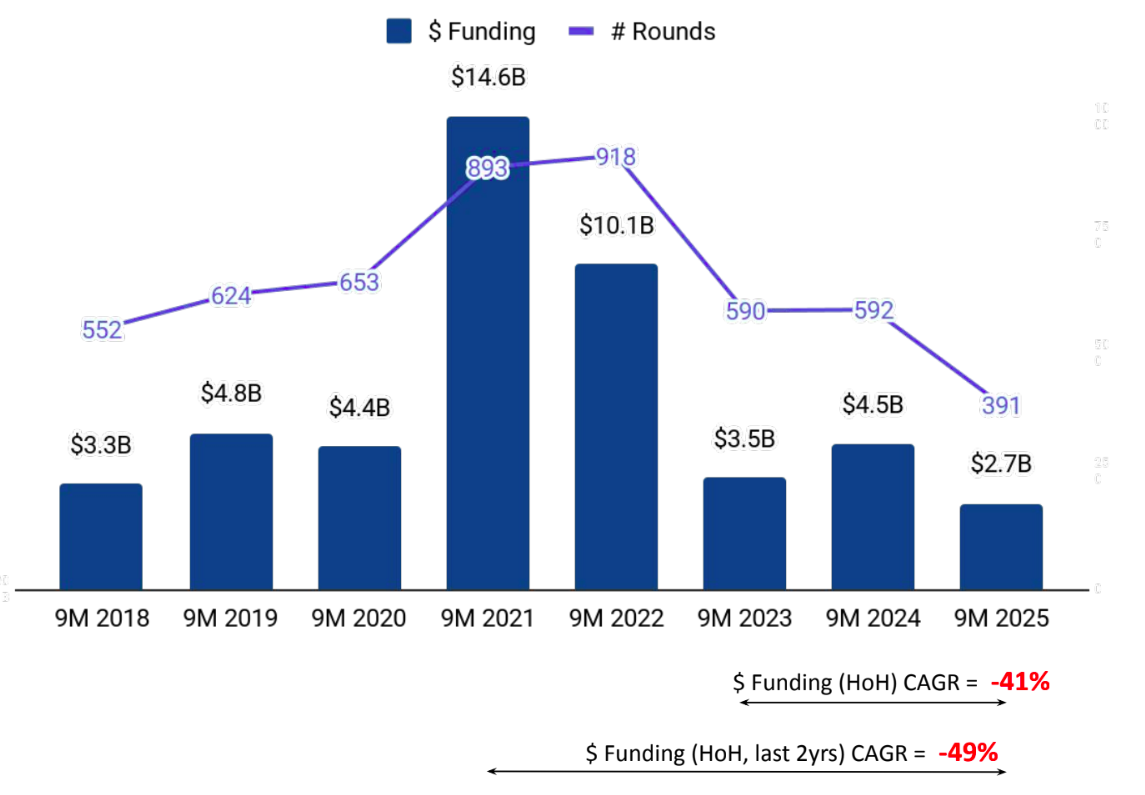
In essence, the dip in overall funding masks a deeper shift toward thoughtful investment and foundational growth. As investor interest gravitates toward early-stage start-ups, Karnataka’s ecosystem appears to be laying the groundwork for its next wave of innovation. If nurtured carefully, this phase could redefine success not by the size of funding rounds, but by the resilience and relevance of the ventures they support.
Follow: Karnataka Government
Also read: Home | Channel 6 Network – Latest News, Breaking Updates: Politics, Business, Tech & More
