
A rare but alarming tiger sighting near Mysuru Airport has triggered an immediate wildlife and security response, putting authorities, residents, and travellers on high alert. The alert came after multiple local reports indicated a possible tiger movement along the forested outskirts near the airport, raising concerns about potential human-wildlife conflict. Given Mysuru’s proximity to wildlife corridors connecting Nagarahole and Bandipur reserves, such sightings, while uncommon, are treated with utmost seriousness to ensure both public safety and animal conservation.
Following the initial tiger sighting near Mysuru Airport, the Forest Department intensified search operations across the surrounding areas. Teams equipped with tracking equipment, camera traps, and tranquilisation tools were deployed along likely movement corridors. Officers also coordinated with local villagers and forest dwellers to gather information on recent sightings, footprints, or signs of the tiger’s presence. The multi-tiered approach aimed to map the tiger’s trajectory, predict potential movement patterns, and ensure timely intervention if human contact became likely.
The Forest Department highlighted that tigers often travel along established routes linking dense forest regions, which occasionally intersect with human settlements. Given Mysuru’s proximity to Nagarahole and Bandipur tiger reserves, the animal’s presence near the airport is not entirely unexpected. Wildlife officials clarified that these sightings typically involve transient movements rather than permanent habitation in urban areas. Nonetheless, heightened vigilance remains essential to prevent potential accidents or conflicts with residents and commuters.
Residents in villages near the airport were advised to limit outdoor activity, especially during dawn and dusk, when tiger movement is most likely. Livestock owners were instructed to secure cattle in fenced enclosures or night shelters to avoid predation. Local authorities distributed awareness leaflets and conducted community briefings to inform people about safety protocols, signs of tiger presence, and emergency contacts. These precautionary measures aim to reduce panic while ensuring human and animal safety.
Airport security was also reinforced, with additional personnel patrolling the perimeter to prevent any accidental encounters. While flight operations continued, airport management requested that ground staff remain alert and report any unusual movement near the runway or surrounding areas. Coordination between aviation authorities and the Forest Department ensured that safety measures for both passengers and wildlife were strictly observed.
Experts from wildlife conservation organisations noted that such tiger sightings underscore the increasing interface between expanding urban areas and natural habitats. Tigers are known to maintain large territories, and their movements often reflect habitat pressures, prey availability, and seasonal patterns. Authorities emphasised that coexistence strategies, including monitoring, community education, and habitat management, are critical to mitigating human-wildlife conflict.
SIGHT OF TIGER
During the search, teams documented tiger tracks and signs of prey activity in nearby forest patches, confirming that the animal was moving through familiar corridors. Camera traps and drones were also deployed to monitor the area without disturbing the tiger. The data collected is expected to help authorities anticipate movements and prevent potential encroachment into densely populated areas.
Local media coverage of the sighting prompted public concern and curiosity. Authorities repeatedly urged calm, clarifying that immediate danger to humans remained low. Officials also highlighted the positive ecological implications of tiger presence in the region, reflecting a recovering wildlife population and healthy biodiversity. Awareness campaigns were intensified, educating citizens on responsible behaviour, safe observation, and prompt reporting of tiger sightings.
Environmentalists have called for long-term measures to reduce conflict, including the creation of green corridors, regulated urban expansion, and improved signage near forested zones. Conservationists stressed that protecting tiger habitats while ensuring public safety requires careful planning, funding, and continuous monitoring. They warned that neglecting these measures could lead to repeated encounters and potential incidents in the future.
Community involvement has proven essential in the ongoing search. Villagers, forest watchers, and local volunteers were mobilised to report signs such as pugmarks, scratches, and vocalisations. This local intelligence is invaluable in directing Forest Department teams efficiently, ensuring rapid response and minimising risk. Collaborative efforts between authorities and communities exemplify a proactive model for human-wildlife coexistence.
As night falls, search operations continue with patrolling teams, monitoring posts, and emergency response protocols in place. Authorities reiterated that the tiger’s presence is temporary and that relocation or intervention would only occur if human safety is directly threatened. Citizens are advised to remain vigilant but not panic, with continuous updates expected from both the Forest Department and Mysuru Police as the search progresses.
The ongoing alert serves as a reminder of the delicate balance between urban expansion and wildlife conservation. Mysuru’s proximity to tiger habitats offers both opportunities for ecological appreciation and responsibilities for coexistence. Authorities are hopeful that, with coordinated efforts, the tiger can be safely guided away from populated areas, preserving both human safety and the integrity of Karnataka’s rich biodiversity.
Officials from the Forest Department, Mysuru Police, and airport authorities swiftly coordinated to monitor the situation. Wildlife experts were deployed to track movements, identify patterns, and assess whether the tiger posed any immediate threat to nearby communities or airport operations. Temporary restrictions were placed on movement in surrounding areas, and local residents were advised to exercise caution while venturing outdoors. The alert also prompted enhanced surveillance around the airport perimeter to prevent any disruption to flights or ground operations.
The tiger sighting underscores the delicate balance between urban expansion and wildlife habitats. Mysuru, while urbanised, remains close to rich biodiversity zones, and sightings near human settlements are becoming increasingly common due to habitat overlap. Experts point out that tigers, being territorial and often following traditional corridors, may venture into semi-urban areas, especially in search of prey or during seasonal movement. Authorities emphasised that the animal is likely not aggressive toward humans unless provoked, but caution is critical.
Wildlife officials have advised residents to avoid open areas during dawn and dusk, keep livestock secured, and report any confirmed sightings immediately. Temporary patrolling teams are covering strategic points, and camera traps have been installed to track tiger movements. Forest authorities stressed that tranquilisation or capture would only be considered if the animal’s presence posed a direct threat, with a primary focus on relocation to ensure safety for both the tiger and the public.
Local airport authorities reassured travellers that flight operations were largely unaffected, although precautionary measures such as additional perimeter checks were being conducted. The Forest Department is in constant touch with airport security teams to ensure that both wildlife monitoring and aviation safety protocols are maintained. This multi-agency approach reflects lessons learned from previous wildlife-human interactions in the region.
Environmentalists and conservationists highlighted that sightings near urban areas indicate the tiger population is recovering and maintaining its range, a positive sign for biodiversity. However, they also warned that rapid urbanisation, encroachment, and habitat fragmentation increase the likelihood of human-animal encounters. The alert near Mysuru Airport serves as a reminder of the coexistence challenges and the importance of community awareness, proper planning, and wildlife-sensitive infrastructure.
Authorities continue to monitor the situation closely, urging vigilance while assuring the public that coordinated efforts are underway to track and, if necessary, safely relocate the tiger. Residents and travellers alike remain cautious, as the city watches the unfolding developments that intertwine urban life with the wild heart of Karnataka.
The tiger sighting near Mysuru Airport has sparked widespread concern among local communities, particularly those living on the forest fringes. Residents reported hearing unusual sounds and spotting paw marks in nearby fields, which led to immediate reporting to the Forest Department. Many villagers expressed anxiety about venturing out for daily activities, including tending to livestock and attending schools. Authorities have advised people to travel in groups, avoid isolated areas, and keep emergency contact numbers handy. Community awareness is being prioritised to prevent panic while ensuring safety for both humans and wildlife.
Airport operations, while largely unaffected, have implemented heightened security measures to ensure passenger safety. Ground staff and vehicle operators have been briefed on emergency protocols in the event of unexpected tiger sightings near the airstrip. Security personnel are patrolling the perimeters, and temporary surveillance cameras have been installed to monitor the tiger’s movement in real-time. Flight schedules are being reviewed to ensure no interference, and contingency plans are in place for any sudden developments.
Wildlife experts note that tigers often venture into human-dominated areas due to seasonal migration patterns or prey scarcity within their natural habitats. Mysuru, being close to Nagarahole National Park and its connecting corridors, frequently witnesses such movements, although direct human encounters remain rare. The Forest Department emphasises that the tiger is likely to avoid populated areas unless cornered or provoked. Proper monitoring and quick reporting are critical to prevent potential conflicts and ensure safe relocation if needed.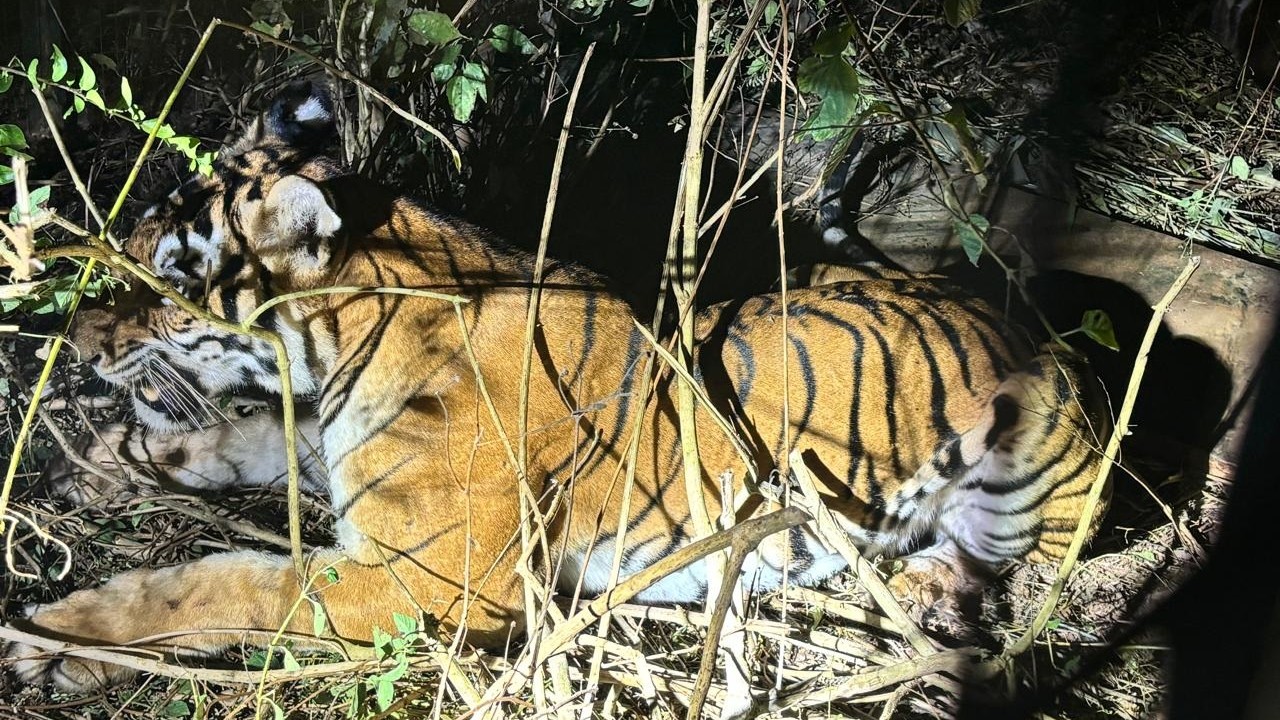
The Forest Department has deployed specialised teams equipped with tranquiliser guns, tracking devices, and night-vision equipment to locate and monitor the tiger. Camera traps have been installed at strategic points along likely paths, and the teams are conducting nocturnal surveillance to track movement patterns. Authorities are coordinating with local police to restrict access to sensitive zones, ensuring minimal disruption to residents while maximizing safety.
Livestock owners in the vicinity have been instructed to secure cattle and avoid leaving animals unattended in open fields. Reports suggest that tigers occasionally hunt near human settlements, especially when natural prey is scarce. Authorities are working to mitigate this risk through early warnings, patrolling, and temporary fencing in vulnerable areas. Residents are also being encouraged to report any fresh sightings or signs, such as claw marks or footprints, to the nearest forest office.
Conservationists have highlighted that such sightings are a reflection of healthy tiger populations maintaining their natural ranges. While human fear is understandable, these encounters indicate that wildlife corridors connecting Mysuru to nearby reserves are functioning, allowing tigers to move across landscapes. Experts stress the importance of coexisting with wildlife and implementing measures like safe corridors, awareness campaigns, and community participation to reduce conflict.
Authorities continue to monitor the situation closely, coordinating between airport officials, local law enforcement, and wildlife experts. They are prepared to take necessary action, including safe relocation, if the tiger strays too close to populated or operational areas. Residents are advised to remain vigilant but not to panic, understanding that these efforts aim to protect both human life and the endangered tiger population. The incident serves as a stark reminder of the delicate balance between urban expansion and wildlife conservation in Karnataka.
Follow: Karnataka Government
Also read: Home | Channel 6 Network – Latest News, Breaking Updates: Politics, Business, Tech & More
