
Bengaluru’s political and civic spotlight turned sharply toward airport management this week as a state Minister publicly admonished Bangalore International Airport Limited (BIAL) over its pick-up and parking regulations at Kempegowda International Airport. The reprimand reflects mounting frustration among commuters, airport users, transport unions, and political actors alike who argue that current protocols are causing unnecessary inconvenience, confusion, and tension on one of the city’s busiest transit corridors. By calling out BIAL, the Minister has injected urgency into a simmering debate over commuter rights, regulatory clarity, and the responsibilities of a private operator managing a public gateway.
The controversy stems from BIAL’s enforcement of specific pick-up and parking rules designed to manage traffic congestion and ensure security around the airport. However, commuters and taxi operators have complained that these rules are overly restrictive, inconsistently applied, and punitive in practice. Social media posts and citizen feedback have highlighted instances where vehicles were fined, turned back, or forced to pay high charges despite unclear signage or lack of alternative waiting areas. These experiences have fuelled resentment, particularly among first-time or infrequent airport users.
The Minister’s comments came after a series of representations from residents and transport associations asserting that the regulations, while intended to streamline traffic, have instead created chaos. In a strongly worded statement, the Minister demanded that BIAL immediately review and rationalise its pick-up and parking policies to prioritise convenience and fairness. The rebuke also stressed that the airport, while managed by a private entity, operates as critical public infrastructure and must therefore be sensitive to commuter challenges.
BIAL officials, in response, defended the regulations as necessary for safety and smooth flow of vehicles in a high-traffic area. They pointed to peak-hour congestion, security protocols, and international standards as drivers behind their approach. However, the Minister countered that these justifications do not excuse situations where passengers are stranded, vehicles turned away without guidance, or exorbitant charges applied without transparent communication.
The debate has ignited broader public discourse on how essential facilities balance regulation with user experience. Airports worldwide face similar challenges, but stakeholders insist that Bengaluru’s airport must refine its approach in consultation with travellers and transport providers. The Minister’s intervention has elevated the conversation, signalling that the State expects tangible improvements rather than bureaucratic explanations.
As Bengaluru’s status as a global city grows, seamless airport access remains a key marker of urban functionality. The rebuke of BIAL underscores the urgency of rethinking regulatory frameworks that govern everyday commuter interactions. Whether this confrontation leads to concrete changes in policy or remains a moment of political posturing will be closely watched by millions who rely on the city’s airport daily.
COMMUTER WOES, REGULATORY RIGIDITY, AND PUBLIC OUTCRY
Public dissatisfaction with the airport’s pick-up and parking regime is not new, but recent momentum behind the complaints has turned it into a political flashpoint. Residents living near the airport, frequent flyers, app-based cab drivers, and even private vehicle owners have voiced similar frustrations. A recurring complaint is the lack of clear, easily visible signage indicating designated pick-up points, parking charges, and alternate waiting areas. Many motorists allege that abrupt instructions from traffic marshals leave them scrambling, unsure of where to wait or how to avoid fines.
Transport operators, including autorickshaw unions and taxi aggregators, have described the system as opaque and arbitrary. According to their accounts, rules are enforced rigidly even when flight delays or passenger confusion contribute to missed pick-up windows. For drivers who depend on airport runs for livelihood, such unpredictability translates into lost income and unnecessary penalisation.
The Minister’s public criticism also referenced specific incidents where passengers were reportedly left on the roadside or made to pay steep fees after travelling long distances to reach the airport. Family members picking up elderly or disabled travellers expressed concern over the lack of accessible waiting spaces close to the terminal. These narratives intensified pressure on authorities to revisit current policies.
BIAL’s defence rests on two major claims: that controlling congestion is essential for safety, and that unlimited waiting or haphazard pick-ups would lead to traffic snarls and security risks. While these assertions are standard practice in many global airports, critics argue that the airport’s implementation has lacked contextual sensitivity to Bengaluru’s unique traffic patterns and passenger needs.
In response to the Minister’s call for review, some commuters have urged the introduction of a grace period for pick-ups, clearer communication channels, and better integration of digital information systems that guide drivers to appropriate zones. There have also been suggestions to streamline entry-exit points and provide real-time updates on space availability to reduce confusion.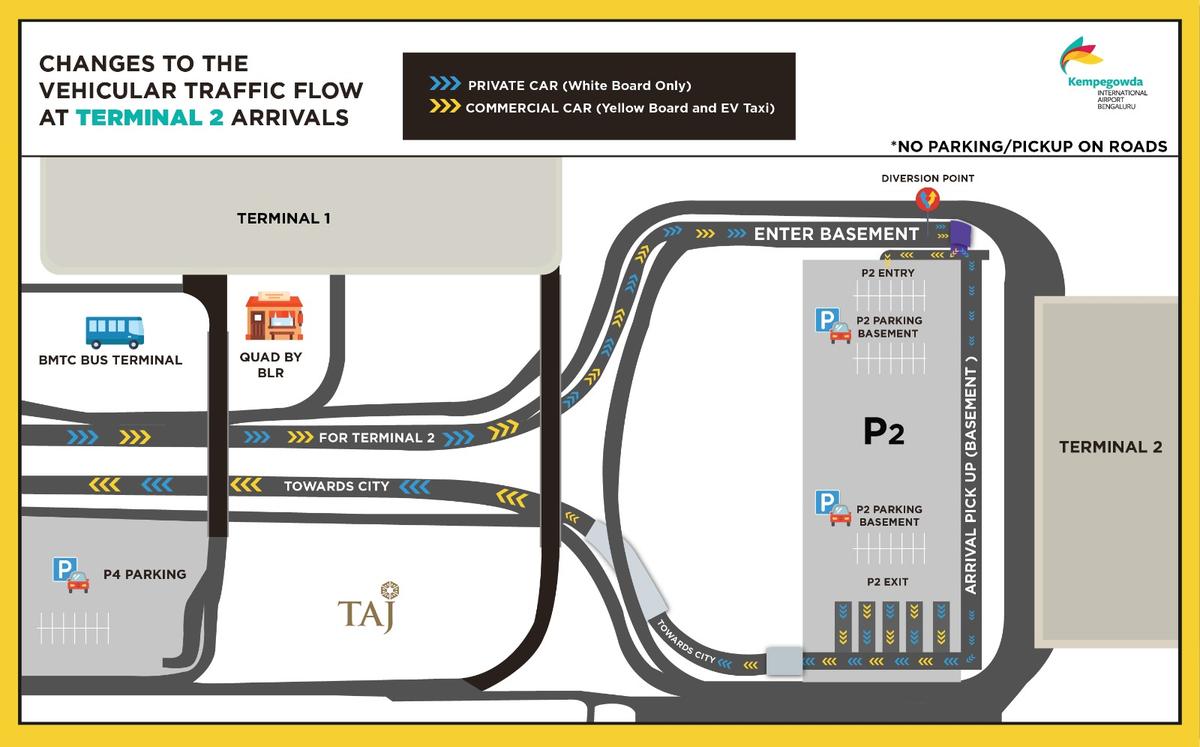
Urban mobility experts point out that airports operate as both transport hubs and public spaces, requiring regulations that balance order with practicality. Inefficient systems not only frustrate users but can also have economic implications by discouraging tourism and business travel.
This public outcry has placed BIAL’s operational framework under intense scrutiny, with many citizens watching closely to see if the rebuke will translate into meaningful reform or dissipate into bureaucratic inertia.
THE GOVERNMENT, BIAL, AND THE PUSH FOR BALANCE
The Minister’s intervention has significant administrative and political implications. By pushing back publicly against BIAL, which operates under a public–private partnership framework, the government is asserting its role as regulator, user advocate, and guardian of public convenience. This sets the stage for potential policy recalibration that could reshape how airport access is managed in Karnataka.
As discussions evolve, one thing remains clear: Bengaluru’s airport access policies are no longer merely a matter of operational detail. They have become a public issue, resonant with everyday frustrations and reflective of broader expectations for urban governance and service delivery.
Government officials have hinted at possible directives for BIAL to streamline procedures, enhance signage, revise penalty structures, and consult stakeholders more actively. There is also talk of deploying additional staff or technology to assist drivers and passengers during peak hours. While such discussions are in early stages, the Minister’s comments have already shifted the narrative from ad hoc complaints to systemic evaluation.
Political analysts suggest that the rebuke reflects broader electoral and civic pressures. Airports are high-visibility public spaces, and issues affecting them resonate with a large cross-section of urban voters, including professionals, students, and frequent travellers. By taking a firm stand, the government aims to position itself as responsive to citizen concerns, especially in a sector where private operators wield substantial autonomy.
However, striking a balance will be complex. Over-correcting regulations could lead to unmanaged traffic, security loopholes, and inefficiencies. BIAL’s position is that any relaxation must be calibrated against safety imperatives. The challenge lies in crafting rules that are both user-friendly and operationally sound.
For its part, BIAL has not ruled out revisiting specific aspects of its pick-up and parking regime. Officials have indicated openness to dialogue with government representatives and commuter groups. Whether this engagement yields concrete amendments to the rules remains uncertain, but the momentum generated by the Minister’s rebuke suggests that complacency is no longer an option.
The airport authority’s next steps will be closely watched. Stakeholders are urging prompt action, citing the summer travel season and high passenger volumes as reasons to act without delay. The coming weeks may see task forces, joint committees, or review panels constituted to examine the issue comprehensively.
IMPACT ON COMMUTERS AND BUSINESS OPERATIONS
Commuters using Bengaluru airport for business, tourism, and family travel have felt the impact of pick-up and parking rules in varied ways. For frequent flyers, confusion over designated zones and fear of penalties have eroded confidence in airport access systems. App-based cab drivers report lost earnings due to enforced waiting limits and fines for minor infractions. Private vehicle owners express frustration over seemingly inflexible regulations during irregular flight schedules.
Airport-adjacent businesses, such as hotels, car-rental services, and logistics providers, also face indirect effects. Delays in pick-ups or constraints on parking flow can disrupt client schedules, bookings, and customer satisfaction. Hospitality sector representatives have called for clearer, more predictable regulations that support seamless entry and exit, particularly for guests unfamiliar with the airport layout.
Moreover, the issue has broader implications for Bengaluru’s reputation as a global tech and business hub. Efficient airport operations are often a benchmark for urban infrastructure quality. Persistent complaints create perceptions of bureaucratic friction, potentially affecting business travellers’ experiences.
Experts recommend that user feedback loops be integrated into operational planning. Regular surveys, hotlines, and digital platforms where commuters can voice concerns in real time could help authorities fine-tune regulations based on actual usage patterns.
Ultimately, the goal for all stakeholders – government, airport authority, transport operators, and commuters – should be a system that facilitates swift, fair, and transparent access without compromising safety or order.
The Minister’s rebuke may thus serve as a catalyst for change, encouraging collaborative problem-solving rather than unilateral enforcement. What emerges from this confrontation could become a model for how India’s major airports balance regulatory imperatives with commuter convenience.
As discussions evolve, one thing remains clear: Bengaluru’s airport access policies are no longer merely a matter of operational detail. They have become a public issue, resonant with everyday frustrations and reflective of broader expectations for urban governance and service delivery.
Follow: Karnataka Government
Also read: Home | Channel 6 Network – Latest News, Breaking Updates: Politics, Business, Tech & More
