
The Bharatiya Janata Party and Janata Dal BJP (Secular) have accused the Karnataka government of misusing taxpayers’ money to fund extensive advertisements promoting a newly launched job scheme. The opposition parties alleged that public funds intended for welfare and development are being diverted for political publicity, particularly ahead of key electoral phases. The controversy has sparked a heated political exchange, with the ruling government defending the outreach as necessary to inform beneficiaries about opportunities. The issue has now moved beyond routine political criticism, raising questions about ethics, governance priorities, and the fine line between public information campaigns and political promotion.
The job scheme in question was introduced as part of the State’s employment generation strategy, aimed at supporting youth, women, and marginalized communities. Government representatives describe it as a significant step toward addressing unemployment and enhancing skill development. However, opposition leaders argue that the scale and frequency of advertisements in newspapers, television, and digital platforms appear disproportionate. They claim that the promotional material prominently features political imagery and messaging that, in their view, resembles campaign-style communication rather than neutral public information.
BJP leaders stated that while public awareness about government schemes is important, it must be carried out responsibly and within financial prudence. They questioned whether the expenditure on advertising aligns with established guidelines governing the use of public funds for publicity. According to them, essential sectors such as education, healthcare, and rural development should take precedence over large publicity campaigns. The party alleged that the advertisements blur the distinction between governance communication and political branding.
JD(S) representatives echoed similar concerns, asserting that excessive spending on publicity reflects misplaced priorities. They argued that beneficiaries are more interested in effective implementation and access to jobs than in promotional content. The party further contended that grassroots communication through employment exchanges and local institutions could be more cost-effective than mass media campaigns. The opposition’s joint criticism has amplified the debate, positioning it as a matter of accountability rather than partisan disagreement alone.
Government officials, however, rejected the allegations, stating that public awareness is a critical component of scheme success. They emphasized that many welfare and employment initiatives fail to reach intended beneficiaries due to lack of information. According to the administration, the advertisements aim to ensure that eligible individuals are informed about registration procedures, eligibility criteria, and timelines. Officials maintained that all publicity expenditure follows prescribed norms and is subject to financial scrutiny.
PUBLICITY OR PROPAGANDA? OPPOSITION SHARPENS ATTACK
The opposition’s primary contention revolves around the nature and tone of the advertisements. BJP leaders argue that the visual presentation and language used in the campaign highlight political leadership rather than focusing solely on the scheme’s functional aspects. They stated that governance communication should remain neutral and avoid elements that could be interpreted as self-promotion. The party indicated that it may raise the issue in the legislature, seeking detailed disclosure of the advertising budget and approval processes.
Observers from public policy institutes point out that disputes over government advertising often lead to broader discussions on regulatory frameworks. Some experts advocate for the creation of independent guidelines at the State level, similar to national standards that emphasize neutrality and public interest. Establishing a review committee to vet large-scale publicity campaigns before release could help reduce allegations of misuse. Such institutional mechanisms, they argue, provide clarity and protect both governments and taxpayers by ensuring that communication remains informational rather than politically suggestive.
Financial accountability advocates emphasize that transparency in budgeting is central to resolving such controversies. Detailed disclosures of expenditure heads, media placement costs, and campaign duration can help citizens understand how funds are allocated. When information is proactively shared, public confidence in administrative intent may improve. Conversely, limited disclosure can allow political narratives to dominate the discourse. Experts suggest that publishing post-campaign impact assessments would further demonstrate whether awareness objectives were achieved efficiently.
Employment specialists note that communication plays a key role in the success of job schemes, especially those targeting youth and informal sector workers. However, they stress that outreach should be accompanied by accessible application systems, skill training centers, and timely placement support. Without these components, publicity alone cannot deliver employment outcomes. Evaluating the scheme’s real-world performance may therefore become as important as examining how it is promoted.
Political commentators observe that such controversies often intensify as electoral cycles approach, when messaging around development programs becomes more visible. In competitive political environments, opposition scrutiny of publicity spending tends to increase. This dynamic underscores the need for governments to adhere strictly to communication norms during sensitive periods. Clear separation between governance information and party messaging can help prevent disputes from overshadowing policy objectives.
Civic groups have proposed that future awareness campaigns include more community-level engagement rather than relying heavily on mass media. Local job fairs, panchayat-level meetings, and collaboration with educational institutions could provide direct outreach at lower cost. Such approaches, they argue, make communication more interactive and reduce perceptions of extravagance. Combining digital platforms with grassroots methods may enhance both efficiency and credibility.
As discussions continue, the broader governance lesson centers on balancing outreach with accountability. Informing citizens about employment opportunities is widely recognized as important, yet public expenditure must be perceived as proportionate and transparent. How the Karnataka government responds to demands for disclosure and evaluation may set precedents for future communication strategies. The outcome of this debate could influence policy frameworks that guide how developmental initiatives are presented to the public while safeguarding trust in the use of taxpayers’ money.
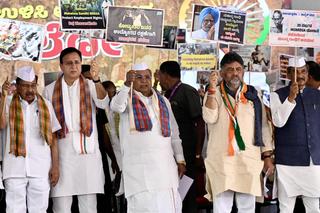
JD(S) leaders pointed out that similar concerns have arisen in the past regarding government publicity expenditure across different administrations. They stressed the need for clear, transparent guidelines to prevent misuse. According to them, public trust can erode if citizens perceive that tax revenue is being used to build political image rather than deliver tangible services. The party suggested that an independent review mechanism could ensure that communication campaigns remain informative rather than promotional.
Political analysts observe that disputes over government advertising are not uncommon, especially in states with active political competition. Public communication is essential for informing citizens, yet the line between awareness and propaganda can be subjective. Experts note that courts and oversight bodies in various contexts have emphasized the importance of maintaining neutrality and avoiding partisan messaging in publicly funded advertisements. The present controversy reflects these broader governance challenges.
The government’s defense centers on the argument that employment initiatives require wide outreach to be effective. Officials pointed out that young job seekers often rely on digital platforms and media channels for information. They added that the campaign’s scale corresponds to the scheme’s statewide coverage. Authorities also indicated that expenditure on publicity represents a small fraction of the overall budget and that funds for core services remain unaffected.
Despite these assurances, opposition leaders continue to press for detailed financial disclosures. They seek information on the agencies involved, cost breakdowns, and duration of the campaign. Transparency advocates argue that proactive disclosure can help resolve doubts and demonstrate compliance with regulations. In the absence of clear data, speculation and political accusations are likely to persist.
GOVERNANCE ETHICS AND PUBLIC PERCEPTION
The debate has brought governance ethics into focus. Scholars note that governments have a duty to communicate with citizens, particularly about programs that affect livelihoods. However, ethical communication requires that information be presented objectively, without emphasizing individual leaders or political slogans. Maintaining this balance is crucial for preserving the distinction between state functions and party interests.
Public perception plays a significant role in shaping the controversy’s impact. Citizens often evaluate such disputes based on their own experiences with public services. If the job scheme leads to visible employment opportunities and efficient processes, the publicity may be viewed as justified. Conversely, if implementation falls short, criticism of advertising expenditure could gain traction. The effectiveness of the scheme itself may therefore influence how the debate evolves.
Media experts suggest that transparency in communication strategy can help reduce political friction. Publishing guidelines, cost details, and objectives of campaigns can reassure the public that advertisements serve informational purposes. Such measures can also help establish benchmarks for future initiatives. Institutionalizing clear standards ensures that public communication remains consistent regardless of changes in political leadership.
From a financial oversight perspective, audit mechanisms are expected to examine compliance with norms governing publicity spending. Budget allocations for information and public relations departments are typically subject to scrutiny. Ensuring that expenditures remain within approved limits and serve intended objectives is essential for maintaining fiscal discipline. Observers note that audit reviews can provide clarity beyond political rhetoric.
Civil society organizations have also entered the discussion, emphasizing the importance of accountability. They argue that public funds carry an obligation of transparency and measurable outcomes. Awareness campaigns, they note, should be evaluated based on reach, effectiveness, and cost-efficiency. Independent assessment of communication impact can help determine whether resources are being used optimally.
As the controversy unfolds, legislative forums may become the next arena for debate. Opposition members are likely to seek answers through questions and discussions, while the government may present data to defend its approach. Such exchanges, while politically charged, are part of democratic oversight. The outcome may influence future policies on government advertising and communication practices.
Ultimately, the issue underscores the delicate balance between informing citizens and maintaining neutrality in expenditure. While the job scheme’s objectives focus on employment generation, the surrounding debate highlights governance principles that extend beyond a single program. How the government addresses concerns about transparency and proportionality will shape public trust. The episode serves as a reminder that effective governance requires not only sound policy but also careful stewardship of public perception and resources.
Follow: Karnataka Government
Also read: Home | Channel 6 Network – Latest News, Breaking Updates: Politics, Business, Tech & More
