
The Congress party organized a night-long satyagraha in Mysuru, protesting against what it described as moves that could weaken or effectively sideline the Mahatma Gandhi National Rural Employment Guarantee Act (MGNREGA). Party leaders, workers, and rural beneficiaries gathered at a prominent public space in the city, holding placards and raising slogans in defense of the rural employment scheme. The protest, which continued through the night, was framed as a symbolic act of solidarity with millions of rural workers who depend on MGNREGA for livelihood security, particularly during periods of agrarian distress and limited employment opportunities.
Speakers at the gathering emphasized that MGNREGA is not merely a welfare measure but a legal entitlement guaranteeing wage employment to rural households. They argued that any reduction in budget allocations, delays in wage payments, or administrative restrictions on work approvals amount to undermining the spirit of the Act. Protesters claimed that in several regions, job card holders are facing reduced workdays and payment backlogs, forcing families to struggle for basic needs. The satyagraha, they said, aimed to draw attention to these concerns and urge authorities to safeguard the scheme’s implementation in both letter and spirit.
Participants included elected representatives, grassroots leaders, women’s self-help group members, and laborers who have worked under MGNREGA projects. Many shared personal experiences of how the scheme helped them during difficult times, such as crop failures or seasonal unemployment. Women beneficiaries highlighted that the program has provided them with independent income and greater financial agency within households. The atmosphere at the protest combined political messaging with emotional testimonies, underscoring the scheme’s role in supporting vulnerable sections of rural society.
Congress leaders at the event accused the government of gradually diluting MGNREGA through policy decisions that restrict funding and limit the scope of permissible works. They contended that rural employment demand remains high and that scaling back the program could exacerbate migration, poverty, and social inequality. The satyagraha was described as a peaceful yet firm assertion of constitutional and social justice values. Organizers said the choice of a night-long vigil symbolized the continuous struggle of rural workers who often endure uncertainty about income and job availability.
Authorities maintained that MGNREGA remains operational but acknowledged challenges in implementation, including fund management and verification processes. Officials emphasized that reforms aim to improve efficiency and transparency. Protesters, however, argued that administrative tightening should not come at the cost of reduced employment access. They demanded timely release of funds, expansion of work categories, and strict adherence to wage payment timelines. The demonstration in Mysuru thus became a focal point for broader debates about rural employment policy and social protection mechanisms.
DEFENDING RURAL LIVELIHOODS AND LEGAL RIGHTS
At the heart of the protest was the assertion that MGNREGA represents a rights-based approach to development. Unlike discretionary welfare schemes, it provides a statutory guarantee of work, creating a safety net for rural households. Activists said that weakening this framework could erode hard-won protections for laborers. They stressed that the scheme has been instrumental in building rural infrastructure such as water conservation structures, roads, and land development works, which in turn support agricultural productivity. Reducing its scope, they argued, would affect both immediate incomes and long-term rural resilience.
Economists note that MGNREGA often acts as a countercyclical measure, injecting purchasing power into rural areas during downturns. Wages earned through the program contribute to local markets and small businesses, creating multiplier effects. Protest speakers pointed out that in districts prone to drought or erratic rainfall, employment under the scheme can prevent distress migration to cities. They argued that curtailing such support could increase urban pressure and deepen rural vulnerabilities. The Mysuru satyagraha highlighted these economic dimensions alongside social justice concerns.
Labor rights advocates also emphasized gender aspects of the scheme. With significant participation of women, MGNREGA has expanded female labor force engagement in rural areas. Protesters said that disruptions in the program disproportionately affect women who rely on its flexible and locally available work opportunities. Ensuring safe worksites, equal wages, and timely payments remains critical, they noted. Speakers called for strengthening grievance redress mechanisms so workers can report delays or irregularities without fear.
Youth participants at the protest expressed concern that shrinking rural employment avenues could intensify unemployment among young people. While MGNREGA is often associated with manual work, they argued that it plays a stabilizing role that supports households investing in education and skill development. By providing a basic income floor, the scheme indirectly contributes to human capital formation. Protest leaders urged policymakers to view MGNREGA as complementary to broader development goals rather than as a fiscal burden.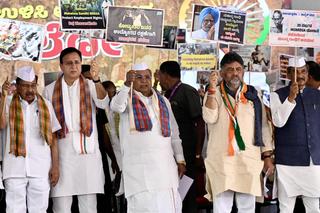
POLITICAL SIGNALS AND FUTURE IMPLICATIONS
The satyagraha also carried political significance, signaling the Congress party’s intent to foreground social welfare issues. Leaders described the protest as part of a larger campaign to protect pro-poor programs and hold authorities accountable for their implementation. They said similar demonstrations could be organized in other districts if concerns remain unresolved. The peaceful nature of the vigil, they noted, reflected the Gandhian roots of satyagraha as a means of moral persuasion rather than confrontation.
Political analysts suggest that debates around MGNREGA often intensify during periods of fiscal tightening, when governments seek to rationalize expenditures. However, they caution that employment guarantees have deep social implications that extend beyond budget calculations. The Mysuru protest may therefore resonate with rural constituencies who view the scheme as essential. Public sentiment around such programs can influence policy priorities and electoral discourse, especially in agrarian regions.
Civil society groups observing the protest urged constructive dialogue between governments and stakeholders. They suggested that operational challenges such as leakages or delays should be addressed through administrative reforms rather than funding cuts. Transparent data sharing, community monitoring, and technology-enabled tracking of payments could improve accountability while preserving employment levels. The protest’s message, they said, underscores the need to balance efficiency with equity.
As dawn approached and the vigil concluded, organizers reiterated that the movement would continue through democratic channels. Memoranda outlining demands were to be submitted to relevant authorities. For participants, the night-long satyagraha was both a symbolic and practical assertion of their reliance on MGNREGA. The event in Mysuru served as a reminder that employment security remains a central concern in rural India, and that policies affecting it evoke strong emotional and political responses.
As the protest drew wider attention, local organizers began coordinating with farmer groups and labor collectives from nearby taluks to build a broader platform around rural employment concerns. They said the Mysuru satyagraha was only the beginning of a sustained outreach effort aimed at informing workers about their rights under MGNREGA. Volunteers distributed pamphlets explaining job card provisions, wage entitlements, and grievance procedures. This educational aspect, leaders noted, is crucial because many beneficiaries are unaware of the full scope of protections available to them under the Act, limiting their ability to demand accountability.
Several participants emphasized that timely wage payments remain one of the most pressing issues. Workers recounted instances where delays stretched into weeks, disrupting household budgets and forcing them to borrow at high interest rates. Protest speakers argued that such delays defeat the very objective of an employment guarantee meant to provide predictable income. They called for streamlined fund release mechanisms and stronger coordination between central and State authorities. Ensuring prompt payments, they said, would restore faith in the scheme and reduce financial stress among rural laborers.
Environmental aspects of MGNREGA works also found mention during discussions at the protest site. Activists highlighted that many projects focus on water conservation, afforestation, and soil improvement, which have long-term ecological benefits. Reducing the scale of these activities, they argued, could weaken local climate adaptation efforts. Participants pointed out that in water-scarce regions, MGNREGA structures such as check dams and ponds have improved groundwater recharge. Protecting the scheme, therefore, aligns not only with employment goals but also with sustainable resource management.
Trade union representatives who joined the vigil drew parallels between MGNREGA and broader labor rights frameworks. They said that employment guarantees serve as a benchmark that discourages exploitative wage practices in informal sectors. When rural workers have an alternative source of income, their bargaining power improves, potentially raising standards across labor markets. Weakening the program, they warned, could increase vulnerability to low-paid or unsafe work. Their intervention underscored the interconnectedness of social protection policies and overall labor welfare.
Cultural performances and songs themed around dignity of labor and rural resilience were organized through the night, adding a community dimension to the protest. Organizers said these expressions helped maintain morale and foster solidarity among participants. The use of art and music reflected the satyagraha’s emphasis on peaceful, collective assertion. Such elements, they noted, make protests more inclusive and accessible, encouraging participation from diverse age groups and backgrounds.
By the time the demonstration concluded, leaders reiterated that the objective was not confrontation but constructive engagement. They appealed to authorities to view the protest as feedback from the ground rather than opposition for its own sake. The satyagraha, they said, symbolized the enduring demand for livelihood security and respect for legal entitlements. Whether policy responses follow will determine how effectively rural employment concerns are addressed in the months ahead, but the Mysuru vigil has clearly added momentum to the conversation around safeguarding MGNREGA.
Follow: Karnataka Government
Also read: Home | Channel 6 Network – Latest News, Breaking Updates: Politics, Business, Tech & More
