
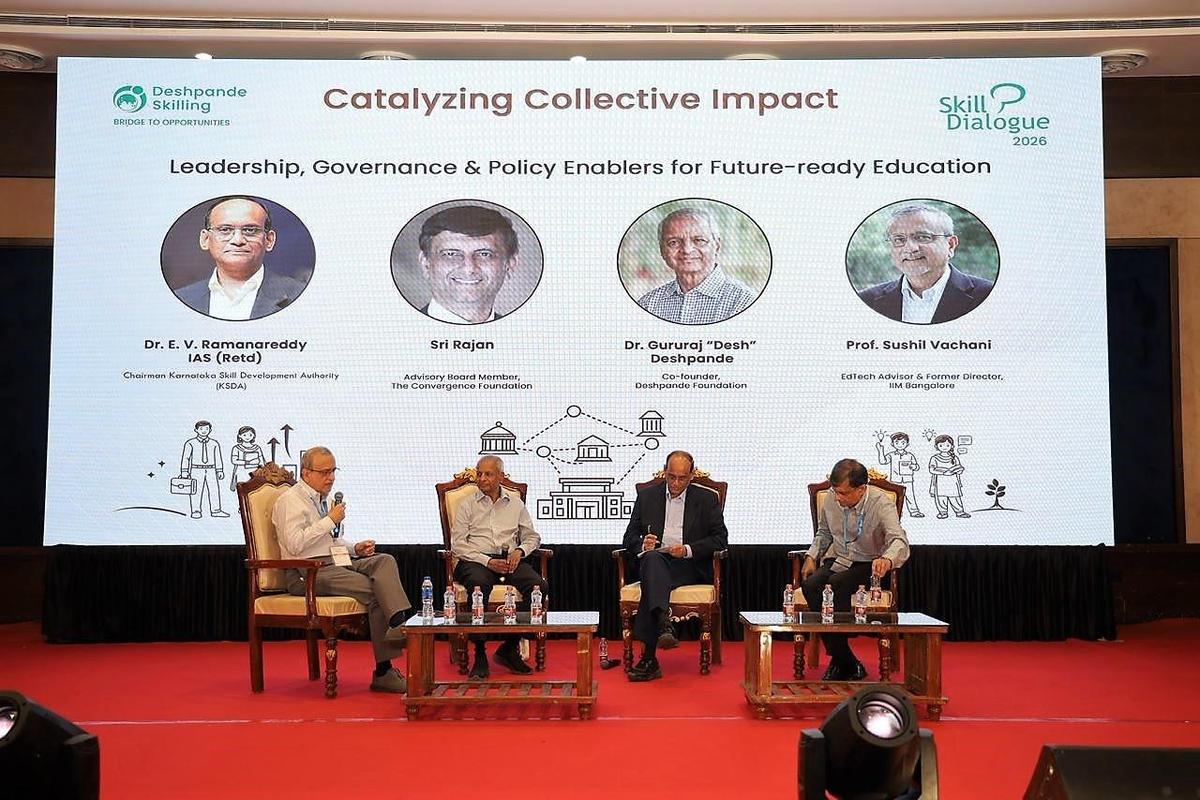
Education systems rooted narrowly in degrees, marks, and examinations are increasingly failing to prepare students for real-world challenges, experts asserted at the Development Dialogue held in Hubballi. Academicians, policy thinkers, industry professionals, and social leaders gathered to deliberate on the future of learning, arguing that education must evolve into a holistic, skill-oriented, and life-centric process. Speakers emphasised that while formal qualifications still hold value, an excessive focus on exams has reduced learning to rote memorisation, stifling creativity, critical thinking, and social responsibility. The dialogue underscored the urgency of reimagining education to meet the demands of a rapidly changing society and economy.
Context of the Development Dialogue
The Development Dialogue in Hubballi was organised as a platform to discuss long-term social and economic transformation, with education emerging as a central theme. Participants highlighted that India stands at a demographic crossroads, with a large young population whose potential can only be unlocked through meaningful learning experiences. Against the backdrop of technological disruption, climate challenges, and shifting labour markets, experts argued that the existing education model is outdated. The Hubballi dialogue sought to move beyond policy rhetoric and examine ground realities, especially in semi-urban and rural contexts where education often remains exam-driven and disconnected from lived experiences.
Voices from Students and Educators
Students and teachers who attended the Development Dialogue echoed the experts’ concerns, sharing first-hand experiences of an exam-driven system. Several students spoke about feeling reduced to ranks and scores, with little space to explore interests or social issues. Educators acknowledged that rigid curricula and assessment pressures often limit their ability to innovate in classrooms. They stressed that giving teachers academic freedom and trusting students’ curiosity could transform learning environments. These testimonies reinforced the argument that meaningful reform must be grounded in lived experiences, not just policy frameworks.
Sustaining Momentum Beyond Dialogue
Speakers concluded by emphasising that dialogues and conferences must translate into sustained action. They proposed forming working groups to pilot alternative assessment methods, community-linked learning projects, and teacher training programmes in the region. By committing to follow-up initiatives, participants hoped to ensure that the ideas discussed do not remain aspirational. The Hubballi dialogue, they said, should serve as a starting point for continuous engagement, demonstrating how conversations on education can evolve into practical, long-term transformation.
Critique of Degree-Centric Education
A recurring concern raised by speakers was the obsession with degrees as the sole marker of intelligence and success. Experts noted that degrees have become transactional credentials rather than reflections of competence. This mindset, they argued, pressures students into choosing fields based on perceived prestige rather than aptitude or interest. As a result, many graduates struggle to adapt to workplaces that demand problem-solving, collaboration, and adaptability. The speakers stressed that education should be a process of discovery and capability-building, not merely a race to accumulate certificates.
Exam Culture and Its Consequences
The examination-centric structure of education was criticised for narrowing the purpose of learning. According to experts, exams often reward memory over understanding, creating anxiety-driven environments that discourage curiosity. Students, they said, are trained to perform under time pressure rather than to think deeply or creatively. This culture disproportionately affects students from disadvantaged backgrounds, who may lack access to coaching and resources. Several speakers pointed out that the exam system often measures conformity rather than originality, limiting innovation and self-expression among learners.
Disconnect Between Education and Society
Participants at the dialogue highlighted a growing disconnect between education and societal needs. While communities grapple with issues such as unemployment, environmental degradation, and social inequality, classrooms often remain insulated from these realities. Experts argued that education must be rooted in local contexts, encouraging students to engage with real problems around them. Such an approach, they said, would not only make learning relevant but also foster empathy and civic responsibility. Hubballi, as a growing educational hub in North Karnataka, was cited as a potential model for community-linked learning initiatives.
Reimagining Learning for the 21st Century
Skill-Based and Experiential Education
Experts unanimously advocated for a shift towards skill-based and experiential learning. This includes integrating internships, apprenticeships, project-based work, and field exposure into curricula from an early stage. They argued that skills such as communication, teamwork, digital literacy, and emotional intelligence are as important as academic knowledge. Experiential education, they said, allows students to learn by doing, making mistakes, and reflecting — processes essential for lifelong learning. Such models, already gaining traction globally, were presented as crucial for India’s future workforce.
Role of Teachers as Facilitators
The dialogue also focused on redefining the role of teachers. Rather than being mere transmitters of information, teachers should act as facilitators and mentors who guide students in exploring ideas and developing independent thought. Experts stressed the need for continuous professional development for educators, enabling them to adapt to new pedagogies and technologies. They argued that empowering teachers is central to transforming education, as no reform can succeed without their active participation and confidence.
Integrating Technology with Purpose
While acknowledging the transformative potential of technology, speakers cautioned against viewing digital tools as a panacea. They argued that technology should support learning objectives rather than dictate them. Online platforms, artificial intelligence, and digital resources can personalise learning and expand access, but only if used thoughtfully. Experts warned that without proper guidance, technology could exacerbate inequalities and reduce human interaction in classrooms. The focus, they said, should be on using technology to enhance understanding, collaboration, and creativity.
Valuing Multiple Intelligences
Another key theme was the recognition of multiple forms of intelligence. Experts criticised the narrow academic benchmarks that prioritise linguistic and mathematical skills while neglecting artistic, social, and practical abilities. They called for assessment systems that value diverse talents, including craftsmanship, caregiving, leadership, and innovation. Such recognition, they argued, would create a more inclusive education system that respects individual differences and reduces the stigma associated with non-traditional career paths.
Mental Health and Well-Being
The pressure of exams and career uncertainty has taken a toll on student mental health, experts noted. Rising stress, anxiety, and burnout among students were cited as warning signs of a system in crisis. Speakers advocated for integrating well-being, mindfulness, and life skills into education. They stressed that education should nurture resilient, emotionally balanced individuals rather than merely producing high scorers. Addressing mental health openly within educational institutions was described as both a moral and practical necessity.
Policy, Practice, and the Road Ahead
Rethinking Assessment and Evaluation
A major takeaway from the dialogue was the need to reform assessment systems. Experts suggested moving towards continuous and formative evaluation methods that focus on progress rather than one-time performance. Portfolio-based assessments, peer evaluations, and real-world projects were proposed as alternatives to high-stakes exams. Such systems, they argued, would encourage consistent engagement and reduce the fear associated with failure. Importantly, failure was reframed as a learning opportunity rather than a stigma.
Bridging Education and Employment
Industry representatives at the dialogue stressed the widening gap between education and employment. Employers, they said, increasingly value adaptability, ethics, and problem-solving over textbook knowledge. To bridge this gap, experts recommended stronger partnerships between educational institutions and industry, civil society, and local governments. These collaborations could help align curricula with evolving needs while preserving education’s broader social purpose. Hubballi’s growing industrial and entrepreneurial ecosystem was cited as fertile ground for such partnerships.
Equity and Access in Educational Reform
Experts warned that any transformation of education must prioritise equity. Rural students, first-generation learners, and marginalised communities often bear the brunt of systemic shortcomings. Reforms that rely heavily on technology or private investment risk excluding those without access. Speakers called for strong public investment in education, ensuring that innovative models reach government schools and colleges as well. Education reform, they argued, must be inclusive to be meaningful.
Cultural Shift and Parental Mindsets
Beyond policy, speakers emphasised the need for a cultural shift in how society perceives education. Parents, they said, often equate success with degrees and ranks, unintentionally reinforcing exam pressure. Changing this mindset requires sustained dialogue and awareness. Experts suggested involving parents and communities in educational reform, helping them understand the value of holistic learning. Without societal buy-in, they warned, even the best-designed reforms may falter.
Local Innovations and Scalable Models
The dialogue highlighted several local initiatives that are already experimenting with alternative education models. From community libraries and skill centres to project-based learning in schools, these examples demonstrated that change is possible even within existing constraints. Experts stressed the importance of documenting and scaling such innovations, adapting them to different contexts rather than imposing one-size-fits-all solutions. Hubballi was positioned as a potential hub for piloting and refining such models.
Role of Government and Institutions
Government institutions were urged to act as enablers rather than controllers of education reform. Experts called for regulatory flexibility that allows institutions to innovate while maintaining quality standards. They emphasised that reform should be gradual and consultative, involving educators, students, and communities. Top-down mandates, they cautioned, often fail to capture classroom realities and may provoke resistance rather than change.
Conclusion
The Development Dialogue in Hubballi made a compelling case for transforming education beyond degrees and exam-centric models. Experts agreed that the challenges of the 21st century demand learners who are curious, adaptable, and socially conscious — qualities that cannot be cultivated through rote learning alone. While degrees and exams may continue to play a role, they must no longer dominate the educational landscape. The discussions in Hubballi highlighted both the urgency and the possibility of change, calling for collective action from policymakers, educators, parents, and society at large. As India seeks to harness its demographic dividend, reimagining education may be not just desirable, but essential for sustainable and inclusive development.
Follow: Karnataka Government
Also read: Home | Channel 6 Network – Latest News, Breaking Updates: Politics, Business, Tech & More
