
Farmley ₹400 Crore Rise Driven by Strong Sales Discipline
Farmley ₹400 crore has become the closest milestone for the Noida-based healthy snacking brand as it reported operating revenue of ₹394 crore in FY25. This marked a sharp rise from ₹230 crore in FY24, reflecting a 71 percent year-on-year growth. More importantly, the company managed to grow revenue faster than expenses, a sign of improving financial control in a highly competitive food market.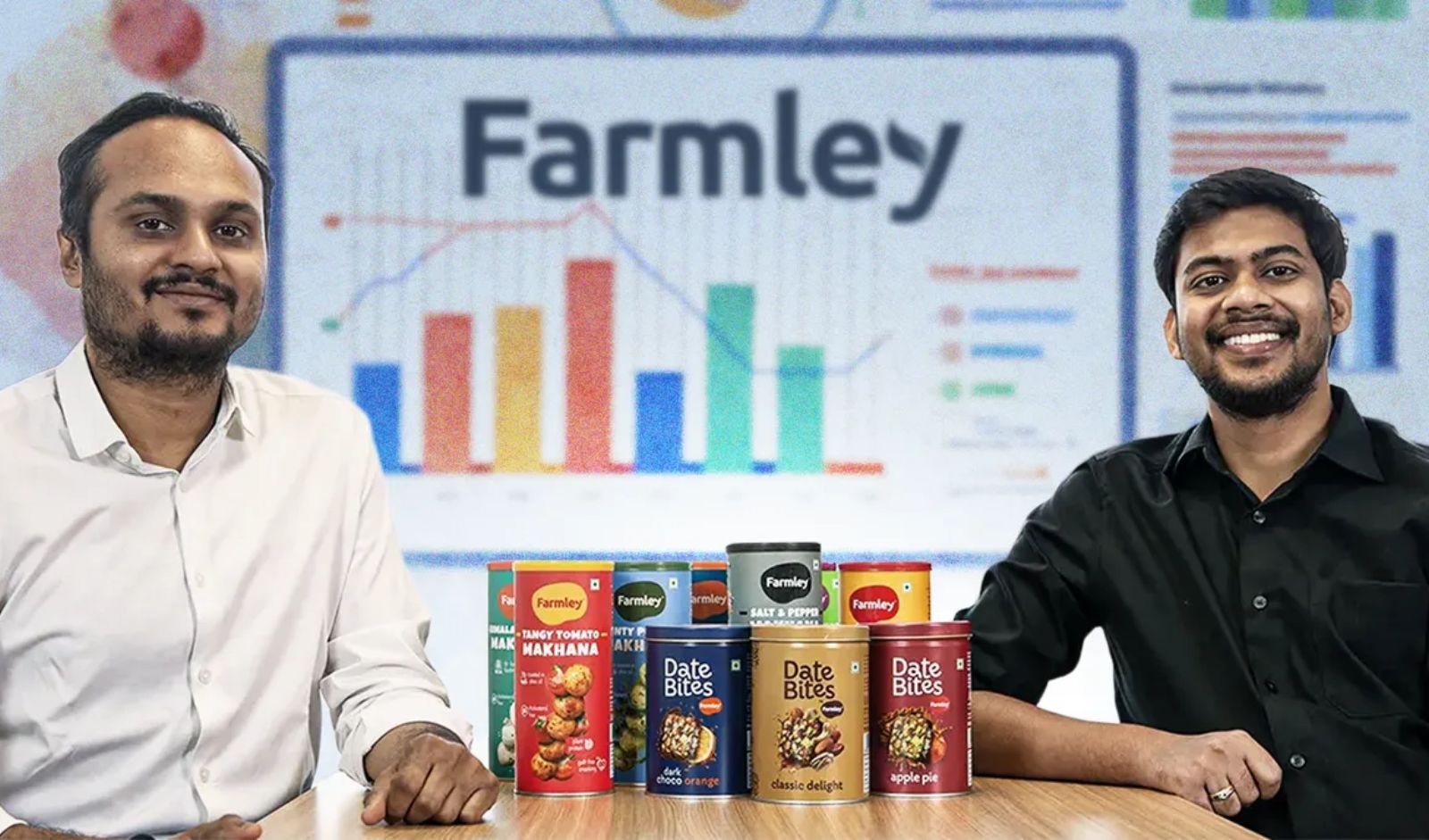
The company’s total income stood at ₹396 crore in FY25, supported by strong performance across online platforms, quick commerce channels, and a wider offline retail presence. While expenses remained high, Farmley showed better efficiency in how money was spent to generate revenue. For every rupee earned, the company spent ₹1.06, improving from ₹1.12 in the previous year.
This improvement highlights a shift from aggressive expansion to more balanced growth, where scale and sustainability are being managed together.
Farmley ₹400 Crore Journey from Bulk Supply to Consumer Brand
did not happen overnight. Founded in 2017 by IIT alumni Akash Sharma and Abhishek Agarwal, the company started as a bulk supplier of dry fruits and nuts. Over time, the founders realised that selling directly to consumers would allow better margins and stronger brand connection. This shift proved critical to Farmley’s current scale.
Today, Farmley offers more than 100 products, including almonds, cashews, raisins, dates, roasted nuts, seeds, trail mixes, makhana snacks, and date-based items. The company sources raw materials directly from over 5,000 farmers in India and abroad, helping maintain quality while managing supply costs.
Farmley now sells across major platforms such as Amazon, Flipkart, Blinkit, Zepto, BigBasket, and through more than 22,000 physical stores. It has also expanded exports to markets like the United States, Australia, Singapore, and the Middle East, adding another layer to its revenue stream.
Farmley ₹400 Crore Costs, Loss Control, and Funding Support
Farmley ₹400 crore growth still comes with high operational costs. The biggest expense remains raw material procurement, especially nuts and dry fruits, which stood at ₹281 crore in FY25. Advertising expenses increased to ₹52 crore as the company continued to invest in brand visibility. Employee costs reached ₹27 crore, while logistics expenses were recorded at ₹20 crore.
Despite these costs, Farmley reduced its net loss to ₹22.5 crore in FY25 from ₹26.5 crore in FY24. The operating loss margin improved to -3.68 percent, showing that losses are narrowing as scale improves. The company ended the year with cash reserves of ₹22 crore and current assets worth ₹163 crore, providing some financial cushion.
Farmley has raised around $55 million, roughly ₹456 crore, in funding so far. This includes a $40 million Series C round in May 2025 led by L Catterton, with participation from DSG Consumer Partners and the BC Jindal Group. The founders continue to hold about 52 percent of the company, retaining control as the business grows.
Farmley ₹400 Crore and a Clear Pattern of Long-Term Growth
Farmley ₹400 crore is part of a longer growth pattern rather than a one-year spike. Over the last four years, the company’s revenue has grown from ₹204 crore in FY22 to ₹394 crore in FY25. During the same period, losses have consistently declined, indicating better cost management and operational discipline.
This trend matters more than headline numbers. Many consumer brands grow fast but struggle to control spending. Farmley’s recent performance suggests a more measured approach, focusing on steady demand, supply efficiency, and gradual improvement in margins. Also Read: Farakka Barrage Project: DoWR, RD & GR Secretary V. L. Kantha Rao proudly Undertakes 2-Day Review
Conclusion
Farmley ₹400 crore revenue puts the company close to a major milestone, but the real story lies in controlled growth and declining losses. With rising demand for healthy snacks and better cost discipline, Farmley appears to be moving toward a more stable phase of expansion without relying on hype or unsustainable spending.
