
A tense confrontation between legislators belonging to the Bharatiya Janata Party and the Congress disrupted the Karnataka Development Programme meeting in Bidar on Tuesday, bringing proceedings to a halt and exposing deep political fault lines in the district’s governance. What was intended to be a platform for reviewing development works and resolving administrative bottlenecks instead descended into chaos, as sharp verbal exchanges escalated into a full-blown clash between elected representatives, forcing officials to suspend the meeting midway.
According to officials present at the venue, the confrontation began during discussions on the implementation of development projects and allocation of funds across constituencies. Members from the opposition BJP accused the ruling Congress of sidelining their constituencies in project approvals and budgetary allocations. Congress legislators strongly refuted the claims, leading to heated arguments that soon drowned out the proceedings.
Senior district officials and the presiding chair attempted to restore order, but repeated interruptions and aggressive exchanges made it impossible to continue. The situation deteriorated further when legislators moved from their seats and confronted each other at close quarters, prompting security personnel to step in. Following the disruption, the meeting was adjourned without concluding the agenda, delaying decisions on several pending development works.
The incident has drawn attention to the increasingly confrontational nature of district-level governance meetings, which are meant to function as non-partisan forums focused on development rather than political rivalry.
Accusations, Countercharges, and a Breakdown of Decorum
BJP legislators alleged that projects recommended during earlier KDP meetings had either been stalled or selectively implemented to favour constituencies represented by ruling party members. They claimed that repeated representations to district authorities had gone unanswered, leaving basic infrastructure works such as road repairs, drinking water schemes, and school upgrades in limbo.
Congress members countered these allegations by accusing the opposition of politicising administrative forums and attempting to disrupt governance. They argued that project approvals were being carried out strictly based on departmental norms, financial availability, and priority needs, not political affiliation. Congress legislators also claimed that the opposition was using the KDP platform to create confrontation rather than contribute constructively.
As tempers flared, the discussion reportedly veered away from development issues and turned personal, with legislators questioning each other’s commitment to the district. Officials said repeated appeals to maintain decorum were ignored, highlighting the difficulty of managing political disagreements within administrative review meetings.
District officials later confirmed that several agenda items, including reviews of irrigation works, health infrastructure upgrades, and progress on housing schemes, could not be taken up due to the disruption.
Political observers noted that KDP meetings, chaired by senior ministers or district in-charge ministers, are designed to ensure coordination between elected representatives and the administration. Disruptions of this nature, they said, undermine the very purpose of such forums and ultimately affect service delivery to citizens.
Impact on Governance and Development
The immediate fallout of the clash is the delay in clearing key development proposals for Bidar district. Officials said that decisions related to fund reallocation, project deadlines, and inter-departmental coordination will now have to wait until the next meeting, the date of which is yet to be finalised.
Administrative sources expressed concern that repeated disruptions in review meetings create uncertainty for line departments, which rely on clear political direction to proceed with projects. “When meetings end without conclusions, it affects timelines and morale,” an official said, speaking on condition of anonymity.
Civil society members in Bidar expressed frustration over the incident, saying that political infighting has repeatedly overshadowed development priorities in the district. Activists pointed out that Bidar continues to lag behind in key indicators such as healthcare access, rural road connectivity, and employment opportunities, making effective governance forums all the more crucial.
Some officials privately admitted that tensions between legislators have been building over recent months, particularly over fund distribution and visibility of development works. The KDP meeting, they said, became the stage where these grievances erupted publicly.
The disruption has also raised questions about the enforcement of rules governing conduct in official meetings. Experts argue that stricter protocols and clearer authority to enforce discipline may be necessary to prevent such incidents.
Political Reactions and Blame Game
Following the clash, leaders from both parties issued statements blaming each other for the breakdown of the meeting. BJP leaders accused the ruling party of intolerance towards dissent and claimed that their legislators were denied a fair opportunity to raise constituency issues.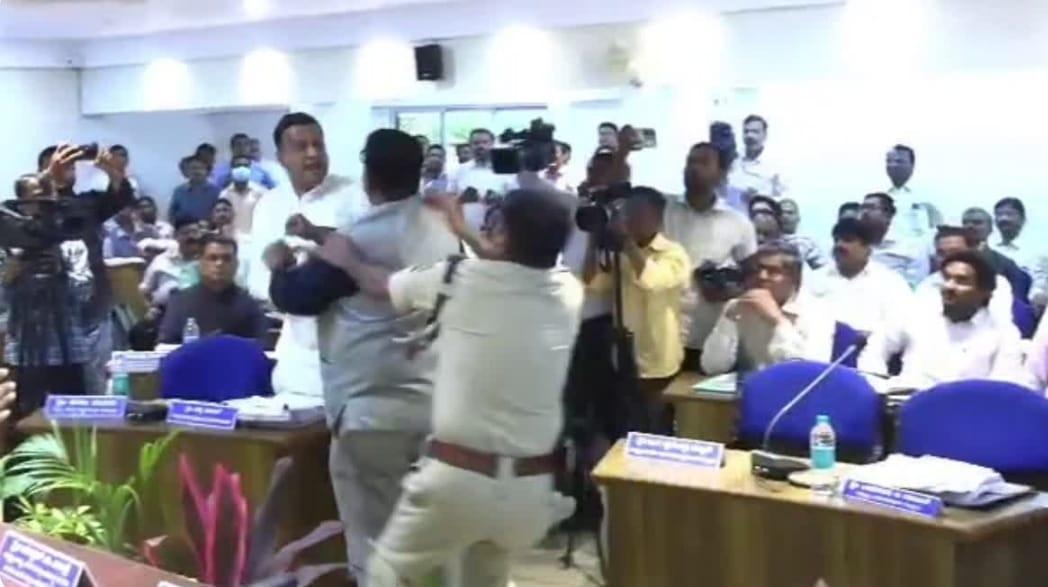
Congress leaders, on the other hand, accused the BJP of deliberately provoking chaos to divert attention from governance failures during its earlier tenure. They said the ruling party remains committed to development and would not allow “political theatrics” to derail administrative functioning.
Senior leaders from both parties attempted to downplay the physical intensity of the confrontation but acknowledged that the verbal clash was unfortunate. Some leaders called for restraint and urged legislators to resolve differences through dialogue rather than confrontation.
The district in-charge minister is expected to submit a report on the incident to the Chief Minister, detailing the sequence of events and the reasons for the adjournment. Officials said the government may issue fresh guidelines to ensure smoother conduct of future meetings.
Political analysts said the clash reflects broader polarisation in Karnataka politics, where even district-level forums are increasingly becoming extensions of legislative confrontations.
Role of the Administration Under Scrutiny
The incident has also put the district administration under scrutiny, with questions being raised about its ability to manage politically sensitive meetings. Former bureaucrats said that while administrators cannot control political disagreements, they can enforce procedural discipline more firmly.
Some suggested that separating political discussions from technical reviews could help reduce friction. For instance, dedicating specific time slots for legislators to air grievances, followed by structured departmental presentations, could bring order to meetings.
Others argued that the presence of senior ministers or neutral moderators could help defuse tensions before they escalate. “Leadership matters in such forums. Firm but fair intervention can prevent a breakdown,” a retired official said.
The Bidar incident has revived calls for training programmes for elected representatives on the functioning of administrative review mechanisms, emphasising their role in governance rather than confrontation.
Meanwhile, officials are working to reschedule the adjourned items, with departments being asked to submit updated progress reports in preparation for the next meeting.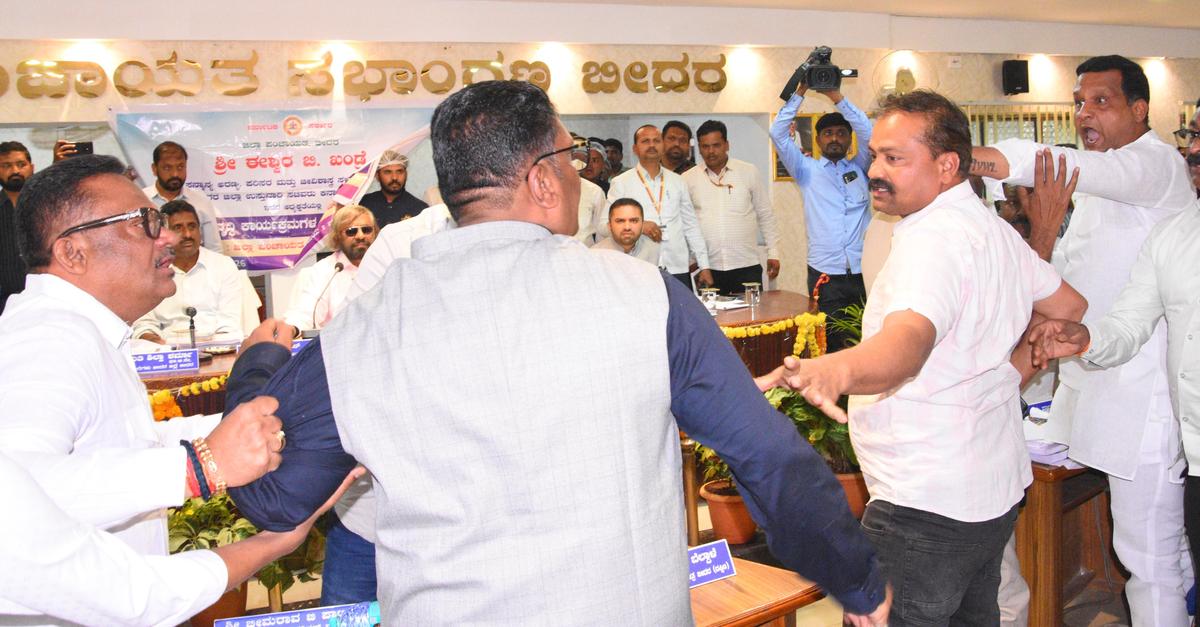
Public Perception and Citizen Discontent
For residents of Bidar, the clash has reinforced cynicism about political priorities. Several citizens expressed disappointment that elected representatives could not set aside differences even in a forum dedicated to development.
Local business associations said uncertainty over project approvals affects investor confidence and slows economic activity. “When governance forums fail, the ripple effects are felt across sectors,” a trader said.
Youth groups and student organisations also criticised the behaviour of legislators, saying it sends a poor message about democratic engagement. They urged leaders to focus on education, employment, and infrastructure rather than political point-scoring.
Social commentators noted that such incidents contribute to declining public trust in institutions. When development meetings are disrupted, citizens often feel that their concerns are secondary to political rivalry.
Some residents called for greater transparency, suggesting that live-streaming or public disclosure of meeting proceedings could act as a deterrent against disruptive behaviour.
A Symptom of Deeper Political Tensions
Analysts argue that the Bidar clash is not an isolated incident but part of a broader pattern of heightened political tension in the State. With upcoming political contests and shifting alliances, district-level forums are increasingly becoming arenas for asserting influence and visibility.
The KDP, originally conceived as a mechanism to bridge political and administrative priorities, risks losing its effectiveness if such confrontations become routine. Experts warn that repeated disruptions could reduce the programme to a symbolic exercise rather than a functional governance tool.
Some political strategists believe that parties must introspect on the long-term costs of such behaviour. While confrontations may yield short-term political mileage, they can erode institutional credibility and voter trust over time.
There are also concerns that bureaucrats may become risk-averse in such environments, delaying decisions to avoid political backlash, which further hampers development.
The Road Ahead
In the aftermath of the disruption, attention has turned to how the government and political parties will respond. Ensuring that the rescheduled meeting proceeds smoothly will be seen as a test of political maturity and administrative control.
Observers say restoring the focus on development will require deliberate effort from all sides, including clear agendas, firm moderation, and a commitment to constructive dialogue. Without these, the risk of repeated disruptions remains high.
For Bidar district, the priority remains addressing long-standing development gaps and ensuring that governance mechanisms function effectively. Citizens and officials alike hope that the clash serves as a wake-up call rather than a precedent.
Ultimately, the incident underscores a fundamental challenge in democratic governance: balancing political contestation with administrative responsibility. Whether Karnataka’s leaders can strike that balance at the district level will shape not just meetings like the KDP, but public faith in the development process itself.
Follow: Karnataka Government
Also read: Home | Channel 6 Network – Latest News, Breaking Updates: Politics, Business, Tech & More
