
Former Chief Minister and JD(S) leader H.D. Kumaraswamy on Tuesday launched a sharp political attack on Karnataka Chief Minister Siddaramaiah, questioning his actual contribution to the AHINDA framework and alleging that corrupt officers are being shielded under the present Congress government. His remarks have reignited political debate in the State, especially around social justice politics, governance, and administrative accountability.
Kumaraswamy also questioned the credibility of internal vigilance mechanisms within the state administration. He argued that when inquiries into corruption remain inconclusive or delayed, it raises doubts about the seriousness of the government’s commitment to clean governance. According to him, prolonged investigations without visible outcomes create public suspicion and allow accused officials to continue functioning without consequences. He said stronger and time-bound vigilance processes are necessary to restore public confidence.
The JD(S) leader further claimed that the Congress government’s narrative of social justice is weakened when administrative transparency is lacking. He argued that marginalised communities suffer the most when corruption goes unchecked, as leakages in welfare delivery directly affect those dependent on state support. Kumaraswamy said that genuine empowerment requires not only welfare announcements but also corruption-free implementation and responsive governance.
Political commentators note that such sharp exchanges are likely to intensify as parties prepare for future electoral contests. AHINDA remains a central ideological tool, and competing claims over its ownership are expected to shape campaign narratives. Analysts say governance performance, especially on corruption and bureaucratic accountability, will be closely scrutinised by voters beyond ideological assertions.
Ultimately, observers believe the controversy underscores a broader demand for measurable governance outcomes. Citizens increasingly expect transparency, swift action against wrongdoing, and clear evidence of social justice policies translating into real change. Whether the government responds with reforms or dismisses the criticism as political rhetoric may significantly influence public trust and the credibility of AHINDA politics in Karnataka.
Speaking to the media, Kumaraswamy said that Siddaramaiah frequently projects himself as the architect and protector of AHINDA — an acronym for minorities, backward classes, and Dalits — but has failed to deliver tangible outcomes for these communities. According to him, the concept has increasingly become a political slogan rather than a policy-driven commitment reflected in governance decisions.
Kumaraswamy alleged that under the current Congress rule, several officers facing serious allegations of corruption continue to hold influential positions. He claimed that instead of acting against such officials, the government has either transferred them to “comfortable postings” or ignored complaints altogether. This, he argued, contradicts the Congress party’s stated commitment to clean administration and social justice.

AHINDA POLITICS AND CLAIMED CONTRADICTIONS
Questioning Siddaramaiah’s long association with AHINDA politics, Kumaraswamy said that real empowerment of backward classes and marginalised groups requires systemic reforms, not rhetorical assertions. He alleged that communities under the AHINDA umbrella continue to face unemployment, lack of access to quality education, and inadequate representation in decision-making bodies.
The JD(S) leader said that if Siddaramaiah had genuinely strengthened AHINDA over decades in public life, the condition of these communities would not remain unchanged. He pointed to rural distress, farmer suicides, and stagnation in employment opportunities as indicators that governance has failed to translate ideology into action.
Kumaraswamy further accused the Congress government of selectively invoking AHINDA only during elections while pursuing policies that benefit a limited political and bureaucratic elite. He said this selective approach undermines the original spirit of inclusive politics and reduces social justice to a vote-gathering exercise.
ALLEGATIONS OF BUREAUCRATIC PROTECTION
A major part of Kumaraswamy’s criticism focused on the alleged protection being extended to tainted officers. He claimed that multiple complaints regarding corruption, irregularities in transfers, and misuse of power are pending without action. According to him, this has created an atmosphere where honest officers feel demoralised while erring officials operate with impunity.
He alleged that political patronage has weakened administrative discipline and accountability. Kumaraswamy said that governance cannot claim moral high ground if the system shields those accused of wrongdoing. “When corrupt officers are protected, it sends a dangerous signal that integrity is optional,” he remarked.
The former Chief Minister also questioned the Congress government’s silence on internal vigilance reports and audit findings. He argued that a truly reform-oriented administration would proactively disclose findings and take corrective action rather than dismiss criticism as political attacks.
CONGRESS RESPONSE AND POLITICAL CONTEXT
Congress leaders dismissed Kumaraswamy’s remarks as politically motivated and said the AHINDA framework remains central to the government’s policy agenda. They argued that several welfare schemes, social security initiatives, and budgetary allocations reflect the government’s commitment to marginalised communities.
Party leaders also accused Kumaraswamy of attempting to reclaim political relevance by attacking Siddaramaiah. They pointed out that Siddaramaiah’s political career has consistently focused on social justice issues and that the government has initiated measures aimed at redistribution and welfare.
However, political analysts note that Kumaraswamy’s remarks tap into a broader public debate about governance credibility. Allegations of bureaucratic protection, even when politically charged, tend to resonate with citizens frustrated by perceived lack of accountability in administration.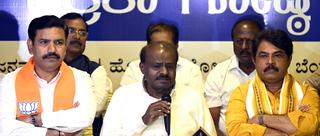
WIDER IMPLICATIONS FOR STATE POLITICS
Observers say the exchange reflects deeper tensions within Karnataka’s political landscape, particularly as parties position themselves around social justice narratives. AHINDA has long been a powerful ideological framework in the State, and competing claims over its legacy are likely to intensify ahead of future electoral battles.
Analysts also point out that corruption allegations against bureaucrats place additional pressure on the government to demonstrate transparency. Even if the claims are contested, public perception plays a crucial role in shaping political narratives.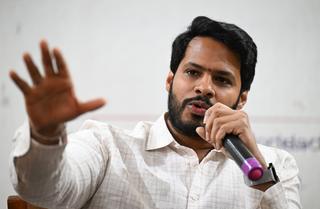
As the political war of words continues, the spotlight remains on whether the government will address concerns related to accountability and governance, or whether the issue will remain confined to partisan exchanges. For now, Kumaraswamy’s remarks have ensured that debates around AHINDA, corruption, and administrative integrity remain firmly in the public discourse.
Kumaraswamy also questioned whether the benefits of welfare schemes claimed under the AHINDA framework were actually reaching intended beneficiaries. He alleged that implementation gaps, middlemen, and administrative delays had diluted the impact of several flagship programmes. According to him, marginalised communities continue to struggle with access to basic services despite repeated assurances from the government. He said that slogans alone cannot substitute measurable outcomes and accused the Congress of focusing more on optics than delivery.
The former Chief Minister further argued that social justice politics loses credibility when governance is perceived as selective or biased. He said that protecting officers accused of wrongdoing sends a message that political loyalty matters more than integrity. This, he claimed, disproportionately affects weaker sections who depend on a fair and transparent administration for access to welfare, land records, housing benefits, and grievance redressal.
Kumaraswamy also raised concerns about frequent transfers and postings within the bureaucracy, alleging that they were driven by political considerations rather than administrative necessity. He said such practices disrupt governance continuity and create an environment where officers focus on pleasing political masters instead of serving the public. According to him, this weakens institutional accountability and undermines public confidence in the system.
Political observers note that Kumaraswamy’s attack is also aimed at reclaiming space in the social justice discourse, traditionally dominated by the Congress. With AHINDA remaining a powerful mobilising concept, JD(S) leaders appear keen to challenge the Congress narrative and highlight perceived contradictions between ideology and governance. Analysts say this reflects an ongoing battle to define who truly represents backward classes and marginalised communities in Karnataka.
The controversy has also sparked discussions among civil society groups, some of whom argue that debates around AHINDA must go beyond political ownership. Activists say that the focus should shift to outcomes such as quality education, employment generation, healthcare access, and fair representation. They stress that social justice frameworks must be periodically evaluated to ensure they evolve with changing socio-economic realities.
Within the bureaucracy, Kumaraswamy’s remarks have triggered quiet unease, with some officers privately acknowledging that allegations of political pressure are not new. While many officers insist they function independently, others admit that fear of transfers or stalled careers can influence decision-making. Experts say strengthening institutional safeguards is essential to ensure officers can act without undue influence.
Congress leaders, meanwhile, have reiterated that allegations of protecting corrupt officers are unfounded and politically driven. They argue that disciplinary processes take time and must follow due procedure. Party spokespersons said selective highlighting of cases creates a misleading narrative and ignores actions taken against erring officials when evidence is established.
However, analysts point out that perception often outweighs process in public discourse. Even isolated incidents of inaction can fuel broader mistrust, especially when accompanied by political accusations. They note that governments must balance procedural fairness with visible accountability to maintain credibility among citizens.
The debate has also reignited questions about the future of AHINDA as a political and governance model. Critics argue that unless accompanied by structural reforms and transparent administration, the framework risks losing relevance. Supporters, however, maintain that it remains essential for addressing historical inequalities and must be strengthened rather than dismissed.
As political sparring continues, the issue has moved beyond individual leaders to larger questions of governance culture in Karnataka. Whether the controversy leads to concrete administrative reforms or remains a rhetorical battle will likely shape public opinion in the coming months. For now, Kumaraswamy’s remarks have ensured that scrutiny of power, accountability, and social justice remains firmly in focus.
Follow: Karnataka Government
Also read: Home | Channel 6 Network – Latest News, Breaking Updates: Politics, Business, Tech & More
