
The Karnataka government has advised all State government employees to wear khadi on the first Saturday of every month, describing the move as a symbolic and cultural initiative aimed at promoting indigenous heritage. The advisory, issued through an administrative circular, frames khadi not merely as fabric but as a representation of India’s freedom movement, rural livelihoods, and sustainable practices. Officials say the step is voluntary in spirit but strongly encouraged as part of a broader effort to reconnect public service with national values. The decision has sparked discussion among employees, unions, and citizens about identity, practicality, and symbolism in governance.
According to senior officials in the Department of Personnel and Administrative Reforms, the initiative seeks to revive awareness about khadi’s historical and socio-economic importance. Khadi has long been associated with self-reliance, simplicity, and Gandhian philosophy. By designating a specific day each month, the government hopes to create a visible reminder within public offices of these ideals. The advisory also aligns with ongoing campaigns promoting handloom sectors and rural artisans. Authorities argue that even symbolic gestures can influence consumer behavior, encouraging citizens to consider locally produced textiles over mass-manufactured alternatives in daily life.
Employee reactions have been mixed, with some welcoming the move as a refreshing cultural expression and others questioning its relevance to administrative efficiency. Supporters say the gesture fosters unity and pride while supporting Indian weavers. Critics, however, argue that clothing choices should remain entirely personal and not be institutionally suggested. Employee associations have clarified that no disciplinary measures are linked to the advisory, emphasizing its non-mandatory nature. Still, the discussion highlights the delicate balance governments must maintain between cultural encouragement and personal autonomy in professional environments.
Officials from the Department of Handlooms and Textiles have expressed optimism that the measure could have a modest economic impact. Even limited demand from government employees across Karnataka could provide steady orders to khadi institutions and cooperatives. Representatives from khadi boards believe regular visibility in offices may also inspire the general public to revisit the fabric. They stress that khadi today is available in diverse styles, suitable for formal settings. The initiative, they say, is not about reverting to the past but adapting tradition to contemporary professional life.
CULTURAL SYMBOLISM AND ADMINISTRATIVE IDENTITY
The government has framed the advisory within a broader narrative of cultural continuity in public service. Officials say civil servants represent the State not only through decisions but also through conduct and presentation. Wearing khadi occasionally, they argue, reinforces a sense of rootedness in India’s socio-political journey. Historians note that khadi played a central role in the freedom struggle, symbolizing resistance to colonial economic systems. By recalling this legacy, the State hopes to remind employees of service ideals rooted in sacrifice, integrity, and collective progress rather than purely bureaucratic functions.
Sociologists observe that clothing in institutions often carries symbolic meaning, from uniforms to dress codes. In this context, the khadi advisory can be seen as a soft cultural cue rather than regulation. Such gestures, experts say, can foster shared identity without imposing rigid conformity. However, they caution that symbolic policies must be accompanied by substantive governance improvements to avoid perceptions of tokenism. The success of the initiative, therefore, may depend on whether employees view it as meaningful recognition of heritage or as a superficial directive disconnected from daily administrative challenges.
Environmental advocates have also supported the move, pointing out khadi’s relatively low carbon footprint compared to synthetic textiles. Hand-spun and hand-woven processes consume less energy and often use natural fibers. Promoting such fabrics aligns with sustainability goals, especially as governments encourage eco-conscious practices. Officials have noted that small behavioral shifts across large employee groups can collectively reduce environmental impact. The advisory thus intersects cultural preservation with ecological awareness, presenting khadi as both heritage and responsible consumption in a time of climate concern.
From a political perspective, the decision reflects an ongoing trend of states incorporating cultural motifs into administrative messaging. While largely symbolic, such moves resonate emotionally with sections of the public. Analysts suggest that initiatives centered on heritage often transcend party lines because of their historical resonance. Still, they warn that public perception will depend on implementation tone. Emphasizing voluntary participation and respect for diversity in attire choices will be key to maintaining positive reception among employees from varied backgrounds and personal preferences.
Employee unions have sought clarification on practical aspects, such as availability, affordability, and climate suitability. Khadi can vary widely in texture and comfort depending on weave and region. Officials have responded that no specific style or supplier is mandated, allowing employees to choose comfortable options. Some departments are exploring exhibitions or stalls featuring certified khadi institutions to improve accessibility. These measures aim to make participation convenient rather than burdensome, reinforcing the advisory’s consultative rather than coercive character across government offices.
ECONOMIC IMPACT AND PUBLIC RESPONSE
Khadi institutions across Karnataka have welcomed the advisory, anticipating increased visibility and potential sales. Representatives say that even a symbolic endorsement by the government can elevate public interest. They note that many young professionals perceive khadi as outdated, and institutional usage could help rebrand it as modern and versatile. Textile experts add that design innovation has expanded khadi’s appeal, with lighter weaves suitable for daily office wear. If sustained, the initiative may contribute incrementally to the financial stability of rural artisans who depend on handloom production.
Citizens have expressed varied opinions on social platforms and in public discussions. Some see the move as a thoughtful reminder of cultural roots, while others question whether symbolic gestures should precede pressing administrative reforms. Observers point out that such debates are common whenever governments engage in identity-linked initiatives. The advisory has nonetheless sparked renewed conversation about the relevance of traditional industries in contemporary economies. By placing khadi in everyday professional spaces, the government has inadvertently revived dialogue on heritage, livelihoods, and consumer responsibility.
Educational institutions and civic groups have shown interest in parallel awareness campaigns about khadi’s history and production process. Workshops and exhibitions could accompany the monthly observance, turning it into a broader learning opportunity. Cultural scholars believe this educational dimension may deepen appreciation beyond mere attire. Understanding the labor-intensive nature of hand-spinning and weaving can foster respect for artisan communities. Officials say such collaborations may be explored, ensuring the advisory evolves into a participatory cultural initiative rather than a routine administrative suggestion.
Some policy analysts view the step as part of a larger narrative emphasizing local economies. Encouraging consumption of domestically produced goods aligns with economic self-reliance strategies. While the advisory alone may not significantly alter market dynamics, it contributes symbolically to that vision. Experts note that consistent institutional endorsement can gradually influence public habits. The government appears to be leveraging its workforce as ambassadors of a message that blends heritage pride with economic consciousness, reflecting broader national conversations on sustainable and localized production models.
As implementation begins, department heads have been advised to communicate the initiative positively, avoiding compulsion. Feedback mechanisms may help authorities gauge employee response and adjust outreach. The long-term impact will likely depend on how organically the practice is adopted. If employees embrace it as a meaningful expression rather than obligation, the advisory could become a distinctive cultural marker within Karnataka’s administrative landscape. Ultimately, the move underscores how governance sometimes extends beyond policy into symbolism, seeking to connect institutions with the historical and emotional threads of society.
In the coming months, the government may also assess whether similar cultural observances can be integrated with other sectors such as education and public outreach. Schools, colleges, and local bodies could be encouraged to host khadi awareness days, linking attire with lessons on history, sustainability, and rural economies. Such expansion would transform the advisory from an internal administrative practice into a broader social movement. Officials indicate that any extension would follow consultations, ensuring that participation remains rooted in encouragement rather than enforcement, thereby preserving the voluntary spirit that defines the current initiative.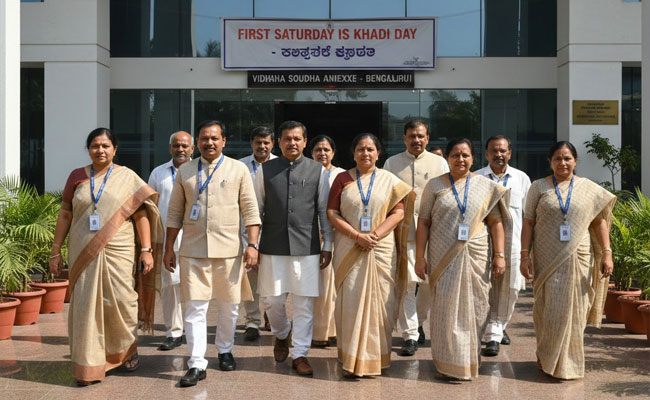
Marketing experts believe visibility within government offices could subtly reshape public perception of khadi as a contemporary fabric rather than ceremonial attire. When citizens interact with officials wearing well-designed khadi garments, it may normalize the fabric in formal and semi-formal settings. Designers and cooperatives are already experimenting with blends and modern cuts to appeal to younger consumers. This intersection of tradition and innovation may prove crucial in ensuring khadi’s relevance in urban professional culture, bridging generational gaps while retaining its core identity as a symbol of self-reliance and craftsmanship.
There is also discussion about leveraging digital platforms to support the initiative. Online directories of certified khadi outlets, artisan stories, and educational content could accompany the monthly observance. By humanizing the production chain, such efforts might foster emotional connection between consumers and weavers. Officials say storytelling can play a vital role in sustaining interest beyond symbolic days. When employees understand the livelihoods behind each garment, participation becomes an act of solidarity rather than routine. This narrative-driven approach could strengthen the social impact envisioned by policymakers behind the advisory.
Cultural commentators suggest that the initiative’s success will ultimately depend on how inclusively it is framed. Karnataka’s workforce reflects diverse linguistic, regional, and cultural backgrounds. Positioning khadi as a unifying national heritage rather than a narrow identity marker will be essential. Emphasizing its role in India’s collective history, environmental benefits, and artisan welfare may broaden acceptance. By framing the advisory through universal values such as sustainability, dignity of labor, and historical remembrance, the government can foster a sense of shared purpose that transcends differences within the administrative community.
As the first observances unfold, attention will likely turn to lived experiences within offices. Whether the day inspires informal conversations about history, sustainability, or local industries may determine its deeper impact. Symbolic acts often gain meaning through shared dialogue and reflection. If the initiative encourages even small moments of awareness and connection among employees, it may achieve its intended emotional resonance. In that sense, the khadi advisory represents more than attire; it is an attempt to weave cultural memory, economic support, and civic identity into the everyday fabric of governance.
Follow: Karnataka Government
Also read: Home | Channel 6 Network – Latest News, Breaking Updates: Politics, Business, Tech & More
