
The Karnataka government has informed the High Court that claims made by petitioners about residing for 28 years in now-demolished houses at Kogilu are “factually incorrect,” triggering a fresh legal and political debate over land rights, rehabilitation, and state accountability. The submission, made during ongoing proceedings, challenges the narrative put forth by residents who alleged long-term habitation before their homes were razed as part of an official drive. The issue has since evolved into a broader confrontation between citizens asserting displacement and the State defending its records, processes, and authority.
Kogilu, located on the outskirts of Bengaluru, has witnessed rapid urban transformation in recent years. Infrastructure expansion, road widening, and development projects have placed pressure on land parcels whose ownership and usage histories are often disputed. In this case, residents approached the court claiming that they had lived in the demolished structures for nearly three decades, arguing that the demolition violated their right to shelter and due process. The State, however, has categorically rejected this assertion, stating that documentary and administrative records do not support the claim of continuous residence for 28 years.
According to the government, the structures in question were either recently constructed or unauthorised extensions that did not qualify for protection under existing rehabilitation or regularisation policies. Officials maintained that the demolition followed due notice and was carried out in accordance with law. The assertion that families had lived there for decades, the State argued, was not only misleading but also intended to create sympathy and judicial pressure.
The High Court, while not delivering a final verdict, has sought clarity on timelines, documentation, and procedural safeguards. The court’s scrutiny has brought the focus back to how urban governance intersects with informal housing, migration, and record-keeping. For the affected residents, the government’s stance has come as a sharp blow, undermining their central claim and weakening their demand for relief.
Public reaction to the case has been divided. While some view the government’s submission as a necessary assertion of facts against exaggerated claims, others fear it reflects a systemic inability to acknowledge long-standing informal settlements that fall outside official documentation. The controversy has reignited questions about whose version of history is recognised by the State and whose is dismissed.
As the matter proceeds, the Kogilu case has become emblematic of a larger urban dilemma, where development imperatives collide with human displacement. The High Court’s eventual ruling is expected to have implications beyond the immediate parties, potentially shaping how future disputes over demolished housing and rehabilitation claims are assessed in Karnataka.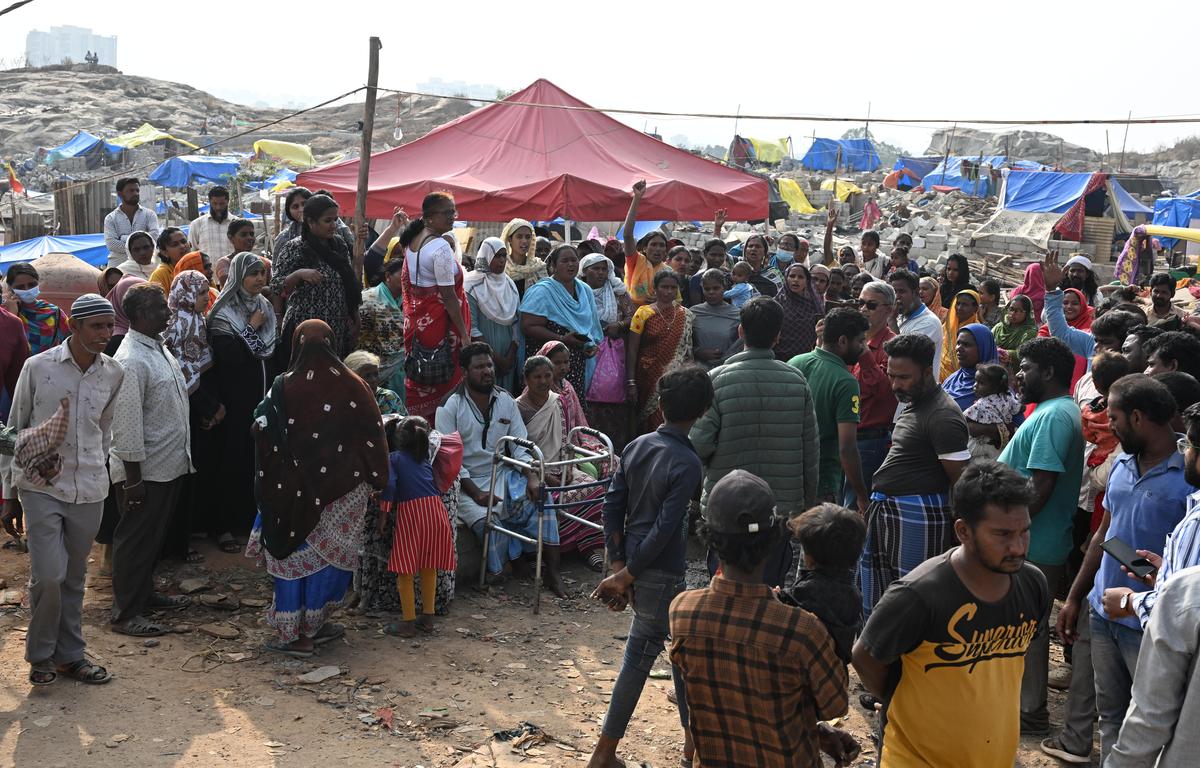
DISPUTED RECORDS AND THE QUESTION OF HABITATION
At the heart of the Kogilu dispute lies the question of evidence. The residents’ claim of 28 years of residence is based largely on oral histories, voter identification, and local familiarity, while the State relies on land records, building approvals, and survey data. The government told the court that revenue documents do not reflect lawful residential occupation over the claimed period and that the land was earmarked for public or developmental use.
State counsel argued that long-term residence cannot be presumed merely because people were present at the site at the time of demolition. They emphasised that the law distinguishes between authorised dwellings, long-standing regularised settlements, and recent encroachments. According to the submission, the Kogilu structures fell into the latter category, making them ineligible for protection or compensation.
The petitioners countered that formal documentation often fails to capture the lived reality of marginalised communities. Many residents, they argued, had lived in the area across generations without formal titles but with the tacit acceptance of local authorities. They claimed access to electricity, water connections, and voter registration as proof of sustained habitation. The demolition, they said, occurred without adequate rehabilitation planning, rendering families homeless overnight.
The High Court has shown concern over this gap between lived experience and official records. Judges have sought explanations on how habitation is verified in areas with informal housing and whether procedural fairness was ensured before demolition. While the State insists notices were served, petitioners argue they were either inadequate or ignored the social consequences of displacement.
Urban policy experts observing the case note that such disputes are increasingly common as cities expand into peri-urban zones. Informal settlements often exist for years without regularisation, creating a grey zone where residents feel secure until development projects intervene. When demolition follows, the absence of formal proof becomes a decisive disadvantage.
The Kogilu case thus raises a critical question: should longevity of occupation alone confer certain protections, or must legality always prevail? The State’s position clearly favours documentary legality, while the petitioners seek recognition of social reality. The court’s eventual interpretation will determine how similar conflicts are addressed in the future.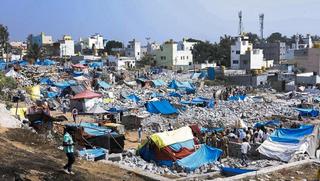
STATE AUTHORITY, DEMOLITION POWERS, AND DUE PROCESS
The Karnataka government’s assertion before the High Court also touches upon the broader issue of how demolition powers are exercised. Authorities argue that unchecked encroachments hinder planned development and strain public infrastructure. From this perspective, firm action, even if unpopular, is necessary to enforce land-use norms and protect public interest.
In its submission, the State maintained that the Kogilu demolition was not arbitrary but followed established procedures. Officials claimed that surveys were conducted, notices issued, and opportunities provided for residents to respond. The allegation that the action was sudden or unlawful, the government said, does not align with the administrative record.
However, critics question whether procedural compliance alone is sufficient in cases involving human habitation. Legal scholars point out that courts have increasingly emphasised proportionality and humane considerations, especially when demolitions affect vulnerable populations. Even if structures are unauthorised, they argue, authorities have a duty to consider rehabilitation and alternative arrangements.
The petitioners’ lawyers have urged the court to examine whether the demolition respected constitutional protections, including the right to life and dignity. They argue that displacement without meaningful rehabilitation violates these principles, regardless of the legality of construction. The State, on the other hand, warns that diluting enforcement could encourage encroachment and undermine urban planning.
This tension reflects a larger governance challenge. As cities grow, governments are under pressure to deliver infrastructure quickly, often encountering resistance from informal settlements along the way. Demolitions become flashpoints, attracting legal challenges and public criticism. The Kogilu case illustrates how such actions can escalate into constitutional disputes when residents contest the State’s narrative.
The High Court’s role, therefore, extends beyond fact-finding. It must balance the State’s authority to regulate land with the judiciary’s responsibility to protect fundamental rights. How the court weighs these competing interests will shape the contours of demolition jurisprudence in Karnataka.
IMPLICATIONS FOR URBAN RESIDENTS AND POLICY
The outcome of the Kogilu case is being closely watched by urban residents across Bengaluru and other rapidly expanding cities in Karnataka. Many informal settlement dwellers fear that the State’s firm stance could embolden authorities to dismiss long-standing habitation claims if they lack formal documentation. For them, the government’s submission signals a narrowing of protection for those living in legal grey zones.
Conversely, supporters of strict enforcement argue that recognising undocumented claims could open floodgates, complicating urban governance. They contend that clarity and consistency in applying land laws are essential for sustainable development. From this viewpoint, the State’s rejection of the 28-year claim is a necessary corrective against exaggerated or false assertions.
Policy analysts suggest that the controversy highlights the need for clearer frameworks to address informal housing. Regularisation schemes, transparent surveys, and updated land records could reduce conflicts by bringing settlements into the formal system before disputes arise. Without such measures, courts are left to adjudicate complex social issues on a case-by-case basis.
The case also underscores the importance of communication and trust between authorities and communities. Sudden demolitions, even if lawful, can breed resentment and resistance. Proactive engagement, rehabilitation planning, and phased implementation may help mitigate backlash and litigation.
For the petitioners, the immediate concern remains relief and recognition. The government’s statement that their claim is factually incorrect has placed them on the defensive, forcing them to substantiate their history of residence. Their struggle reflects the vulnerability of those whose lives unfold outside formal records.
A JUDICIAL TEST OF FACTS AND FAIRNESS
As the Karnataka High Court continues to hear arguments, the Kogilu dispute stands as a test of how facts are established and fairness is interpreted in urban displacement cases. The State’s categorical denial of the 28-year residence claim has sharpened the legal battle, shifting focus to evidence, timelines, and administrative conduct.
The court’s eventual ruling is expected to clarify the standards required to prove long-term habitation and the obligations of the State when demolishing residential structures. Whether oral histories and indirect indicators can supplement formal records will be a key question. Equally important will be the court’s view on rehabilitation duties in cases deemed factually incorrect by the government.
Beyond the courtroom, the case has stirred public reflection on the meaning of home and belonging in a rapidly changing city. For many, residence is defined not by papers but by years of life lived in a place. For the State, legality and planning imperatives often take precedence. Reconciling these perspectives is one of the most pressing challenges of urban governance.
Whatever the verdict, the Kogilu case will leave a lasting imprint on policy and jurisprudence in Karnataka. It serves as a reminder that development, when divorced from social sensitivity, can fracture trust. At the same time, it underscores the necessity of accurate records and lawful processes in managing urban growth.
As Bengaluru expands and similar disputes emerge, the balance struck in this case may guide future action. The High Court’s handling of the “factually incorrect” claim will not only decide the fate of the petitioners but also signal how the law views history, habitation, and the right to shelter in an evolving urban landscape.
Follow: Karnataka Government
Also read: Home | Channel 6 Network – Latest News, Breaking Updates: Politics, Business, Tech & More
