
More than 150 families were left homeless following a large-scale demolition drive carried out in Yelahanka on the outskirts of Bengaluru, triggering anguish, anger and urgent questions about rehabilitation and due process. Makeshift houses, small brick dwellings and temporary shelters were razed as part of an anti-encroachment operation, leaving hundreds of residents, including children, elderly persons and daily wage workers, scrambling for shelter amid the rubble of what once were their homes.
Residents and activists have emphasised that displacement without rehabilitation can have cascading effects on mental health and community cohesion. Families report heightened stress, anxiety and uncertainty, with children displaying signs of trauma from sudden disruption of their routines. Social networks that once provided support during crises have been fractured, leaving vulnerable individuals, especially single parents and the elderly, without assistance. Experts warn that prolonged neglect of such psychosocial impacts can exacerbate long-term hardships for already marginalised communities.
The demolition has also drawn criticism for its timing and execution. Several residents noted that the drive coincided with winter months, exposing families to cold nights and inadequate shelter. Human rights advocates argue that authorities must consider environmental and seasonal factors when planning such operations, and that eviction schedules should prioritise safety and minimum disruption to daily life.
Local political leaders and opposition parties have called for accountability and transparency in the process. They demanded that officials provide a clear list of affected families, outline eligibility for compensation, and ensure immediate access to temporary housing. They also urged the administration to engage directly with residents to plan sustainable rehabilitation rather than relying solely on notices and enforcement actions.
As the dust settles over Yelahanka, the urgent need for a balanced approach to urban governance is evident. Experts stress that city planning must integrate affordable housing, legal pathways for low-income settlements, and proactive rehabilitation measures to prevent such crises. Without these, the cycle of informal settlement, eviction, and displacement is likely to continue, leaving countless families in limbo while the city’s growth proceeds unabated.
The demolition, carried out by civic and revenue authorities with police support, began early in the day and continued for several hours. Officials stated that the structures were illegal encroachments on government land and that the action was necessary to reclaim public property. However, residents alleged that they were not given adequate notice or alternative arrangements, turning the operation into a humanitarian crisis overnight.
As bulldozers moved in, families rushed to salvage whatever belongings they could. Clothes, utensils, schoolbooks and identity documents lay scattered across the site. Many residents broke down as they watched their homes collapse, saying years of savings and labour were wiped out in a matter of minutes. For several families, the demolished structures represented not just shelter but a sense of stability built over decades.
Local residents said the settlement housed construction workers, domestic workers, street vendors and migrant labourers who contribute significantly to the city’s informal economy. “We clean the city, build its houses, work in its homes. Today, the city has thrown us out,” said one resident, sitting amid debris with her children.
Authorities maintained that the drive was conducted following legal procedures and that notices had been issued earlier. They said encroachments had been identified after surveys and that repeated warnings were ignored. However, residents contested these claims, stating that many families never received written notices and were unaware of the exact date of demolition.
The sudden displacement has raised concerns about the absence of immediate rehabilitation measures. With no temporary shelters provided, several families spent the night in the open or sought refuge with relatives and neighbours. Children missed school, elderly persons struggled without medicines, and working adults lost daily wages as survival took precedence over employment.
Displacement, Due Process and Human Cost
The demolition has once again highlighted the complex and often contentious issue of urban evictions in rapidly expanding cities like Bengaluru. As land values rise and infrastructure projects accelerate, informal settlements frequently find themselves in the crosshairs of development and regulation. While authorities argue that encroachments hinder planned growth, the human cost of abrupt evictions remains a pressing concern.
Residents of the demolished settlement claimed that many of them possessed documents such as ration cards, voter IDs and Aadhaar cards registered at the same address, which they believed legitimised their residence. Some said they had been paying electricity bills and local levies for years, reinforcing their belief that their settlement had been informally regularised.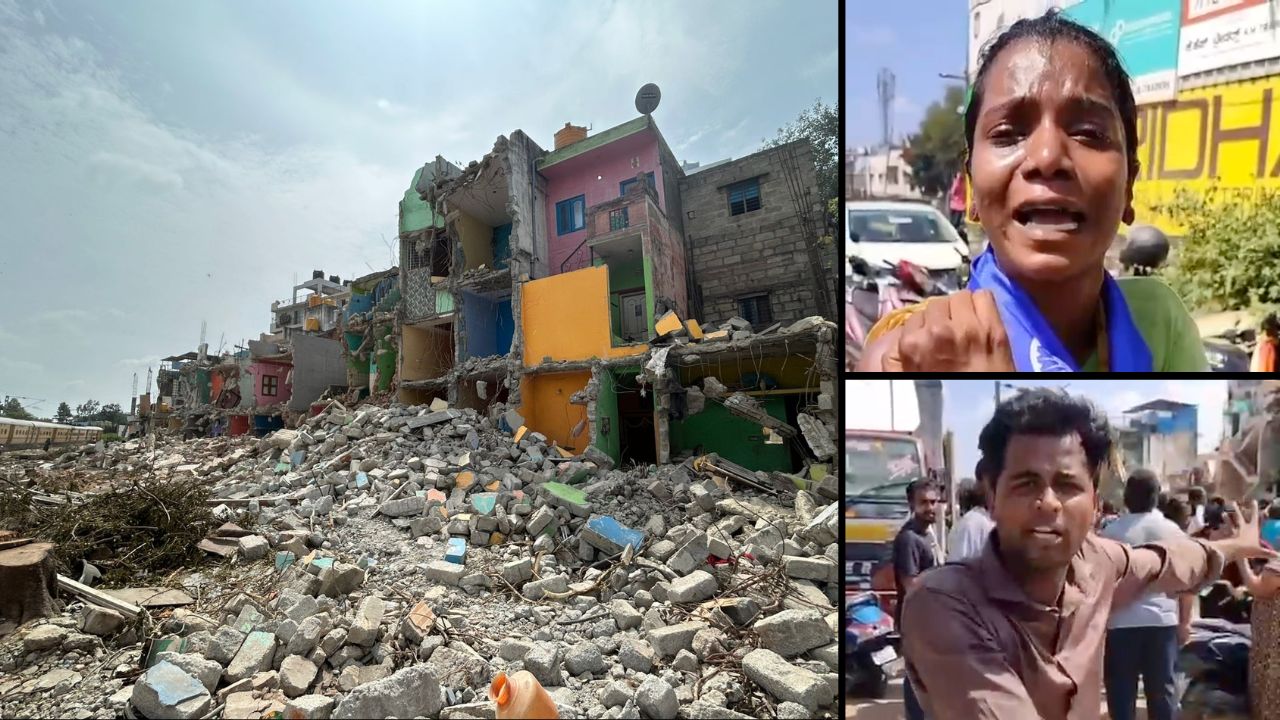
Legal experts point out that possession of identity documents does not confer land ownership, but they also emphasise that eviction processes must adhere strictly to principles of natural justice. This includes clear notice, adequate time to respond and, in many cases, rehabilitation for economically weaker sections. The absence of visible resettlement arrangements in Yelahanka has therefore drawn criticism from rights groups.
Children were among the worst affected. With their homes demolished, many lost school uniforms, textbooks and certificates. Parents expressed fear that prolonged displacement could disrupt education permanently, especially for first-generation learners. Teachers from nearby government schools said several students did not turn up after the demolition, and some families had informed them that they might move out of the area altogether.
Women residents spoke of heightened vulnerability following the eviction. Without secure shelter, concerns about safety, sanitation and privacy have become acute. Pregnant women and new mothers said access to healthcare had become uncertain, while elderly residents worried about exposure to cold nights and lack of medical support.
Activists working with urban poor communities said the Yelahanka demolition reflects a broader pattern where enforcement actions prioritise land clearance over human rehabilitation. They argued that while removing encroachments may be legally justified, it must be accompanied by humane and well-planned relocation measures. “Eviction without rehabilitation is not governance, it is abandonment,” said one activist.
Officials, however, defended the action, stating that encroachments cannot be allowed to continue indefinitely. They said public land is meant for infrastructure, public utilities and environmental protection, and illegal occupation deprives the larger population of these benefits. Some officials also claimed that certain residents had moved in recently, anticipating eventual compensation or alternative housing.
The contradiction between official narratives and residents’ accounts has fueled demands for an independent inquiry. Opposition leaders visited the site and accused the authorities of acting insensitively. They demanded immediate temporary shelters, food assistance and a comprehensive rehabilitation plan, warning that failure to act would deepen social distress.
Urban Growth, Inequality and the Search for Solutions
The Yelahanka demolition has reopened a larger debate about urban planning and inequality in Bengaluru. As the city expands outward, low-income workers often settle on unused land close to employment hubs due to the absence of affordable housing. Over time, these settlements become integral to the city’s functioning, even as they remain legally precarious.
Urban planners argue that the recurring cycle of informal settlement, demolition and displacement reflects a systemic failure to provide inclusive housing solutions. They note that while Bengaluru attracts investment and high-income residents, housing policies for the urban poor lag far behind demand. Without viable alternatives, informal settlements become the only option for thousands of families.
Economists point out that forced evictions also carry economic costs. Displaced workers lose productivity, children drop out of school and health outcomes worsen, creating long-term social burdens. “When you displace a workforce without rehabilitation, the city eventually pays the price,” said an expert, adding that humane urban policy is also sound economic policy.
In the aftermath of the demolition, civil society organisations have stepped in to provide immediate relief. Volunteers distributed food, drinking water and basic supplies to affected families. Some groups are assisting residents in documenting losses and exploring legal options. However, activists stress that charity cannot replace State responsibility.
Residents are now demanding clear answers from the administration. They want temporary shelters, access to basic amenities and a timeline for permanent rehabilitation. Many say they are willing to relocate if provided with affordable housing and reasonable proximity to their workplaces. What they oppose, they insist, is being rendered homeless without warning or support.
The administration has indicated that it will review the situation and consider relief measures for eligible families. Officials said surveys would be conducted to identify long-term residents and assess possible rehabilitation options. However, past experiences have made residents sceptical of such assurances, fearing prolonged delays and bureaucratic hurdles.
Legal challenges are also being considered. Lawyers assisting the residents said they may approach the courts, arguing that the demolition violated procedural safeguards and constitutional rights to life and shelter. Courts in previous cases have emphasised the need for humane treatment of slum dwellers, even when evictions are legally sanctioned.
As night falls over the cleared land in Yelahanka, the silence is heavy with uncertainty. For the families affected, the demolition is not merely an administrative action but a life-altering rupture. Their immediate concern is survival, but their larger struggle is for recognition, dignity and a place in the city they help sustain.
The episode serves as a stark reminder that urban development cannot be divorced from social justice. Bulldozers may clear land in a day, but the consequences of displacement linger for years. Whether the Yelahanka demolition becomes another forgotten eviction or a turning point towards more compassionate urban governance will depend on how authorities respond to the human crisis unfolding in its wake.
Follow: Karnataka Government
Also read: Home | Channel 6 Network – Latest News, Breaking Updates: Politics, Business, Tech & More
