
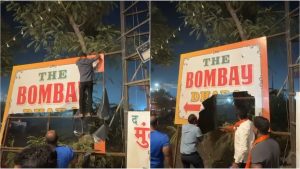
A controversy over the naming of a roadside eatery erupted on Thursday when Maharashtra Navnirman Sena (MNS) activists tore down the signboard of a popular roadside restaurant called “Bombay Dhaba” in Bhiwandi, citing objections to the use of the old city name Bombay instead of Mumbai. The incident, which occurred on the Mumbai–Nashik Highway near the Thane–Bhiwandi border, was triggered after MNS chief Raj Thackeray noticed the sign while travelling and directed party workers to take action.
The dramatic move has sparked a sharp debate about regional identity, cultural pride and political mobilisation as municipal elections draw closer across Maharashtra. Party activists, defending their action, argue that continued use of Bombay undermines Marathi heritage and the official identity of the city and state.
MNS Takes Issue with ‘Bombay’ Signboard
According to eyewitness accounts and party workers at the scene, Raj Thackeray was returning from an election campaign tour when he noticed the “Bombay Dhaba” signboard. Annoyed by the use of the city’s colonial-era name, he allegedly instructed MNS workers to remove the sign. Within minutes, activists gathered at the location, tore down the illuminated board and instructed the restaurant owner to change the name to reflect Mumbai’s official identity within eight days.
The restaurant owner, who was present during the incident, reportedly agreed to the demand and assured party workers that he would comply with the request within the stipulated time.
MNS workers said that the action was not aimed at the establishment itself but was a symbolic assertion of Marathi pride and cultural respect. They argued that retaining Bombay in business names goes against the constitutional and civic identity recognised by the state and should be phased out.
Political Context and Rising Sensitivities
The Bombay Dhaba row has emerged at a politically sensitive time. Across Maharashtra, local body polls and municipal elections are underway, and political parties are increasingly focusing on regional identity and cultural symbolism as part of their campaign narratives.
For Raj Thackeray and the MNS, emphasising Marathi identity has long been a core element of their political brand. The party has historically taken strong stances on language and culture, advocating that Marathi be given prominence in public signage, government communication, and popular usage. This episode, critics claim, reflects an intensification of that stance amid competition for voters who prioritise regional pride.
Opposition parties and political commentators, however, argue that such actions risk alienating business owners and citizens who may view the incident as an overreach or unnecessary provocation. These critics suggest that focusing on cultural symbolism may detract from pressing governance issues such as infrastructure, employment and urban services, which are key concerns for many residents.
Nevertheless, supporters of Raj Thackeray say that symbolic acts reinforce values that matter deeply to a large section of Maharashtra’s electorate. They argue that names, language and public signage are not trivial matters but are tied to a sense of belonging and respect for local heritage.
MNS Response and Public Statements
Following the incident, several MNS officials issued statements defending the action. They emphasised that the party is committed to preserving Maharashtra’s identity and ensuring that public spaces reflect the official names and heritage of the state. The activists reiterated that the restaurant owner was cooperative and promised to comply, showing that there was no intent to harm the business.
In statements to local media, MNS representatives said that such actions are part of a broader cultural movement to ensure that Marathi identity, language and history are respected in public life. They also said that the party will continue to campaign on issues of cultural pride ahead of the election season, urging citizens to support candidates who uphold Maharashtra’s traditions.
Local Reactions and Diverse Views
Reactions among local residents have been mixed. Some passersby and customers at nearby shops said they supported the move, emphasising the importance of respecting local identity and the official name Mumbai that replaced Bombay decades ago. They noted that many people, especially from outside Maharashtra, still refer to the city using the old name despite repeated shifts in official usage.
Others, however, expressed concern that the incident could set a precedent for unnecessary interference in small businesses. Some local business owners, while understanding the sentiment, said they worry such actions could discourage tourism or economic activity if not handled sensitively.
Political analysts also warn that while cultural assertion can energise a party’s base, it may also polarise voters who prioritise economic and civic issues. They suggest that balancing cultural concerns with practical governance challenges will be critical for parties seeking broader electoral support.
Historical and Cultural Background
The name Bombay has long been a subject of political and cultural debate. Originally given during the colonial era, Bombay was officially renamed Mumbai in 1995 by the state government to reflect local Marathi identity and heritage. The change was championed by pro-Marathi organisations and has since been widely adopted in official contexts.
However, many people still use Bombay informally, especially in popular culture and business branding. While some view this as a nostalgic reference, others see it as resistance to change or a reluctance to embrace Marathi identity fully.
The latest action by the MNS brings that debate back into the spotlight, raising questions about how language, history and identity intersect with politics in modern-day Maharashtra.
Impact on Upcoming Elections
With municipal elections and local body polls approaching, the Bombay Dhaba controversy is likely to become a talking point among voters. Parties may use the incident to reinforce broader narratives about cultural respect, administrative priorities and political leadership.
For Raj Thackeray and the MNS, the episode reinforces their longstanding focus on Marathi language and cultural identity — themes that have historically resonated with a segment of the electorate. Despite criticism from some quarters, MNS leaders are expected to continue emphasising these issues as part of their campaign strategy.
Meanwhile, other political parties might seek to counter by highlighting governance issues and development agendas, urging voters to focus on tangible civic problems rather than symbolic debates.
Read More: https://channel6network.com/bjp-maharashtra-repackaged-expired-product/
