
In a significant boost to public education and future-ready learning, Nasscom Foundation, in collaboration with Applied Materials, has launched a comprehensive STEM training programme for students and teachers in State-run schools across Malur taluk in Kolar district. The initiative aims to strengthen science, technology, engineering, and mathematics education at the grassroots level, with a focus on experiential learning, teacher capacity-building, and equitable access to quality resources. Education officials describe the programme as a critical intervention at a time when government schools are seeking to bridge learning gaps and prepare students for a rapidly evolving digital economy.
The programme will cover multiple government high schools and pre-university colleges in Malur, targeting students from Classes 6 to 12. According to organisers, the initiative is designed not merely as a short-term training module but as a structured, multi-year engagement that integrates STEM concepts into everyday classroom teaching. The collaboration brings together Nasscom Foundation’s experience in education and digital inclusion with Applied Materials’ expertise in advanced technology and engineering.
Officials involved in the rollout said the programme responds to long-standing concerns about uneven access to quality STEM education in semi-urban and rural areas. While private schools in urban centres increasingly offer robotics, coding, and advanced laboratory exposure, government school students often rely on outdated curricula and limited infrastructure. This initiative seeks to narrow that gap by introducing hands-on learning, problem-solving approaches, and real-world applications of scientific concepts.
At the heart of the programme is a dual focus on students and teachers. While students will receive structured training in core STEM areas, teachers will undergo intensive upskilling to ensure sustainability beyond the project period. Education department officials stressed that empowering teachers is key to ensuring that the benefits of such initiatives extend to future batches of students as well.
Representatives from Nasscom Foundation said the Malur programme aligns with their broader mission of fostering digital literacy, employability, and innovation among underserved communities. By focusing on government schools, the initiative aims to reach first-generation learners who may not otherwise have exposure to advanced STEM education. The Foundation believes that early exposure can spark curiosity, confidence, and aspiration among students.
Applied Materials officials highlighted that the partnership reflects the company’s commitment to inclusive growth and long-term community development. They said that investing in education, particularly STEM education, is essential for building a skilled workforce that can contribute to India’s technological and manufacturing ambitions. Malur, they noted, represents a microcosm of the challenges and opportunities present in semi-urban India.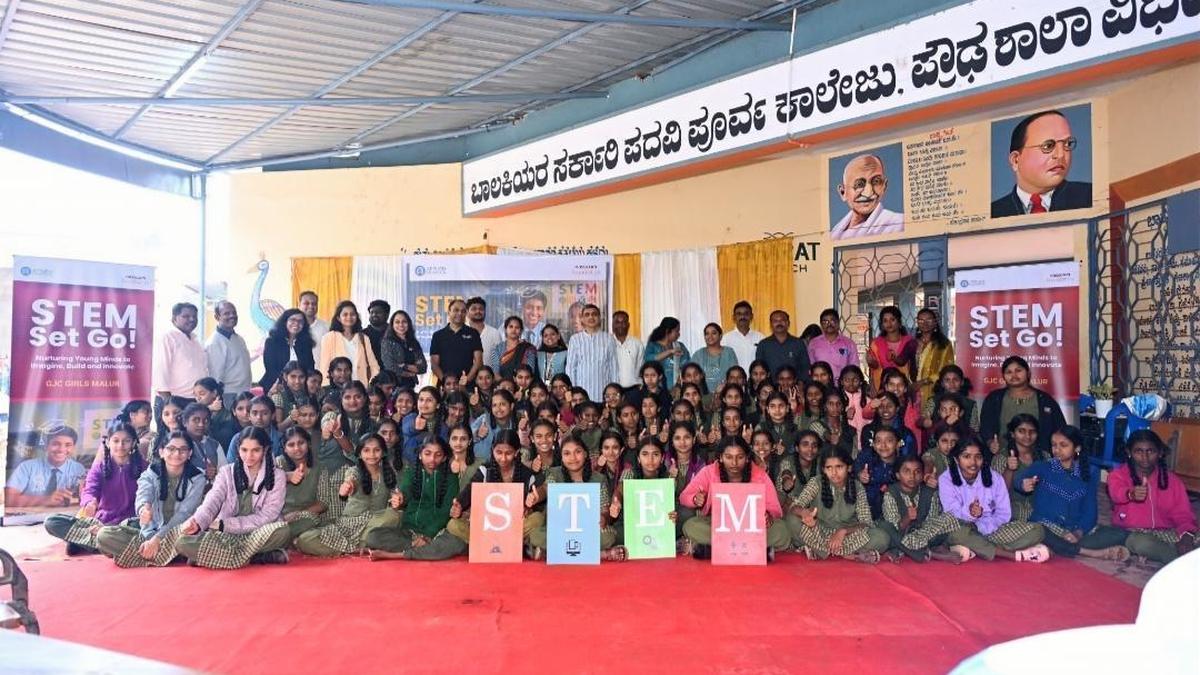
Inside the Programme: Curriculum, Teachers, and Learning Spaces
The STEM training programme includes modules on basic coding, scientific inquiry, mathematics applications, and foundational engineering concepts. Students will engage in project-based learning, where they are encouraged to identify problems in their surroundings and develop simple technological or scientific solutions. This approach, educators say, helps demystify STEM subjects and makes learning more relatable and engaging.
Laboratory enhancement forms another key component of the initiative. Selected schools will receive equipment and learning kits designed to support practical experiments and demonstrations. These resources aim to move beyond rote learning and enable students to observe, test, and question scientific principles actively. Teachers say such facilities can significantly improve comprehension and retention.
Teacher training sessions will focus on modern pedagogical methods, including inquiry-based learning, classroom technology integration, and assessment techniques that prioritise understanding over memorisation. Many government school teachers, particularly in rural areas, have limited opportunities for professional development. The programme seeks to address this gap by offering structured workshops and continuous mentoring.
Education officials involved in the programme emphasised that teachers are not being treated merely as recipients of training but as partners in curriculum adaptation. Their feedback will be used to tailor modules to local contexts, ensuring that lessons are aligned with students’ linguistic, cultural, and academic realities. This collaborative approach, they said, increases the likelihood of meaningful impact.
The initiative also includes periodic evaluations to track student progress and teacher effectiveness. Data collected through assessments and classroom observations will be used to refine the programme over time. Organisers believe that evidence-based adjustments are essential to avoid one-size-fits-all interventions that fail to address local needs.
Students participating in pilot sessions have reportedly responded positively, particularly to hands-on activities that allow them to build, experiment, and collaborate. Teachers say that such engagement is often missing in traditional classrooms, where large class sizes and rigid syllabi limit interactive learning.
Bridging Gaps in Public Education
The Malur STEM initiative comes against the backdrop of broader concerns about learning outcomes in government schools. Studies and assessments have repeatedly highlighted gaps in conceptual understanding, particularly in mathematics and science. While enrolment rates have improved, quality of learning remains uneven, prompting calls for targeted interventions.
Officials from the Department of School Education said partnerships with credible organisations can help address systemic limitations without replacing the role of the State. By leveraging external expertise and resources, government schools can experiment with innovative models that may later be scaled up through public funding.
Parents in Malur have welcomed the programme, viewing it as an opportunity for their children to access skills typically associated with private education. For many families, especially those dependent on agriculture or informal labour, such exposure is seen as a pathway to better career prospects and social mobility.
Educationists caution, however, that short-term enthusiasm must be matched by long-term commitment. Sustained funding, continuous teacher support, and alignment with State curricula are necessary to ensure that gains are not lost once external partners exit. Organisers have acknowledged this concern and said the programme has been designed with scalability and continuity in mind./dq/media/media_files/2025/12/15/nasscom-2025-12-15-16-27-20.png)
Civil society observers note that Malur’s selection is significant. Located close to Bengaluru yet marked by rural characteristics, the region reflects the transitional nature of many parts of Karnataka. Interventions here, they argue, can offer valuable lessons for similar regions grappling with educational inequality.
The initiative also aligns with national priorities around STEM education and skill development. Policymakers have increasingly emphasised the need to strengthen science and technology education to support economic growth and innovation. Programmes like this, experts say, can complement government efforts by addressing local implementation challenges.
Teachers at the Centre of Change
Teachers participating in the training have described it as both challenging and energising. Many admit that they initially felt apprehensive about concepts such as coding or digital tools, particularly those who have taught for decades using traditional methods. However, hands-on workshops and peer learning have helped build confidence.
Senior educators note that teacher mindset plays a crucial role in the success of such initiatives. When teachers view STEM as accessible rather than intimidating, students are more likely to engage positively. The programme’s emphasis on continuous mentoring aims to reinforce this shift in attitude.
Some teachers have highlighted the importance of language-sensitive instruction. In government schools where Kannada is the primary medium, introducing STEM concepts requires careful translation and contextualisation. Trainers have reportedly worked closely with teachers to ensure that technical terms are explained clearly without alienating students.
Education officials say the programme also encourages interdisciplinary teaching, where science, mathematics, and technology are connected rather than treated as isolated subjects. This approach mirrors real-world problem-solving and helps students see the relevance of what they learn.
Looking Ahead: Aspirations and Accountability
Nasscom Foundation and Applied Materials have indicated that the Malur initiative will be closely monitored, with the possibility of expansion to other regions based on outcomes. Success, they say, will be measured not only by test scores but by changes in student confidence, curiosity, and aspirations.
There is also an emphasis on inclusivity, with efforts to ensure that girls and students from marginalised backgrounds participate fully. Organisers acknowledge that gender gaps persist in STEM fields and say early intervention in government schools is essential to address this imbalance.
Education department officials have expressed hope that such collaborations will inspire more public-private partnerships focused on quality rather than mere infrastructure. While classrooms and buildings are important, they argue, true transformation lies in pedagogy, teacher empowerment, and student engagement.
Critics caution against over-reliance on corporate-led initiatives, stressing the need for strong public investment and accountability. They argue that while partnerships can be valuable, the State must retain leadership in setting priorities and ensuring equitable access across regions.
As the programme unfolds, students in Malur are beginning to experience a different kind of classroom, one that encourages questions, experimentation, and imagination. For many, this exposure may be their first encounter with the idea that science and technology are not distant or abstract, but tools they can use to understand and shape the world around them.
In the long run, the success of the initiative will depend on how deeply it becomes embedded in everyday school life. If teachers continue to apply new methods, if students retain their curiosity, and if institutions commit to sustained support, the partnership could leave a lasting imprint.
For now, the collaboration between Nasscom Foundation and Applied Materials represents a hopeful step toward more equitable education. In classrooms across Malur, chalkboards are beginning to share space with experiments, ideas, and aspirations, signalling a quiet but meaningful shift in how young minds are being prepared for the future.
Follow: Karnataka Government
Also read: Home | Channel 6 Network – Latest News, Breaking Updates: Politics, Business, Tech & More
