
Tiruchy City to a Halt Following Peak Hour Awareness Rally
Tiruchy city to a halt was the situation faced by thousands of commuters on Tuesday morning after a road safety awareness rally organised by the city police caused severe traffic congestion at one of the busiest junctions in the city. What was planned as an educational event under Road Safety Month turned into a major inconvenience for office-goers, school students, patients, and daily commuters who were caught in long vehicle queues for nearly an hour.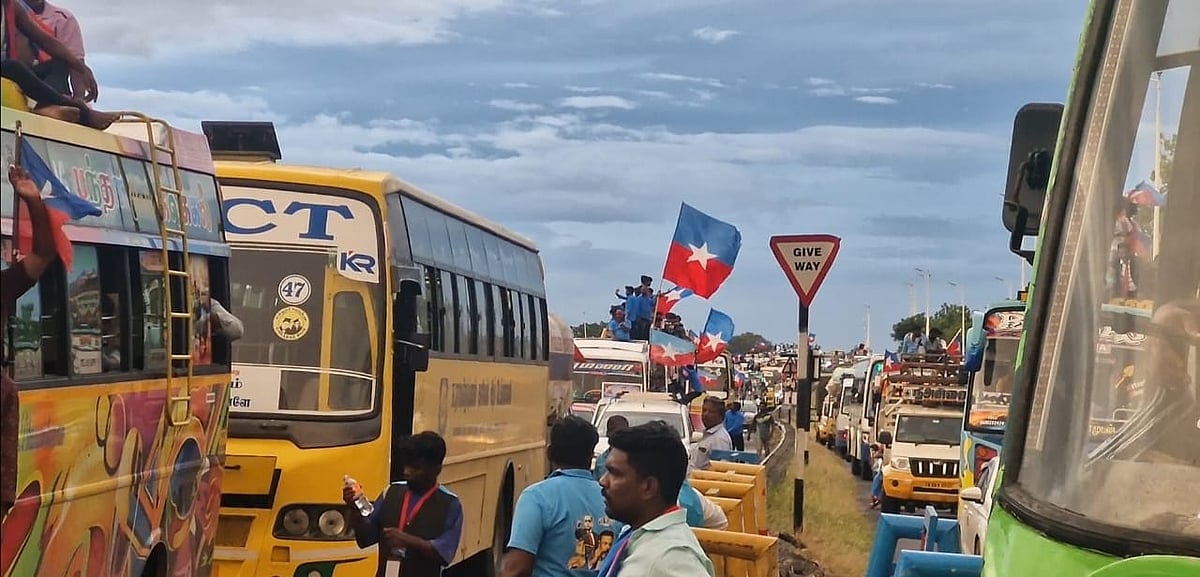
The rally was conducted near the MGR statue roundabout, a crucial traffic point that connects several important roads leading to government offices, hospitals, courts, bus stands, and residential areas. Due to its location and constant vehicle movement, the junction already experiences heavy congestion during morning peak hours. The decision to hold a large public rally at this time led to widespread criticism from the public.
Tiruchy City to a Halt at MGR Statue Junction During Peak Hours
The MGR statue roundabout plays a vital role in Tiruchy’s traffic network. Roads from the district collectorate, government hospital, court complex, old central bus stand, Chathiram bus stand, and nearby residential zones all converge at this point. Several schools, temples, and medical facilities are also located close by, making uninterrupted traffic flow essential, especially in the morning.
On Tuesday, around 1,200 students were brought to the junction along with police personnel as part of the awareness rally. Roads near the roundabout were blocked well before the rally began, and traffic restrictions were put in place from around 9 am. The rally officially started at 10 am, but congestion had already built up much earlier.
Vehicles moving through EVR Road, Bharathidasan Road, Students’ Road, and Major Saravanan Road were forced to slow down or stop completely. Commuters reported being stuck for long durations, with some taking nearly double their usual travel time. School buses, ambulances, and government staff vehicles were also affected.
Many office-goers said they reached their workplaces late despite leaving home on time. Parents accompanying children to schools faced stress as buses and private vehicles remained stationary for extended periods. Patients travelling to hospitals nearby experienced delays, raising concerns about emergency access during such events.
Tiruchy City to a Halt Raises Questions on Planning and Crowd Management
The rally was flagged off by the city’s top police official and concluded near the head post office. While the intention was to spread awareness about road safety and helmet usage, the execution drew criticism. Citizens questioned why such an event was scheduled during peak office and school hours at a highly congested location.
Several commuters expressed frustration, stating that Tiruchy frequently faces traffic problems due to rallies, protests, and public programmes. Many felt that a police-organised event should have set an example in planning and traffic coordination rather than adding to the problem.
A few residents pointed out that road safety awareness loses its meaning when it creates unsafe and stressful road conditions. Long queues, honking vehicles, and stranded pedestrians reflected poor crowd and traffic management, according to locals.
Police officials defended the timing, stating that students could not be brought earlier in the morning or later in the day due to school schedules. They maintained that the disruption was temporary and unavoidable. However, this explanation did little to satisfy commuters who bore the brunt of the disruption.
Urban planners and civic observers have long argued that awareness programmes should be held in open grounds, auditoriums, or less congested areas. Using major junctions during rush hours, they say, reflects a lack of coordination between public safety goals and everyday city functioning. Also Read: India UAE Defence Partnership: Modi and MBZ Strengthen Bilateral Ties
Conclusion
The incident where Tiruchy city to a halt became a reality has once again highlighted the need for better planning of public events. While road safety awareness is important, poor execution during peak hours at critical junctions defeats the purpose and inconveniences the public. The episode has sparked a wider discussion on how authorities can balance awareness initiatives with the daily needs of a growing city.
