
Introduction: Unusual Water Surge at Lonar Lake
Water levels at Lonar Lake, a unique geological feature in Maharashtra’s Buldhana district formed by a meteorite impact thousands of years ago, have risen dramatically in recent months. Officials and experts report that the increase, believed to be between 15 to 20 feet compared to previous levels, has raised alarms among environmentalists, heritage conservationists and local communities alike. This unexpected rise in water has led to widespread concerns about the lake’s ecological health, submergence of historical structures, and potential long-term environmental impact.
What Is Lonar Lake and Why It Matters
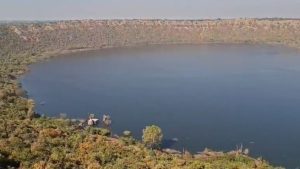
Lonar Lake is one of the few impact craters in basaltic rock on Earth, created when a meteorite struck the Deccan Plateau. The lake has a mean diameter of about 1.83 kilometres and lies within a volcanic basalt field that dates back millions of years. Its saline and alkaline waters make it ecologically distinct from many other freshwater lakes, and its geological origin has made it a subject of scientific research and tourism. The area also forms part of the Lonar Wildlife Sanctuary, a protected zone that supports a range of flora and fauna adapted to the lake’s unique environment.
The lake’s standing water and the surrounding forest create an environment that supports various species unique to this region, making it a focal point for both ecological studies and biodiversity conservation efforts.
Extent of the Water Rise
Local observations and official reports suggest that the water level at Lonar Lake has been rising steadily since around September of last year. Continuous inflow from at least four perennial springs around the lake rim is believed to be the primary reason for this increase. Experts say that the water level has increased by about 15 to 20 feet over this period, a significant rise for a naturally enclosed water body with no natural outlet.
This substantial increase in water level has already inundated several historically important structures on the lake’s perimeter, posing real threats to local cultural heritage. Among the submerged structures is the Kamalja Devi Temple, a centuries-old shrine that now has water entering its sanctum sanctorum. The Deepstambh, a traditional lamp tower situated before the temple, now stands half submerged, indicating just how profound the changes to the lake’s water level have become.
Court Orders Public Interest Litigation
The Nagpur Bench of the Bombay High Court has taken notice of the situation and ordered the filing of a Public Interest Litigation (PIL) to further investigate the causes and the risks involved. The court has expressed serious concern about the rapid rise in water level and its potential effects on the lake’s unique ecology, heritage structures, and surrounding environment. A bench consisting of Justice Anil Kilor and Justice Raj Wakode has asked for a detailed PIL to be submitted within the next seven days, demonstrating the urgency of addressing this environmental challenge.
To assist the court, Advocate Mohit Khajanchi has been appointed as Amicus Curiae — a friend of the court — to help prepare the litigation document and present a comprehensive case on the rising water level, its impacts, and necessary remedial measures.
Expert Observations and Scientific Inquiries
Initial inspections ordered by state authorities involved groundwater experts and local administrative officials. Professor Ashok Tejankar and Tehsildar Bhushan Patil were among those who examined the lake to gather data and observe current conditions. While the exact scientific reasons behind the water surge remain unclear, experts have stressed the need for deeper research to understand both hydrological and environmental factors at play.
Environmentalists are voicing concern that continued freshwater inflow from springs into a saline, alkaline water body could alter the lake’s natural chemistry. Lonar Lake is known for its high salinity, and mixing with freshwater could disrupt the ecological balance that supports its specialized biodiversity. The appearance of fish, which have not historically been characteristic of the lake’s fauna due to its saline nature, has been noted by observers and suggested as a sign of ecological changes.
Threats to Cultural and Natural Heritage
The rapid rise in water levels poses clear threats not only to the lake’s ecological structure but also to the cultural and heritage sites situated along its banks. The submergence of ancient temples and sacred sites has alarmed historians, archaeologists, and local devotees alike, who fear that prolonged inundation may lead to irreversible damage. Such temples are part of the cultural landscape that has coexisted with the lake for generations.
The high court’s intervention reflects the multi-faceted nature of the problem, involving environmental science, heritage conservation, and community interests. Authorities are now seeking expert opinions and empirical data that could guide remediation and conservation strategies without compromising the geological uniqueness of this impact crater.
Local and Scientific Community Responses
Local residents and researchers have expressed mixed reactions to the situation. Some believe that the rising waters could be linked to altered rainfall patterns or increased groundwater discharge from surrounding springs. Others point to longer-term changes in regional climate or hydrology as contributing factors. There is also concern that the absence of a natural outlet for Lonar Lake means that any increase in inflow will inevitably raise water levels until evaporation or seepage balances the input.
Meanwhile, scientists have called for comprehensive field studies and data collection to understand not only why the water level is rising but also how this might influence the long-term sustainability of the lake’s unique saline ecosystem. The challenge, they say, is to balance conservation priorities with natural geological and hydrological processes
Looking Ahead: Conservation and Monitoring
As the water level in Lonar Lake continues to be monitored, authorities have been urged to adopt a multidimensional approach that includes scientific research, environmental protection, cultural heritage preservation, and community engagement. The high court’s directive to compile a thorough PIL is expected to bring together data and recommendations from various experts, potentially establishing a roadmap for sustainable management.
Lonar Lake’s status as a national geo-heritage monument and a site of global scientific interest underscores the need for coordinated action to protect this remarkable landscape. The rise in water level highlights how even ancient natural wonders are susceptible to changing environmental conditions and human-influenced hydrological dynamics.
Read More: https://channel6network.com/mahayuti-to-secure-mayor-posts/
