Wednesday, May 6, 2026
Home Blog Page 249

Humayun Kabir Kingmaker Claim in 2026 Bengal Elections

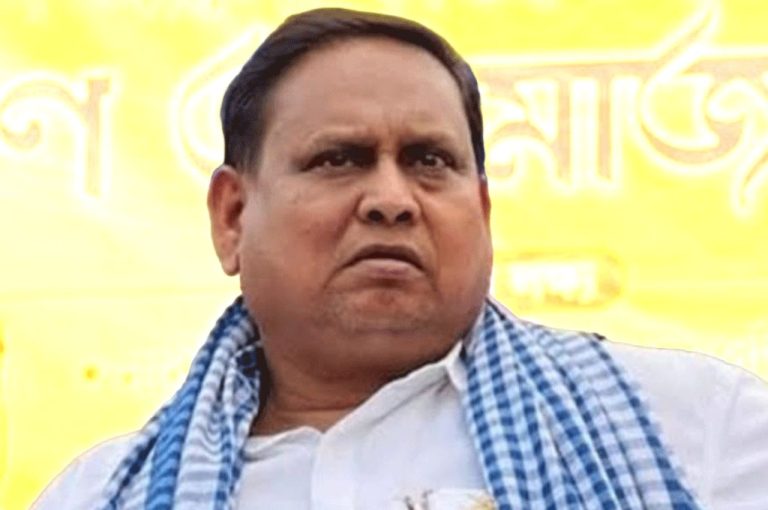
Humayun Kabir Kingmaker Claim: Suspended Trinamool Congress (TMC) MLA Humayun Kabir has made headlines by declaring that he will emerge as a “kingmaker” in the 2026 West Bengal Assembly elections. His bold claim—that no party will cross the majority mark and that his new political outfit will hold the balance of power—has sparked debate across Bengal’s political landscape. This essay explores Kabir’s statement, the context of his suspension, the electoral math, and the broader implications for democracy in West Bengal.


Kabir’s Kingmaker Assertion

Kabir announced that he would contest 135 seats under a new party to be formally launched on December 22 at Berhampore. He argued that neither the ruling TMC nor the BJP would cross the 148‑seat majority threshold in the 294‑member assembly, making his support indispensable for government formation.

This is a striking claim, especially given his suspension from TMC for defying party discipline and his controversial involvement in laying the foundation of a mosque modeled on the Babri Masjid in Murshidabad.

For official electoral references:


Humayun Kabir Kingmaker Claim: Political Context

Kabir’s suspension reflects the internal tensions within TMC, which has faced challenges from both BJP and Left‑Congress alliances. His decision to remain an MLA despite suspension suggests he intends to leverage his legislative position while building his new party.

He hinted at alliances with Congress and CPI(M), with CPI(M) leader Mohammed Salim reportedly taking responsibility for talks. However, AIMIM rejected any alliance, calling Kabir’s overtures “politically suspect.”


Electoral Math and Strategy

Kabir’s estimate that no party will cross 148 seats is based on the assumption of a fragmented mandate. His strategy appears to be:

  • Contesting in Murshidabad and other districts where he has influence.
  • Seeking seat‑sharing arrangements with Congress and Left parties.
  • Positioning himself as a broker of alliances in a hung assembly.

For official references on assembly composition:


Human Cost and Governance Concerns

Kabir’s rise also highlights the human cost of political instability:

  • Citizens face uncertainty about governance.
  • Farmers and workers are caught in bureaucratic processes like Special Intensive Revision (SIR) of electoral rolls.
  • Block Level Officers (BLOs) face immense stress during voter verification.

For BLO responsibilities:


Border Security and Selective Application of SIR

Kabir questioned why SIR is being conducted in Bengal, Assam, and Kerala but not in other border states. He argued that border protection is the responsibility of central forces like BSF and ITBP, not state‑level voter verification drives.

Government references:


Technology and Transparency Issues

Kabir raised concerns about the AI app used to identify duplicate voters, questioning its origin, data sources, and transparency. This reflects broader anxieties about the use of technology in democratic processes without clear accountability.

For IT governance:


TMC’s Response

TMC leaders dismissed Kabir’s claims as “daydreaming”. State general secretary Arup Chakraborty mocked him, saying he should focus on saving his security deposit rather than imagining himself as a kingmaker.

This response underscores TMC’s confidence in its electoral strength and its attempt to downplay Kabir’s challenge.


Broader Implications for Democracy

Kabir’s announcement raises important questions:

  • Can suspended leaders realistically build new parties that influence state politics?
  • How does selective application of electoral processes affect public trust?
  • What safeguards exist to ensure transparency in voter verification and technology use?

Relevant constitutional reference:


Conclusion

Humayun Kabir’s claim of becoming a kingmaker in 2026 reflects both ambition and political calculation. While his suspension and controversies cast doubt on his credibility, his strategy of contesting 135 seats and seeking alliances could disrupt Bengal’s electoral balance.

Ultimately, the incident highlights the need for transparent electoral processes, strong witness protection, and accountable governance. Democracy thrives not on bold claims but on institutions that safeguard citizens’ rights and dignity.

Also read: Home | Channel 6 Network – Latest News, Breaking Updates: Politics, Business, Tech & More

Sheikh Shahjahan Case: Witness Injured in Basanti Expressway Crash

Sheikh Shahjahan Case: The recent accident on the Basanti Expressway in West Bengal, which left a key witness against Trinamool Congress (TMC) strongman Sheikh Shahjahan critically injured and claimed two lives, has reignited debates about law, order, and witness protection in India. The incident is not just a tragic road crash—it carries deep political and legal implications, especially given Shahjahan’s controversial history in Sandeshkhali and his alleged involvement in multiple criminal cases.


Sheikh Shahjahan Case: The Incident

According to reports, Bhola Ghosh, a crucial witness in cases against Sheikh Shahjahan, was traveling with his son and driver when a truck rammed into their car near a petrol pump. The collision was so severe that the vehicle fell into a ditch, killing Ghosh’s son and driver instantly. Ghosh was rushed to Minakhan rural hospital in critical condition.

Police have stated that they are investigating whether this was a mere accident or a deliberate attempt to silence a witness. The truck driver fled the scene and remains absconding.

For official references:


Background on Sheikh Shahjahan

Sheikh Shahjahan, often described as the “terror of Sandeshkhali,” has been accused of land encroachment, extortion, coercion, and mistreatment of women. His name first surfaced in connection with the multi‑crore food distribution scam, which led to the arrest of former state minister Jyotipriya Mullick.

In January 2024, Shahjahan was arrested by the Central Bureau of Investigation (CBI) after allegedly leading an attack on Enforcement Directorate (ED) officials who had gone to question him.

Government references:


Witness Protection Concerns

The accident raises serious questions about witness safety in politically sensitive cases. India has a Witness Protection Scheme (2018) approved by the Supreme Court, but its implementation remains patchy.

Relevant government link:

Witnesses often face intimidation, harassment, and even physical harm. The timing of this accident, just a day after threats were allegedly issued by Shahjahan’s aides to a family in Sandeshkhali, has fueled suspicions that the crash may not have been coincidental.


Political Context

The Sandeshkhali episode became a major talking point during the 2024 Lok Sabha elections, with Prime Minister Narendra Modi himself calling the events “shameful.” The area has long been under Shahjahan’s influence, with even a local market named after him.

The accident has therefore taken on political overtones, with opposition parties demanding accountability and transparency in the investigation.


Human Cost

Beyond politics, the tragedy underscores the human cost of lawlessness:

  • A father critically injured.
  • A son and driver killed.
  • Families devastated.
  • Communities living in fear of local strongmen.

This reflects the broader issue of how ordinary citizens bear the brunt of political violence and criminal intimidation.


Law Enforcement Challenges

The police have admitted they are unsure whether the crash was accidental or deliberate. This highlights the challenges faced by law enforcement in politically charged cases:

  • Difficulty in gathering evidence.
  • Pressure from political actors.
  • Limited resources for witness protection.

For official law enforcement frameworks:


Broader Implications for Democracy

The incident is emblematic of a larger problem: when witnesses are unsafe, justice itself is compromised. If citizens fear retaliation for speaking out, the democratic process suffers.

Electoral integrity, rule of law, and public trust all depend on ensuring that witnesses and whistleblowers are protected.


Conclusion

The Basanti Expressway crash is more than a road accident—it is a test case for India’s commitment to witness protection and rule of law. The government and judiciary must ensure a transparent investigation, safeguard witnesses in politically sensitive cases, and restore public confidence in democratic institutions.

Also read: Home | Channel 6 Network – Latest News, Breaking Updates: Politics, Business, Tech & More
Voter ID Cards Dumped in Nadia District: Human Cost and Electoral Integrity in Bengal

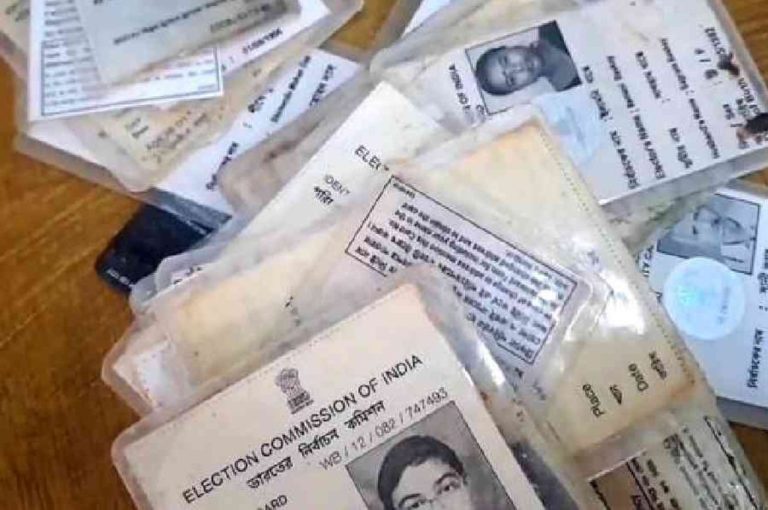
Voter ID Cards: The discovery of a sack filled with Elector Photo Identity Cards (EPICs) near National Highway 12 in West Bengal’s Nadia district has sparked widespread concern. The incident raises questions about electoral integrity, voter data security, and accountability in the run‑up to the Bengal elections. While the police have initiated an investigation, political parties have already begun trading accusations, highlighting the sensitive nature of voter identification in India’s democratic process.


Voter ID Cards: Incident Overview

Residents of Shantipur in Nadia district noticed a sack lying near a garbage dump. Upon inspection, they found it contained numerous voter ID cards. Authorities were alerted, and the police seized the sack for verification.

This discovery comes at a time when the Special Intensive Revision (SIR) of electoral rolls is underway in West Bengal, adding urgency to the matter.

For official context:


Political Reactions

  • A local TMC leader alleged that BJP workers deliberately dumped the cards to manipulate voter rolls.
  • BJP leaders countered, claiming that the area was under TMC control and that the discarded cards were linked to bogus voting practices.

This exchange underscores the polarized political climate in Bengal, where voter identification has become a battleground for legitimacy.


Electoral Roll Verification and SIR

The Special Intensive Revision (SIR) process began on November 4 and is scheduled to continue until December 11. It involves distribution of enumeration forms, verification of voter details, and removal of duplicate entries.

Relevant government references:

The timing of the discovery of dumped voter cards during SIR raises concerns about whether the process is being compromised or manipulated.


Human Cost of Electoral Processes

Electoral verification exercises often impose a human cost:

  • Farmers and daily wage workers lose valuable time and income while standing in queues.
  • Block Level Officers (BLOs) face immense pressure, sometimes leading to stress and burnout.
  • Citizens are forced to repeatedly authenticate documents, creating frustration and distrust.

This incident adds another layer of anxiety, as people worry whether their voter identity is secure or vulnerable to misuse.


Security and Accountability

The dumping of voter ID cards raises critical questions:

  • How were these cards issued and why were they discarded?
  • Were they duplicates, fraudulent, or genuine cards belonging to citizens?
  • Who is responsible for safeguarding voter identity data?

For official accountability structures:


Technology and Transparency

Concerns have also been raised about the use of AI apps to identify duplicate voters. Without transparency about how these tools are developed and deployed, citizens fear misuse of personal data.

For IT governance:


Broader Implications for Democracy

The incident is not just about one sack of voter ID cards. It symbolizes the fragility of trust in democratic institutions. If citizens believe their voter identity can be discarded or manipulated, confidence in the electoral process erodes.

Clean electoral rolls are essential, but they must be maintained with fairness, transparency, and respect for citizens’ dignity.


Conclusion

The discovery of dumped voter ID cards in Nadia district highlights the urgent need for:

  • Transparent investigation by the police and Election Commission.
  • Accountability mechanisms to prevent misuse of voter data.
  • Public awareness so citizens can verify their voter status and protect their rights.

Democracy thrives on trust. Incidents like this remind us that safeguarding electoral integrity is not just a bureaucratic task but a constitutional responsibility that affects every citizen.

Also read: Home | Channel 6 Network – Latest News, Breaking Updates: Politics, Business, Tech & More
Special Intensive Revision (SIR) Implementation and Human Cost in Bengal Elections

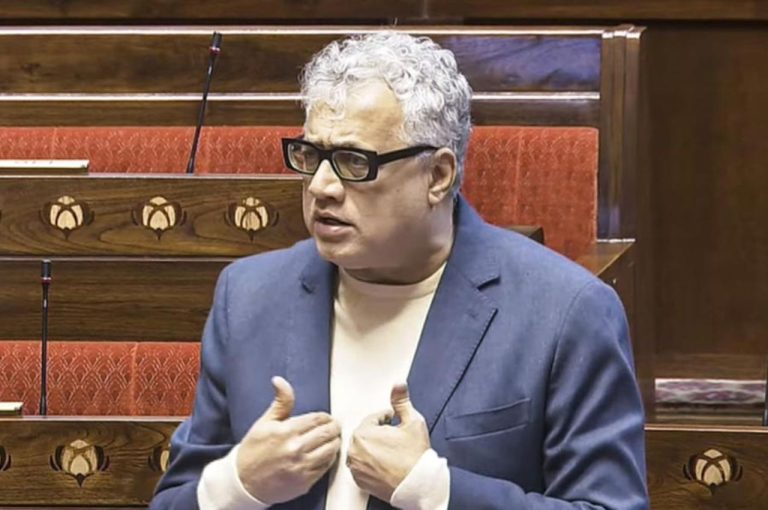
Special Intensive Revision: The debate around Special Intensive Revision (SIR) of electoral rolls has become one of the most pressing issues ahead of the West Bengal Assembly elections. Trinamool Congress (TMC) leader Derek O’Brien has raised serious concerns about the methodology, fairness, and human cost of the exercise. While no one disputes the importance of clean electoral rolls, the controversy lies in how the process is being implemented, its impact on ordinary citizens, and the lack of transparency in the use of technology such as AI apps for voter verification.


Background on SIR

The Special Intensive Revision (SIR) is a process conducted by the Election Commission of India (ECI) to update and verify electoral rolls. It is meant to ensure that only eligible citizens are included and duplicate or fraudulent entries are removed.

O’Brien’s critique is not of the concept itself but of the haphazard implementation. He argues that the same rolls were used in the 2024 Lok Sabha elections, so questioning their validity now raises doubts about consistency and fairness.


Special Intensive Revision: Human Cost of Implementation

One of the strongest points raised is the human toll of the SIR process:

  • Farmers forced to stand in long queues during the Rabi season, losing valuable agricultural time.
  • Daily wage workers losing income while running from office to office to authenticate documents.
  • Block Level Officers (BLOs) facing immense psychological and physical pressure, with reports of suicides linked to the stress of the exercise.

This highlights the social and economic disruption caused by bureaucratic processes when not carefully planned.

For reference on BLO responsibilities: ECI – Handbook for BLOs


Border Security and Political Context

O’Brien also questioned why SIR is being conducted in Bengal, Assam, and Kerala but not in other border states like Meghalaya, Mizoram, Manipur, and Nagaland. He emphasized that border protection is the responsibility of central forces such as the Border Security Force (BSF) and Indo-Tibetan Border Police (ITBP).

Government links for context:

This raises the issue of whether the SIR is being selectively applied, potentially targeting Bengali-speaking citizens under suspicion of being “infiltrators.”


Technology Concerns

Another major concern is the use of an AI app to identify duplicate voters. O’Brien pointed out that there is no clarity on who developed the app, what data it uses, or whether tenders were issued transparently.

This lack of transparency in deploying technology for democratic processes is alarming. Citizens deserve to know how their data is being processed and safeguarded.

For official IT governance: National Informatics Centre (NIC)


Constitutional and Democratic Implications

The Election Commission is a constitutional body expected to function impartially. If electoral rolls are suddenly deemed defective, it raises questions about the legitimacy of past elections. O’Brien even asked whether the Lok Sabha elected in 2024 should be dissolved if the rolls were compromised.

Relevant constitutional reference: Constitution of India – Election Commission (Article 324)


Conclusion

The debate over SIR is not about rejecting electoral reforms but about ensuring they are fair, transparent, and humane. The human cost, the selective application, and the opaque use of technology all demand scrutiny. Clean electoral rolls are essential, but democracy must not come at the expense of citizens’ dignity and livelihood.

Also read: Home | Channel 6 Network – Latest News, Breaking Updates: Politics, Business, Tech & More

December 11, 2025: Nifty 50 Closes 140 Points Higher; RICO Auto, WelInv, Neogen Shine as Arkade, Hubtown Drag

New Delhi, December 11, 2025:
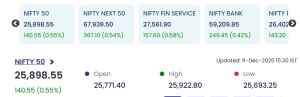
Indian markets ended Thursday’s session on a firm note, with the Nifty 50 rising 140.55 points (0.55%) to close at 25,898.55. Supported by strong gains across financials, banks, and select mid-cap stocks, the market maintained upward momentum throughout the day.

Also Read: December 11, 2025 (midday): Nifty 50 Gains 88 Points by Midday; Neogen, RICO Auto Lead Gainers as KSR, Arkade Drag


Indices Record Broad-Based Gains; Bank Nifty Jumps 249 Points

The Nifty 50 opened at 25,771.40, climbed to an intraday high of 25,922.80, and touched a low of 25,693.25, reflecting strong buying interest across sectors.

Other key indices also advanced:

  • Nifty Next 50: 67,939.50 (+0.54%)

  • December 11Nifty Financial Services: 27,561.90 (+0.58%)
  • Nifty Bank: 59,209.85 (+0.42%)

The broader strength in financial heavyweights and high-volume mid-caps contributed to the strong close.


Top Gainers: RICO Auto Surges 15%; Neogen, WelInv Deliver Strong Moves

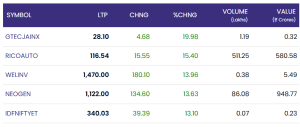
GTECJAINX continued to hold the top percentage gain, rising 19.98% to ₹28.10.

RICOAUTO delivered a standout performance with a gain of 15.40% to ₹116.54, backed by an exceptionally high volume of 511.25 lakh shares and a traded value of ₹580.58 crore, making it one of the day’s most active counters.

Other major gainers included:

Screenshot 2025 12 11 161445

Stock LTP (₹) Change (₹) % Change Volume (Lakhs) Value (₹ Cr)
WELINV 1,470.00 +180.10 13.96% 0.38 5.49
NEOGEN 1,122.00 +134.60 13.63% 86.08 948.77
IDFNIFTYET 340.03 +39.39 13.10% 0.07 0.23

Neogen, with a massive traded value nearing ₹949 crore, remained one of the strongest institutional favourites of the day.


Top Losers: Arkade Falls 9%; Hubtown, AdventHTL Extend Declines

Selling pressure persisted in select mid-cap names despite broader market strength.

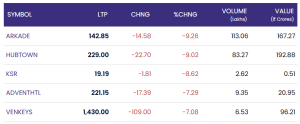
Arkade topped the losers’ list with a decline of 9.26%, closing at ₹142.85, supported by high delivery volumes of 113.06 lakh shares and a traded value of ₹167.27 crore.

Other major laggards included:

Screenshot 2025 12 11 161451

Stock LTP (₹) Change (₹) % Change Volume (Lakhs) Value (₹ Cr)
HUBTOWN 229.00 -22.70 -9.02% 83.27 192.88
KSR 19.19 -1.81 -8.62% 2.62 0.51
ADVENTHTL 221.15 -17.39 -7.29% 9.35 20.95
VENKEYS 1,430.00 -109.00 -7.08% 6.53 96.21

Hubtown continued its multi-session decline, signaling persistent bearish sentiment.


Conclusion: December 11, 2025

The Indian markets closed with robust gains, supported by strength in banking, financials, and high-volume mid-caps such as RICO Auto and Neogen. Despite pockets of weakness in stocks like Arkade, Hubtown, and Venkeys, the broader sentiment remained positive. Traders now look ahead to global cues and market signals that may shape the next trading session.


December 11, 2025 (midday): Nifty 50 Gains 88 Points by Midday; Neogen, RICO Auto Lead Gainers as KSR, Arkade Drag

New Delhi, December 11, 2025:
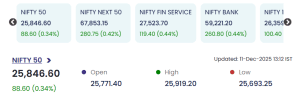
Indian equity markets extended morning gains into the afternoon session, with the Nifty 50 rising 88.60 points (0.34%) to 25,846.60 by 1:12 PM IST. Broader indices also traded higher, led by strong performances in financials, banks, and select mid-cap stocks.

Also Read: December 11, 2025 (opening): Nifty 50 Opens Firm, Gains 40 Points; GTEC Jainx, GoldTech Lead Top Gainers as Hubtown Declines


Indices Maintain Upward Momentum; Bank Nifty Rises 260 Points

The Nifty 50 opened at 25,771.40, hit an intraday high of 25,919.20, and touched a low of 25,693.25, reflecting sustained buying interest through the session.

Key indices showed broad strength:

  • Nifty Next 50: 67,853.15 (+0.42%)

  • December 11Nifty Financial Services: 27,523.70 (+0.44%)
  • Nifty Bank: 59,221.20 (+0.44%)

The rally in index heavyweights contributed to solid intraday sentiment.


Top Gainers: Neogen Jumps Over 15%; RICO Auto, GoldTech, WelInv Shine

Small- and mid-cap stocks witnessed strong upward moves by midday.

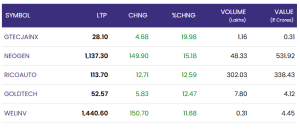
GTECJAINX remained the top percentage gainer, rising 19.98% to ₹28.10.

Neogen surged 15.18% to ₹1,137.30, supported by heavy traded value of ₹531.92 crore, indicating strong institutional interest.

Other major gainers included:

Screenshot 2025 12 11 131258

Stock LTP (₹) Change (₹) % Change Volume (Lakhs) Value (₹ Cr)
RICOAUTO 113.70 +12.71 12.59% 302.03 338.43
GOLDTECH 52.57 +5.83 12.47% 7.80 4.12
WELINV 1,440.60 +150.70 11.68% 0.31 4.45

RICO Auto’s massive volume of 302 lakh shares stood out as one of the most active trades of the session.


Top Losers: KSR Drops 11%, Arkade Declines 10.7%

Selling pressure continued in select mid-cap and small-cap names.

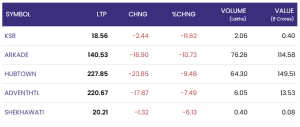
KSR led the losers, falling 11.62% to ₹18.56, reflecting sharp bearish sentiment.

Arkade followed with a 10.73% decline to ₹140.53, accompanied by strong volumes of 76.26 lakh shares, signaling heavy offloading.

Other significant losers included:

Screenshot 2025 12 11 131307

Stock LTP (₹) Change (₹) % Change Volume (Lakhs) Value (₹ Cr)
HUBTOWN 227.85 -23.85 -9.48% 64.30 149.51
ADVENTHTL 220.67 -17.87 -7.49% 6.05 13.53
SHEKHAWATI 20.21 -1.32 -6.13% 0.40 0.08

Hubtown’s continued decline shows sustained selling pressure over multiple sessions.


Conclusion: December 11, 2025

Markets remained firmly in positive territory by early afternoon, supported by strong gains in financials and robust activity in select mid-cap stocks like Neogen and RICO Auto. Despite this, weakness in stocks such as KSR, Arkade, and Hubtown kept market breadth mixed. Investors will track global cues and institutional flows as the trading day progresses.


December 11, 2025 (opening): Nifty 50 Opens Firm, Gains 40 Points; GTEC Jainx, GoldTech Lead Top Gainers as Hubtown Declines

New Delhi, December 11, 2025:
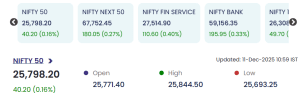
Indian equity benchmarks opened on a positive note on Thursday, with the Nifty 50 rising 40.20 points (0.16%) to 25,798.20 by 10:59 AM IST. Broader indices also traded higher, supported by gains in financial, banking, and mid-cap segments, as overall market sentiment improved.

Also Read: December 10, 2025: Nifty 50 Closes Lower by 81 Points Amid Broad Sell-Off; Rajsree Sugars, Focus Shine as Hubtown, Kaynes Slide


Indices Trade Higher Led by Banking and Financial Stocks

The Nifty 50 recorded an opening level of 25,771.40, touched a high of 25,844.50, and registered a low of 25,693.25, indicating a stable upward bias through the early session.

Key index movements included:

  • Nifty Next 50: 67,752.45 (+0.27%)
  • December 11Nifty Financial Services: 27,514.90 (+0.40%)
  • Nifty Bank: 59,156.35 (+0.33%)

The positive trend across index heavyweights contributed to an encouraging start for the markets.


Top Gainers: GTEC Jainx Surges Nearly 20%

Small-cap and mid-cap counters outperformed significantly in the morning session.
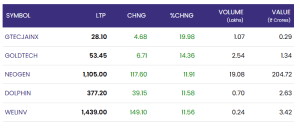
GTECJAINX emerged as the top gainer, climbing 19.98% to ₹28.10, supported by active volume.

Other notable gainers included:

Screenshot 2025 12 11 105935

Stock LTP (₹) Change (₹) % Change Volume (Lakhs) Value (₹ Cr)
GOLDTECH 53.45 +6.71 14.36% 2.54 1.34
NEOGEN 1,105.00 +117.60 11.91% 19.08 204.72
DOLPHIN 377.20 +39.15 11.58% 0.70 2.63
WELINV 1,439.00 +149.10 11.56% 0.24 3.42

The rally in these stocks highlights heavy retail participation and trading enthusiasm in high-beta small-cap counters.


Top Losers: Hubtown Extends Decline, Drops Nearly 9%

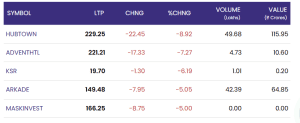
On the downside, Hubtown continued to face selling pressure, falling 8.92% to ₹229.25 with strong volumes of 49.68 lakh shares, indicating sustained bearish sentiment around the stock.

Other major losers included:

Screenshot 2025 12 11 105946

Stock LTP (₹) Change (₹) % Change Volume (Lakhs) Value (₹ Cr)
ADVENTHTL 221.21 -17.33 -7.27% 4.73 10.60
KSR 19.70 -1.30 -6.19% 1.01 0.20
ARKADE 149.48 -7.95 -5.05% 42.39 64.85
MASKINVEST 166.25 -8.75 -5.00% 0.00 0.00

The declines reflect profit booking and stock-specific weakness in some mid-cap names following recent volatility.


Conclusion: December 11, 2025

The Indian markets began Thursday’s session on a positive note, supported by gains in financial and banking stocks and strong performances from select mid-cap and small-cap counters. While market breadth was largely positive, significant declines in a few mid-cap names, including Hubtown and Advent Health, provided some resistance to broader gains. Traders will be watching intraday cues and global trends closely as the session progresses.


India-Russia Defence Cooperation: Tepid Response to Su-57 & Drone Offers

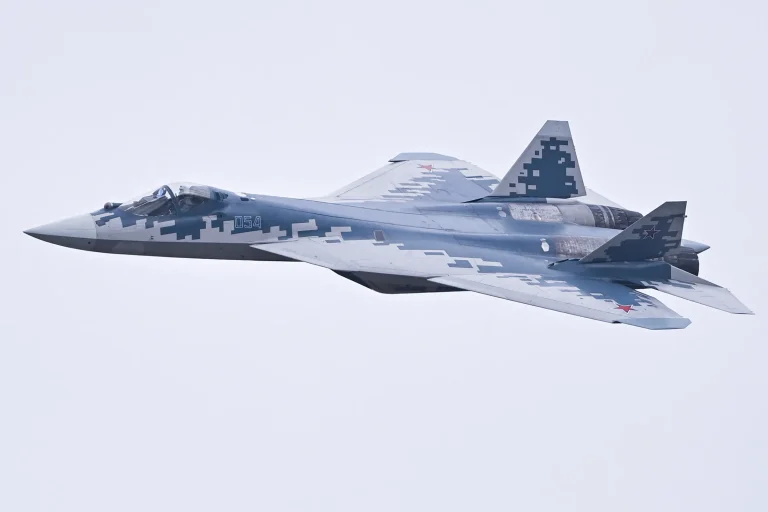
New Delhi – Russia’s latest attempts to expand India-Russia defence cooperation have met with a surprisingly lukewarm response from New Delhi, marking a significant shift in bilateral military relations. Moscow’s proposals for advanced equipment including the Su-57 fifth-generation stealth fighter, long-range drones, and submarines have failed to generate expected enthusiasm from Indian officials.

Russian Proposals Meet Limited Interest

In the run-up to President Vladimir Putin’s recent visit to India, Moscow made repeated outreach efforts promoting various defence platforms. The proposals for India-Russia defence cooperation included the Geran series of kamikaze drones, submarines, and advanced aircraft systems.

However, a senior official revealed that India did not show significant interest in the equipment offered through these India-Russia defence cooperation channels. “The Russians were expecting major movement on the sidelines of the visit and are still pursuing the proposals. We are very much focusing on development of indigenous products,” the official stated.

This restrained response represents a notable departure from India’s historical pattern of arms procurement and signals changing priorities in India-Russia defence cooperation dynamics.

Putin Visit Yields Limited Defence Breakthroughs

Despite high expectations surrounding President Putin’s visit, much-watched defence announcements in India-Russia defence cooperation did not materialize. While 19 agreements aimed at boosting bilateral trade were signed, there was no breakthrough on collaboration involving the Su-57 or Russia’s S-500 air defence system.

The absence of major defence deals during this high-profile visit underscores the evolving nature of India-Russia defence cooperation. The focus appears to be shifting from large platform acquisitions to more strategic, technology-focused partnerships that align with India’s self-reliance goals.

Indigenous Defence Manufacturing Takes Priority

The restrained response to Russian proposals comes at a time when India is driving an aggressive push towards self-reliance in defence manufacturing. This strategic shift is reshaping traditional patterns of India-Russia defence cooperation, with New Delhi prioritizing domestic capabilities over foreign acquisitions.

Defence Minister Rajnath Singh, while dedicating 125 newly completed Border Roads Organisation projects to the nation in Leh on December 7, underscored the transformation in domestic defence capacity. His remarks highlighted how India’s evolving capabilities are influencing decisions about India-Russia defence cooperation.

Record Defence Production Achievements

Singh emphasized that India, once heavily dependent on arms imports, now boasts a record defence production value of ₹1.51 lakh crore, up from ₹46,000 crore in 2014. This dramatic increase reflects India’s growing self-sufficiency and explains the measured approach to new India-Russia defence cooperation proposals.

Defence exports have surged from under ₹1,000 crore to nearly ₹24,000 crore in a decade, representing what Singh described as a paradigm shift in India’s defence industrial base. These achievements provide context for India’s selective approach to India-Russia defence cooperation opportunities.

Geran Drones Proposal Lacks Appeal

The Geran drones—Russia’s indigenized variant of Iran’s Shahed-136 kamikaze drone—have played a major role in Moscow’s low-cost attrition strategy in Ukraine, enabling mass salvo attacks. Despite their battlefield effectiveness, Indian manufacturers and services have not shown interest in acquiring them through India-Russia defence cooperation channels.

This lack of interest in proven combat systems highlights India’s confidence in developing indigenous alternatives rather than importing foreign solutions, even from traditional partners in India-Russia defence cooperation frameworks.

Su-57 and S-500 Collaboration Stalls

Two of the most significant proposals in recent India-Russia defence cooperation discussions—collaboration on the Su-57 fifth-generation fighter and the S-500 air defence system—have failed to progress. These platforms represent cutting-edge Russian military technology, yet India has remained uncommitted.

The Su-57, Russia’s answer to fifth-generation stealth fighters, was once expected to be a cornerstone of future India-Russia defence cooperation. However, India’s own Advanced Medium Combat Aircraft (AMCA) program and other indigenous initiatives appear to have reduced the urgency for such acquisitions.

Working Group Meeting in Moscow

On October 29, the 23rd Working Group Meeting of the India-Russia Inter-Governmental Commission on Military Technical Cooperation was held in Moscow. Co-chaired by Sanjeev Kumar, Secretary (Defence Production), and Andrey A. Boytsov, First Deputy Director of Russian Federal Service for Military-Technical Cooperation, the discussions spanned tri-service cooperation and defence R&D.

This institutional framework for India-Russia defence cooperation continues to function, with the meeting concluding with the signing of a Protocol outlining fresh areas of collaboration and mutual growth. However, big-ticket defence deals remain elusive, reflecting India’s strategic recalibration.

Strategic Implications

The tepid response to Russian proposals signals a fundamental shift in India-Russia defence cooperation dynamics. While the relationship remains important, India is increasingly selective about acquisitions, preferring technology transfer and joint development over direct purchases.

This evolution in India-Russia defence cooperation reflects India’s maturing defence industrial base and growing confidence in indigenous capabilities. The focus is shifting from dependency to partnership, with India seeking relationships that support rather than substitute domestic manufacturing.

Balancing Traditional Ties with New Priorities

India faces the challenge of maintaining strong India-Russia defence cooperation while pursuing self-reliance goals. The careful navigation of this balance explains the measured response to Moscow’s proposals, as New Delhi seeks to preserve strategic relationships while advancing indigenous capabilities.

Future of Bilateral Defence Relations

As India-Russia defence cooperation evolves, the emphasis appears to be moving toward collaborative R&D, technology sharing, and niche capability development rather than large platform acquisitions. This approach allows India to leverage Russian expertise while building domestic capacity.

The current phase of India-Russia defence cooperation reflects India’s transformation from a major arms importer to an emerging defence exporter with growing indigenous capabilities, fundamentally altering the dynamics of this historically crucial bilateral relationship.

India-US Trade Talks: Critical Negotiations Begin to Resolve Tariff Disputes

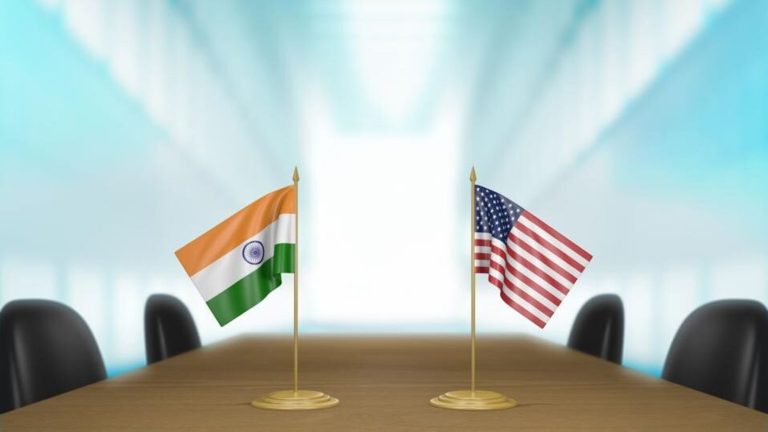
New Delhi – Fresh rounds of India-US trade talks have commenced with the arrival of Deputy US Ambassador for Trade Rick Switzer in New Delhi on December 10. These high-level discussions represent a crucial step toward finalizing a bilateral trade agreement that could significantly transform economic relations between the world’s largest democracy and its most powerful ally.

Familiarization Visit Sets Stage

The India-US trade talks taking place on December 10 and 11 are characterized as primarily a familiarization trip by Ministry of External Affairs spokesperson Randhir Jaiswal, who confirmed the visit during a media briefing. This initial engagement allows both sides to establish rapport and lay groundwork for more substantive negotiations.

“Ambassador Rick Switzer will be meeting with senior officials in the Indian government to further discussions on trade,” Jaiswal announced. The India-US trade talks will involve discussions with key government officials who oversee India’s trade policy and economic relations with Washington.

Comprehensive Trade Agreement in Focus

Both countries have been actively negotiating a comprehensive trade agreement through these India-US trade talks that would cover multiple sectors. The ambitious goal is to increase bilateral trade significantly, building on the already substantial economic relationship between the two nations.

The India-US trade talks aim to create a framework that addresses concerns on both sides while expanding opportunities for businesses in both countries. Several rounds of negotiations have already taken place, demonstrating the commitment of both governments to reaching a mutually beneficial agreement.

Optimism for Fair and Balanced Deal

India and the United States have emphasized their commitment to concluding a fair and balanced trade deal through ongoing India-US trade talks. Commerce Secretary Sunil Agarwal expressed confidence at the FICCI Annual General Meeting on November 28, stating that both countries remain optimistic about reaching an agreement by year’s end.

“We are hopeful that we can finalize a solution within this calendar year,” Agarwal stated, reflecting the positive momentum behind the India-US trade talks. Both governments have stressed the importance of an agreement that benefits both sides equitably, ensuring long-term sustainability of the trade relationship.

Timeline Adjustments and Policy Changes

The timeline for completing the first phase of the India-US trade talks had to be adjusted due to recent changes in US trade policies. The implementation of tariffs on Indian goods created additional complexities that required careful negotiation and diplomatic finesse.

Despite these adjustments, officials involved in the India-US trade talks remain committed to finalizing the first tranche of the agreement within the next few months. The flexibility shown by both sides in adapting to changing circumstances demonstrates the strategic importance both nations place on their economic partnership.

Tariff Challenges and Tensions

The road to successful India-US trade talks has not been entirely smooth, with significant hurdles emerging from US tariff measures. Former President Donald Trump introduced tariffs that were first set at 25% in August 2021, followed by another 25% increase shortly thereafter.

These tariffs targeted Indian goods, citing issues including India’s ongoing purchase of Russian oil. This action was part of broader reciprocal tariff measures implemented in response to trade deficits with countries like India, creating challenges that the current India-US trade talks must address.

The tariff issue represents one of the most contentious topics in the India-US trade talks, requiring diplomatic skill and economic pragmatism from negotiators on both sides.

Maintaining Open Dialogue

Despite challenges, both countries have kept dialogue channels open throughout the India-US trade talks. Several rounds of negotiations have continued, demonstrating resilience in the bilateral relationship even during periods of trade tension.

India remains hopeful that these India-US trade talks will yield concrete results, with officials expressing confidence that the first tranche of the agreement will be finalized despite earlier delays. This persistence reflects the strategic importance both nations attach to their economic relationship.

Also Read: Trump Gold Card: Revolutionary $1M Visa Program Launched for Foreign Talent

Ambitious Trade Volume Targets

The proposed Bilateral Trade Agreement being discussed in the India-US trade talks aims to more than double current trade volume between the two countries. The goal is to increase bilateral trade from USD 191 billion to an ambitious USD 500 billion by 2030.

This dramatic expansion target underscores the enormous economic potential that the India-US trade talks seek to unlock. Achieving this goal would make the India-US economic relationship one of the most significant bilateral trade partnerships globally.

High-Level Political Commitment

The agreement being negotiated through the India-US trade talks was first discussed during Prime Minister Narendra Modi’s visit to Washington earlier this year. Both sides demonstrated eagerness to formalize the deal, with leaders from both countries publicly expressing support for strengthened economic ties.

This high-level political commitment provides crucial backing for the India-US trade talks, ensuring that negotiators have the mandate and support necessary to reach ambitious agreements.

India’s Broader Trade Strategy

The India-US trade talks are part of India’s larger strategy of pursuing trade agreements with multiple global partners. To date, India has signed 14 Free Trade Agreements and six Preferential Trade Agreements, demonstrating its commitment to economic integration.

India continues ongoing negotiations for FTAs with several other key international players, including the European Union. The India-US trade talks represent one of the most significant components of this broader trade liberalization strategy.

Strategic Importance

The current round of India-US trade talks carries strategic importance beyond immediate economic benefits. The discussions reflect both countries’ recognition that their economic interdependence serves broader geopolitical interests, including maintaining a rules-based international order and balancing global economic power.

As Deputy US Ambassador Rick Switzer engages with Indian officials, these India-US trade talks represent more than routine economic negotiations—they embody the deepening partnership between two major democracies navigating an increasingly complex global landscape.

IndiGo Crisis Escalates in Ahmedabad as 10 More Flights Face Sudden Cancellations

0

IndiGo Crisis Continues to Disrupt Ahmedabad Travelers as Multiple Flights Get Cancelled

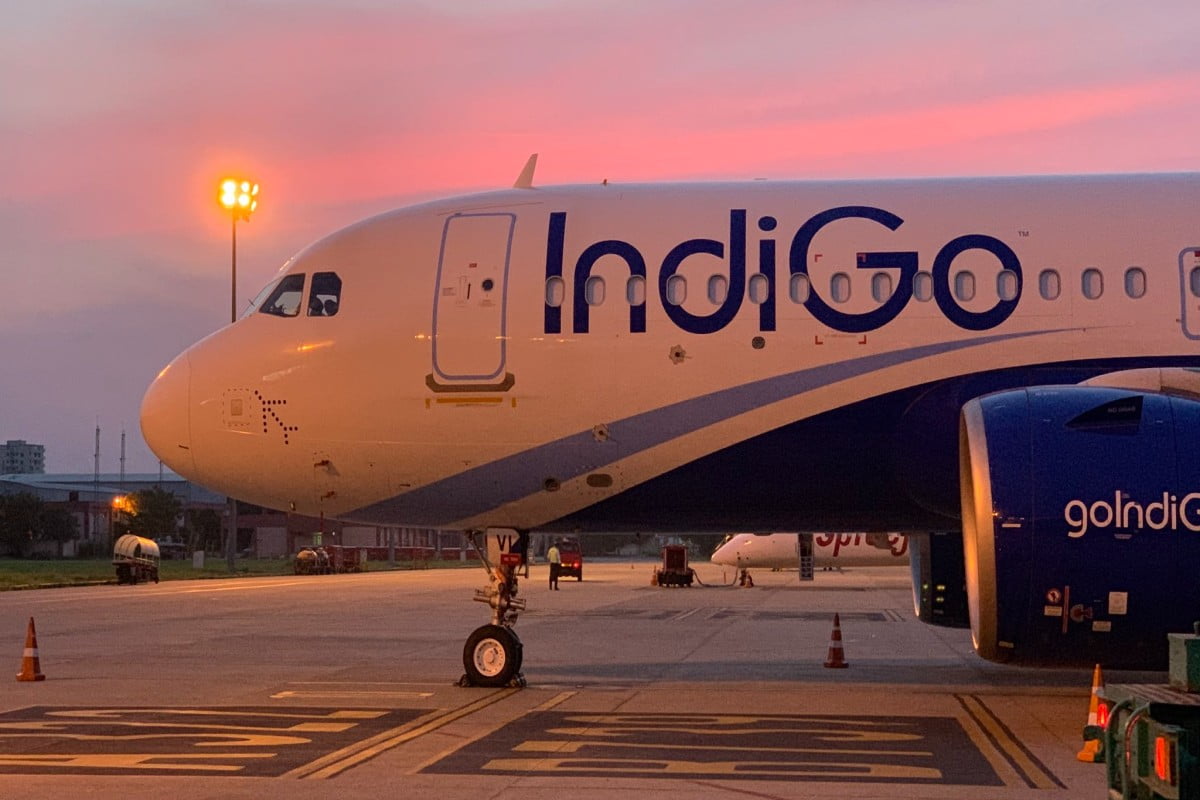
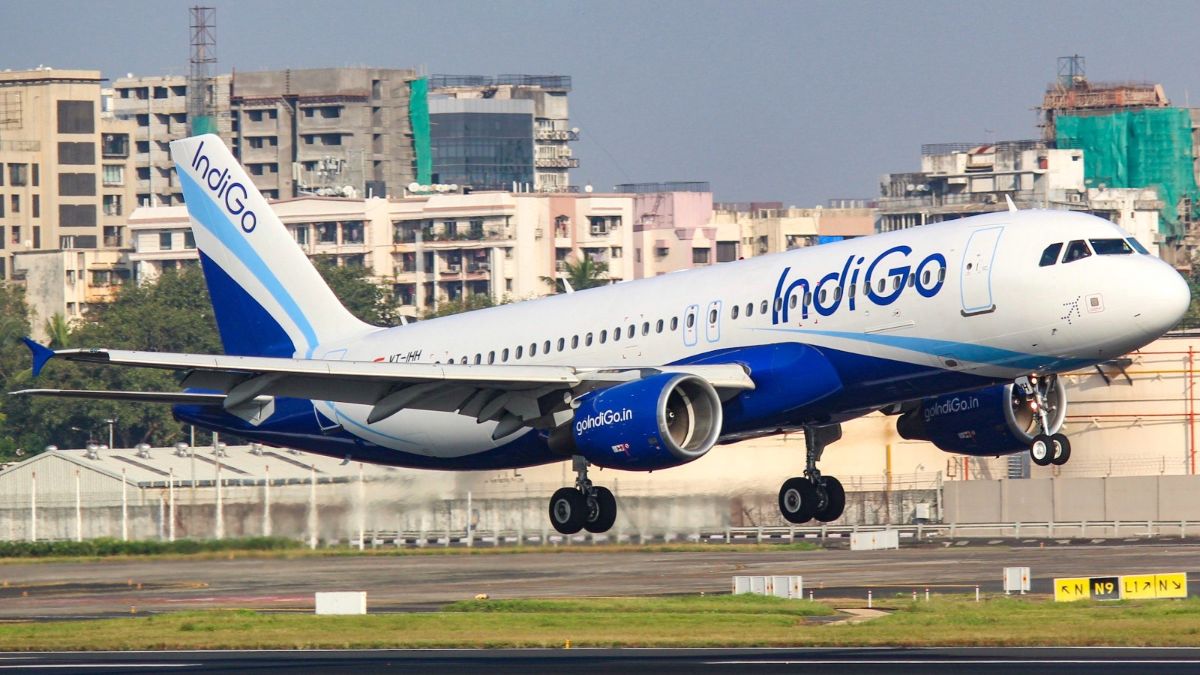
Ahmedabad travelers are facing mounting frustration as the ongoing IndiGo operational crisis leads to multiple flight cancellations, throwing schedules into disarray. Early reports from the airport suggest that passengers arriving for their flights were met with unexpected cancellations, leaving families, business travelers, and students stranded. The disruption comes at a time when travel demand is high, intensifying the challenges for both passengers and airline staff.indigo mysore hyderabad flight resumed

Passengers Stranded and Left in Uncertainty

The chaos at Ahmedabad airport began early in the morning, as flight boards displayed cancellations without prior notice. Many passengers reported that they were informed only after arriving at the airport, creating confusion and anxiety. Families traveling with children, senior citizens and business travelers were particularly affected, with many missing crucial meetings or personal commitments.

Long queues formed at customer service counters as travelers sought assistance. Staff tried to manage the situation by helping passengers rebook flights or arrange alternative travel, but the scale of cancellations overwhelmed the airport personnel. For many, hours passed in uncertainty, adding to the frustration and stress caused by the disruptions.

IndiGo Grapples with Operational Challenges

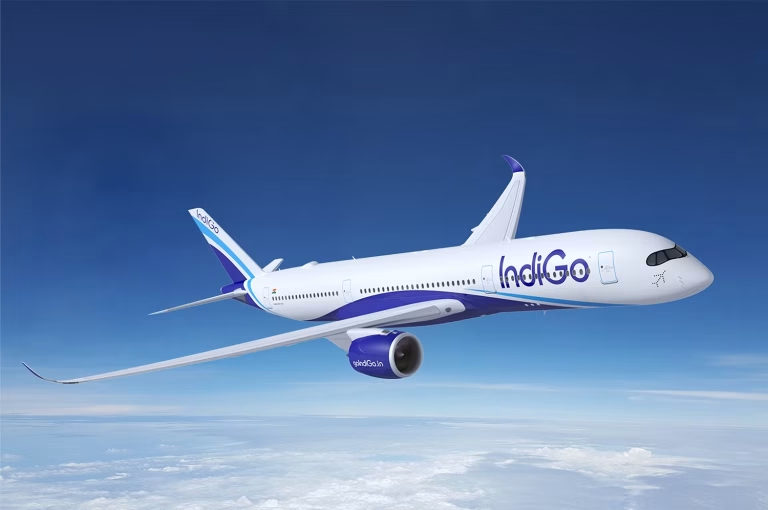
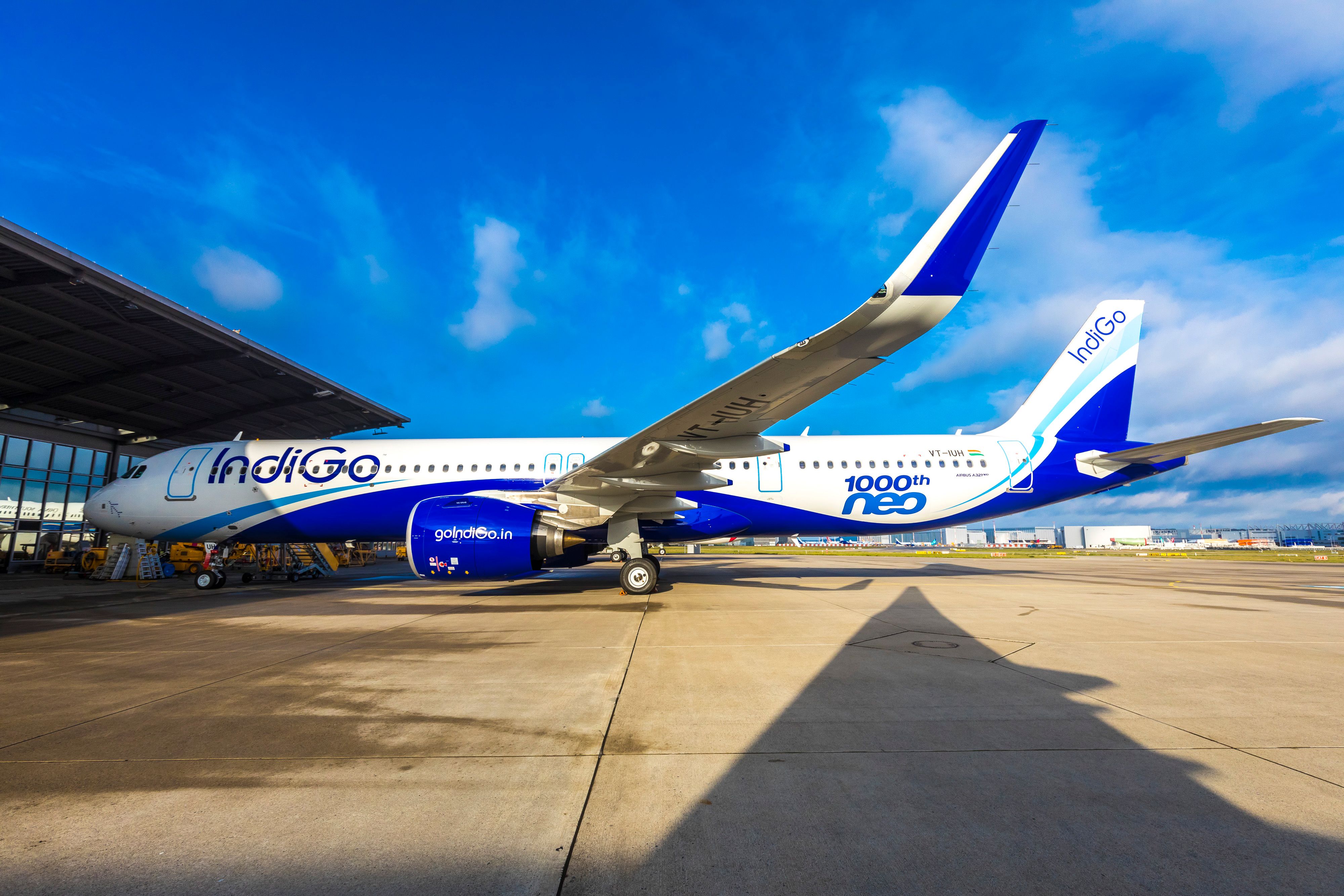
IndiGo, India’s largest airline by passenger volume, has been battling multiple operational issues over the past weeks. Reports indicate that staff shortages, scheduling conflicts and technical problems have contributed to repeated flight cancellations. The ongoing disruptions have sparked criticism from passengers, who say that the airline has failed to provide timely updates or adequate support during the crisis.IndiGo takes delivery of 1000th A320neo Family aircraft

While airlines face challenges due to high passenger traffic and unforeseen operational hurdles, repeated cancellations put pressure on both service quality and customer trust. IndiGo now faces heightened scrutiny as travelers question the reliability of the airline, especially during peak travel periods when demand is highest.

Demand for Prompt Solutions from Passengers

Stranded travelers have voiced urgent demands for immediate solutions. Many are requesting compensation for cancelled flights, quicker rebooking options and clear communication regarding delays or alternate arrangements. Business travelers have expressed concerns over disrupted schedules and missed opportunities, while families emphasize the stress caused to children and elderly passengers.

Passengers also highlighted the financial strain of arranging last-minute alternatives, including private transport or booking on other carriers. The crisis has reinforced the need for airlines to maintain strong operational planning and customer service during disruptions, to minimize inconvenience and maintain trust.

IndiGo’s Response and Measures Underway

IndiGo has acknowledged the cancellations and cited operational challenges as the cause. The airline has assured passengers that it is taking steps to restore regular schedules and minimize inconvenience. Measures reportedly include prioritizing affected flights, increasing staff at key airports, and assisting passengers with alternate travel options.indigo flight cover

Experts in aviation stress that while operational disruptions are sometimes unavoidable, clear communication, proactive rebooking assistance and timely updates are critical in managing passenger expectations. IndiGo’s ability to implement these measures effectively will be closely watched in the coming days.

Broader Implications for Air Travel

The ongoing crisis in Ahmedabad reflects broader pressures on the Indian aviation industry, where rising passenger numbers often strain operational capacity. For IndiGo, resolving the current issues promptly is essential not only for customer satisfaction but also for sustaining its position in a highly competitive market.

Passengers continue to monitor updates from the airline closely, hoping for rapid rescheduling and reassurance that further disruptions will be minimized. The coming days will test IndiGo’s operational resilience and its ability to balance logistical challenges with maintaining passenger confidence.

Authorities and consumer groups are urging the airline to provide transparent updates and better on-ground support. Travelers are also demanding faster compensation processes for cancelled flights. Many fear that repeated disruptions could affect future booking decisions. The situation underscores the importance of planning and communication in managing large-scale airline operations effectively.

Also read: https://channel6network.com/jiohotstarsouthinbound/