Sunday, May 17, 2026
Home Blog Page 365

Bihar Election Campaign: PM Modi’s Fierce Attack on Congress Over Insults

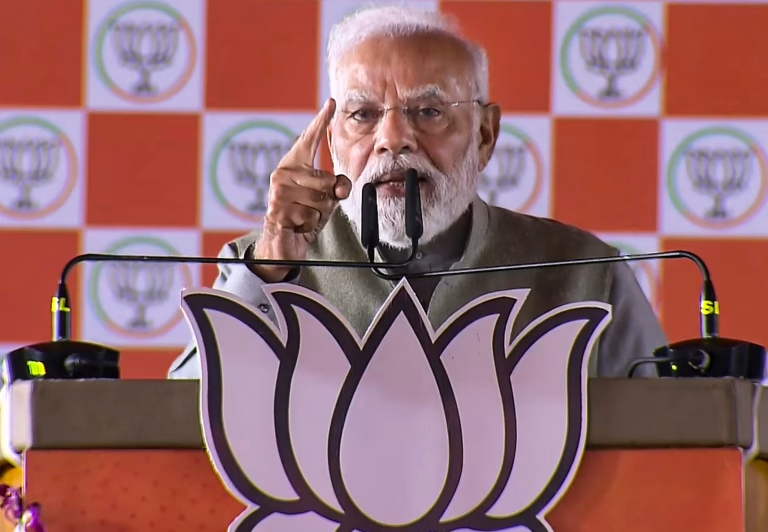
Bihar – Prime Minister Narendra Modi launched a blistering assault on the Congress party and its INDIA bloc partners during a Bihar election campaign rally in Chhapra on Thursday, accusing them of systematically insulting the people of Bihar across different states. The Prime Minister’s remarks at this crucial Bihar election campaign event focused on highlighting what he described as a pattern of disrespect toward Biharis by opposition parties, particularly recalling a controversial 2022 incident involving former Punjab Chief Minister Charanjit Singh Channi.

The Bihar election campaign has entered its most intense phase as the state prepares for assembly elections scheduled in two phases on November 6 and 11, with results to be declared on November 14. Modi’s aggressive positioning during this Bihar election campaign rally signals the high stakes involved for both the ruling NDA coalition and the opposition INDIA bloc.

Channi’s 2022 Controversy Resurfaces

At the heart of Modi’s Bihar election campaign attack was a 2022 incident during Punjab’s election campaign when Channi, then serving as Chief Minister, had urged people not to allow “bhaiyas” from Uttar Pradesh and Bihar to enter the state. The Prime Minister pointedly noted that Congress MP Priyanka Gandhi Vadra was present on stage during Channi’s controversial remarks and appeared to be smiling.

“Friends, I want to remind you — those with the lantern (RJD), the hand (Congress), and their INDIA alliance partners, how they have insulted Bihar. The Congress Chief Minister in Punjab openly declared that people from Bihar would not be allowed to enter his state,” Modi stated during the Bihar election campaign rally, emphasizing that a member of the Gandhi family was applauding the statement.

This reference to the 2022 incident has become a central theme in the current Bihar election campaign, with Modi using it to question the opposition’s commitment to Bihar’s dignity and interests.

Congress Accused of Calculated Conspiracy

Expanding his criticism during the Bihar election campaign rally, Prime Minister Modi alleged that the Congress party’s strategy represents a calculated conspiracy designed to damage the Rashtriya Janata Dal (RJD) in Bihar. He pointed out that despite Congress leaders insulting Biharis in their respective states, the RJD has invited them to campaign in Bihar itself.

“This time, in these elections, they have crossed all limits. The same Congress leaders who insulted Bihar in their own states have now been invited by the RJD to campaign here. This is a calculated conspiracy by the Congress — they want the RJD to suffer maximum damage,” Modi declared during the Bihar election campaign event.

The Prime Minister suggested that this Bihar election campaign strategy reveals deep rifts within the INDIA bloc, particularly between RJD and Congress, which could potentially benefit the NDA coalition.

Pattern of Insults Across Multiple States

During the Bihar election campaign rally, Modi highlighted what he described as a pattern of insults directed at Biharis across various opposition-ruled states. He specifically mentioned incidents in Telangana, Karnataka, and Tamil Nadu, where he claimed that Congress and DMK leaders have mistreated people from Bihar.

“Meanwhile, in Telangana and Karnataka, Congress leaders insult the people of Bihar, and in Tamil Nadu, the DMK mistreats the hardworking people from Bihar. Despite all this, the RJD in Bihar remains silent as if struck dumb,” the Prime Minister stated at the Bihar election campaign gathering.

This broader narrative during the Bihar election campaign attempts to position the opposition as inherently hostile to Bihar’s interests and its migrant population working in other states.

RJD’s Silence Questioned

A key element of Modi’s Bihar election campaign strategy involved questioning RJD’s silence on these alleged insults. The Prime Minister portrayed RJD supremo and its leadership as complicit through their inaction, suggesting they have prioritized alliance politics over defending Bihar’s honor and dignity.

Also Read: Tejashwi Yadav BJP Bold Accusation Ahead Bihar Polls 2025: Claims Nitish Kumar Won’t Be CM

This line of attack during the Bihar election campaign aims to create a wedge between RJD and its traditional voter base by suggesting the party has abandoned its role as defender of Bihari pride in favor of maintaining relationships with parties that allegedly disrespect the state’s people.

NDA’s Commitment to Bihar’s Development

Pivoting from criticism to promises during the Bihar election campaign, Modi emphasized his partnership with Chief Minister Nitish Kumar in pursuing Bihar’s development agenda. He declared that fulfilling the dreams of Bihar’s people represents both his personal commitment and that of the NDA government.

“Today, I give you a guarantee — your dream is my commitment. Narendra and Nitish are dedicated to fulfilling your dreams. The journey from good governance (sushasan) to prosperity in Bihar must continue uninterrupted,” Modi proclaimed at the Bihar election campaign rally.

Massive Public Support Claimed

The Prime Minister hailed what he described as massive public support at the Chhapra Bihar election campaign gathering, interpreting the crowd’s enthusiasm as a clear indication that voters want another NDA government. “The atmosphere in Chhapra is clearly saying — ‘Phir ek baar NDA sarkaar’ (Once again, an NDA government),” Modi declared.

He also emphasized his personal connection to the region, noting, “This land is not only of culture but also of movements. There is magic in this soil — it can even make words come alive. Friends, I too am a Member of Parliament from Purvanchal.”

Electoral Stakes and Timeline

As the Bihar election campaign enters its final days, both alliances are intensifying their efforts to secure voter support. The two-phase polling scheduled for November 6 and 11 will determine the state’s political direction for the next five years, with results to be announced on November 14.

Conclusion

The Bihar election campaign has clearly become a battle not just over governance and development promises, but also over identity, dignity, and respect for the state’s people, with Modi’s aggressive strategy attempting to position the NDA as Bihar’s true defenders.

Trump Xi Meeting: Big Breakthrough Delivers Major Trade Agreements

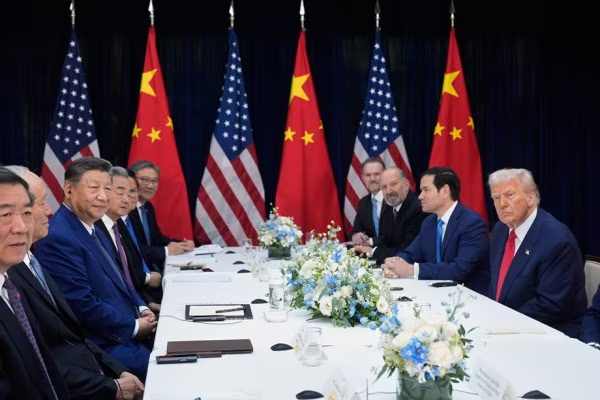
Busan – The Trump Xi meeting held in South Korea’s Busan on Thursday has produced substantial progress in US-China relations, with President Donald Trump calling the one hour and forty-minute discussion with Chinese President Xi Jinping a “great success.” The Trump Xi meeting took place on the sidelines of the Asia-Pacific Economic Cooperation (APEC) summit in Gyeongju, marking a pivotal moment in the relationship between the world’s two largest economies.

Following the Trump Xi meeting, President Trump announced sweeping tariff reductions on Chinese imports, signaling a major thaw in the trade tensions that have characterized relations between Washington and Beijing. The agreements reached during this high-stakes diplomatic encounter encompass multiple critical areas, from fentanyl control to rare earth elements and geopolitical challenges.

Fentanyl Tariffs Slashed in Half

One of the most immediate outcomes from the Trump Xi meeting was the significant reduction in fentanyl-related tariffs. Trump agreed to cut fentanyl tariffs on China from 20 percent to 10 percent, with the reduction taking effect immediately. The decision came after Xi Jinping committed to working “very hard to stop the flow” of fentanyl into the United States.

Trump expressed confidence in China’s commitment to addressing the fentanyl crisis, stating, “I believe they are really taking strong action.” This tariff reduction represents a concrete measure of goodwill resulting from the Trump Xi meeting and demonstrates progress on an issue that has been a major point of contention in bilateral relations.

Overall Tariff Reduction Announced

Beyond fentanyl-specific tariffs, the Trump Xi meeting produced an even more substantial agreement on overall trade duties. Trump announced that he would reduce tariffs on Chinese goods imported into the United States from 57 percent to 47 percent, representing a 10-percentage-point decrease across the board.

This comprehensive tariff cut is contingent upon China’s promise to address the fentanyl situation effectively. The reduction signals a significant de-escalation in the trade war that has imposed heavy costs on businesses and consumers in both nations. The Trump Xi meeting thus achieved what many analysts considered unlikely just weeks ago—a substantive rollback of protectionist measures.

Rare Earth Elements Agreement Reached

A major breakthrough from the Trump Xi meeting involved rare earth elements, which had emerged as a critical flashpoint in US-China relations. Both parties reached a one-year extendable agreement on China’s supply of crucial rare earths to the United States, addressing American concerns about access to these strategic materials essential for advanced technologies and defense applications.

“There’s no roadblock at all on rare earths…That will hopefully disappear from our vocabulary for a little while,” Trump declared, indicating satisfaction with the arrangement. This agreement from the Trump Xi meeting provides certainty for American industries dependent on these materials while giving China leverage through the renewable nature of the deal.

Reciprocal State Visits Planned

The Trump Xi meeting also established a framework for continued high-level diplomatic engagement between the two nations. Trump announced plans to visit China in April, with Xi Jinping scheduled to travel to the United States sometime thereafter. “I’ll be going to China in April and he’ll be coming here sometime after that, whether it’s in Florida, Palm Beach or Washington, DC,” Trump told reporters aboard Air Force One.

Also Read: Trump Tariffs Resolution: Senate Passes Bold Bipartisan 51-47 Vote

These reciprocal visits demonstrate the leaders’ commitment to maintaining dialogue and building upon the progress achieved during the Trump Xi meeting in Busan. The scheduling of future meetings suggests both sides view the current momentum as worth sustaining through continued personal diplomacy.

Taiwan Issue Notably Absent

Interestingly, the Trump Xi meeting did not address the highly sensitive issue of Taiwan, despite its centrality to US-China tensions. When asked about Taiwan discussions, Trump stated clearly that the topic “never came up. That was not discussed actually.”

The absence of Taiwan from the Trump Xi meeting agenda likely reflects both leaders’ desire to focus on areas where progress was achievable rather than risk derailing positive momentum with contentious territorial disputes. This strategic omission allowed the meeting to conclude on an optimistic note.

Ukraine Cooperation Discussed

The Trump Xi meeting also touched on the ongoing conflict in Ukraine, with both leaders agreeing to work collaboratively toward a resolution. “Ukraine came up very strongly. We talked about it for a long time, and we’re both going to work together to see if we can get something,” Trump explained.

Trump indicated that Xi Jinping committed to helping address the Ukraine situation, stating, “Xi Jinping is going to help us, and we’re going to work together on Ukraine.” This represents an interesting development in the Trump Xi meeting outcomes, suggesting potential Chinese involvement in efforts to resolve the European conflict.

Diplomatic Implications

The Trump Xi meeting in Busan represents a significant shift in the trajectory of US-China relations. After years of escalating tensions, trade disputes, and hostile rhetoric, the substantive agreements reached during this encounter suggest both nations recognize the need for stable, productive relations.

The meeting’s success may provide a template for future negotiations, demonstrating that despite fundamental differences, the world’s two superpowers can find common ground on practical issues when leaders engage directly.

Economic Impact Expected

The tariff reductions announced following the Trump Xi meeting will have immediate economic implications for businesses and consumers in both countries. American importers will benefit from lower duties on Chinese goods, potentially reducing costs for consumers, while Chinese exporters gain improved access to the crucial American market.

Conclusion

The Trump Xi meeting in Busan has delivered tangible results that exceed many observers’ expectations, establishing a foundation for improved bilateral relations while addressing key economic and security concerns through practical agreements and continued diplomatic engagement.

55-year Old Indian-Origin Man Killed Canada: Tragic Death After Confronting Stranger

Edmonton, Canada – An Indian-origin man killed Canada has sent shockwaves through the diaspora community after Arvi Singh Sagoo, a 55-year-old businessman, died following a brutal assault in Edmonton. The tragic incident occurred when Sagoo confronted a stranger who was urinating on his vehicle, leading to a violent attack that ultimately claimed his life. This case of an Indian-origin man killed Canada highlights growing concerns about random violence and public safety in Canadian cities.

The Edmonton Police Service (EPS) confirmed the incident in a statement issued Wednesday, detailing how officers responded to an assault call near 109 Street and 100 Avenue at approximately 2:20 am. What began as a confrontation over disrespectful behavior escalated into a fatal encounter, making this Indian-origin man killed Canada case one of the most tragic incidents in recent Edmonton history.

The Fatal Encounter on October 19

The sequence of events leading to this Indian-origin man killed Canada tragedy began in the early morning hours of October 19. Arvi Singh Sagoo and his girlfriend had been enjoying dinner at a nearby restaurant and were returning to their parked vehicle when they discovered a disturbing scene. Upon reaching their car, Sagoo found a man urinating on it, prompting him to confront the individual about his unacceptable behavior.

According to witness accounts, when Sagoo asked, “Hey, what are you doing?” the stranger responded with disturbing nonchalance, saying, “Whatever I want.” The situation rapidly deteriorated as the man walked up to Sagoo and delivered a powerful punch to his head. The force of the blow caused Sagoo to collapse immediately to the ground, leaving him unconscious.

Sagoo’s girlfriend, witnessing the horrific assault, immediately called emergency services. This Indian-origin man killed Canada incident demonstrates how quickly everyday confrontations can turn deadly when aggression replaces civil discourse.

Police Response and Initial Assessment

When Edmonton Police Service officers arrived at the scene, they found Sagoo unconscious and in critical condition. “Upon arrival, officers found an unconscious 55-year-old man. The man was treated and transported to hospital by EMS with life-threatening injuries,” the official police statement confirmed.

Emergency medical services rushed Sagoo to the hospital, where he was immediately placed on life support due to the severity of his head injuries. The medical team fought to save his life, but the trauma from the assault proved too severe. This Indian-origin man killed Canada case would ultimately end in tragedy five days later.

Suspect Arrested and Charged

Police quickly identified and arrested the suspect in this Indian-origin man killed Canada case. The accused, 40-year-old Kyle Papin, was initially charged with aggravated assault immediately following the incident. According to police reports, Papin and Sagoo were complete strangers with no prior connection, making this attack entirely random and unprovoked.

The initial charges against Papin reflected the serious nature of the assault, but the legal consequences would escalate following Sagoo’s death. Police confirmed that the two men had no previous relationship, underscoring the random and senseless nature of this Indian-origin man killed Canada tragedy.

Victim Succumbs to Injuries

Despite receiving intensive medical care and being placed on life support, Arvi Singh Sagoo succumbed to his injuries on October 24, five days after the assault. His death transformed what was already a serious assault case into a homicide investigation, marking another heartbreaking instance of an Indian-origin man killed Canada in a violent crime.

Also Read: Nuclear Weapons Testing: Trump’s Alarming Announcement Breaks 30-Year Moratorium

Following Sagoo’s death, the Edmonton Police Service Homicide Unit took over the investigation. Additional charges against Kyle Papin are now pending, with authorities working to upgrade the charges from aggravated assault to reflect the fatal outcome. Papin is scheduled to appear in court on November 4, 2025, where he will face justice for this Indian-origin man killed Canada case.

Victim’s Background and Family

Arvi Singh Sagoo was a respected businessman who had built a life in Edmonton. He ran his own business in the city and was known as a hardworking member of the community. This Indian-origin man killed Canada leaves behind two teenage children who must now cope with the sudden and violent loss of their father.

The impact of this Indian-origin man killed Canada incident extends far beyond the immediate family. Sagoo’s friend, Vincent Ram, has launched a fundraising campaign to support the grieving family. The fundraiser aims to cover funeral expenses and provide financial assistance for living costs, ensuring that Sagoo’s teenage children receive support during this devastating time.

Community Response and Support

The news that an Indian-origin man killed Canada in such circumstances has resonated deeply within the South Asian diaspora community. The randomness and brutality of the attack have raised questions about public safety and the risks ordinary citizens face during everyday activities.

Community members have rallied around Sagoo’s family, offering both emotional and financial support. The fundraiser initiated by Vincent Ram has become a focal point for the community to express solidarity and ensure the family’s immediate needs are met.

Legal Proceedings Ahead

As the case of this Indian-origin man killed Canada moves forward, the legal system will determine the full extent of Kyle Papin’s culpability. With the homicide unit now investigating and additional charges pending, prosecutors will seek justice for Arvi Singh Sagoo and his family.

The court appearance scheduled for November 4, 2025, will mark the beginning of formal legal proceedings in this Indian-origin man killed Canada case, as the justice system works to hold the perpetrator accountable for this senseless act of violence.

Conclusion

The tragic death of Arvi Singh Sagoo serves as a sobering reminder of how quickly everyday situations can turn fatal, leaving families shattered and communities grieving another senseless loss.

Nuclear Weapons Testing: Trump’s Alarming Announcement Breaks 30-Year Moratorium

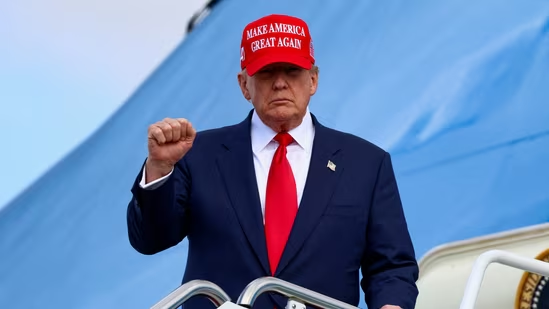
Washington D.C. – President Donald Trump has suggested the United States will resume nuclear weapons testing for the first time in 30 years, marking a dramatic shift in American nuclear policy. Trump announced the decision on social media, stating that nuclear weapons testing would proceed on an “equal basis” with Russia and China. The announcement, which came minutes before his meeting with Chinese President Xi Jinping in South Korea, has raised alarm bells internationally about a potential return to Cold War-era nuclear escalation.

The United States has not conducted nuclear weapons testing since 1992, maintaining a voluntary moratorium that has been observed by virtually all nuclear-armed nations. While the US military regularly tests missiles capable of delivering nuclear warheads, actual detonation of these weapons has remained suspended for three decades.

Trump’s Social Media Declaration

In a post on his Truth Social platform, Trump justified the resumption of nuclear weapons testing by claiming other countries were conducting such tests. “Because of other countries’ testing programs, I have instructed the Department of War to start testing our Nuclear Weapons on an equal basis,” Trump wrote. “That process will begin immediately.”

However, Trump provided few specific details about what the nuclear weapons testing would entail or which countries he believed were actively testing. The announcement appeared to conflate the testing of missile delivery systems with the actual detonation of nuclear warheads, creating confusion among military officials and international observers.

Kremlin Issues Stark Warning

The Kremlin responded swiftly to Trump’s nuclear weapons testing announcement, with spokesman Dmitry Peskov warning that Russia would follow suit if any country abandons the testing moratorium. “If someone abandons the moratorium, Russia will act accordingly,” Peskov stated during a call with reporters.

Peskov referenced earlier warnings from Russian President Vladimir Putin, who had previously indicated Moscow would resume nuclear weapons testing if other nations did so first. The Kremlin spokesman emphasized that while a global ban on nuclear tests remains in place, Russia stands ready to respond in kind to any country that breaks this moratorium.

Confusion Over Trump’s Intent

When Trump spoke to reporters aboard Air Force One while returning to Washington, he appeared to conflate different types of weapons testing. “I see them testing and I say, well, if they’re going to test, I guess we have to test,” Trump told reporters, though he did not specify which countries he was referring to.

Vice Admiral Richard Correll, Trump’s nominee to lead the military command overseeing the nation’s nuclear arsenal, was pressed by senators during his confirmation hearing to interpret the president’s comments on nuclear weapons testing. “I wouldn’t presume that the president’s words meant nuclear testing,” Correll cautiously stated.

Senator Mazie Hirono of Hawaii challenged this interpretation, pointing out, “Well, that’s what he said.” Independent Senator Angus King of Maine suggested Trump might have meant testing of weapons delivery systems rather than actual nuclear weapons testing, though Correll admitted he had no insight into the president’s intent.

Global Treaty Implications

The Comprehensive Nuclear Test Ban Treaty, which the United States signed but never ratified, has been observed since its adoption by all countries possessing nuclear weapons, with North Korea being the only exception. Trump’s announcement of renewed nuclear weapons testing would mark the first time a major nuclear power has broken this informal moratorium in decades.

Also Read: Trump Tariffs Resolution: Senate Passes Bold Bipartisan 51-47 Vote

UN Secretary-General Antonio Guterres strongly condemned Trump’s announcement, warning that “current nuclear risks are already alarmingly high.” Guterres reminded the world of “the disastrous legacy of over 2,000 nuclear weapons tests carried out over the last 80 years.”

Russian Nuclear-Powered Weapons Development

Putin recently announced that Russia tested new atomic-powered and nuclear-capable systems, including the Burevestnik cruise missile and the Poseidon underwater drone. However, Peskov emphasized these tests involved nuclear-powered delivery systems, not actual nuclear weapons testing through warhead detonation. Russia’s last nuclear weapons testing occurred in 1990.

In 2023, Putin signed legislation revoking Russia’s ratification of the global nuclear test ban, claiming parity with the United States was necessary since the US Senate never ratified the treaty.

Chinese Response and Concerns

A Chinese Foreign Ministry spokesperson urged the United States to fulfill its obligations under the Comprehensive Nuclear Test Ban Treaty. “China hopes the U.S. will earnestly fulfill its obligations under the Comprehensive Nuclear Test Ban Treaty and honor its commitment to suspend nuclear testing,” stated Guo Jiakun at a Beijing briefing.

Arms Control Experts Sound Alarm

Daryl Kimball, executive director of the Arms Control Association, sharply criticized Trump’s nuclear weapons testing announcement, calling the president “misinformed and out of touch.” Kimball noted the US has no legitimate reason to resume nuclear explosive testing and estimated it would require at least 36 months to prepare the former Nevada test site for renewed nuclear weapons testing.

Contradictory Messaging on Denuclearization

Despite announcing plans for nuclear weapons testing, Trump told reporters he favors “denuclearization” and “de-escalation,” claiming the US is “actually talking to Russia about that,” though he provided no elaboration.

Conclusion

Trump’s announcement regarding nuclear weapons testing represents a potentially seismic shift in global nuclear policy, threatening to unravel decades of international restraint and risking a new nuclear arms race among major powers.

Trump Tariffs Resolution: Senate Passes Bold Bipartisan 51-47 Vote

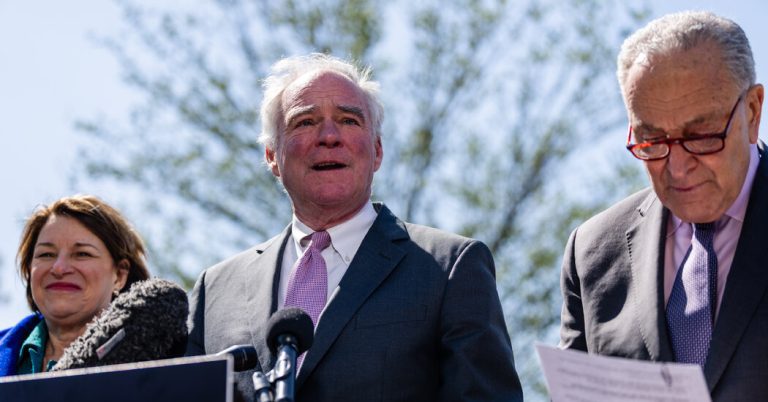
Washington D.C. – In a significant political development, the US Senate has passed a Trump tariffs resolution aimed at ending the President’s controversial trade duties. The resolution, which secured passage with a 51-47 vote, represents the Senate’s third vote this week challenging Trump’s tariff policies. What makes this Trump tariffs resolution particularly noteworthy is the bipartisan support it received, with four Republican senators joining Democrats to oppose their party leader’s signature trade agenda.

The Trump tariffs resolution underscores growing Congressional concern over trade policies that have faced widespread criticism both domestically and internationally. Despite President Donald Trump’s continued promotion of his tariff strategy on the global stage, lawmakers back home are increasingly pushing back against measures they view as economically damaging.

Republican Senators Break Ranks

Four Republican senators demonstrated remarkable political courage by supporting the Trump tariffs resolution alongside their Democratic colleagues. The Republicans who voted for the measure were Senator Lisa Murkowski of Alaska, Senator Susan Collins of Maine, and Kentucky’s Senator Rand Paul and Senator Mitch McConnell.

This cross-party cooperation proved crucial to the resolution’s success, as the narrow 51-47 margin demonstrates. Without these four Republican votes, the Trump tariffs resolution would not have achieved the majority needed for passage. The defection of these senators, particularly former Senate Majority Leader Mitch McConnell, signals deepening fractures within the Republican Party over Trump’s trade approach.

Limitations of the Senate Action

While the Trump tariffs resolution represents a symbolic victory for tariff opponents, it faces substantial obstacles before becoming effective policy. The resolution must still pass through the House of Representatives, where Republican leadership has explicitly refused to bring it to the floor for consideration.

This procedural roadblock means the Trump tariffs resolution, despite its Senate success, may not pose an immediate threat to the President’s trade policies. House Republican leaders remain aligned with Trump’s protectionist vision, creating a firewall against Congressional efforts to dismantle his tariff architecture.

Nevertheless, the Senate vote on the Trump tariffs resolution sends a clear political message about growing Republican dissent on trade issues, potentially influencing future policy debates and the 2026 midterm elections.

Trump’s Asia Trip and China Trade Developments

The passage of the Trump tariffs resolution coincided with President Trump‘s return to Washington following a week-long diplomatic mission across Asia. During this trip, Trump met with Chinese President Xi Jinping amid ongoing trade tensions between the world’s two largest economies.

In what administration officials described as a breakthrough, Trump announced an extension of the trade truce with China. More significantly, he revealed plans to reduce overall tariffs on Chinese imports from 57 percent to 47 percent, representing a 10-percentage-point decrease in duties.

This tariff reduction on Chinese goods comes as the Trump tariffs resolution moves through Congress, creating an interesting juxtaposition between executive action and legislative resistance.

Also Read: Trump Xi Meeting at APEC Summit: Bold Talks to Resolve 100% Tariff Trade War

Supreme Court Challenge Looms

The Trump tariffs resolution gains additional relevance as the Supreme Court prepares to hear arguments next week concerning the fundamental legality of Trump’s tariff program. The court will examine whether the tariffs were lawfully imposed under the International Emergency Economic Powers Act (IEEPA), an emergency-powers statute.

This Supreme Court review could determine whether Trump possessed the constitutional authority to implement his sweeping tariff regime without more explicit Congressional approval. The timing of the Trump tariffs resolution passage, just before this crucial hearing, may influence public perception and potentially the judicial deliberations themselves.

Legal experts anticipate the Supreme Court’s decision could reshape presidential trade authority for generations, regardless of the Trump tariffs resolution’s ultimate fate.

India-US Trade Negotiations Under Pressure

The Trump tariffs resolution also emerges against the backdrop of complex trade negotiations between the United States and India. New Delhi faces steep 50 percent tariffs on Indian imports that took effect in August, with half imposed as penalties for India’s energy trade relationship with Russia.

President Trump has repeatedly claimed that Prime Minister Narendra Modi assured him India would terminate its oil trade with Russia. However, the Indian government has firmly denied any such conversation occurred between the two leaders.

Union Minister Piyush Goyal recently emphasized India’s independent stance, stating that India will not accept any trade agreement “with a gun to our head.” This declaration clarifies that India refuses to succumb to pressure tactics in bilateral negotiations, even as it seeks resolution on tariff issues.

The India-US trade situation demonstrates how the Trump tariffs resolution reflects broader international concerns about American trade policy’s impact on longstanding diplomatic partnerships.

Political Implications Moving Forward

The successful passage of the Trump tariffs resolution, despite its uncertain legislative future, reveals significant political vulnerabilities in Trump’s trade agenda. The bipartisan nature of the vote suggests that protectionist policies may not command universal support even within Republican circles.

As the 2026 midterm elections approach, the Trump tariffs resolution vote could become a referendum point for constituents affected by trade wars, retaliatory tariffs, and increased consumer prices.

Conclusion

The Trump tariffs resolution represents a pivotal moment in American trade policy debates. While procedural hurdles may prevent its immediate implementation, the bipartisan Senate vote signals growing resistance to unilateral executive trade actions. With Supreme Court scrutiny pending and international negotiations ongoing, the future of Trump’s tariff program remains uncertain despite his continued advocacy for protectionist measures.

Mumbai Hostage Crisis: Shocking Rs.2 Crore Payment Dispute Behind Rohit Arya Siege

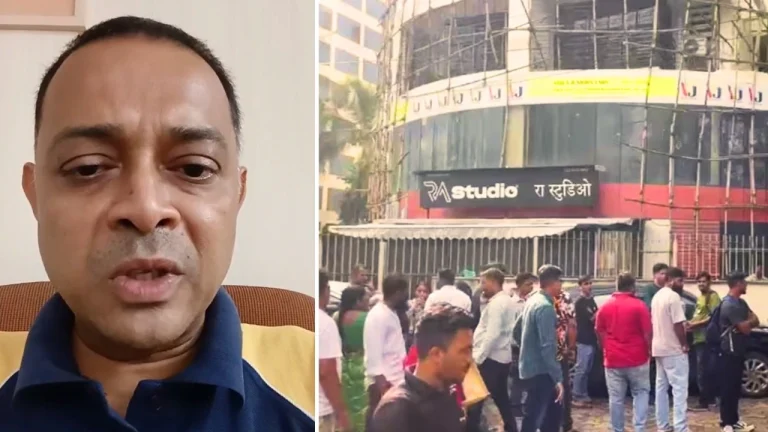
Maharashtra – The Mumbai hostage crisis that unfolded in Powai on Thursday evening shocked the nation when filmmaker and activist Rohit Arya held 17 teenagers hostage at an audition theatre. The siege, which lasted 3.5 hours, ended when police shot Arya during the rescue operation. During the Mumbai hostage crisis, Arya released a video claiming the Maharashtra government owed him ₹2 crore for work completed under a government-approved cleanliness initiative.

Late Thursday evening, the Maharashtra government’s school education department issued a detailed statement addressing the controversy surrounding the unpaid dues that allegedly triggered the Mumbai hostage crisis. The department’s response painted a significantly different picture from Arya’s claims, citing documentation issues and procedural violations.

The Swachhata Monitor Initiative

At the center of the Mumbai hostage crisis was the Swachhata Monitor Program, a cleanliness drive implemented in schools across Maharashtra. Rohit Arya’s firm, Apsara Media Entertainment Network, operated Project Let’s Change under this initiative. The program was first approved in September 2022 through Corporate Social Responsibility (CSR) funding via a government letter.

The initiative received approval for a second time in June 2023, with the government paying ₹9,90,000 to Arya’s company. For the third phase in 2023-24, under the Mukhyamantri Majhi Shala Sundar Shala campaign, the government approved a substantial fund of ₹2 crore to implement Swachhata Monitor Phase-2. However, this is where complications arose that would eventually contribute to the Mumbai hostage crisis.

Government’s Claims About Documentation Issues

According to the education department’s statement, the budget submitted by Arya for the ₹2 crore project lacked proper documentation and supporting materials. The proposal included various components such as advertising costs, management expenses, technical support, and online links for screening the Let’s Change film, but these items were presented without adequate supporting documents.

“Due to these technical gaps, this scheme could not be implemented,” the department stated, explaining why the funds were never released despite the initial approval. The government maintained that Arya was demanding payment without proper documentation, which violated standard government procurement procedures.

Unauthorized Fee Collection Discovered

The situation became more complex when the government discovered that Arya’s firm was charging registration fees directly from schools for participation in Swachhata Monitor 2024-25 through a private website, without government approval. This unauthorized fee collection became a significant point of contention in the dispute that preceded the Mumbai hostage crisis.

Arya had submitted a new proposal requesting ₹2,41,81,000 to implement the Swachhata Monitor 2024-25 initiative across all state schools. While this proposal was under government consideration, authorities learned about the private fee collection scheme.

Government’s August 2024 Directive

On August 23, 2024, the Commissioner of Education in Pune issued specific instructions to Apsara Media Entertainment Network. The company was directed to deposit all amounts collected from schools into a government account. Additionally, Arya’s firm was required to submit a written commitment that it would not charge any fees from schools for the Swachhata Monitor initiative going forward.

Also Read: Maharashtra Doctor Suicide: Shocking New Evidence & Procedural Lapses Exposed

The government stated that only after fulfilling these two conditions would Arya’s proposal for implementing Swachhata Monitor 2024-25 be submitted for approval. However, according to the department, Arya never provided the requisite information, preventing any further action on the matter.

Former Minister’s Personal Intervention

Former state school education minister Deepak Kesarkar revealed that he had personally given money to Rohit Arya after the filmmaker complained about payment defaults. Kesarkar, who served as education minister from 2022 to 2024, convened a meeting with department officials to investigate Arya’s claims.

“It was revealed that he hadn’t submitted the required documents. In government, no department can release funds without proper bills. He was demanding payment without documentation and refused to listen to officials,” Kesarkar explained. The Shiv Sena leader stated that he eventually paid Arya some amount from his personal account “out of humanity.”

Kesarkar also disclosed that Arya had staged a protest outside his home demanding payment, emphasizing that the filmmaker “should have sorted it out with the department instead of taking children hostage.”

Program Discontinuation

The Swachhata Monitor scheme was ultimately discontinued after the Devendra Fadnavis-led government assumed power following the 2024 assembly elections, marking the end of a program that had become synonymous with the tragic Mumbai hostage crisis.

Conclusion

The Mumbai hostage crisis exposed deep-rooted issues in government contractor relationships and payment processing procedures. While Arya claimed ₹2 crore in unpaid dues, the government maintained that proper documentation was never submitted, making payment impossible under established protocols. The tragic incident resulted in the loss of Arya’s life and traumatized 17 young hostages, highlighting the devastating consequences when contractual disputes escalate beyond legal and administrative channels. The Mumbai hostage crisis serves as a grim reminder of the importance of transparent communication and proper documentation in government dealings.

Critical EU Chemical Weapons Restrictive Measures: Ten Nations Align Against Global Threat

The European Union has reinforced its commitment to combating the proliferation and deployment of chemical weapons through a decisive announcement confirming the alignment of ten countries with new chemical armaments restrictive measures. This significant development, formalised through Council Decision (CFSP) 2025/960 on May 20, 2025, represents a unified international response to the ongoing threat posed by chemical weapons development and usage.

chemical weapons restrictive measuresAlso Read: chemical weapons restrictive measures

Others: Rahul Gandhi, PM Modi

Understanding the Chemical Weapons Restrictive Measures Framework

The chemical weapons restrictive measures were adopted by the Council on May 20, 2025, amending Decision (CFSP) 2018/1544, which originally established the EU’s legal framework for addressing chemical weapons proliferation. This comprehensive sanctions regime encompasses travel bans, asset freezes, and prohibitions on providing financial resources to designated individuals and entities involved in chemical weapons activities.

The chemical weapons restrictive measures framework operates under both the EU’s common foreign and security policy and Article 215 of the Treaty on the Functioning of the European Union, creating a thematic sanctions regime designed to counter threats posed by chemical weapons use and proliferation. The dual legal foundation ensures comprehensive enforcement across all European Union member states and participating countries.

The chemical weapons restrictive measures currently apply to twenty-five individuals and six entities, with the latest additions specifically targeting Russian Armed Forces components. These sanctions remain in force until October 16, 2026, demonstrating the European Union’s sustained commitment to addressing this critical security concern.

Countries Aligning With Chemical Weapons Restrictive Measures

Ten nations have formally aligned themselves with the chemical weapons restrictive measures: Albania, Bosnia and Herzegovina, Georgia, Iceland, Liechtenstein, Moldova (Republic of), Montenegro, North Macedonia, Norway, and Ukraine. This alignment requires these countries to ensure their national policies conform to the Council Decision, creating a broader coalition beyond the European Union’s immediate membership.

The participation of Ukraine in these chemical weapons restrictive measures holds particular significance, given that the country has been directly affected by chemical weapons usage documented by international observers. The alignment demonstrates solidarity among nations committed to upholding international law and the principles of the Chemical Weapons Convention.

Each aligning country commits to implementing the chemical weapons restrictive measures within its national legal frameworks, including enforcing travel bans on designated individuals, freezing assets of sanctioned entities, and preventing the provision of financial support to those involved in chemical weapons activities.

Latest Additions to Chemical Weapons Restrictive Measures

The May 2025 Council Decision added three Russian entities to the chemical weapons restrictive measures list: the Radiological Chemical and Biological Defence Troops, the 27th Scientific Centre, and the 33rd Central Scientific Research and Testing Institute of the Ministry of Defence of the Russian Federation. All three entities belong to the Russian Armed Forces and have been implicated in chemical weapons development and deployment.

This decision followed reports from the Organisation for the Prohibition of Chemical Weapons (OPCW) issued in November 2024 and February 2025, which confirmed the presence of riot control agents such as CS (2-Chlorobenzalmalononitrile) and related compounds in samples collected from Ukrainian frontlines. The chemical weapons restrictive measures directly address the use of these agents as methods of warfare, which violates the Chemical Weapons Convention to which Russia is a State Party.

The addition of these entities to the chemical weapons restrictive measures demonstrates the European Union’s responsiveness to verified intelligence and its commitment to holding accountable those entities involved in chemical weapons proliferation and usage.

Screenshot 2025 09 03 alle 15.24.19 e1756906031170.png 2Historical Context of Chemical Weapons Restrictive Measures

The European Council confirmed on March 22, 2018, that the use of chemical weapons, including any toxic chemicals used as weapons under any circumstances, is completely unacceptable, must be systematically and rigorously condemned, and constitutes a security threat to all. This declaration formed the foundation for subsequent chemical weapons restrictive measures.

The Council adopted the legal framework for chemical weapons restrictive measures on October 15, 2018, establishing comprehensive measures against proliferation and use. Since its implementation, the framework has been regularly renewed and expanded to address emerging threats and incorporate new intelligence regarding chemical weapons activities.

The chemical weapons restrictive measures have been progressively strengthened, with previous sanctions targeting individuals and entities involved in various incidents, including the poisoning of Alexei Navalny with Novichok-type nerve agents and the production of chemical weapons delivery systems in Syria.

Role of International Organisations in Supporting Chemical Weapons Restrictive Measures

The European Union is the biggest contributor of voluntary funding to the Organisation for the Prohibition of Chemical Weapons activities, with EU member states’ combined yearly assessed contributions accounting for approximately 25% of the OPCW’s regular annual budget. This financial support reinforces the effectiveness of chemical weapons restrictive measures through enhanced monitoring and verification capabilities.

The OPCW’s technical expertise has been instrumental in documenting violations that trigger chemical weapons restrictive measures. The organisation’s investigation and fact-finding missions provide the evidence base necessary for the European Union to designate individuals and entities for sanctions.

The European Union and OPCW concluded a cooperation agreement in February 2024, establishing a memorandum of understanding that enhances coordination and strategic cooperation. This partnership strengthens the implementation and enforcement of chemical weapons restrictive measures globally.

Impact and Objectives of Chemical Weapons Restrictive Measures

The chemical weapons restrictive measures serve multiple strategic objectives. Primarily, they aim to deter future chemical weapons usage by imposing significant consequences on perpetrators and their supporting infrastructure. The asset freezes and travel bans create tangible obstacles for individuals and entities involved in these activities.

Additionally, the chemical weapons restrictive measures support the full implementation of the Chemical Weapons Convention by demonstrating the international community’s commitment to enforcement. The sanctions complement diplomatic efforts and reinforce global norms against chemical weapons proliferation.

The European Union continuously monitors developments related to chemical weapons, restrictive measures, and can amend the list of designated persons and entities at any time based on new intelligence. This adaptive approach ensures the sanctions remain relevant and effective in addressing evolving threats.

51759488 f17e 411f 9f74 fe34071e9519Conclusion

The alignment of ten countries with the European Union’s chemical weapons restrictive measures represents a significant milestone in international efforts to combat chemical weapons proliferation. These comprehensive sanctions, targeting specific Russian entities involved in chemical weapons development and usage, demonstrate the global community’s unified stance against these prohibited weapons. As the chemical weapons restrictive measures framework continues until October 2026, the international coalition remains vigilant in monitoring compliance and responding to emerging threats, ensuring accountability and deterrence remain at the forefront of global security efforts.

Leadership Crisis at IIM Calcutta: Director and Chairman Clash Over Governance, Innovation-Park Relocation and Tenure Extensions at a Premier B-School

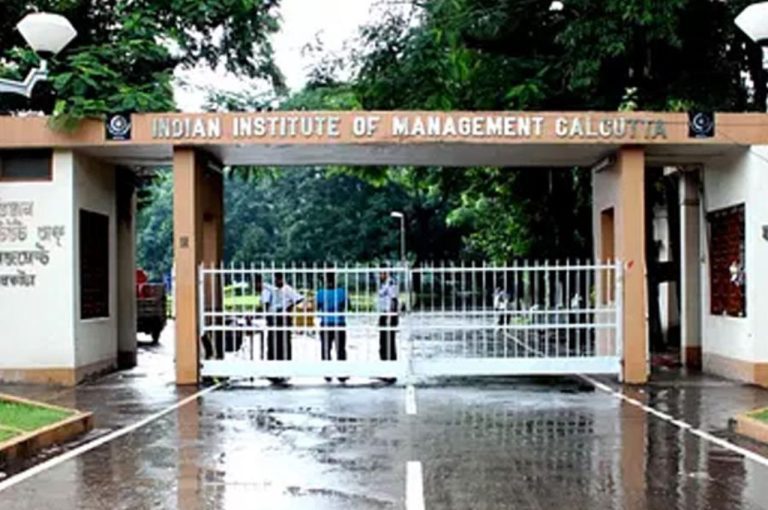
Leadership Crisis at IIM Calcutta: One of India’s leading business schools, IIM Calcutta (located in Joka, Kolkata) is facing a deepening administrative crisis. The newly appointed Director, Alok Kumar Rai, who assumed the role on 30 July 2025, has been reported to have clashed publicly with the Chairman of the Board of Governors (BoG), Shrikrishna G. Kulkarni, over major governance decisions, the relocation of its Innovation Park, accommodation arrangements, and broader institutional autonomy.

Compounding the leadership friction, the Chief Administrative Officer (CAO) of IIM Calcutta, Alok Chandra, has sought voluntary retirement ahead of his scheduled tenure, citing discomfort with the Director’s style of functioning.

The confrontation at the top is not only a sign of internal discord but raises questions about governance, accountability, institutional legacy, regulatory oversight and the ability of India’s elite management institutions to function with stability and transparency.


Leadership Crisis at IIM Calcutta: The Core of the Dispute

Reports indicate that the new Director, Alok Kumar Rai, in a meeting with senior officials of the Ministry of Education in Delhi, expressed frustration about what he perceived as the over-reach of the BoG Chairman and the Board in daily academic and strategic decision-making. In particular, he raised the following grievances:

  • His proposal to relocate the Innovation Park from the Joka campus to a newer campus in New Town was not supported by the Board.
  • The delay in arranging suitable accommodation for him as Director – he has reportedly been without dedicated faculty accommodation for two months, which he considered untenable given the status of the office. His sense of being sidelined in decision-making and lack of institutional support in executing his agenda.

The Board of Governors, chaired by Kulkarni, is alleged to have been making strategic decisions and influencing institutional direction without full consultation of the Director, an arrangement Rai reportedly finds unacceptable. Additionally, Kulkarni’s term as Chairman had already exceeded its regular tenure under the IIM Act and remains a contentious point.

The voluntary retirement request submitted by the CAO, Alok Chandra — two years before the end of his tenure — signals internal unease. Sources suggest Chandra was uncomfortable with the Director’s style and possibly the Board’s decision-making processes. As per one report, the institute has not yet formally accepted Chandra’s request, but the very act of submission raises alarm bells.


Institutional Background & Legacy Issues

IIM Calcutta, established in 1961 as India’s first IIM, has built an enviable reputation in management education, research and thought-leadership. However, the institution has in recent years seen recurring episodes of leadership instability. For example, former Director Anju Seth resigned in March 2021 after reportedly clashing with the Board; the institution dismissed her resignation in the public-domain statement as a matter of “receipt of letter”.

A 2024 review noted that IIM Calcutta had changed directors three times in three years and still lacked permanent leadership in some strategic places.

These patterns contribute to systemic concerns: delayed appointments of deans, pending recruitment of senior faculty, incomplete strategic projects such as the Innovation Park, and a sense among some faculty and students of diminished institutional momentum.

Against this backdrop, the current clash acquires added gravity. At a time when management institutions are expected to lead innovation, global engagement, and academic agility, internal governance disruption can erode institutional credibility, affect faculty morale, hamper student outcomes and undermine international positioning.


Key Governance Questions & Tensions

There are several pivotal governance questions emerging from the inside of IIM Calcutta’s leadership crisis:

1. Role Clarity between Director and Board
Under the IIM Act, the Director is the chief academic and executive officer of the institute, while the Board of Governors provides strategic oversight and maintains fiduciary responsibility. When the Board and the Director are perceived to be in conflict about major decisions—such as the relocation of innovation infrastructure—the risk is a breakdown in institutional functioning.

For example, the Board’s decision to approve a new Director’s residence via CPWD, while not yet completing interim accommodation arrangements, raised serious questions of implementation delays. The Director views his accommodation as essential to fulfil his administrative role. The Board claims that arrangements consistent with prior practice have been made.

2. Tenure and Legitimacy of the Chairman
The Chairman of the Board, Shrikrishna G. Kulkarni, had completed his regular term in 2022. The ministry of education had directed IIMs to extend the term by one year until the Search-cum-Selection Committee procedures are finalised—though the IIM Act (including its 2023 amendment) makes no provision for such extensions. Most IIMs, including IIM Calcutta, complied with the directive. This irregularity has been flagged as undermining institutional legitimacy.

The clash centres partly on whether decisions taken by an ‘over-tenured’ Chairman might have legitimacy. When institutional rules are put aside in favour of ad hoc extensions, power imbalances can emerge.

3. Strategic Project Disagreements: The Innovation Park Shift
One of the flashpoints is the relocation of the Innovation Park—which supports industry-linked research, start-ups and technology transfer—from Joka to New Town. The Director argues the move is critical for infrastructure synergy, access to industry, and branding. The Board, however, is cautious or has not formally approved it at the “competent authority” level. The disagreement over this major infrastructure shift reflects differences in vision and perhaps power. 4. Administrative Stability: CAO’s Early Exit
The early retirement request of the CAO, Alok Chandra, raises questions about internal discontent, executive support for leadership, and stability of the administration. The CAO is key to operations, and his departure ahead of term may impact institutional continuity.

5. Faculty, Deans and Program Appointments
In recent years, IIM Calcutta has reportedly lagged in filling senior faculty and dean positions. Change in leadership often delays such decisions; this time around the standoff may further slow down recruitment, research funding, curriculum innovation and student placement processes.


Stakeholder Perspectives

From the Director’s Office
Rai, as director, emphasises stakeholder inclusion, strategic innovation and institutional positioning. While he has publicly laid out his agenda centred around “integration, innovation, inclusion, internationalisation and Indianness”, he perceives a lack of procedural support and decision‐making autonomy. He reportedly described his interaction with the Board to ministry officials as “frustrating”.

From the Board/Chairman’s Office
The Board, through its statement, argued that normal governance procedures are being followed. The Institute stated that “the regular functioning of the Director follows the directives and procedures as laid down in the IIM Calcutta Regulations, which have been duly approved by the Ministry of Education.” The Board further noted that the proposal for relocation of the Innovation Park “has not been formally placed before the competent authorities at this stage.”

From Faculty and Staff
While the institution continues its academic functioning—welcoming new doctoral batches and other academic programmes—some faculty and insiders claim that the leadership uncertainty is dampening morale. According to past reviews, confusion around deans’ appointments and strategic projects has already eroded faculty confidence.

From the Ministry of Education / Government Oversight
The Ministry has reportedly stepped in to defuse the situation. Senior officials met with the Director in Delhi for two hours and explored options to stabilise the campus leadership crisis. The government has also reportedly indicated that it does not wish the Director to resign at this juncture.


Impact on Institutional Reputation & Functioning

IIM Calcutta is a marquee institution, with national and international rankings, extensive alumni networks, and industry partnerships. Leadership instability carries several risks:

  • Research & Funding – Uncertainty at the top may deter large grants, industry collaborations and innovation ecosystem engagement.
  • Student Recruitment & Placements – High-ranking B-schools rely on brand stability; news of governance discord may affect applications and recruiter confidence.
  • Faculty Retention & Hiring – Senior faculty seek stable, well-governed environments; repeated leadership changes impact institutional attractiveness.
  • Vision & Strategy Execution – Major initiatives like the Innovation Park or international centres require sustained leadership; governance disagreements can derail them.
  • Regulatory Risk – If governance practices deviate from statutorily prescribed norms (e.g., tenure extensions, decision-making process), regulatory bodies may intervene, affecting autonomy and credibility.

Governance Norms & Regulatory Framework

Under the IIM Act, 2017 (and subsequent amendments), the following are relevant:

  • The Director is appointed by the Visitor (President of India) on the recommendation of the Search-cum-Selection Committee.
  • The Board of Governors is the apex governing body for each IIM; it includes the Chairman, Director, faculty member(s), financial expert(s), industry representative(s) and government nominee(s).
  • Tenures of Chairpersons and Directors are regulated—any deviation without statutory basis can raise legal and governance issues.

In the present case, the extension of the Chairman’s term beyond four years without legislative basis prompts scrutiny. Also, decisions such as relocation of major infrastructure projects and acquisition of accommodation for the Director should adhere to institutional regulations, CPWD procedures, budgetary approvals and Board oversight.

Governance experts argue that elite institutions must combine academic freedom with transparent processes, clear accountability, and timely leadership transitions. When personal power or unilateral decision-making takes precedence, it may undermine institutional ethos.


Comparative Context: Leadership Storms in IIMs

IIM Calcutta is not unique in facing leadership turbulence. Other IIMs have had clashes between Directors and Boards, delays in deanships, and disagreements over strategic direction. For example, IIM Calcutta’s own earlier director Anju Seth resigned after months of friction with the Board.

Observers say that as IIMs evolve into global brand-entities, the traditional governance model (faculty-led, board-supported) is under strain from increasing demands: global accreditation, corporate partnerships, commercialization, and expansion into multiple campuses. Without smooth governance, even top institutions can falter.


The Road Ahead: What Must Be Resolved

For the crisis to be resolved and the institution to regain momentum, several actions appear necessary:

  • Clear resolution of Director-Board relationship – A definitive governance charter outlining roles, decision rights, meeting protocols and conflict resolution mechanisms.
  • Completion of major appointments and projects – Filling the CAO role definitively, proceeding with deans’ appointments, and formally approving or shelving the relocation of the Innovation Park.
  • Restoration of leadership stability – Ensuring the Director is supported with appropriate accommodation, administrative infrastructure and decision-making authority.
  • Regulatory compliance – Ensuring the Chairman’s tenure is regularised or replaced, aligning with the IIM Act and Ministry guidelines to avoid perception of ad-hoc extensions.
  • Communication and stakeholder reassurance – Faculty, students, industry partners and alumni need a stable roadmap so they can invest trust in the institution’s future.
  • Governance audit or independent review – Given repeated leadership churn, an external review of governance practices, faculty recruitment, project implementation and Board engagement may strengthen institutional resilience.

Conclusion

The leadership turmoil at IIM Calcutta underscores how even premier institutions are vulnerable to governance lapses, power struggles and procedural ambiguity. The clash between Director Alok Kumar Rai and Chairman Shrikrishna Kulkarni is symptomatic of deeper tensions between tradition and transformation, oversight and execution, strategy and control.

For IIM Calcutta, the stakes are not just internal. The brand, the alumni legacy, student outcomes, industry partnerships and global reputation all hinge on institutional coherence and stable leadership. If the governance crisis persists, the institution risks not only reputational damage but strategic drift, lost opportunities and faculty decline.

On the other hand, if the current impasse is swiftly resolved through transparent processes, strong leadership and a clear strategic roadmap, IIM Calcutta can regain its footing and perhaps emerge stronger—reinforced by introspection and reform.

As the education ecosystem in India becomes more competitive and globally connected, governance challenges of this scale must be taken seriously. Institutions cannot rest on legacy alone; they must match governance to ambition, and administration to vision.

The next few months at IIM Calcutta will thus be critical. Whether the governing board and the Director can find common ground—or whether external intervention will force a reset—remains to be seen. But for the students, faculty, alumni and broader management-education ecosystem, the direction this institution takes now may signal more than just one leadership change—it may reflect the future of governance in India’s elite educational institutions.


External Links for Context and Reference

Also read: Home | Channel 6 Network – Latest News, Breaking Updates: Politics, Business, Tech & More

Cyclone Montha Weakens After Landfall But Brings Torrential Rains Across Bengal and Neighbouring States: IMD Issues Heavy Rainfall Warnings, Advises Vigilance

Cyclone Montha: After a tense week of weather alerts and coastal preparedness, Cyclone Montha — which struck India’s eastern coast on October 28, 2025 — has now weakened significantly following landfall in Andhra Pradesh. Despite losing strength, its remnants continue to unleash heavy rainfall, gusty winds, and local flooding across parts of West Bengal, Odisha, Bihar, Jharkhand, and northeastern India.

The India Meteorological Department (IMD) confirmed that the cyclone, which was initially classified as a severe cyclonic storm, has degraded into a well-marked low-pressure area as it moves inland. However, the lingering system remains moisture-heavy, posing risks of flash floods, waterlogging, and landslides — particularly in north Bengal and the hilly regions.


🌊 Formation and Path of Cyclone Montha

Cyclone Montha originated as a low-pressure area over the Bay of Bengal earlier this week. It gradually intensified under warm sea-surface temperatures and favourable wind patterns. The system made landfall between Machilipatnam and Kalingapatnam along the Andhra coast late on October 28, with wind speeds reaching up to 110 km/h.

After hitting land, the cyclone moved north-northwestward, crossing southern Odisha before entering Chhattisgarh and Jharkhand. By October 30, it had weakened into a low-pressure system, but its outer rain bands continued to impact West Bengal, resulting in widespread showers and thunderstorms across the state.

According to the IMD’s Kolkata Regional Meteorological Centre, the system will continue to affect the state till Saturday evening, especially the north Bengal districts of Jalpaiguri, Alipurduar, Darjeeling, and Cooch Behar.

🔗 For live updates, visit the official IMD page: https://mausam.imd.gov.in/


Impact on West Bengal: Heavy Rains and Local Disruptions

Although West Bengal escaped a direct hit, the cyclone’s moisture-laden remnants have blanketed the state in heavy rainfall.

  • South Bengal: Kolkata, Howrah, South 24 Parganas, and East Midnapore recorded moderate to heavy showers accompanied by thunder. The city witnessed intermittent rainfall since Wednesday night, measuring around 8 mm in Alipore within 24 hours.
  • North Bengal: IMD issued orange alerts for Darjeeling, Jalpaiguri, Alipurduar, and Cooch Behar, warning of very heavy rainfall (7–20 cm) and possible landslides in hilly areas.
  • Rivers and Drainage: The Subarnarekha, Jalangi, and Teesta rivers are flowing close to warning levels in several regions, prompting district administrations to keep rescue teams on alert.
  • Agricultural Impact: Continuous rainfall may damage paddy, jute, and vegetable crops nearing harvest season, particularly in Murshidabad, Nadia, and North 24 Parganas.

The Kolkata Municipal Corporation (KMC) has deployed emergency teams to address waterlogging, particularly in Behala, Dum Dum, and Salt Lake sectors.

🔗 Follow WB Disaster Management updates: https://wbdmd.gov.in/


🌀 IMD Alerts and Forecasts

The India Meteorological Department (IMD) has issued the following warnings for West Bengal and nearby regions:

  • Orange Alert (Heavy Rainfall): North Bengal districts — Darjeeling, Jalpaiguri, and Alipurduar.
  • Yellow Alert (Moderate Rainfall): South Bengal districts — Kolkata, Hooghly, East Midnapore, and Nadia.
  • Thunderstorm Warning: Isolated lightning and gusty winds (up to 50 km/h) likely over Gangetic Bengal.

The Bay of Bengal remains turbulent, with waves reaching 2.5–3 metres, leading to fishing restrictions along the coastal belts of East Midnapore and South 24 Parganas. Fishermen have been advised not to venture into the sea until further notice.

🔗 IMD Cyclone Bulletin: https://rsmcnewdelhi.imd.gov.in/


🚨 Government and Administrative Response

The West Bengal government has activated control rooms in all coastal and hill districts to coordinate disaster management operations.

  • NDRF and SDRF teams have been stationed in South 24 Parganas, Jalpaiguri, and Darjeeling.
  • Electricity restoration units are on standby to address power outages due to fallen trees or waterlogging.
  • The State Irrigation Department has started round-the-clock monitoring of river embankments, particularly in the Sundarbans delta.
  • The Education Department has advised schools in heavy rainfall zones to suspend classes temporarily.

Chief Minister Mamata Banerjee reviewed the situation through a high-level meeting with state officials, directing them to ensure that no loss of life or major property damage occurs. Relief materials, including tarpaulins, food grains, and medicine kits, have been pre-positioned in vulnerable areas.

🔗 Government of West Bengal Official Portal: https://wb.gov.in/


🌾 Economic and Agricultural Impacts

The cyclone’s passage has caused considerable agricultural stress, especially in the Gangetic plains of Bengal:

  • Paddy and Jute Fields: Many farmers fear water stagnation may destroy crops ready for harvest.
  • Vegetable Markets: Supply disruptions have caused price fluctuations in tomatoes, potatoes, and green chillies across Kolkata and suburban markets.
  • Fisheries: The fishing ban along the coast has impacted over 20,000 fishermen, halting daily income temporarily.

Economists estimate that the state’s short-term agricultural loss could cross ₹150 crore, depending on the duration of the rainfall and floodwater drainage.

🔗 Agriculture Weather Updates: https://agricoop.nic.in/


🌍 Neighbouring States Also Affected

Cyclone Montha’s weakening core has spread widespread rainfall beyond Bengal:

  • Odisha: Heavy downpour in Gajapati, Ganjam, and Rayagada districts; minor landslides reported.
  • Bihar and Jharkhand: Heavy showers and strong winds in Ranchi, Hazaribagh, and Patna regions.
  • Northeast India: Parts of Assam and Meghalaya likely to receive intense rainfall till Sunday.

The National Disaster Response Force (NDRF) and state agencies are on standby across all affected states to assist with rescue and relief operations if required.

🔗 National Disaster Management Authority: https://ndma.gov.in/


🧠 Climate Context: A Growing Pattern

Cyclone Montha’s behaviour — rapid intensification, followed by inland persistence — highlights India’s evolving climate risks. Experts note that:

  • The Bay of Bengal has witnessed a 40% increase in pre- and post-monsoon cyclones over the past two decades.
  • Rising sea-surface temperatures and moisture-rich air currents contribute to more unpredictable rainfall post-landfall.
  • The prolonged impact over inland states like Jharkhand and Chhattisgarh mirrors recent storms such as Cyclone Yaas (2021) and Cyclone Mocha (2023).

Environmentalists argue that the frequency of such cyclones is a wake-up call for climate adaptation and urban drainage planning, particularly in Kolkata’s ageing stormwater systems and north Bengal’s fragile slopes.

🔗 Indian Institute of Tropical Meteorology: https://www.tropmet.res.in/


🏠 Safety Advisory for Citizens

Authorities have urged citizens to remain cautious until conditions stabilise:

  1. Avoid unnecessary travel, especially in flood-prone or hilly areas.
  2. Keep emergency kits ready, including torches, batteries, drinking water, and first aid.
  3. Stay indoors during thunderstorms and avoid contact with electrical poles or waterlogged streets.
  4. Do not attempt to cross flooded roads or streams.
  5. Follow official updates only from IMD and state departments.

🔗 Disaster Preparedness Guide: https://ndma.gov.in/en/floods


🌤️ Forecast: What Lies Ahead

According to the latest IMD update, the remnants of Montha will continue to cause scattered rain till Saturday night, after which the weather is expected to gradually improve across southern Bengal.

  • Sunday onward, skies are likely to clear, though humidity may rise sharply due to lingering moisture.
  • North Bengal, however, may continue to experience intermittent rain due to the interaction of the weakening system with Himalayan air currents.

Meteorologists predict that another low-pressure system may form over the Andaman Sea by mid-November, though it is too early to determine its intensity.

🔗 Long-range forecast portal: https://mausam.imd.gov.in/imd_latest/contents/extended_forecast.php


📜 Conclusion: A Reminder of Preparedness

While Cyclone Montha may have lost its intensity, its aftermath serves as a reminder that post-landfall systems can still bring severe secondary impacts. West Bengal’s proactive response — timely warnings, disaster teams, and communication outreach — has so far prevented large-scale destruction.

As Bengal transitions into November, a period of relatively stable weather is expected. However, with climate patterns changing rapidly, the state’s coastal and hill ecosystems remain under threat. The need for sustainable drainage, better coastal defences, and disaster education has never been more urgent.

For now, residents can look forward to improving weather by Sunday — but remain cautious, prepared, and informed.


🔗 External Reference Links (Official and Verified Sources)

Also read: Home | Channel 6 Network – Latest News, Breaking Updates: Politics, Business, Tech & More