Wednesday, March 4, 2026
Home Blog Page 37

Darjeeling Birthday Celebration 2026 – First‑Ever Event at Lloyd’s Cemetery, Social Activism, and Governance Lessons in Heritage Preservation

The Darjeeling birthday celebration 2026 marks a historic moment for the hill town. For the first time, social activists organized an event at Lloyd’s Cemetery, commemorating the founding of Darjeeling as a hill station. This symbolic celebration highlights the town’s colonial past, cultural diversity, and evolving identity.

The initiative underscores the intersection of heritage preservation, social activism, and governance accountability, where communities reclaim history to strengthen cultural pride and tourism.


2. Darjeeling Birthday Celebration 2026: The Event

  • Venue: Lloyd’s Cemetery, Darjeeling.
  • Organizers: Local social activists and heritage enthusiasts.
  • Objective: Celebrate Darjeeling’s “birthday” as a town, acknowledging its colonial origins and cultural journey.
  • Significance: First‑of‑its‑kind event, blending history, community, and activism.

3. Why This Case Matters

  • Cultural pride: Reinforces Darjeeling’s identity as a heritage town.
  • Tourism potential: Adds a new dimension to Darjeeling’s attractions.
  • Governance accountability: Citizens expect support for heritage initiatives.
  • Public trust: Handling of heritage events influences confidence in institutions.

4. Political and Social Reactions

  • Local government: Welcomed initiative as part of cultural tourism.
  • Civil society: Expressed optimism about heritage preservation.
  • Opposition voices: Called for more structural reforms beyond symbolic events.
  • Observers: Noted potential for initiative to reshape narratives on heritage governance in Bengal.

5. Governance Challenges

The Darjeeling birthday celebration reflects systemic governance issues:

  • Heritage preservation: Need for restoration of colonial sites.
  • Tourism management: Balancing cultural events with ecological sustainability.
  • Administrative accountability: Transparency in heritage funding is essential.
  • Judicial oversight: Courts may intervene if heritage sites are endangered.

6. Community Concerns

  • Families: Seek clarity on how heritage events benefit livelihoods.
  • Youth: Demand fair opportunities in tourism and cultural industries.
  • Civil society groups: Call for participatory governance in heritage policy.
  • Opposition voices: Warn of marginalisation if initiatives remain symbolic.

7. Government External Links for Assistance


8. Historical Context of Darjeeling

  • 1800s: Darjeeling developed as a hill station under British colonial rule.
  • 1900s: Became famous for tea, tourism, and education.
  • 2000s: Heritage debates intensified over preservation of colonial sites.
  • 2026: First‑ever birthday celebration reflects continuity of efforts to reclaim history.

9. Global Comparisons

Similar heritage celebrations worldwide:

  • UK: Town anniversaries celebrated with heritage walks.
  • USA: Cities commemorate founding days with cultural festivals.
  • Japan: Heritage towns celebrate anniversaries with community rituals.

India’s case mirrors these global practices where heritage celebrations collide with governance, community welfare, and accountability.


10. Governance Lessons

The Darjeeling birthday celebration teaches:

  • Transparency in heritage initiatives builds credibility.
  • Community engagement ensures legitimacy of reforms.
  • Balanced vigilance strengthens governance legitimacy.
  • Judicial oversight protects fairness in heritage governance.

11. Future Outlook – Heritage Governance in Darjeeling

India must move towards:

  • Digitised monitoring systems for heritage sites.
  • Public dashboards showing progress of restoration projects.
  • Independent audits of heritage funding.
  • Educational campaigns linking heritage with civic responsibility.

✅ Conclusion

The Darjeeling birthday celebration 2026 is more than a symbolic event—it is a test of India’s democratic resilience and governance credibility. As social activists organize the first‑ever commemoration at Lloyd’s Cemetery, ordinary citizens await clarity on whether governance will deliver transparency, fairness, and respect for heritage dignity. For Darjeeling, the lesson is clear: democracy thrives when governance delivers inclusivity and accountability in heritage management.

Also read: Home | Channel 6 Network – Latest News, Breaking Updates: Politics, Business, Tech & More

Sundarbans Gender Role Experiment 2026 – Cooking and Kabaddi as Tools of Social Change, Youth Empowerment, and Governance Lessons in Equality

The Sundarbans gender role experiment 2026 has attracted attention for its innovative approach to challenging stereotypes. By encouraging boys to cook and girls to play kabaddi, the initiative aims to dismantle rigid gender norms in one of India’s most traditional regions. This experiment is not just about sports or culinary skills—it is about reshaping mindsets, empowering youth, and promoting equality.


2. Sundarbans Gender Role Experiment 2026: The Experiment

  • Activities: Boys are trained in cooking, while girls are encouraged to play kabaddi.
  • Objective: Break stereotypes that assign domestic work to women and physical sports to men.
  • Community involvement: Local schools, NGOs, and families are participating.
  • Significance: Reflects broader efforts to promote gender equality in rural India.

3. Why This Case Matters

  • Youth empowerment: Encourages confidence and skill development among girls.
  • Cultural shift: Challenges centuries‑old stereotypes in conservative communities.
  • Governance accountability: Citizens expect support for gender equality initiatives.
  • Public trust: Handling of experiment influences confidence in institutions.

4. Political and Social Reactions

  • Local government: Welcomed initiative as part of social development.
  • Civil society: Expressed optimism about long‑term impact.
  • Opposition voices: Called for more structural reforms beyond symbolic experiments.
  • Observers: Noted potential for initiative to reshape narratives on gender equality in Bengal.

5. Governance Challenges

The Sundarbans experiment reflects systemic governance issues:

  • Education gaps: Need for curriculum reforms to include gender equality.
  • Resource allocation: Ensuring adequate facilities for sports and training.
  • Administrative accountability: Transparency in implementation is essential.
  • Judicial oversight: Courts may intervene if rights to equality are violated.

6. Community Concerns

  • Families: Seek clarity on how experiment benefits children’s futures.
  • Youth: Demand fair opportunities in both domestic and athletic skills.
  • Civil society groups: Call for participatory governance in gender policy.
  • Opposition voices: Warn of marginalisation if initiatives remain symbolic.

7. Government External Links for Assistance


8. Historical Context of Gender Role Reforms in India

  • 2000s: Campaigns focused on education for girls.
  • 2010s: Sports initiatives encouraged female participation.
  • 2020s: Social experiments began challenging stereotypes in rural areas.
  • 2026: Sundarbans experiment reflects continuity of efforts to promote equality.

9. Global Comparisons

Similar gender role experiments worldwide:

  • Japan: Boys encouraged to learn cooking in schools.
  • Africa: Girls promoted in football and athletics to break stereotypes.
  • Europe: Gender‑neutral education policies challenge traditional roles.

India’s case mirrors these global practices where social experiments collide with governance, community welfare, and accountability.


10. Governance Lessons

The Sundarbans experiment teaches:

  • Transparency in social initiatives builds credibility.
  • Community engagement ensures legitimacy of reforms.
  • Balanced vigilance strengthens governance legitimacy.
  • Judicial oversight protects fairness in gender governance.

11. Future Outlook – Gender Equality Governance in India

India must move towards:

  • Digitised monitoring systems for gender equality initiatives.
  • Public dashboards showing progress of social experiments.
  • Independent audits of gender programs.
  • Educational campaigns linking equality with civic responsibility.

✅ Conclusion

The Sundarbans gender role experiment 2026 is more than a social experiment—it is a test of India’s democratic resilience and governance credibility. As boys cook and girls play kabaddi, ordinary citizens await clarity on whether governance will deliver transparency, fairness, and respect for equality. For India, the lesson is clear: democracy thrives when governance delivers inclusivity and accountability in gender management.


Also read: Home | Channel 6 Network – Latest News, Breaking Updates: Politics, Business, Tech & More
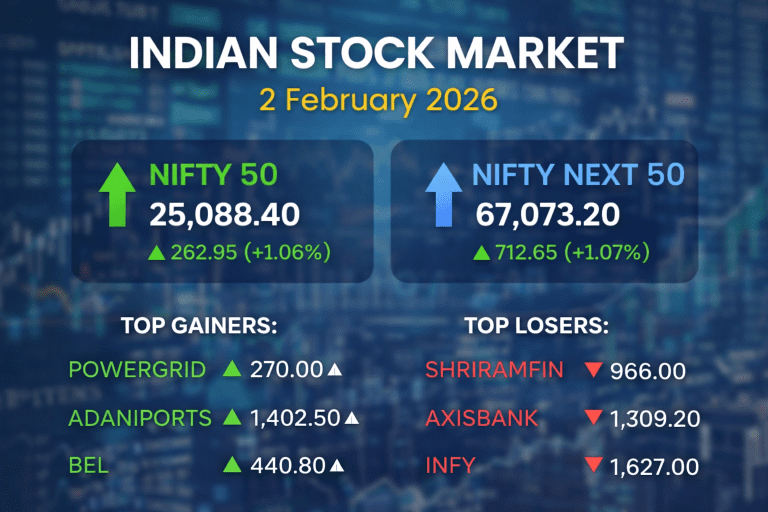
2 February 2026: Indian Markets Rebound as Nifty 50 Rallies Over 1%; Power and Infra Stocks Lead the Charge

Indian equity markets staged a strong rebound on Monday, 2 February 2026, with benchmark indices closing firmly in the green, supported by broad-based buying in power, infrastructure, and select PSU stocks. Positive sentiment around capital expenditure–led growth and bargain hunting after recent volatility helped lift market confidence through the session.

Also Read: 1 February 2026: Indian Markets End Sharply Lower as Nifty 50 Slides Nearly 2%; Broad-Based Sell-Off Drags Financials and PSUs


Benchmark Performance: Nifty Posts Solid Gains

The Nifty 50 ended the session at 25,088.40, rising 262.95 points (1.06%). The index opened at 24,796.50, climbed to an intraday high of 25,108.10, and touched a low of 24,679.40, indicating sustained buying interest throughout the day.

Other key indices also closed higher:

  • Nifty Next 50 surged 1.07% to 67,073.20, reflecting strong participation in broader markets.

  • 2 February 2026Nifty Financial Services gained 0.37% to 26,799.00.

  • Nifty Bank added 0.35% to 58,619.00, though private banks underperformed select PSU names.


Market Breadth: Advances Outpace Declines

Market breadth remained positive, with advances clearly outnumbering declines. Heavy trading volumes in select large-cap and PSU stocks suggested institutional accumulation, particularly in sectors linked to infrastructure, defence, and utilities.


Top Gainers: Power, Ports and PSUs Outperform

Several stocks delivered sharp gains on strong volumes:

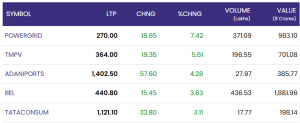
  • Power Grid Corporation of India jumped 7.42% to ₹270.00, emerging as the top gainer amid strong interest in power transmission plays.

  • TMPV rose 5.61% to ₹364.00, backed by heavy trading activity.

  • Screenshot 2026 02 02 223530Adani Ports and Special Economic Zone advanced 4.28% to ₹1,402.50, tracking optimism around logistics and trade-linked infrastructure.

  • Bharat Electronics Limited gained 3.63% to ₹440.80, continuing its positive momentum amid defence-sector tailwinds.

  • Tata Consumer Products climbed 3.11% to ₹1,121.10, supported by steady buying in consumption-focused names.


Top Losers: Financials and IT Face Profit-Taking

Despite the broader rally, select stocks closed lower due to profit-booking:

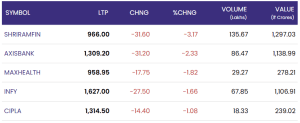
  • Shriram Finance slipped 3.17% to ₹966.00, the steepest decline among frontline stocks.

  • Axis Bank fell 2.33% to ₹1,309.20, weighing on the banking pack.

  • Screenshot 2026 02 02 223539Max Healthcare Institute declined 1.82% to ₹958.95 after recent gains.

  • Infosys eased 1.66% to ₹1,627.00, as IT stocks remained under pressure.

  • Cipla edged down 1.08% to ₹1,314.50.


What Drove Today’s Rally

The rebound was led by PSU-heavy sectors, particularly power, defence, and infrastructure, as investors rotated into stocks with visibility on government-led capex and order inflows. While financials and IT saw selective weakness, overall sentiment improved as buying broadened beyond index heavyweights.


Conclusion: 2 February 2026

The Nifty 50’s over 1% gain signals a return of confidence after recent volatility, with investors selectively accumulating infrastructure and PSU-linked stocks. While pockets of profit-taking persist in banks and IT, the broader market tone has turned constructive. Near-term direction will hinge on sector rotation, earnings cues, and sustained institutional participation.

For real time stock Updates, visit NSE website.

Siliguri to Varanasi High Speed Corridor 2026 – Detailed Analysis of Union Budget Inclusion, Regional Growth Potential, and Governance Lessons in Connectivity

The Siliguri to Varanasi high speed corridor 2026 has emerged as one of the most significant infrastructure announcements in the Union Budget. By linking North Bengal’s Siliguri with Uttar Pradesh’s Varanasi, the project promises to transform trade, tourism, and regional integration. While stakeholders welcome the inclusion, critics argue that Bengal still lacks a broader special package for its industries, leaving questions about regional equity.

This development underscores the intersection of infrastructure, governance accountability, and regional development, where connectivity projects are framed as engines of growth but also spark debates about fairness in budget allocations.


2. Siliguri to Varanasi High Speed Corridor 2026: The Project

  • Type: High‑speed rail / connectivity corridor.
  • Budget inclusion: Announced in Union Budget 2026.
  • Strategic importance: Connects Siliguri (gateway to Northeast India) with Varanasi (cultural and economic hub).
  • Economic impact: Expected to benefit tea, tourism, textiles, and logistics sectors.
  • Political undertone: Seen as growth‑oriented but lacking a Bengal‑specific package.

3. Why This Case Matters

  • Economic growth: Corridor could reduce freight costs and boost exports.
  • Tourism: Easier travel to Darjeeling, Dooars, and Varanasi.
  • Governance accountability: Citizens expect clarity on project implementation.
  • Public trust: Handling of corridor influences confidence in institutions.

4. Political and Social Reactions

  • Bengal government: Welcomed project but demanded more industry‑specific support.
  • Uttar Pradesh government: Highlighted Varanasi’s role as a cultural hub.
  • Opposition voices: Criticised budget for ignoring Bengal’s tea and jute industries.
  • Civil society: Expressed mixed views—some see corridor as progress, others as insufficient.

5. Governance Challenges

The corridor reflects systemic governance issues:

  • Regional equity: Balancing national projects with state‑specific packages.
  • Land acquisition: Ensuring fair compensation for affected communities.
  • Environmental risks: Himalayan terrain poses challenges for construction.
  • Administrative accountability: Transparency in project timelines is essential.

6. Community Concerns

  • Families: Seek job creation through construction and operations.
  • Youth: Demand fair opportunities in logistics and tourism.
  • Civil society groups: Call for participatory governance in project planning.
  • Opposition voices: Warn of marginalisation if industries remain unsupported.

7. Government External Links for Assistance


8. Historical Context of Connectivity Projects

  • 2000s: National corridors focused on Delhi–Mumbai and Chennai–Bengaluru.
  • 2010s: Northeast India demanded better connectivity.
  • 2020s: Political debates intensified over regional equity in infrastructure.
  • 2026: Siliguri–Varanasi corridor reflects continuity of efforts to integrate eastern India.

9. Siliguri to Varanasi High Speed Corridor 2026: Global Comparisons

Similar connectivity projects worldwide:

  • China: High‑speed rail corridors drive regional growth.
  • Japan: Shinkansen links boost tourism and trade.
  • EU: Cross‑border corridors integrate economies.

India’s case mirrors these global practices where connectivity projects are framed as growth drivers but often spark debates on regional fairness.


10. Governance Lessons

The Siliguri–Varanasi corridor teaches:

  • Transparency in project planning builds credibility.
  • Community engagement ensures legitimacy of reforms.
  • Balanced vigilance strengthens governance legitimacy.
  • Judicial oversight protects fairness in infrastructure governance.

11. Future Outlook – Connectivity Governance in India

India must move towards:

  • Digitised monitoring systems for corridor projects.
  • Public dashboards showing progress of construction.
  • Independent audits of infrastructure spending.
  • Educational campaigns linking connectivity with civic responsibility.

✅ Conclusion

The Siliguri–Varanasi high‑speed corridor 2026 is more than a budget announcement—it is a test of India’s democratic resilience and governance credibility. As the project promises growth for Bengal and Uttar Pradesh, ordinary citizens await clarity on whether governance will deliver transparency, fairness, and respect for regional dignity. For India, the lesson is clear: democracy thrives when governance delivers inclusivity and accountability in connectivity management.

Also read: Home | Channel 6 Network – Latest News, Breaking Updates: Politics, Business, Tech & More

Bengal Budget Debate 2026 – Samik Bhattacharya Rejects Bihar Comparison, Highlights Allocations for Jute, Handloom and Metro Projects

Bengal Budget Debate 2026: Bengal BJP president Samik Bhattacharya has defended the Union Budget 2026, arguing that West Bengal has received significant allocations and should not be compared with Bihar, which got a special package last year. His remarks come amid criticism that the budget lacked a Bengal‑specific package, with opposition parties framing it as neglect of the state.


📰 Key Highlights of Bhattacharya’s Defense

  • Comparison with Bihar rejected: Bhattacharya said Bihar’s special package in 2025 was unique and linked to its production of makhana and other local industries.
  • Allocations for Bengal: He pointed to funds for jute, handloom, girls’ hostels, freight corridors, and three Metro projects in Kolkata, stressing that Bengal has not been ignored.
  • Growth‑oriented budget: He described the Union Budget as focused on infrastructure and national development, not on state‑specific appeasement.
  • Political undertone: His defense comes as opposition parties accuse the BJP of sidelining Bengal ahead of elections.

📊 Bengal Budget Debate 2026: Broader Context

  • Bihar precedent: In 2025, Bihar received targeted allocations for makhana, Madhubani saris, and canal projects, seen as a poll‑driven package.
  • Bengal’s expectations: Many stakeholders hoped for similar targeted incentives for Bengal’s tea, jute, and tourism sectors.
  • Economist’s view: BJP MLA Ashok Lahiri argued that budgets must remain bias‑free across 28 states, though he acknowledged Bihar’s case was unique.

🌍 Impact on Bengal

  • Industries: Jute and handloom sectors benefit from allocations, but tea and tourism stakeholders remain disappointed.
  • Infrastructure: Metro projects and freight corridors could boost connectivity and jobs.
  • Social sector: Girls’ hostels and education allocations aim to improve inclusivity.
  • Political narrative: Opposition parties highlight the absence of a “Bengal package” as evidence of neglect.

🗣️ Stakeholder Reactions

  • Opposition voices: Criticised the budget as politically motivated and anti‑Bengal.
  • Civil society: Mixed views—some welcome infrastructure focus, others demand industry‑specific support.
  • Observers: Analysts note that BJP’s stronger electoral position reduces the need for state‑specific packages compared to coalition years.

📌 Governance Challenges

  • Regional equity: Balancing national projects with state‑specific needs.
  • Industry support: Ensuring Bengal’s tea, textiles, and tourism sectors receive adequate incentives.
  • Administrative accountability: Transparency in allocation decisions is essential.
  • Judicial oversight: Courts may intervene if constitutional provisions on federal balance are violated.

🌐 Global Comparisons

  • USA: Federal budgets often criticized for neglecting specific states.
  • EU: Regional development funds sometimes unevenly distributed.
  • Asia: Countries like Indonesia face debates over regional equity in budget allocations.

India’s case mirrors these global struggles where budget priorities collide with governance, community welfare, and accountability.


✅ Conclusion

The Union Budget 2026 debate in Bengal reflects both economic and political tensions. While Samik Bhattacharya insists Bengal has received “a lot” through allocations in jute, handloom, infrastructure, and social sectors, critics argue the absence of a Bengal‑specific package is a missed opportunity. The controversy highlights a broader governance lesson: budgets must balance national growth with regional equity to sustain public trust.

Here are some relevant external government and institutional links you can use for context and reference when writing about the Union Budget 2026 and Bengal’s allocations:

Also read: Home | Channel 6 Network – Latest News, Breaking Updates: Politics, Business, Tech & More

Tea Industry Budget Snub 2026 – Detailed Analysis of Union Budget’s Impact on Bengal & Assam Brew Belt, Stakeholder Reactions, and Governance Lessons in Agricultural Policy

The tea industry budget snub 2026 has left a bitter taste in India’s brew belt. Stakeholders across Bengal and Assam expressed disappointment after the Union Budget failed to announce any special package or targeted incentives for the tea sector. Despite being one of India’s largest export commodities and a livelihood source for millions, the tea industry continues to struggle with rising costs, stagnant wages, and global competition.

This controversy underscores the intersection of agriculture, governance accountability, and regional equity, where budget allocations are seen not just as fiscal measures but as signals of political intent.


2. The Budget Announcement

  • Highlight: Union Budget 2026 emphasized infrastructure, corridors, and manufacturing.
  • Exclusion: No special package for tea industry despite demands.
  • Industries affected: Tea plantations in Bengal and Assam, small growers, and workers.
  • Significance: Raises questions about government’s commitment to traditional industries.

3. Why This Case Matters

  • Economic importance: Tea is a major export commodity and foreign exchange earner.
  • Employment: Millions of workers, especially women, depend on tea plantations.
  • Governance accountability: Citizens expect fair distribution of resources.
  • Political stakes: Neglect of tea industry may influence electoral narratives in Bengal and Assam.

4. Tea Industry Budget Snub 2026: Stakeholder Reactions

  • Tea associations: Expressed disappointment, calling budget a “missed opportunity.”
  • Planters: Warned of rising costs and shrinking margins.
  • Workers’ unions: Criticised government for ignoring wage concerns.
  • Opposition voices: Framed budget as anti‑farmer and anti‑worker.
  • Observers: Noted potential for issue to reshape narratives on governance in tea‑producing states.

5. Governance Challenges

The tea industry snub reflects systemic governance issues:

  • Rising input costs: Fertilizers, fuel, and wages increase production costs.
  • Global competition: Sri Lanka, Kenya, and China challenge India’s tea exports.
  • Administrative accountability: Transparency in allocation decisions is essential.
  • Judicial oversight: Courts may intervene if labour rights are violated.

6. Community Concerns

  • Families: Seek better wages and healthcare in tea estates.
  • Youth: Demand fair opportunities in tea industry modernization.
  • Civil society groups: Call for participatory governance in agricultural policy.
  • Opposition voices: Warn of marginalisation if tea industry continues to be overlooked.

7. Government External Links for Assistance


8. Historical Context of Tea Industry Support

  • 2000s: Tea industry sought subsidies for modernization.
  • 2010s: Government introduced welfare schemes but limited in scope.
  • 2020s: Rising global competition intensified demands for special packages.
  • 2026: Current budget reflects continuity of challenges in balancing national priorities with regional industries.

9. Global Comparisons

Similar budget controversies worldwide:

  • Sri Lanka: Tea industry subsidies remain central to policy.
  • Kenya: Government invests heavily in tea research and exports.
  • UK: Traditional industries like coal and steel faced similar neglect in budgets.

India’s case mirrors these global struggles where budget priorities collide with governance, community welfare, and accountability.


10. Governance Lessons

The tea industry budget snub teaches:

  • Transparency in allocations builds credibility.
  • Community engagement ensures legitimacy of reforms.
  • Balanced vigilance strengthens governance legitimacy.
  • Judicial oversight protects fairness in agricultural governance.

11. Future Outlook – Tea Industry Governance in India

India must move towards:

  • Digitised monitoring systems for tea industry subsidies.
  • Public dashboards showing progress of tea welfare initiatives.
  • Independent audits of tea board allocations.
  • Educational campaigns linking tea industry sustainability with civic responsibility.

✅ Conclusion

The tea industry budget snub 2026 is more than a fiscal omission—it is a test of India’s democratic resilience and governance credibility. As stakeholders rue the absence of a package, ordinary citizens await clarity on whether governance will deliver transparency, fairness, and respect for agricultural dignity. For Bengal and Assam, the lesson is clear: democracy thrives when governance delivers inclusivity and accountability in industry management.

Also read: Home | Channel 6 Network – Latest News, Breaking Updates: Politics, Business, Tech & More

Bengal Budget Package 2026 – Detailed Analysis of Three Corridors, Missing State Incentives, and Governance Lessons in Connectivity and Industry Support

The Bengal budget package 2026 debate has intensified after the Union Budget announced three new economic corridors but did not include a special package for West Bengal. Critics argue that while connectivity projects are welcome, the absence of targeted incentives for Bengal’s industries—such as textiles, tea, and tourism—reflects a missed opportunity to strengthen the state’s economy and political goodwill ahead of elections.

This controversy underscores the intersection of infrastructure development, governance accountability, and regional equity, where budget allocations are often seen through both economic and political lenses.


2. Bengal Budget Package 2026: The Announcement

  • Budget highlight: Three new economic corridors announced to boost national connectivity.
  • Exclusion: No special package for Bengal despite demands.
  • Industries affected: Textiles, tourism, tea, and MSMEs in Bengal.
  • Significance: Raises questions about regional balance in budget priorities.

3. Why This Case Matters

  • Economic growth: Bengal’s industries need targeted support to compete nationally.
  • Governance accountability: Citizens expect fair distribution of resources.
  • Political stakes: Absence of Bengal package may influence electoral narratives.
  • Public trust: Handling of allocations affects confidence in institutions.

4. Political and Social Reactions

  • State government: Criticised budget for ignoring Bengal’s needs.
  • Opposition voices: Called it politically motivated neglect.
  • Civil society: Expressed disappointment over lack of industry‑specific incentives.
  • Observers: Noted potential for issue to reshape narratives on governance and elections in Bengal.

5. Governance Challenges

The budget reflects systemic governance issues:

  • Regional equity: Balancing national corridors with state‑specific packages.
  • Industry support: Ensuring textiles, tourism, and MSMEs receive adequate incentives.
  • Administrative accountability: Transparency in allocation decisions is essential.
  • Judicial oversight: Courts may intervene if constitutional provisions on federal balance are violated.

6. Community Concerns

  • Families: Seek job creation through industry revival.
  • Youth: Demand fair opportunities in textile and tourism sectors.
  • Civil society groups: Call for participatory governance in budget planning.
  • Opposition voices: Warn of marginalisation if Bengal continues to be overlooked.

7. Government External Links for Assistance


8. Historical Context of Budget Allocations in Bengal

  • 2000s: Bengal often demanded special packages for tea and jute industries.
  • 2010s: Connectivity projects expanded but industry‑specific support remained limited.
  • 2020s: Political debates intensified over budget neglect.
  • 2026: Current budget reflects continuity of challenges in balancing national and regional priorities.

9. Global Comparisons

Similar budget controversies worldwide:

  • USA: Federal budgets often criticized for neglecting specific states.
  • EU: Regional development funds sometimes unevenly distributed.
  • Asia: Countries like Indonesia face debates over regional equity in budget allocations.

India’s case mirrors these global struggles where budget priorities collide with governance, community welfare, and accountability.


10. Governance Lessons

The Bengal budget debate teaches:

  • Transparency in allocations builds credibility.
  • Community engagement ensures legitimacy of reforms.
  • Balanced vigilance strengthens governance legitimacy.
  • Judicial oversight protects fairness in fiscal governance.

11. Future Outlook – Budget Governance in Bengal

India must move towards:

  • Digitised monitoring systems for budget allocations.
  • Public dashboards showing progress of industry‑specific initiatives.
  • Independent audits of budget distribution.
  • Educational campaigns linking budget literacy with civic responsibility.

✅ Conclusion

The Bengal budget package 2026 controversy is more than a fiscal debate—it is a test of India’s democratic resilience and governance credibility. As three corridors are announced but Bengal receives no special package, ordinary citizens await clarity on whether governance will deliver transparency, fairness, and respect for regional dignity. For Bengal, the lesson is clear: democracy thrives when governance delivers inclusivity and accountability in budget management.

Also read: Home | Channel 6 Network – Latest News, Breaking Updates: Politics, Business, Tech & More

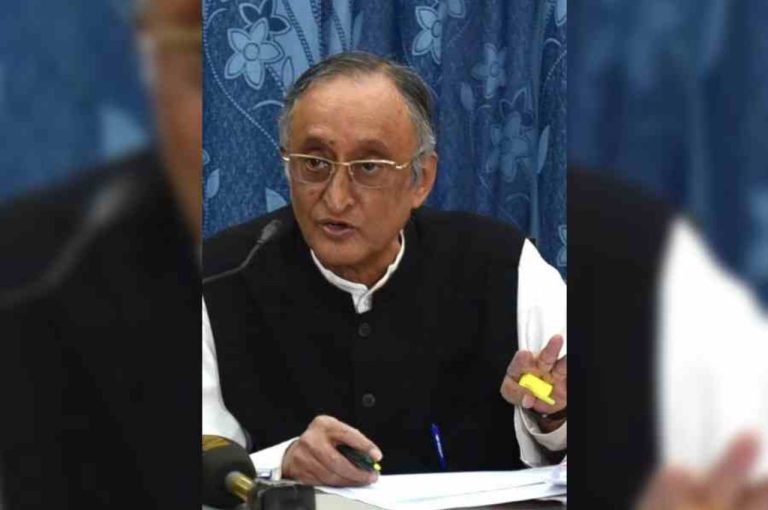
Union Budget 2026 Criticized – Amit Mitra Labels It Anti‑Farmer, Anti‑Youth, and Ignoring the Middle Class

Union Budget 2026 Criticized: Former West Bengal finance minister Amit Mitra has sharply criticized the Union Budget 2026, calling it “anti‑farmer, anti‑youth, and offering nothing for the middle class.” His remarks highlight concerns about inadequate support for agriculture, lack of job creation measures, and insufficient relief for salaried households.


🔎 Key Highlights of Amit Mitra’s Criticism

  • Farmers ignored: Mitra argued that the budget failed to provide meaningful subsidies, MSP (Minimum Support Price) assurances, or rural credit expansion.
  • Youth neglected: He emphasized the absence of large‑scale job creation programs, skill development initiatives, or targeted schemes for graduates.
  • Middle class overlooked: According to him, there were no significant tax reliefs or incentives for salaried families struggling with inflation.
  • Overall tone: He described the budget as “disconnected from ground realities,” suggesting it prioritizes corporate interests over common citizens.

📊 Broader Context of the Union Budget 2026

  • Agriculture allocation: While funds were earmarked for infrastructure, critics argue direct farmer benefits were limited.
  • Employment measures: The budget focused on digital economy and manufacturing, but lacked immediate job guarantees.
  • Taxation: No major changes in income tax slabs, disappointing the middle class.
  • Social sector: Spending on health and education increased modestly, but not enough to address post‑pandemic challenges.

🧑‍🌾 Union Budget 2026 Criticized: Impact on Farmers

  • Rising input costs (fertilizers, fuel) remain unaddressed.
  • No clear roadmap for MSP reforms.
  • Limited investment in irrigation and crop insurance.
  • Mitra warned this could deepen rural distress and migration.

👩‍🎓 Impact on Youth

  • Unemployment rates among graduates remain high.
  • Budget’s emphasis on AI and digital skilling seen as too narrow.
  • Lack of immediate employment schemes like apprenticeships or public sector recruitment.
  • Mitra argued this risks alienating young voters.

👨‍👩‍👧 Impact on Middle Class

  • No tax relief despite rising inflation.
  • Housing and education costs continue to burden families.
  • Mitra said the middle class feels “ignored” compared to corporate beneficiaries.

🌍 Governance and Political Implications

  • Opposition narrative: Mitra’s remarks strengthen opposition claims that the budget favors big business.
  • Public perception: Farmers, youth, and salaried households may feel excluded.
  • Electoral impact: Could influence upcoming state and national elections.

🌐 Global Comparisons

  • USA: Budgets often include direct tax credits for families.
  • EU: Agricultural subsidies remain central to policy.
  • India: Critics argue the 2026 budget lacks similar direct support mechanisms.

📌 Government Resources for Reference


✅ Conclusion

The Union Budget 2026 has sparked sharp criticism from Amit Mitra, who labeled it “anti‑farmer, anti‑youth, and nothing for the middle class.” His remarks reflect broader concerns about whether the budget adequately addresses India’s pressing challenges—rural distress, youth unemployment, and middle‑class inflation. For citizens, the debate underscores a key question: does the budget prioritize inclusive growth, or does it tilt toward corporate interests at the expense of everyday households?

Also read: Home | Channel 6 Network – Latest News, Breaking Updates: Politics, Business, Tech & More

Two Minor Siblings Lose Lives in Tragic Salem Road Accident in 2026

0

Two Minor Siblings Killed While Travelling for Festival Visit

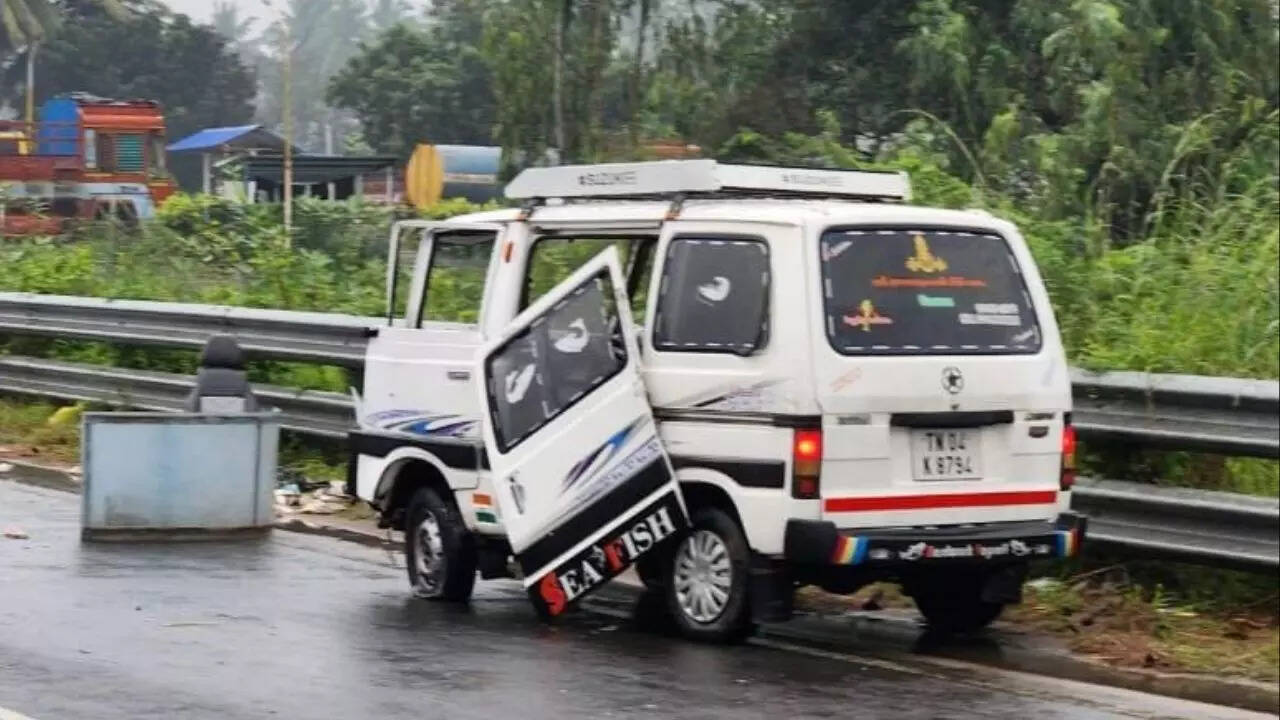
Two minor siblings lost their lives in a heartbreaking road accident near Sankagiri in Salem district, casting a shadow over what was meant to be a religious visit connected to Thai Poosam celebrations. The incident took place late on Saturday night and unfolded in front of the children’s parents, adding to the tragedy of the event.2 minor boys killed while learning to drive car in Namakkal

The victims, aged 13 and 11, were travelling with family members toward a temple in Salem. What began as a routine journey for worship ended in loss, grief, and unanswered questions after a lorry allegedly rammed into the two-wheeler they were riding on.

Two Minor Siblings Thrown Off Bike After Lorry Impact

The accident occurred on a busy stretch near the Chinnakkavundanur bypass, an area known for frequent heavy vehicle movement. The family was travelling on two motorcycles, maintaining close distance with each other.Tamil Nadu: 3 pedestrians including 2 women killed in road accident in  Namakkal district | Erode News - Times of India

According to preliminary information, one of the motorcycles was being ridden by a family acquaintance, with the two children seated behind him. Their parents followed on another two-wheeler. As they approached the bypass near Sankagiri, a lorry reportedly hit the motorcycle carrying the children from behind.

Two Minor Siblings Suffer Fatal Injuries at Accident Spot

The force of the collision threw both children onto the road. They suffered severe head and body injuries and died on the spot. The rider of the motorcycle survived the crash with minor injuries and was able to alert others.

Witnessing the accident unfold, the children’s parents, who were riding just behind, lost control of their vehicle and fell onto the road. Though they escaped with minor injuries, they were left traumatised after seeing their children lying motionless on the road.

Passersby stopped to help and immediately informed the police and emergency services. Despite quick response, the children could not be saved.

Two Minor Siblings’ Death Sparks Search for Hit-and-Run Lorry

Police officials who reached the spot confirmed that the lorry involved in the accident fled the scene without stopping. A case has been registered, and efforts are underway to identify and trace the vehicle responsible for the hit-and-run.

Two Minor Siblings’ Family Left in Shock and Grief

The children belonged to a family from Komarapalayam in neighbouring Namakkal district. Relatives and locals gathered at the accident site and later at the hospital, expressing grief and anger over the reckless driving that claimed the young lives.3 Velankanni pilgrims from Kerala killed after van rams into their car in  Theni

Residents of the area pointed out that the bypass road often sees speeding heavy vehicles, especially at night. They urged authorities to increase surveillance, install warning signs, and enforce stricter speed regulations to prevent similar tragedies. Also Read: NGT Asks Tamil Nadu to Expand Proven Waste Control Model Across Public Events

Police are reviewing CCTV footage from nearby roads and toll points to identify the lorry. Officials have assured that strict action will be taken once the vehicle and driver are traced.

Conclusion

The death of two minor siblings in this tragic accident highlights the growing dangers on highways and bypass roads, especially for families travelling on two-wheelers. As investigations continue, the incident stands as a painful reminder of the need for responsible driving, stronger enforcement, and better road safety measures to prevent such irreversible losses.

Environmentalists Divided Over New Eco Trails in Sensitive Landscapes

0

Environmentalists Divided as Budget Signals Eco Tourism Expansion

Environmentalists divided over the Union Budget’s proposal to introduce trekking and bird-watching trails in ecologically sensitive regions such as Podhigai Malai in the Western Ghats and Pulicat Lake near Chennai. While the announcement highlights the aim of developing environmentally responsible tourism, reactions from conservation groups and researchers show a clear split on how such initiatives should move forward.Greening Mother Earth: How Vanvadi In Maharashtra Is Reclaiming Forests For  A Cause - Vikalp Sangam

Supporters see these trails as an opportunity to promote awareness and conservation through controlled access. Critics, however, warn that without strict safeguards, the move could harm fragile ecosystems, wildlife habitats, and water sources that support both biodiversity and local communities.

Environmentalists Divided on Risks to Forests and Wildlife

Podhigai Malai is a significant ecological zone, known as the origin of important rivers and home to diverse plant and animal species. Any human intervention in this region carries long-term consequences if not carefully planned and monitored.How environmentalist Jibi Pulu is using ecotourism to turn Mishmi tribe  conservationists - Vikalp Sangam

Concerns raised by environmental groups focus on the impact of increased human presence in forested areas. Conservation advocates argue that even well-intended eco-tourism can turn damaging when visitor numbers rise beyond what the landscape can sustain.

Podhigai Malai holds ecological and cultural importance due to its role in sustaining river systems and forest biodiversity. Environmental groups caution that trekking activities could disturb wildlife movement, increase litter, and raise the risk of forest fires.

Environmentalists Divided Over Podhigai Malai’s Fragile Balance

There are also growing concerns about human-wildlife conflict in areas surrounding the foothills. Increased footfall may push animals closer to human settlements, creating safety risks for both people and wildlife. Critics stress that these issues must be addressed before opening the region to recreational activities.Designing more sustainable hiking trails | Yale Environment Review

Some environmental voices have also linked the trekking proposal to broader worries about resource extraction in sensitive regions. They argue that conservation policies must remain consistent and should not allow tourism to become a gateway for further ecological disturbance.

Researchers emphasise the need to assess the carrying capacity of forest areas before any development. This includes evaluating how many visitors the region can handle without harming soil quality, vegetation, wildlife, and water sources. Conservation guidelines already exist at the national level, and experts say these must be followed strictly.

Environmentalists Divided but See Value in Regulated Nature Access

While Podhigai Malai has drawn strong cautionary responses, the bird-watching trail proposed at Pulicat Lake has received a more balanced reception from environmental workers familiar with the region.

Pulicat Lake is an important wetland that attracts migratory birds and supports fishing communities. Advocates of the bird trail believe that structured and regulated access can help people understand the value of wetlands and the need for protection.

Environmentalists Divided on How Awareness Should Be Built

Supporters of the Pulicat trail argue that guided pathways, visitor limits, and educational signage can reduce damage while increasing public awareness. They point to examples where controlled access has helped protect ecosystems by building respect among visitors.

However, even those welcoming the initiative stress that regulation is key. Limiting visitor numbers, monitoring activities, and involving local authorities are seen as essential steps. Without clear rules, the risk of overcrowding and disturbance remains high.

Environmental workers note that successful eco-tourism models rely on long-term planning rather than short-term attraction. Trails must be designed with input from ecologists, local communities, and conservation agencies to ensure that tourism supports, rather than weakens, environmental protection. Also Read: NGT Asks Tamil Nadu to Expand Proven Waste Control Model Across Public Events

Conclusion

Environmentalists divided on the proposed eco trails reflect a larger debate on development versus conservation. While nature-based tourism can educate and inspire, its success depends entirely on careful planning, strict regulation, and respect for ecological limits. How these trails are implemented will decide whether they protect natural heritage or place it under new strain.