Friday, May 15, 2026
Home Blog Page 324

Governor Bill Assent Ruling: Landmark Supreme Court Verdict on Constitutional Powers

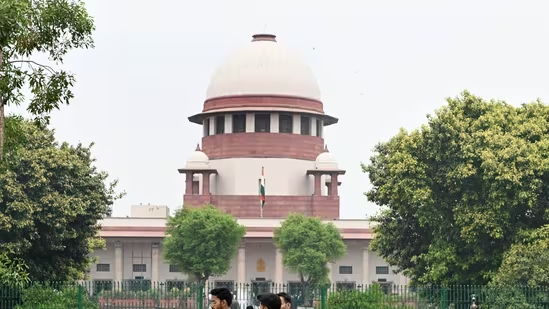
New Delhi – The Supreme Court Of India delivered a landmark governor bill assent ruling on Thursday through a five-judge Constitution bench, declaring that governors and the President cannot be bound by judicially imposed timelines when granting assent to state legislation. This significant verdict addresses critical questions about constitutional discretion and the separation of powers between the judiciary and executive branches.

Nullification of Previous Verdict

The governor bill assent ruling specifically nullifies an April 8 decision by a two-judge bench in the Tamil Nadu case that had established strict timelines for gubernatorial assent and introduced the concept of “deemed assent” in cases of inordinate delays. The Constitution bench determined that the previous decision created substantial confusion and doubt requiring an authoritative opinion from a larger bench.

The earlier verdict had imposed a one-month deadline for governors to act on re-enacted bills and created a three-month timeline for bills reserved for presidential consideration. The current governor bill assent ruling found these mandates inconsistent with both constitutional text and established precedent, concluding that such judicial action violated the fundamental principle of separation of powers.

Constitutional Framework and Discretionary Powers

The governor bill assent ruling clarifies that the Constitution envisages a carefully balanced structure for processing state legislation that does not permit courts to impose procedural timelines on constitutional authorities. The bench emphasized that Articles 200 and 201 grant governors and the President defined, textually rooted discretion that cannot be disturbed by externally crafted time-bound mandates.

Chief Justice of India Bhushan R Gavai, along with justices Surya Kant, Vikram Nath, PS Narasimha, and Atul S Chandurkar, delivered this advisory opinion under Article 143. The governor bill assent ruling established that importing judicial timelines would effectively rewrite the Constitution rather than interpret it within its established framework.

Three Constitutional Options for Governors

According to the governor bill assent ruling, when presented with a bill, governors have three constitutionally authorized choices: granting assent, withholding assent and returning the bill (provided it is not a money bill), or reserving the bill for presidential consideration. The bench emphasized that returning a bill with comments constitutes part of a “constitutional dialogue” meant to promote deliberation rather than confrontation.

The governor bill assent ruling specifically clarified that governors “cannot withhold assent simpliciter” without invoking the process of returning the bill. Even after a legislature re-enacts a bill following reconsideration, governors retain two options—granting assent or reserving it for the President. The notion that reconsideration eliminates these options was declared contrary to constitutional text and structure.

Also Read: Al-Falah University Blast Probe: Shocking SIT Investigation Reveals Campus Links

Limited Scope of Judicial Review

While the governor bill assent ruling establishes that discharge of functions under Articles 200 and 201 is “non-justiciable,” it acknowledges that courts may intervene in specific circumstances. Where prolonged, deliberate inaction occurs, courts may issue limited direction requiring a governor to exercise one of the three constitutionally prescribed options, without dictating which option to choose.

The governor bill assent ruling drew a firm line regarding judicial review scope. Courts cannot test the merits of a governor’s or President’s decision under Articles 200 and 201, nor can they examine the legality of bills before they ripen into law. Judicial review extends only to cases where bills are held in abeyance through prolonged and deliberate inaction.

Preservation of Separation of Powers

The governor bill assent ruling reaffirmed fundamental constitutional principles by preventing judicial overreach into executive domains. The bench explained that while the governor ordinarily acts on the aid and advice of the council of ministers, the Constitution contemplates situations where discretion must be exercised independently, with Article 200 being one such provision.

The court warned that while gubernatorial discretion is not unfettered, it cannot be reduced to a purely “perfunctory” role. The governor bill assent ruling struck a balance by acknowledging that governors serve more than ceremonial functions while ensuring their powers remain subject to constitutional constraints rather than judicial micromanagement.

Presidential Reference and Key Questions

The governor bill assent ruling responded to a reference made by President Droupadi Murmu under Article 143 in May, seeking clarity on whether the Supreme Court can set binding timelines for gubernatorial or presidential assent. The reference placed 14 significant questions before the Court, addressing whether silence in Articles 200 and 201 can be judicially filled by imposing procedural timelines.

Among these questions, the governor bill assent ruling declined to answer three, determining they fell outside the functional scope of inquiry into constitutional roles. The bench refused to address questions regarding Article 145(3) on bench composition, Union-state dispute adjudication outside Article 131, and broadly framed questions about powers under Article 142.

Implications for Federal Relations

The governor bill assent ruling has significant implications for federal relations in India’s constitutional framework. While it may have reiterated separation of powers principles, it leaves the federal debate open, particularly in a politicized environment where some states claim governors function as agents of the Union government.

For states like West Bengal, Tamil Nadu, Punjab, Telangana, and Karnataka that complained about gubernatorial inaction, the governor bill assent ruling offers limited relief. The bench acknowledged that indefinite stalling of bills cannot defeat democratic governance, and where the people’s will expressed through the legislature is frustrated by absence of decision, courts may intervene in a limited manner.

Constitutional Dialogue and Deliberation

The governor bill assent ruling emphasized that Articles 168, 200, and 201 together reflect a dialogic model of federal functioning. This model contemplates deliberation between governors, the President, and legislatures rather than mechanical endorsement or veto processes. Returning bills with comments and reserving them for presidential consideration are integral features ensuring questions of constitutional validity, federal implications, or inter-state effects receive proper attention.

The verdict establishes that imposing judicial timelines disregards this deliberative scheme and risks reducing complex constitutional functions into inflexible administrative timetables, ultimately undermining the nuanced balance the Constitution’s framers intended to create.
Delhi Teen Suicide Case: 4 School Teacher Suspended After Metro Tragedy

0

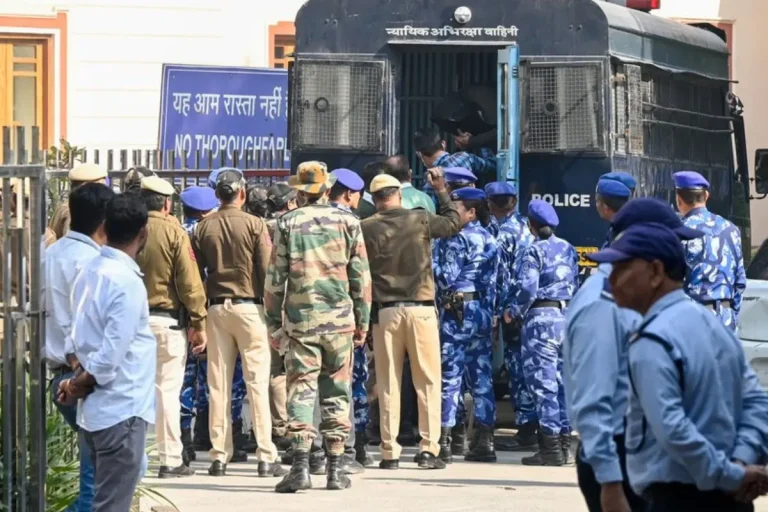
New Delhi – A tragic Delhi teen suicide case has resulted in the immediate suspension of four school teachers following allegations of prolonged mental harassment. The incident occurred when a 16-year-old Class 10 student jumped from the platform at Rajendra Place Metro Station on Tuesday afternoon, prompting widespread outrage and demands for accountability from educational authorities.

Incident Details and Timeline

The Delhi teen suicide case unfolded at 2:34 pm on Tuesday when the student jumped from the Rajendra Place Metro Station platform. Emergency responders immediately transported the teenager to BLK Super Speciality Hospital, where medical professionals declared him dead upon arrival. The tragic incident has sparked intense scrutiny of the school’s handling of student welfare and teacher conduct.

Authorities investigating the Delhi teen suicide case have confirmed that the student left behind a suicide note specifically naming several teachers and blaming them for causing severe mental distress. This critical piece of evidence has become central to the ongoing investigation and has prompted swift administrative action against the accused educators.

Teacher Suspensions and Official Action

Following the Delhi teen suicide case, school authorities issued suspension letters to four teachers implicated in the allegations. Official correspondence reviewed in connection with the case states: “This is to inform you that the school has been made aware of an FIR registered against you, bearing No. 336A Tis Hazari Court, dated 19th November 2025. The matter is currently under investigation by the appropriate authorities.”

The suspension letters in the Delhi teen suicide case further emphasized: “In view of the seriousness of the allegations the competent authority has decided to place you under suspension with immediate effect. You shall remain under suspension till the completion of the investigation and further orders from the competent authority.” This administrative action reflects the gravity with which authorities are treating the allegations.

Family Allegations of Prolonged Harassment

The family’s account of the Delhi teen suicide case paints a disturbing picture of systematic harassment spanning an entire academic year. According to the victim’s father, his son endured continuous scolding and trouble from teachers over minor issues. The family alleges they repeatedly raised concerns with school authorities, but their complaints were ignored or inadequately addressed.

“For the last one year, my son was being scolded and troubled by his teachers over petty issues. He told us about it, and we raised our concerns with his teachers but nothing happened. Even his friends were troubled by those teachers,” the father stated while discussing the Delhi teen suicide case. This testimony suggests a pattern of behavior that extended beyond a single student.

Tuesday’s Critical Incident at School

The final day before the Delhi teen suicide case tragedy reportedly included a particularly distressing incident at school. The father alleged that his son collapsed at school on Tuesday, but his teacher dismissed the episode as fake. When the distressed teenager insisted he had genuinely fainted and began crying, the teacher allegedly continued to dismiss his condition as fabricated.

This alleged incident on the day of the Delhi teen suicide case raises serious questions about teacher sensitivity to student distress and the school’s protocols for responding to medical emergencies. The family contends this dismissive attitude exemplified the ongoing pattern of disregard for their son’s wellbeing.

Student’s Mental Health Struggles

Central to understanding the Delhi teen suicide case is the victim’s documented struggle with depression. The family has stated that their son had been depressed for an extended period and had explicitly informed both counsellors and teachers about his suicidal thoughts. This revelation raises critical questions about the school’s mental health support systems and intervention protocols.

The fact that the student communicated his intentions in the Delhi teen suicide case to school staff members yet still proceeded to take his life suggests potential failures in the school’s crisis response mechanisms. Mental health professionals emphasize that such direct communications should trigger immediate intervention protocols.

Family and Community Protest

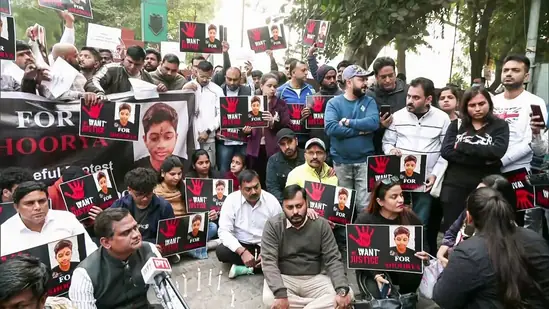
The Delhi teen suicide case prompted an organized protest outside the school in Ashok Palace on Thursday. Parents and friends of the deceased student gathered to demand strict action against the accused teachers and comprehensive accountability from school authorities. The demonstration reflects broader community concerns about student safety and institutional responsibility.

Protesters in the Delhi teen suicide case are calling for systemic changes in how schools handle student complaints and mental health concerns. The incident has become a rallying point for advocates of stronger student protection measures and improved teacher training in recognizing mental health warning signs.

Investigation and Legal Proceedings

Delhi Police have registered an FIR in the Delhi teen suicide case at Tis Hazari Court, bearing number 336A and dated November 19, 2025. The investigation is examining the allegations of mental harassment, the school’s response to family complaints, and whether adequate support systems were in place for struggling students.

The suicide note left by the victim in the Delhi teen suicide case serves as primary evidence, explicitly naming teachers and detailing the mental distress they allegedly caused. Investigators are interviewing classmates, reviewing school records, and examining communication between the family and school authorities.

Implications for School Accountability

The Delhi teen suicide case highlights urgent questions about institutional accountability in educational settings. Schools have a duty of care toward students that extends beyond academic instruction to include emotional wellbeing and safety. This incident may prompt policy reviews regarding teacher conduct standards, mental health resources, and complaint resolution procedures across educational institutions.

Al-Falah University Blast Probe: Shocking SIT Investigation Reveals Campus Links

Faridabad, Haryana – Faridabad Police have established a Special Investigation Team to conduct a comprehensive Al-Falah University blast probe, examining how the educational institution became a base for an alleged extremist module that operated without detection for several years. This development comes as multiple central agencies continue parallel investigations into the Delhi blast incident.

Special Investigation Team Formation

The Al-Falah University blast probe has been assigned to a dedicated SIT comprising two Assistant Commissioners of Police, one inspector, and two sub-inspectors. The team has commenced preparing a detailed report analyzing the university’s operations, funding mechanisms, and potential support networks that may have facilitated the alleged activities on campus.

Police spokesperson confirmed that the SIT has begun examining all aspects related to the university’s connection with the Delhi incident. The investigation focuses on understanding how accused doctors allegedly utilized the university premises as a safe operational hub, including methods used to obtain, store, and transport explosive materials from Faridabad to Delhi without triggering alerts from any monitoring authority.

Commissioner Directs Comprehensive Investigation

Faridabad Police Commissioner Satender Kumar Gupta has instructed the SIT conducting the Al-Falah University blast probe to thoroughly examine how the university environment allegedly enabled an extremist module to operate undetected over an extended period. The directive emphasizes mapping every connection and operational detail related to the accused individuals.

Investigators are currently collecting extensive information regarding funding channels, suspect movements, alleged local support from surrounding villages, and the unexplained disappearance of several faculty members following the emergence of the blast case. The Al-Falah University blast probe aims to uncover systemic failures that may have allowed such activities to continue without detection.

DGP’s Campus Visit Triggers Action

The SIT formation occurred shortly after Haryana Director General of Police OP Singh visited the campus earlier this week. During his visit, Singh expressed grave concern about what he characterized as the “collapse of internal security mechanisms” at the institution. He specifically directed the Faridabad Deputy Commissioner and Police Commissioner to personally monitor the case and assume leadership roles in the investigation.

The DGP’s intervention underscores the seriousness with which authorities are treating the Al-Falah University blast probe. His directives have resulted in enhanced scrutiny of the university’s administrative processes and security protocols that were in place during the alleged period of extremist operations.

Explosive Material Origins Under Scrutiny

Preliminary investigative findings in the Al-Falah University blast probe suggest that explosive materials used in the Delhi incident originated from Dhauj village in Faridabad. The SIT is conducting discreet investigations along this route, examining potential facilitators and identifying operational gaps that may have enabled the accused to evade detection by security agencies.

The investigation seeks to establish a complete chain of custody for the explosive materials, from their source in Dhauj village to their alleged storage at university premises and eventual transportation to Delhi. This aspect of the Al-Falah University blast probe is critical to understanding the full scope of the alleged operation.

Also Read: Red Fort Blast: Shocking Links to Al Falah University Emerge As 10 Found Missing

University Operations and Funding Patterns

A key component of the Al-Falah University blast probe involves analyzing the institution’s financial operations and funding patterns. Investigators are examining whether any irregular financial transactions or funding sources may have supported the alleged extremist activities. The SIT is reviewing bank records, donation receipts, and other financial documentation to identify suspicious patterns.

The team is also investigating how the university’s administrative oversight systems failed to detect the alleged activities. This includes examining approval processes for campus activities, visitor management protocols, and faculty supervision mechanisms that were in place during the relevant period.

Cricket Tournament Exclusion

In a related development affecting the Al-Falah University blast probe, the institution has been excluded from the North Zone Inter-University Cricket Tournament organized by Aligarh Muslim University. The event, which attracts participation from eighty-four universities across North India, has cancelled the scheduled match between Al-Falah University and Manav Rachna University set for November 22.

Tournament organizers cited the ongoing Al-Falah University blast probe and associated security concerns as reasons for the exclusion. This decision reflects the broader impact of the investigation on the university’s standing within the academic community and its ability to participate in inter-institutional activities.

NIA Involvement and Arrests

While the Al-Falah University blast probe continues at the local level, central agencies including the National Investigation Agency have made four arrests in connection with the Red Fort blast case. These suspects have been remanded to ten-day custody as investigators work to establish links between various individuals and locations involved in the alleged operation.

The coordinated investigation involving multiple agencies aims to comprehensively map the network, funding sources, and operational methods allegedly employed. The Al-Falah University blast probe represents a crucial component of this larger investigative effort to understand how such activities were planned and executed.

Moving Forward

As the Al-Falah University blast probe progresses, authorities continue gathering evidence and interviewing relevant individuals to establish a complete picture of events. The investigation’s findings will likely have significant implications for security protocols at educational institutions across the region and may prompt reviews of oversight mechanisms designed to prevent such incidents in the future.

November 20, 2025 (Mid-cap): Nifty 50 Rallies to 26,174 Mark as Midcaps Surge; Select Counters Show Exceptional Strength, Losers Face Steep Falls

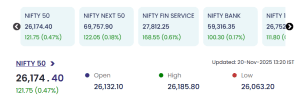
Indian equities witnessed another robust session on November 20, 2025, with the Nifty 50 advancing by 121.75 points or 0.47% to 26,174.40 by early afternoon. Strong institutional flows into financials, select midcaps, and outperforming sectoral indices helped in extending the broader market rally. Meanwhile, volatility persisted in the mid and smallcap segments with some stocks seeing double-digit swings.

Also Read: November 20, 2025 (Opening): Nifty 50 Extends Winning Streak, Hovers Above 26,100; Select Midcaps Advance on Robust Volumes

Market Overview:

November 20, 2025The Nifty 50 opened at 26,132.10 and maintained upward momentum, reaching a high of 26,185.80 and a low of 26,063.20 during the session. Nifty Next 50 also gained 0.18% to 69,757.90, while Nifty Financial Services surged over 0.61%, and the banking index added 0.17%. These moves reflected confidence in the economic recovery and investor preference for quality names.​


Leading Gainers:

Midcap and smallcap stocks led the outperformance, registering significant price and volume action:

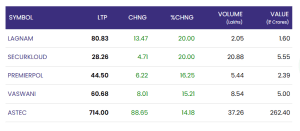
  • LAGNAM and SECURKLOUD both soared by 20% to ₹80.83 and ₹28.26, respectively, on healthy trading volumes.

  • Screenshot 2025 11 20 132112PREMIERPOL jumped 16.25% to ₹44.50.

  • VASWANI rose 15.21% to ₹60.68.

  • ASTEC gained 14.18% to ₹714.00, with the highest turnover among gainers at ₹262.40 crores.​

Market attention continued to shift toward nimble, high-growth stories within the broader rally.

Major Losers:

Profit-taking and volatility hammered some recent outperformers, with sharp intraday declines in high-volume counters:

  • MCLOUD slumped 20% to ₹53.52 despite substantial trading volume of 146.76 lakh shares.

  • Screenshot 2025 11 20 132118ENERGYDEV dropped 15.02% to ₹23.26.

  • MANGALAM shed 11.92% to ₹47.90.

  • PWL lost 10.95% to ₹127.59, with significant value traded at over ₹1,099 crore.

  • GROWW closed 8.89% down at ₹154.78, accompanying a massive ₹1,469 crore turnover and 934.88 lakh share volume.​

Such deep declines highlighted selective risk-off behavior, especially after frenzied run-ups in prior sessions.

Conclusion: November 20, 2025

Buoyed by sectoral leadership and institutional participation, the Nifty 50 surged above 26,174 on November 20, 2025, with focused midcap strength and select stock breakouts. However, aggressive profit-booking in high-flying counters provided a stark reminder of ongoing market volatility. Traders and investors remain alert to sectoral shifts as the post-rally environment brings rapid moves across market segments.


For real time stock Updates, visit NSE website.

November 20, 2025 (Opening): Nifty 50 Extends Winning Streak, Hovers Above 26,100; Select Midcaps Advance on Robust Volumes

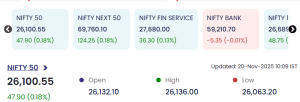
The Indian equity market demonstrated continued strength on November 20, 2025, with the Nifty 50 closing at 26,100.55, up 47.90 points or 0.18%. While sectoral indices performed mixed, the sustained buying in select midcap stocks and heavyweight counters kept the overall sentiment bullish. Key gainers outshone broader indices on strong volumes, even as profit-booking persisted in certain recent outperformers.

Also Read: November 19, 2025: Nifty 50 Extends Rally to Hit Fresh Peak; Power, Capital Goods Lead Gainers While Profit-Booking Hits Popular Stocks

Market Overview:

November 20, 2025The Nifty 50 opened at 26,132.10 and managed to achieve a session high of 26,136.00, with intraday lows at 26,063.20. Nifty Next 50 also rose by 0.18% to 69,760.10, while the Nifty Financial Services index climbed 0.13%, both reflecting steady institutional flows. In contrast, the Nifty Bank fell slightly by 0.01%, highlighting a minor rotation out of banking names.​
Leading Gainers:

Select midcap and smallcap stocks registered sharp percentage gains, drawing notable trading activity:

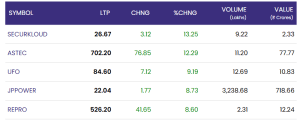
  • SECURKLOUD climbed 13.25% to ₹26.67, maintaining its momentum with active volume.

  • ASTEC rocketed 12.29% to ₹702.20, on impressive buying interest.

  • Screenshot 2025 11 20 100946UFO rose 9.19% to ₹84.60.

  • JPPOWER advanced 8.73% to ₹22.04, with a substantial volume of 3,238.68 lakh shares and a ₹718.66 crore turnover.

  • REPRO gained 8.60% to ₹526.20.​

These robust moves highlighted investor focus on growth and high-trading counters.


Major Losers:

Several prominent counters saw meaningful corrections driven by profit-taking and sectoral rotation:

  • ENERGYDEV fell 9.24% to ₹24.84.

  • GROWW declined 8.06% to ₹156.20, with a volume of over 655 lakh shares and value exceeding ₹1,033 crore.

  • Screenshot 2025 11 20 100953PWL dropped 7.88% to ₹131.99, despite hefty volumes at 292.40 lakh shares.

  • RICOAUTO slipped 6.74% to ₹108.31.

  • NAVKARURB eased by 5.52% to ₹1.71.​

This wave of selling helped balance the market, indicating that investors were rotating out of recent winners.

Conclusion: November 20, 2025

November 20, 2025, saw the Nifty 50 solidify its position above 26,100, extending the rally on the back of select midcap surges and institutional participation. While individual corrections persisted in a handful of active stocks, the upbeat market mood underscored resilient optimism and the continued hunt for outperformers in the Indian equity landscape.


For real time stock Updates, visit NSE website.

November 19, 2025: Nifty 50 Extends Rally to Hit Fresh Peak; Power, Capital Goods Lead Gainers While Profit-Booking Hits Popular Stocks

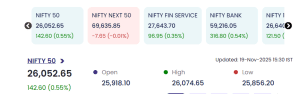
The Indian stock market ended yet another session on a strong note on November 19, 2025, with the Nifty 50 climbing 142.60 points, or 0.55%, to close at an impressive 26,052.65. Broad market optimism was driven by gains in financials and capital goods, while some individual counters faced sharp profit-taking after recent rallies. The session was marked by robust activity across sectors, underlining the sustained investor confidence in domestic equities.

Also Read: November 19, 2025: Nifty 50 Surges Beyond 26,000 Mark; Select Midcap Stocks Shine Amidst Strong Broader Sentiment

Market Overview:

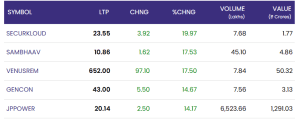
november 19The Nifty 50 opened at 25,918.10 and maintained upward momentum to reach an intraday high of 26,074.65, with a low at 25,856.20. Financials, banking, and capital goods sectors participated in the advance, as shown by a 0.35% rise in Nifty Financial Services and a 0.54% gain for Nifty Bank. In contrast, Nifty Next 50 slipped by 0.01%, showing selective sectoral rotation.​


Leading Gainers:

Some of the session’s top performers delivered double-digit percentage gains, reflecting strong buying interest:

  • SECURKLOUD climbed 19.97% to ₹23.55 on healthy trading volumes.

  • SAMBHAAV moved up 17.53% to ₹10.86, with robust participation.

  • Screenshot 2025 11 19 200249VENUSREM surged 17.50% to ₹652.00, showcasing renewed momentum.

  • GENCON rose 14.67% to ₹43.00.

  • JPPOWER gained 14.17% to ₹20.14 on extraordinary trading volume of 6,523.66 lakh shares and a turnover exceeding ₹1,291 crores.​

These stocks reflected renewed investor appetite in midcap and low-priced shares.

Major Losers:

Meanwhile, several high-profile stocks witnessed sharp profit booking after strong earlier runs:

  • SAMMAAANCAP dropped 13.33% to ₹158.40 despite a large volume of 674.72 lakh shares.

  • MANGALAM shed 11.11% to ₹54.39.

  • Screenshot 2025 11 19 200256GROWW lost 10% to ₹169.89 on massive volume of 1,424.73 lakh shares and value over ₹2,522 crores.

  • ARSSBL fell 9.82% to ₹697.95.

  • KEC decreased 9.15% to ₹710.20.​

The correction in these names signaled traders locking in gains after a phase of strong price appreciation.

Conclusion: November 19

The rise of the Nifty 50 above 26,000 on November 19, 2025, underscores the resilience and depth of the Indian equity market amid varied sectoral moves. While profit-taking remains evident in some popular stocks, sustained interest in midcaps and power stocks suggests a continued bullish undertone and dynamic market leadership heading into the next trading sessions.


For real time stock Updates, visit NSE website.

November 19, 2025: Nifty 50 Surges Beyond 26,000 Mark; Select Midcap Stocks Shine Amidst Strong Broader Sentiment

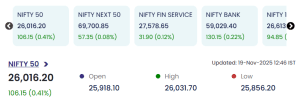
On November 19, 2025, the Indian equities market continued its upward march, with the Nifty 50 index surging by 106.15 points, or 0.41%, to touch 26,016.20 by mid-day. The positive momentum was broad-based, as financial, banking, and select midcap stocks contributed to the rally, demonstrating renewed investor confidence after a brief period of consolidation.

Also Read: November 19, 2025 (opening): Nifty 50 Rises Modestly Amid Volatile Trade; Select Stocks Outperform as Market Moods Shift

Market Overview:

November 19The Nifty 50 opened at 25,918.10 and quickly built gains, registering a session high of 26,031.70 and a low of 25,856.20. The Nifty Next 50 also advanced, up by 0.08% to 69,700.85, while Nifty Financial Services and Nifty Bank indices posted 0.12% and 0.22% gains respectively. This positive breadth reflected a strong undertone across the market as participants continued to rotate into outperforming financials and select sectoral leaders.​

Leading Gainers:

Several midcap names outperformed and drew significant trading interest:

  • SECURKLOUD soared by 19.97% to ₹23.55, driven by robust volumes.

  • SAMBHAAV jumped 19.05% to ₹11.00 on trading of over 30 lakh shares.

  • Screenshot 2025 11 19 124722GOLDTECH gained 13.20% to ₹62.35, marking another session of sustained buying.
  • LAXMIINDIA rose by 11.92% to ₹146.70, as demand remained strong.

  • AVANTIFEED climbed 10.44% to ₹846.95, supported by high turnover of ₹608.68 crores.​

These impressive moves showcased midcap resilience and the appetite for bottom-up stock picking.

Major Losers:

Despite the rally, a few large-volume stocks saw steeper corrections:

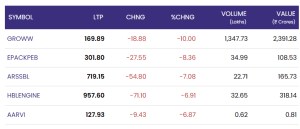
  • GROWW fell 10% to ₹169.89, leading the laggards with heavy volume of 1,347.73 lakh shares and a ₹2,391 crore turnover.

  • EPACKPEB declined by 8.36% to ₹301.80.

  • Screenshot 2025 11 19 124731ARSSBL slipped 7.08% to ₹719.15.

  • HBLENGINE eased by 6.91% to ₹957.60.

  • AARVI dropped 6.87% to ₹127.93.​

These losses signaled profit-booking and sectoral rebalancing in the face of a broader market rally.

Conclusion: November 19,2025

The Nifty 50’s rise above 26,000 on November 19, 2025, underscored strong positive sentiment and a renewed risk-on approach among investors. While select midcaps captured attention with outsized gains, sporadic profit taking in a few counters highlighted the dynamic nature of ongoing market participation. The day reinforced the need for discerning stock selection as broader bullishness prevailed.


For real time stock Updates, visit NSE website.

November 19, 2025 (opening): Nifty 50 Rises Modestly Amid Volatile Trade; Select Stocks Outperform as Market Moods Shift

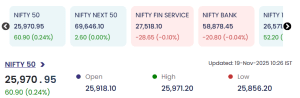
On November 19, 2025, the Indian stock market staged a modest recovery with the Nifty 50 index climbing 60.90 points or 0.24% to 25,970.95 in morning trades. The upmove came as financial services and banking stocks lagged, while selective buying and sector rotation buoyed frontline indices. Despite mixed undertones, specific stocks posted striking gains, even as others saw sharp reversals.

Also Read: November 18, 2025: Nifty 50 Retreats as Market Sentiment Turns Cautious; Select Stocks Defy Downtrend

Market Overview:

November 19The Nifty 50 opened at 25,918.10 and secured a session high at 25,971.20, while the low touched 25,856.20, reflecting cautious optimism among investors. Nifty Next 50 ended nearly flat, while Nifty Financial Services and Nifty Bank indices edged lower, losing 0.10% and 0.04% respectively. This demonstrated the effects of profit booking in heavyweight sectors and renewed interest in select midcaps.​
Leading Gainers:

Even amid sectoral churn, several stocks delivered notable double-digit returns:

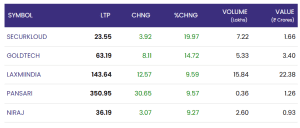
  • SECURKLOUD jumped 19.97% to ₹23.55 on robust trading volume.

  • GOLDTECH surged 14.72% to ₹63.19.
  • Screenshot 2025 11 19 102616LAXMIINDIA advanced 9.59% to ₹143.64.

  • PANSARI posted a gain of 9.57% to ₹350.95.

  • NIRAJ rallied 9.27% to ₹36.19.​

The strong moves in these counters highlighted ongoing institutional and retail flows into select growth stories.

Major Losers:

Despite the positive broader index move, some high-volume stocks posted significant losses:

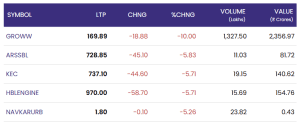
  • GROWW sank 10% to ₹169.89, with very heavy volume at 1,327.50 lakh shares and value surpassing ₹2,356 crores.

  • ARSSBL declined 5.83% to ₹728.85.

  • Screenshot 2025 11 19 102624KEC slipped 5.71% to ₹737.10.

  • HBLENGINE fell 5.71% to ₹970.00.

  • NAVKARURB dropped 5.26% to ₹1.80.​

The declines were largely on account of profit-taking after previous gains and active sectoral realignment.

Conclusion: November 19, 2025

Market action on November 19, 2025, reflected a tug-of-war between profit booking in heavyweight stocks and selective accumulation in midcaps and smallcaps. With the Nifty 50 notching a 0.24% gain, the day showcased the importance of stock selection and sectoral agility as market dynamics evolve.


For real time stock Updates, visit NSE website.

November 18, 2025: Nifty 50 Retreats as Market Sentiment Turns Cautious; Select Stocks Defy Downtrend

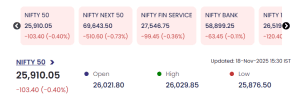
The Indian equities market experienced a notable pullback on November 18, 2025, with the Nifty 50 index closing 103.40 points lower at 25,910.05—a decline of 0.40%. Negative sentiment was widespread across sectoral indices and reflected in most major stocks. However, a handful of companies managed to deliver impressive gains despite the broader market’s weakness, highlighting opportunistic trading amid volatility.

Also Read: November 17, 2025: Indian Markets Rally as Nifty 50 Crosses 26,000 Mark; Financials and Select Stocks Lead the Surge

Indices: Broad-Based Declines

november 18On November 18, the Nifty 50 slumped by 0.40% to 25,910.05 after opening at 26,021.80, peaking at 26,029.85, and marking a low of 25,876.50. Other key indices, including the Nifty Next 50, Nifty Financial Services, and Nifty Bank, also posted losses, retreating by 0.73%, 0.36%, and 0.11% respectively. The market’s reversal followed a period of strong gains, with investors booking profits and adopting a risk-averse approach due to global and local uncertainties.​


Top Gainers: Selective Outperformance

Amidst the widespread downturn, a few stocks bucked the negative trend and posted double-digit gains:

  • SECURKLOUD soared 19.99% to ₹19.63, with strong volume of 4.07 lakh shares.

  • ENERGYDEV climbed 19.97% to ₹26.61 amid robust trading of 26.56 lakh shares.

  • Screenshot 2025 11 18 204650BANG rose 13.28% to ₹58.60 after gaining ₹6.87 in the session.
  • PANSARI advanced 9.99% to ₹320.30.

  • TPHQ ended up 9.43% at ₹0.58, supported by healthy activity at 31.80 lakh shares.​

Active buying in these stocks suggested focused interest, even as overall sentiment was subdued.

Top Losers: Pressure Across Board

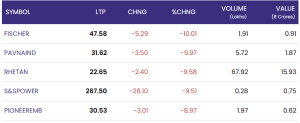
Most notable losers suffered significant single-session declines, with several stocks dropping close to 10% or more:

  • FISCHER dropped 10.01% to ₹47.58.

  • PAVNAIND fell 9.97% to ₹31.62.

  • RHETAN declined 9.58% to ₹22.65 despite heavy volume of 67.92 lakh shares.

  • Screenshot 2025 11 18 204659S&SPOWER tumbled 9.51% to ₹267.50.

  • PIONEEREMB lost 8.97% to ₹30.53.​

This wave of selling was mainly attributed to profit-booking and risk-off moves by traders.

Conclusion: November 18, 2025

The significant drop in the Nifty 50 on November 18, 2025, marks a sharp pause in recent rallying trends, with widespread profit-booking evident across sectors. While most stocks mirrored the broader downtrend, a handful of gainers stood out for their resilience and investor interest. Volatility is expected to persist as traders weigh near-term risks and potential catalysts in the days ahead.


For real time stock Updates, visit NSE website.

19-Year-Old Arrested for Sexually Harassing Bengaluru-Based Advocate: Shocking

BENGALURU — A 19-year-old youth has been arrested on charges of sexually harassing a woman advocate in Bengaluru, following a complaint lodged at a city police station earlier this week. According to officials, the incident took place near the advocate’s residence, where the accused allegedly followed her, made obscene gestures, and attempted to initiate physical contact. The woman immediately alerted her family and later approached the police to file a formal complaint. After reviewing CCTV footage from the area, the police traced and detained the suspect on Wednesday.Bengaluru Sexual Assault: Professor arrested for sexually harassing 19-year- old student at his home; asked her to breakup with boyfriend | Bengaluru News - The Times of India

Eyewitnesses stated that the accused had reportedly been loitering in the locality for several days before the incident. Residents claim that they feared he was observing women and girls returning from work and college. According to police sources, the accused hails from a nearby neighbourhood and has no prior criminal record, but investigators are now verifying whether similar complaints had gone unreported. Following the arrest, the youth was booked under relevant sections of the Indian Penal Code pertaining to sexual harassment, stalking, and intent to outrage a woman’s modesty.


Victim Speaks Out, Demands Stronger Action

The advocate, who works at a private law firm, emphasised that the incident highlights rising concerns about women’s safety in Bengaluru’s residential zones. She said that while many harassment cases occur in public spaces, everyday neighbourhoods often do not receive adequate policing. The survivor added that harassment can happen even in seemingly safe localities, and that victims should not hesitate to report such acts immediately. She urged law enforcement to ensure that strict charges are pursued against perpetrators regardless of their age, background, or criminal history.

Several lawyers from the Bengaluru Bar Association expressed solidarity with the survivor, stating that harassment of women in the legal profession is often brushed aside due to their perceived ability to “handle matters legally.” They emphasised that no professional training can eliminate the trauma of harassment or stalking. Senior advocates insisted that women lawyers, like any other citizen, must not be expected to endure such behaviour as part of their public life. Many also pointed out that gender bias within the justice system must be addressed through regular sensitisation sessions for police, prosecutors, and courtroom staff interacting with survivors.


Legal experts emphasised that immediate reporting plays a crucial role in building stronger cases against harassers. When victims delay lodging complaints, perpetrators often escape due to lack of evidence, especially in cases involving stalking and verbal abuse. Lawyers noted that collecting digital proof, CCTV footage, and witness testimonies becomes easier when complaints are filed promptly. They underscored that the criminal justice system increasingly relies on digital documentation, making early reporting a strategic tool for conviction. However, they also argued that law enforcement must be trained to support traumatised survivors who might find immediate reporting emotionally difficult.


Women’s rights groups are urging Bengaluru Police to adopt a more community-oriented policing model that focuses on safety audits of neighbourhoods. They recommend involving Resident Welfare Associations, student groups, and local businesses to map unsafe stretches and suggest constructive fixes. Suggested solutions include better street lighting, emergency call buttons in commercial pockets, and increased deployment of police personnel during late hours. Activists argue that harassment thrives in spaces perceived as neglected by authorities. By proactively building safe neighbourhood infrastructure, law enforcement can deter offenders before crimes escalate, thereby reducing long-term psychological and legal stress on survivors.


Many residents in the locality where the incident occurred have demanded visible policing to discourage harassment. They claim that despite rising population density, the area lacks regular patrols and round-the-clock surveillance. Individuals who stay out late for work say they often feel unsafe walking home, particularly on streets with inadequate lighting. They believe that police presence itself acts as a deterrent to mischief, stalking, and petty crimes. Citizens have urged local authorities to schedule patrol patterns based on public movement rather than routine timings. They stated that policing should adapt to neighbourhood lifestyles instead of following rigid, outdated timelines.


Psychologists commenting on the case highlighted the importance of addressing behavioural issues among young offenders. They warn that seemingly “minor” acts of harassment at a young age can escalate into severe crimes if left unchecked. Early intervention, they argue, is crucial not only for justice for survivors but also for preventing offenders from developing long-term predatory tendencies. Experts recommend rehabilitation programmes, gender education, and psychological counselling for first-time offenders alongside legal punishment. They emphasised that accountability and corrective behavioural therapy must go hand in hand, particularly when dealing with offenders still transitioning into adulthood.


Youth organisations have responded by calling for better sex education and consent awareness programmes in schools and colleges. Student groups argue that societal silence around consent leads young people to misunderstand boundaries, causing harmful behaviour that escalates into criminal acts. They advocate that consent must be taught as a fundamental part of social behaviour rather than solely in the context of sexual relationships. Young leaders believe that accessible education about respect, privacy, and bodily autonomy will help shape healthier social attitudes. They also urged institutions to create safe reporting systems for students who face harassment on or off campus.


Women commuters expressed that many harassment cases go unreported because victims fear lengthy procedures or public humiliation. Some described experiencing stalking or intimidation but choosing to remain silent assuming the offender would eventually stop. They said this silence often results in emboldening perpetrators, who feel confident they will evade consequences. Commuters demanded simpler reporting mechanisms like WhatsApp complaint lines, anonymous evidence submissions, and immediate on-ground responses. They believe that making reporting quicker and less stigmatised will encourage more women to come forward, ultimately helping authorities identify repeated offenders and prevent crimes from escalating to physical violence.


Retired police officials suggested developing a behavioural threat assessment system for cases involving stalking or repeated harassment. Such systems, they said, would allow police to record early warning signs of criminal tendencies before they lead to serious offences. Retired officers pointed out that many crimes involving assault on women begin with unreported harassment or unnoticed stalking. By tracking repeat suspicious behaviour, local police could intervene early, issue warnings, or mandate counselling. They argued that proactive methods would reduce women’s vulnerability in public spaces and establish a culture where even minor harassment is treated as a legitimate security concern.


Some law students following the case suggested that survivor-friendly legal procedures must become a permanent mandate rather than dependent on individual officers’ goodwill. They argued that the emotional impact of harassment should be considered when designing reporting systems, evidence collection protocols, and victim support. Law students believe that police stations should have counsellors or trained officers to help survivors articulate complaints without fear or shame. They also recommended that charge sheet filing be monitored for delay so cases do not lose strength over time. By institutionalising survivor-centric practices, they hope courts will witness higher conviction rates.


Residents concluded that the community must take shared responsibility for ensuring women’s safety rather than placing the burden solely on survivors. They stated that neighbourhood watch groups, social awareness activities, and youth mentoring programmes could create safer environments. Individuals stressed that speaking up against harassment, even as witnesses, is essential to breaking the cycle of intimidation. Citizens said they should not wait for major crimes before becoming vigilant. By challenging inappropriate behaviour early and supporting legal action, community members believe they can help create neighbourhoods where women feel respected and protected in their everyday lives.

Delhi girl's account of sexual assault by drunk intruder in her own PG will make you cringe - India Today

The advocate further pointed out that young offenders should not be dismissed as “harmless” due to their age. According to her, leniency encourages a cycle of intimidation and misconduct. She stressed the need for gender-sensitivity campaigns in schools and community institutions. The police assured her that the complaint would be taken seriously and that the case would be pursued without compromise. The advocate said she planned to encourage other women to speak up against harassment, emphasising that silence only emboldens offenders.


Police Investigating Prior Behaviour and Patterns: Arrest

Authorities are now investigating whether the youth targeted other women in the area. While no prior formal complaints have been documented, police are gathering information from local residents and examining CCTV recordings from previous weeks. Officials said that in many cases of harassment, victims feel reluctant to come forward due to social stigma or fear of prolonged legal processes. Detectives added that early investigation will focus on verifying whether the youth engaged in repeated stalking and whether he acted alone or with others.

Police officials also stated that the accused will undergo behavioural assessment to determine whether the act was spontaneous or premeditated. If repeated behaviour is established, stricter sections of the law may be invoked. Authorities said that even if no prior police complaint was filed, consistent evidence gathered from neighbours, footage, and pattern of movement can legally strengthen the case. Bengaluru police reiterated their commitment to prioritising crimes against women and appealed to citizens to report suspicious activities immediately.


Growing Concern Over Street Harassment in BengaluruPrajwal Revanna sexual assault case | Power play, politics, and perversion - The Hindu

Women’s rights activists say the incident reflects a broader trend of harassment in urban centres, particularly affecting women who commute late or live in semi-commercial areas. Advocacy groups argue that while Bengaluru has seen improvements in public transportation safety and surveillance infrastructure, harassment in residential pockets remains under-addressed. Many women hesitate to approach police, especially when offenders are juveniles or from known communities.

Activists are demanding increased patrol units during evening hours, along with installation of CCTV cameras in sensitive stretches of residential localities. They believe that a combination of law enforcement and public awareness can bring tangible change. Some groups also suggested mandatory sensitisation workshops for first-time offenders, alongside legal punishment, stating that punitive measures alone cannot transform attitudes towards women’s autonomy and safety.


Conclusion: A Call for Vigilance and Accountability

The arrest of the 19-year-old accused has sparked conversations about accountability, youth misconduct, and women’s safety in Bengaluru. The survivor’s decision to report the incident promptly is being viewed as a pivotal step in encouraging other victims to seek justice. Law enforcement agencies now face the challenge of ensuring a strong, uncompromised prosecution while investigating whether the youth’s behaviour is part of a wider pattern. As civil society groups, residents, and legal professionals call for more proactive measures, the case underscores the urgent need for both legal and social responses to everyday harassment in urban India.

Follow: Karnataka Government

Also read: Home | Channel 6 Network – Latest News, Breaking Updates: Politics, Business, Tech & More