Saturday, May 16, 2026
Home Blog Page 342

Bihar Voter Turnout Record: Big 64.4% Participation Stuns Nation

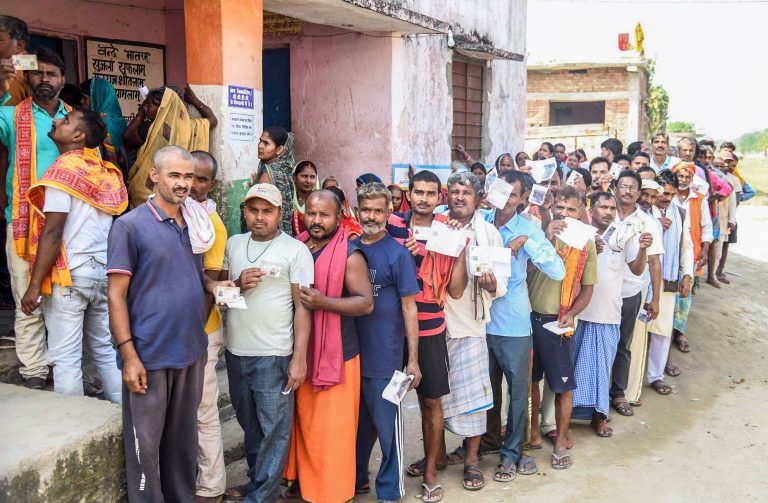
Bihar – Bihar has achieved a remarkable Bihar voter turnout record in the first phase of its Assembly elections, with 64.46 percent of eligible voters exercising their franchise on Thursday. This historic turnout represents the highest voter participation in the state’s electoral history, surpassing previous benchmarks and demonstrating robust democratic engagement across 121 Assembly constituencies.

Chief Electoral Officer Vinod Singh Gunjiyal confirmed the provisional Bihar voter turnout record, stating that polling commenced at 7 am and concluded at 6 pm under stringent security arrangements. The achievement marks a significant milestone in the state’s democratic journey and reflects strong citizen participation in the electoral process.

Comparative Historical Analysis

The current Bihar voter turnout record surpasses the state’s previous highest participation rate of 62.57 percent recorded during the 2000 Bihar Assembly elections. According to Election Commission data, this achievement also edges past the 64.6 percent turnout witnessed during the 1998 Lok Sabha election in the state.

This historical comparison underscores the significance of Thursday’s polling, demonstrating increased civic consciousness and voter engagement over the past quarter-century. The incremental improvement in participation rates reflects the Election Commission’s sustained efforts to encourage democratic participation and improve electoral accessibility.

Massive Electoral Exercise Across State

The first phase of voting involved a massive democratic exercise, with approximately 3.75 crore eligible voters across 18 districts. The Bihar voter turnout record was achieved through polling at 45,341 polling stations, of which 36,733 were located in rural areas, ensuring widespread accessibility for voters across diverse geographical locations.

A total of 1,314 candidates had their electoral fate sealed through this phase of voting, representing various political parties and independent contestants. The scale of this democratic exercise demonstrates the complexity and magnitude of conducting free and fair elections in India’s third most populous state.

District-wise Performance Variations

While the overall Bihar voter turnout record stands at an impressive 64.46 percent, different districts showed varying levels of participation. According to CEO Gunjiyal, Begusarai district recorded the highest voter turnout among all participating districts, demonstrating exceptional civic engagement and effective election management.

Conversely, Sheikhpura district registered the lowest polling percentage in this phase, though still contributing to the overall historic turnout figures. These variations highlight the diverse socio-political dynamics across different regions of Bihar and the varying levels of electoral enthusiasm among different communities.

Advanced Monitoring and Technology Integration

The Bihar voter turnout record was achieved under unprecedented technological supervision. Chief Election Commissioner Gyanesh Kumar, along with Election Commissioners Sukhbir Singh Sandhu and Vivek Joshi, monitored the polling process through live webcasting, which was implemented at 100 percent of polling stations for the first time in Bihar’s electoral history.

This complete digital coverage ensured transparency and allowed real-time monitoring of the electoral process, contributing to the smooth conduct of polls and potentially encouraging higher voter participation. The technological integration represents a significant advancement in electoral management and accountability.

Also Read: Khesari Lal Illegal Construction: Shocking Notice Amid Bihar Polls 2025

Complaint Resolution and Administrative Efficiency

Despite the massive scale of operations, the Bihar voter turnout record was achieved with efficient complaint resolution mechanisms. According to the Bihar CEO, 143 complaints were received throughout the day and were immediately addressed by election officials, demonstrating responsive administrative action.

This prompt resolution of grievances helped maintain the integrity of the electoral process and ensured that voter concerns did not impede participation. The swift administrative response contributed to the smooth functioning of the democratic exercise and helped build voter confidence in the system.

Incidents and Security Challenges

While the Bihar voter turnout record represents an overall success, the day was not without incidents. Polling was boycotted at certain booths in Buxar, Fatuha, and Suryagarha, according to the Bihar CEO, highlighting localized challenges in the democratic process.

In Lakhisarai, deputy chief minister Vijay Kumar Sinha alleged that his convoy was attacked by opposition party workers. He claimed to be in the area investigating complaints of voter intimidation. Additional Chief Electoral Officer Amit Kumar Pandey confirmed that a detailed report has been requested, with action to be taken based on findings.

Another incident occurred in the Manjhi assembly constituency of Saran district, where sitting CPI(ML) Liberation MLA Satyendra Yadav’s convoy was attacked by unidentified persons. Police confirmed that all occupants, including the MLA, escaped without injuries.

Path Forward: Phase 2 and Result Declaration

With the Bihar voter turnout record set in phase 1, attention now turns to the remaining 122 seats of the 243-member assembly, which will vote on November 11. The Election Commission will assess whether similar enthusiasm continues in the second phase.

The counting of votes for both phases will take place on November 14, when the electoral verdict will determine the political future of Bihar. The historic turnout in phase 1 has set high expectations for democratic participation in the concluding phase.

The Bihar voter turnout record achieved on Thursday demonstrates the vitality of Indian democracy and the commitment of Bihar’s citizens to participate in shaping their state’s future through the ballot box, setting a benchmark for future elections across the country.
Khesari Lal Illegal Construction: Shocking Notice Amid Bihar Polls 2025

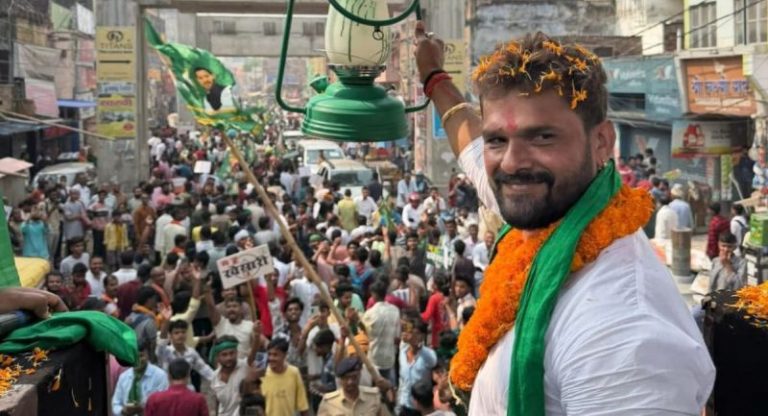
Bihar – The Mira Bhayander Municipal Corporation has issued an official notice to Bhojpuri actor and singer Khesari Lal Yadav regarding Khesari Lal illegal construction at his residence in Mira Road. The timing of this notice is particularly significant as Yadav is currently contesting the Bihar Assembly elections as a Rashtriya Janata Dal candidate from the Chapra constituency.

According to municipal officials, the notice pertains to serious violations of construction regulations at the actor-turned-politician’s property. The development has added an unexpected complication to Yadav’s electoral campaign in Bihar, drawing attention to his properties in Maharashtra while he focuses on winning votes in his home state.

Unauthorized Structures Identified by Municipal Authorities

The Khesari Lal illegal construction case specifically involves “unauthorized installation of iron angles and a tin sheet shed” at his Mira Road residence, as confirmed by a senior MBMC official on Thursday. Municipal authorities discovered these additions during routine inspections of properties in the area, which led to the issuance of the formal notice to the property owner.

The official statement from the municipal corporation clearly outlined the nature of the violations. The structures in question appear to be additions made without proper municipal approvals or building permissions, which is a violation of local construction regulations and municipal bylaws that govern building activities in the Mira Bhayander region.

Legal Requirements and Compliance Deadline

The notice regarding the Khesari Lal illegal construction contains specific directives for the property owner. “The notice asks the owner of the premises to get these illegal additions removed, failing which the encroachment department will initiate action as per municipal laws,” the MBMC official explained in an official statement.

The municipal corporation has made its position clear regarding enforcement. If voluntary compliance is not achieved within the stipulated timeframe, the civic body will take matters into its own hands. “If the illegal structure is not voluntarily removed, the civic body will undertake demolition at the owner’s cost,” the official added, emphasizing the serious financial implications for non-compliance.

This provision means that Yadav would not only face the demolition of the unauthorized structures but would also be required to bear all costs associated with the municipal demolition action, adding a financial burden to the legal complications.

Property Status During Election Campaign

Residents living in the vicinity of the Khesari Lal illegal construction site have provided additional context about the property’s current status. According to local residents, the house has been locked and unoccupied for several weeks now, suggesting that the family has been away from the premises for an extended period.

Some neighbors have indicated that Yadav’s family members have traveled to Bihar to support his election campaign, which would explain the prolonged absence from the Mira Road property. This absence, however, does not exempt the property owner from compliance with municipal regulations or responding to official notices.

Also Read: Priyanka Gandhi Bihar Elections 2025: Bold Prediction Shakes Political Landscape

The locked status of the property may complicate the process of serving notices and ensuring timely compliance with the municipal corporation’s directives. It also raises questions about property maintenance and oversight while the owner is engaged in political activities in another state.

Electoral Context: Chapra Assembly Seat

The Khesari Lal illegal construction controversy emerges at a critical juncture in Yadav’s political career. He is contesting on a Rashtriya Janata Dal ticket from the Chapra assembly seat, which represents a significant electoral challenge. The constituency has been a stronghold of the Bharatiya Janata Party, with CN Gupta winning the seat consistently since 2015.

Yadav’s decision to enter electoral politics from this particular constituency indicates the RJD’s strategy to leverage his popularity as a Bhojpuri entertainment industry figure to challenge the BJP’s dominance. However, the timing of the municipal notice could potentially impact his campaign narrative and provide opposition parties with material for criticism.

Candidate Response and Communication Gap

Attempts to reach Khesari Lal Yadav for comments regarding the Khesari Lal illegal construction notice have been unsuccessful. The candidate could not be contacted for his perspective on the allegations or his plans for addressing the municipal compliance issues. This communication gap leaves several questions unanswered about his response strategy and whether he intends to contest the notice or comply with the removal orders.

The lack of immediate response from Yadav or his representatives may be attributed to his involvement in intensive campaigning activities in Bihar, where the first phase of assembly elections was underway. However, the legal matter requires attention regardless of his political commitments in another state.

Implications for Political Career

The Khesari Lal illegal construction case presents potential challenges for the RJD candidate’s political image. As a public figure contesting elections, adherence to legal and regulatory frameworks becomes particularly important. Any perception of flouting construction laws could be exploited by political opponents during the campaign.

The Khesari Lal illegal construction matter also highlights the complexities faced by entertainment personalities who transition into politics while maintaining properties and business interests across multiple states. The municipal action in Khesari Lal illegal construction serves as a reminder that legal compliance remains mandatory regardless of one’s political aspirations or celebrity status.

As the Bihar election campaign progresses and the municipal deadline approaches, resolution of the Khesari Lal illegal construction issue will require the candidate’s attention to prevent escalation into a demolition action that could generate negative publicity during this crucial electoral period.

Priyanka Gandhi Bihar Elections 2025: Bold Prediction Shakes Political Landscape

Bihar – Congress Member of Parliament Priyanka Gandhi Vadra made a significant intervention in the Priyanka Gandhi Bihar elections discourse on Thursday, claiming that the current NDA government would be voted out if fair elections were conducted in the state. Addressing a public rally during her campaign in the Govindganj area of East Champaran district, the Congress leader leveled serious allegations about electoral irregularities that have dominated political conversations.

The Congress MP’s statements came as the first phase of Bihar assembly polls was underway, with voting scheduled to continue until 6 pm across most constituencies. Her remarks have added a new dimension to an already contentious electoral battle in the state.

65 Lakh Votes Allegedly Deleted from Electoral Rolls

During the Priyanka Gandhi Bihar elections campaign rally, the Congress leader made explosive claims about voter list manipulations. She alleged that a staggering 65 lakh votes have been deleted from Bihar’s electoral rolls, raising questions about the integrity of the democratic process in the state.

“I can guarantee that if fair elections are conducted here, you people will throw this government and form a new government,” Priyanka Gandhi asserted confidently before the gathered crowd. Her statement reflects the opposition’s broader concerns about electoral transparency and the authenticity of voter registration processes.

Connection to Haryana Elections Controversy

The Priyanka Gandhi Bihar elections allegations were reinforced by references to similar claims made about the Haryana assembly elections. She stated that her brother, Lok Sabha Leader of Opposition Rahul Gandhi, had demonstrated evidence of vote rigging in Haryana, where allegedly 25 lakh fake votes were added to the electoral rolls.

“Yesterday, Rahul Gandhi showed that the votes were rigged in the Haryana elections. 25 lakh fake votes… Today, their arrogance is such that they disrespect your votes,” she told the rally attendees. This connection between the two state elections suggests a pattern that the Congress party believes is undermining democratic processes.

Critique of Government’s Response to Opposition

During Priyanka Gandhi Bihar elections speech, the Congress MP criticized the Prime Minister’s characterization of opposition leaders. She countered claims that opposition leaders insult people in states like West Bengal, Kerala, and Bihar, stating instead that they are advocating for people’s rights and empowerment.

“The Prime Minister of the country, wherever he goes, he says that the opposition leaders are insulting the people in West Bengal, Kerala and Bihar. We are talking about your rights, your empowerment,” Priyanka Gandhi stated, framing the opposition’s role as defenders of democratic rights rather than critics of the electorate.

Personal Anecdote Highlights Democratic Values

A poignant moment in the Priyanka Gandhi Bihar elections campaign came when she shared a childhood memory from Amethi. She recalled witnessing a woman scold her father, late Prime Minister Rajiv Gandhi, for failing to install a water tap in her village as promised.

“When I was 10-12 years old, I saw a woman in Amethi scold my father. She said, ‘tum Rajiv Bhaiya toh ho hamare, Pradhan Mantri hoge lekin aapne bola tha hamare yaha nal (tap) lagaoge par lagaya nahi abhi tak, hum dobara vote nahi denge aapko,'” she recounted.

Also Read: AAP Accuses BJP Voting Fraud: Explosive Double Voting Claims Surface

This anecdote served to illustrate what Priyanka Gandhi characterized as a time when India’s democracy was stronger, and citizens could question even the Prime Minister without fear. She contrasted this with the present situation, saying, “Nowadays, everyone has to fear. If you ask for your rights, you know the police will beat you and the administration will shut you down.”

First Phase Voting Records Significant Turnout

While the Priyanka Gandhi Bihar elections campaign generated headlines, the actual voting process was proceeding across the state. According to Election Commission data, Bihar recorded a voter turnout of 42.31 percent as of 1 pm during the first phase of assembly elections.

Among the 18 districts participating in this phase, Gopalganj led with the highest turnout of 46.73 percent, followed by Lakhisarai at 46.37 percent and Begusarai at 46.02 percent. The state capital, Patna, continued to record the lowest turnout among all districts at 37.72 percent.

District-wise Voting Pattern Analysis

The Priyanka Gandhi Bihar elections discussion unfolded as diverse voting patterns emerged across districts. Bhojpur recorded 41.15 percent turnout, Buxar 41.10 percent, Darbhanga 39.35 percent, Khagaria 42.94 percent, Madhepura 44.16 percent, Munger 41.47 percent, and Muzaffarpur 45.41 percent as of 1 pm.

Other districts including Nalanda (41.87 percent), Saharsa (44.20 percent), Samastipur (43.03 percent), Saran (43.06 percent), Sheikhpura (41.23 percent), Siwan (41.20 percent), and Vaishali (42.60 percent) showed moderate voter participation.

Key Constituency Performance

Among notable constituencies monitored during the Priyanka Gandhi Bihar elections campaign day, Raghopur recorded 43.3 percent turnout, Mahua 40.41 percent, and Tarapur 44.35 percent. Bankipur registered the lowest turnout at just 25 percent, while other key constituencies including Chapra (39.57 percent), Mokama (41.78 percent), and Siwan (40.19 percent) showed varying levels of voter engagement.

The Priyanka Gandhi Bihar elections speech included allegations and predictions have set the stage for intense post-election scrutiny of the electoral process in Bihar, as parties await the final results.

CBI Mustafa Son Death: Shocking Punjab Murder Probe Reveals Family Conspiracy

0

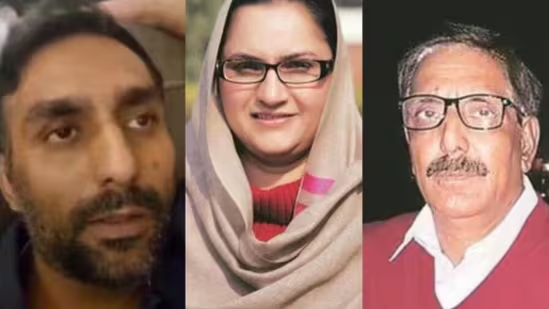
Punjab – The Central Bureau of Investigation has officially taken charge of the CBI Mustafa son death case, registering a murder investigation against the family of former Punjab Director General of Police Mohammad Mustafa on Thursday evening. The federal agency’s intervention marks a significant escalation in the probe into the mysterious death of Aqil Akhter, who was found dead at his Panchkula residence under suspicious circumstances.

Officials familiar with the development confirmed that the CBI has re-registered the first information report originally filed by local police, naming multiple family members as accused. The case has drawn widespread attention due to the prominence of those involved and the disturbing allegations that have emerged during the investigation.

Charges and Accusations in the Case

The CBI Mustafa son death investigation involves serious criminal charges under the Bharatiya Nyaya Sanhita. The agency has named Mohammad Mustafa, his wife and three-time former MLA Razia Sultana, their daughter, and their daughter-in-law under Sections 103(1) covering murder and Section 61 addressing criminal conspiracy.

According to a CBI spokesperson’s official statement, “There was simmering discontent between the deceased and his family.” This internal family conflict forms a crucial backdrop to understanding the circumstances surrounding Aqil Akhter’s death and the subsequent investigation.

Explosive Social Media Video Allegations

A critical piece of evidence in the CBI Mustafa son death probe is a video that Aqil Akhter posted on social media on August 27. In this public statement, the deceased made startling allegations about his family members. He claimed to have discovered illicit relations between his father, the former DGP, and his own wife, creating a deeply troubling family situation.

Furthermore, Aqil alleged that his family members, specifically including his mother and sister, were conspiring against him. He feared they were planning either to kill him or to implicate him in a fabricated legal case. These prophetic warnings, made just weeks before his death, have now become central to the murder investigation.

Discovery of the Body and Initial Response

Aqil Akhter was discovered unconscious at his residence located in Sector 4 of the Mansa Devi Complex area in Panchkula. Emergency responders transported him to the Civil Hospital in Sector 6, where medical personnel declared him dead upon arrival. The initial circumstances surrounding his death raised immediate questions about the cause and manner of his passing.

The family’s initial explanation for the CBI Mustafa son death was that Aqil had died due to a drug overdose. Following the post-mortem examination, authorities released the body to the family for cremation at their ancestral village in Saharanpur, Uttar Pradesh. This seemingly straightforward conclusion, however, would soon be challenged by new information.

Dramatic Turn in Investigation

The CBI Mustafa son death case took a dramatic turn when Shamshudeen Chaudhary, a Malerkotla resident and family acquaintance, filed a formal complaint with authorities. Chaudhary’s complaint specifically referenced the August 27 video that Aqil had posted on social media, bringing the deceased’s allegations back into focus.

Also Read: CBI Raid Bhullar: Massive Search at Suspended DIG’s 55-Acre Farmhouse

This complaint prompted local police to register a murder case, which subsequently caught the attention of state authorities. The serious nature of the allegations, combined with the prominence of the accused family members, necessitated a higher level of investigation.

Haryana Government Orders CBI Probe

Recognizing the sensitivity and complexity of the CBI Mustafa son death case, the Haryana government ordered a federal investigation last month. This decision transferred the probe from local police to the Central Bureau of Investigation, ensuring a more thorough and impartial examination of the circumstances surrounding Aqil’s death.

The state government’s decision to involve the CBI reflects the high-profile nature of the case and the need for an investigation free from potential local influences or pressures. Federal involvement typically signals that authorities are treating the matter with utmost seriousness.

Family’s Response to Investigation

Former DGP Mohammad Mustafa has publicly stated his position regarding the CBI Mustafa son death investigation. He has maintained that both he and his family members are willing to fully cooperate with the federal investigation. This assertion of cooperation comes despite the serious murder and conspiracy charges that have been registered against them.

The family’s willingness to cooperate will be tested as the CBI conducts its detailed investigation, which may include extensive questioning of all accused parties, forensic examinations, and a thorough review of the evidence including the crucial social media video posted by the deceased.

Implications and Ongoing Investigation

The CBI Mustafa son death probe represents one of the most sensitive investigations involving a former senior police officer’s family. The case raises questions about family dynamics, alleged relationships, and the tragic death of a young man who appeared to have foreseen danger to his own life.

As the investigation of CBI Mustafa son death progresses, the CBI will need to examine all evidence carefully, including the social media allegations, post-mortem findings, witness statements, and any other forensic evidence. The agency’s findings could have significant implications for all family members named in the case and may shed light on what truly transpired in this tragic incident.

Trump India Visit 2026: Stunning Announcement Amid Trade Tensions

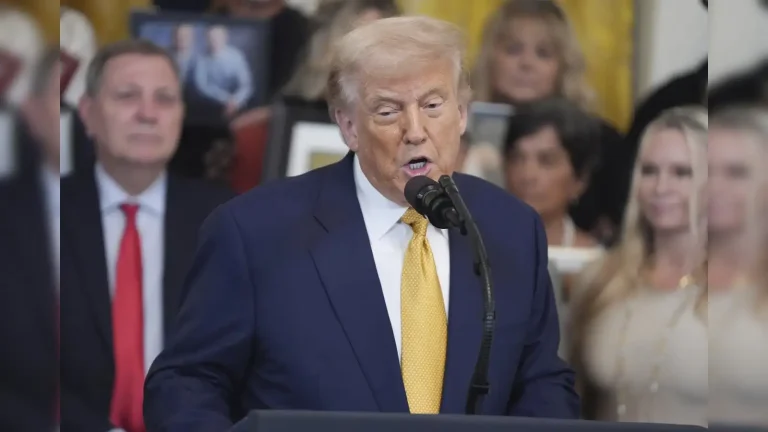
Washington D.C. – United States President Donald Trump has indicated a potential Trump India visit next year, describing Prime Minister Narendra Modi as “a great man” and “a friend” during remarks at the White House on Thursday. The announcement comes amid complex trade negotiations between the two nations, following Washington’s imposition of significant tariffs on New Delhi.

Speaking to reporters after announcing a new initiative to reduce weight loss drug prices, Trump expressed optimism about his ongoing discussions with the Indian Prime Minister. “He is a friend of mine, and we speak. Prime Minister Narendra Modi is a great man. He is a friend of mine, and we speak and he wants me to go there. We will figure that out, I will go,” Trump stated emphatically.

Timeline for Presidential Visit Emerges

When reporters directly questioned Trump about the possibility of a Trump India visit in 2026, the President responded affirmatively, saying, “It could be, yes.” This confirmation marks a significant development in bilateral relations, particularly given the current tensions over trade policies and tariff impositions.

The President’s comments suggest a warming of relations despite economic disagreements, with Trump emphasizing that his discussions with Modi were “going great.” This positive assessment indicates that both leaders are actively working to navigate the challenging trade landscape while maintaining diplomatic ties.

Tariff Tensions and Trade Negotiations Context

The potential Trump India visit occurs against the backdrop of substantial trade friction between Washington and New Delhi. The United States has imposed a 50 percent tariff on India, including an additional 25 percent duty, specifically targeting India’s continued purchase of Russian oil. These measures have created significant economic pressure and formed the centerpiece of ongoing bilateral negotiations.

Despite these tariff challenges, Trump acknowledged progress on the Russian oil issue, stating that Modi “largely stopped buying from Russia.” This admission suggests that India has made concessions in response to American pressure, potentially paving the way for improved relations and justifying a presidential visit.

Shift from Previous Reports

The announcement of a possible Trump India visit represents a notable shift from earlier this year. Reports from August indicated that Trump did not plan to attend the Quad summit in India later in 2025, following Washington’s tariff impositions. These reports suggested that the relationship between the two leaders had become strained, with Modi being “officially on the outs.”

The earlier assessment noted that Trump had initially told Modi he would travel to India for the Quad summit but subsequently canceled those plans. The reversal from those August reports to the current positive statements about a Trump India visit demonstrates the dynamic nature of US-India relations and suggests successful behind-the-scenes diplomatic efforts.

Also Read: Trump India Pakistan War Claims: Big Details on 8 Jets Downed

White House Press Briefing Developments

The Trump India visit announcement came during a White House press briefing that was briefly interrupted when a representative from one of the pharmaceutical companies fainted during the event. White House Medical Unit staff quickly responded, and the individual was reported to be fine. White House Press Secretary Karoline Leavitt confirmed the incident and assured that the representative was okay before the briefing resumed.

Official US Position on India Relations

White House Press Secretary Karoline Leavitt reaffirmed the administration’s commitment to strengthening bilateral ties earlier in the week. “The President is positive and feels very strongly about the India-US relationship,” Leavitt stated. She referenced Trump’s Diwali celebration in the Oval Office with high-ranking Indian-American officials as evidence of the administration’s engagement with the Indian community and government.

Leavitt’s remarks about the potential Trump India visit came after Trump described India as being “very good” on the Russian oil issue during his Asia tour. The President claimed that PM Modi had assured him India would curb or halt crude oil imports from Moscow, representing a significant policy shift.

India’s Response and Energy Policy

India’s Ministry of External Affairs has maintained its position on energy sourcing decisions, emphasizing that policies are guided by national interests and consumer welfare. MEA spokesperson Randhir Jaiswal stated, “India is a significant importer of oil and gas. It has been our consistent priority to safeguard the interests of the Indian consumer in a volatile energy scenario.”

Jaiswal also noted that India has sought to expand energy procurement from the United States for many years, with steady progress over the last decade. “The current Administration has shown interest in deepening energy cooperation with India. Discussions are ongoing,” he added, indicating that the potential Trump India visit could further these energy cooperation talks.

Implications for Bilateral Relations

The anticipated Trump India visit would represent a crucial opportunity for both nations to strengthen ties beyond trade disputes. Trump’s characterization of Modi as “a great man” and consistent references to their friendship suggest a personal rapport that could facilitate difficult negotiations on tariffs, energy policy, and strategic partnerships.

As discussions continue under the shadow of significant tariff impositions, the Trump India visit could serve as a platform for resolving outstanding issues and charting a path forward for one of the world’s most important bilateral relationships in the coming years.

AAP Accuses BJP Voting Fraud: Explosive Double Voting Claims Surface

New Delhi – A major political controversy has erupted as AAP accuses BJP voting irregularities, claiming that multiple party leaders cast their ballots in both Delhi and Bihar Assembly elections despite the Election Commission’s efforts to eliminate duplicate voter registrations. The allegations, made during a press conference on Thursday, have sparked intense debate about electoral integrity and raised questions about the effectiveness of the Special Intensive Revision drive conducted by the Election Commission of India.

The controversy centers around three prominent political figures who allegedly exercised their voting rights in two different states during the 2025 electoral cycle, contradicting the Election Commission’s assurance that the SIR would prevent such duplication.

AAP’s Serious Allegations Against BJP Leaders

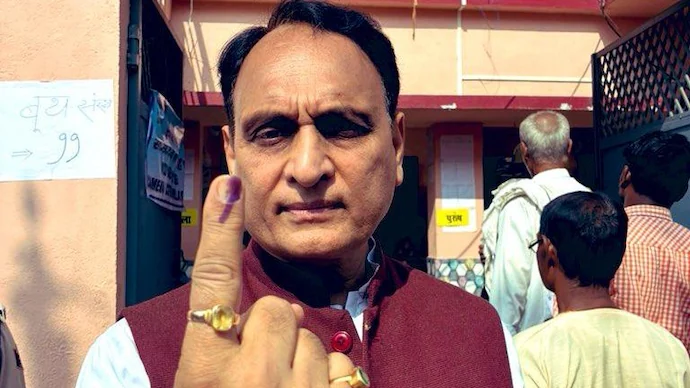
Delhi’s Aam Aadmi Party president Saurabh Bharadwaj led the charge with specific accusations against three individuals. When AAP accuses BJP voting fraud, the party named Rajya Sabha MP Rakesh Sinha, Delhi unit’s Purvanchal Morcha president Santosh Ojha, and party functionary Nagendra Kumar as those who allegedly voted twice in different states.

Bharadwaj described the situation as “vote theft” and questioned how these leaders managed to circumvent the electoral safeguards. “The Election Commission had promised that after the SIR, no voter could remain registered in two states. Then how did these BJP leaders manage to vote again in Bihar?” he stated during the press conference.

The AAP leader emphasized the gravity of the situation by highlighting that even a state-level party president was allegedly involved in the practice. “Even the BJP’s Purvanchal Morcha president is voting in two states. Imagine the scale of vote theft that must be happening across the country,” Bharadwaj warned.

BJP’s Defense and Clarification

When AAP accuses BJP voting irregularities, the accused party members have responded with their own explanations. Rakesh Sinha took to social media platform X to defend himself against what he called “baseless and morally contested allegations.” The Rajya Sabha MP posted a video clarification stating that he had legally shifted his voter registration from Delhi to his native village Manseerpur in Begusarai district, Bihar.

“My name is only on Bihar’s electoral roll. It was earlier in Delhi’s electoral roll, and I got it deleted through a procedure established by law,” Sinha explained in his post. He accused AAP, Congress, and their allies of making false accusations and described the party leaders as “liars and morally degraded.”

The Delhi BJP unit chose not to issue an official statement on the matter, leaving individual leaders to address the allegations independently.

Evidence Presented by AAP

As AAP accuses BJP voting fraud, the party presented what it described as photographic and digital evidence to support its claims. Bharadwaj specifically cited social media posts made by the accused leaders as proof of their dual voting activities.

According to the AAP president, Santosh Ojha posted on his verified Instagram account on Thursday: “Voted today with resolve for prosperous Buxar, empowered Bihar, and developed India.” This post, combined with records showing Ojha had voted in Delhi earlier, formed the basis of the allegations against him.

The party maintained detailed records and social media screenshots to substantiate each claim, presenting them as evidence of systematic electoral manipulation.

Also Read: Mumbai BJP Chief Warning: Big Statement After Mamdani’s Historic NYC Victory 2025

Broader Implications for Electoral Integrity

The controversy surrounding how AAP accuses BJP voting practices extends beyond individual cases to raise fundamental questions about electoral reforms. Saurabh Bharadwaj characterized the situation as “a systemic subversion of democracy” and urged citizens to raise their voices peacefully through democratic and constitutional channels.

AAP Rajya Sabha MP Sanjay Singh added weight to the allegations by suggesting a pattern of preferential treatment. “This is the real face of Bihar’s SIR. BJP loyalists seem to have received an all-India permit to vote anywhere they want,” Singh stated, implying systematic failures in the electoral process.

Election Commission’s Special Intensive Revision Drive

The Special Intensive Revision drive was implemented by the Election Commission specifically to eliminate duplicate voter registrations and ensure electoral roll accuracy. The first phase of Bihar polls took place on November 6, following the completion of this revision process.

The effectiveness of the SIR drive has now come under scrutiny as AAP accuses BJP voting irregularities that allegedly occurred despite these safeguards. The Election Commission has not yet responded to the allegations or provided clarification on how such duplication, if proven, could have occurred after the revision process.

Political Ramifications and Pending Investigation

The allegations have significant implications for both parties and the broader electoral system. As AAP accuses BJP voting fraud, the controversy adds another dimension to the already contentious political landscape in Delhi and Bihar. The timing of the AAP accuses BJP voting, coming immediately after the first phase of Bihar polling, has intensified their political impact.

The lack of response from the Election Commission in AAP accuses BJP voting fraud leaves many questions unanswered about the verification processes and the potential scale of duplicate registrations across the country. Citizens and political observers await official clarification on these serious allegations that strike at the heart of democratic integrity.

Trump India Pakistan War Claims: Big Details on 8 Jets Downed

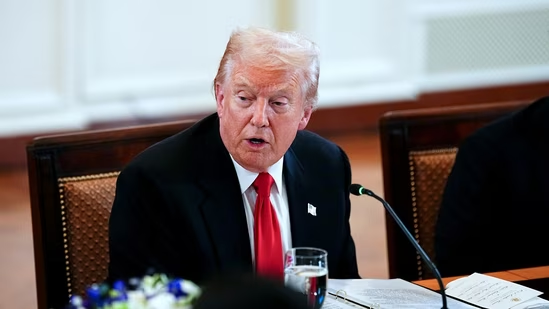
Washington D.C. – US President Donald Trump has once again made headlines with his recurring narrative about preventing a military conflict between two nuclear-armed nations. Speaking at the White House, Trump elaborated on his Trump India Pakistan war claims, revealing that eight aircraft were shot down during the May escalation. This marks an addition to his previous accounts, as he explained that the count increased from seven to eight because one aircraft that was “sort of shot down is now abandoned.”

The President emphasized his role in de-escalating tensions between the South Asian neighbors, attributing his success to the strategic use of economic leverage. According to Trump, his threat to impose tariffs on both nations played a decisive role in bringing them to the negotiation table within 24 hours.

Tariffs as Deterrent: Trump’s Economic Diplomacy Strategy

During his remarks at the White House, Trump highlighted how he utilized tariffs as a tool for conflict resolution. “If you look at India and Pakistan, they were about to fight, two nuclear nations. Eight planes were shot down. And I said, ‘If you guys are going to fight, I am going to put tariffs on you,'” Trump stated. He claimed that both countries were unhappy with the tariff threat but ultimately agreed to a ceasefire.

The President asserted that out of eight wars he claims to have ended, five or six were resolved through the use of tariffs. These Trump India Pakistan war claims form part of his broader narrative about using economic pressure as a diplomatic weapon. “Without tariffs, I wouldn’t have been able to do that,” he added, emphasizing the effectiveness of his approach.

Background: May 2025 Military Escalation

The military tensions between the two countries escalated significantly in May 2025 following a devastating terror attack in Pahalgam that claimed 26 lives. In response, India conducted Operation Sindoor, launching raids on alleged terror bases across the border. This military action triggered a series of retaliatory measures, leading to several days of heightened conflict between the nuclear-armed neighbors.

According to Trump’s account, he intervened on May 9, threatening both nations with severe trade consequences if they continued their military operations. The following day, both countries announced a ceasefire, which Trump credits entirely to his diplomatic intervention.

Trump’s Repeated Claims Across Multiple Platforms

The Trump India Pakistan war claims have been a recurring theme in the President’s public statements. At an event in Miami, Florida, Trump reiterated that his threats of cutting trade relations forced New Delhi and Islamabad to halt their military operations. He mentioned that he was in the midst of negotiating trade deals with both nations when he learned about the escalating conflict.

At the Asia-Pacific Economic Cooperation summit in South Korea, Trump again emphasized his role, stating that he “threatened India and Pakistan with tariffs” to prevent what he described as a potential nuclear war. The consistency of these Trump India Pakistan war claims across multiple forums suggests the President views this as a significant foreign policy achievement of his administration.

India’s Firm Rejection of Third-Party Intervention

Despite Trump’s repeated assertions, India has categorically rejected any suggestion of third-party involvement in resolving the conflict. The Ministry of External Affairs issued a clear statement affirming that the ceasefire was achieved through established military communication channels between the Director Generals of Military Operations of both countries.

Also Read: Trump Republicans Advice: Shocking Strategy Revealed After Democrats Sweep Elections

“India’s position remains unchanged, all issues with Pakistan are to be resolved bilaterally, without any third-party involvement,” the ministry stated firmly. This official position directly contradicts the Trump India Pakistan war claims regarding American intervention in the conflict resolution process.

The Diplomatic Implications Of Trump India Pakistan war claims

The divergence between Trump’s narrative and India’s official position highlights the complexities of international diplomacy. While Trump continues to tout his role in preventing a potential nuclear conflict, India maintains that the resolution was achieved through bilateral channels without external mediation.

The Trump India Pakistan war claims raise questions about the actual sequence of events in May and the extent of American involvement in South Asian affairs. The eight aircraft mentioned by Trump represent a significant military engagement, though independent verification of these details remains limited.

Conclusion: Conflicting Narratives

As Trump continues to highlight his Trump India Pakistan war claims as evidence of successful economic diplomacy, the gap between American and Indian accounts of the May events remains unresolved. While the President insists that tariff threats were instrumental in achieving peace, India’s steadfast position on bilateral conflict resolution without third-party interference presents a contrasting perspective on how the ceasefire was actually negotiated and implemented.

Court Rejects Bail Plea of TMC MLA Jiban Krishna Saha in West Bengal School Jobs Scam: Fresh Blow in Ongoing Recruitment Investigation

Court Rejects Bail Plea of TMC MLA: In a significant development in the West Bengal school jobs scam, a special court on Wednesday rejected the bail plea of Trinamool Congress (TMC) MLA Jiban Krishna Saha, who has been in judicial custody since April in connection with allegations of illegal recruitment and bribery in the state’s school teacher appointment process.

The court’s order marks another setback for the legislator, who represents the Burwan constituency in Murshidabad district, and is among several high-profile figures from the ruling party currently under investigation by the Central Bureau of Investigation (CBI) and the Enforcement Directorate (ED).

According to court officials, Saha’s bail was denied on the grounds that the investigation is still in progress and that releasing the accused at this stage could “influence witnesses or tamper with evidence.”


Background: The Expanding Web of the West Bengal School Jobs Scam

The West Bengal School Service Commission (SSC) recruitment scam has emerged as one of the largest corruption cases in the state’s recent history.

The case revolves around alleged irregularities in the appointment of assistant teachers and non-teaching staff in government-aided schools between 2014 and 2021, when thousands of candidates allegedly secured posts by paying bribes or leveraging political connections instead of qualifying through the official examination process.

Investigations by the CBI and ED have already led to the arrest of several senior political leaders, including former Education Minister Partha Chatterjee, his aide Arpita Mukherjee, and other TMC legislators.

Saha’s involvement, according to CBI sources, came to light after recovered documents, mobile data, and statements from intermediary agents pointed to his role in facilitating illegal recruitment through the Murshidabad district network.

“The agency has found multiple digital evidences and call records linking Saha to the recruitment racket. Large sums of money were collected through intermediaries in exchange for recommending names,” a CBI official said on condition of anonymity.


Court Rejects Bail Plea of TMC MLA: The Case Against Jiban Krishna Saha

The CBI’s chargesheet alleges that Saha acted as a link between local middlemen and key officials within the Education Department. He allegedly used his political influence to manipulate teacher selection lists and ensured postings for candidates who paid bribes.

During an earlier search operation, officials reportedly recovered bundles of cash, mobile phones, and documents from properties linked to Saha and his associates.

The ED, which is probing the money-laundering aspect of the scam, claims that funds collected through illegal means were invested in real estate and other assets across Murshidabad and neighbouring districts.

“Saha’s financial records show unexplained cash deposits and property transactions inconsistent with his declared income,” stated an ED official familiar with the case.

The legislator has consistently denied wrongdoing, claiming the charges are “politically motivated.” His lawyers argued that he has cooperated with the investigators and that continued detention violates his right to liberty.

However, the special court observed that the evidence presented so far “prima facie indicates active participation” and refused to grant bail.


Court’s Observations on the Bail Plea

The special judge, while pronouncing the order, stated that the investigation remains incomplete, and several crucial witnesses are yet to be examined.

The court remarked:

“The accused, being a person of political influence, has the potential to interfere with the investigation process if released. Hence, bail cannot be granted at this juncture.”

Legal experts note that the court’s reasoning aligns with established judicial precedent, where bail is denied in cases involving serious economic offences until key evidence has been collected and verified.

The CBI also presented fresh digital evidence allegedly linking Saha to multiple candidates who were recruited illegally between 2016 and 2020. The court directed the agency to submit its supplementary chargesheet within the next month.


Political Fallout and Party Response

The rejection of Saha’s bail plea has intensified political tension in Bengal, with the opposition BJP and Congress accusing the ruling TMC of shielding corruption.

Leader of Opposition Suvendu Adhikari commented:

“The court’s decision proves what we have been saying all along — that this government is neck-deep in corruption. Every time the investigation moves forward, another TMC leader gets exposed.”

The Trinamool Congress, however, defended Saha and reiterated that the law must take its own course.

TMC spokesperson Kunal Ghosh said:

“The party has full faith in the judiciary. Jiban Krishna Saha’s case is sub judice, and we will not comment further. The opposition is trying to politicise the issue.”

The TMC leadership has maintained that no party directive sanctioned illegal recruitment and that individuals accused in the scam must face the legal process independently.


Timeline: How the Case Unfolded

2014–2016: Alleged irregular recruitments begin under the School Service Commission’s selection process.

2018: Complaints from candidates surface; several petitions reach the Calcutta High Court demanding transparency.

2021: The High Court orders the CBI to investigate alleged anomalies in Group C and D recruitments.

2022: The ED joins the probe to track money trails. Former minister Partha Chatterjee is arrested along with his aide Arpita Mukherjee.

April 2023: CBI arrests Jiban Krishna Saha, MLA from Burwan, after seizing incriminating evidence from his residence.

2024–2025: Multiple charge sheets filed. Bail petitions of several accused, including Saha, rejected.


Legal Context and Ongoing Investigations

The CBI continues to examine recruitment records, digital data, and bank transactions related to the case.

The Enforcement Directorate (ED) is pursuing the money trail aspect, investigating how bribe funds were laundered and diverted into assets.

Both agencies are coordinating with the Calcutta High Court, which is monitoring the investigation’s progress.

Legal analysts say that as the scam involves thousands of beneficiaries and complex financial transactions, the case could take years to reach final judgment.

According to the ED’s interim report, at least ₹350 crore may have been exchanged through various channels as part of the illegal recruitment racket.


Impact on the Education System

The recruitment scandal has had far-reaching effects on West Bengal’s education sector.

Thousands of legitimate candidates who cleared examinations have alleged that they were unfairly excluded due to corruption. The state government, under pressure from the court, has since cancelled many appointments found to be irregular.

A senior official from the West Bengal Board of Secondary Education (WBBSE) stated that the department is working to restore integrity in the recruitment system through new digital verification measures and merit-based assessments.

“We are committed to transparent selection through technology-driven systems to prevent political interference,” said the official.


Public and Civil Society Reactions

Public anger has grown as the investigation expands. Civil rights groups and student organisations have demanded swift justice and reforms to prevent future scams.

Siliguri-based education activist Sujata Dutta said:

“The scam is not just about money; it’s about betrayal of young people’s trust. Hundreds of qualified candidates have lost opportunities.”

Demonstrations have been held across Kolkata and districts like Nadia and Murshidabad, calling for strict punishment of those involved regardless of party affiliation.


The Political and Administrative Fallout

The school jobs scam has become a political flashpoint in West Bengal’s governance narrative.

With several TMC leaders under investigation, opposition parties have sought to portray the ruling party as morally compromised.

At the same time, the scandal has eroded public confidence in government recruitment systems. Political observers believe the issue could significantly influence upcoming panchayat and Assembly elections, as voters continue to express frustration with corruption.


Possible Next Steps for Jiban Krishna Saha

Saha’s legal team is expected to approach the Calcutta High Court seeking bail. If denied again, they may appeal to the Supreme Court of India.

The case will likely hinge on how much additional evidence the CBI and ED can present in their supplementary charge sheets.

If convicted under the Prevention of Corruption Act and Prevention of Money Laundering Act, Saha could face imprisonment of up to seven years along with disqualification from holding public office.


Conclusion: The Road Ahead in the West Bengal School Jobs Scam

The rejection of Jiban Krishna Saha’s bail plea underscores the judiciary’s tough stance on corruption and the continuing gravity of the West Bengal school jobs scam.

As the CBI and ED pursue deeper layers of the racket, the scandal remains a test of the state’s commitment to transparency and public accountability.

For now, Saha’s continued incarceration signals that the investigation is far from over — and that political ripples from the recruitment scam will continue to shape West Bengal’s political discourse in the months ahead.


External Reference Links

Also read: Home | Channel 6 Network – Latest News, Breaking Updates: Politics, Business, Tech & More

November 6, 2025: Nifty 50 Slides to 25,509.70 Amid Broad-Based Selling; Major Action in REDINGTON, UTKARSHBNK, EXXARO

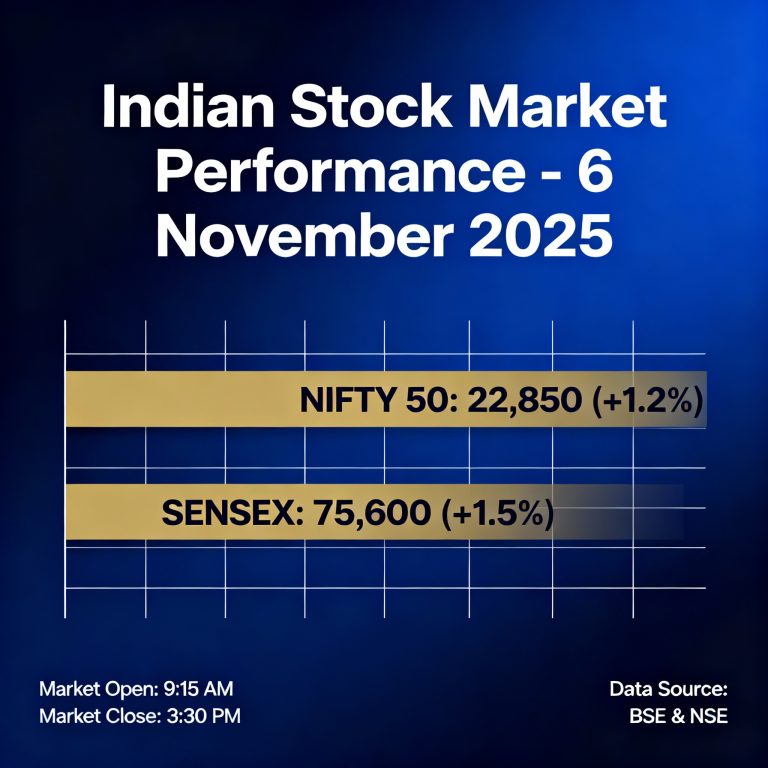
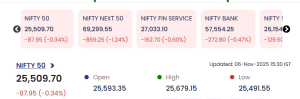
On November 6, 2025, the Indian stock market experienced a sharp decline, with the Nifty 50 index ending at 25,509.70, shedding 87.95 points or 0.34%. Market sentiment was broadly weak as sectoral indices and key midcap stocks mirrored the downward trend, reflecting heightened caution among investors amid global and domestic uncertainties.

Also Read: November 6, 2025 (Mid-cap): Nifty 50 Ends Flat at 25,558.70; Market Sees Selective Action in Gainers and Losers

Nifty 50 and Sectoral Overview

Indian stock market november 6The Nifty 50 opened at 25,593.35, touched an intraday high of 25,679.15, and slumped to a low of 25,491.55 before settling lower for the day. Other major indices including Nifty Next 50, Nifty Financial Services, and Nifty Bank followed suit, with Nifty Next 50 falling by 1.24% and banking stocks showing pronounced weakness. The session was characterized by increased volatility and profit booking across most sectors.
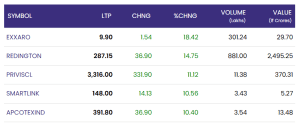


Top Gainers: EXXARO, REDINGTON, PRIVISCL, SMARTLINK, APCOTEXIND

Despite the broad sell-off, several stocks bucked the trend and posted strong gains:

  • EXXARO surged by 18.42% to close at 9.90, on heavy volumes of over 301 lakh shares and a trading value of ₹29.70 crore.

  • Screenshot 2025 11 07 000749REDINGTON rallied 14.75% to 287.15, topping the value charts with an astonishing turnover of ₹2,495.25 crore and volumes crossing 881 lakh shares.
  • PRIVISCL soared 11.12% to 3,316.00, while SMARTLINK and APCOTEXIND gained 10.56% and 10.40% respectively, with strong volume activity adding momentum.

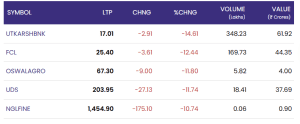
Top Losers: UTKARSHBNK, FCL, OSWALAGRO, UDS, NGLFINE

The day’s steepest declines were witnessed in the following counters:

  • UTKARSHBNK tumbled 14.61% to 17.01, leading the laggards on huge volumes of 348 lakh shares and a value of ₹61.92 crore.

  • Screenshot 2025 11 07 000757FCL dropped by 12.44% to 25.40, driven by brisk activity totaling ₹44.35 crore.
  • OSWALAGRO and UDS each fell over 11%, with OSWALAGRO closing at 67.30 and UDS ending at 203.95.

  • NGLFINE slipped 10.74% to 1,454.90, capping off a session dominated by downside volatility in select names.

Conclusion

The Indian markets closed lower on November 6, 2025, reflecting broad-based selling pressure in both benchmark indices and midcaps. While several stocks outperformed on the back of heavy investor participation, widespread declines defined the trading landscape. Market participants remain attentive to evolving economic data and global cues, with a preference for selective buying in fundamentally strong counters.

For real time stock Updates, visit NSE website.

November 6, 2025 (Mid-cap): Nifty 50 Ends Flat at 25,558.70; Market Sees Selective Action in Gainers and Losers

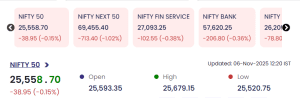
On November 6, 2025, the Indian stock market traded in a restrained manner with the Nifty 50 closing marginally lower at 25,558.70, down by 38.95 points or 0.15%. The broader sentiment reflected cautious optimism, with stocks in both advancing and declining camps displaying heightened volatility and impressive turnover in certain midcap counters.

Also Read: November 6, 2025 (opening): Nifty 50 Hovers Near 25,550 Mark Amid Volatile Session; Top Gainers and Losers

Nifty 50 and Sectoral Performance

November 6, 2025Nifty 50 maintained a close range, opening at 25,593.35, reaching a high of 25,679.15, and recording a low of 25,520.75 by mid-session. Sectoral indices mirrored the main index, posting moderate declines. Notably, Nifty Next 50, Nifty Financial Services, and Nifty Bank also ended the session in negative territory, expressing the market’s wary approach ahead of key events.
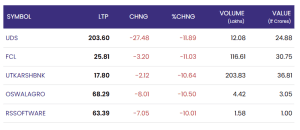


Top Losers: UDS, FCL, UTKARSHBNK, OSWALAGRO, RSSOFTWARE

Stocks witnessing the steepest declines included:

  • UDS settled at 203.60 after losing 27.48 points (down 11.89%), with a traded volume of 12.08 lakh shares and a transaction value of ₹24.88 crore.

  • Screenshot 2025 11 06 122026FCL dropped by 11.03% to 25.81 on robust trading of 116.61 lakh shares, reflecting negative cues and a value turnover of ₹30.75 crore.
  • UTKARSHBNK and OSWALAGRO also saw double-digit percentage falls, closing at 17.80 and 68.29 respectively, while RSSOFTWARE shed 10.01% to 63.39 on lower volumes.

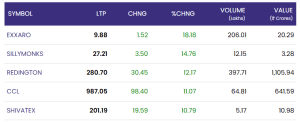
Top Gainers: EXXARO, SILLYMONKS, REDINGTON, CCL, SHIVATEX

Among the outperformers:

  • EXXARO climbed by 18.18% to close at 9.88 on substantial volumes of 206.01 lakh shares and a value of ₹20.29 crore, marking the session’s highest percentage gain.

  • Screenshot 2025 11 06 122019SILLYMONKS advanced 14.76%, closing at 27.21, while REDINGTON soared 12.17% to 280.70, capturing trader attention with an extremely high turnover of ₹1,105.94 crore on nearly 398 lakh shares.

  • CCL and SHIVATEX saw impressive gains of 11.07% and 10.79%, respectively, with CCL also clocking a notable value of ₹641.59 crore.

Conclusion: November 6, 2025 (Mid-cap)

The equities market action on November 6, 2025, signaled a phase of careful stock selection as broad indices faced resistance. While headline indices moved within a tight band, a handful of stocks experienced outsized moves, driven by investor-specific interest and sector dynamics. Market participants remain alert to forthcoming economic indicators and news flows for future direction.

For real time stock Updates, visit NSE website.