Saturday, May 16, 2026
Home Blog Page 350

Bihar Assembly Elections 2025: Explosive JP Nadda Attack on RJD’s ‘Jungle Raj’

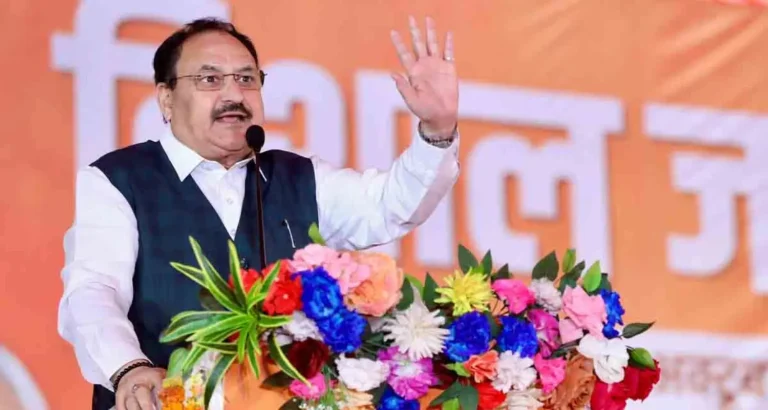
Bihar – As campaigning concluded for the first phase of the Bihar assembly election, BJP National President JP Nadda launched a scathing attack on the Rashtriya Janata Dal (RJD), claiming the party’s acronym represents “Rangdari” (extortion), “Jungle Raj” (lawless rule), and “Dadagiri” (bullying). Addressing a public meeting in Madhuban on Tuesday, Nadda sought to remind voters of what he characterized as the dark period of RJD governance while contrasting it with the development achievements of the National Democratic Alliance (NDA) government.

Nadda’s Sharp Criticism of RJD Leadership

During his address at the Bihar assembly election rally, JP Nadda specifically targeted RJD leaders Lalu Yadav and his son Tejashwi Yadav, accusing them of attempting to deceive voters with “new, alluring promises” despite their past association with lawlessness and hooliganism. The BJP president emphasized that the RJD’s historical legacy continues to define the party, regardless of its current campaign rhetoric.

Nadda referenced a controversial 2003 rally organized by Lalu Yadav in Patna, titled “Tel Pilawan, Lathiya Bhajan” (Oiling the sticks, breaking the sticks). According to the BJP chief, this rally exemplified the RJD’s approach to governance during the Bihar assembly election campaign period then. “Through this Tel Pilawan, Lathiya Bhajan rally, RJD supporters had attempted to spread fear and terror in Lalu’s name by wielding lathis,” Nadda stated, invoking memories of what he described as an era of intimidation and violence.

BJP’s Counter to Employment Promises

Addressing the employment promises made by the opposition during the Bihar assembly election campaign, Nadda took aim at Tejashwi Yadav’s pledge to provide jobs to every family. The BJP president expressed skepticism about the feasibility of such commitments, suggesting they were unrealistic and misleading. “Tejashwi says we will give jobs to every family. When we give jobs to every family, not an inch of corner land will be left in Bihar,” Nadda remarked, implying that the opposition’s promises were impractical and designed solely to win votes.

This critique forms part of the BJP’s broader strategy in the Bihar assembly election to position itself as the party of realistic governance and achievable development goals, contrasting its approach with what it characterizes as the opposition’s empty rhetoric.

Attack on Congress and Mahagathbandhan

Expanding his criticism beyond the RJD, JP Nadda also targeted the Congress party, the other major constituent of the Mahagathbandhan (grand alliance) opposing the NDA in the Bihar assembly election. The BJP president claimed that Congress lacks both strategy and clear objectives in the electoral contest. “The Congress has no strategy nor any goal in the Bihar Assembly elections. There is a wave of NDA in Bihar, and our government is being formed with a massive majority,” Nadda declared confidently.

This assertion reflects the BJP’s confidence about its prospects in the Bihar assembly election, with party leadership projecting a decisive victory for the NDA coalition led by Chief Minister Nitish Kumar’s Janata Dal (United) and the BJP.

Highlighting NDA’s Development Agenda

Central to Nadda’s speech at the Bihar assembly election rally was the emphasis on development achievements under the NDA government. The BJP president hailed what he called the “rapid development in Bihar under the leadership of Prime Minister Narendra Modi and Chief Minister Nitish Kumar,” characterizing the current period as the state’s “golden era.”

Also Read: Rahul Gandhi Caste Census: Controversial Army Remarks Spark Fierce Debate Amid Bihar Polls 2025

“Today’s Bihar is rapidly advancing on the path of development, and for that, under the guidance of Modi Ji, Nitish Kumar Ji is working with full strength and dedication. This is Bihar’s golden era, a hallmark of a bright future,” Nadda proclaimed. He urged Bihar residents to contribute to the creation of “Viksit Bharat, Viksit Bihar” (Developed India, Developed Bihar), linking the state’s progress to the broader national development vision.

Twenty Years of NDA Governance

Reflecting on two decades of NDA rule in Bihar, Nadda argued that the Bihar assembly election represents a crucial opportunity to provide stability and fresh momentum to the state’s development trajectory. “The development train of Bihar has been set on track in the NDA government over the last 20 years. This election is to provide stability to Bihar and to give a new momentum to development,” he stated.

The BJP president made a pointed appeal to voters, urging them not to forget what he termed the “darkness of RJD” rule and to choose the NDA’s vision of progress instead. This contrast between the alleged chaos of previous RJD governments and the claimed development under NDA rule forms the cornerstone of the BJP’s campaign strategy in the Bihar assembly election.

Election Schedule and Stakes

The Bihar assembly election will determine the composition of the state’s 243-seat Assembly through voting in two phases scheduled for November 6 and November 11. The counting of votes is set for November 14, when the political future of India’s third-most populous state will be decided.

The Bihar assembly election carries significant implications not just for state governance but also for national politics. A strong NDA performance would consolidate the coalition’s hold on a major Hindi heartland state, while a Mahagathbandhan victory would provide momentum to opposition forces ahead of future electoral contests.

Political Significance

As the Bihar assembly election campaigning concluded for the first phase, both alliances have presented starkly different visions for the state. The NDA has focused on development credentials and administrative stability, while the Mahagathbandhan has emphasized social justice, employment generation, and addressing what it characterizes as unfulfilled promises of the current government.

Nadda’s aggressive rhetoric in Madhuban exemplifies the high-stakes nature of the Bihar assembly election, with both sides recognizing that the outcome will shape Bihar’s political landscape for years to come. The reference to historical events and the invocation of the “Jungle Raj” narrative demonstrate the BJP’s strategy of making this election a referendum on contrasting governance models.
NYC Mayor Election 2025: Big Turnout as Mamdani Projected to Win

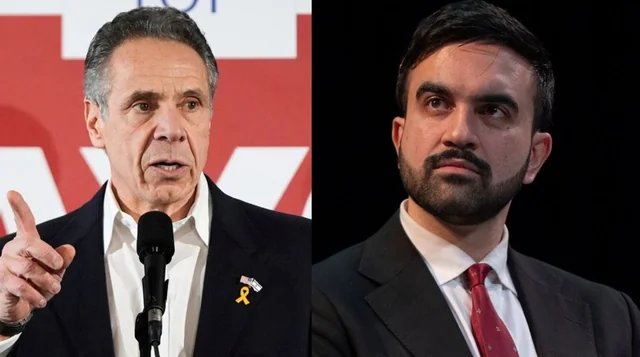
NYC, United States – The NYC mayor election 2025 has concluded with projections indicating that Democrat Zohran Mamdani will become the city’s youngest leader in decades and its first Muslim mayor. Tuesday’s election witnessed unprecedented voter engagement, with approximately 1.75 million residents casting their ballots by 6 pm local time, marking the highest turnout in any New York mayoral race in at least three decades. The historic contest featured three prominent candidates: 34-year-old democratic socialist Mamdani, former governor Andrew Cuomo running as an independent, and Republican Curtis Sliwa.

Record-Breaking Voter Participation

The NYC mayor election 2025 drew extraordinary attention from residents across the city’s five boroughs—Manhattan, Brooklyn, Queens, the Bronx, and Staten Island. According to the city’s Board of Elections, the turnout figures by early evening had already surpassed records dating back three decades, demonstrating the high stakes and intense public interest in this consequential race. Polling locations remained open from 6:00 am to 9:00 pm Eastern Time, accommodating the massive wave of voters determined to have their voices heard in shaping the city’s future leadership.

The remarkable participation in the NYC mayor election 2025 reflects the significance of the choices facing New York City residents. Each candidate represented distinctly different visions for the city, and the heightened engagement suggests that voters recognized the transformative potential of their decision. The record turnout also indicates strong civic engagement across diverse communities throughout the metropolitan area.

The Candidates and Their Campaigns

The NYC mayor election 2025 featured three candidates with vastly different backgrounds and political trajectories. Zohran Mamdani, at just 34 years old, ran as a democratic socialist on the Democratic ticket, positioning himself as a progressive voice for change. His campaign resonated particularly with younger voters and those seeking bold new approaches to the city’s challenges.

Andrew Cuomo entered the NYC mayor election 2025 as an independent candidate, attempting a remarkable political comeback four years after resigning as New York governor amid multiple sexual harassment allegations. His decision to run as an independent rather than seeking the Democratic nomination reflected the complicated nature of his return to the political arena. Cuomo’s campaign emphasized his experience in executive governance and his familiarity with managing large-scale governmental operations.

Curtis Sliwa represented the Republican Party in the NYC mayor election 2025, offering voters a conservative alternative. His campaign focused on law and order issues and positioned him as someone who could stand up to federal pressures, particularly from the Trump administration. For some residents concerned about the city’s relationship with Washington, Sliwa presented himself as a potential counterbalance to federal overreach.

Trump Factor and National Implications

The NYC mayor election 2025 carried significant national implications, particularly due to interventions by US President Donald Trump. Throughout the campaign, Trump threatened to cut off federal funding to New York City if Mamdani won, adding an unprecedented federal dimension to the local race. These threats from the White House elevated what might have been purely a municipal contest into a flashpoint of national political attention.

Also Read: Trump-Modi Trade Talks: Big Updates on US-India Relations Revealed

Trump’s opposition to Mamdani in the NYC mayor election 2025 stemmed from months of back-and-forth exchanges between the two. The president’s public statements about withholding funding raised questions about federal-city relations and the autonomy of local governance. For many voters, this federal interference became a factor in their decision-making, with some rallying behind Mamdani in response to what they perceived as inappropriate presidential meddling.

Historic Significance of Mamdani’s Projected Victory

The projected outcome of the NYC mayor election 2025 carries profound historical significance for the nation’s largest city. If confirmed, Mamdani would become New York City’s first Muslim mayor, representing a milestone for religious diversity in American political leadership. At 34, he would also be the youngest person to lead the city in decades, potentially bringing fresh perspectives and generational change to City Hall.

Mamdani’s victory in the NYC mayor election 2025 would thrust him onto the national political stage, particularly given the confrontational dynamic with President Trump. His success as a democratic socialist also signals potential shifts in the city’s political landscape and could influence progressive movements in other major urban centers across the country.

Election Night Procedures and Results

The NYC mayor election 2025 followed established procedures for vote counting and result reporting. After polls closed at 9:00 pm ET, officials began releasing vote tallies, starting with early voting and mail-in ballots. Initial updates were expected between 9:30 and 10:00 pm Eastern Time, with most results anticipated by late night if the race proved decisive rather than contested.

Major outlets typically project winners after the 9 pm deadline when margins are sufficiently clear to call the race with confidence. The high turnout in the NYC mayor election 2025 meant that counting would take considerable time, but the volume of votes also suggested that the eventual margin might be substantial enough for networks to make early projections.

What a Cuomo or Sliwa Victory Would Have Meant

While Mamdani appears projected to win the NYC mayor election 2025, the alternative outcomes carried their own significance. A Cuomo victory would have represented one of the most remarkable political comebacks in recent American history, demonstrating that voters were willing to look past his resignation scandal and trust him with executive authority once again.

Had Sliwa prevailed in the NYC mayor election 2025, it would have marked a surprising Republican victory in overwhelmingly Democratic New York City. Such an outcome would have placed a Republican in charge of the country’s largest city at a complex political moment, with implications for the party’s urban strategies nationwide.

Looking Forward

The conclusion of the NYC mayor election 2025 marks the beginning of a new chapter for New York City, with the projected winner facing immediate challenges and opportunities in leading America’s most populous municipality.

Rahul Gandhi Caste Census: Controversial Army Remarks Spark Fierce Debate Amid Bihar Polls 2025

Bihar – Congress leader Rahul Gandhi has intensified his demand for a Rahul Gandhi caste census while making controversial statements about representation in India’s major institutions, including the armed forces. Speaking at a rally in Bihar’s Kutumba on November 4, the last day of campaigning for the first phase of the assembly election scheduled for November 6, the Lok Sabha Leader of Opposition claimed that communities considered upper castes have “total control” over corporates, bureaucracy, judiciary, and even the military.

Gandhi’s Claims About Institutional Control

During his speech advocating for the Rahul Gandhi caste census, the Congress leader asserted that Dalits, backward classes, and minorities, who he said form 90% of India’s population, are not adequately represented in key institutions. “Take out the list of the 500 biggest companies, and search for Dalits, Extremely Backward Classes, Mahadalits, minorities, Adivasis in them. You will not find anyone. You won’t find a single one. All of them come from the 10% population,” he stated, referring apparently to the dominant castes of “savarnas.”

Gandhi continued his argument by claiming that bank wealth, jobs, and positions in the bureaucracy predominantly go to this 10% population. In his most controversial statement supporting the Rahul Gandhi caste census demand, he extended this assertion to the judiciary and armed forces. “Look at the judiciary. They get everything there too. They have control over the army,” he said, speaking in Hindi. “And the 90% population — you will not find them anywhere.”

The Context of Kutumba Rally

The Congress leader was speaking in Kutumba, a segment reserved for the Scheduled Castes where Bihar Congress chief Rajesh Ram is the Mahagathbandhan candidate. This marks perhaps the first time Gandhi has explicitly linked the army to his argument for the Rahul Gandhi caste census. A video of the rally is available on his social media handle, with his speech beginning at the 12-minute mark.

Gandhi’s political pitch over the past few years has consistently focused on “social justice” and “anti-caste” themes, particularly in Bihar where the Congress’s bigger partner in the Mahagathbandhan, the RJD, has traditionally been a party of the backward classes, Yadavs in particular, and Muslims.

BJP’s Strong Response to Army Reference

The reference to the armed forces in the context of the Rahul Gandhi caste census demand triggered immediate and fierce backlash from BJP leaders. BJP spokesperson Pradeep Bhandari posted on social media: “Rahul Gandhi now wants to divide even our Armed Forces on caste lines! The Indian Army, Navy, and Air Force stand for Nation First, not caste, creed or class. Rahul Gandhi hates our brave armed forces! Rahul Gandhi is Anti – Indian Army!”

Andhra Pradesh minister Satya Kumar Yadav criticized Gandhi’s rhetoric as hitting “a new low.” He wrote: “By dragging the Indian Army into his casteist tirade, he has insulted one of the world’s most professional and apolitical forces, where soldiers serve not by caste, but by the tricolour.”

Mumbai BJP spokesperson Suresh Nakhua added that in his opposition to Prime Minister Modi, Gandhi “has already crossed the line of hating India.”

Data Supporting the Rahul Gandhi Caste Census Argument

While advocating for the Rahul Gandhi caste census, Gandhi has been citing surveys and data to make his point about backward classes being deprived of representation due to caste discrimination. Recent nationwide caste data is not available as the next census will count that, but Bihar conducted a caste survey in 2023 that provides relevant insights.

Also Read: Kharge Nitish Kumar Remarks: Bold Prediction About CM Seat Amid Bihar Elections 2025

The Bihar survey put the ratio of so-called upper castes or unreserved category at just over 15%. The survey revealed that Extremely Backward Classes (EBCs), for whom the RJD and Congress-led Mahagathbandhan has made specific promises, are the largest caste or community group in Bihar at 36%, followed by Other Backward Classes at 27%, Scheduled Castes at just short of 20%, and tribals at a little under 2%. In terms of religion, just under 18% of the population is Muslim, and about 82% Hindu.

Representation in Armed Forces and Judiciary

No official breakup of caste representation is available for the armed forces, though they have traditionally had regiments named after communities. The armed forces do not make official data available on such counts, making the Rahul Gandhi caste census demand particularly relevant for those seeking transparency in representation.

Regarding the judiciary, data shared by the government in Parliament reveals concerning patterns that support the Rahul Gandhi caste census argument. Only one in 20 judges appointed to different high courts between 2018 and 2022 were from minority communities. Only 4% belonged to Scheduled Castes or Scheduled Tribes, and around 11% were from Other Backward Classes, according to the law ministry’s reply to a parliamentary question.

The ministry noted that there is no reservation in appointment of judges to the Supreme Court and High Courts, stating that “categorywise data pertaining to representation of any caste or class of persons… is not centrally available.” However, since 2018, judges have been required to provide details regarding their social background. The ministry underlined that while the responsibility for initiating proposals for judicial appointments vests with the Chief Justice of India and Chief Justices of respective High Courts, “the government is committed to enhancing social diversity in judiciary.”

The Political Stakes

Gandhi’s push for the Rahul Gandhi caste census represents a central pillar of his political strategy, particularly in Bihar where caste identities play a crucial role in electoral politics. His assertion that such data is crucial for equal representation and constitutional rights resonates with large sections of the backward classes and marginalized communities. However, his inclusion of the armed forces in this argument has opened a new front of political controversy, with opponents accusing him of attempting to divide the military along caste lines.

Trump-Modi Trade Talks: Big Updates on US-India Relations Revealed

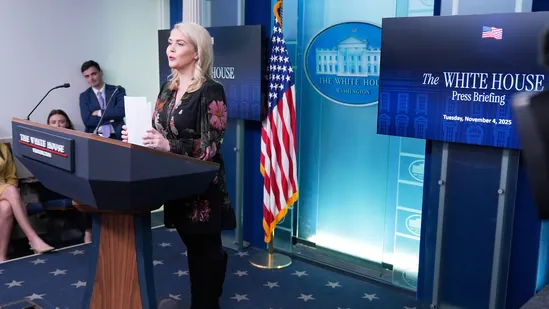
Washington D.C. – The White House has confirmed that Trump-Modi trade talks are continuing at an intensive level, with President Donald Trump and Prime Minister Narendra Modi maintaining frequent communication on critical bilateral issues. White House Press Secretary Karoline Leavitt made these revelations during a press briefing on Tuesday, providing insights into the ongoing diplomatic and economic discussions between the world’s largest democracies.

White House Confirms Ongoing Discussions

During the press briefing, Karoline Leavitt emphasized that Trump-Modi trade talks remain a priority for the current administration. She stated that President Trump and his trade team “continue to be in very serious discussions” with India on various topics of mutual interest. The press secretary’s comments came in response to questions about the future of India-US citizenship and the broader relationship between the two nations.

Leavitt highlighted the strong personal rapport between the two leaders, noting that Trump-Modi trade talks are facilitated by frequent direct communication. “I know the president has great respect for Prime Minister Modi, and they speak pretty frequently,” she said, underscoring the robust nature of the bilateral relationship at the highest level of leadership.

President Trump’s Positive Stance on India Relations

The White House press secretary revealed that President Trump feels “very positive and strongly” about the future of India-US relations, particularly regarding citizenship matters. This positive sentiment extends to the Trump-Modi trade talks, which cover a wide range of issues affecting both nations. The administration’s commitment to maintaining strong ties with India reflects the strategic importance of the relationship in the current geopolitical landscape.

Trump’s favorable view of Prime Minister Modi has been evident in recent public statements. The press secretary referenced Trump-Modi trade talks that took place during Diwali celebrations at the Oval Office, demonstrating the personal investment both leaders have in nurturing this critical partnership. These interactions go beyond formal diplomatic protocol, reflecting a genuine mutual respect between the two leaders.

Historical Context of Trump-Modi Relationship

The Trump-Modi trade talks build upon a relationship that has developed significantly over recent years. On October 28, President Trump referred to Prime Minister Modi as the “nicest looking man” while also describing him as a “killer” in negotiations. These remarks, made ahead of the Asia-Pacific Economic Cooperation (APEC) forum, illustrate Trump’s respect for Modi’s negotiating capabilities and leadership style.

The president’s characterization of Modi reflects the complex nature of Trump-Modi trade talks, which involve balancing friendship with hard-nosed negotiation on issues that affect millions of citizens in both countries. This dynamic has become a hallmark of the US-India relationship under Trump’s presidency.

Key Issues on the Table

Several critical topics feature prominently in Trump-Modi trade talks, with trade policy and citizenship rights among the most significant. The discussions reflect both nations’ interests in strengthening economic ties while addressing concerns about market access, tariffs, and regulatory frameworks.

One controversial topic that has emerged in recent Trump-Modi trade talks involves India’s oil trade with Russia. Around Diwali, President Trump made significant claims asserting that India would halt its oil trade with Russia. Since last month, Trump has made several public statements about India stopping oil trade with Russia, adding a geopolitical dimension to the bilateral discussions.

These claims about Russia-India oil trade have become a talking point in Trump-Modi trade talks, highlighting how the US-India relationship intersects with broader global energy and security considerations. The issue demonstrates the complexity of modern diplomatic relations, where economic, strategic, and political factors are deeply intertwined.

Also Read: Canada Indian Student Visa Rejections: Shocking 75% Denial Rate

Ambassador’s Role in Strengthening Ties

Karoline Leavitt also highlighted the important role of US Ambassador to India Sergio Gore in facilitating Trump-Modi trade talks and representing American interests in New Delhi. She praised Gore as “a great US ambassador to India” who will represent the country “very well.” The ambassador’s position is crucial in implementing the outcomes of Trump-Modi trade talks and maintaining day-to-day diplomatic relations between Washington and New Delhi.

Gore’s appointment reflects the administration’s commitment to placing experienced diplomats in key positions to advance the agenda established through Trump-Modi trade talks. His role involves translating high-level agreements into practical policy outcomes that benefit both nations.

Domestic Political Context

While discussing Trump-Modi trade talks, the White House briefing also touched on domestic political matters. Karoline Leavitt addressed allegations made by New York mayoral candidate Zohran Mamdani regarding voter intimidation by Trump, calling them “completely irresponsible and based on zero evidence.” She characterized these allegations as “another example of how the Democrat party unfortunately stands for nothing.”

This domestic political context occurs as millions of New Yorkers vote to choose their mayor. Zohran Mamdani, a democratic socialist, is competing against Andrew Cuomo, a former Democratic governor running as an independent. The White House’s response to these allegations reflects the broader political environment in which Trump-Modi trade talks are taking place.

Looking Forward

The continuation of Trump-Modi trade talks signals a commitment from both administrations to address outstanding issues and strengthen the bilateral relationship. As the discussions progress, observers will be watching closely to see how agreements reached through Trump-Modi trade talks translate into concrete policy changes affecting trade, immigration, defense cooperation, and technology partnerships between the United States and India.

Bilaspur Train Accident: Tragic Death Toll Rises to 11, Compensation Announced

Chhattisgarh – The Bilaspur train accident that occurred near the railway station in Chhattisgarh has resulted in a devastating loss of life, with the death toll climbing to 11 as of Wednesday morning. The tragic incident, which took place on Tuesday afternoon, has sent shockwaves through the community and raised serious concerns about railway safety in the region. Officials continue to monitor the situation as rescue operations wind down and investigations into the cause of the collision begin.

Details of the Bilaspur Train Accident

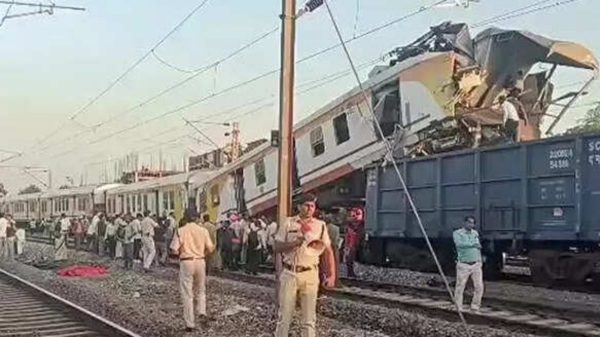
The Bilaspur train accident occurred around 4 pm on Tuesday when a mainline electric multiple unit (MEMU) passenger train collided with a goods train from behind. The passenger train was traveling from Gevra in the neighboring Korba district to Bilaspur when the catastrophic collision took place. The incident happened just a few kilometers away from Bilaspur city, which serves as the headquarters of the South Eastern Central Railway (SECR) zone.

The impact of the Bilaspur train accident was exceptionally severe, with eyewitnesses describing scenes of chaos and destruction. Railway officials reported that the force of the collision was so intense that one coach of the passenger train ended up completely mounted on top of a wagon of the cargo train. This unusual positioning of the derailed coach complicated rescue efforts and highlighted the severity of the impact.

Rising Death Toll and Casualties

Inspector General Sanjeev Shukla of the Bilaspur Range confirmed that eight bodies were initially recovered from the site of the Bilaspur train accident, including four women and four men. However, as rescue operations progressed and debris was cleared from the accident site, the death toll tragically rose to 11. Officials have warned that the final count may increase further as teams continue to search through the wreckage and clear remaining debris from the collision site.

In addition to the fatalities, at least 20 passengers sustained injuries in the Bilaspur train accident. The injured victims were immediately transported to medical facilities for treatment. Bilaspur collector Sanjay Agrawal confirmed that the injured passengers were shifted to Apollo Hospital and the Chhattisgarh Institute of Medical Sciences (CIMS) in Bilaspur, where they are receiving medical attention. One of the injured passengers was reported to be in critical condition, raising concerns about the possibility of the death toll increasing further.

Government Response and Compensation

In response to the Bilaspur train accident, Chhattisgarh Chief Minister Vishnu Deo Sai swiftly announced a compensation package for the victims and their families. The state government will provide ₹5 lakh as ex gratia payment to the families of each deceased victim. Additionally, ₹50,000 will be provided to each of the injured passengers to help cover medical expenses and provide financial relief during this difficult time.

The Chief Minister expressed his condolences to the families affected by the Bilaspur train accident and assured them that the state government would provide all necessary support during this tragic period. The compensation announcement came within hours of the accident, demonstrating the government’s commitment to supporting the victims and their loved ones.

Rescue and Relief Operations

Rescue operations at the site of the Bilaspur train accident began immediately after the collision was reported. Emergency responders, railway officials, and local authorities worked tirelessly through the night to rescue trapped passengers and recover victims from the wreckage. The challenging task of clearing debris and accessing trapped passengers was complicated by the unusual positioning of the derailed coach atop the goods train wagon.

Medical teams were stationed at the accident site to provide immediate first aid to injured passengers before they were transported to hospitals. The coordinated response from multiple agencies helped ensure that injured passengers received prompt medical attention, potentially saving lives and preventing further complications.

Investigation and Safety Concerns

As rescue operations near completion at the site of the Bilaspur train accident, attention is now turning to investigating the cause of the collision. Railway officials have initiated a formal inquiry to determine what led to the passenger train ramming into the goods train from behind. Preliminary investigations will focus on several potential factors, including signal failures, human error, mechanical issues, or track problems.

The Bilaspur train accident has once again highlighted concerns about railway safety in India, particularly regarding collision prevention systems and operational protocols. The fact that the accident occurred near the headquarters of the South Eastern Central Railway zone has intensified scrutiny on safety measures and operational standards in the region.

Community Impact

The Bilaspur train accident has deeply affected the local community, with many families anxiously waiting for news about their loved ones. The passenger train was carrying commuters traveling between Gevra and Bilaspur, a common route for daily travelers and workers in the region. The loss of 11 lives and injuries to 20 others has left the community in mourning.

As investigations continue and families begin to cope with their losses, questions about preventing future accidents remain paramount. The Bilaspur train accident serves as a somber reminder of the importance of maintaining rigorous safety standards and implementing advanced collision prevention technologies across India’s vast railway network.

Booth-Level Officers in Malda Protest Against Inhuman Workload Ahead of Bengal’s Special Voter Roll Revision 2025 — Growing Concerns Over Pressure, Fatigue, and Electoral Fairness

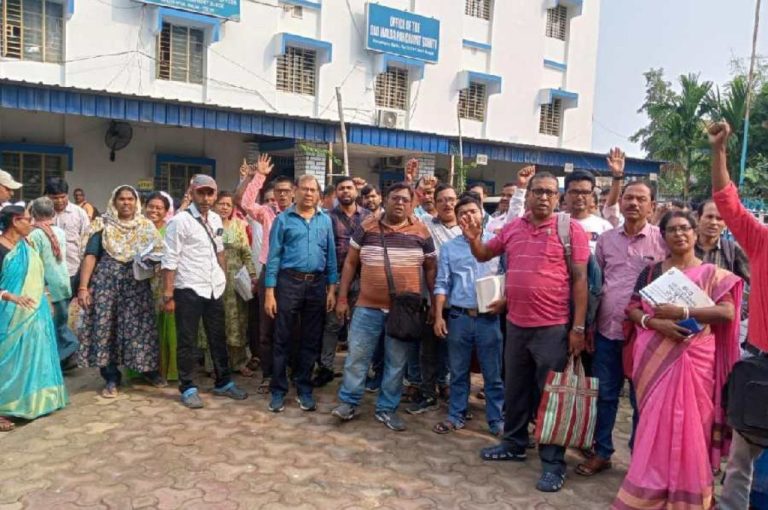
Booth-Level Officers in Malda: Just a day before the official rollout of West Bengal’s Special Intensive Revision (SIR) of Electoral Rolls 2025, the district of Malda became the epicentre of unrest. Nearly 100 Booth-Level Officers (BLOs) gathered in front of the Old Malda Block Development Office (BDO) to protest what they described as “inhuman workload” imposed on them ahead of the massive voter verification drive.

The protest by these BLOs — many of whom are school teachers performing dual roles — reflects not only the physical and emotional strain faced by ground-level staff but also signals deeper administrative cracks in the state’s election machinery. Their outcry sheds light on the human cost of conducting one of India’s largest democratic processes.


Who Are the Booth-Level Officers in Malda and Why Their Role Matters

Booth-Level Officers form the backbone of India’s electoral system. Appointed by the Election Commission, they act as the direct link between voters and the electoral administration. Their responsibilities include distributing voter forms, conducting door-to-door surveys, verifying details, updating records, and ensuring no eligible voter is left out of the list.

In West Bengal’s Special Intensive Revision (SIR), BLOs have been tasked with visiting thousands of households to verify voter identity, address, and eligibility — a process that requires long hours, meticulous attention, and impartiality. However, many BLOs in Malda claim that these expectations have reached unmanageable levels, especially when combined with their regular teaching responsibilities.


“We Are Overworked and Ignored,” Say BLOs

During the protest, several BLOs voiced their frustration over the excessive workload.
One of them, Soma Bhagat, a primary school teacher, said:

“We have to teach during school hours and then carry out BLO duties afterward. It’s inhuman — we are forced to work 8 to 10 hours every day without rest.”

Another BLO, Partha Sanyal, highlighted the logistical nightmare faced by many officers who live far away from their assigned schools and voter areas:

“Some of us travel 50 to 90 kilometres daily to our schools. After returning home, we have to visit households for the enumeration process. It’s impossible to manage both responsibilities at once.”

The officers demanded either exemption from school duties during the revision period or special leave with administrative support. They argued that without relief, both education and voter verification would suffer.


Political Pressures Intensify Administrative Burden

Beyond the workload, BLOs in Malda also raised alarms about political interference and pressure.
A section of officers cited remarks from local political leaders suggesting that BLOs would “visit homes to remove names of voters,” a statement perceived as a direct attack on their neutrality and safety.

This has led to growing fear among the BLO community that their impartial role in the electoral process is being politicized. The Election Commission of India mandates that BLOs must remain neutral and act strictly under official supervision — any perception of bias could erode public trust in the revision process.

Such tensions are especially sensitive in Bengal, where voter list politics have often intertwined with broader issues of migration, citizenship, and religious identity.


Understanding the Special Intensive Revision (SIR) 2025

The Special Intensive Revision (SIR) is part of the Election Commission’s nationwide voter list verification initiative. The exercise ensures that every eligible voter is listed, while removing duplicates, deceased persons, and invalid entries.

In West Bengal, the SIR assumes greater importance due to ongoing concerns about illegal infiltration, document authenticity, and migration patterns — all politically charged topics.

The state government and the Chief Electoral Officer (CEO) of Bengal have directed all districts to ensure flawless implementation. However, the massive scale of the project — spanning over 79,000 polling booths and involving lakhs of voters — has placed immense pressure on field-level workers.


Malda: A Microcosm of Statewide Stress

Malda, located near the Bangladesh border, is a district known for its complex demographic composition and high population density. Voter verification here is particularly demanding due to overlapping rural and urban populations, internal migration, and literacy challenges.

The protesting BLOs argued that they were not provided with adequate logistical support, transport allowances, or technological tools to manage their workload efficiently. Many said they were expected to complete enumeration for hundreds of households daily, an unrealistic target given travel constraints and their dual employment as teachers.


Administrative Response: Promises but Few Solutions

District election officials acknowledged receiving complaints but maintained that the workload was “part of the process.” They assured BLOs that their grievances would be forwarded to higher authorities and that “reasonable adjustments” might be made to ease pressure.

However, the protestors remain skeptical. One BLO commented:

“We’ve heard promises before. Nothing changes. We are doing the ground-level work while others take the credit. There must be proper coordination, or this exercise will collapse.”

As of now, there has been no official announcement regarding any reduction in workload, financial compensation, or leave exemption for teacher-BLOs.


Human Cost of Bureaucratic Pressure

The Malda protest also highlights a broader issue often ignored during large-scale governance drives — the human toll of bureaucratic overwork. BLOs, despite being at the heart of voter registration, often receive meagre allowances, no health benefits, and little recognition.

Many BLOs in Malda reported that they are expected to carry out enumeration duties after sunset, which not only increases fatigue but also raises safety concerns, particularly for female officers working in rural areas.

Moreover, the lack of rest days, continuous reporting demands, and frequent political scrutiny are pushing many to the edge. As one officer put it:

“We’re treated like machines, not human beings. Every election, every revision — it’s the same story.”


Education Sector Impact

Because many BLOs are school teachers, their absence or exhaustion directly affects the education system. Teachers claim that their students’ learning hours are getting reduced because of their extra duties.

The West Bengal Primary Teachers’ Association (WBPTA) has also raised concerns, urging the administration to either relieve teachers from electoral responsibilities during active school sessions or provide alternative manpower.

Failure to balance these roles risks harming both education outcomes and electoral efficiency — two pillars of democratic governance.


Linking the Malda Protest to Statewide Electoral Concerns

This protest comes amid larger political tensions around the voter roll revision in Bengal.
While the ruling Trinamool Congress (TMC) government is leading the state-wide SIR initiative, the Bharatiya Janata Party (BJP) has already demanded re-verification of voter documents before the process begins, alleging the use of fake certificates and forged IDs.

This political tug-of-war has created an atmosphere of suspicion, where even administrative tasks like enumeration have become politically charged. For BLOs, who are caught between bureaucratic expectations and political scrutiny, the pressure is immense.


Electoral Experts Weigh In

Political and governance experts have voiced concerns about the sustainability of current voter verification practices.

Dr. Pratap Sinha, an election governance researcher, noted:

“If the backbone of the voter verification system — the BLOs — are overburdened and demo.ralized, the entire process risks credibility. Enumeration is not just paperwork; it’s about trust between citizens and the state.”

Another expert, Prof. Nilanjan Basu, added:

“This protest exposes the underbelly of India’s democratic machinery. Without adequate compensation, rest, and protection from political interference, no electoral reform can be truly fair.”


Broader Implications for Electoral Integrity

The SIR in West Bengal is meant to ensure transparency, accuracy, and fair participation in future elections. However, if BLOs are unable to carry out their duties efficiently due to workload and political tension, the integrity of the entire process could be jeopardized.

Voters may face:

  • Delays in enumeration or corrections.
  • Errors in inclusion/exclusion due to fatigue or confusion.
  • Distrust toward the fairness of the revision process.

Moreover, if teacher-BLOs continue to bear dual burdens, both education and election duties could see long-term inefficiencies.


The Road Ahead: Reforms and Recommendations

Experts and officers alike are calling for reforms in how BLOs are managed and supported. Key recommendations include:

  1. Dedicated BLO Cadre: The Election Commission should consider creating a permanent cadre of professional BLOs, independent of school or administrative staff.
  2. Fair Compensation: Increase allowances and provide travel reimbursements to match actual workload and distances covered.
  3. Training and Psychological Support: Offer regular training sessions and stress management workshops.
  4. Use of Digital Tools: Introduce mobile-based enumeration apps to reduce manual paperwork.
  5. Protection from Political Pressure: Enforce strict disciplinary action against any political interference in BLO duties.
  6. Coordination Between Departments: Education and election departments should work in tandem to ensure teachers are not overburdened.

Conclusion: A Warning Bell for the State

The Malda BLO protest is more than a local disturbance — it’s a warning bell for the entire state’s electoral system.
If the grievances of those who form the foundation of the electoral process remain unaddressed, the credibility of Bengal’s Special Voter Roll Revision 2025 could come under question.

This incident highlights an urgent need for the Election Commission, Chief Electoral Officer, and State Government to prioritize the welfare of booth-level officers, ensuring they have the resources, rest, and respect necessary to carry out their duties.

As West Bengal gears up for another politically charged election season, the voices from Malda remind the nation that democracy depends not just on votes cast — but on the dignity and dedication of those who make every vote possible.


External References for Context

Also read: Home | Channel 6 Network – Latest News, Breaking Updates: Politics, Business, Tech & More

November 4, 2025: Indian Markets End Sharply Lower; Selective Buying in Midcaps

On November 4, 2025, Indian equity benchmarks closed with pronounced losses, deepening the market correction into the final trading session. Despite widespread selloff across indices, a handful of midcap stocks managed strong advances, underscoring the persistent divergence in sectoral sentiment and intraday volatility.​

Also Read: November 4, 2025 (Mid-day): Indian Stock Market Extends Losses; Select Stocks Defy Downtrend

Nifty 50 Suffers Steep Decline

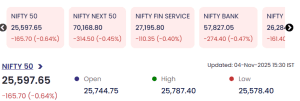
November 4, 2025The Nifty 50 index ended the day at 25,597.65, falling by 165.70 points or 0.64%. The session opened at 25,744.75 and traded between a high of 25,787.40 and a low of 25,578.40, marking a clear downward trend as bears dominated the market. Other major indices, including Nifty Next 50 and Nifty Fin Service, also registered substantial declines, highlighting broad-based pressure in banking, financials, and heavyweight stocks.


Heavy Losers Pressure Sentiment

The market’s negative tone was accentuated by sharp losses in several stocks:

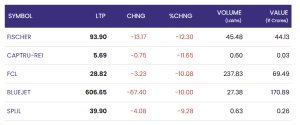
  • FISCHER plunged 12.30% to ₹93.90, on strong volumes worth ₹44.13 crores.

  • Screenshot 2025 11 05 002111CAPTRU-RE1 tumbled 11.65% to ₹5.69, indicating sustained selling.
  • FCL shed 10.08% to end at ₹28.82, displaying outsized turnover at 237.83 lakh shares.

  • BLUEJET and SPILIL also witnessed double-digit declines, dragging broader indices with them.

This selloff underlined risk aversion and profit booking in high-beta names as the market entered correction territory.​

Midcap Outperformers Buck the Trend

Contrary to the dominant bearish environment, select midcaps posted impressive gains:

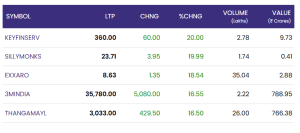
  • KEYFINSERV jumped 20% to ₹360.00, leading the gainers with strong activity.

  • SILLYMONKS surged 19.99% to ₹23.71, continuing its run as a high-momentum performer.

  • Screenshot 2025 11 05 002105EXXARO soared 18.54%, highlighting increased investor interest.
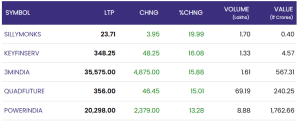
  • 3MINDIA climbed 16.55% to ₹35,780.00, registering a notable traded value of ₹788.95 crores.

  • THANGAMAYL rallied 16.50% to ₹3,033.00, seeing sustained volumes and value.

The selective surge in such midcaps points to active sectoral rotation, resilient institutional interest, and opportunity-seeking among traders even during broader market turmoil.​

Conclusion: November 4, 2025

The trading session on November 4, 2025, was marked by significant declines across headline indices, with Nifty 50 dropping over 165 points. Nevertheless, a few midcaps managed remarkable gains, proving that selective optimism persists even in bearish primary trends. The day’s performance underlines the dynamism of Indian equities, where active participation and swift sector rotation continue to shape outcomes for investors.


For real time stock Updates, visit NSE website.

November 4, 2025 (Mid-day): Indian Stock Market Extends Losses; Select Stocks Defy Downtrend

The Indian stock market continued its downward momentum during the afternoon session of November 4, 2025, with benchmark indices facing extended pressure. While the broader trend remained weak, several individual stocks posted significant gains and losses, highlighting an active trading day marked by concentrated moves in index heavyweights and select small caps.​

Also Read: November 4, 2025 (Opening): Indian Stock Market Sees Volatility Amid Sharp Movers

Key Gainers Lead Selective Buying

Screenshot 2025 11 04 122442Despite a negative market tone, some stocks attracted robust buying interest:
  • SILLYMONKS surged 19.99% to ₹23.71, supported by healthy volumes.

  • KEYFINSERV jumped 16.08% to ₹348.25, registering a notable change in price and turnover.

  • 3MINDIA rallied 15.88%, ending at ₹35,575.00 with a value of ₹567.31 crores traded.

  • QUADFUTURE gained 15.01%, closing at ₹356.00, and saw strong participation with volumes at 69.19 lakhs.

  • POWERINDIA advanced 13.28% to ₹20,298.00, leading in traded value at ₹1,762.66 crores, signalling major institutional activity.

These counters stood out for their robust performance, indicating selective optimism amongst traders desiring growth opportunities in niche segments.​


Heaviest Losers Drag Market Sentiment

The top decliners weighed heavily on overall sentiment:

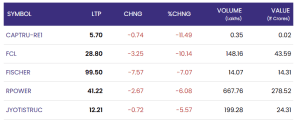
  • CAPTRU-RE1 plummeted 11.49% to ₹5.70 in thin trading.

  • November 4, 2025 FCL declined 10.14% to ₹28.80, notably on high volumes exceeding 148 lakh shares.
  • FISCHER lost 7.07%, while RPOWER dropped 6.08% despite high volume turnover, recording trades worth ₹278.52 crores.

  • JYOTISTRUC fell 5.57%, closing at ₹12.21, adding to broader sectoral weakness.

Steep declines in these stocks point to concentrated selling, particularly in names with low liquidity or negative news flow.​

Nifty 50 Slides Further Amid Market Volatility

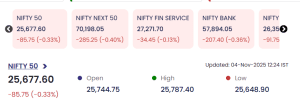
Screenshot 2025 11 04 122434The Nifty 50 index ended the session at 25,677.60, lower by 85.75 points or 0.33%. The benchmark opened at 25,744.75, rose to an intraday high of 25,787.40, but slipped to a low of 25,648.90 as selling intensified during the midday trade. Sectoral indices such as Nifty Next 50 and Nifty Fin Service also registered losses, with the Bank index dropping by 207 points, underscoring broad-based pressure across major sectors.​

Conclusion: November 4, 2025 (Mid-day)

November 4, 2025, saw the Indian stock market extend its losses with the Nifty 50 falling over 85 points in the afternoon session. While most stocks mirrored the market’s downtrend, select performers such as POWERINDIA and KEYFINSERV managed to defy the larger negative sentiment, posting significant gains. The session reflected both the intensity of sector-wide selling and the resilience of targeted buying, signifying a volatile but opportunity-driven market environment.


For real time stock Updates, visit NSE website.

November 4, 2025 (Opening): Indian Stock Market Sees Volatility Amid Sharp Movers

On November 4, 2025, the Indian stock market experienced notable volatility, with the Nifty 50 index registering a moderate decline. Despite the headline indices closing in the red, several stocks stood out for their extraordinary movements, both on the gainers and losers list, reflecting mixed investor sentiment across different sectors.​

Also read: Indian Stock Market Ends Higher: Strong Gains and Sharp Declines Mark November 3, 2025 Close

Major Declines Lead Market Lower

November 4, 2025 (Opening)Several stocks faced significant selling pressure, resulting in sharp declines:
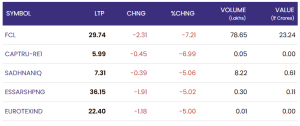
  • FCL plunged by 7.21%, closing at ₹29.74 with considerable trading volumes, registering a fall of ₹2.31.

  • CAPTRU-RE1 and SADHNANIQ also recorded steep losses of 6.99% and 5.06%, respectively.

  • ESSARSHPNG and EUROTEXIND followed closely, losing over 5% each amid low trading turnover.​

These performances indicate focused selling in select small- and mid-cap counters, particularly within low-liquidity segments.

Nifty 50 Index Settles Lower

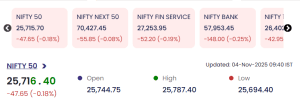
Screenshot 2025 11 04 094109The Nifty 50 index ended the session at 25,716.40, down 47.65 points (-0.18%) from the previous close. Intraday fluctuations saw the index open at 25,744.75, hit a high of 25,787.40, and a low of 25,694.40. Other major indices, such as Nifty Next 50 and Nifty Fin Service, also registered marginal declines, reflecting a cautious trading environment across broader markets.​
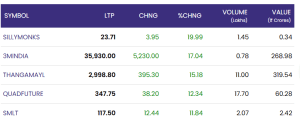
Top Performers Propel Intraday Gains

Amidst the general decline, several stocks posted spectacular gains:

  • SILLYMONKS soared 19.99% to close at ₹23.71, fueled by strong investor interest.

  • Screenshot 2025 11 04 0941323MINDIA and THANGAMAYL rose by 17.04% and 15.18%, respectively, each posting substantial advances in value and volumes.

  • QUADFUTURE and SMLT also climbed by double digits, bucking the broader market trend and suggesting selective optimism among traders.​

The standout rally in these stocks points to sectoral rotation and targeted buying, even on a subdued trading day.

Conclusion: November 4, 2025 (Opening)

The Indian stock market’s session on November 4 was characterized by sharp movements in select counters amid a moderately weaker overall index. While the Nifty 50 and other major indices closed with minor losses, the day was notable for both steep declines in low-cap counters and eye-catching rallies in specific stocks. These mixed signals underscore the uneven sentiment currently prevailing among market participants as they navigate sectoral shifts and search for resilience amid volatility.


For real time stock Updates, visit NSE website.

A Heart-Stirring Push for Justice in Domestic Help Assault Case: Fierce 3-Step Reckoning

Justice: The suspension of three staff members and imminent action against a Police Sub-Inspector (PSI) in a domestic help assault case has triggered widespread public reaction, exposing once again the deep societal concern over institutional apathy toward vulnerable workers. The case, first brought to light through local outrage, has since grown into a rallying point demanding accountability from those entrusted with protection and welfare. Citizens, activists, and legal observers say that this swift disciplinary response suggests an important shift in how such incidents are addressed — but caution that long-term change depends on systemic reform rather than momentary reactions.

The assault allegedly took place under circumstances that reflect both physical brutality and emotional humiliation. The survivor, employed as domestic staff, reportedly endured multiple rounds of abuse before the situation was formally reported. While both neighbours and co-workers had noticed signs of distress, the survivor’s reluctance to come forward earlier reveals the cultural and economic fear many domestic workers face daily. Historically, these workers operate in private spaces where abuse remains unseen and difficult to prove. This case has become symbolic of that hidden violence, pushing institutions to respond more assertively.

Authorities have confirmed that three personnel — reportedly connected to procedural lapses and delayed response — have been suspended. Meanwhile, preliminary inquiries suggest that a PSI may have either mishandled or underplayed the seriousness of the complaint. Departmental action is expected soon. Rights groups argue that the speed of disciplinary decisions marks a noticeable departure from earlier cases where delays or defensive postures protected officials. The public’s emotional investment comes from a collective discomfort: if systems cannot protect those most vulnerable, then the idea of safety itself feels uncertain.6 Psi Officers Royalty-Free Images, Stock Photos & Pictures | Shutterstock

Accountability Under Scrutiny 

The suspension of staff has prompted institutional introspection. The questioned PSI allegedly failed to act promptly, despite having information that should have triggered immediate protective measures. Instead of ensuring timely medical assistance, counselling, or shelter for the survivor, reports indicate that the officer may have initially treated the case as a routine household dispute. Critics argue that this reveals a troubling lack of sensitivity to violence within domestic spaces. Advocacy organisations note that domestic workers, unlike formal sector employees, often rely on goodwill rather than law for their protection, leaving them vulnerable.

Official statements have emphasised that departmental inquiry is now underway to examine communication lapses, evidence handling, and procedural accountability. If the PSI is confirmed to have been negligent, punishment could include demotion, transfer, or dismissal. Observers say the case has garnered attention precisely because it exposes this chain of failure. The legal framework around domestic workers remains weak, with inconsistent implementation across regions. Empathetic response is often reliant on individual officers’ sensitivity rather than systemic support. Many hope that this inquiry becomes a turning point for institutional protocol.

The survivor has reportedly begun receiving support services, including medical care and counselling. Social workers are helping assess both physical and psychological impact. While immediate safety has been secured, longer-term support is still needed, as survivors often face stigma, loss of livelihood, and social isolation. Authorities have indicated willingness to protect identity, ensure rehabilitation benefits, and explore legal restitution. Human rights advocates insist that the emotional recovery of the survivor must be treated as seriously as the criminal case. They note that many victims struggle silently even after official interventions end.

Local communities have expressed solidarity through neighbourhood meetings and online mobilisation. Many are asking how such violence could persist unnoticed. Domestic workers often form deep emotional bonds with families they serve, yet lack formal protection. The heartbreak in this case stems from the sense of betrayal: a worker entrusted within a household space was instead harmed. Community groups argue that this emotional breach intensifies the demand for visible justice. They also emphasise that protecting domestic workers requires cultural change alongside legal mechanisms, prompting conversations that extend beyond the courtroom.

Activists say the case reflects larger patterns. Domestic staff, especially women and young workers, face numerous risks including physical assault, wage exploitation, and social confinement. Many migrate for work and cannot depend on family networks for protection. The emotional strain is compounded by social invisibility: their work is inside private homes, hidden from public scrutiny. When they are harmed, evidence is scarce, and the oppressor often holds greater social power. The present case is seen as evidence of the need for stricter mandatory registration, awareness training, and routine welfare checks for domestic workers.

Legal observers note that the disciplinary steps taken so far are administrative, and the criminal investigation must still determine culpability regarding assault. If charges are proven, punishment could include imprisonment, fines, and compensation to the survivor. Some lawyers urge creation of special cells dedicated to domestic labour welfare. They propose awareness drives teaching workers how to report abuse safely, and helplines that respond sensitively. The immediate suspension of staff sends a signal that mishandling such cases will not be tolerated, yet many say deeper structural reform is necessary.6 Psi Officers Royalty-Free Images, Stock Photos & Pictures | Shutterstock

Public Outcry and Emotional Aftershocks 

Public reaction to the assault has been deeply emotional. People describe the incident as shocking because it reveals cruelty existing quietly in neighbourhood homes. It has forced many to re-evaluate their assumptions about domestic life, where care and trust are expected. Social media users have shared messages demanding justice and expressing empathy for the survivor. The emotional momentum is strong because the case challenges the comforting illusion that violence only exists in distant spaces. Here, it entered a house that should have been safe — and that felt personal.

The suspension of staff has satisfied some, but many caution that temporary action is not enough. The emotional intensity comes from fear that such violence could happen anywhere. People want accountability to go beyond individuals to the systems that permit silence. Women’s organisations are pushing for better training across the police hierarchy to distinguish household disputes from worker abuse. They argue that officers must learn to recognise vulnerabilities, especially among low-income, migrant, or young workers. Without such sensitivity, emotional harm multiplies, and trauma lingers long after physical wounds heal.

The possible involvement of multiple officials has raised questions about workplace culture within police stations. Some say informal attitudes toward domestic violence continue to influence decision-making. If officers believe such cases are “not serious,” they may fail to take urgent steps. Reform advocates believe emotional training is crucial. Officers must learn to listen to fear, not only to bruises. The survivor in this case reportedly resisted reporting earlier because of fear of retaliation or disbelief. Police must create safe environments where victims feel heard. Institutional empathy can save lives.

Domestic worker unions have renewed calls for legislation granting stronger legal recognition. Many workers remain excluded from labour laws and lack grievance systems. If abused, they must navigate legal channels alone, often without financial support. This case has become a symbol of that loneliness. Advocacy groups say the emotional pain extends beyond injury — it reflects years of normalised hierarchy. Workers are told to be grateful, obedient, and silent. When that silence is broken, society must respond compassionately. Stronger worker identity, registration, and welfare schemes could empower survivors to speak.

Neighbours who helped report the case say the ordeal has shaken them. They describe the survivor as soft-spoken and hardworking, creating emotional proximity that has intensified outrage. People now discuss warning signs they may have missed — unusual silence, sudden withdrawal, or visible injuries. This self-reflection has prompted greater vigilance. Community members are increasingly calling for anonymous reporting channels. Emotional awareness within neighbourhoods is emerging as a silent ally in preventing abuse. Once communities recognise their role, they become critical support networks for those silently suffering.

Officials are under pressure to ensure transparency. Earlier misconduct cases have eroded public trust, making every new incident feel heavier. To rebuild confidence, authorities must clearly communicate disciplinary outcomes. Emotional healing, experts say, includes public reassurance that institutions can protect. The proposed action against the PSI is viewed as a litmus test. If handled weakly, it may deepen cynicism. If handled strongly, it may inspire renewed confidence. People want a system where responsibility is non-negotiable, especially when the vulnerable are harmed.6 Psi Officers Royalty-Free Images, Stock Photos & Pictures | Shutterstock

Rehabilitation of the survivor is expected to extend over months. Beyond medical care, psychological assistance is essential. Trauma specialists highlight that violence in intimate and domestic settings often results in long-lasting emotional scars. Survivors may struggle with trust, sleep, and personal relationships. They may fear new workplaces or avoid social contact. Economic support is also important. If the survivor cannot return to work, alternative livelihood assistance should be offered. The emotional journey is long; society must acknowledge its duty to accompany survivors beyond headlines.

Policy advisers argue that while immediate disciplinary action is reassuring, preventive architecture is more important. Establishing strict reporting protocols, mandatory legal awareness workshops, and periodic review of registered households employing domestic help could create safer environments. Local administrations should build databases of active workers, employers, and welfare provisions. Emotional safety must be embedded by design, not offered only after harm. Only then can workers feel that institutions value their dignity as much as their labour.

In conclusion, the suspensions and proposed action against the PSI mark a significant institutional response to a deeply emotional domestic help assault case. The incident reveals painful truths about vulnerability inside households and the responsibility of authorities to protect those who cannot easily protect themselves. While disciplinary measures are a step forward, the pursuit of justice must continue through structural reform, emotional rehabilitation, and public vigilance. Each measure — legal, social, or cultural — must affirm one message: that every worker deserves safety, dignity, and compassionate protection in every home they enter.

Follow: Karnataka Government

Also read: Home | Channel 6 Network – Latest News, Breaking Updates: Politics, Business, Tech & More