Saturday, May 16, 2026
Home Blog Page 353

In Bilaspur Train Tragedy: 4 Dead and Several Injured After Passenger Train Collides with Goods Train

In Bilaspur, Rescue Operations Continue as Railway Teams Rush to the Spot

In Bilaspur, Chhattisgarh, a tragic train collision on Tuesday evening claimed four lives and left several others injured. The accident occurred when a passenger MEMU train traveling from Gevra to Bilaspur rammed into a stationary goods train near the Bilaspur railway station. The incident has sent shockwaves through the region, with railway and district authorities launching an immediate rescue and relief operation.Four dead as MEMU passenger train collides with freight train near  Chhattisgarh's Bilaspur - Social News XYZ

According to early reports, the accident took place around 4 p.m. near Gatora, just a few kilometers away from Bilaspur station. Railway officials confirmed that several passengers sustained injuries of varying degrees, with at least one person reported to be in critical condition. District Collector Sanjay Agrawal confirmed that rescue teams, police personnel, and medical staff were deployed immediately to assist the victims and transport the injured to nearby hospitals.

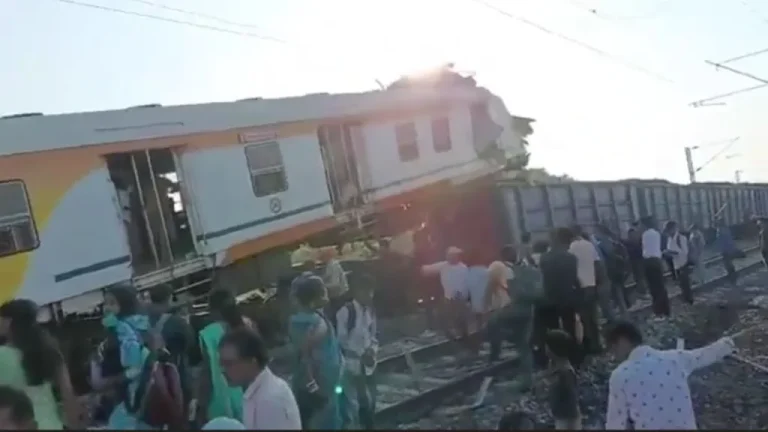
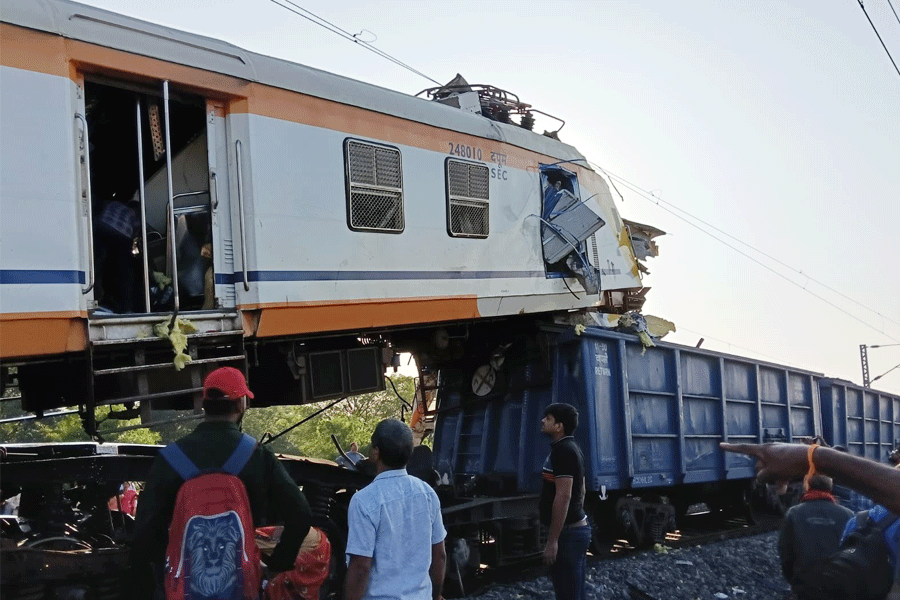
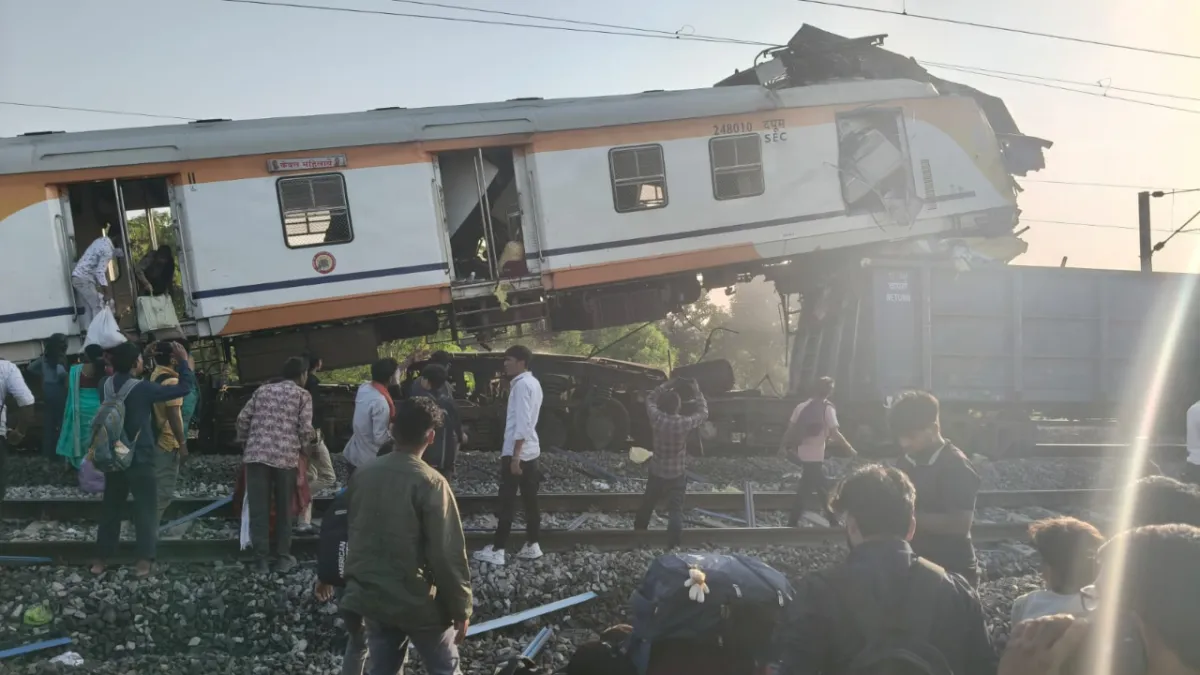
Visuals from the accident site showed a disturbing picture of the passenger train’s coaches piled onto the rear of the goods train, highlighting the severity of the impact. Hydraulic cutters and cranes were brought in to pull out trapped passengers from the damaged compartments. Rescue teams worked tirelessly through the evening, ensuring that no individual remained unaccounted for.Several Killed in Bilaspur Train Collision, Rescue Ops On - Pragativadi I  Latest Odisha News in English I Breaking News

Speaking to the media, Bilaspur Collector Sanjay Agrawal stated that while four fatalities have been confirmed, the exact number of injured passengers is still being verified as rescue operations continue. “All available medical and emergency support has been mobilized. Passengers who were critically injured have been rushed to government and private hospitals in Bilaspur,” he added.

In Bilaspur Accident, Officials Announce Ex-Gratia and Begin Investigation

A senior railway official from the South East Central Railway zone mentioned that the collision likely occurred because both trains were operating on the same track, though the final cause would be determined only after a formal investigation. “It’s common for trains to run on the same track under regulated conditions, but we will wait for the Commissioner of Railway Safety’s report to understand the exact cause,” said Bilaspur Railway CPRO Suskar Vipul Vilasrao.Bilaspur train accident | Several feared dead after passenger, goods trains  collide near Chhattisgarh's Bilaspur - Telegraph India
In Bilaspur, the Railways have set up multiple helpline numbers for passengers and families seeking information about those onboard the ill-fated train. Officials confirmed that the helpline lines will remain active until rescue and relief operations are fully completed. The Railway Administration also issued a statement assuring the public that all possible assistance is being extended to victims and their relatives.

The Railways announced ex-gratia compensation for the affected families ₹10 lakh for the next of kin of the deceased, ₹5 lakh for those seriously injured, and ₹1 lakh for passengers with minor injuries. This move came as part of the central government’s immediate relief initiative to support those impacted by the tragedy.

In Bilaspur, Authorities Ensure Medical Aid and Helpline Support for Victims’ Families

Eyewitness accounts from the scene described moments of chaos as locals and railway staff rushed to pull passengers from the mangled coaches. “There were screams, smoke, and people trying to break open doors. The rescue teams arrived within minutes and began clearing debris,” said a constable present at the site. Ambulances lined the area, transporting the injured continuously through the night.
Chhattisgarh train accident: Two feared dead after passenger train collides  with goods train in Chhattisgarh's Bilaspur | India News – India TVMedical teams from nearby hospitals were kept on standby, and special wards were set up to handle the influx of injured passengers. Local residents also joined in to donate blood and provide food and water to the victims and rescue workers. The community response in Bilaspur has been strong, with several volunteers stepping up to assist in relief efforts.

Authorities have assured that a detailed investigation will be carried out to determine whether human error, signaling failure, or technical malfunction led to the collision. Preliminary findings are expected to be shared in the coming days. In the meantime, railway traffic on the affected route has been temporarily suspended as the damaged coaches and wagons are being cleared from the tracks.

As night fell over Bilaspur, rescue teams continued their work under floodlights, ensuring every injured person received timely treatment. Officials from both the central and state governments are monitoring the situation closely, with a focus on safety measures to prevent similar tragedies in the future. Also Read: Bihar Defence Corridor Plans: Shah Reveals Bold Transformative Vision

Conclusion:
The accident in Bilaspur stands as a somber reminder of the critical need for rail safety and operational vigilance. While rescue operations continue, families mourn the lives lost in the collision. Authorities have pledged swift investigation and full support to victims, as the Bilaspur community unites in grief and resilience following one of its most heartbreaking railway tragedies.
Coimbatore Rape Accused Details: Shocking Brothers Revelation

0

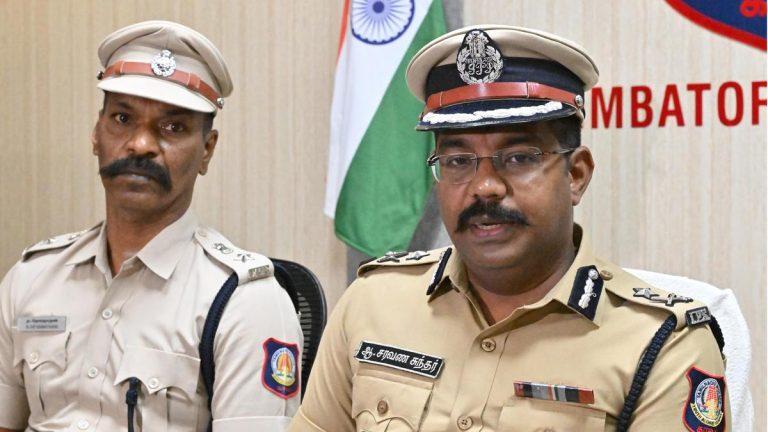
Tamil Nadu – Critical Coimbatore rape accused details have emerged following the arrest of three men involved in the sexual assault of a college student near Coimbatore airport in Tamil Nadu. Coimbatore City Police Commissioner Saravana Sundar confirmed that the accused are identified as Satish alias Karuppsamy (30), his brother Karthi alias Kalishewaran (21), and their relative Guna alias Thavasi (20). These Coimbatore rape accused details reveal a disturbing family connection among the perpetrators, with two being biological brothers and the third being their relative.

The Coimbatore rape accused details indicate that all three worked as labourers in a lathe unit, providing insight into their socioeconomic background and employment status before committing the heinous crime.

Circumstances Leading to the Crime

According to preliminary investigation findings, the Coimbatore rape accused details reveal a sequence of criminal activities on the night of the assault. The trio had robbed a two-wheeler and consumed alcoholic drinks before passing by the airport area. While traveling on a mud road near the airport in their intoxicated state, they noticed the female student and her male friend talking inside a car.

These Coimbatore rape accused details establish that the assault was not premeditated but occurred opportunistically after the accused had already engaged in vehicle theft and alcohol consumption. The combination of criminal activity and intoxication created the conditions that led to the brutal sexual assault.

Criminal History of the Accused

Further investigation into the Coimbatore rape accused details revealed troubling criminal backgrounds. The three accused were named in pending criminal cases, including murder and theft charges. Significantly, the trio were attending court in connection with a murder case, indicating that they were already facing serious criminal charges when they committed the sexual assault.

These Coimbatore rape accused details demonstrate a pattern of violent criminal behavior and suggest that the perpetrators were already known to law enforcement authorities before this incident occurred.

Details of the Assault

The Coimbatore rape accused details provide a disturbing account of how the crime unfolded. The accused approached the car where the student sat with her male friend and broke the windows using stones. They inflicted cut injuries on the male companion using a sickle, causing him to fall unconscious from the attack.

According to Coimbatore rape accused details from police statements, the trio then dragged the woman to a deserted location without any lighting and sexually assaulted her. The deliberate choice of an isolated, dark location demonstrates the calculated nature of the assault despite the perpetrators’ intoxicated state.

Timeline and Police Response

The Coimbatore rape accused details include a precise timeline of events. The incident occurred on the night of November 2, with the male friend regaining consciousness and calling the police control room at approximately 11:20 pm. A police team arrived promptly at the spot, and the survivor was taken to a hospital after emerging from the crime scene.

Commissioner Sundar stated in the Coimbatore rape accused details that the survivor was out of danger and being provided with psychological counseling, addressing both physical and mental health needs following the traumatic assault.

Investigation and Arrest Operation

The Coimbatore rape accused details highlight extensive investigative work conducted by police. Investigators examined approximately 300 CCTV footage clips and corroborated them with inputs received from the public. This comprehensive surveillance analysis allowed officials to identify the suspects’ exit route and ultimately locate them.

Police tracked the three accused to their hiding spot in Vellakinaru at around 10:40 pm on Monday. The Coimbatore rape accused details reveal that when the police team reached the location to apprehend them, the accused attacked the officers, forcing law enforcement to use minimum force to overpower them.

Police Shootout Details

Critical Coimbatore rape accused details involve the circumstances of the arrest shootout. Police opened fire on the trio below their knees when the suspects attacked the arresting team. One accused sustained a gunshot wound in one leg, while the other two were injured in both legs during the police action.

The Coimbatore rape accused details also note that a police constable was injured when the trio attacked the team, demonstrating the violent resistance offered by the perpetrators. All accused were admitted to a government facility for treatment, along with the injured constable.

Government Response

Tamil Nadu Chief Minister MK Stalin’s response forms an important part of the Coimbatore rape accused details. He ordered police to file a chargesheet within one month and secure maximum punishment as quickly as possible. Stalin termed the sexual assault “inhumane,” stating that no harsh words would sufficiently condemn such “heinous crimes.”

Police filed a gang rape case against the three accused, and the Coimbatore rape accused details confirm that legal proceedings are moving forward expeditiously as per the Chief Minister’s directive to ensure swift justice for the survivor.

Bilaspur Train Collision: Tragic 5 Deaths After MEMU Crash

Chhattisgarh – A tragic Bilaspur train collision claimed at least five lives on Tuesday when a MEMU local passenger train collided with a goods train near Bilaspur railway station in Chhattisgarh. The devastating Bilaspur train collision occurred around 4 pm, sending shockwaves through the region and triggering immediate rescue operations. Several other passengers sustained injuries in the accident, with authorities working urgently to provide medical treatment and extract trapped victims from the wreckage.

The Bilaspur train collision involved a stationary goods train that was hit by the moving MEMU local train, according to sources. This clarification about the circumstances of the Bilaspur train collision indicates that the passenger train was the moving vehicle at the time of impact, while the goods train remained stationary at its position near the railway station.

Casualties and Rescue Efforts

IG Bilaspur Sanjeev Shukla confirmed that five deaths have been verified so far in the Bilaspur train collision, with two bodies still trapped in the debris. Bilaspur Collector Sanjay Agarwal stated that rescue operations remain underway as teams work to extract the trapped victims and assist injured passengers. The Bilaspur train collision rescue operation involves multiple agencies coordinating to provide emergency medical care and clear the accident site.

A police officer present at the accident spot during the Bilaspur train collision reported that two people remain trapped in the wreckage, complicating rescue efforts. The complex nature of the Bilaspur train collision scene, with the MEMU passenger train’s front portion lodged on top of the goods train, has made extraction operations particularly challenging for rescue personnel.

Visual Evidence of Impact Severity

Visuals from the Bilaspur train collision site showed the dramatic and disturbing aftermath of the accident. The MEMU passenger train’s front portion was lodged on top of the goods train, creating a chaotic scene that gripped the area with tension. These images from the Bilaspur train collision demonstrate the severe impact force involved, explaining why casualties occurred and why rescue operations have proven challenging.

The railways immediately moved all available resources to the Bilaspur train collision spot. The Railway Public Relations Officer stated that all measures are being implemented for the treatment of injured passengers, reflecting the urgency with which authorities responded to the emergency.

Emergency Helpline Numbers Established

Authorities responding to the Bilaspur train collision quickly established multiple helpline numbers to assist affected families and provide information. At the accident site itself, two helpline numbers were issued: 9752485499 and 8602007202. These dedicated lines allow concerned relatives and others seeking information about the Bilaspur train collision to contact authorities directly.

Additionally, contact numbers for nearby railway stations were provided to facilitate communication regarding the Bilaspur train collision. Champa Junction can be reached at 808595652, Raigarh at 975248560, and Pendra Road at 8294730162. This comprehensive communication network ensures that information about the Bilaspur train collision reaches all concerned parties efficiently.

Also Read: Latest Tharoor Dynastic Politics Remarks Spark Heated Congress Debate

Compensation Announced for Victims

In response to the Bilaspur train collision, authorities announced substantial ex gratia compensation for victims and their families. An amount of ₹10 lakh has been declared for the next of kin of each deceased person. Those who sustained serious injuries in the Bilaspur train collision will receive ₹5 lakh, while passengers with minor injuries will be compensated with ₹1 lakh.

These compensation announcements following the Bilaspur train collision represent standard railway disaster response protocols, providing immediate financial support to affected families during their time of crisis and recovery.

Medical Care and Administrative Response

Injured persons from the train collision in Bilaspur have been shifted to nearby hospitals for treatment. The railway administration is extending all possible assistance and coordination to affected passengers, according to an official bulletin. Senior officials are present at the Bilaspur train collision site, closely monitoring the situation and ensuring that rescue and relief operations proceed efficiently.

Official Inquiry Ordered

A detailed inquiry into the train collision in Bilaspur will be conducted by the Commissioner of Railway Safety (CRS). This investigation will examine the circumstances that led to the accident, including whether proper safety protocols were followed and what preventive measures might prevent similar incidents in the future. The CRS inquiry into the Bilaspur train collision represents standard procedure for major railway accidents.

Recent Pattern of Railway Accidents

The train collision in Bilaspur occurs within weeks of another tragic railway incident where four people, including a woman and her daughter, were run over by Amrapali Express in Bihar’s Begusarai district while attempting to cross railway tracks. That incident occurred on the Barauni-Katihar section near Rahua railway crossing, where victims walked through tracks to avoid waterlogging.

In September, four members of a family died after being run over by the Vande Bharat Express near Pandarak railway station in Patna’s Barh. This pattern of recent railway accidents, including the Bilaspur train collision, raises concerns about railway safety measures and the need for enhanced protocols to protect both passengers and those near railway infrastructure.

The train collision in Bilaspur investigation and subsequent safety recommendations will be crucial in preventing future tragedies on India’s extensive railway network.

Canada Indian Student Visa Rejections: Shocking 75% Denial Rate

New Delhi – The Canada Indian student visa rejections have reached alarming levels, with nearly 75% of Indian applications for studying at Canadian institutions being denied in August 2025. This represents a dramatic shift from what was once a preferred destination for Indian students, as the Canada Indian student visa rejections rate has more than doubled from 32% in August 2023. The country’s restrictions on international students have disproportionately impacted applicants from India, according to official government data.

Canada reduced the number of international student permits issued for a second consecutive year in early 2025 as part of its strategy to curb temporary migration and address widespread student visa fraud. The Canada Indian student visa rejections phenomenon reflects this broader policy shift that has fundamentally altered the landscape for prospective Indian students.

Comparative Rejection Rates Reveal Disparity

The Canada Indian student visa rejections data reveals significant disparities in how different nationalities are being treated. While approximately 74% of Indian applicants to study at Canadian post-secondary institutions were denied permits in August 2025, the overall study permit application rejection rate stood at around 40% for both August 2023 and August 2025. This indicates that the Canada Indian student visa rejections rate is nearly double the general denial rate.

Chinese applicants experienced considerably lower rejection rates, with only about 24% of Chinese study permits being rejected in August 2025. This stark contrast in the Canada Indian student visa rejections compared to other major source countries raises questions about the specific factors affecting Indian applications.

Dramatic Decline in Application Numbers

Beyond the high rejection rate, the Canada Indian student visa rejections crisis is accompanied by a massive drop in application volume. The number of Indian students applying for study permits witnessed a major decline, plummeting from 20,900 in August 2023 to just 4,515 in August 2025. This represents a nearly 78% decrease in applications, suggesting that prospective students are either deterred by the high Canada Indian student visa rejections rate or are choosing alternative destinations.

For years, India has been Canada’s top source of international students, making the current Canada Indian student visa rejections trend particularly significant. The combination of high rejection rates and declining applications represents a fundamental shift in Canada-India educational ties.

Fraud Detection as Primary Reason

The primary driver behind the Canada Indian student visa rejections surge is the detection of widespread fraud in applications. Canadian authorities in 2023 discovered that almost 1,550 study permit applications included fake letters of acceptance, with many of these fraudulent documents being traced back to India. This discovery prompted stricter verification processes that directly contributed to increased Canada Indian student visa rejections.

The immigration department’s upgraded verification system has significantly enhanced fraud detection capabilities. The new system flagged more than 14,000 likely fraudulent letters of acceptance from applications received last year. This sophisticated detection mechanism has been instrumental in identifying problematic applications, thereby increasing Canada Indian student visa rejections as authorities crack down on fraudulent submissions.

Enhanced Verification and Financial Requirements

A spokesperson for Canada’s immigration department clarified that the country has substantially tightened its verification process for international students in response to fraud concerns. This enhanced scrutiny directly impacts Canada Indian student visa rejections as applications now face more rigorous examination. Additionally, Canada has increased the financial requirements for applicants, creating another barrier that contributes to higher Canada Indian student visa rejections.

Also Read: India’s US Exports Plunge: Alarming 37.5% Drop Amid Tariffs

These policy changes represent a comprehensive overhaul of Canada’s approach to international student admissions, with the Canada Indian student visa rejections serving as the most visible outcome of these stricter standards.

Indian Embassy Response

The Indian embassy in Ottawa acknowledged awareness of the increasing Canada Indian student visa rejections rate while emphasizing that permit issuance remains entirely within Canadian authority. However, the embassy strongly advocated for Indian students’ quality and value.

In a statement, the embassy emphasized that “some of the best quality students available in the world are from India, and Canadian institutions have in the past greatly benefited from the talent and academic excellence of these students.” This diplomatic response to Canada Indian student visa rejections attempts to preserve the reputation of Indian students while acknowledging Canada’s sovereign decision-making authority.

Diplomatic Context

The high Canada Indian student visa rejections rate occurs against the backdrop of strained diplomatic relations. New Delhi and Ottawa are working to repair ties after more than a year of diplomatic tensions during former Prime Minister Justin Trudeau’s administration. The Canada Indian student visa rejections issue adds complexity to these already challenging bilateral relations.

Canada’s Stated Position

Canada’s Foreign Affairs Minister Anita Anand addressed the Canada Indian student rejections controversy during a visit to India last month. She stated that while Ottawa remains focused on protecting the integrity of its immigration system, the country still aims to have Indian students studying in Canada. This balancing act reflects Canada’s attempt to address fraud concerns while maintaining educational and diplomatic relationships, even as Canada Indian student visa rejections continue at historically high levels.

Delhi Air Quality Crisis: “Severe” Pollution Level Imminent Today With AQI at 309

0

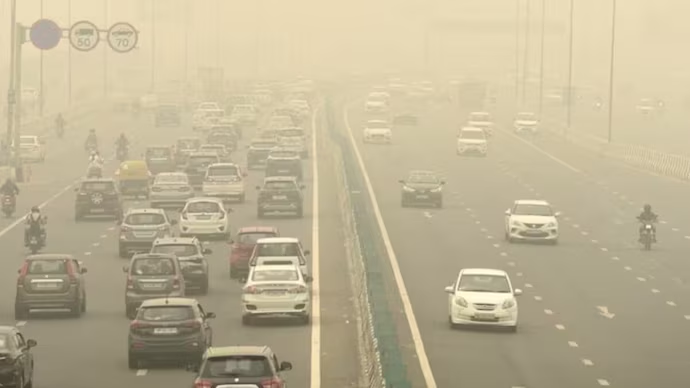
New Delhi – The Delhi air quality crisis persisted on Tuesday with the Air Quality Index remaining firmly in the ‘very poor’ category and forecast to deteriorate further to ‘severe’ levels. According to data from the Sameer app, the AQI in the Capital stands at 309, indicating that the Delhi air quality crisis shows no signs of immediate improvement. This ongoing environmental emergency has engulfed the city in haze, affecting millions of residents and raising serious health concerns.

The Delhi air quality crisis entered a critical phase at the start of November when the AQI slipped into the ‘very poor’ category. Since then, pollution levels have consistently remained at dangerous levels, with the Central Pollution Control Board recording an average AQI of 309 based on data collected until 4 pm on Monday.

Regional Variations in Pollution Levels

The Delhi air quality crisis manifests differently across various parts of the capital, with some areas experiencing significantly worse conditions than others. Alipur recorded the poorest air quality at an alarming AQI of 421, placing it in the ‘severe’ category. This represents one of the worst-affected areas in the current Delhi air quality crisis, exposing residents to extremely hazardous breathing conditions.

In contrast, Sri Aurobindo Marg recorded the lowest AQI reading at 152, still classified as ‘moderate’ but significantly better than other monitoring stations. This variation demonstrates how the Delhi air quality crisis affects different neighborhoods with varying intensity, likely due to factors including traffic density, industrial activity, and local geography.

Continuous Very Poor Category Status

The Delhi air quality crisis has maintained its grip on the capital for three consecutive days. Haze enveloped Delhi on Monday as the air quality index remained in the ‘very poor’ category for the third straight day. The 24-hour average AQI stood at 309 at 4 pm, representing a slight improvement from Sunday when it was recorded at 366 in the same category at the identical time.

This persistent pattern in the Delhi air quality crisis indicates that despite minor fluctuations, the overall pollution situation remains critically poor without substantial improvement. The consistency of dangerous air quality levels underscores the severity of the environmental emergency facing the capital.

Data Quality and Monitoring Concerns

The Delhi air quality crisis monitoring has revealed concerning gaps in data collection. Three stations in Delhi showed ‘moderate’ air quality on Monday, including ITO, a busy traffic intersection with an AQI reading of 188. However, closer examination revealed significant issues with the monitoring system during the Delhi air quality crisis.

The ITO station had several hours of missing data, raising questions about the reliability of readings during the Delhi air quality crisis. Data on the Sameer app showed AQI at ITO as low as 80 (satisfactory) at 8 am on Monday, creating confusion about actual pollution levels. These data gaps complicate efforts to accurately assess and respond to the Delhi air quality crisis.

Forecast Predicts Further Deterioration

The Delhi air quality crisis is expected to worsen before showing any improvement. According to the Early Warning System (EWS) bulletin issued on Sunday, air quality is forecast to deteriorate further to touch the ‘severe’ level on Tuesday. This represents a significant escalation in the Delhi air quality crisis, potentially triggering emergency pollution control measures.

The forecast indicates that the Delhi air quality crisis will return to ‘very poor’ levels again on Wednesday, suggesting continued dangerous breathing conditions for at least several more days. This pattern of deterioration followed by marginal improvement characterizes the cyclical nature of Delhi’s pollution problems.

Meteorological Factors Contributing to Crisis

An approaching western disturbance is expected to lead to atmospheric stagnation, exacerbating the Delhi air quality crisis. This weather pattern typically reduces wind speeds and prevents the dispersion of pollutants, trapping them close to ground level where they affect human health most severely.

Wind patterns showed some variation during the Delhi air quality crisis, with speeds touching 10 km/hr on Sunday before declining to 5 km/hr on Monday. Meteorologist Mahesh Palawat from Skymet noted these changes, while another meteorologist Navdeep Dahiya warned that a fresh layer of smog might be expected on November 4 and November 5.

Forecast System Updates Missing

Concerns about the Delhi air quality crisis response are compounded by the absence of updated forecasts. No updated forecast was issued on Monday, and the Decision Support System, which provides breakup of Delhi’s pollution sources, also remained unupdated. This lack of current information during the Delhi air quality crisis hampers both public awareness and administrative decision-making.

The western disturbance is predicted to negatively affect AQI on November 4 and November 5, potentially deepening the Delhi air quality and exposing residents to even more hazardous pollution levels during this critical period.

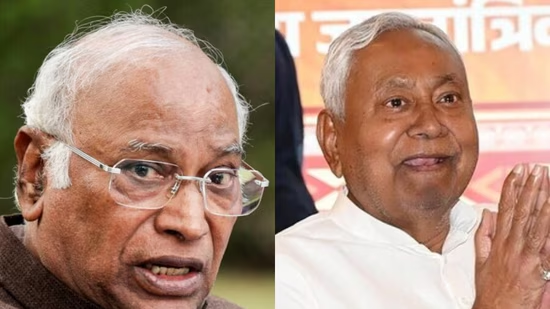
Kharge Nitish Kumar Remarks: Bold Prediction About CM Seat Amid Bihar Elections 2025

Bihar – Congress President Mallikarjun Kharge launched a scathing offensive through his Kharge Nitish Kumar remarks at a rally in poll-bound Bihar’s Vaishali on Monday. The Congress chief’s attack came a day after Prime Minister Modi’s ‘katta’ jibe at Congress and RJD, marking an escalation in the war of words ahead of Bihar assembly elections. The Kharge Nitish Kumar remarks centered on allegations that the Bihar chief minister has surrendered to BJP for power but will ultimately be denied the chief minister’s post.

“Sitting in BJP’s Lap” Accusation

The most striking aspect of the Kharge Nitish Kumar remarks was the vivid imagery used to describe the Bihar chief minister’s relationship with BJP. Kharge stated that Nitish Kumar is now “sitting in BJP’s lap” but predicted that despite this subservience, the saffron party won’t reward him with the chief minister’s position. Instead, according to the Kharge Nitish Kumar remarks, BJP will give the post to some ‘chela’ (disciple or follower).

This prediction in the Kharge Nitish Kumar remarks suggests internal NDA dynamics where Nitish Kumar might be sidelined despite being the face of the alliance in Bihar. The use of the term ‘chela’ implies that BJP might elevate a loyalist from within its own ranks or someone more pliable to party leadership.

Two Decades of Governance Criticized

The Kharge Nitish Kumar remarks included harsh criticism of the Bihar chief minister’s long tenure in office. Kharge emphasized that Nitish Kumar has taken oath as Chief Minister nine times and ruled Bihar for twenty years, yet according to the Congress president, has failed to improve people’s lives meaningfully. This aspect of the Kharge Nitish Kumar remarks directly challenges the development narrative that NDA has been promoting.

Kharge’s specific allegations in his Kharge Nitish Kumar remarks focused on employment and migration issues. He claimed that despite two decades in power, Nitish Kumar failed to provide adequate jobs or stop the migration of Bihar’s youth to other states seeking employment opportunities. This critique strikes at core governance issues that resonate with Bihar’s electorate.

Betrayal of Socialist Legacy Alleged

A significant component of the Kharge Nitish Kumar remarks involved accusations of betraying socialist ideological heritage. Kharge lambasted Kumar for allegedly abandoning the legacy of socialist icons including Jayaprakash Narayan, Ram Manohar Lohia, and Karpoori Thakur. These leaders represent Bihar’s proud socialist tradition, and the Kharge Nitish Kumar remarks positioned the current chief minister as having forsaken these principles.

The Kharge Nitish Kumar remarks specifically criticized Nitish Kumar for joining hands with what Kharge termed the “anti-women” BJP, which he said believes in the “Manu Smriti.” This reference to the ancient Hindu text, controversial for its hierarchical social prescriptions, was used to contrast BJP’s ideology with the egalitarian principles of socialist leaders.

Cannot Champion Marginalized Causes

Expanding on the ideological critique in his Kharge Nitish Kumar remarks, the Congress president declared that Nitish Kumar cannot genuinely champion the causes of Dalits, Other Backward Classes (OBCs), and Extremely Backward Classes (EBCs) while being associated with BJP. Kharge stated that Kumar’s association with a party that “believes in Manu Smriti” makes him incompatible with representing marginalized communities’ interests.

This aspect of the Kharge Nitish Kumar remarks attempts to undermine one of the Bihar chief minister’s key political strengths—his traditional support among backward classes and his reputation as a champion of social justice politics.

Modi’s Campaign Intensity Mocked

Beyond the direct Kharge Nitish Kumar remarks, the Congress president also targeted Prime Minister Narendra Modi’s intensive campaigning in Bihar. Kharge mocked Modi’s extensive presence in the state, comparing it humorously to someone organizing “his son’s wedding.” This comparison in the Kharge Nitish Kumar remarks speech suggested that Modi’s involvement was excessive and perhaps desperate.

Kharge criticized Modi for having time to tour the world but allegedly not taking stock of affairs within his own country except during elections. The Kharge Nitish Kumar remarks rally also featured criticism of Modi’s visible presence even during municipal polls, suggesting opportunistic political engagement rather than genuine governance concern.

Electoral Context and Timing

The Kharge Nitish Kumar remarks come at a crucial juncture as campaigning intensifies ahead of Bihar Assembly elections. Opposition leaders are sharpening their attacks on the ruling JD(U)-BJP alliance, and Kharge’s statements represent a comprehensive assault on both the state and central leadership of NDA.

According to the polling schedule referenced during the Kharge Nitish Kumar remarks rally, the first phase of Bihar elections will be held on November 6 for 121 assembly constituencies, with the second phase for the remaining 122 constituencies scheduled for November 11. Vote counting will occur on November 14.

Strategic Political Messaging

The Kharge Nitish Kumar remarks represent a multi-pronged political strategy: questioning Nitish Kumar’s loyalty rewards from BJP, criticizing his governance record, challenging his ideological consistency, and undermining his social justice credentials—all aimed at weakening NDA’s position before crucial voting begins.

Bihar Defence Corridor Plans: Shah Reveals Bold Transformative Vision

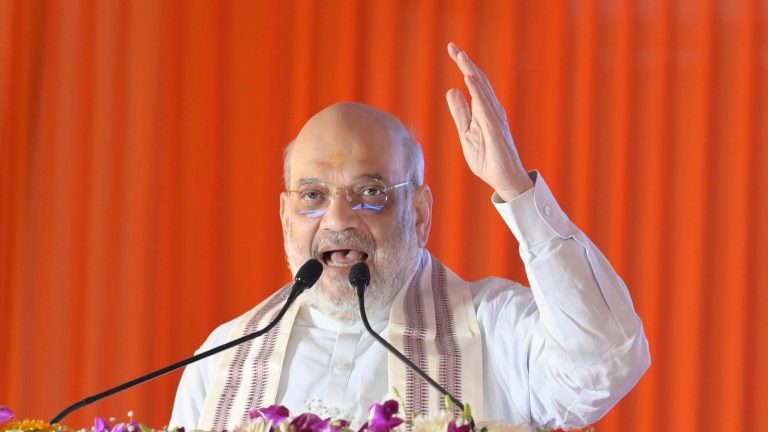
Bihar – Union Home Minister Amit Shah announced ambitious Bihar defence corridor plans on Monday, outlining a transformative agenda for the state if NDA is voted to power. Addressing poll rallies in Sheohar and Sitamarhi, Shah presented a comprehensive vision that includes establishing defence manufacturing facilities and setting up factories in each district of Bihar. The Bihar defence corridor plans represent a significant commitment to industrializing the state and creating employment opportunities.

Shah expressed strong confidence that NDA will form the government in Bihar, predicting that RJD-Congress will be “wiped out by 1 pm on November 14” when election results are declared. The Bihar defence corridor plans form the centerpiece of NDA’s development promise to voters.

Historic Flood Problem to Be Addressed

A crucial component accompanying the Bihar defence corridor plans involves tackling Bihar’s centuries-old flood problem. Shah emphasized that from Emperor Chandragupta Maurya’s time to the present Narendra Modi era, the Gandak, Koshi, and Ganga rivers have consistently wreaked flood havoc across Bihar. The NDA has committed to forming a special commission dedicated to making Bihar completely flood-free if voted to power.

The Bihar defence corridor plans are integrated with water management strategies. Shah specifically announced that Koshi river waters will be harnessed to irrigate 50,000 hectares in the Mithilanchal region, demonstrating how industrial development and agricultural improvement can work in tandem.

Industrial Development and Manufacturing Focus

The Bihar defence corridor plans encompass extensive industrial development across the state. Shah announced that factories will be established in each district, complemented by MSME (Micro, Small and Medium Enterprises) parks and industrial parks throughout Bihar. This district-level industrial approach aims to ensure equitable development and prevent concentration of manufacturing in select urban areas.

Shah emphasized the strategic importance of the Bihar defence corridor plans by stating that explosives manufactured in Bihar’s proposed defence corridor will be used in future military operations against Pakistan. This statement connects the industrial project directly to national security objectives, giving it strategic significance beyond economic development.

Connectivity and Infrastructure Promises

Supporting the Bihar defence corridor plans, Shah announced several major connectivity projects. A Vande Bharat train will be launched from Sitamarhi to Ayodhya on the consecration day of the Sita temple, enhancing religious tourism and regional connectivity. The Sitamarhi-Ayodhya Ramjanaki Path will be constructed at a cost of ₹550 crore, while ₹5,000 crore will be invested in doubling the Ayodhya-Sitamarhi rail track.

Also Read: Modi Chhath Halloween Controversy: Explosive BJP Campaign Strategy Ahead Bihar Elections 2025

These transportation initiatives complement the Bihar defence corridor plans by ensuring robust logistics infrastructure essential for industrial development and defence manufacturing operations.

Regional Development Initiatives

The Mithilanchal region features prominently in both the Bihar defence corridor plans and broader development agenda. Shah announced that this region will be developed as a global knowledge center with an investment of ₹500 crore, positioning Bihar as an educational and intellectual hub alongside its industrial transformation.

Aviation infrastructure also received attention in announcements accompanying the Bihar defence corridor plans. Shah committed to transforming Patna, Darbhanga, Purnea, and Bhagalpur airports to global standards, facilitating both commercial connectivity and potential defence logistics requirements.

Healthcare and Agricultural Revival

Beyond the Bihar defence corridor plans, Shah announced that each district of Bihar will have a medical college, addressing the state’s healthcare infrastructure deficit. This commitment demonstrates NDA’s multi-sectoral development approach extending beyond industrial manufacturing.

Shah also promised revival of all closed sugar mills in Bihar within a 2.5-year timeframe, addressing agricultural processing and farmer income concerns. This agricultural focus complements the Bihar defence corridor plans by ensuring balanced development across manufacturing and agricultural sectors.

Religious and Cultural Projects

Shah performed the ground-breaking ceremony for the ₹850-crore Sita temple at Punaura Dham in Sitamarhi, connecting the Bihar defence corridor plans with cultural and religious heritage projects. This approach appeals to voters’ religious sentiments while promoting tourism development.

Financial Allocations and Comparisons

Defending the Bihar defence corridor plans and overall NDA performance, Shah provided comparative financial data. He stated that Prime Minister Modi sanctioned ₹18.70 lakh crore to Bihar over 10 years, contrasting sharply with only ₹2.80 lakh crore during RJD-Congress rule. This massive difference in resource allocation provides credibility to ambitious promises including the defence corridor.

National Security Context

Shah contextualized the Bihar defence corridor plans within national security frameworks. Taking a jibe at Congress, he contrasted past approaches where “biryanis used to be served on a platter” to militants with the current government’s decisive Operation Sindoor, launched within 10 days of the Pahalgam attack.

Political Vision Statement

Concluding his presentation of the Bihar defence corridor plans, Shah asserted that Lalu Prasad’s tenure was characterized by scams, while only the Nitish Kumar-Narendra Modi partnership can ensure a developed Bihar. This political framing positions the defence corridor and associated development projects as achievable only under NDA governance.

Modi Chhath Halloween Controversy: Explosive BJP Campaign Strategy Ahead Bihar Elections 2025

Bihar – The Modi Chhath Halloween controversy emerged as a central campaign issue on Monday, November 3, as the Bharatiya Janata Party and Prime Minister Narendra Modi sought to frame the opposition Mahagathbandhan as anti-Hindu. Election campaigning in Bihar took a sharp religious and cultural turn, with BJP strategically juxtaposing traditional Hindu festivals against Western cultural celebrations to create a powerful political narrative.

The Modi Chhath Halloween controversy centers on BJP’s allegations that opposition parties, particularly RJD and Congress, prioritize Western culture over traditional Hindu festivals. This controversy has become a defining moment in Bihar’s electoral politics, with both sides engaging in intense rhetoric.

Lalu Yadav’s Halloween Celebration Sparks Backlash

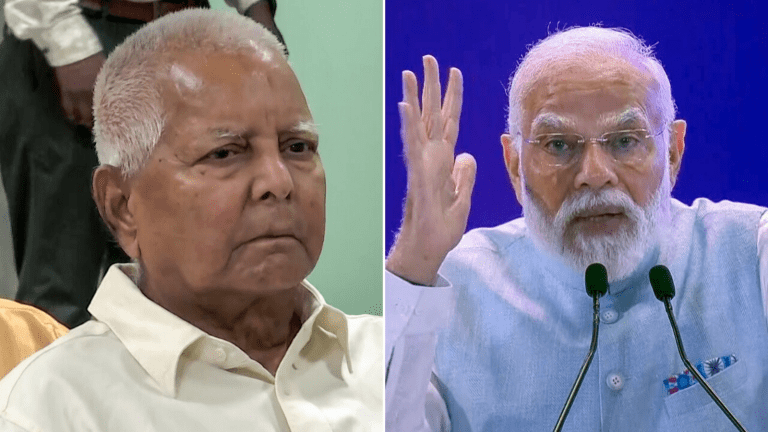
At the heart of the Modi Chhath Halloween controversy lies a video of veteran RJD leader Lalu Prasad Yadav celebrating Halloween with his grandchildren at home. The visuals, shared by his daughter Rohini Acharya, showed children dressed in various costumes, including one as a Grim Reaper, while Yadav laughed and enjoyed time with them.

BJP immediately seized upon this Halloween celebration as evidence supporting their narrative in the Modi Chhath Halloween controversy. The party’s farmers’ wing posted on social media platforms, reminding Bihar voters that this was the same Lalu Yadav who in February called the Kumbh festival “meaningless” or “faltu.” The post emphasized the contrast between dismissing traditional Hindu festivals while enthusiastically celebrating foreign festivals like Halloween.

BJP Links Opposition to Chhath Festival Insult

The Modi Chhath Halloween controversy intensified when Home Minister Amit Shah explicitly linked the RJD-Congress alliance to insulting the Chhath festival, which holds immense religious significance in Bihar and was celebrated just days before these campaign speeches. Speaking at a rally in Shivhar, Shah directly accused Congress leader Rahul Gandhi of insulting Chhathi Maiya, the mother deity worshipped during Chhath Puja.

Shah’s accusations in the Modi Chhath Halloween controversy referred to Gandhi’s claims that Prime Minister Modi had a clean pond created for himself next to the polluted Yamuna in BJP-ruled Delhi to perform what Gandhi termed as “drama” on Chhath. Shah declared that by making such statements, the opposition had insulted not just Modi but the sacred festival itself and the deity associated with it.

Prime Minister Modi’s Multi-Pronged Attack

Prime Minister Modi’s involvement elevated the Modi Chhath Halloween controversy to a national conversation. At multiple rallies for NDA candidates, Modi accused the RJD-Congress combine of being disdainful towards Chhath Puja while simultaneously opposing the Ram temple at Ayodhya. This strategic linking of multiple religious issues created a comprehensive narrative about opposition’s alleged anti-Hindu stance.

In the Modi Chhath Halloween controversy, Modi also raised security concerns, alleging that opposition parties were being soft on “infiltrators.” Speaking in an area with significant Muslim population, Modi stopped short of making direct communal allegations but stated that INDIA bloc parties were “compromising national security” and had “jumped in to protect infiltrators” whenever BJP took steps to remove them.

Historical Context: Lalu’s Kumbh Remarks

The Modi Chhath Halloween controversy gained additional ammunition from Lalu Yadav’s past statements. BJP highlighted his February remark calling the Kumbh festival pomp “meaningless” or “faltu.” This historical comment became crucial evidence in BJP’s argument that opposition leaders consistently disrespect Hindu festivals and traditions while embracing Western cultural celebrations.

Also Read: BJP Kharge Bihar Remarks: Sudhanshu Trivedi’s Bold Response Ahead Polls 2025

The juxtaposition in the Modi Chhath Halloween controversy between dismissing India’s largest religious gathering and celebrating a Western holiday became a powerful campaign tool for BJP, particularly effective among traditional voters who value religious and cultural heritage.

Priyanka Gandhi’s Counter-Attack

Congress leader Priyanka Gandhi Vadra responded sharply to the Modi Chhath Halloween controversy by mocking Prime Minister Modi’s focus on alleged insults. Addressing rallies in Saharsa and Lakhisarai districts, she suggested Modi should establish a new “Apamaan Mantralaya” (Ministry of Insults) given his government’s apparent obsession with perceived slights.

Priyanka’s response to the Modi Chhath Halloween controversy accused Modi of deliberately diverting public attention from critical governance issues including unemployment, corruption, and poverty. She claimed that whenever citizens ask legitimate questions, Modi either ignores them or complains about being insulted, rather than providing substantive answers about development and governance.

Electoral Strategy and Implications

The Modi Chhath Halloween controversy represents a calculated electoral strategy by BJP to mobilize voters on religious and cultural identity issues. By contrasting traditional Hindu festivals with Western celebrations, BJP attempts to position itself as the protector of Indian culture and Hindu traditions.

Lalu Prasad Yadav, despite remaining mostly in the background due to corruption cases and health issues, continues to be a prime target for PM Modi and NDA in the Modi Chhath Halloween controversy. His past statements and recent actions provide BJP with continuous ammunition for their cultural nationalism narrative, making this controversy a potentially decisive factor in Bihar’s electoral outcome.

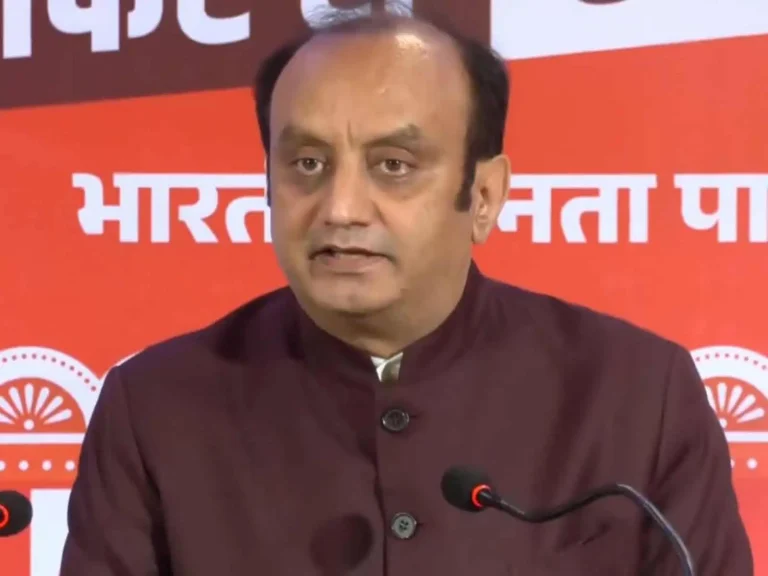
BJP Kharge Bihar Remarks: Sudhanshu Trivedi’s Bold Response Ahead Polls 2025

Bihar – The BJP Kharge Bihar remarks controversy intensified on Monday when BJP national spokesperson Sudhanshu Trivedi launched a comprehensive counter-attack against Congress president Mallikarjun Kharge. The confrontation emerged after Kharge allegedly used objectionable language against Prime Minister Narendra Modi during a press conference in Patna, referring to him as ‘jhooton ke sardar’ (leader of liars). Trivedi’s response to the BJP Kharge Bihar remarks included detailed development statistics and sharp criticism of Congress leadership.

Development Statistics Challenge Kharge’s Assertions

In his rebuttal to the BJP Kharge Bihar remarks, Sudhanshu Trivedi presented extensive data demonstrating Bihar’s transformation under NDA rule. According to Trivedi, Bihar’s per capita income witnessed remarkable growth from ₹6,900 to ₹67,000 during the NDA tenure. The state’s Gross State Domestic Product (GSDP) expanded dramatically from ₹23,000 crore to ₹3.17 lakh crore, representing exponential economic growth.

Trivedi’s response to the BJP Kharge Bihar remarks emphasized that electricity coverage in Bihar increased from a mere 22 percent to complete 100 percent coverage under NDA governance. He directly challenged Kharge, questioning whether these documented facts constituted lies, thereby turning the Congress president’s accusations back on him.

Historical Context and Congress Contradictions

The BJP Kharge Bihar remarks controversy took an interesting turn when Trivedi referenced historical statements from Congress leadership. He specifically cited March 2013, when then Prime Minister Manmohan Singh publicly lauded Nitish Kumar’s developmental works and declared Bihar as India’s fastest-growing state. Trivedi questioned whether Singh’s statements were also lies, highlighting what he termed as Congress’s contradictory positions.

Trivedi alleged that INDIA bloc leaders, including those behind the BJP Kharge Bihar remarks, were suffering from a paradox. He systematically deconstructed the opposition’s arguments by pointing to their own previous statements that acknowledged Bihar’s development trajectory.

Budget Allocation Contradictions Exposed

Addressing the BJP Kharge Bihar remarks regarding resource allocation, Trivedi highlighted another apparent contradiction in Congress positions. He claimed that Congress leaders, following the Union Budget 2025-26, stated that a substantial portion of the budget was dedicated to Bihar, leaving limited resources for other states. Some Congress leaders allegedly remarked sarcastically that they couldn’t determine if the budget was for the nation or specifically for Bihar.

Trivedi’s counter to the BJP Kharge Bihar remarks emphasized this contradiction—Congress first complained about excessive budget allocation to Bihar, and now claims nothing has been given to the state. He posed a direct question: which statement represents the lie—their earlier remarks or current assertions?

Also Read: Modi Tejashwi CM Claim: Stunning ‘Gunpoint’ Insider Revelation Ahead Bihar Polls 2025

Allegations of Changing Narratives

The BJP spokesperson’s response to the BJP Kharge Bihar remarks included harsh criticism of what he termed Congress’s characteristic behavior. Trivedi alleged that Congress has a tendency to change colors over time, with lying being their only constant trait. This sharp accusation formed a central component of BJP’s counter-narrative against the opposition’s criticism.

“Night Blindness” Taunt and Visible Development

In a particularly pointed response to the BJP Kharge Bihar remarks, Trivedi used a metaphorical taunt, stating that “those suffering from night blindness have no cure.” This comment suggested that opposition leaders were deliberately ignoring Bihar’s visible development despite overwhelming evidence.

Trivedi emphasized that anyone arriving at Patna airport or traveling through Bihar’s roads could clearly observe the transformation. He described Bihar’s development as being “as clear as a mirror,” implying that opposition criticism stems from willful blindness rather than factual assessment.

Infrastructure Achievements Highlighted

Responding comprehensively to the BJP Kharge Bihar remarks, Trivedi detailed specific infrastructure achievements in Bihar. He mentioned that the state now has two All India Institutes of Medical Sciences (AIIMS), multiple Indian Institutes of Technology (IITs), and plans for establishing a medical college in each district of Bihar. These concrete examples were presented as evidence contradicting opposition claims about inadequate development.

Chhath Festival Controversy

The BJP Kharge Bihar remarks controversy expanded to include religious and cultural dimensions when Trivedi alleged that Congress leader Rahul Gandhi mocked the Chhath festival by terming it a “drama.” Trivedi warned that “Chhathi Maiyya will teach them a lesson in this election,” invoking the religious sentiment associated with the important Bihar festival.

Electoral Predictions and Final Warning

Concluding his response to the BJP Kharge Bihar remarks, Trivedi made bold electoral predictions for Bihar polls. He stated that people would reject what he termed “certified liars” charged with corruption and instead vote for “the time-tested duo of Nitish Kumar and Narendra Modi” to power.

The BJP Kharge Bihar remarks controversy represents a significant escalation in political rhetoric ahead of Bihar elections, with both sides presenting competing narratives about the state’s development trajectory and governance quality.

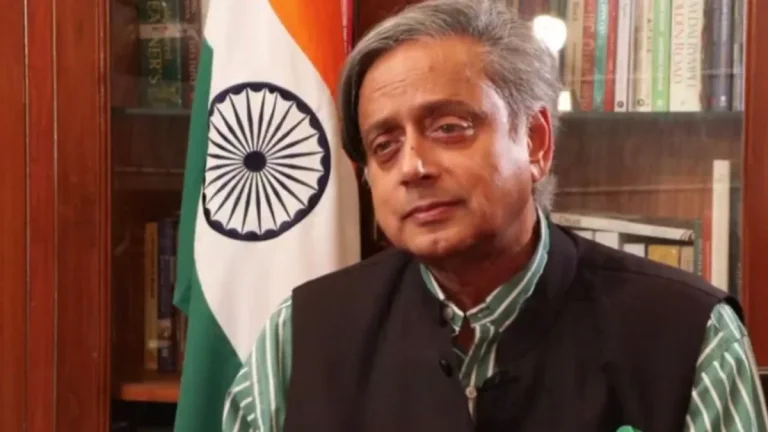
Latest Tharoor Dynastic Politics Remarks Spark Heated Congress Debate

New Delhi – The Tharoor dynastic politics remarks have triggered a significant political controversy after BJP leaders seized upon statements made by Congress MP Shashi Tharoor. The dispute centers around an October 31 opinion piece published on Project Syndicate, where Tharoor extensively discussed lineage-driven politics and its impact on governance quality in India. The Tharoor dynastic politics remarks provided opposition parties with ammunition to criticize what they termed as direct attacks on prominent political figures.

BJP leaders claimed that the Tharoor dynastic politics remarks specifically targeted Rahul Gandhi, whom they labeled as India’s “nepo kid,” and Tejashwi Yadav, referred to as “chhota nepo kid.” This interpretation of Tharoor’s words has created ripples within Congress ranks and sparked intense debate about political dynasties across party lines.

Congress Leaders Defend Dynastic Politics

Following the controversy surrounding Tharoor dynastic politics remarks, several Congress leaders came forward with their perspectives. Congress leader Udit Raj offered a nuanced defense, arguing that dynastic approaches extend far beyond politics into various sectors of Indian society. He emphasized that this phenomenon is not unique to the political sphere.

Raj explained that professional continuity within families occurs across all fields—doctors’ children often pursue medicine, business families maintain their enterprises, and similarly, political families continue their legacy. According to Raj’s response to the Tharoor dynastic politics remarks, election tickets are frequently distributed along caste and family lines, reflecting broader societal patterns rather than being exclusive to politics.

Examples of Dynastic Influence Across Party Lines

In his reaction to Tharoor dynastic politics remarks, Udit Raj cited numerous examples of dynastic influence spanning multiple political parties. He mentioned prominent leaders including Union Home Minister Amit Shah, West Bengal Chief Minister Mamata Banerjee, and figures from various regional parties. From Naidu to Pawar, DMK to other regional parties, Raj highlighted how dynastic politics permeates Indian political landscape across ideological boundaries.

The Congress leader acknowledged that the primary loss in this system is that opportunities remain confined within family circles, limiting fresh talent from entering political leadership. This admission, while responding to Tharoor dynastic politics remarks, demonstrated a realistic assessment of the challenges posed by hereditary political succession.

Defense of Gandhi Family Legacy

Congress MP Pramod Tiwari mounted a vigorous defense of the Nehru-Gandhi family in response to Tharoor dynastic politics remarks. Tiwari emphasized that leadership stems from merit and capability rather than merely familial connections. He specifically highlighted Pandit Jawaharlal Nehru as the most capable Prime Minister in Indian history.

Tiwari’s response to the Tharoor dynastic politics remarks included emotional references to the sacrifices made by Gandhi family members. He pointed out that Indira Gandhi and Rajiv Gandhi both sacrificed their lives serving the nation. Tiwari challenged critics by asking which other family in India possessed comparable levels of sacrifice, dedication, and ability, directly questioning BJP’s moral authority on this issue.

Democratic Process and Family Background

Congress leader Rashid Alvi offered a democratic perspective on Tharoor dynastic politics remarks, emphasizing that voters ultimately decide who leads in a democracy. Alvi argued that restricting individuals from contesting elections based on their family background would be fundamentally undemocratic. He stressed that public decision-making power cannot be curtailed by imposing restrictions on candidates whose parents held political office.

Alvi’s response to the Tharoor dynastic politics remarks highlighted that similar patterns exist across all professional fields, raising questions about how such restrictions could practically be implemented without undermining democratic principles.

Core Arguments in Tharoor’s Article

The Tharoor dynastic politics remarks that sparked this controversy centered on plainspeak about the Nehru-Gandhi dynasty, political leadership, and birthright issues. Tharoor explicitly discussed how “nepotism trumps meritocracy” in contemporary Indian politics.

In his piece, Tharoor acknowledged the Nehru-Gandhi dynasty’s connection to India’s freedom struggle, including Jawaharlal Nehru, Indira Gandhi, Rajiv Gandhi, and current leaders Rahul Gandhi and Priyanka Gandhi Vadra. However, the Tharoor dynastic politics remarks emphasized how this legacy has cemented the problematic idea that political leadership can be inherited as a birthright.

Impact on Governance Quality

The Tharoor dynastic politics remarks specifically addressed governance quality, arguing that when political power is determined by lineage rather than ability, commitment, or grassroots engagement, the quality of governance inevitably suffers. Tharoor stressed that the situation becomes especially problematic when candidates’ primary qualification is their surname.

Internal Party Tensions

The controversy surrounding Tharoor dynastic politics remarks has exposed existing tensions within Congress. Previous incidents, including Tharoor’s selection for the Operation Sindoor delegation despite party objections and his praise for the Uri strike, have highlighted ongoing friction. Udit Raj previously termed him BJP’s “super spokesperson,” indicating deeper internal disagreements that the current controversy has amplified.

The Tharoor dynastic politics remarks continue to generate debate about meritocracy versus hereditary succession in Indian democracy.