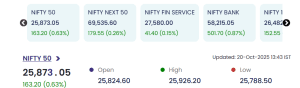
On October 20, 2025 — in the early afternoon session — the Indian stock market continued its upward momentum, led by robust gains in major indices and strong performances in several high-volume stocks. At 13:43 IST, the market’s overall sentiment was bullish, reflected in Nifty’s notable rise and exceptional activity among both top gainers and losers.
Nifty 50 opened at 25,824.60, hit a high of 25,926.20, and a low of 25,788.50, indicating a consistent upward trajectory.
Financial and banking stocks provided significant support, with Nifty Bank surging by 0.87%.
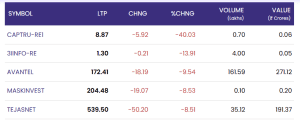
Top 5 Losers
Symbol
LTP
Change
% Change
Volume (Lakhs)
Value (₹ Cr)
CAPTRU-RE1
8.87
-5.92
-40.03
0.70
0.06
3IINFO-RE
1.30
-0.21
-13.91
4.00
0.05
AVANTEL
172.41
-18.19
-9.54
161.59
271.12
MASKINVEST
204.48
-19.07
-8.53
0.10
0.20
TEJASNET
539.50
-50.20
-8.51
35.12
191.37
CAPTRU-RE1 was the steepest decliner with a 40% plunge.
High trading in AVANTEL and TEJASNET marked these as stocks under significant pressure from either negative triggers or heavy profit booking.
3IINFO-RE and MASKINVEST also faced sharp declines, emphasizing selective weakness in small/mid-cap themes.
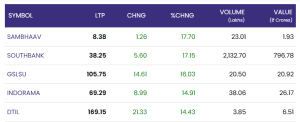
Top 5 Gainers
Symbol
LTP
Change
% Change
Volume (Lakhs)
Value (₹ Cr)
SAMBHAAV
8.38
1.26
17.70
23.01
1.93
SOUTHBANK
38.25
5.60
17.15
2,132.70
796.78
GSLSU
105.75
14.61
16.03
20.50
20.92
INDORAMA
69.29
8.99
14.91
38.06
26.17
DTIL
169.15
21.33
14.43
3.85
6.51
SOUTHBANK dominated both volume and value, surging over 17% amidst heavy trading.
SAMBHAAV, GSLSU, and INDORAMA all saw double-digit percentage surge, indicating strong buy-side participation and possible stock-specific news/catalysts.
DTIL rounded off the gainers’ list with impressive upward movement on solid volumes.
Conclusion: Indian Stock Market
As of early afternoon on October 20, 2025, Indian equity markets demonstrated remarkable breadth in high surges, especially in financial, mid-cap, and select high-beta stocks. The market’s positivity, highlighted by Nifty 50’s strength and substantial action in both gainers and losers, signals healthy investor appetite as the trading day progresses.
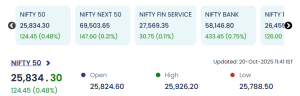
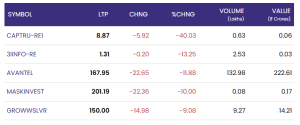
On October 20, 2025, the Indian stock market witnessed notable moves with significant action among both top gainers and losers. Midday updates reflect a positive undertone in the broader market, with the Nifty 50 index recording steady gains. Analysis of the most active stocks provides insight into sector rotation and investor sentiment on a crucial trading day.
Nifty 50 opened at 25,824.60, touched a high of 25,926.20, and a low of 25,788.50, reflecting a range-bound upward trend as of 11:41 IST.
The positive performance is driven by robust movements across sectors including banking and midcaps.
Top 5 Losers
Symbol
LTP
Change
% Change
Volume (Lakhs)
Value (₹ Cr)
CAPTRU-RE1
8.87
-5.92
-40.03
0.63
0.06
3IINFO-RE
1.31
-0.20
-13.25
2.53
0.03
AVANTEL
167.95
-22.65
-11.88
132.98
222.61
MASKINVEST
201.19
-22.36
-10.00
0.08
0.17
GROWWSLVR
150.00
-14.98
-9.08
9.27
14.21
CAPTRU-RE1 led the decline with a drop of 40.03%, highlighting significant downward pressure.
AVANTEL, despite a high traded value, dropped 11.88%, indicating profit booking or negative news flow.
Broader negative sentiment in select mid- and small-cap stocks contributed to the observed volatility.
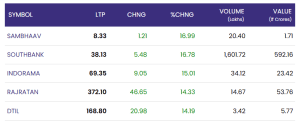
Top 5 Gainers
Symbol
LTP
Change
% Change
Volume (Lakhs)
Value (₹ Cr)
SAMBHAAV
8.33
1.21
16.99
20.40
1.71
SOUTHBANK
38.13
5.48
16.78
1,601.72
592.16
INDORAMA
69.35
9.05
15.01
34.12
23.42
RAJRATAN
372.10
46.65
14.33
14.67
53.76
DTIL
168.80
20.98
14.19
3.42
5.77
SAMBHAAV topped the gainer’s list with a 16.99% jump, followed closely by SOUTHBANK which also saw exceptional volume activity, reinforcing bullish momentum in select financial stocks.
RAJRATAN and INDORAMA gained over 14%, riding on positive market sentiment and possibly strong earnings expectations or news triggers.
Conclusion: October 20, 2025 (Opening)
The Indian equity market showcased resilience on October 20, 2025, with the Nifty 50 index advancing by 0.48% amid a mix of profit booking and aggressive buying across themes. The standout performers on both ends highlighted rotational interest among investors as macro and sectoral cues dictated intraday trends. Close attention to index levels and movers will be crucial as the session progresses toward the close.
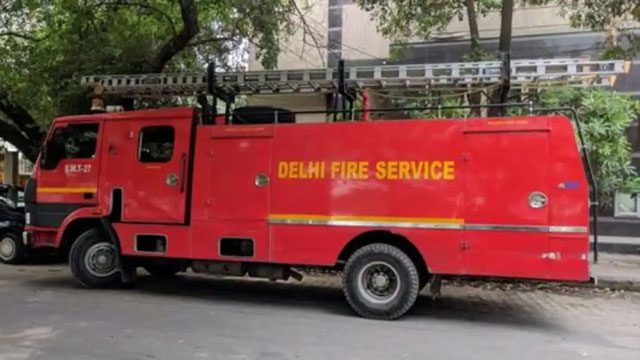
New Delhi – The Delhi Fire Services handled 269 emergency calls on Diwali night, marking a significant spike in Delhi fire incidents during the festival of lights. Despite the high volume of calls, authorities confirmed that no major accidents or casualties were reported, reflecting the effectiveness of the department’s preparedness and rapid response capabilities during the high-risk festive period.
A senior DFS officer confirmed that the department remained on high alert throughout the festival, with all fire stations and quick response teams strategically deployed across the city to handle the anticipated surge in Delhi fire incidents. The comprehensive deployment strategy proved successful in preventing any major tragedies despite the numerous calls received.
Nature of Delhi Fire Incidents Reported
The majority of Delhi fire incidents on Diwali night were related to minor blazes caused by firecrackers and diyas, traditional oil lamps used during the festival. While these incidents were relatively small in scale, the sheer volume required coordinated emergency response efforts to ensure public safety and prevent escalation into larger conflagrations.
“We received 269 fire calls till midnight. Fortunately, no major incidents were reported,” the senior DFS officer stated, emphasizing that the Delhi fire incidents remained manageable throughout the night despite the festival activities and widespread firecracker use across the capital.
Comprehensive Preparedness Strategy
The Delhi Fire Services had implemented extensive preparedness measures in anticipation of the increased Delhi fire incidents during Diwali celebrations. The department cancelled all leaves for its staff, ensuring maximum personnel availability to respond to emergencies. This decision proved crucial in managing the high volume of calls received throughout the night.
Additionally, all vehicles and fire-fighting equipment were thoroughly checked before the festival to ensure prompt response to emergency calls related to Delhi fire incidents. The proactive maintenance and readiness checks eliminated potential delays caused by equipment failures during critical response operations.
Strategic Planning for Public Safety
The DFS officer revealed that detailed planning had been conducted well in advance to ensure public safety during the festive period and minimize the impact of Delhi fire incidents. This advance planning included risk assessment, resource allocation, communication protocols, and coordination mechanisms to handle multiple simultaneous emergencies.
“The Delhi Fire Services plays a crucial role during Diwali in combating fire-related incidents and ensuring the safety of citizens,” the officer emphasized, highlighting the department’s recognition of its critical responsibility during high-risk periods when Delhi fire incidents typically surge due to festive activities.
Comparison with Previous Year’s Data
The 269 Delhi fire incidents reported this year represents an increase from the previous year, when the DFS received over 200 calls on Diwali night. This approximately 35% rise in emergency calls reflects either increased vigilance and reporting by citizens or a genuine increase in fire-related incidents during this year’s celebrations.
The year-over-year comparison of Delhi fire incidents provides valuable data for future planning and resource allocation. Understanding these trends helps the department better prepare for subsequent festivals and implement more effective preventive measures.
Post-Diwali Air Quality Crisis
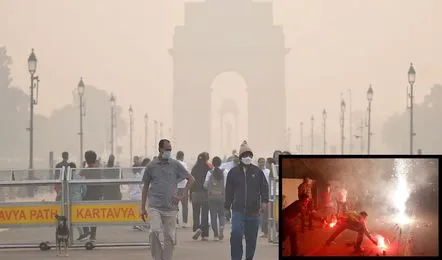
While the Delhi fire incidents on Diwali night were successfully managed without major casualties, the capital woke up to a different crisis on Tuesday morning. Delhi faced a thick and heavy layer of smog as air quality deteriorated to the ‘Very Poor’ category, with most monitoring stations marked in the ‘red zone’ of pollution.
According to Central Pollution Control Board data, the overall Air Quality Index in Delhi stood at 350 as of 8 am on Tuesday. The environmental impact of the same activities that generated many Delhi fire incidents—firecracker bursting—created a severe air quality emergency that persisted beyond the festival night.
Worst-Affected Areas by Pollution
The CPCB data showed that Bawana recorded an AQI of 423 as of 8 am, Jahangirpuri had an AQI of 407, and Wazirpur with an AQI of 408 remained the worst-hit areas, with air quality falling under the ‘Severe’ category. These locations likely also experienced their share of Delhi fire incidents during the celebrations.
Other significant readings included Anand Vihar at 358, Ashok Vihar at 389, Burari Crossing at 399, Chandani Chowk at 350, IGI Airport Terminal 3 at 302, ITO at 342, Lodhi Road at 322, Mundka at 366, Najafgarh at 336, Narela at 358, Patparganj at 342, and Punjabi Bagh at 376.
Air Quality Comparison Across Indian Cities
The post-Diwali air quality crisis was not limited to Delhi, though the capital faced the most severe conditions among major Indian cities. Mumbai’s air quality was recorded in the ‘poor’ category with an AQI of 214 as of 8 am, while Patna registered 224, Jaipur 231, and Lucknow 222.
In contrast, southern cities fared significantly better. Bengaluru’s AQI stood at 94, Chennai at 153, and Hyderabad at 107, suggesting that either firecracker use was more restrained in these cities or meteorological conditions were more favorable for pollutant dispersal, potentially resulting in fewer Delhi fire incidents-type emergencies.
Health Implications of Poor Air Quality
During ‘very poor’ air quality conditions like those following the night of Delhi fire incidents, residents face breathing difficulties and can develop respiratory illnesses upon prolonged exposure. The ‘severe’ air quality category affects even healthy people and seriously impacts those with existing diseases, according to the CPCB.
Successful Emergency Response Despite Challenges
The successful management of 269 Delhi fire incidents on Diwali night demonstrates the Delhi Fire Services’ operational capability and readiness. The absence of major casualties despite the high volume of calls reflects credit on the department’s planning, resource deployment, and personnel dedication.
However, the challenge for Delhi authorities extends beyond managing immediate Delhi fire incidents to addressing the longer-term environmental and health consequences of festival celebrations, requiring comprehensive policy interventions that balance cultural traditions with public safety and environmental protection.
New Delhi – Thick smog and toxic air engulfed the national capital on Tuesday morning, as Delhi pollution Diwali aftermath reached alarming levels just one day after the festival of lights. The air quality plunged to the ‘Very Poor’ category on the Air Quality Index, with most monitoring stations across the city recording pollution levels in the dangerous ‘red zone’.
The overall AQI in Delhi stood at 350 as of 8 am on Tuesday, according to Central Pollution Control Board data, confirming fears that the Delhi pollution Diwali situation would deteriorate significantly following firecracker bursting during the festival. An already choking city woke up to even worse conditions, with residents experiencing difficulty breathing and reduced visibility due to the dense smog layer.
Top 10 Most-Polluted Areas After Diwali
The Delhi pollution Diwali crisis manifested most severely in specific neighborhoods across the capital. Five monitoring stations recorded AQI levels in the ‘severe’ category, exceeding 400, while five others remained in the ‘very poor’ category, though still dangerously high.
Bawana emerged as the most polluted area with an AQI of 427 in the severe category, representing extremely hazardous air conditions for residents. Following closely behind, Wazirpur and Alipur both recorded AQI levels of 408 in the severe category, indicating widespread contamination across northern Delhi.
Jahangirpuri registered an AQI of 407 in the severe category, while Burari Crossing recorded 402, also falling in the severe zone. These five locations represent the Delhi pollution Diwali epicenters where air quality posed immediate health risks to vulnerable populations including children, elderly residents, and those with respiratory conditions.
The remaining five areas in the top ten most-polluted locations included Shadipur with an AQI of 399, Ashok Vihar at 391, Punjabi Bagh at 376, Sonia Vihar at 374, and Vivek Vihar also at 374, all falling in the ‘very poor’ category of the Delhi pollution Diwali index.
Widespread Pollution Across Multiple Areas
Beyond the top ten most-polluted locations, the Delhi pollution Diwali crisis extended to numerous other neighborhoods. JLN Stadium recorded an AQI of 318, ITO registered 347, while Lodhi Road showed an AQI of 327. Anand Vihar, which has consistently been among the worst-affected areas, recorded an AQI of 360.
Okhla Phase-2 registered an AQI of 353, North Campus at Delhi University recorded 363, and Dilshad Garden showed 357, demonstrating that the Delhi pollution Diwali problem affected areas across all geographical zones of the capital. Even the air quality around Indira Gandhi International Airport remained in the ‘very poor’ category with an AQI of 313, potentially impacting flight operations and passenger health.
Days Leading to Diwali Showed Steady Deterioration
The Delhi pollution Diwali catastrophe was not entirely unexpected, as air quality had been steadily worsening in the days leading up to the festival. AQI levels turned increasingly alarming each day, despite preventive measures and warnings from environmental authorities.
Even as Stage 2 of the Graded Action Response Plan kicked in on Sunday, the city recorded AQI in the ‘severe’ category the next day on Diwali itself. The AQI of most stations exceeded 300, while Anand Vihar and Wazirpur already registered 400-plus readings before the main festival celebrations, indicating that the Delhi pollution Diwali crisis was building momentum.
Similar but even more alarming readings were recorded on Tuesday following the Diwali night when fireworks lit up the city. The Delhi pollution Diwali measurements showed that despite Supreme Court restrictions and green cracker guidelines, the air quality deteriorated further after the celebrations, suggesting widespread non-compliance with firecracker regulations.
With the onset of winter, Delhi experiences a sharp surge in toxic air and pollution each year due to meteorological conditions that trap pollutants close to the ground. The Delhi pollution Diwali episode represents the beginning of the capital’s annual winter pollution crisis.
Supreme Court’s Green Cracker Guidelines
On October 15, just days before Dhanteras and Diwali, the Supreme Court allowed the sale and use of green firecrackers in the Delhi-NCR region between October 18 to 20, attempting to balance festive celebrations with environmental protection concerns related to Delhi pollution Diwali risks.
However, the permission came with strict conditions—crackers from outside the NCR were prohibited, and their use was restricted to specific time slots: 6-7 pm and 8-10 pm. The top court described this as a “balanced approach” to allow festive celebrations while safeguarding the environment from excessive Delhi pollution Diwali damage.
Widespread Violation of Time Restrictions
Despite the Supreme Court’s carefully calibrated approach to managing Delhi pollution Diwali risks, crackers were reportedly burst well beyond the designated time windows. This widespread violation became one factor in pushing hourly PM 2.5 levels in parts of the city to around 29 times the permissible standards.
The flagrant disregard for timing restrictions undermined the judiciary’s attempt to find middle ground between cultural celebrations and environmental protection. The resulting Delhi pollution Diwali crisis demonstrates the challenge authorities face in enforcing pollution control measures during festive seasons.
Health Implications and Future Concerns
The severe Delhi pollution Diwali readings pose immediate health risks, particularly for vulnerable populations. Exposure to such high pollution levels can cause respiratory distress, cardiovascular problems, eye irritation, and aggravation of existing health conditions.
As winter progresses, the Delhi pollution Diwali episode marks the beginning of several months of poor air quality. Without effective intervention and enforcement of pollution control measures, residents face prolonged exposure to hazardous air conditions that significantly impact public health and quality of life in the national capital.
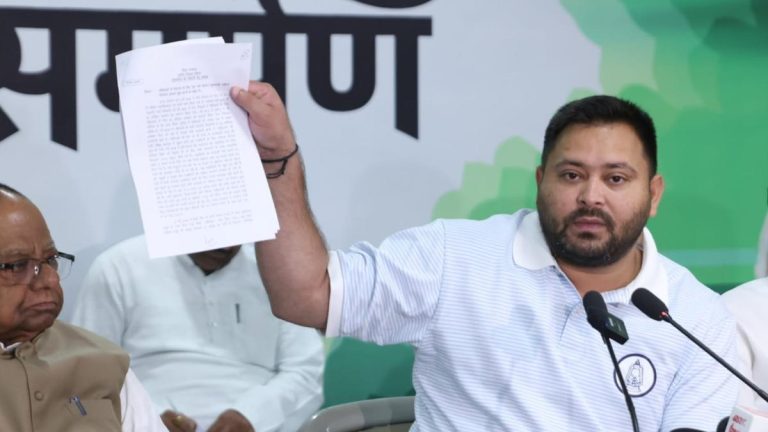
Bihar – Rashtriya Janata Dal released a comprehensive list on Monday naming RJD Bihar candidates for 143 seats in the upcoming Bihar assembly elections 2025. The announcement marks a significant development in the state’s electoral landscape, as the party has fielded its prominent leader Tejashwi Yadav from the Raghopur assembly seat in Vaishali district, maintaining the constituency’s association with the Yadav political dynasty.
The release of the RJD Bihar candidates list comes against the backdrop of an ongoing stalemate within the INDIA bloc over seat-sharing arrangements for the Bihar assembly elections scheduled for November 6 and 11. The counting and declaration of results will take place on November 14, making this a tightly scheduled electoral contest.
Tejashwi Yadav’s Strategic Constituency Choice
The decision to field Tejashwi Yadav, the Leader of Opposition in Bihar Assembly, as one of the RJD Bihar candidates from Raghopur represents strategic continuity for the party. Raghopur has been historically significant for the RJD, and Tejashwi’s candidature from this seat reinforces the party’s commitment to maintaining its traditional strongholds while leading the opposition charge against the ruling NDA.
As a key figure among the RJD Bihar candidates, Tejashwi Yadav’s contest from Raghopur will likely serve as a barometer for the party’s overall performance in the elections. His leadership and campaign strategy will be crucial in mobilizing voters across the state, particularly among the party’s core support base.
Critical Timeline for RJD Bihar Candidates
The announcement of RJD Bihar candidates comes at a crucial juncture, as the deadline to withdraw nomination papers for 121 of the 243 seats set to go to polls in the first phase on November 6 was scheduled to end at 3 pm on Monday. By late Sunday, a total of 1,375 nominations had been accepted, indicating intense competition across constituencies.
This tight timeline puts pressure on the RJD Bihar candidates and the party organization to finalize campaign strategies, allocate resources, and mobilize grassroots workers efficiently. The compressed schedule leaves little room for last-minute adjustments or strategic realignments.
Congress Adds to Mahagathbandhan Candidate Pool
Alongside the RJD Bihar candidates announcement, the Congress party released another list of six candidates on Monday for the Bihar Assembly polls, taking the total number of candidates announced by the party to 60. The Congress list was announced post-midnight, highlighting the urgency and ongoing negotiations within the alliance.
According to the latest Congress list, the party fielded Surendra Prasad Kushwaha from Valmiki Nagar, Abidur Rehman from Araria, Jalil Mastan from Amour, Tauquir Alam from Barari, Praveen Singh Kushwaha from Kahalgaon, and Vinod Chaudhary from Sikandra (SC). These announcements complement the RJD Bihar candidates, though a formal seat-sharing deal continues to elude the Mahagathbandhan.
The release of the RJD Bihar candidates list, despite the ongoing seat-sharing stalemate within the INDIA bloc, suggests the party has decided to move forward unilaterally to meet electoral deadlines. The RJD and Congress, as the two main constituents of the Mahagathbandhan alliance, have been unable to reach a comprehensive understanding on seat distribution.
This lack of formal agreement raises questions about coordination between the RJD Bihar candidates and Congress candidates in constituencies where both parties might have interests. The absence of a clear seat-sharing formula could lead to internal competition within the opposition alliance, potentially benefiting the ruling NDA.
Among the RJD Bihar candidates, several high-profile figures have attracted attention. Reports indicate that popular Bhojpuri singer and actor Khesari Lal Yadav is among the party’s candidates, bringing celebrity appeal to the electoral contest. Such candidates often help parties reach wider audiences and attract media attention, though their electoral success depends on various factors beyond popularity.
The inclusion of diverse profiles among RJD Bihar candidates suggests the party’s strategy of balancing traditional political figures with fresh faces who can appeal to different demographic segments, particularly younger voters.
Defections and Turncoats Impact Political Landscape
Political leaders’ shifting loyalties has been a defining feature this season in Bihar’s run-up to the assembly elections, affecting the composition of RJD Bihar candidates and other parties’ lists. The latest turncoat is former MP and four-time MLA Sarfaraz Alam, who formally joined Prashant Kishor’s Jan Suraaj Party.
Alam, son of former Union minister Mohammad Taslimuddin, has won the Jokihat assembly seat four times—twice on the Rashtriya Janata Dal ticket in 1996 and 2000, and twice on the Janata Dal (United) ticket in 2010 and 2015. His departure represents a loss for the potential pool of RJD Bihar candidates and highlights the fluid nature of political affiliations in the state.
A total of nine candidates who secured victories in previous state elections under different party banners are now contesting under new affiliations, complicating the electoral calculus for RJD Bihar candidates and opposition strategies. Following the collapse of the Grand Alliance-led government last year, seven MLAs from the RJD and Congress have switched allegiance to support the National Democratic Alliance.
All but one of these defectors have been rewarded with party tickets for the forthcoming polls, suggesting that the NDA has successfully leveraged these defections for electoral advantage. This pattern poses challenges for the RJD Bihar candidates, who must now compete against former allies in some constituencies.
Strategic Implications for Electoral Contest
The release of the comprehensive RJD Bihar candidates list for 143 seats demonstrates the party’s determination to contest a substantial number of constituencies despite alliance complications. This extensive candidate roster suggests the RJD is positioning itself as the primary opposition force in Bihar, regardless of the seat-sharing uncertainties with Congress and other INDIA bloc partners.
The performance of RJD Bihar candidates in the upcoming elections will be crucial in determining the future trajectory of opposition politics in Bihar and could influence alliance dynamics in other states as well.
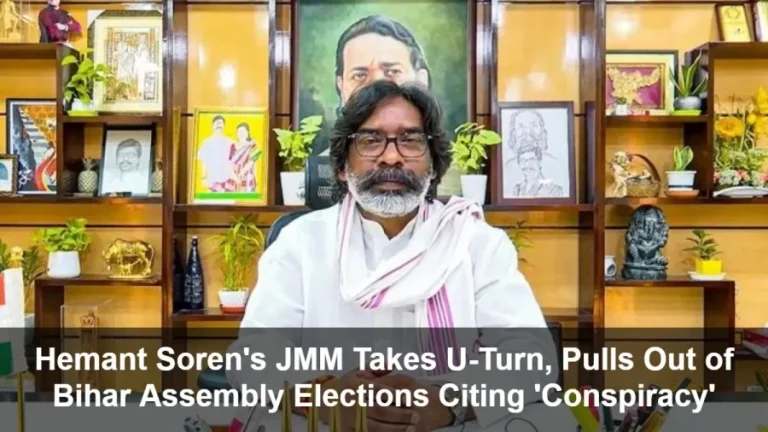
Bihar – In a dramatic political turnaround, the Hemant Soren-led Jharkhand Mukti Morcha announced that it will not contest the upcoming Bihar Assembly elections, despite having declared its intention to fight independently just days earlier. This unexpected decision regarding JMM Bihar polls participation has sent shockwaves through the opposition INDIA bloc and raised serious questions about alliance cohesion ahead of crucial state elections.
The reversal on JMM Bihar polls comes merely two days after the party announced it would contest elections independently in six assembly segments, having already begun the candidate selection process and public positioning for the electoral battle in the neighboring state.
Senior Leader Announces Withdrawal Decision
Speaking to reporters, senior JMM leader and Jharkhand state tourism minister Sudivya Kumar announced the party’s withdrawal from JMM Bihar polls, citing what he termed a “political conspiracy” by alliance partners. Kumar’s statement indicated deep dissatisfaction with how the party has been treated within the INDIA bloc framework during seat-sharing negotiations.
Kumar’s announcement regarding JMM Bihar polls withdrawal was accompanied by a stern warning about reviewing alliances in Jharkhand itself, suggesting the ramifications of this decision could extend beyond Bihar and impact the political landscape in the party’s home state.
Alliance Review Threat Over Bihar Snub
The JMM’s decision to abandon JMM Bihar polls participation comes with a significant threat to existing political arrangements. Kumar stated that his party will review the alliance in Jharkhand with the Congress and Rashtriya Janata Dal, and give a befitting reply to what he characterized as a “snub” by these parties.
“The RJD and the Congress are responsible for depriving JMM from contesting the election as part of a political conspiracy. JMM will give a befitting reply to this, and review its alliance with RJD and Congress,” Kumar declared, signaling that the JMM Bihar polls controversy could have far-reaching consequences for opposition unity across multiple states.
Timeline of JMM Bihar Polls Announcements
The chaotic sequence of events surrounding JMM Bihar polls reveals serious organizational and strategic confusion within the party and the broader opposition alliance. Initially, the Hemant Soren-led party announced it would contest the elections independently in six assembly segments, suggesting confidence in going solo despite being part of a larger opposition coalition.
This independent stance on JMM Bihar polls appeared to be a calculated political decision, possibly aimed at establishing the party’s presence in Bihar and expanding its geographical footprint beyond its traditional Jharkhand stronghold.
Congress Candidate Announcements Trigger Crisis
The turning point in the JMM Bihar polls saga appears to have been the Congress party’s release of its first list of 48 candidates for the upcoming Bihar Assembly elections on Thursday. The Congress fielded its state unit chief Rajesh Ram from Kutumba seat and CLP leader Shakeel Ahmad Khan from Kadwa, apparently without adequate consultation with JMM regarding seat distribution.
Following the Congress announcement, the timeline of JMM Bihar polls declarations became increasingly erratic. On Friday, the party made a one-off announcement, fielding Rishi Mishra from Jale constituency. Then on Saturday, the party released a list of five candidates, suggesting it was still moving forward with its independent electoral strategy.
The withdrawal from JMM Bihar polls participation reflects growing uncertainty within the INDIA bloc over seat-sharing and coordination mechanisms. The incident highlights the challenges opposition parties face in presenting a united front against the ruling National Democratic Alliance, particularly when it comes to accommodating regional parties with overlapping geographical interests.
The mishandling of JMM Bihar polls negotiations demonstrates the fragility of opposition alliances built primarily on anti-incumbency sentiment rather than clear organizational structures and decision-making protocols. Without established mechanisms for conflict resolution, such disputes can escalate rapidly and publicly.
Implications for Jharkhand Politics
Perhaps the most serious consequence of the JMM Bihar polls controversy is Kumar’s threat to review the party’s alliance with Congress and RJD in Jharkhand. This suggestion carries significant weight, as these parties currently govern Jharkhand together, with Hemant Soren serving as Chief Minister with Congress and RJD support.
Any breakdown in this arrangement due to the JMM Bihar polls dispute could destabilize the Jharkhand government and create opportunities for the BJP-led opposition in the state. The threat appears designed to pressure Congress and RJD into making concessions or clarifications about how the JMM Bihar polls situation unfolded.
Political Conspiracy Allegations
Kumar’s characterization of the JMM Bihar polls exclusion as a “political conspiracy” by the RJD and Congress suggests the party believes it was deliberately sidelined despite being a legitimate alliance partner. This accusation points to deeper trust issues within the INDIA bloc that extend beyond simple seat-sharing arithmetic.
The allegation that Congress and RJD conspired to deprive JMM of its rightful place in JMM Bihar polls contests raises questions about whether larger parties in the alliance are willing to accommodate smaller regional partners or prefer to maintain their own dominance in specific states.
Future of Opposition Unity in Question
The collapse of JMM Bihar polls participation plans serves as a cautionary tale about the challenges facing opposition unity efforts. As Bihar prepares for crucial assembly elections, the inability of INDIA bloc partners to manage even basic coordination on candidate selection and seat distribution reveals serious organizational weaknesses.
The JMM Bihar polls controversy demonstrates that opposition parties must develop more robust mechanisms for internal negotiation and dispute resolution if they hope to present a credible alternative to the well-organized NDA. Without addressing these fundamental coordination problems, such alliances risk fragmenting at critical moments, undermining their electoral prospects and credibility with voters seeking a united opposition.
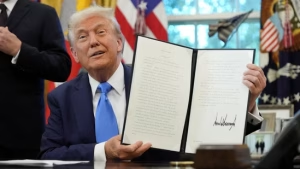
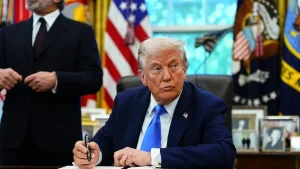
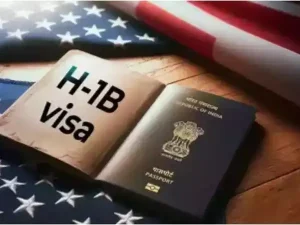
Washington D.C. – In a major relief for thousands of Indian professionals and students in the United States, the US Citizenship and Immigration Services has clarified that recent international graduates sponsored for H-1B status while already in the country will not be required to pay the steep $100,000 fee introduced by the Donald Trump administration last month. This marks the first time the Trump administration has actively clarified questions about the controversial H-1B visa fees that created widespread panic among the Indian diaspora.
Officials had earlier stated that existing H-1B visa holders would not be required to pay the H-1B visa fees announced last month. However, the latest guidance provides comprehensive clarification on various categories of visa holders and their exemption status, addressing weeks of confusion and anxiety within the Indian-American community.
Understanding the Original H-1B Visa Fees Announcement
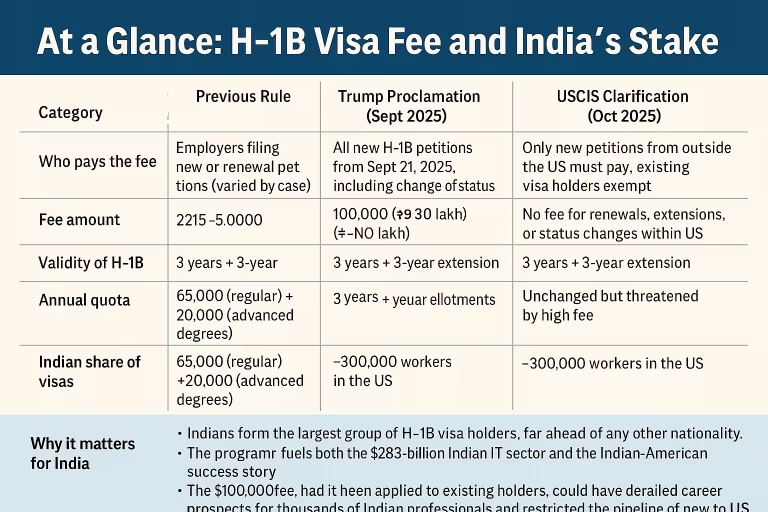
The clarification comes after weeks of confusion following Trump’s proclamation, which mandated steep annual H-1B visa fees equivalent to around ₹90 lakh for employers sponsoring technically skilled foreign workers. The fee was scheduled to take effect from 12:01 am ET on September 21, triggering immediate panic among Indian workers, US employers, and immigration attorneys across the country.
Previously, visa application costs ranged between $215 and $5,000, depending on company size and category. The new H-1B visa fees of $100,000 would have been 20 to 100 times higher, exceeding the median annual salary of many new H-1B workers. Experts warned that these H-1B visa fees could “effectively kill the H-1B programme” by making it unaffordable for many employers and startups.
Comprehensive Relief for Existing Visa Holders
In its latest guidance addressing the H-1B visa fees controversy, USCIS stated that the $100,000 fee will not apply to anyone already in the United States on a valid visa. This includes F-1 student visa holders, L-1 intra-company transferees, and current H-1B visa holders seeking renewals or extensions.
The proclamation regarding H-1B visa fees “does not apply to any previously issued and currently valid H-1B visas, or any petitions submitted prior to 12:01 a.m. ET on September 21, 2025,” the agency clarified. It also stated that H-1B holders can continue traveling in and out of the United States without restriction, addressing one of the biggest concerns raised after the H-1B visa fees announcement.
Students Transitioning to Work Visas Exempt
The USCIS further confirmed that existing foreign nationals applying for a change of status will not face the new H-1B visa fees. This particularly benefits international students on F-1 visas transitioning to H-1B jobs after graduation, a common pathway for Indian students who complete their education in the United States.
This exemption from H-1B visa fees represents crucial relief for the thousands of Indian students who graduate annually from American universities and seek employment opportunities in the US technology and services sectors.
Why Indians Were Most Affected by H-1B Visa Fees
The announcement about H-1B visa fees exemptions comes as a major reprieve for Indian tech professionals, who form the backbone of the H-1B visa program. There are approximately 300,000 Indian workers currently in the US on H-1B visas, mostly employed in the technology and services industries.
Indians account for about 70% of all new H-1B visa allocations, followed by Chinese nationals at 11-12%, according to US administration data. This overwhelming representation meant that the H-1B visa fees would have disproportionately impacted the Indian community compared to any other nationality.
The H-1B visa allows highly skilled workers to live and work in the United States for up to three years at a time, with a possible extension of another three years. Each year, 85,000 new visas are awarded through a lottery system, with Indians dominating the allocation numbers.
Impact on Indian-American Community and Economy
For India, the stakes surrounding H-1B visa fees are exceptionally high. The H-1B visa has long been a gateway for middle-class upward mobility, with many Indian families building lives in the US through this route. Researchers behind The Other One Percent, a seminal study on Indian-Americans, have noted that the H-1B visa has been instrumental in making Indian-Americans one of the most educated and highest-earning communities in the US.
When counted with dependents, H-1B visa holders make up roughly one-fourth of the 3 million-strong Indian-American population, highlighting the community’s deep reliance on the programme and vulnerability to changes in H-1B visa fees policy.
Indian IT companies such as Infosys, Tata Consultancy Services, and Wipro have historically used the H-1B visa to deploy engineers to US client sites. American firms like Amazon, Microsoft, and Google also depend heavily on H-1B workers, many of whom are Indian graduates from US universities.
Political Reactions to H-1B Visa Fees Controversy
Trump’s original announcement of the $100,000 H-1B visa fees drew swift reactions both in the US and India. US Commerce Secretary Howard Lutnick defended the move, saying it was designed to attract “high earners” and discourage companies from bringing in “low earners who take jobs from Americans.”
He added that while H-1B quotas remain at 65,000 regular and 20,000 advanced degree slots, “there’ll just be less of them issued” under the new H-1B visa fees structure.
There was also a political row in India after Trump announced the H-1B visa fees. Leader of Opposition Rahul Gandhi accused Prime Minister Narendra Modi of failing to protect Indian workers’ interests, while Congress chief Mallikarjun Kharge called the fee a “birthday gift” from Trump to Modi, referring to the US President’s recent call to the Prime Minister.
The Centre said it was studying the implications of the new H-1B visa fees policy. Meanwhile, Prime Minister Modi, speaking in Gujarat, reiterated his call for “self-reliance,” saying India’s “only real enemy is dependence on other countries,” suggesting a strategic pivot away from reliance on foreign employment opportunities affected by H-1B visa fees.
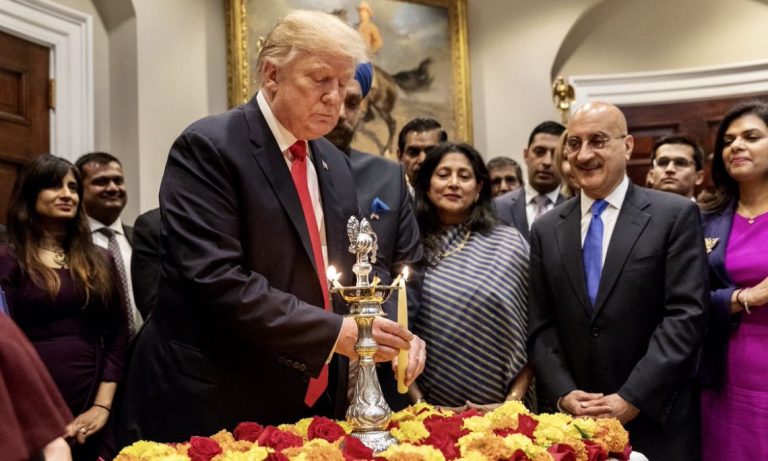
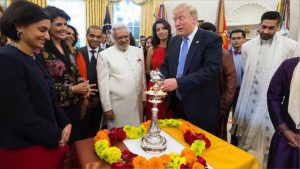
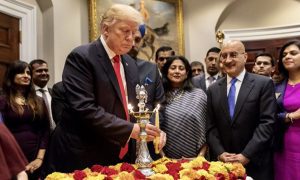
Washington D.C. – The Trump Diwali Bash is set to light up the White House today, marking one of the most vibrant cultural events of the year. U.S. President Donald Trump will host the grand Diwali celebration at 4 pm local time (1:30 am IST, October 22), welcoming members of the Indian-American community, diplomats, and senior officials. This year’s event will focus on the timeless message of light’s victory over darkness and the spirit of unity and renewal.
President Trump’s Message on Diwali’s Spirit
Ahead of the Trump Diwali Bash, President Trump extended warm Diwali greetings to all Americans, emphasizing the festival’s universal message of hope and goodness. His message, published on the official White House website, described Diwali as “a reminder of light’s victory over darkness and good’s triumph over evil.”
“Today, I send my best wishes to every American celebrating Diwali—the Festival of Lights,” the President said. “For many Americans, Diwali is a timeless reminder of light’s victory over darkness. It is also a time to bring families and friends together to celebrate community, draw strength from hope, and embrace a lasting spirit of renewal.”
The Trump Diwali Bash aims to highlight the values of family, friendship, and faith that resonate deeply across cultures.
Celebrations Planned at the White House
The Trump Diwali Bash will feature traditional Indian elements, including lamp lighting, Indian sweets, and vibrant cultural performances representing India’s diverse heritage. The President is expected to deliver a short speech reflecting on the festival’s deeper message of peace, togetherness, and renewal.
As part of the celebration, diyas and lanterns will illuminate the East Room of the White House, symbolizing the victory of light over darkness. Dignitaries from the Indian-American community, diplomats, and prominent guests from across the U.S. are scheduled to attend.
The Trump Diwali Bash continues a tradition that has gained increasing recognition in recent years, showcasing how Indian festivals are celebrated on global platforms of power and diplomacy.
Diwali’s Growing Recognition Across the United States
Beyond the Trump Diwali Bash, Diwali has gained remarkable recognition across the United States. Several states, including Pennsylvania, Connecticut, and California, have officially recognized Diwali as a state holiday. California’s Assembly Bill 268, which allows schools to close and employees to take paid leave for the festival, will take effect in January 2026.
School districts in major cities such as New York, Edison, and Jersey City, along with parts of Texas, have begun observing Diwali as an official school holiday. The Trump Diwali Bash highlights how the festival has become not only a celebration of cultural pride but also a symbol of inclusion within the American social fabric.
The Five Days of Diwali Explained
The Trump Diwali Bash also draws attention to the spiritual and cultural depth of the five-day festival.
Day 1: Dhanteras — The festival begins with Dhanteras, when people buy gold, silver, or utensils and worship wealth and prosperity.
Day 2: Naraka Chaturdashi (Chhoti Diwali) — The second day marks the cleansing of homes and minds, celebrating light over ignorance.
Day 3: Main Diwali Day — The central day of Diwali involves prayers to Lord Ganesha and Goddess Lakshmi, seeking wisdom and wealth.
Day 4: Govardhan Puja — Devotees perform rituals to honor nature and Lord Krishna’s protection of life and the environment.
Day 5: Bhai Dooj — The festival concludes with sisters praying for the long lives of their brothers, reinforcing family bonds.
Each of these traditions will find symbolic representation at the Trump Diwali Bash, which intends to celebrate the essence of harmony and goodwill.
Trump’s Message of Unity and Renewal
During the Trump Diwali Bash, the President is expected to reaffirm his commitment to diversity and cultural inclusion in America. He has previously spoken about the importance of festivals like Diwali in strengthening America’s multicultural fabric.
“As millions of citizens light diyas and lanterns, we rejoice in the eternal truth that good will always triumph over evil,” Trump’s message read. His emphasis on renewal and unity aligns with the festival’s broader message of hope, peace, and harmony.
The Trump Diwali Bash represents not just a celebration but also a diplomatic gesture, reinforcing cultural ties between the U.S. and India. By hosting the event, the President acknowledges the growing influence of the Indian-American community and the universal relevance of Diwali’s themes.
A Cultural Bridge of Light
The Trump Diwali Bash underscores how Diwali transcends national and religious boundaries. As diyas glow within the White House, the celebration serves as a beacon of unity, illustrating how traditions from across the world can enrich American society.
With Indian music, sweets, and dance performances, the event promises to blend tradition with diplomacy, reaffirming Diwali’s place as a festival of hope that inspires millions across the globe.
As the Trump Diwali Bash unfolds today, it stands as a testament to the enduring power of light—both literal and symbolic—to unite people across cultures, reminding the world that even amid uncertainty, the triumph of good over evil remains eternal.
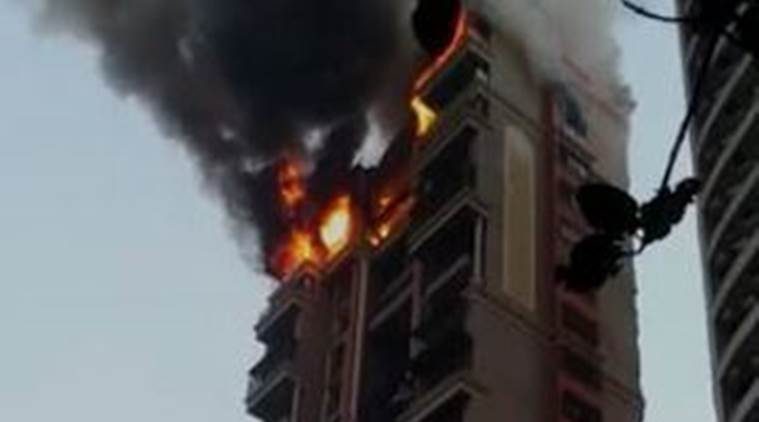
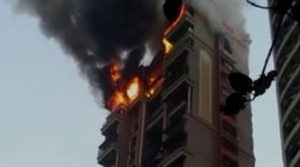
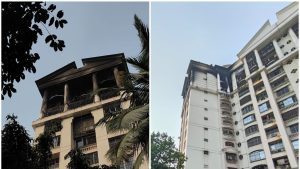
Mumbai – At least four people lost their lives when a massive Navi Mumbai fire broke out at Raheja Residency housing society on Monday night, coinciding with Diwali celebrations across the country. The tragic incident occurred at the residential complex located in Vashi Sector-14, transforming what should have been a night of festivities into one of mourning for multiple families.
The Navi Mumbai fire originated on the 10th floor of the apartment complex before rapidly spreading to the 11th and 12th floors, creating a life-threatening situation for residents trapped in the affected areas. The intensity and speed of the blaze caught many residents off guard, leading to the devastating loss of life and multiple injuries.
Short Circuit Identified as Cause
Preliminary investigations into the Navi Mumbai fire have identified a short circuit as the primary cause of the devastating blaze. Electrical short circuits remain one of the most common causes of residential fires, particularly during festival seasons when electrical loads increase significantly due to decorative lighting and increased appliance usage.
The Navi Mumbai fire reportedly started on the 10th floor before the flames spread vertically to higher floors, a pattern typical of electrical fires in multi-story residential buildings. The vertical spread of the fire posed particular challenges for evacuation efforts and firefighting operations, as residents on upper floors found themselves trapped between the ascending flames and limited escape routes.
Young Girl Among Victims of Navi Mumbai Fire
The victims of the Navi Mumbai fire included a six-year-old girl who lived on the 12th floor, making the tragedy particularly heartbreaking. The child, identified as Vedika Sundar Balakrishnan, was among four people who could not escape the rapidly spreading flames. Her death highlights the vulnerability of young children during fire emergencies, as they often depend entirely on adults for evacuation.
The other victims of the Navi Mumbai fire were identified as Kamala Hiral Jain, an 84-year-old elderly resident; Sundar Balakrishnan, 44, who was likely related to young Vedika; and Pooja Rajan, 39. The age range of the victims—from a young child to an elderly woman—underscores how fire emergencies endanger all demographic groups, with the very young and very old being particularly vulnerable.
Multiple Injuries Reported in Incident
Beyond the four fatalities, the Navi Mumbai fire resulted in approximately ten people sustaining injuries of varying severity. The injured residents are currently hospitalized and receiving medical treatment for burns, smoke inhalation, and other trauma-related conditions. The medical teams are working to stabilize all patients and provide necessary care for their recovery.
The Navi Mumbai fire’s injury toll could have been significantly higher had firefighting teams not responded promptly to contain the blaze. Many residents suffered injuries while attempting to evacuate through smoke-filled corridors or waiting for rescue on balconies and other accessible areas.
Fire Brought Under Control After Intensive Operation
Firefighting teams worked intensively to bring the Navi Mumbai fire under control, preventing it from spreading to additional floors or neighboring buildings. The operation required coordination between multiple fire brigade units, emergency medical services, and local police to manage the crisis effectively.
The successful containment of the Navi Mumbai fire prevented what could have been an even larger catastrophe. However, the damage to the affected floors was substantial, with electric wiring, household items, and structural elements suffering extensive fire and smoke damage.
Recent History of Fire Incidents in Mumbai Region
The Navi Mumbai fire follows a troubling pattern of fire-related incidents in the Mumbai metropolitan region. Just a day before this tragedy, a blaze in Mumbai’s Cuffe Parade area claimed the life of a 15-year-old boy and injured three others. That fire broke out early in the morning and was extinguished within 20 minutes by prompt firefighting response.
The Cuffe Parade incident was confined to a ground-plus-one-storey house, where the fire damaged electric wiring, installations, three electric vehicle batteries, and various household items. Fortunately, neighboring homes escaped damage in that incident, unlike the vertical spread seen in the Navi Mumbai fire.
Other Recent Fire Emergencies in Mumbai
Weeks before the Navi Mumbai fire, a car caught fire on Mumbai’s Coastal Road, creating a traffic emergency that forced temporary closure of both southbound and northbound lanes. While no casualties were reported in that incident, it highlighted the vulnerability of the city’s critical infrastructure to fire hazards.
Even more devastating was a cooking gas cylinder blast in Mumbai’s Kandivali area that preceded the Navi Mumbai fire by several weeks. That explosion resulted in four deaths, adding to the growing concern about fire safety standards and emergency preparedness in residential areas across the Mumbai metropolitan region.
Urgent Need for Fire Safety Measures
The repeated occurrence of fire incidents, culminating in the tragic Navi Mumbai fire, raises serious questions about fire safety protocols in residential complexes. The prevalence of electrical short circuits as a primary cause suggests the need for mandatory electrical safety audits, particularly in older buildings and during high-usage periods like festivals.
The Navi Mumbai fire serves as a somber reminder that fire safety cannot be taken lightly. Residential societies must ensure functional fire suppression systems, clear evacuation routes, regular safety drills, and proper maintenance of electrical installations to prevent such tragedies.
Community Response and Investigation
As the Navi Mumbai fire investigation continues, authorities will examine whether all fire safety regulations were properly followed at Raheja Residency. The findings will be crucial in determining if any negligence contributed to the tragedy and in formulating stronger fire safety standards for residential complexes throughout the region.
The Navi Mumbai fire has left the Vashi community in shock and mourning, with residents demanding better fire safety infrastructure and emergency response capabilities to prevent future tragedies.
New Delhi – Millions of lamps illuminated homes and hearts on Monday as people celebrated Diwali, the festival of lights, across India and throughout the world. The occasion witnessed an unprecedented outpouring of goodwill as world leaders Diwali greetings came from diverse nations, reflecting the festival’s global significance and the growing recognition of Hindu, Jain, and Sikh communities worldwide.
Leaders from the United States, United Kingdom, Israel, Pakistan, United Arab Emirates, Canada, Singapore, and Sri Lanka extended warm wishes, emphasizing universal themes of light triumphing over darkness, hope prevailing over despair, and good conquering evil. These world leaders Diwali messages highlighted the festival’s transcendent appeal beyond religious boundaries.
Donald Trump’s White House Diwali Statement
US President Donald Trump issued an official statement through the White House, conveying his wishes to Americans celebrating the festival. His world leaders Diwali message emphasized the festival’s deeper significance for American society and its values.
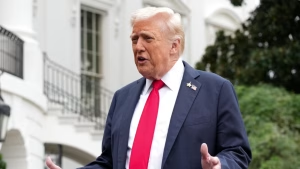
“Today, I send my best wishes to every American celebrating Diwali—the ‘Festival of Lights’. For many Americans, Diwali is a timeless reminder of light’s victory over darkness. It is also a time to bring families and friends together to celebrate community, draw strength from hope, and embrace a lasting spirit of renewal,” Trump stated in his official message.
The President added, “As millions of citizens light diyas and lanterns, we rejoice in the eternal truth that good will always triumph over evil,” reinforcing the philosophical underpinnings that make world leaders Diwali greetings resonate across cultures.
Keir Starmer Reflects on Mumbai Visit
British Prime Minister Keir Starmer extended greetings to Hindus, Jains, and Sikhs across Britain, drawing on his recent personal experience in India. His world leaders Diwali message carried particular authenticity, having recently participated in Diwali celebrations in Mumbai.
“Earlier this month I lit a diya in Mumbai as a symbol of devotion, joy, and renewed bonds. As we celebrate this Festival of Lights, let’s keep building a Britain where everyone can look ahead with hope,” Starmer posted on social media, connecting the festival’s symbolism to his vision for an inclusive Britain.
Canadian PM Mark Carney’s Tribute
Canadian Prime Minister Mark Carney joined the chorus of world leaders Diwali greetings, acknowledging the significant Indian diaspora in Canada and their contributions to Canadian society.
“Tonight, families and communities across Canada will light diyas and celebrate the triumph of light over darkness — of good over evil. Wishing everyone celebrating Diwali a joyful Festival of Lights,” Carney posted, recognizing the festival’s importance to Canadian multiculturalism.
Benjamin Netanyahu’s Message of Partnership
Israeli Prime Minister Benjamin Netanyahu sent personalized wishes to Prime Minister Narendra Modi and the people of India, making his world leaders Diwali greeting a diplomatic gesture emphasizing bilateral ties.
“Wishing my friend Narendra Modi and the people of India a very Happy Diwali! May the Festival of Lights bring hope, peace and prosperity to your great nation. Israel and India stand together — partners in innovation, friendship, defence and a brighter future,” Netanyahu stated, intertwining festival wishes with strategic partnership acknowledgment.
Shehbaz Sharif’s Inclusive Message
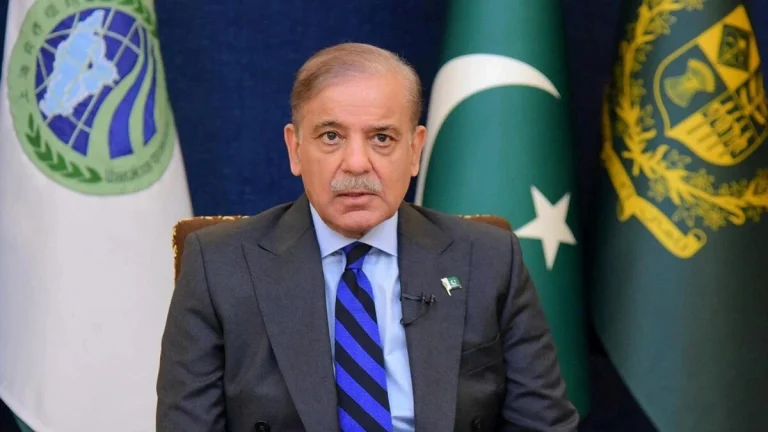
Pakistan’s Prime Minister Shehbaz Sharif extended world leaders Diwali greetings to the minority Hindu community in Pakistan and globally, emphasizing themes of religious harmony and social cohesion.
“On the auspicious occasion of Diwali, I extend my heartfelt greetings to our Hindu community in Pakistan and around the world. As homes and hearts are illuminated with the light of Diwali, may this festival dispel darkness, foster harmony, and guide us all toward a future of peace, compassion, and shared prosperity,” Sharif stated.
He added, “The spirit of Diwali that embodies light over darkness, good over evil, and hope over despair inspires our collective resolve to overcome the challenges confronting our societies, from intolerance to inequality. Let us work together to ensure that every citizen, regardless of faith or background, can live in peace and contribute to progress.”
Middle Eastern and Asian Leaders Join Celebration
Sheikh Mohammed bin Rashid Al Maktoum, Ruler of Dubai and Prime Minister of the UAE, extended world leaders Diwali greetings acknowledging the significant Indian community in the Emirates.
“Warmest wishes and greetings to those celebrating Diwali in the UAE and around the world. May this festival of lights bring peace, safety, and prosperity to you and your loved ones. Happy Diwali!” he stated.
Singapore Prime Minister Lawrence Wong conveyed world leaders Diwali wishes through a video message, emphasizing the festival’s deeper meaning: “Light over darkness. Hope over fear. As we count down to Deepavali, we celebrate not just the lights that fill our homes, but the meaning they carry in our hearts.”
Sri Lankan President Anura Kumara Dissanayake extended world leaders Diwali greetings to Hindus in Sri Lanka and abroad, connecting the festival’s symbolism to national objectives: “As lamps are lit in every home, we pray that this festival’s light dispels the darkness in our hearts and illuminates our collective path. This celebration of good over evil mirrors our government’s resolve to defeat the threats to our nation’s progress, from drug abuse to extremism.”
Indian-Origin Leaders Share Personal Messages
Prominent Indian-origin figures also shared world leaders Diwali greetings. FBI Director Kash Patel posted, “Happy Diwali—celebrating the Festival of Lights around the world, as good triumphs over evil.”
Republican leader Vivek Ramaswamy stated, “Happy Diwali! May the light prevail over darkness.”
New York’s Indian-origin mayoral frontrunner Zohran Mamdani said, “Shubh Deepavali! Wishing everyone a very happy Diwali. Across our city, families are lighting diyas and celebrating the triumph of light over darkness and hope over despair. New York shines brighter tonight because of the people who bring their light and traditions home.”
These world leaders Diwali messages collectively demonstrate the festival’s universal appeal and its growing recognition as a celebration of shared human values transcending geographical and cultural boundaries.