Saturday, April 25, 2026
Home Blog Page 85

TikTok US Deal: Groundbreaking Agreement Saves App from Ban

Washington D.C. – TikTok announced on Thursday that it had finalized a long-awaited agreement establishing a joint venture majority-owned by American investors to operate its US business, marking a pivotal moment in the company’s struggle to avoid a ban linked to its Chinese ownership. The TikTok US deal represents a milestone after years of intense negotiations and national security concerns.

Structure of the TikTok US Deal

The newly formed TikTok USDS Joint Venture LLC will serve more than 200 million users and 7.5 million businesses across the United States. Under the TikTok US deal framework, American and global investors will hold 80.1 percent of the venture, while ByteDance, the Chinese parent company, will retain a 19.9 percent stake.

The TikTok US deal includes three managing investors who will each hold 15 percent: cloud computing firm Oracle, private equity group Silver Lake, and Abu Dhabi-based investment company MGX. This ownership structure addresses longstanding concerns about Chinese control over American user data and content algorithms.

Key Investors in TikTok US Deal

The TikTok US deal brings together prominent American investors and investment firms. TikTok confirmed that investors in the venture include Dell Family Office, the investment firm of Dell Technologies founder Michael Dell, along with Vastmere Strategic Investments, Alpha Wave Partners, Revolution, Merritt Way, Via Nova, Virgo LI, and NJJ Capital.

This diverse investor coalition in the TikTok US deal demonstrates significant American business confidence in the platform’s future and addresses government concerns about foreign ownership and control of a major social media platform operating in the United States.

Leadership Appointments in TikTok US Deal

As part of the TikTok US deal, former TikTok USDS executives Adam Presser and Will Farrell were appointed as chief executive officer and chief security officer, respectively, of the new joint venture. Their appointments signal continuity in operations while establishing American leadership.

Additionally, TikTok chief executive Shou Chew was named to the venture’s board as part of the TikTok US deal. Chew leads the company’s global business operations and strategy, ensuring coordination between international operations and the newly independent American entity.

Historical Context of TikTok US Deal

The TikTok US deal represents the culmination of disputes that began in August 2020 when US President Donald Trump first attempted to ban the app over national security concerns. Years of negotiations, legal challenges, and political pressure preceded this agreement.

The Trump administration delayed enforcement of a law until January 23 that would have banned the app unless its Chinese owner sold it. The TikTok US deal emerged as the solution to satisfy legal requirements while maintaining operational continuity for millions of American users and businesses.

Data Protection Measures in TikTok US Deal

A critical component of the TikTok US deal involves strict measures to protect user data, secure algorithms, and manage content moderation. The company committed to retraining, testing, and updating its content recommendation algorithm using exclusively US user data.

Under the TikTok US deal, the algorithm will be stored in Oracle’s US-based cloud system, addressing concerns about Chinese government access to American user information. These security provisions represent the most comprehensive data protection framework yet implemented by a major social media platform with foreign ownership ties.

Algorithm Management Under TikTok US Deal

The TikTok US deal includes specific provisions regarding the company’s proprietary content recommendation algorithm. The plan put forward by the White House allows ByteDance to lease a copy of its content algorithm to the new US TikTok entity rather than transferring complete ownership.

This arrangement in the TikTok US deal balances ByteDance’s intellectual property interests with American security requirements, creating a novel framework for managing technology transfers in national security-sensitive sectors.

ByteDance’s Retained Control in TikTok US Deal

Despite the majority American ownership established by the TikTok US deal, ByteDance is expected to retain control of key business components. The Chinese company will maintain oversight of TikTok’s advertising unit and the rapidly growing TikTok Shop e-commerce platform.

These retained interests in the TikTok US deal ensure ByteDance continues benefiting financially from its creation while satisfying American requirements for operational independence in areas deemed most sensitive to national security concerns.

Consistency with Previous Proposals

The details of the TikTok deal remain largely consistent with proposals shared in September when Trump delayed enforcement of the ban legislation. This consistency suggests the framework underwent thorough negotiation and represents a carefully balanced compromise between competing interests.

The TikTok deal’s alignment with earlier proposals also indicates that fundamental concerns about data security and content control have been adequately addressed through the joint venture structure and accompanying security measures.

Impact on Users and Businesses

The TikTok deal ensures uninterrupted service for more than 200 million American users who have made the platform central to their social media experience. Additionally, 7.5 million businesses that rely on TikTok for marketing, customer engagement, and sales can continue operations without disruption.

Small businesses and content creators who built substantial followings and revenue streams through TikTok will particularly benefit from the TikTok deal’s resolution of uncertainty that had threatened their livelihoods.

Broader Implications of TikTok US Deal

The TikTok deal establishes potential precedents for how foreign-owned technology companies can operate in the United States while addressing national security concerns. The joint venture model with majority American ownership, strict data controls, and algorithm independence may serve as a template for future situations involving foreign technology platforms.

As the TikTok deal implementation proceeds, its success or failure will likely influence policy decisions regarding other Chinese-owned applications and services operating in American markets, making this agreement a watershed moment in US-China technology relations.
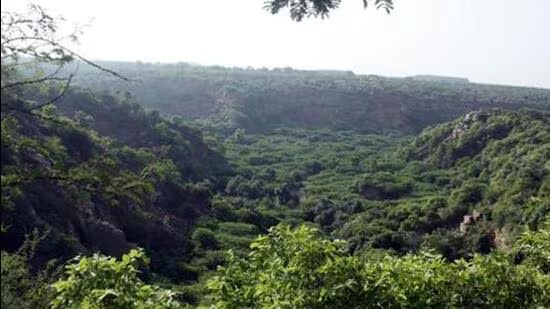

Aravalli March Protest: Massive 700-km Journey Challenges Supreme Court Ruling

New Delhi – Environmental activists and community leaders have announced an ambitious Aravalli march protest beginning January 24, 2026, covering 700 kilometers through four states to challenge the Supreme Court’s controversial November 2025 ruling that altered the definition of the Aravalli range. The journey represents a significant grassroots mobilization to protect one of India’s most ecologically sensitive regions.

Aravalli March Protest Route and Scope

Members of the Aravalli Virasat Jan Abhiyan, a coalition of environmentalists, community leaders, social activists, researchers, and concerned citizens, announced the Aravalli march protest at a press conference in Delhi on Thursday. The extensive journey will commence from Aravalli district in Gujarat, traversing through multiple districts across four states.

The Aravalli march protest route will cover three districts in Gujarat before moving through 27 districts in Rajasthan and seven districts in Haryana, ultimately reaching Delhi. This comprehensive coverage aims to engage communities dependent on the hills and raise awareness about the range’s ecological importance.

Core Demands of Aravalli March Protest

The primary objective of the Aravalli march protest is to demand complete recall of the Supreme Court’s November 20, 2025, judgment. Neelam Ahluwalia, a coalition member, articulated the movement’s position: “Aravallis require strict protection, not senseless definitions to exclude the majority of areas from legal protection and so-called ‘sustainable mining plans’.”

The Aravalli march protest specifically demands that the Supreme Court scrap what activists term the “regressive new definition” of the Aravallis provided by a committee spearheaded by the Union environment ministry. Protesters argue this definition fundamentally undermines conservation efforts.

Controversial Supreme Court Ruling

The catalyst for the Aravalli march protest was the Supreme Court’s November 20, 2025, acceptance of a new definition of the Aravalli Hills and Range. Based on recommendations from a Union environment ministry-appointed committee, this definition limits classification to landforms rising at least 100 meters above local relief and clustering within specified distances.

Also Read: Delhi Road Cleaning Project: Massive Rs. 1,487 Crore Initiative Unveiled

Environmental groups organizing the Aravalli march protest have criticized this ruling, warning that the criteria could exclude large portions of the ancient range from legal protection. They fear this exclusion could open previously protected areas to mining and development activities.

Ecological Concerns Driving Aravalli March Protest

Coalition members participating in the Aravalli march protest raised serious concerns about potential ecological damage. They warned that the altered definition could harm ecologically sensitive areas including wetlands, wildlife habitats, and watershed or catchment systems by permitting mining operations.

The Aravalli march protest activists have called for all mining in the region to stop entirely, emphasizing that the range plays a crucial role in north India’s environmental health and cannot be compromised for industrial development.

Water Activist’s Contribution to Aravalli March Protest

Renowned water activist Rajendra Singh, also part of the coalition organizing the Aravalli march protest, launched a book highlighting threats facing the Aravallis at Thursday’s event. His participation adds significant credibility to the movement’s environmental concerns.

Speaking about the Aravalli march protest objectives, Singh stated: “We want this journey to encourage everyone in the country to join the effort to protect the Aravallis. Additionally, there has been discussion regarding the creation of a barrier to protect the range, but this is not needed, as a natural barrier already exists and should be preserved.”

Tribal Communities’ Stake in Aravalli March Protest

The Aravalli march protest emphasizes the direct impact on tribal communities whose livelihoods depend entirely on the range. Kusum Rawat, a leader of the Adivasi Ekta Parishad from the Bhil tribe, explained the deep connection between indigenous communities and the Aravallis.

“All the different tribal communities living in the lap of the Aravallis rely on the forest for food, fuel, medicinal herbs and raw materials such as bamboo and tendu leaves,” Rawat stated, highlighting why the Aravalli march protest matters to indigenous populations.

Tribal Dependence on Aravalli Resources

Participants in the Aravalli march protest point out that hill slopes provide essential grazing land, while rain-fed terraces allow cultivation for tribal communities. Seasonal streams and water bodies supply drinking water and support small-scale fishing activities that sustain local populations.

The Aravalli march protest organizers emphasize that adivasi cultural identity, livelihood, and sustenance depend directly on the health of the Aravalli hills, forests, and their natural resources. This cultural dimension adds urgency to environmental protection demands.

Awareness and Community Engagement Goals

Beyond demanding judicial review, the Aravalli march protest aims to raise nationwide awareness about the range’s ecological importance. By interacting with communities dependent on the hills throughout the 700-kilometer journey, organizers hope to build broader public support for Aravalli protection.

The Aravalli march protest strategy involves grassroots engagement across multiple states, ensuring that local voices contribute to the larger conservation narrative and demonstrating widespread opposition to the court’s redefinition.

Legal Protection Concerns

The Aravalli protest highlights fundamental questions about environmental jurisprudence and the balance between development and conservation. Activists argue that the November 2025 ruling represents a dangerous precedent where technical definitions can override long-standing ecological protections.

Path Forward

As the Aravalli protest prepares to launch on January 24, it represents more than environmental activism—it embodies a struggle to preserve India’s natural heritage against what organizers view as regressive policy changes. The journey through Gujarat, Rajasthan, Haryana, and Delhi will test whether grassroots mobilization can influence judicial and governmental decisions on environmental protection.

Delhi HC Rape Case: Court Upholds Shocking Life Sentence for Father

0

New Delhi – The Delhi High Court has delivered a significant verdict in a disturbing Delhi HC rape case, upholding the life sentence of a man convicted of raping his 14-year-old daughter. The court observed that a father entrusted with protecting his child cannot be shown any leniency for such heinous crimes, setting a strong precedent in cases involving parental sexual abuse.

Delhi HC Rape Case Verdict and Key Observations

In this harrowing Delhi HC rape case, a bench of Justices Prathiba M Singh and Madhu Jain declared: “A father who is supposed to safeguard the safety and security of his own daughter cannot be shown any relaxation in such cases.” The order was released on January 21, though the court delivered the ruling on January 15.

The Delhi HC rape case involved the court hearing the convict’s appeal against a trial court’s July 30 and August 29, 2025, orders that had convicted him of rape, criminal intimidation, and aggravated penetrative sexual assault under the Protection of Children from Sexual Offences (POCSO) Act, sentencing him to life imprisonment.

Background of the Delhi HC Rape Case

The Delhi HC rape case originated from events in July 2021, when the victim, then three months pregnant, and her mother approached the police. They alleged that the father had sexually assaulted the minor on multiple occasions while she was asleep at home.

Following the complaint in this Delhi HC rape case, police conducted investigations and filed the chargesheet in March 2022 under rape and aggravated penetrative sexual assault provisions of the POCSO Act. The case highlighted the horrific reality of sexual abuse within families and the vulnerability of minors.

Convict’s Arguments in Delhi HC Rape Case

Before the high court in this Delhi HC rape case, the convict presented several arguments challenging his conviction. He asserted that the chain of custody of biological samples had not been properly established, as testing of the foetus was conducted 14 days after collection.

In the Delhi HC rape case proceedings, the convict further contended that the forensic science laboratory (FSL) report could not be the sole basis for conviction, particularly since the victim had stated that she did not know how she became pregnant. He also submitted that his wife had turned hostile and claimed she was unaware of who had impregnated their daughter.

Also Read: Delhi Police Stabbing Incident: Brave Officers Injured During Dramatic Arrest

Prosecution’s Position in Delhi HC Rape Case

Opposing the appeal in the Delhi HC rape case, Delhi Police was represented by additional public prosecutor Ritesh Bahari along with advocate Divya Yadav. They argued that settled judicial precedents recognize DNA testing as conclusive evidence in rape cases.

The prosecution in this Delhi HC rape case maintained that the trial court’s findings did not warrant any interference, emphasizing the reliability and conclusiveness of scientific evidence in establishing guilt beyond reasonable doubt.

DNA Evidence Proves Decisive in Delhi HC Rape Case

In its comprehensive 17-page verdict, the high court in this Delhi HC rape case observed that while the family’s social and economic circumstances could explain the inconsistent or hostile statements of the victim and her mother, the DNA evidence conclusively established the offence.

The court in the Delhi HC rape case stated: “The social circumstances and the economic status of the family may have compelled the prosecutrix and her mother to give contradictory statements or to turn hostile. However, in such cases, the court cannot completely ignore the scientific evidence which has come on record.”

Court’s Reasoning on Scientific Evidence

The Delhi HC rape case judgment emphasized the paramount importance of DNA evidence. “In the present case, the DNA testing, being conclusive and unimpeachable evidence establishing the factum of physical relationship of the appellant with the minor daughter, leaves no scope for doubt and accordingly the conviction of the appellant cannot be faulted,” the court declared.

This portion of the Delhi HC rape case verdict reinforces the legal principle that scientific evidence carries significant weight in criminal proceedings, particularly when testimony may be compromised by various social and economic factors.

Social and Economic Context in Delhi HC Rape Case

The Delhi HC rape case highlighted important considerations regarding witness testimony in cases involving vulnerable families. The court acknowledged that social circumstances and economic status may compel victims and family members to give contradictory statements or turn hostile during proceedings.

Despite recognizing these societal pressures in the Delhi HC rape case, the court maintained that scientific evidence cannot be ignored when it conclusively establishes criminal acts. This balanced approach ensures justice while understanding the complex dynamics that affect testimony in such cases.

Protection of Children from Sexual Offences Act Application

The Delhi minor’s rape case was prosecuted under the POCSO Act, which provides special protection for children against sexual offenses. The convict faced charges of aggravated penetrative sexual assault, rape, and criminal intimidation under this legislation.

The Delhi HC rape case demonstrates the stringent application of POCSO Act provisions, particularly in cases involving parental abuse where the power dynamic and breach of trust make the crimes especially egregious.

Legal Precedent Set by Delhi HC Rape Case

This Delhi minor’s rape case establishes important legal precedent regarding the treatment of DNA evidence in sexual assault cases and the severity of punishment for parental sexual abuse. The court’s unequivocal stance that fathers entrusted with protecting their children deserve no leniency sends a strong message.

Implications and Conclusion

The Delhi minor’s rape case verdict reinforces the judiciary’s commitment to protecting children from sexual abuse, even when perpetrated by those closest to them. By upholding the life sentence and emphasizing the conclusiveness of DNA evidence despite hostile witnesses, the court has strengthened the legal framework for prosecuting such heinous crimes and ensuring justice for vulnerable victims.

Delhi Road Cleaning Project: Massive Rs.1,487 Crore Initiative Unveiled

0

New Delhi – The national capital is set to launch an ambitious Delhi road cleaning project that will deploy electric mechanical road sweepers, litter pickers, and dust dumping vehicles to clean 2,800 kilometers of roads every day. The comprehensive masterplan submitted by the Delhi government outlines a decade-long initiative aimed at combating one of the city’s biggest pollution sources.

Financial Allocation for Delhi Road Cleaning Project

According to the masterplan, the Delhi road cleaning project will require an investment of approximately ₹1,487 crore over 10 years to keep the arterial road network clean. A senior government official explained that in May 2025, the cabinet had initially approved ₹1,230 crore for this project, under which diesel and CNG-based vehicles were to be procured.

However, the Delhi road cleaning project has been updated to exclusively use electric vehicles, demonstrating the government’s commitment to environmental sustainability. The revised plan includes procurement of 70 electric mechanical road sweepers, six electric water tankers, 24 electric dust dumping vehicles, 140 litter pickers, and other specialized machinery.

Three-Zone Division for Delhi Road Cleaning Project

The Delhi road cleaning project masterplan divides the city into three distinct zones to ensure comprehensive coverage. The North zone will receive ₹564.6 crore, making it the largest allocation, while the South zone will get ₹465 crore, and the East zone will be allocated ₹385 crore.

This strategic division in the Delhi road cleaning project ensures that resources are distributed based on the specific needs and road network density of each zone, optimizing the effectiveness of cleaning operations across the capital.

Also Read: Delhi Weather Alert: IMD Issues Critical Yellow Warning for Rainfall

Deployment Strategy and Coverage

The Delhi road cleaning project will focus on 1,410 kilometers of roads that are over 60 feet wide and maintained by the Public Works Department (PWD). These machines will be strategically deployed to achieve maximum efficiency in cleaning operations.

Officials involved in the Delhi road cleaning project have set an ambitious target of cleaning a minimum of 2,800 kilometers of lanes every day. This means all PWD roads will be cleaned once every two days, ensuring consistent maintenance of the city’s major arterial network.

Zone-Wise Machine Deployment

The Delhi road cleaning project includes a detailed zone-wise distribution of cleaning equipment. In the North zone, 28 electric mechanical road sweeping machines will be deployed, along with 56 litter picker machines. The South zone will receive 23 sweepers and 46 litter pickers, while the East zone will get 19 sweepers and 38 litter pickers.

Additionally, the Delhi road cleaning project will purchase 24 dust dumping machines to dispose of collected dust across all zones. This comprehensive equipment deployment ensures that each zone has adequate resources for effective road maintenance.

Electric Vehicle Focus in Delhi Road Cleaning Project

A defining feature of the Delhi road cleaning project is its exclusive use of electric vehicles to prevent additional pollution. “All machines will be electric so that they do not cause pollution,” a government official stated, emphasizing the environmental consciousness of the initiative.

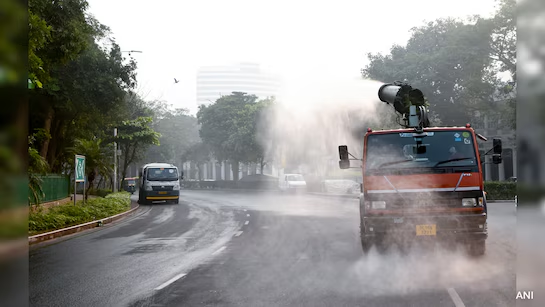
The Delhi road cleaning project will implement a multi-step cleaning process where mechanical road sweepers, anti-smog guns, and water tankers will work in conjunction to ensure deep cleaning of roads. After cleaning, water will be sprinkled to ensure roads are completely clean and dust-free.

Addressing Delhi’s Dust Pollution Crisis

The Delhi road cleaning project directly addresses one of the capital’s most significant pollution sources. According to a 2018 source apportionment study by The Energy and Resources Institute (TERI), dust can contribute to as much as 25% of Delhi’s bad air quality.

Dust-related pollution manifests as elevated PM10 levels, and the TERI study found that potholes, unpaved roads, and broken footpaths—all of which cause road dust—were the largest source of such particles in the air. The Delhi road cleaning project specifically targets this issue through systematic cleaning operations.

Existing Infrastructure and Gaps

Currently, the Municipal Corporation of Delhi (MCD) operates 52 mechanical road sweeper units that are deployed on PWD roads wider than 60 feet. A senior MCD official explained that PWD did not have its own road sweeping units, and MCD’s machinery was engaged in cleaning these roads.

The Delhi road cleaning project will fill this infrastructure gap by providing PWD with dedicated cleaning equipment, reducing dependency on MCD resources and ensuring more consistent road maintenance.

Health Impact and PM10 Concerns

The Delhi road cleaning project addresses serious health concerns associated with dust pollution. The primary pollutant in dust is PM10, which is heavier particulate matter that cannot travel far but severely affects lungs, causing various respiratory diseases.

By systematically removing dust from roads, the Delhi road cleaning project aims to significantly reduce PM10 levels in the air, potentially improving respiratory health outcomes for Delhi’s residents.

Global Tender Process

The Delhi road cleaning project will follow transparent procurement procedures with global tenders being issued for respective zones. This competitive bidding process ensures that the government obtains the best available technology and services at competitive prices.

Long-Term Vision

The 10-year timeline of the Delhi road cleaning project demonstrates a long-term commitment to maintaining the city’s road infrastructure and air quality. By investing in electric vehicles and comprehensive cleaning systems, the project positions Delhi as a leader in sustainable urban maintenance practices while addressing critical pollution challenges that have plagued the capital for years.

Trump Hand Bruise: Shocking Explanation Amid Growing Health Concerns

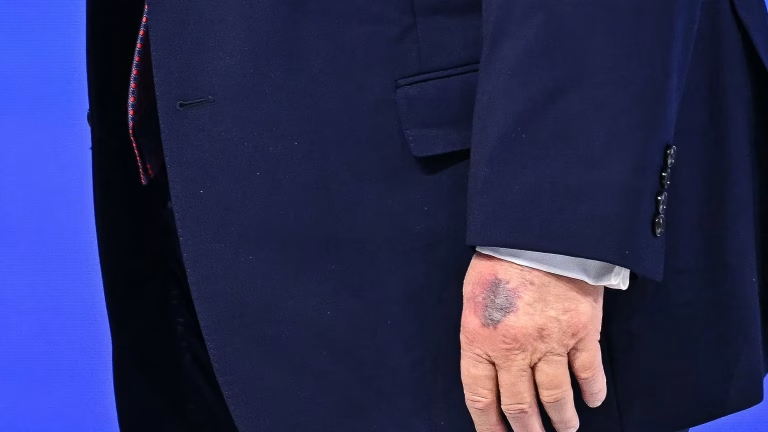
Washington D.C. – President Donald Trump has offered a straightforward explanation for the fresh Trump hand bruise that appeared on his left hand during his recent visit to Davos, Switzerland. The 79-year-old president told reporters aboard Air Force One that he simply hit a table at the World Economic Forum, causing the purple mark that sparked renewed speculation about his health.

Trump Hand Bruise Explained During Air Force One Interview

The Trump hand bruise became a topic of discussion when the president addressed reporters during his return flight. “I clipped it on the table,” Trump told journalists, referring to the visible purple mark on his left hand. “I put a little, what do they call it?, cream on it. But I clipped it,” he added, attempting to downplay the injury.

Press Secretary Karoline Leavitt provided additional context about the Trump hand bruise, stating that the president had “hit his hand on the corner of the signing table” at the Board of Peace signing ceremony in Davos, “causing it to bruise.” This explanation aimed to address the visible discoloration that had become apparent in photographs from the event.

Pattern of Bruising Raises Questions

The fresh Trump hand bruise on his left hand comes as the president has been seen with frequent bruising on his right hand since returning to the White House last year. Trump has often concealed these marks with bandages and makeup, leading to ongoing questions about the underlying causes and his overall health status.

The White House has previously addressed the recurring bruising issues, explaining that the Trump hand bruise pattern is due to a combination of frequent handshaking and the aspirin he takes for his cardiovascular health. Aspirin, commonly prescribed for heart health, is known to thin blood and can make individuals more susceptible to bruising from minor impacts.

Jon Stewart’s Commentary on Trump Hand Bruise

The Trump hand bruise incident also attracted attention from late-night television. Jon Stewart and The Daily Show referenced the injury with a satirical take connecting it to the ongoing tensions over Greenland. The program’s social media account shared a photo of the bruise, writing: “Breaking: Trump annexes Gangreneland.”

This was a double entendre referring to gangrene, a condition where a lack of blood circulation results in severe swelling and tissue death. While clearly intended as humor, the joke highlighted the public interest in the Trump hand bruise and broader health concerns.

Chronic Health Conditions Disclosed

Beyond the Trump hand bruise, the administration has disclosed several health conditions affecting the president. Last summer, officials revealed that Trump’s leg swelling had been diagnosed as a symptom of chronic venous insufficiency, a common condition in which faulty vein valves allow blood to pool in the lower extremities.

Also Read: Trump Board of Peace: India Noticeably Absent from Controversial Gaza Initiative

This condition causes swelling, cramping, and skin changes, and can be managed with medication or targeted medical procedures. The disclosure came after visible swelling in Trump’s legs sparked speculation about his overall health and fitness for office.

Broader Health Speculation Surrounding Trump Hand Bruise

The Trump hand bruise incident has contributed to ongoing speculation about the president’s fitness given his age and various health indicators. Beyond the bruising, observers have noted swelling in his legs and several apparent moments of the president dozing off during public events.

These visible signs, including the recurring Trump hand bruise pattern, have led to questions about whether the White House is providing complete transparency regarding the president’s health status. At 79 years old, Trump is the oldest person to assume the presidency in American history.

Unannounced Hospital Visit Adds to Concerns

An unannounced hospital visit last year added to suspicions of secrecy around Trump’s health, intensifying scrutiny that the Trump hand bruise has only reinforced. The unexpected medical appointment raised questions about what health issues might have necessitated immediate attention.

Weeks after the hospital visit, Trump’s doctor attempted to reassure the public by stating that MRI imaging had shown the president to be in “excellent” cardiovascular health. This disclosure came as part of broader efforts to address concerns that incidents like the Trump hand bruise continue to generate.

Aspirin and Blood Thinning Effects

The Trump hand bruise susceptibility has been partially attributed to the president’s aspirin regimen. Blood thinners like aspirin, while beneficial for cardiovascular health, significantly increase the likelihood and severity of bruising from minor impacts that might not affect individuals not taking such medications.

Medical experts note that elderly patients on aspirin therapy often experience more frequent and pronounced bruising, even from everyday activities. The Trump hand bruise from hitting a table would align with this medical understanding, though the frequency of such incidents remains notable.

Transparency and Presidential Health

The Trump hand bruise incident raises broader questions about transparency regarding presidential health. Historically, the American public has expected detailed information about their leaders’ medical conditions, particularly when visible signs suggest potential health issues.

While the White House has provided explanations for the Trump hand bruise and other health-related observations, some critics argue that more comprehensive medical disclosures would be appropriate given Trump’s age and the demanding nature of the presidency.

Managing Public Perception

The administration’s handling of the Trump hand bruise explanation—providing a straightforward account of a minor table injury—represents an attempt to manage public perception and avoid fueling speculation. However, the recurring nature of such bruising incidents ensures continued scrutiny.

As Trump continues his second term, the Trump hand bruise and similar health indicators will likely remain subjects of public interest and media attention. The administration faces ongoing challenges in balancing privacy concerns with the public’s legitimate interest in understanding their president’s health and fitness for office.

Delhi Weather Alert: IMD Issues Critical Yellow Warning for Rainfall

0

New Delhi – The India Meteorological Department has issued a Delhi weather alert for Friday, predicting light to moderate rainfall accompanied by thunderstorms, lightning, and gusty winds across the national capital. This development comes as Delhi experiences a temporary reprieve from winter chill, with Thursday recording the warmest January day in seven years at 27.1 degrees Celsius.

Yellow Alert Details in Delhi Weather Alert

The Delhi weather alert includes a yellow warning for Friday, with the IMD forecasting that skies over Delhi-NCR will remain generally cloudy throughout the day. According to the bulletin, residents can expect “very light to light rain accompanied with thunderstorm/lightning and gusty winds (speed 30-40 kmph). Shallow to moderate fog during morning hours.”

IMD officials elaborated on the Delhi weather alert, stating that one or two spells of light rain, accompanied by thunderstorms, lightning, and gusty winds of speed 30-40 kmph are likely to occur during the early to forenoon hours on Friday. Another spell of very light to light rain is expected towards the afternoon and evening hours.

Western Disturbance Behind Delhi Weather Alert

The Delhi weather alert has been issued due to an active western disturbance affecting the region. This weather system is likely to cause multiple spells of light to moderate continuous rainfall throughout Friday, according to meteorological officials. The western disturbance represents a significant weather pattern that brings moisture-laden winds to northern India.

Furthermore, the IMD has predicted the influence of another consecutive western disturbance over northwest India from January 26 to 28. This subsequent weather system is likely to lead to an increase in minimum temperatures across the region, extending the impact of the current Delhi weather alert period.

Expected Wind Conditions in Delhi Weather Alert

A crucial component of the Delhi weather alert involves significantly increased wind speeds anticipated for Friday. These enhanced wind speeds are expected to play a vital role in dispersing pollutants accumulated in the atmosphere, potentially leading to further improvement in the national capital’s air quality.

The gusty winds predicted in the Delhi weather alert, with speeds reaching 30-40 kmph, will provide much-needed ventilation to the city’s atmosphere. This natural dispersion mechanism could prove beneficial for residents who have been grappling with poor air quality throughout the winter season.

Air Quality Shows Marginal Improvement

Coinciding with the Delhi weather alert, the capital’s air quality has shown marginal improvement. Delhi recorded an average Air Quality Index (AQI) of 313 (very poor) at 8am on Thursday, compared to 330 (very poor) recorded at 4pm on Wednesday. The enhanced wind speeds predicted in the Delhi weather alert are expected to further improve these conditions.

The uptick in air quality, combined with favorable meteorological conditions indicated in the Delhi weather alert, prompted the sub-committee on the Graded Response Action Plan (GRAP) of the Commission for Air Quality Management (CAQM) to revoke Stage III curbs across Delhi-NCR with immediate effect on Thursday, January 22.

GRAP Stage III Restrictions Revoked

The panel observed that Delhi’s AQI has been improving owing to favourable meteorological conditions and recorded 322 on Thursday. The forecast by IMD/IITM, which forms the basis of the Delhi weather alert, indicates that AQI is likely to remain in the “moderate” to “poor” category in coming days.

Keeping in view the disruptive nature of restrictions under Stage-III of the extant GRAP impacting a large number of stakeholders and the public, the CAQM Sub-Committee unanimously decided to revoke all actions under Stage-III of the extant schedule of GRAP in the entire NCR with immediate effect.

Broader Regional Impact of Delhi Weather Alert

The Delhi weather alert is part of a larger weather pattern affecting northern India. The IMD has predicted severe weather conditions with heavy rain, hailstorm, and thunderstorms (with gusty winds) over parts of Jammu & Kashmir, Himachal Pradesh, Uttarakhand, and Punjab.

Additionally, hailstorm and thunderstorms are predicted in parts of Haryana, West Uttar Pradesh, and Rajasthan, indicating that the weather system triggering the Delhi weather alert has widespread implications across the northwestern region of the country.

Temperature Trends and Winter Retreat

The Delhi weather alert comes against the backdrop of easing winter chill over the past few days. Thursday’s maximum temperature of 27.1 degrees Celsius marked the warmest January day in seven years, suggesting a gradual retreat of winter conditions in the national capital.

This warming trend, combined with the rainfall predicted in the Delhi weather alert, indicates a transitional weather phase. The consecutive western disturbances forecast from January 26 to 28 are expected to further influence temperature patterns, with predictions of increased minimum temperatures.

Precautionary Measures for Residents

Residents are advised to take necessary precautions in response to the Delhi weather alert. The combination of rainfall, thunderstorms, lightning, and gusty winds requires vigilance, particularly during outdoor activities. Morning fog conditions mentioned in the Delhi weather alert may also impact visibility for commuters.

The improved air quality resulting from increased wind speeds provides a positive aspect to the weather changes. However, residents should remain updated on the evolving weather situation as the western disturbance continues to influence conditions across the region throughout the coming days.

Lula India Visit: Critical Talks Confirmed Amid Escalating US Tariff Tensions

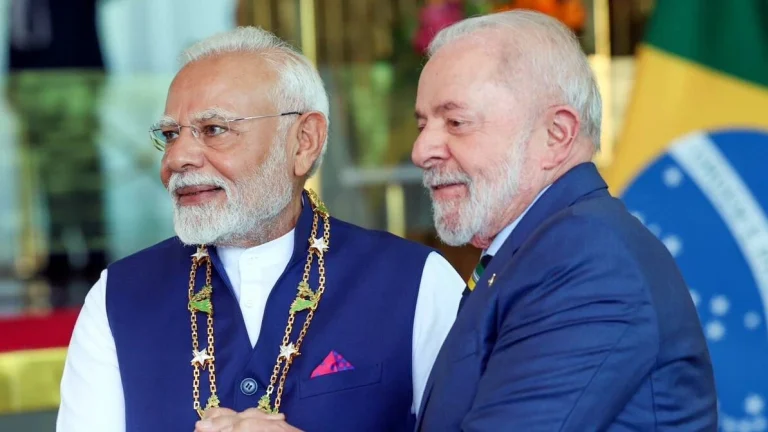
New Delhi – Prime Minister Narendra Modi and Brazilian President Luiz Inácio Lula da Silva held crucial discussions on Thursday, confirming the upcoming Lula India visit scheduled for February. The conversation comes at a critical juncture as both nations navigate challenging tariff tensions imposed by US President Donald Trump, highlighting the growing importance of cooperation among Global South countries.

Lula India Visit Dates Confirmed for February

People familiar with the matter confirmed that the Lula India visit will take place during February 19-21. Lula personally dialled Modi to discuss his upcoming trip to New Delhi, where he will participate in the AI Impact Summit and hold bilateral meetings with the Indian Prime Minister.

The Lula India visit was initially announced last August when the Brazilian President committed to undertaking a state visit to India in early 2026. The timing of this visit assumes particular significance given the current global economic challenges and shared concerns over US trade policies.

Strategic Partnership Poised for New Heights

Following their telephonic conversation, Modi expressed enthusiasm about the strengthening bilateral relationship. “Glad to speak with President Lula. We reviewed the strong momentum in the India-Brazil Strategic Partnership, which is poised to scale new heights in the year ahead,” Modi stated on social media.

The Prime Minister emphasized that the Lula India visit represents an opportunity to deepen cooperation vital for advancing shared interests of the Global South. “Our close cooperation is vital for advancing the shared interests of the Global South. I look forward to welcoming him to India soon,” he added.

Comprehensive Bilateral Cooperation Review

According to an official readout from the Indian government, Modi and Lula recalled their meetings in Brazil and South Africa last year during the Lula India visit discussion. Both leaders expressed satisfaction at significant progress achieved across diverse areas of cooperation, including trade, investment, technology, defence, energy, health, agriculture, and people-to-people ties.

The leaders also exchanged views on regional and global issues and underscored the importance of reformed multilateralism in addressing shared challenges. This emphasis on multilateral reform aligns with both countries’ vision for a more equitable global governance system.

Context of Trump’s Tariff Offensive

The Lula India visit preparation occurs against the backdrop of aggressive tariff policies implemented by the Trump administration. Both India and Brazil have been hit with substantial tariffs, with India facing a massive 50% levy on exports to the United States—half of which Trump labeled a “penalty” over India’s purchase of Russian oil.

Also Read: Trump Board of Peace: India Noticeably Absent from Controversial Gaza Initiative

When Lula announced the state visit last August, he was actively engaged in efforts to rally members of the BRICS grouping, currently chaired by India, on tackling tariffs imposed by Trump. The Lula India visit is expected to include discussions on coordinated responses to these economic challenges.

Trump’s Evolving Position on India

Despite the tariff tensions, Trump expressed confidence in achieving a “good” trade deal with India during his address at the World Economic Forum in Davos, Switzerland. “I have a great respect for your prime minister (Modi). He is a fantastic man and a friend of mine. We are gonna have a good deal,” Trump stated.

However, nearly five months after the tariffs took effect, continued uncertainty surrounds when a trade deal may be struck. The Lula India visit may provide both countries an opportunity to discuss strategies for managing relations with the unpredictable US administration.

Complications in US-India Trade Negotiations

Trade negotiations between Indian and US officials have been underway since before the tariffs took effect, with formal talks beginning in March-April last year. Recent statements by Trump administration officials have deepened the mystery surrounding potential agreements.

US Commerce Secretary Howard Lutnick claimed that a potential trade deal fell through because Modi did not call Trump, though India quickly rejected these claims. Another aide recently suggested Trump had greenlit a bill that could hike tariffs on India to 500%, raising concerns about the future trajectory of bilateral relations that the Lula India visit may address.

Brazil’s Tariff Experience with Trump

The Trump administration had imposed a 40% tariff on Brazilian products in July on top of a 10% tariff imposed earlier. These tariffs were retaliatory measures for the Brazilian Supreme Court’s conviction of Trump ally and Lula’s predecessor, Jair Bolsonaro, for attempting a coup.

However, the 40% tariffs on Brazilian food products, including beef, coffee, cocoa, and fruits, were later withdrawn in November. Rising food prices had become a major factor behind Trump’s declining approval ratings, demonstrating the domestic political costs of aggressive trade policies that may be discussed during the Lula India visit.

BRICS Dynamics and Future Engagement

India and Brazil are key members of the BRICS grouping, which Trump has repeatedly attacked, claiming the bloc works to undermine the US dollar by settling trade in national currencies. People familiar with the matter indicated that Lula is unlikely to attend the BRICS Summit in India later this year, as he is expected to focus on his campaign ahead of Brazil’s general election in October.

The Lula India visit in February will therefore represent a crucial bilateral engagement before Brazil’s electoral season intensifies, allowing both leaders to solidify cooperation frameworks and coordinate positions on pressing global issues.

Looking Forward

The confirmed Lula India visit represents a significant diplomatic engagement that extends beyond bilateral relations to encompass broader Global South solidarity in the face of economic pressures from developed nations. As both countries navigate challenging international waters, their partnership assumes increasing strategic importance for shaping a more balanced global economic order.

Pakistan Board of Peace: Sharif Faces Explosive Backlash Over Trump’s Gaza Initiative

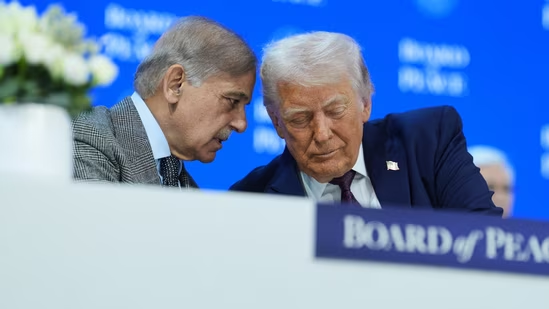
Switzerland – Pakistan Prime Minister Shehbaz Sharif’s decision to join US President Donald Trump’s Board of Peace for Gaza has ignited a fierce political controversy in Islamabad. The signing ceremony at the World Economic Forum in Davos, Switzerland, which Sharif portrayed as a significant diplomatic achievement, has been condemned by opposition parties as non-transparent and morally indefensible, triggering demands for withdrawal and even a national referendum.

Pakistan Board of Peace Decision Sparks Political Firestorm

During the World Economic Forum gathering, Sharif joined world leaders in signing the charter for Trump’s Board of Peace initiative. However, the Pakistan Board of Peace membership decision has created intense domestic backlash, with opposition parties questioning the lack of consultation and transparency in committing the nation to this controversial international mechanism.

The Board of Peace was formally unveiled by Trump as part of the second phase of his 20-point plan aimed at ending the Gaza conflict. Beyond Gaza, the board is intended to serve as a new international mechanism for resolving global conflicts, with a mandate encompassing governance capacity-building, reconstruction, investment attraction, and large-scale funding mobilization.

PTI Leads Opposition Against Pakistan Board of Peace Membership

The Pakistan Tehreek-e-Insaf (PTI), the party of jailed former Prime Minister Imran Khan, has led the charge against the government’s decision regarding Pakistan Board of Peace participation. In a stern statement, PTI announced it does not accept the decision, arguing that matters of such international significance require full transparency and inclusive consultation with all major political stakeholders.

PTI leaders emphasized that any participation in international peace initiatives should complement and reinforce the United Nations’ multilateral system rather than creating parallel structures that could complicate global governance. The party views the Pakistan Board of Peace commitment as potentially undermining established international frameworks.

Demands for Referendum and Parliamentary Scrutiny

Imran Khan’s party has called for the government to withdraw Pakistan Board of Peace formal participation until a complete consultative process is conducted. This process, according to PTI, should be subject to parliamentary scrutiny and must involve consultation with Imran Khan himself, despite his current incarceration.

In an unprecedented demand, PTI has even called for a national referendum on the Pakistan Board of Peace decision, underscoring the gravity with which the opposition views this international commitment. The party argues that such a significant foreign policy decision requires broader national consensus.

Opposition Leader Denounces Move as Morally Incorrect

Adding to the mounting pressure on Sharif over the Pakistan Board of Peace issue, Allama Raja Nasir Abbas, chief of the Majlis Wahdat-e-Muslimeen (MWM) and Leader of the Opposition in the Senate, denounced the move as “morally incorrect and indefensible.”

While expressing support for the Palestinian people, PTI clarified it would not accept any plans that go against the wishes of the people of Gaza or Palestine as a whole. This stance reflects concerns that the Pakistan Board of Peace framework may not adequately represent Palestinian interests or aspirations.

Trump’s Ultimatum Complicates Pakistan Board of Peace Position

The criticism of Pakistan Board of Peace membership intensified as Trump used the Davos platform to issue stark ultimatums, stating that Palestinian militant group Hamas must disarm or face “elimination.” This hardline position has raised questions about whether the board genuinely serves Palestinian interests or primarily advances American strategic objectives in the region.

The timing and nature of Trump’s statements have strengthened opposition arguments that the Pakistan Board of Peace participation may not align with the country’s traditional support for Palestinian self-determination and sovereignty.

Limited International Participation Raises Questions

The Pakistan Board of Peace initiative itself has faced significant scrutiny regarding its legitimacy and international support. While the Trump administration invited around 60 countries, including major powers like India and China, fewer than 20 ultimately participated in the Davos launch.

Those countries that signed on to the Pakistan Board of Peace framework are joining a body where permanent membership reportedly carries a $1 billion price tag, raising concerns about the financial implications of participation.

Member Nations and Global Response

The countries that have accepted Trump’s invitation to join alongside Pakistan Board of Peace include Argentina, Albania, Armenia, Azerbaijan, Bahrain, Belarus, Bulgaria, Egypt, Hungary, Indonesia, Jordan, Kazakhstan, Kosovo, Morocco, Mongolia, Qatar, Saudi Arabia, Turkey, the United Arab Emirates, Uzbekistan, and Vietnam.

Notably absent from the Pakistan Board of Peace membership are permanent members of the UN Security Council (except the United States) and other G7 nations. This limited participation from major global powers has fueled speculation that the initiative may struggle to achieve its ambitious goals.

Concerns About UN Replacement

Many countries view the Pakistan Board of Peace and the broader Board of Peace initiative as a move to supplant the United Nations. The board is being projected by Washington as a new international body to usher in peace and stability in Gaza and beyond, triggering speculation that it may respond to other global conflicts as well.

Critics argue that creating parallel international structures undermines the multilateral system built over decades and could fragment global governance mechanisms. The Pakistan Board of Peace controversy reflects these broader concerns about the future of international diplomacy and conflict resolution.

Background and Context

In October, Israel and Hamas agreed to Trump’s peace plan, setting the stage for the Board of Peace initiative. The Pakistan Board of Peace participation represents Sharif’s attempt to position the country as a significant player in Middle Eastern diplomacy, though domestic opposition suggests this strategy may carry substantial political costs at home.

Trump Board of Peace: India Noticeably Absent from Controversial Gaza Initiative

Switzerland – US President Donald Trump launched his ambitious Trump Board of Peace initiative at the World Economic Forum in Davos, Switzerland, on Thursday, notably without Indian participation. The newly formed body, conceived primarily for promoting peace in Gaza, has sparked international concerns about potentially undermining the United Nations’ role in global conflict resolution.

India Declines Participation in Trump Board of Peace

Despite receiving an invitation last week along with approximately 60 other countries, India maintained a conspicuous absence from the Trump Board of Peace signing ceremony. People familiar with the matter confirmed that no Indian officials attended the event at the Swiss mountain resort, and the Indian government has yet to make a final decision regarding membership in this controversial initiative.

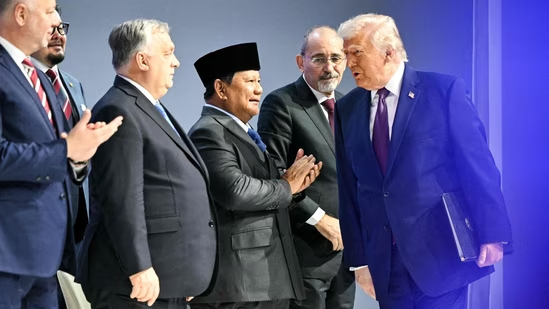
The Trump Board of Peace ceremony saw participation from 19 countries, with 11 heads of state or government signing the founding documents. However, significantly, no permanent member of the UN Security Council besides the United States has joined the board, nor has any G7 member other than the US expressed support for the initiative.

Sweeping Mandate Raises International Concerns

The official charter of the Trump Board of Peace contains no specific mention of Gaza, instead outlining an expansive mandate that could potentially challenge existing international frameworks. The document states the board will promote stability and secure enduring peace in conflict-affected areas, with Trump himself suggesting the body’s role could extend far beyond Gaza.

“I think we can spread out to other things as we succeed with Gaza,” Trump declared at the ceremony. “We can do numerous other things. Once this board is completely formed, we can do pretty much whatever we want to do.”

Pakistan Joins Trump Board of Peace Despite India’s Absence

Pakistan Prime Minister Shehbaz Sharif was among the leaders who signed documents establishing the Trump Board of Peace. The ceremony was also attended by Pakistan Army Chief Field Marshal Asim Munir, whom Sharif pointed out to Trump during the proceedings.

Trump used the occasion to again claim credit for allegedly ending eight wars in nine months, including the conflict between India and Pakistan in May. The US President stated that Sharif had praised him for supposedly saving millions of lives through his intervention.

India Rejects Trump’s Conflict Resolution Claims

India has categorically rejected Trump’s assertions about ending the India-Pakistan conflict. According to Indian officials, hostilities concluded after four days of fighting when military officials from both nations reached an understanding independently, without external mediation.

The Trump Board of Peace arrangement raised particular concerns in some quarters due to Pakistan’s membership, especially given the recent bilateral tensions and India’s position on the May conflict’s resolution.

Countries Participating in Trump Board of Peace

The signing ceremony saw participation from diverse nations across different regions. Heads of state or government from Argentina, Armenia, Azerbaijan, Bulgaria, Hungary, Indonesia, Kazakhstan, Kosovo, Pakistan, Paraguay, and Uzbekistan signed the founding documents.

Senior officials from eight additional countries—Bahrain, Jordan, Morocco, Qatar, Saudi Arabia, Turkey, UAE, and Mongolia—also participated in establishing the Trump Board of Peace. The geographical diversity of participants reflects the initiative’s global ambitions, though the absence of major powers remains notable.

UN Undermining Concerns Shape India’s Position

Sources familiar with the matter indicated that India closely monitored positions taken by key partners, including France and Russia, before making its decision. Concerns about the Trump Board of Peace potentially undermining the United Nations and Trump remaining as permanent chairman influenced India’s cautious approach.

Trump himself acknowledged the board could work alongside the UN but emphasized that the world body played no role in the eight wars he claimed to have “stopped,” including the India-Pakistan conflict.

Gaza Development Plans and Second Phase Challenges

Jared Kushner, Trump’s son-in-law and member of both the executive board and Gaza executive board of the Trump Board of Peace, outlined a development plan for Gaza. However, his presentation made no mention of establishing a pathway toward a Palestinian state.

The Gaza executive board forms part of the second phase of a US-brokered agreement between Israel and Hamas. The first phase—a ceasefire finalized last October—has experienced significant violence, raising questions about the viability of subsequent phases.

The second phase faces substantial challenges, including disarming Hamas and ensuring the withdrawal of Israeli forces from Gaza. These complex issues will test the Trump Board of Peace’s effectiveness in its primary stated objective.

India’s Alternative Diplomatic Engagement

While absent from the Trump Board of Peace, India will have opportunities to engage with the Gaza peace process through alternative channels. New Delhi is scheduled to host a meeting of foreign ministers from Arab League member states during January 30-31.

Neena Malhotra, secretary (South) in India’s external affairs ministry, met with envoys of Arab League states on Thursday to review preparations for this significant gathering. Additionally, Prime Minister Narendra Modi is expected to travel to Israel in February, providing further opportunities for regional consultations on Middle Eastern stability and peace processes independent of the Trump Board of Peace framework.