Wednesday, April 29, 2026
Home Blog Page 150

Bengal SIR Voter Portal 2026 – Detailed Analysis of Election Commission’s Digital Initiative, Mamata Banerjee’s Concerns, and Governance Lessons for Electoral Integrity

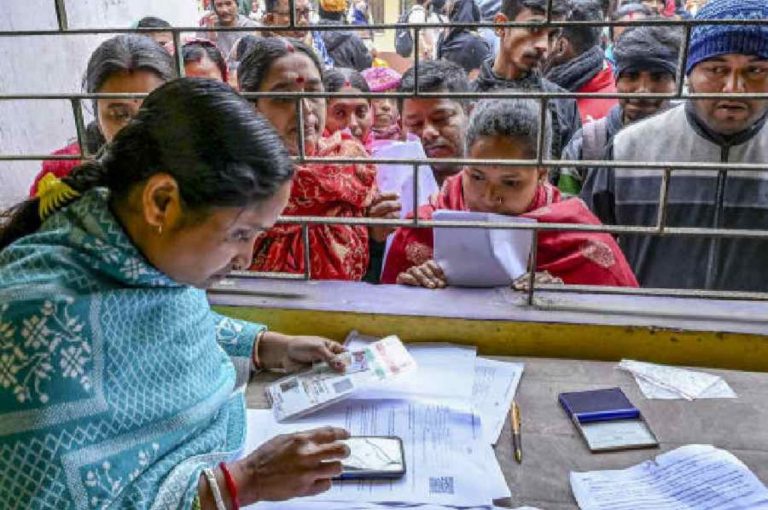
The Bengal SIR voter portal 2026 initiative marks a significant step in India’s electoral reforms. The Election Commission of India (ECI) announced plans to launch a digital portal that would allow citizens to clear “logical discrepancies” in voter lists before hearings. This comes amid heated debates in Bengal, where Chief Minister Mamata Banerjee has repeatedly criticised the Special Intensive Revision (SIR) exercise as a “farce” that risks disenfranchising genuine voters.


2. What Are “Logical Discrepancies”?

  • Discrepancies flagged by algorithms in the voter database.
  • Examples include:
    • Duplicate entries across constituencies.
    • Age mismatches (e.g., minors listed as voters).
    • Missing or inconsistent address details.
    • Death records not updated.
  • The portal aims to let voters self‑verify and correct errors before formal hearings.

3. Election Commission’s Plan

  • Launch of a dedicated online portal for Bengal voters.
  • Citizens can log in, check discrepancies, and upload supporting documents.
  • Portal designed to reduce backlog of cases during hearings.
  • Officials believe it will increase transparency and efficiency.
  • Training modules for Booth Level Officers (BLOs) and Electoral Registration Officers (EROs) to handle digital submissions.

4. Mamata Banerjee’s Concerns

  • Mamata has written multiple letters to the Chief Election Commissioner, calling the SIR “fundamentally flawed.”
  • Allegations include:
    • Defective IT systems prone to errors.
    • Inconsistent instructions issued to officials.
    • Backend deletions without officer knowledge.
    • Exclusion of Booth Level Agents (BLAs) from hearings.
  • She warned that the process could lead to large‑scale disenfranchisement.

5. Political Context

  • Bengal’s voter list has long been a political battleground.
  • BJP accuses TMC of shielding fictitious and illegal voters.
  • TMC accuses BJP of using the SIR to suppress minority and opposition votes.
  • The portal is seen as an attempt by the ECI to restore credibility amid these accusations.

6. Bengal SIR Voter Portal 2026: Governance Challenges

The initiative reflects broader challenges:

  • Balancing technology with inclusivity in voter management.
  • Trust deficit between ruling party and Election Commission.
  • Public confusion due to inconsistent communication.
  • Need for grievance redressal mechanisms to reassure citizens.

7. Government External Links for Assistance


8. Historical Context of Electoral Roll Disputes in Bengal

  • 2000s: Allegations of bogus voters became common in Kolkata and border districts.
  • 2011–2019: Electoral roll revisions often coincided with political clashes.
  • 2024–25: SIR flagged millions of discrepancies nationwide.
  • 2026: Current controversy reflects Bengal’s long history of contested voter lists.

9. Community Impact

  • Citizens fear wrongful deletions of genuine names.
  • Elderly and ill voters struggle to travel long distances for hearings.
  • Minority communities express concern about targeted exclusions.
  • Civil society groups demand transparent grievance mechanisms.

10. Global Comparisons

Similar voter roll controversies worldwide:

  • USA: Allegations of voter suppression through purges in Georgia and Florida.
  • UK: Concerns about disenfranchisement under new voter ID laws.
  • Nigeria: Disputes over duplicate registrations and ghost voters.

Bengal’s case mirrors these global struggles where electoral integrity collides with political suspicion.


11. Governance Lessons

The SIR portal initiative teaches:

  • Digital tools must be user‑friendly to ensure inclusivity.
  • Independent audits of IT systems can reassure citizens.
  • Community engagement ensures trust in reforms.
  • Judicial oversight provides safeguards against arbitrary deletions.

12. Future Outlook – Democracy in Bengal

India must move towards:

  • Digitised grievance redressal portals for voter roll issues.
  • Periodic audits of electoral rolls by independent agencies.
  • Public dashboards showing deletions and additions transparently.
  • Educational campaigns to help citizens verify their status.

13. Conclusion

The Bengal SIR voter portal 2026 is more than a technical fix—it is a test of democratic integrity. By allowing citizens to clear discrepancies before hearings, the Election Commission hopes to reduce tensions and restore trust. Yet, Mamata Banerjee’s warnings of disenfranchisement highlight the fragile balance between accuracy and inclusivity in voter list management. For Bengal, the lesson is clear: democracy must be safeguarded not only at the ballot box but also in the processes that determine who gets to vote.

Also read: Home | Channel 6 Network – Latest News, Breaking Updates: Politics, Business, Tech & More
Bengal ED Raids Political Controversy 2026 – Detailed Analysis of Mamata Banerjee’s Remarks, Opposition Reactions, and Governance Lessons for Democracy

The Bengal ED raids political controversy 2026 has become a flashpoint in India’s political discourse. Chief Minister Mamata Banerjee’s comments on Enforcement Directorate (ED) actions against I‑PAC, the political consultancy firm working with Trinamool Congress (TMC), triggered outrage from Opposition parties. While Mamata accused the Centre of political vendetta and misuse of agencies, the Opposition lashed out at her remarks, branding them “shameless” and accusing her of undermining democratic institutions.


2. The ED Rigmarole

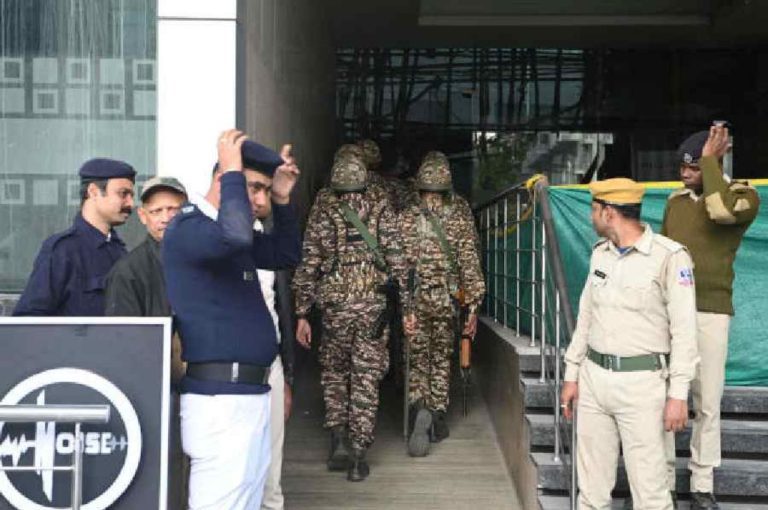
  • The ED conducted raids on I‑PAC offices in Kolkata, citing alleged irregularities.
  • I‑PAC, founded by strategist Prashant Kishor, has been associated with TMC since 2021.
  • The raids coincided with TMC’s preparations for Assembly elections, raising suspicions of timing.
  • Mamata Banerjee described the raids as “rigmarole” and accused Union Home Minister Amit Shah of orchestrating them.

3. Mamata Banerjee’s Remarks

  • Mamata accused the BJP of weaponising central agencies against political opponents.
  • She framed the raids as an attack on federalism and democracy.
  • Declared: “This is not democracy, this is dictatorship.”
  • Announced plans to lead protest marches in Kolkata, mobilising party cadres and civil society.

4. Opposition’s Reaction

  • Opposition leaders expressed shock at Mamata’s remarks.
  • They accused her of double standards, pointing to corruption cases involving TMC leaders.
  • Some branded her comments as “shameless”, arguing she was defending consultants instead of addressing governance issues.
  • The BJP claimed the ED was acting within its mandate and accused Mamata of politicising investigations.

5. Governance Challenges

The controversy reflects:

  • Use of central agencies in politically sensitive contexts.
  • Trust deficit between state and Centre.
  • Public perception of bias in enforcement actions.
  • Need for institutional safeguards to protect democratic processes.

6. Government External Links for Assistance


7. Historical Context of Agency Raids in Bengal

  • 2019–2021: CBI and ED raids on TMC leaders during Narada and Saradha scams.
  • 2021: I‑PAC staff detained briefly in Tripura, sparking protests.
  • 2024–25: Multiple raids on opposition leaders across states.
  • 2026: Current raids intensify debate on agency neutrality.

8. Community Impact

  • TMC cadres mobilised in Kolkata, chanting slogans against BJP.
  • Civil society groups debated the role of agencies in democracy.
  • Citizens expressed concern about erosion of federal balance.
  • Opposition parties in Bengal extended solidarity to TMC, framing it as a larger democratic struggle.

9. Global Comparisons

Similar controversies worldwide:

  • Turkey: Opposition parties accuse government of using agencies to suppress dissent.
  • USA: Debates over FBI investigations during election cycles.
  • Pakistan: NAB raids often criticised as politically motivated.

Bengal’s case mirrors these global struggles where state power and democratic freedoms collide.


10. Bengal ED Raids Political Controversy 2026: Governance Lessons

The ED raids controversy teaches:

  • Agency independence must be safeguarded.
  • Transparency in enforcement actions builds public trust.
  • Federal dialogue can reduce tensions between Centre and states.
  • Civil society vigilance is crucial to protect democratic rights.

11. Future Outlook – Democracy in Bengal

India must move towards:

  • Codified rules for agency raids during election periods.
  • Judicial oversight of politically sensitive investigations.
  • Public dashboards for transparency in enforcement actions.
  • Strengthening federal institutions to balance Centre‑state relations.

12. Conclusion

The Bengal ED raids political controversy 2026 is more than a dispute over financial records—it is a test of India’s democratic resilience. Mamata Banerjee’s remarks and the Opposition’s sharp criticism highlight the fragile balance between agency independence and political accountability. For India, the lesson is clear: democracy must be defended not only at the ballot box but also against the misuse of institutions.

Also read: Home | Channel 6 Network – Latest News, Breaking Updates: Politics, Business, Tech & More
Bengal IPAC Raids Democracy Controversy 2026 – Detailed Analysis of Mamata Banerjee’s Protest, Amit Shah’s Role, and Governance Lessons for Electoral Integrity

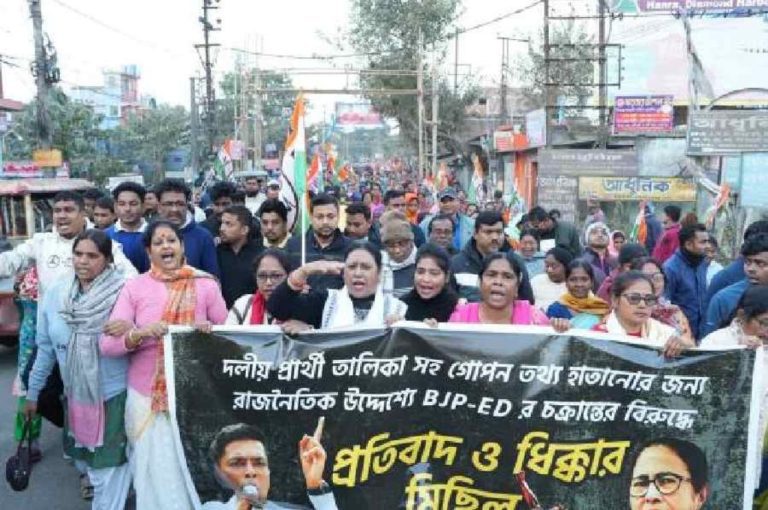
The Bengal IPAC raids democracy controversy 2026 has become a defining moment in India’s political discourse. On January 9, Chief Minister Mamata Banerjee accused Union Home Minister Amit Shah of orchestrating Enforcement Directorate (ED) raids on Indian Political Action Committee (I‑PAC) offices in Kolkata. Calling it a “murder of democracy”, Mamata announced she would lead a protest march from Jadavpur to Hazra in Calcutta, mobilising party workers and civil society against what she described as political vendetta and authoritarianism.


2. The Raids on I‑PAC

  • The ED conducted raids on I‑PAC offices in Kolkata, citing alleged irregularities in financial transactions.
  • I‑PAC, founded by strategist Prashant Kishor, has been working with TMC since 2021.
  • Officials reportedly seized documents and digital records.
  • The raids coincided with TMC’s preparations for Assembly elections, raising suspicions of timing and intent.

3. Mamata Banerjee’s Response

  • Mamata described the raids as “nasty politics” and directly blamed Amit Shah.
  • She accused the BJP of using central agencies to intimidate political opponents.
  • Declared: “This is not democracy, this is dictatorship. Bengal will resist.”
  • Announced a protest march in Kolkata, calling on citizens to join.
  • Framed the issue as a battle for democratic rights rather than just party politics.

4. Bengal IPAC Raids Democracy Controversy 2026: Political Context

  • I‑PAC has been instrumental in shaping TMC’s campaigns, including the “Bangla Nijer Meyekei Chaye” (Bengal wants its own daughter) slogan in 2021.
  • BJP has repeatedly accused I‑PAC of manipulating voter outreach and finances.
  • The raids come amid heightened tensions over electoral roll revisions (SIR) and welfare scheme debates.
  • Mamata’s framing of the raids as an attack on democracy resonates with her larger narrative of federalism vs centralisation.

5. Governance Challenges

The controversy reflects:

  • Use of central agencies in politically sensitive contexts.
  • Trust deficit between state and Centre.
  • Public perception of bias in enforcement actions.
  • Need for institutional safeguards to protect democratic processes.

6. Government External Links for Assistance


7. Historical Context of Agency Raids in Bengal

  • 2019–2021: CBI and ED raids on TMC leaders during Narada and Saradha scams.
  • 2021: I‑PAC staff detained briefly in Tripura, sparking protests.
  • 2024–25: Multiple raids on opposition leaders across states.
  • 2026: Current raids intensify debate on agency neutrality.

8. Community Impact

  • TMC cadres mobilised in Kolkata, chanting slogans against BJP.
  • Civil society groups debated the role of agencies in democracy.
  • Citizens expressed concern about erosion of federal balance.
  • Opposition parties in Bengal extended solidarity to TMC, framing it as a larger democratic struggle.

9. Global Comparisons

Similar controversies worldwide:

  • Turkey: Opposition parties accuse government of using agencies to suppress dissent.
  • USA: Debates over FBI investigations during election cycles.
  • Pakistan: NAB raids often criticised as politically motivated.

Bengal’s case mirrors these global struggles where state power and democratic freedoms collide.


10. Governance Lessons

The I‑PAC raids controversy teaches:

  • Agency independence must be safeguarded.
  • Transparency in enforcement actions builds public trust.
  • Federal dialogue can reduce tensions between Centre and states.
  • Civil society vigilance is crucial to protect democratic rights.

11. Future Outlook – Democracy in Bengal

India must move towards:

  • Codified rules for agency raids during election periods.
  • Judicial oversight of politically sensitive investigations.
  • Public dashboards for transparency in enforcement actions.
  • Strengthening federal institutions to balance Centre‑state relations.

12. Conclusion

The Bengal I‑PAC raids democracy controversy 2026 is more than a dispute over financial records—it is a test of India’s democratic resilience. Mamata Banerjee’s framing of the raids as a “murder of democracy” and her decision to lead a protest march highlight the stakes of electoral integrity in Bengal. For India, the lesson is clear: democracy must be defended not only at the ballot box but also against the misuse of institutions.

Also read: Home | Channel 6 Network – Latest News, Breaking Updates: Politics, Business, Tech & More
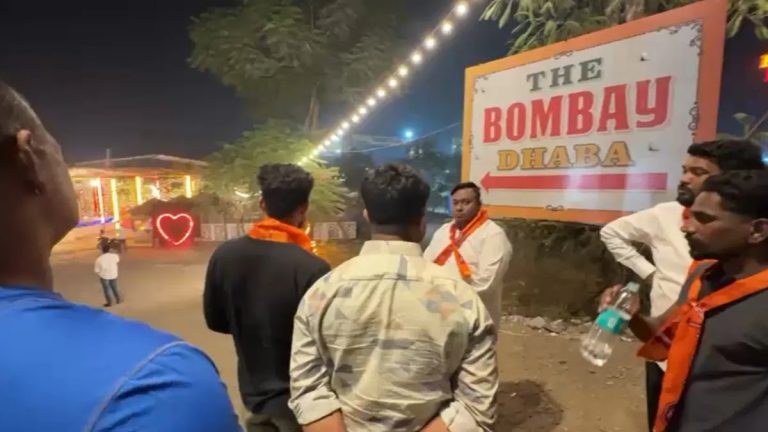
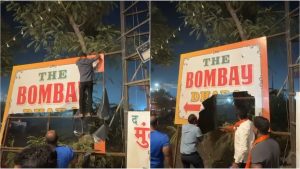
Raj Thackeray Sparks Intense ‘Bombay Dhaba’ Row in Bhiwandi: MNS Tears Down Signboard Over Mumbai Name Objection

A controversy over the naming of a roadside eatery erupted on Thursday when Maharashtra Navnirman Sena (MNS) activists tore down the signboard of a popular roadside restaurant called “Bombay Dhaba” in Bhiwandi, citing objections to the use of the old city name Bombay instead of Mumbai. The incident, which occurred on the Mumbai–Nashik Highway near the Thane–Bhiwandi border, was triggered after MNS chief Raj Thackeray noticed the sign while travelling and directed party workers to take action.

The dramatic move has sparked a sharp debate about regional identity, cultural pride and political mobilisation as municipal elections draw closer across Maharashtra. Party activists, defending their action, argue that continued use of Bombay undermines Marathi heritage and the official identity of the city and state.

MNS Takes Issue with ‘Bombay’ Signboard

According to eyewitness accounts and party workers at the scene, Raj Thackeray was returning from an election campaign tour when he noticed the “Bombay Dhaba” signboard. Annoyed by the use of the city’s colonial-era name, he allegedly instructed MNS workers to remove the sign. Within minutes, activists gathered at the location, tore down the illuminated board and instructed the restaurant owner to change the name to reflect Mumbai’s official identity within eight days.

The restaurant owner, who was present during the incident, reportedly agreed to the demand and assured party workers that he would comply with the request within the stipulated time.

MNS workers said that the action was not aimed at the establishment itself but was a symbolic assertion of Marathi pride and cultural respect. They argued that retaining Bombay in business names goes against the constitutional and civic identity recognised by the state and should be phased out.

Raj Thackeray sparks 'bombay dhaba' row: MNS tears down signboard

Political Context and Rising Sensitivities

The Bombay Dhaba row has emerged at a politically sensitive time. Across Maharashtra, local body polls and municipal elections are underway, and political parties are increasingly focusing on regional identity and cultural symbolism as part of their campaign narratives.

For Raj Thackeray and the MNS, emphasising Marathi identity has long been a core element of their political brand. The party has historically taken strong stances on language and culture, advocating that Marathi be given prominence in public signage, government communication, and popular usage. This episode, critics claim, reflects an intensification of that stance amid competition for voters who prioritise regional pride.

Opposition parties and political commentators, however, argue that such actions risk alienating business owners and citizens who may view the incident as an overreach or unnecessary provocation. These critics suggest that focusing on cultural symbolism may detract from pressing governance issues such as infrastructure, employment and urban services, which are key concerns for many residents.

Nevertheless, supporters of Raj Thackeray say that symbolic acts reinforce values that matter deeply to a large section of Maharashtra’s electorate. They argue that names, language and public signage are not trivial matters but are tied to a sense of belonging and respect for local heritage.

MNS Response and Public Statements

Following the incident, several MNS officials issued statements defending the action. They emphasised that the party is committed to preserving Maharashtra’s identity and ensuring that public spaces reflect the official names and heritage of the state. The activists reiterated that the restaurant owner was cooperative and promised to comply, showing that there was no intent to harm the business.

In statements to local media, MNS representatives said that such actions are part of a broader cultural movement to ensure that Marathi identity, language and history are respected in public life. They also said that the party will continue to campaign on issues of cultural pride ahead of the election season, urging citizens to support candidates who uphold Maharashtra’s traditions.

Local Reactions and Diverse Views

Reactions among local residents have been mixed. Some passersby and customers at nearby shops said they supported the move, emphasising the importance of respecting local identity and the official name Mumbai that replaced Bombay decades ago. They noted that many people, especially from outside Maharashtra, still refer to the city using the old name despite repeated shifts in official usage.

Others, however, expressed concern that the incident could set a precedent for unnecessary interference in small businesses. Some local business owners, while understanding the sentiment, said they worry such actions could discourage tourism or economic activity if not handled sensitively.

Political analysts also warn that while cultural assertion can energise a party’s base, it may also polarise voters who prioritise economic and civic issues. They suggest that balancing cultural concerns with practical governance challenges will be critical for parties seeking broader electoral support.

Historical and Cultural Background

The name Bombay has long been a subject of political and cultural debate. Originally given during the colonial era, Bombay was officially renamed Mumbai in 1995 by the state government to reflect local Marathi identity and heritage. The change was championed by pro-Marathi organisations and has since been widely adopted in official contexts.

However, many people still use Bombay informally, especially in popular culture and business branding. While some view this as a nostalgic reference, others see it as resistance to change or a reluctance to embrace Marathi identity fully.

The latest action by the MNS brings that debate back into the spotlight, raising questions about how language, history and identity intersect with politics in modern-day Maharashtra.

Impact on Upcoming Elections

With municipal elections and local body polls approaching, the Bombay Dhaba controversy is likely to become a talking point among voters. Parties may use the incident to reinforce broader narratives about cultural respect, administrative priorities and political leadership.

For Raj Thackeray and the MNS, the episode reinforces their longstanding focus on Marathi language and cultural identity — themes that have historically resonated with a segment of the electorate. Despite criticism from some quarters, MNS leaders are expected to continue emphasising these issues as part of their campaign strategy.

Meanwhile, other political parties might seek to counter by highlighting governance issues and development agendas, urging voters to focus on tangible civic problems rather than symbolic debates.

Read More: https://channel6network.com/bjp-maharashtra-repackaged-expired-product/

BJP in Maharashtra Is a ‘Repackaged Expired Product’, Says Sena Mouthpiece Ahead of Critical 2026 Polls

The political temperature in Maharashtra rose sharply after the Shiv Sena (UBT) mouthpiece launched a scathing attack on the Bharatiya Janata Party (BJP), describing it as a “repackaged expired product” that has lost both credibility and relevance in the state’s political landscape. The sharp editorial comes at a time when Maharashtra is heading toward important civic and local body elections, making political narratives and public perception increasingly crucial.

The editorial criticised the BJP’s leadership and functioning in Maharashtra, alleging that the party no longer enjoys genuine public support and is surviving through political manoeuvring rather than grassroots acceptance. Using a strong commercial metaphor, the piece claimed that while the BJP continues to rebrand itself through alliances and power equations, its political appeal among voters has already crossed its expiry date.

Questioning BJP’s Political Strength in the State

The Sena mouthpiece argued that the BJP lacks an independent political base in Maharashtra and has instead relied heavily on breaking rival parties, absorbing leaders, and reshaping alliances to remain in power. According to the editorial, such tactics may help retain administrative control but fail to build long-term trust among voters.

The piece further stated that the BJP’s repeated emphasis on power at the Centre has not translated into meaningful governance outcomes for Maharashtra. It accused the party of prioritising political dominance over addressing pressing state-level issues such as farmer distress, unemployment, rising prices, and urban infrastructure challenges.

Double-Engine Government’ Narrative Challenged

Taking aim at the BJP’s frequently used “double-engine government” slogan, the editorial described it as an outdated narrative that no longer resonates with the people of Maharashtra. It argued that despite being part of both state and central governments at different times, the BJP has failed to deliver tangible benefits that justify such claims.

According to the editorial, voters are increasingly questioning whether the promised development has reached the grassroots or remained limited to announcements and publicity campaigns. The piece suggested that public dissatisfaction is growing, particularly in urban centres and rural belts where economic pressures continue to mount.

Raj Thackeray said that the BJP is on "borrowed mandates".

Allegations of Power Politics and Pressure Tactics

The editorial also accused the BJP of relying on power tactics rather than democratic consensus. It alleged that investigative agencies and administrative pressure have been used to weaken opposition voices and destabilise rival parties in Maharashtra. Such methods, it claimed, damage democratic institutions and erode public faith in fair political competition.

The Sena mouthpiece warned that while these strategies may provide short-term political gains, they carry long-term consequences for democratic values. It stressed that Maharashtra’s political culture has historically been rooted in ideological debate, social reform, and mass movements rather than coercive politics.

Appeal to Maharashtra’s Political Identity

Linking the criticism to the broader idea of Maharashtra’s political and cultural identity, the editorial argued that the state has always valued self-respect, progressive thought, and regional pride. It claimed that voters are becoming increasingly aware of attempts to dilute this identity through opportunistic alliances and centralised decision-making.

The piece positioned regional parties as better equipped to understand and represent Maharashtra’s unique social and cultural fabric. It asserted that political leadership in the state should emerge from local struggles and public engagement rather than being imposed through power arithmetic.

Elections as a Turning Point

With civic and local body elections approaching, the editorial described the upcoming polls as a crucial test of public sentiment. It suggested that voters now have an opportunity to evaluate political claims against lived realities and decide whether they wish to endorse what it termed “expired politics wrapped in new packaging.”

The Sena mouthpiece called on citizens to vote thoughtfully, urging them to assess governance performance, accountability, and respect for democratic values rather than slogans or political branding. It argued that elections should serve as a corrective mechanism when political parties drift away from public welfare.

Read More: https://channel6network.com/maharashtra-dharma-unites-bmc-battle-2026/

Political Reactions Expected

The strong language used in the editorial is expected to provoke sharp reactions from the BJP, further intensifying political discourse in the state. Analysts anticipate that the coming weeks will witness heightened exchanges between rival parties as they attempt to frame narratives and consolidate voter bases.

As Maharashtra enters a politically sensitive phase, statements such as these reflect not only inter-party rivalry but also a broader debate about governance, democracy, and political ethics in the state.:

Read more:

https//channel6network.com/maharashtra-public-holiday-for-civic-polls/


Maharashtra Declares January 15 Public Holiday for Civic Polls; Stock Market, Banks Remain Uncertain

The Maharashtra government has officially declared January 15, 2026, a Maharashtra public holiday as voters across the state prepare to cast their ballots in crucial civic body elections, including the Brihanmumbai Municipal Corporation (BMC) polls. The decision, issued under the Negotiable Instruments Act, aims to remove barriers to voting and encourage broad participation in the democratic process.

In a coordinated announcement on Friday, authorities confirmed that the holiday will apply to government and semi-government offices, public undertakings, banks, educational institutions and several key sectors within the jurisdictions of 29 municipal corporations where polling is scheduled.

Civic elections in Maharashtra are on January 15, with votes to be counted on January 16, marking one of the state’s largest local body polls in recent years. Voting hours for Mumbai extend from 7:30 am to 5:30 pm, during which eligible citizens can visit polling stations across all wards within their respective jurisdictions.

Maharashtra has declared January 15, 2026, a public holiday for local body elections, though clarity on bank and market closures is awaited.

What the Holiday Means for Citizens and Workers?

The government’s notification emphasizes that the Maharashtra public holiday is intended to provide citizens with the time and opportunity to exercise their constitutional right to vote without conflict from work or institutional obligations. By declaring a holiday specifically for civic polls, officials hope to drive higher voter turnout, which has historically varied across regions in previous elections.

For many state employees, school and college students, and business workers in the affected areas, this day off ensures they can participate in the electoral process without sacrificing employment or attendance responsibilities. However, the holiday’s application outside municipal jurisdictions,  particularly in private offices and workplaces may vary, with some employers offering voluntary leave or adjusted schedules.

Banks and Financial Sector: Status Still Unclear

Despite the formal declaration of a Maharashtra public holiday, confusion remains around operations of major financial institutions on January 15. While the holiday mandates closure of government and certain public services in civic poll areas, official pronouncements from the Reserve Bank of India (RBI) regarding bank closures have not yet been issued.

Normally, under the Negotiable Instruments Act, certain regulated markets may shut down on days designated for public holidays within specific jurisdictions. But in the current case, banks and branches outside the directly affected corporate limits may not be subject to compulsory closure without RBI notification.

This has left customers and financial professionals uncertain about whether branches will remain open, particularly in urban centres such as Mumbai and Pune where civic polling areas overlap significantly with commercial activity zones.

Will the Stock Market Be Closed? What Investors Should Know

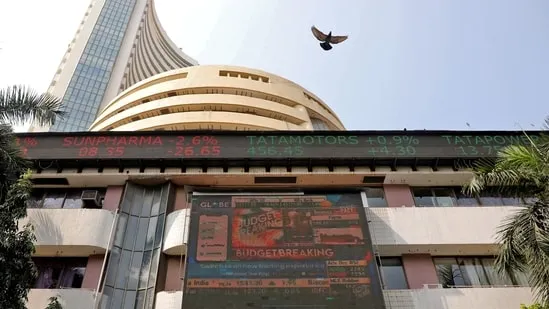
One of the most frequently asked questions following the holiday announcement has been: Will the Bombay Stock Exchange (BSE) and the National Stock Exchange (NSE) be closed on January 15?

As of now, both major Indian stock exchanges have not formally declared January 15 a trading holiday despite the government’s civic poll holiday order. Market authorities typically issue holiday calendars well in advance, and no such notification has been released regarding a market closure tied to the civic polls.

The date also coincides with the weekly expiry of certain derivative contracts, which adds complexity to traders’ expectations for market operations. Without official confirmation, investors and brokers are keeping a close watch on exchange communications, seeking clarity on whether normal trading sessions will proceed.

Will the Bombay Stock Exchange (BSE) and the National Stock Exchange (NSE) be closed on January 15?

Election Preparedness and Administrative Measures

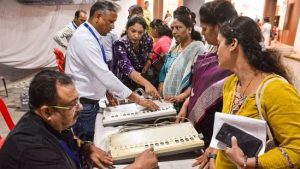
Alongside the holiday declaration, the State Election Commission has completed extensive logistical preparations for the civic polls. This includes ensuring readiness of Electronic Voting Machines (EVMs) and necessary training for polling staff across all participating municipal corporations.

State Election Commissioner Dinesh Waghmare issued directives emphasizing strict compliance with training schedules for election officials. He noted that officials who fail to complete mandatory preparatory work could face punitive measures under applicable election rules.

Authorities also drew attention to practical arrangements at polling stations, such as provision of drinking water, shade, sanitation facilities, and special considerations for elderly or differently-abled voters. These steps are aimed at streamlining the voting process and minimizing inconvenience on the major polling day.

Voter Mobilization and Public Participation

Officials have urged citizens to make full use of the Maharashtra public holiday by arriving at polling stations and fulfilling what they described as a civic duty critical to local governance and public accountability. Messaging from election authorities highlighted that local body governance plays a direct role in civic services, including sanitation, local roads, public health and community welfare making broad participation particularly relevant.

While voter enthusiasm has shown encouraging signs in many areas, election officials are also monitoring challenges such as identification verification and voter list accuracy in parts of the state. Public awareness campaigns and outreach via local bodies have been underway to ensure that voters are informed about when and where to cast their ballots on January 15.

What Happens Next

As the state counts down to January 15, residents, businesses, and institutions continue to prepare for the Maharashtra public holiday and civic poll day. With banks and financial markets yet to confirm operational status, citizens are advised to stay updated via official channels for any late announcements regarding closures or schedule adjustments.

In the meantime, election machinery across Maharashtra remains in full gear, aiming for a smooth and inclusive polling process that reflects the democratic spirit at the heart of local governance.

Read More: https://channel6network.com/maharashtra-dharma-unites-bmc-battle-2026/

January 9, 2026: Markets Trade Lower in Afternoon Session as Nifty 50 Slides Below 25,700; Banking and Financial Stocks Drag

Indian equity markets remained under pressure in afternoon trade on Friday, January 9, 2026, as sustained selling in banking, financial, and infrastructure stocks weighed on benchmark indices. While selective buying was seen in FMCG, energy, and IT stocks, broader market sentiment stayed weak amid continued risk aversion.

As of 1:47 PM IST, all major indices were trading in the red, reflecting a cautious and defensive market mood.

Also Read: January 9, 2026: Markets Trade Mixed in Mid-Morning Session as Nifty 50 Slips Below 25,850; Select Energy and IT Stocks Gain


Benchmark Indices Performance

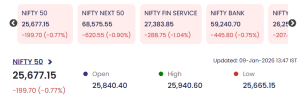
The Nifty 50 declined 199.70 points or 0.77% to trade at 25,677.15. The index opened at 25,840.40, touched an intraday high of 25,940.60, but remained under selling pressure for most of the session, slipping to a low of 25,665.15.

Other key indices also traded lower:

  • Nifty Next 50 fell 620.55 points (-0.90%) to 68,575.55, indicating weakness in broader markets.

  • January 9Nifty Financial Services dropped 288.75 points (-1.04%) to 27,383.85.
  • Nifty Bank declined 445.80 points (-0.75%) to 59,240.70, dragged down by losses in major private lenders and financial stocks.


Top Gainers: FMCG, Energy and IT Stocks Provide Limited Support

Despite overall market weakness, select stocks from FMCG, energy, and IT sectors managed to post gains, offering limited support to the indices.

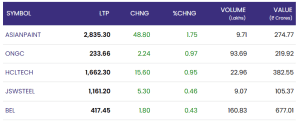
  • Asian Paints rose 1.75% to ₹2,835.30, emerging as the top gainer amid buying interest in consumption-oriented stocks.

  • ONGC gained 0.97% to ₹233.66, supported by strength in energy stocks.

  • HCL Technologies advanced 0.95% to ₹1,662.30, outperforming the broader IT sector.

  • Screenshot 2026 01 09 134839JSW Steel added 0.46% to ₹1,161.20, showing mild recovery in metal stocks.
  • Bharat Electronics Ltd (BEL) edged up 0.43% to ₹417.45, backed by strong trading volumes.


Top Losers: Banking, Infrastructure and Auto Stocks Under Pressure

Selling pressure was prominent in banking, infrastructure, and auto stocks, which featured among the top losers of the session.

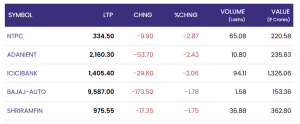
  • NTPC declined 2.87% to ₹334.50, leading losses among power stocks.

  • Adani Enterprises fell 2.43% to ₹2,160.30, reflecting weakness in infrastructure-related counters.

  • Screenshot 2026 01 09 134849ICICI Bank slipped 2.06% to ₹1,405.40, dragging the banking index lower.

  • Bajaj Auto dropped 1.78% to ₹9,587.00, weighing on the auto sector.

  • Shriram Finance declined 1.75% to ₹975.55, adding to pressure on financial stocks.


Market Outlook

Market participants remain cautious amid continued selling in financials and lack of broad-based buying support. Analysts expect near-term volatility to persist, with stock-specific cues, global developments, and sectoral trends likely to guide market direction in the remainder of the trading session.


Conclusion: January 9, 2026

Indian equity markets traded lower in afternoon trade on January 9, with the Nifty 50 slipping below the 25,700 mark. While selective gains in FMCG, energy, and IT stocks provided limited support, sustained weakness in banking and financial stocks continued to weigh on overall market sentiment.


For real time stock Updates, visit NSE website.

January 9, 2026: Markets Trade Mixed in Mid-Morning Session as Nifty 50 Slips Below 25,850; Select Energy and IT Stocks Gain

Indian equity markets traded on a mixed note during mid-morning trade on Friday, January 9, 2026, as selective buying in energy, defence, and IT stocks was offset by weakness in banking and heavyweights. Investor sentiment remained cautious amid continued sectoral rotation and lack of broad-based participation.

As of 10:53 AM IST, benchmark indices reflected subdued momentum, with frontline indices showing marginal losses.

Also Read: January 8, 2026: Markets End Sharply Lower as Nifty 50 Closes Below 25,920; Metals, IT and Energy Stocks Drag Benchmarks


Benchmark Indices Performance

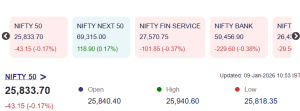
The Nifty 50 was trading at 25,833.70, down 43.15 points or 0.17%. The index opened at 25,840.40, moved higher to an intraday high of 25,940.60, but failed to sustain gains and slipped to a low of 25,818.35.

Other key indices showed a mixed trend:

  • Nifty Next 50 gained 118.90 points (0.17%) to 69,315.00, outperforming frontline indices.

  • January 9Nifty Financial Services declined 101.85 points (-0.37%) to 27,570.75.
  • Nifty Bank slipped 229.60 points (-0.38%) to 59,456.90, dragged down by losses in private banking stocks.


Top Gainers: Energy, Defence and IT Stocks Lead

Buying interest was visible in select energy, defence, and IT counters, which featured among the top gainers of the session.

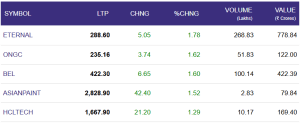
  • Eternal rose 1.78% to ₹288.60, supported by strong volumes of 268.83 lakh shares, making it one of the most actively traded stocks.

  • ONGC gained 1.62% to ₹235.16, reflecting strength in energy stocks.

  • Screenshot 2026 01 09 105505Bharat Electronics Ltd (BEL) advanced 1.60% to ₹422.30, backed by healthy turnover.
  • Asian Paints climbed 1.52% to ₹2,828.90, indicating buying interest in consumption-linked stocks.

  • HCL Technologies moved up 1.29% to ₹1,667.90, outperforming the broader IT sector.


Top Losers: Banking, Infrastructure and Auto Stocks Under Pressure

Selling pressure was seen in select banking, infrastructure, and auto stocks, which emerged as key drags on the benchmark indices.

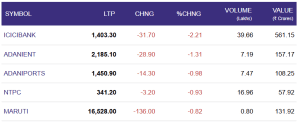
  • ICICI Bank declined 2.21% to ₹1,403.30, leading losses in the banking space.

  • Adani Enterprises slipped 1.31% to ₹2,185.10, reflecting weakness in infrastructure-related stocks.

  • Screenshot 2026 01 09 105514Adani Ports fell 0.98% to ₹1,450.90, despite steady volumes.
  • NTPC eased 0.93% to ₹341.20, tracking mild weakness in power stocks.

  • Maruti Suzuki declined 0.82% to ₹16,528.00, weighing on the auto sector.


Market Outlook

Market participants remain selective as sectoral rotation continues to dominate trading activity. Analysts expect near-term volatility to persist, with stock-specific cues, global developments, and sector-wise performance guiding market direction through the remainder of the session.


Conclusion: January 9, 2026

Indian equity markets traded mixed in mid-morning trade on January 9, with the Nifty 50 hovering below the 25,850 mark. While gains in energy, defence, and IT stocks offered limited support, weakness in banking and select heavyweights continued to cap upside momentum.


For real time stock Updates, visit NSE website.

Maharashtra Dharma Takes Centre Stage: Uddhav Thackeray Calls BMC Election a CRITICAL ‘Battle for State Identity’ in 2026

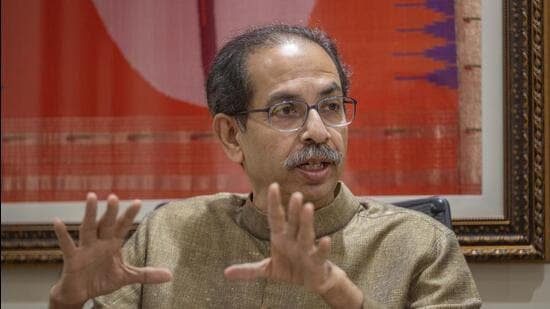
In a candid interview ahead of the upcoming Brihanmumbai Municipal Corporation (BMC) election, Shiv Sena (UBT) president Uddhav Thackeray asserted that the contest is not merely political but a defining struggle for Maharashtra Dharma — a term he used to describe the duty to safeguard the state’s cultural identity and Marathi pride.

“This battle is not about power or positions; it is about Maharashtra Dharma — about protecting the soul, culture and dignity of Maharashtra and the Marathi people,” Thackeray said during the interview.

Thackeray, emphasized that the January 15 municipal polls represent “a battle for survival… not just for us but for the Marathi people in Mumbai,” framing his party’s campaign in terms of preserving local heritage and community interests.


Alliance with Raj Thackeray on Maharashtra Dharma

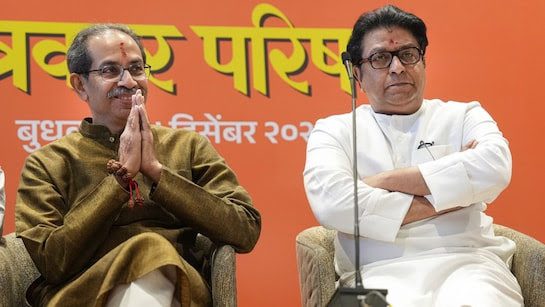
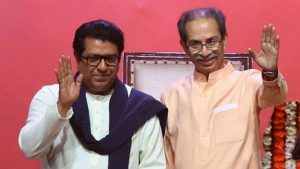
The Shiv Sena (UBT) leader highlighted his recent political collaboration with cousin Raj Thackeray, head of the Maharashtra Navnirman Sena, as rooted in shared cultural values rather than opportunistic politics. The two leaders have stressed that their alliance reflects a united stand for Maharashtra Dharma — protecting the state’s ethos after years of factional splits and political upheavals.

Both leaders have accused the ruling Mahayuti administration of undermining Marathi identity and neglecting local development, even warning that Mumbai’s cultural character is at risk if proactive measures aren’t taken.


Shiv Sena (UBT) chief Uddhav Thackeray and Maharashtra Navnirman Sena (MNS) founder Raj Thackeray formally united for the Brihanmumbai Municipal Corporation (BMC) elections, framing their alliance as a "Maharashtra Dharma"—a duty to protect the state's pride and the interests of the Marathi people.

Focus on Marathi Pride and Civic Issues

Thackeray’s campaign messaging revolves around prioritizing the interests of Marathi-speaking residents, development of local infrastructure, cleanliness, and asserting Mumbai’s unique identity amid rapid urban change. He also criticized other political parties for driving a wedge between cultural priorities and municipal governance.

Political Context Ahead of BMC Polls

The BMC election is seen as a litmus test for the Shiv Sena (UBT) after major splits in the party and shifting electoral dynamics over the past few years. Opposition parties contend that the Maharashtra Dharma narrative is a strategy to consolidate regional votes, while supporters of Thackeray argue it reflects genuine concern for the state’s heritage.

Read More: https://channel6network.com/ed-vs-tmc-drama-protest-at-amit-shahs-office/

Looking Ahead

With less than a week to go before voting, political debates in Mumbai are intensifying around cultural identity, urban governance, and the future of local leadership. As the campaign enters its final phase, Maharashtra Dharma remains a central talking point among voters and political strategists alike.

ED vs TMC Drama: Explosive Protest at Amit Shah’s Office

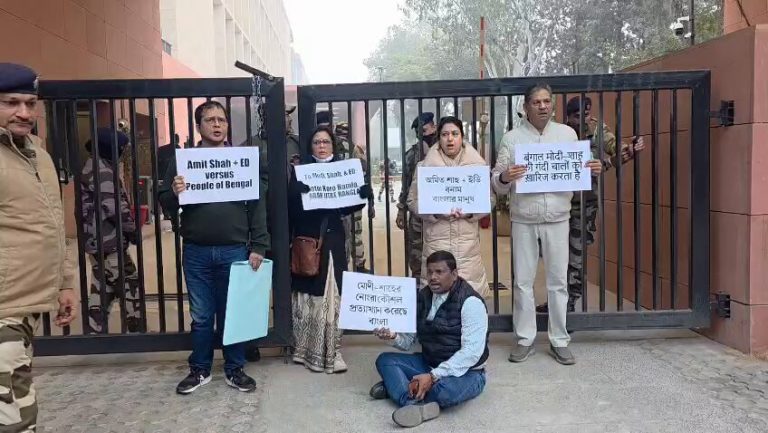
West Bengal – The ongoing ED vs TMC drama reached a new climax on Friday as the political confrontation escalated dramatically to Union home minister Amit Shah’s doorstep in Delhi. Eight Trinamool Congress MPs staged a dharna outside Shah’s office on Friday morning, protesting the Enforcement Directorate raids conducted at the Indian Political Action Committee (I-PAC) office in Kolkata a day earlier. This ED vs TMC drama marks a significant escalation in the confrontation between the West Bengal ruling party and central agencies, coming just a day after party supremo and Chief Minister Mamata Banerjee’s dramatic visit to the residence of I-PAC head during the raids.

MPs Lead Protest in ED vs TMC Drama

Those leading the protest in the latest chapter of the ED vs TMC drama included prominent party members Mahua Moitra, Derek O’Brien, Satabdi Roy, Bapi Haldar, Saket Gokhale, Pratima Mondal, Kirti Azad and Dr Sharmila Sarkar. Holding placards and raising slogans outside Shah’s office, the MPs accused the Centre of misusing central agencies to target opposition parties ahead of elections. Visuals from the protest site showed MPs holding placards that read, “Bengal rejects Modi-Shah’s dirty politics,” as they sought to highlight what the party characterizes as political vendetta against the ruling Trinamool Congress in West Bengal.

I-PAC Raids Trigger ED vs TMC Drama

The ED vs TMC drama was triggered by Enforcement Directorate raids at I-PAC chief Pratik Jain’s residence and the group’s office in Kolkata on Thursday. I-PAC, which does political consultancy for TMC and also looks after its IT and media cell, became the focal point of this confrontation. The ED stated the raids were linked to people who generated proceeds of coal smuggling, while the TMC has vehemently contested this characterization, viewing the action as politically motivated rather than legitimate law enforcement activity targeting financial irregularities.

Mamata’s Dramatic Intervention in ED vs TMC Drama

The ED vs TMC drama intensified when West Bengal Chief Minister Mamata Banerjee “rushed” to the search locations, alleging that the central agency was “looting” sensitive TMC documents. Dramatic visuals of a charged Mamata Banerjee dodging media persons and holding documents she claimed she took back flooded social media, creating a spectacle that captured national attention. The chief minister’s physical intervention at the raid site represented an unprecedented move in the ED vs TMC drama, with Banerjee personally confronting the investigating officers during their operation.

Conflicting Narratives in ED vs TMC Drama

The ED vs TMC drama has produced sharply conflicting narratives from both sides. While Mamata Banerjee alleged the agency was attempting to steal party documents, electoral strategies, and voter data, the ED later stated that the search proceedings were peaceful until the chief minister arrived with a large number of police personnel. This clash of accounts has become central to the ED vs TMC drama, with each side presenting fundamentally different versions of what transpired during the Thursday raids at I-PAC premises.

Also Read: Mamata Banerjee Protest Rally: Dramatic ED Showdown Over I-PAC Raid

Political Vendetta Allegations in ED vs TMC Drama

In her attack on the BJP-led central government, under which the ED functions, Mamata Banerjee described the search as an act of “political vendetta” in the ongoing ED vs TMC drama. The chief minister termed Union home minister Amit Shah as “naughty,” directly accusing him of misusing constitutional agencies to intimidate opposition parties. “This is not law enforcement. Is this how the nastiest and naughty home minister functions, who cannot protect the country and is sending agencies to harass before elections?” she said after visiting the residence of Pratik Jain, bringing personal criticism into the ED vs TMC drama.

Electoral Context of ED vs TMC Drama

The timing of the ED vs TMC drama is particularly significant as West Bengal assembly elections are expected in the coming months. The Trinamool Congress has consistently maintained that central agency actions against opposition parties intensify ahead of polls, citing this pattern as evidence of political motivation rather than legitimate investigation. The ED vs TMC drama, playing out just months before crucial state elections, has become a central issue in Bengal’s political discourse, with the TMC using it to rally support and portray itself as a victim of central government overreach.

Documents at Center of ED vs TMC Drama

A crucial element in the ED vs TMC drama involves the documents that Mamata Banerjee claimed to have retrieved from the raid site. The chief minister stated these documents contained information about TMC’s assembly poll candidates, party strategies, and voter databases—materials she described as essential party property that the ED was attempting to confiscate. Visuals showed Banerjee holding documents in a green file cover while addressing the media, making the physical possession of these papers a symbolic flashpoint in the ED vs TMC drama.

Agency Justification in ED vs TMC Drama

The Enforcement Directorate’s position in the ED vs TMC drama centers on its claim that the raids were linked to investigations into proceeds from coal smuggling. However, the TMC has questioned why a money laundering investigation would target a political consultancy firm’s office and require confiscation of electoral documents and strategies. This disconnect between the stated purpose of the investigation and the materials allegedly targeted has become a key point of contention in the ED vs TMC drama.

Future Implications of ED vs TMC Drama

As the ED vs TMC drama continues to unfold, the confrontation raises significant questions about the relationship between central investigative agencies and state governments led by opposition parties. The protest at Amit Shah’s office represents an attempt by the TMC to take the battle to the central government’s doorstep, transforming the ED vs TMC drama from a state-level issue into a national political controversy. With assembly elections approaching, this confrontation is likely to remain a defining feature of Bengal’s political landscape in the coming months.