Friday, May 1, 2026
Home Blog Page 174

Baloch Leader Jaishankar Letter: Urgent Warning on China-Pakistan Alliance

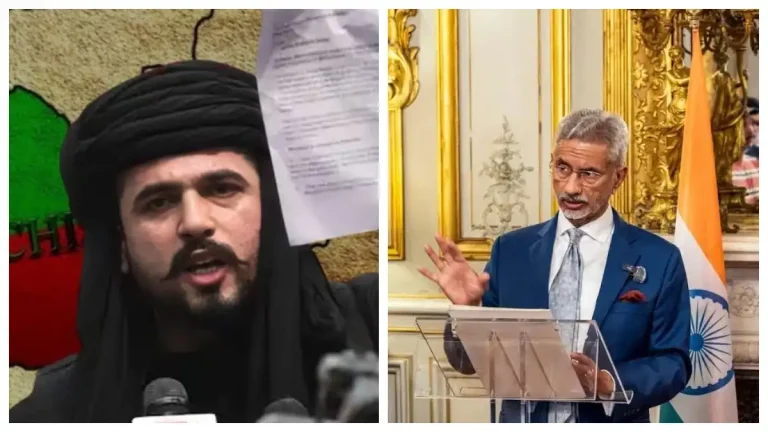
New Delhi – Mir Yar Baloch, a prominent Baloch leader and human rights activist, has addressed an open letter to External Affairs Minister S Jaishankar, raising serious concerns about the deepening Beijing-Islamabad alliance. The Baloch leader Jaishankar letter warns that China could deploy military troops in Pakistan’s Balochistan region within the next few months, posing significant regional security challenges.

The Baloch leader Jaishankar letter comes at a critical juncture as Baloch nationalist leaders declared independence from Pakistan in May 2025. Mir Baloch has announced that the Republic of Balochistan will celebrate the “2026 Balochistan Global Diplomatic Week” in the first week of 2026, enabling the region to engage directly with countries worldwide.

Decades of Repression Under Pakistani Control

In his communication, the Baloch leader Jaishankar letter notes that Balochistan has faced decades of repression under Pakistan’s control, including what he described as state-sponsored violence and egregious human rights abuses. The activist emphasized that the people of Balochistan have endured Pakistan’s state occupation and state-sponsored terrorism for the past seventy-nine years.

“The people of Balochistan have endured Pakistan’s state occupation, state-sponsored terrorism, and egregious human rights atrocities for the past seventy-nine years. The time has now arrived to eradicate this festering affliction at its roots, ensuring lasting peace and sovereignty for our nation,” the Baloch leader Jaishankar letter stated.

Praise for Operation Sindoor

The Baloch leader Jaishankar letter included commendation for what Mir Baloch described as the bold and resolute actions taken by the Indian Government under Prime Minister Narendra Modi’s leadership in 2025 through Operation Sindoor. The operation dismantled Pakistan-backed terrorism hubs following the April 22 Pahalgam terror attack last year.

Mir Baloch described these measures in the Baloch leader Jaishankar letter as a demonstration of India’s exemplary courage and steadfast commitment to regional security and justice. This acknowledgment reflects the strategic alignment between Baloch independence aspirations and India’s counter-terrorism efforts.

New Year Greetings and Historical Ties

The Baloch leader Jaishankar letter extended New Year congratulations on behalf of the six crore patriotic citizens of the Republic of Balochistan to the one hundred and forty crore people of India, both Houses of Parliament, the media, civil society, and all esteemed individuals.

“This auspicious occasion provides an opportunity to reflect upon and celebrate the profound historical, cultural, commercial, economic, diplomatic, defence, and multifaceted ties that have bound Bharat and Balochistan for centuries,” the Baloch leader Jaishankar letter noted. These enduring relations are exemplified by sacred sites such as the Hinglaj Mata Temple (Nani Mandir), which stands as a timeless symbol of shared heritage and spiritual connections.

Unwavering Support for India

The Baloch leader Jaishankar letter reaffirmed unwavering support for India and its government in fostering friendship, trust, and mutual interests encompassing peace, prosperity, development, trade, defence, security, future energy challenges, and the mitigation of concealed threats.

This declaration in the Baloch leader Jaishankar letter signals the Baloch leadership’s strategic orientation toward India as they pursue independence from Pakistan. The statement emphasizes shared interests in regional stability and security cooperation.

Warning About China-Pakistan Economic Corridor

A critical component of the Baloch leader Jaishankar letter addresses concerns about the China-Pakistan Economic Corridor (CPEC). Baloch asserted that the people of Balochistan view the escalating strategic alliance between Pakistan and China as profoundly dangerous, warning that Beijing, in collaboration with Islamabad, has advanced CPEC to its final phases.

“Should the capabilities of Balochistan’s defence and freedom forces not be further bolstered, and if they continue to be overlooked as per longstanding patterns, it is conceivable that China could deploy its military forces in Balochistan within a few months,” the Baloch leader Jaishankar letter warned.

Threat of Chinese Military Deployment

The Baloch leader Jaishankar letter emphasized that the presence of Chinese boots on Balochistani soil without the will of the 60 million Baloch people would pose an unimaginable threat and challenge to the futures of both India and Balochistan. This stark warning highlights the geostrategic implications of potential Chinese military presence in the region.

Mir Yar Baloch claimed in the Baloch leader Jaishankar letter that unless Baloch resistance and defence forces are strengthened and taken seriously, the region could soon witness a direct Chinese military presence. Any Chinese troop deployment in Balochistan without the consent of the local population would have wider regional consequences.

Call for Strengthening Baloch Forces

The Baloch leader Jaishankar letter urged that Balochistan’s defence and freedom forces must be bolstered to prevent Chinese military deployment. The activist emphasized that continuing to overlook these forces according to longstanding patterns would be strategically dangerous for regional security.

This appeal in the Baloch leader Jaishankar letter represents a direct request for international support, particularly from India, to strengthen Baloch resistance capabilities against both Pakistani occupation and potential Chinese military presence.

Official Responses and Context

China and Pakistan have repeatedly denied allegations of military expansion under CPEC, maintaining that the project is economic in nature. However, India has consistently opposed CPEC, stating that it passes through Pakistan-occupied Jammu and Kashmir and raises sovereignty and security concerns.

The Baloch leader Jaishankar letter adds another dimension to these existing tensions by highlighting local Baloch opposition to CPEC and concerns about Chinese militarization of the region.

Regional Security Implications

The Baloch leader Jaishankar letter underscores the complex geopolitical dynamics in South Asia, where multiple factors—including terrorism, separatist movements, Chinese expansionism, and historical territorial disputes—intersect. The communication reflects how non-state actors and independence movements view and respond to major power competition in the region.

As Balochistan seeks international recognition and support for its independence claims, the Baloch leader Jaishankar letter represents an attempt to align with India’s strategic interests while warning of shared threats from the Pakistan-China alliance.
Jaishankar Pakistan Bad Neighbour: Strong Warning on Terrorism and Defense Rights

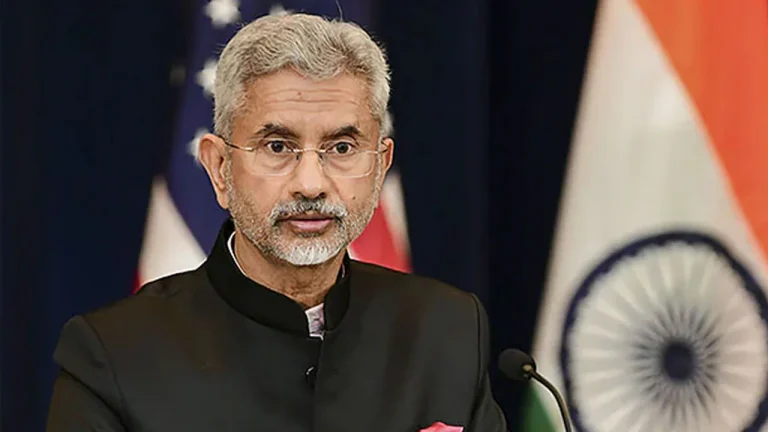
Chennai – External Affairs Minister S Jaishankar on Thursday called Pakistan a “bad neighbour” and asserted that India has the unequivocal right to defend its people against terrorism. The Jaishankar Pakistan bad neighbour statement came during his address to students at the Indian Institute of Technology, Madras, where he spoke candidly about India’s approach to cross-border terrorism and national security.

The minister emphasized that “nobody can tell us what we should or should not do” in an apparent reference to Operation Sindoor, India’s military response to terrorist attacks perpetrated from Pakistani territory. The Jaishankar Pakistan bad neighbour remarks reflect India’s firm stance on protecting its citizens and territory from persistent terrorist threats.

India’s Right to Defend Against Terrorism

Speaking at IIT Madras, Jaishankar articulated India’s position on dealing with terrorism sponsored by neighboring countries. The Jaishankar Pakistan bad neighbour statement included a clear declaration that when a country deliberately, persistently, and unrepentantly continues with terrorism, India has the right to defend its people against such threats.

“You can also have bad neighbours. Unfortunately, we do. When you have bad neighbours, if you look to the one to the west, if a country decides that it will deliberately, persistently, and unrepentantly continue with terrorism, we have a right to defend our people against terrorism. We will exercise that right,” Jaishankar stated emphatically.

The minister further asserted that how India exercises this right is entirely up to the country itself. The Jaishankar Pakistan bad neighbour remarks made clear that India will do whatever necessary to defend itself, without seeking approval or permission from any external entity.

Reference to Operation Sindoor

The Jaishankar Pakistan bad neighbour statement appeared to reference Operation Sindoor, which India conducted last year in response to the devastating Pahalgam terror attack in Jammu and Kashmir. The operation targeted terror infrastructure in Pakistan and Pakistan-occupied Kashmir following the April attack that was perpetrated by The Resistance Front, a proxy of Pakistan-based terror group Lashkar-e-Taiba (LeT).

India exercised its right to defend its people against terrorism through Operation Sindoor, demonstrating the practical application of the policy articulated in the Jaishankar Pakistan bad neighbour statement. The operation represented a significant military response to cross-border terrorism that has plagued India for decades.

Indus Waters Treaty Suspension

The Jaishankar Pakistan bad neighbour remarks also addressed the suspension of the Indus Waters Treaty (IWT) of 1960 with Pakistan, which occurred after the deadly Pahalgam attack. Jaishankar explained that decades of terrorism are incompatible with good neighbourliness, and countries cannot expect to receive benefits of good neighbourly relations while simultaneously sponsoring terrorism.

“Many years ago, we agreed to a water-sharing arrangement, but if you had decades of terrorism, there is no good neighbourliness. If there is no good neighbourliness, you don’t get the benefits of that good neighbourliness. You can’t say, ‘Please share water with me, but I will continue terrorism with you.’ That’s not reconcilable,” he stated.

This aspect of the Jaishankar Pakistan bad neighbour statement demonstrates how India is willing to use all available diplomatic and strategic levers to respond to persistent terrorism.

Also Read: PM Modi Buddha Relics Exhibition: Sacred Piprahwa Artifacts Unveiled in Delhi

Contrast with Other Neighbours

Jaishankar provided context for the Jaishankar Pakistan bad neighbour statement by contrasting Pakistan with India’s other neighbours. He noted that India is blessed with “a lot of neighbours of various kinds” and explained that when a neighbour is good or at least not harmful, India’s natural instinct is to be kind and helpful.

“If you have a neighbour who is good to you or at least who is not harmful to you, your natural instinct is to be kind, to help that neighbour, and that’s what we do as a country,” he said. This contextualization makes the Jaishankar Pakistan bad neighbour statement more impactful by showing that India’s approach varies based on how it is treated.

Previous Statements on Pakistan Army

The Jaishankar Pakistan bad neighbour statement follows earlier remarks where the minister said that “much of India’s problems” emanate from the Pakistani army. Last month, he made an observation about good and bad military leaders, which was interpreted as a reference to Pakistan Army Chief Field Marshal Asim Munir.

These consistent statements demonstrate that the Jaishankar Pakistan bad neighbour position represents a sustained and coherent policy approach rather than isolated rhetoric.

The Pahalgam Attack and Its Aftermath

Tensions between India and Pakistan escalated significantly following the Pahalgam attack on April 22, which resulted in 26 civilian deaths. After establishing cross-border links to the attack, India launched Operation Sindoor on May 7, striking multiple terror camps in Pakistan and PoK and reportedly killing over 100 terrorists.

The Jaishankar Pakistan bad neighbour statement reflects the continuing impact of this incident on bilateral relations. Pakistan responded with a massive missile and drone attack, which India intercepted. In retaliation, Indian armed forces struck airfields in Pakistan before a ceasefire was announced on May 10.

Policy Implications and National Sovereignty

The Jaishankar Pakistan bad neighbour statement carries significant policy implications for India’s approach to national security and regional relations. By asserting that India will determine its own response to terrorism without external direction, the minister reinforced India’s sovereign right to protect its citizens.

The statement also signals to the international community that India expects support—or at minimum, non-interference—in its efforts to combat cross-border terrorism. The Jaishankar Pakistan bad neighbour position emphasizes that countries cannot simultaneously sponsor terrorism and expect normal bilateral relations.

Strategic Message to Students

Delivering the Jaishankar Pakistan bad neighbour statement at IIT Madras allowed the minister to communicate India’s strategic thinking to the next generation of leaders, scientists, and policymakers. The frank discussion about national security challenges and India’s response options helps prepare young Indians to understand complex geopolitical realities.

The Jaishankar Pakistan bad neighbour remarks demonstrate how India articulates its security concerns while maintaining diplomatic language that emphasizes defensive rather than aggressive intentions, positioning the country as responding to threats rather than initiating conflict.

Private EVs Delhi Cabs: CM Gupta Announces Game-Changing Taxi Policy

0

New Delhi – The Delhi government announced on Friday a transformative policy change that will allow privately owned electric and BS-VI compliant vehicles to operate as taxis in the Capital. The decision regarding private EVs Delhi cabs represents a significant shift in the city’s transportation landscape, aimed at reducing congestion and pollution while expanding mobility options for residents.

Chief Minister Rekha Gupta chaired a high-level meeting with major automobile manufacturers and cab aggregators, including Ola, Uber, and Rapido, to discuss accelerating electric vehicle adoption and expanding shared mobility. The regulatory changes for private EVs Delhi cabs are expected to be implemented in the coming days following commitments from ride-hailing companies.

Regulatory Amendments for Private Vehicle Integration

According to a government statement, ride-hailing companies expressed readiness to onboard private EVs and BS-VI cars as taxis. However, they noted that allowing private EVs Delhi cabs would require changes to existing transport regulations. CM Gupta assured representatives that the government would amend necessary rules promptly while stressing that passenger safety measures must be strictly enforced.

The regulatory framework will need to address various aspects including licensing requirements, insurance coverage, vehicle inspection standards, and driver verification processes. These amendments will create the legal pathway for private EVs Delhi cabs to operate within established ride-hailing platforms.

Shared Taxis and Women-Driven Services

In addition to allowing private EVs Delhi cabs, ride-hailing companies agreed to launch two significant initiatives within one month. The companies committed to operating shared taxi services and introducing taxis driven by women drivers, addressing both environmental concerns and gender inclusivity in the transportation sector.

The introduction of shared taxi services aligns with the government’s strategy to reduce the number of vehicles on Delhi’s roads. By encouraging carpooling and shared rides through private EVs Delhi cabs, authorities hope to decrease traffic congestion while making transportation more affordable for commuters.

Chief Minister’s Vision for Sustainable Transport

CM Gupta emphasized that sustainable pollution control in Delhi would not be possible without reducing traffic volume and shifting commuters toward shared and electric transport. This statement underscores the strategic importance of allowing private EVs Delhi cabs as part of a broader environmental and transportation policy.

The meeting, which included Transport Minister Pankaj Kumar Singh and senior officials, focused on comprehensive solutions to Delhi’s chronic air quality and traffic problems. The integration of private EVs Delhi cabs into the ride-hailing ecosystem represents a key pillar of this multi-faceted approach.

Also Read: PM Modi Buddha Relics Exhibition: Sacred Piprahwa Artifacts Unveiled in Delhi

Integration of E-Rickshaws and Shuttle Services

Beyond private EVs Delhi cabs, CM Gupta suggested integrating e-rickshaws into aggregator platforms, further expanding the range of electric mobility options available to Delhi residents. The government is also exploring pilot projects for shuttle services along the Ring Road and to the airport, creating dedicated shared mobility corridors.

These additional initiatives complement the policy on private EVs Delhi cabs by creating a comprehensive ecosystem of electric and shared transportation options throughout the capital.

Automaker Demands and Government Response

Automakers present at the meeting, including Tata Motors, Mahindra, and Maruti Suzuki, highlighted the need for a robust public charging network and consumer-friendly policies to make a meaningful impact on air quality. The success of private EVs Delhi cabs will depend significantly on the availability of convenient charging infrastructure.

In response, CM Gupta offered government land for establishing charging stations, demonstrating commitment to supporting the private EVs Delhi cabs initiative. However, she urged companies to explore solar power for charging operations, ensuring that the electricity used for EVs comes from renewable sources rather than coal-fired power plants.

Expert Analysis and Safeguards

Experts welcomed the move to allow private EVs Delhi cabs while cautioning that clear safeguards are essential for successful implementation. Amit Bhatt of the International Council on Clean Transportation noted that several countries already allow private vehicles on aggregator platforms with positive results.

Bhatt explained that since aggregator vehicles travel far more than personal vehicles, the emissions benefits from private EVs Delhi cabs can be significant. However, he emphasized this must be done carefully, with clear rules on safety, insurance, liability, and platform accountability to protect passengers and regulatory integrity.

Rapido’s Carpooling Solution

A Rapido spokesperson revealed that the company proposed its peer-to-peer carpooling service, ‘Hopr’, as a scalable solution for reducing congestion and emissions in Delhi. This service would complement the private EVs Delhi cabs policy by enabling private vehicle owners to share rides with other commuters traveling similar routes.

The carpooling model represents an efficient use of existing vehicle capacity, potentially reducing the total number of vehicles on the road even as private EVs Delhi cabs expand mobility options.

Environmental and Economic Benefits

The policy allowing private EVs Delhi cabs serves multiple objectives simultaneously. Environmentally, it promotes zero-emission transportation while reducing overall vehicle numbers through shared mobility. Economically, it creates income opportunities for private vehicle owners while making transportation more affordable through competition and ride-sharing.

The shift toward private EVs Delhi cabs also reduces dependence on fossil fuels, contributing to energy security and reducing the city’s carbon footprint. As Delhi continues battling severe air pollution, particularly during winter months, expanding electric vehicle adoption through this policy represents a crucial intervention.

Implementation Timeline

With ride-hailing companies committing to launch shared taxi services and women-driven cabs within one month, and the government promising to amend regulations in the coming days, the policy on private EVs Delhi cabs appears poised for rapid implementation. This swift action reflects the urgency authorities feel about addressing Delhi’s transportation and environmental challenges.

The success of this initiative will likely depend on effective coordination between government agencies, ride-hailing platforms, automakers, and infrastructure providers to create a seamless ecosystem supporting electric and shared mobility throughout the capital.

Delhi Air Quality Improves: Stage-III GRAP Curbs Lifted Across NCR

0

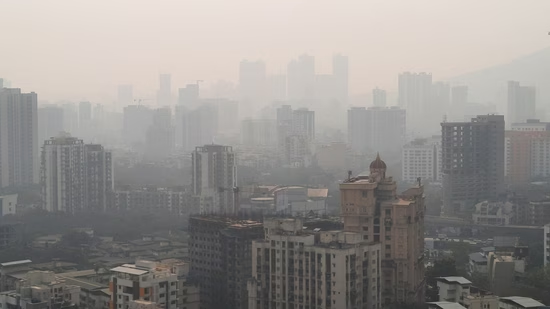
New Delhi – The Commission for Air Quality Management (CAQM) on Friday revoked Stage-III measures of the Graded Response Action Plan (GRAP) across the National Capital Region following marked improvement in pollution levels. The decision came after Delhi air quality improves substantially, with the Air Quality Index showing a significant downward trend that prompted authorities to ease stringent restrictions.

According to an official press update, Delhi’s Air Quality Index (AQI), which stood at 380 a day earlier, dropped sharply to 236 by 4 pm on January 2, indicating a consistent improvement pattern. This dramatic reduction in pollution levels demonstrates that measures implemented to combat air pollution have yielded positive results as Delhi air quality improves beyond critical thresholds.

CAQM Decision on Stage-III Restrictions

Taking note of the improvement, the CAQM sub-committee on GRAP decided to withdraw all restrictions mandated under Stage-III with immediate effect across the NCR. The lifting of these curbs provides relief to residents and businesses that had been operating under stringent pollution control measures designed for severe air quality conditions.

However, the decision to ease restrictions does not represent a complete rollback of air quality measures. As Delhi air quality improves, authorities remain vigilant about maintaining these gains and preventing any reversal of the positive trend observed in recent days.

Continued Enforcement of Stage-I and Stage-II Measures

The official update clarified that preventive and regulatory actions prescribed under GRAP Stages I and II will continue to remain in force across the National Capital Region. This measured approach ensures that even as Delhi air quality improves, basic pollution control protocols remain active to prevent deterioration.

Authorities have emphasized that winter weather continues to pose challenges for air quality management in the region. The meteorological conditions during winter months typically trap pollutants closer to the ground, making sustained vigilance essential even when Delhi air quality improves temporarily.

Citizen Compliance and Guidelines

Residents have been urged to follow the citizen guidelines prescribed under GRAP Stages I and II. Public cooperation remains crucial for maintaining the air quality improvements achieved through government interventions and favorable weather conditions. Individual actions, when multiplied across millions of residents, significantly impact whether Delhi air quality improves or deteriorates.

These guidelines typically include recommendations such as using public transportation, avoiding activities that generate dust, refraining from burning waste, and reducing unnecessary vehicular trips. Continued adherence to these practices will be essential as authorities work to consolidate the gains made in recent days.

Environmental Minister’s Response

Reacting to the Commission for Air Quality Management’s decision to withdraw Stage-III curbs, Delhi Environment Minister Manjinder Singh Sirsa praised Chief Minister Rekha Gupta’s leadership. He attributed the fact that Delhi air quality improves to sustained action taken on the ground across multiple pollution sources.

Also Read: Signature Bridge Maintenance: PWD Takes Bold Control With Rs.1.5 Crore Security Plan

Sirsa explained that authorities have intensified action on every major source of pollution, including vehicular emissions, industrial waste, dust, and open dumping. The government has also deployed new technology to strengthen the fight against air pollution, contributing to the measurable improvements in air quality metrics.

Government’s Commitment to Sustained Action

The Environment Minister emphasized that the improvement in air quality should not lead to complacency. “This is not the time to relax. This is the time to double our efforts and consolidate the gains we’ve made,” Sirsa stated, highlighting the government’s commitment to maintaining momentum even as Delhi air quality improves.

He further noted that each small victory in the battle against air pollution fuels motivation to make Delhi’s air cleaner every single day. This statement reflects an understanding that air quality management requires sustained, long-term commitment rather than temporary emergency measures.

Understanding the AQI Improvement

The dramatic improvement from an AQI of 380 to 236 represents a shift from “very poor” to “poor” air quality category. While 236 still indicates unhealthy air conditions, particularly for sensitive groups, the improvement demonstrates that interventions are working effectively. As Delhi air quality improves, the goal remains to push the AQI into “moderate” or “satisfactory” ranges.

An AQI of 380 falls in the “very poor” category where respiratory effects are common even among healthy individuals. The reduction to 236, while still concerning, significantly reduces health risks for the general population and shows that Delhi air quality improves when appropriate measures are implemented.

Multi-Source Pollution Control Strategy

The government’s comprehensive approach targets multiple pollution sources simultaneously. Vehicular emissions, one of the largest contributors to Delhi’s air pollution, have been addressed through restrictions on older vehicles and promotion of public transportation. Industrial waste control has been intensified with stricter monitoring and enforcement.

Dust control measures, including mechanized sweeping of roads and covering of construction sites, have been implemented more rigorously. Open dumping and burning of waste, common practices that significantly worsen air quality, have faced increased penalties and enforcement. These combined efforts explain why Delhi air quality improves when all measures work in concert.

Looking Forward

As winter conditions persist, authorities recognize that the battle against air pollution requires continued vigilance. While the lifting of Stage-III restrictions provides relief, the retention of Stage-I and Stage-II measures ensures that basic protections remain in place. The goal is to ensure that Delhi air quality improves not just temporarily but establishes a sustainable upward trend.

The government has indicated its commitment to using technology, enforcement, and public cooperation to maintain and build upon current improvements, working toward the day when Delhi consistently enjoys clean, healthy air throughout the year.

PM Modi Buddha Relics Exhibition: Sacred Piprahwa Artifacts Unveiled in Delhi

New Delhi – Prime Minister Narendra Modi will inaugurate today a monumental exhibition showcasing sacred Buddhist relics at an unlikely yet historically significant location in Delhi. The PM Modi Buddha relics exhibition marks a rare opportunity for the public to witness some of the most significant Buddhist archaeological discoveries ever made in India, displayed against the backdrop of Delhi’s ancient fortifications.

The Grand International Exposition of Sacred Piprahwa Relics will be held at the Rai Pithora Cultural Complex, a temporary museum constructed inside the Qutub Golf Course complex. This PM Modi Buddha relics exhibition represents a convergence of faith, archaeology, and global Buddhist heritage, bringing together artifacts that have shaped religious history across Asia and beyond.

Six-Month Public Display of Sacred Artifacts

The PM Modi Buddha relics exhibition will remain accessible to the public for approximately six months following today’s inauguration. Jointly curated by the Archaeological Survey of India (ASI) and the National Museum, the exhibition has been carefully designed to present the relics not merely as objects of devotion but as witnesses to the spread of Buddhism across continents.

An ASI official explained that the exhibition will feature the Piprahwa relics alongside sections tracing the expansion of Buddhist culture and artifacts recovered from different parts of the world. The comprehensive scope of the PM Modi Buddha relics exhibition offers visitors an unprecedented encounter with objects that sit at the intersection of multiple disciplines and traditions.

Historic Venue at Qila Rai Pithora

The venue itself carries profound symbolic weight for the PM Modi Buddha relics exhibition. Qila Rai Pithora, though largely reduced to fragments of ramparts and buried walls, marks one of the earliest phases of Delhi’s urban history. The fortification represents the first of the so-called seven cities of Delhi.

According to ASI records, the Tomar Rajputs initially settled around Surajkund before shifting westward, where Anangpal II raised Lal Kot. Prithviraja III, known better as Rai Pithora, later extended this fortification toward the end of the 12th century, creating Qila Rai Pithora. The site has undergone careful beautification and restoration specifically to frame the PM Modi Buddha relics exhibition.

Archaeological Preservation and Presentation

While much of the original structure has been lost to time, officials emphasized that recent work has focused on stabilization and presentation rather than reconstruction. Minor restoration has been carried out along surviving sections of the wall wherever required, with emphasis on creating a museum-like setting for the exhibition without altering the archaeological character of the site.

The PM Modi Buddha relics exhibition thus presents visitors with two distinct sides of Indian history—one rooted in kings and fortifications, and the other in relics that depict devotion and spiritual legacy.

The Sacred Piprahwa Relics

At the heart of the PM Modi Buddha relics exhibition are the Piprahwa relics, discovered in 1898 by British civil engineer William Claxton Peppé at Piprahwa in present-day Uttar Pradesh. These relics are believed to be associated with the mortal remains of Lord Buddha and were enshrined by his followers around the 3rd century BCE.

The spiritual importance of these artifacts extends far beyond the Indian subcontinent, making them objects of deep reverence for Buddhists across the world. The relics are among the most significant Buddhist finds ever made in India, representing an irreplaceable connection to the historical Buddha.

Government Secures Relics from Auction

Originally slated to be auctioned in Hong Kong in May 2025, the sacred relics were secured by the Union Ministry of Culture, preventing their dispersal into private collections. An ASI official confirmed that these sacred artifacts have now returned to public custody and will form the centerpiece of the PM Modi Buddha relics exhibition.

Also Read: Assam Illegal Foreigners Deportation: Bold 7-Day Pushback Policy Announced

This government intervention ensured that objects of such immense cultural and spiritual significance remain accessible to the public rather than becoming private property.

International and Repatriated Artifacts

The PM Modi Buddha relics exhibition also brings together a carefully selected group of repatriated and international artifacts that enrich the narrative of Buddhist heritage. These include an 11th century CE Celestial Dancer (Apsara) sculpture returned from the United States, demonstrating successful cultural repatriation efforts.

Additionally, the exhibition features a 2nd century CE panel depicting the Miracle of Sravasti, acquired from Kabul, showing Buddha radiating flames. A plaque illustrating the 12 deeds of Sakyamuni Buddha, returned from Tibet, further enhances the international character of the PM Modi Buddha relics exhibition.

Ticketed Entry and Final Preparations

An official from the National Museum confirmed that entry to the PM Modi Buddha relics exhibition will be ticketed. Preparations reached their final stages following a site visit by Union Culture and Tourism Minister Gajendra Singh Shekhawat late last month, ensuring all arrangements meet the standards required for such significant cultural artifacts.

Cultural and Historical Significance

Set against the ruins of Delhi’s first city, the PM Modi Buddha relics exhibition offers people a unique chance to experience the convergence of political and spiritual history. The exhibition represents not just a display of ancient objects but a living connection to traditions that continue to shape millions of lives across the world.

The six-month duration ensures that visitors from across India and internationally will have ample opportunity to witness these extraordinary relics and understand their place in the broader narrative of human civilization and religious development.

North Carolina ISIS Attack Plot: FBI Prevents Deadly New Year’s Eve Massacre

North Carolina – The US Justice Department announced on Friday that it successfully prevented a North Carolina ISIS attack plot that could have resulted in multiple casualties on New Year’s Eve. An 18-year-old man from Mint Hill, North Carolina, was arrested and charged with providing material support to a foreign terrorist organization after planning a violent knife-and-hammer assault inspired by ISIS ideology.

Christian Sturdivant was taken into custody by federal agents on Wednesday following an extensive undercover operation that revealed his intention to carry out mass violence. The North Carolina ISIS attack plot was thwarted through coordinated efforts between multiple law enforcement agencies working to protect public safety.

Detailed Attack Plans Discovered

Federal Bureau of Investigation agents who searched Sturdivant’s home recovered crucial evidence of the North Carolina ISIS attack plot, including a handwritten note titled “New Years Attack 2026.” This document allegedly outlined detailed plans to stab up to 20 people and subsequently attack responding police officers.

The recovered note listed specific items to be used in the attack, including a vest, mask, tactical gloves, and two knives. According to prosecutors, the document stated a goal of stabbing as many civilians as possible, explicitly listing a target number of “20 to 21” victims. This chilling detail demonstrates the calculated nature of the North Carolina ISIS attack plot.

Martyrdom Operation Planning

The handwritten note included a section titled “martyrdom Op,” which allegedly outlined Sturdivant’s plan to attack responding police officers with the intention of dying as a martyr. This aspect of the North Carolina ISIS attack plot reveals the extremist ideology driving the planned violence and the suspect’s willingness to sacrifice his own life.

Law enforcement officials seized physical evidence from under Sturdivant’s bed, including a blue hammer, a wooden-handled hammer, and two butcher knives. These weapons were apparently staged and ready for use in the planned attack.

Undercover Operation Reveals Intent

The North Carolina ISIS attack plot was exposed through an undercover operation where FBI agents successfully infiltrated Sturdivant’s online communications. Prosecutors revealed that the alleged plot was foiled after Sturdivant began communicating online with an individual he believed was affiliated with ISIS, but who was actually a government online covert employee, referred to in the criminal complaint as “OC.”

During these online exchanges on December 14, Sturdivant allegedly sent the undercover operative an image of two hammers and a knife, demonstrating his commitment to carrying out the attack. He allegedly stated, “I will do jihad soon,” and described himself as “a soldier of the state,” meaning ISIS, according to the US Attorney’s Office.

Target Locations Identified

In subsequent conversations with the undercover operative, Sturdivant allegedly discussed plans to attack a specific grocery store in North Carolina. The North Carolina ISIS attack plot also included intentions to purchase a firearm to use along with knives during the assault, expanding the potential lethality of the planned violence.

Also Read: ISIS Attack Thwarted: FBI Stops New Year’s Eve Plot in North Carolina

The suspect also mentioned plans to target a fast-food restaurant in the town of Mint Hill, indicating multiple locations were being considered for the attack. This multi-target approach would have complicated law enforcement response and potentially increased casualties.

FBI Director Comments on Prevention

FBI Director Kash Patel announced on Friday that authorities had successfully thwarted the North Carolina ISIS attack plot. He wrote on social media that the FBI and partners foiled another potential New Year’s Eve attack from an individual allegedly inspired by ISIS, thanking law enforcement partners for “working with us and undoubtedly saving lives.”

James C. Barnacle, Jr., special agent in charge of the FBI Charlotte Field Office, emphasized the Bureau’s mission to protect the American people. He stated that the case demonstrates the FBI’s dedication to do everything possible to protect North Carolina residents.

Social Media Activity and ISIS Support

The FBI in Charlotte received information on December 18 that Sturdivant was making multiple social media posts in support of ISIS, a designated foreign terrorist organization. These posts provided initial evidence of the developing North Carolina ISIS attack plot.

In one post from early December 2025, prosecutors said Sturdivant shared an image depicting two miniature figurines of Jesus with on-screen text stating, “May Allah curse the cross worshipers.” The Attorney’s Office described this post as consistent with ISIS’s historic practice of calling for the extermination of non-believers, including Christians and Muslims who do not adhere to the group’s extremist ideology.

Legal Proceedings and Custody

Sturdivant appeared before US District Judge Susan Rodriguez on Friday morning and was ordered to remain in federal custody. He has not yet entered a plea to the charge of providing material support to a foreign terrorist organization. A hearing in the North Carolina ISIS attack plot case has been scheduled for January 7.

If convicted, Sturdivant faces a statutory maximum sentence of 20 years in federal prison. The case demonstrates the serious legal consequences for individuals who plan terrorist attacks on American soil.

Multi-Agency Collaboration

The successful prevention of the North Carolina ISIS attack plot resulted from collaboration between the FBI, Department of Justice, NYPD, Mint Hill Police Department, and Joint Terrorism Task Force partners. This coordinated effort was essential in investigating and disrupting what authorities described as a serious threat of violent attack against innocent civilians.

Brazil Bus Truck Collision: Devastating Crash Kills 11 in Rio Grande do Sul

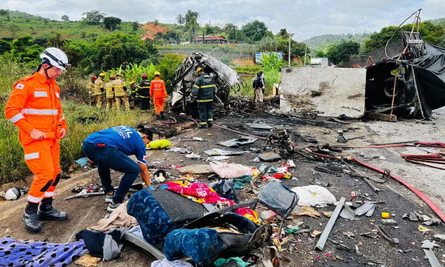
Brazil – A devastating Brazil bus truck collision on Friday claimed the lives of at least 11 people in the southernmost state of Rio Grande do Sul. The head-on crash between a passenger bus and a sand-carrying truck occurred on a federal highway, creating a catastrophic scene that challenged rescue workers and highlighted ongoing concerns about road safety in the region.

The Federal Highway Police confirmed the tragedy in an official statement, detailing the circumstances surrounding the deadly Brazil bus truck collision that unfolded during midday hours on one of the state’s major transportation routes.

Accident Details and Timeline

The fatal Brazil bus truck collision took place on a federal highway in Rio Grande do Sul around 11:30 a.m. local time, corresponding to 1430 GMT. The timing of the accident, during late morning hours when traffic typically flows steadily, raises questions about the circumstances that led to the head-on impact between the two large vehicles.

According to the Federal Highway Police statement, the collision resulted in immediate fatalities and serious injuries to passengers aboard the bus. The force of the impact was severe enough to cause the truck’s cargo to breach the bus’s structure, creating additional complications for emergency responders.

Casualties and Injured Victims

The Brazil bus truck collision resulted in at least 11 confirmed fatalities, making it one of the deadliest road accidents in the region in recent times. In addition to those who lost their lives, seven other people sustained injuries of varying severity in the crash.

The injured victims were promptly transported to nearby hospitals for emergency medical treatment, according to police reports. The extent of their injuries and their current medical conditions have not been fully disclosed, though the rapid response of emergency services likely prevented additional fatalities from the Brazil bus truck collision.

Rescue Complications Due to Sand Cargo

One of the most significant challenges facing rescue workers at the scene of the Brazil bus truck collision was the truck’s cargo. The vehicle was transporting sand at the time of the accident, and the impact caused a substantial portion of this cargo to spill into the bus itself.

The Federal Highway Police explained that the sand infiltration into the bus created extraordinary difficulties for rescuers attempting to access the vehicle and assist trapped passengers. This unusual complication in the Brazil bus truck collision significantly slowed rescue operations and may have impacted survival chances for some victims.

Emergency Response Efforts

Despite the challenging conditions created by the spilled sand, emergency responders worked diligently at the scene of the Brazil bus truck collision. Firefighters, medical personnel, and highway police coordinated their efforts to extract victims from the wreckage and provide immediate medical attention to survivors.

The complexity of the rescue operation required specialized equipment to remove the sand and debris blocking access to passengers. This aspect of the Brazil bus truck collision underscores the unpredictable nature of road accidents and the diverse challenges emergency responders must be prepared to handle.

Also Read: Saudi Coalition Strikes Yemen: 20 Separatist Fighters Killed in Escalating Conflict

Location and Highway Conditions

The Brazil bus truck collision occurred in Rio Grande do Sul, Brazil’s southernmost state, which borders both Argentina and Uruguay. The state’s federal highways serve as crucial transportation corridors for both passenger and commercial vehicles, connecting various municipalities and facilitating interstate commerce.

Federal highways in Brazil vary in their conditions and safety features, with some stretches receiving more maintenance and upgrades than others. The specific stretch where the Brazil bus truck collision occurred has not been characterized in terms of its safety record or recent maintenance history.

Investigation and Cause Determination

While the Federal Highway Police have confirmed the basic facts of the Brazil bus truck collision, the specific cause of the head-on crash remains under investigation. Determining whether factors such as mechanical failure, driver error, road conditions, or other circumstances contributed to the accident will require thorough analysis.

Investigators will likely examine multiple factors including vehicle maintenance records, driver logs and qualifications, road conditions at the time of the crash, visibility, and whether any traffic violations occurred prior to the Brazil bus truck collision.

Road Safety Concerns in Brazil

This tragic Brazil bus truck collision adds to ongoing concerns about road safety throughout the country. Brazil has historically struggled with high rates of traffic accidents and fatalities on its extensive highway network, which spans both urban and rural areas across the vast nation.

Factors contributing to road accidents in Brazil often include inadequate highway maintenance, insufficient traffic enforcement, variable driver training standards, and the challenge of monitoring safety compliance across such a large geographical area. The Brazil bus truck collision serves as a sobering reminder of these persistent challenges.

Impact on Local Community

The loss of 11 lives in the Brazil bus truck collision represents a significant tragedy for the communities of Rio Grande do Sul. Families have been devastated by the sudden loss of loved ones, while survivors and witnesses will require support to process the traumatic experience.

The accident has likely prompted renewed calls for improved highway safety measures, enhanced vehicle inspections, and better emergency response capabilities to prevent future tragedies similar to this Brazil bus truck collision.

Ongoing Developments

As authorities continue investigating the Brazil bus truck collision, additional information about the victims, the exact cause of the crash, and potential safety improvements may emerge in the coming days and weeks.

Indians Losing Legal Status Canada: Critical Crisis Affects 1 Million by 2026

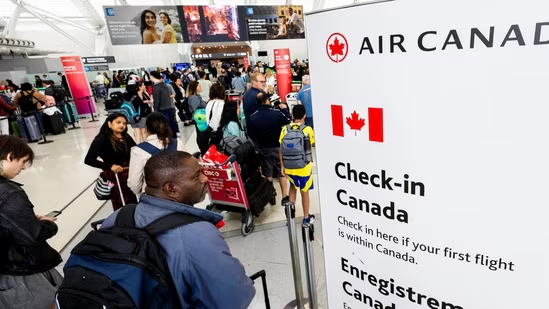
New Delhi – Canada is facing an unprecedented immigration crisis as nearly one million Indian nationals are at risk of Indians losing legal status Canada by mid-2026. Data obtained from Immigration, Refugees and Citizenship Canada (IRCC) reveals that approximately 1,053,000 work permits expired by the end of 2025, with another 927,000 set to expire in 2026, creating a massive bottleneck in the country’s immigration system.

Mississauga-based immigration consultant Kanwar Seirah obtained these statistics and shared them, highlighting the severity of the situation facing temporary foreign workers and international students. The crisis of Indians losing legal status Canada represents nearly half of all individuals expected to become undocumented in the country.

Understanding the Legal Status Crisis

As work permits expire, holders automatically lose their legal status unless they successfully secure another visa or transition to permanent residency. However, these pathways have become increasingly restricted as the Canadian government continues to tighten immigration rules, particularly targeting temporary workers and international students.

The government has also introduced new measures to manage asylum claims, further complicating the situation for those seeking to maintain legal status. The phenomenon of Indians losing legal status Canada stems directly from these stricter regulations combined with the natural expiration cycle of work permits issued in previous years.

Unprecedented Numbers Create System Bottleneck

Immigration consultant Kanwar Seirah warned that Canada has never faced such high numbers of people losing their legal status simultaneously. In the first quarter of 2026 alone, nearly 315,000 work permit expiries are expected, creating what experts describe as a severe “bottleneck” in the immigration system.

By comparison, the last quarter of 2025 saw over 291,000 expiries. This dramatic increase demonstrates how the crisis of Indians losing legal status Canada is accelerating at an alarming rate, overwhelming the capacity of immigration authorities to process applications and provide alternative pathways for affected individuals.

Conservative Estimates Point to Two Million Undocumented

Seirah estimates that by mid-2026, at least two million people in Canada could be living without legal status, with Indian nationals accounting for roughly half of this number. He described the figure for Indians losing legal status Canada as a “very conservative estimate,” noting that tens of thousands of study permits will also expire during this period.

Many asylum applications may also face rejection, adding to the number of individuals without legal documentation. The scale of this crisis represents an unprecedented challenge for both the affected individuals and Canadian immigration authorities tasked with managing the situation.

Social Impact in Greater Toronto Area

The growth of the undocumented population has already caused visible social issues in parts of the Greater Toronto Area, including Brampton and Caledon. Tent encampments have appeared in wooded areas, housing people who are undocumented and struggling to survive without legal status.

Brampton-based journalist Nitin Chopra documented one such tent city and reported anecdotal information that individuals experiencing Indians losing legal status Canada were working for cash payments in the underground economy. Additionally, unscrupulous operators have allegedly opened bureaus facilitating marriages of convenience as desperate individuals seek any pathway to legal status.

Economic and Social Consequences

The crisis of Indians losing legal status Canada extends beyond individual hardship to broader social and economic implications. People without legal status cannot access regular employment, healthcare, or social services, pushing them into vulnerable situations where exploitation becomes common.

Also Read: ISIS Attack Thwarted: FBI Stops New Year’s Eve Plot in North Carolina

The underground economy grows as employers take advantage of workers desperate for income, offering below-minimum wages and unsafe working conditions. This situation creates a parallel society of undocumented individuals living in fear while contributing to the economy without protection or recognition.

Activist Groups Mobilize for Reform

Groups such as the Naujawan Support Network, which advocates for workers’ rights, are planning protests in January to highlight the crisis caused by expiring permits. Bikramjit Singh, a Toronto-based activist with the Network, explained they are working to “build momentum” to address the plight of immigrant workers without legal pathways to remain in Canada.

The Network’s campaign slogan, “Good enough to work, good enough to stay,” reflects its call for comprehensive reforms that would allow temporary workers and students to remain legally in the country. These activists argue that individuals experiencing Indians losing legal status Canada have contributed significantly to the Canadian economy and deserve pathways to permanent residency.

Systemic Immigration Policy Challenges

The crisis highlights fundamental tensions in Canada’s immigration system. The country has relied heavily on temporary foreign workers and international students to fill labor shortages and support the education sector. However, the pathway from temporary to permanent status has not kept pace with the number of individuals entering through these programs.

As a result, Indians losing legal status Canada reflects a systemic failure to align temporary immigration programs with realistic pathways to permanent residency. The government’s recent tightening of rules appears to have exacerbated rather than solved underlying issues.

Looking Ahead: Need for Comprehensive Solutions

The situation of Indians losing legal status Canada requires immediate attention and comprehensive policy reforms. Solutions must address both the immediate crisis of expiring permits and the long-term structural issues in Canada’s immigration system. Without intervention, the country faces the prospect of a large undocumented population living in precarious conditions, unable to fully contribute to society while remaining vulnerable to exploitation.

Saudi Coalition Strikes Yemen: 20 Separatist Fighters Killed in Escalating Conflict

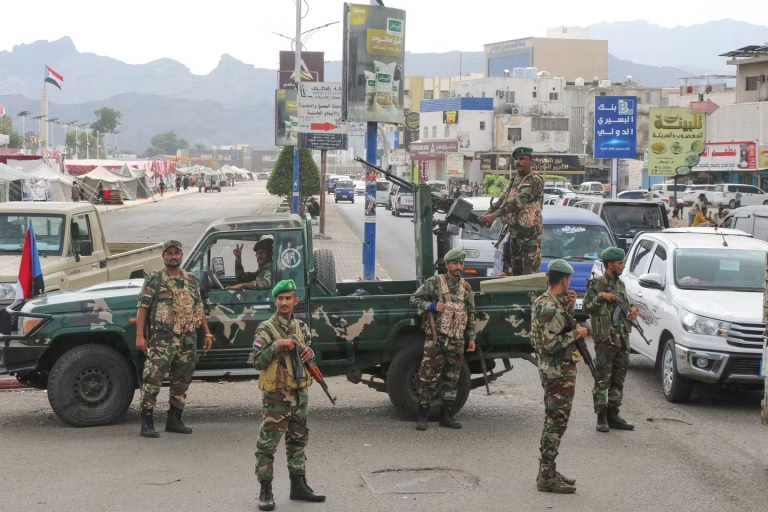
Saudi Arabia – At least 20 separatist fighters were killed on Friday when the Saudi coalition strikes Yemen targeted military installations controlled by the United Arab Emirates-backed Southern Transitional Council. The airstrikes mark a significant escalation in tensions between Gulf powers, occurring just two days after the UAE announced its withdrawal from the region following earlier bombardments in Yemen’s Mukalla.

The deadly attacks represent the first time coalition forces have caused casualties since the STC seized almost all provinces of Hadramout and Mahra, including critical oil facilities, earlier in December. The Saudi coalition strikes Yemen have disrupted airport operations and intensified the complex power struggle playing out across the war-torn nation.

Deadly Airstrikes Target Multiple Military Sites

The fighters died in coordinated attacks on military bases in Al-Khasha and Seiyun, according to an official from the Southern Transitional Council’s forces. The Saudi coalition strikes Yemen specifically hit the airport and military base in Hadramout’s Seiyun city, with witnesses confirming multiple impacts across strategic locations.

The airstrikes have severely disrupted civilian infrastructure, with no planes taking off or landing at Aden airport for more than 24 hours. Despite the operational shutdown, the ministry has not officially announced the airport’s closure, leaving travelers and residents in uncertainty about when normal operations will resume.

Strategic Timing and Military Objectives

The Saudi coalition strikes Yemen came shortly after pro-Saudi forces launched a campaign to peacefully take control of military sites in Hadramout. This timing suggests a coordinated effort to reassert Saudi influence in the region following the STC’s territorial gains throughout December.

Hadramout governor Salem Al-Khanbashi, who leads the province’s Saudi-backed local forces, insisted that the operation does not constitute a declaration of war. He clarified that the mission aims to peacefully and systematically hand over military sites and does not target any specific political or social group.

UAE Seeks De-escalation After Withdrawal

Following the Saudi coalition strikes Yemen, the UAE stated that it seeks de-escalation and confirmed that its last forces had left Yemen. The Gulf nation’s withdrawal came after Saudi Arabia bombed the port city of Mukalla on Tuesday, targeting a shipment that had arrived from the UAE.

Saudi authorities alleged the shipment carried weapons, while the UAE firmly denied these claims, stating the shipment contained only vehicles. This dispute over the Mukalla bombardment appears to have triggered the broader crisis between the two Gulf powers, ultimately leading to the UAE’s complete military withdrawal from Yemen.

STC Declares ‘Existential War’

A military spokesperson for the Southern Transitional Council characterized the situation as a “decisive and existential war” with Saudi-backed forces in Yemen. The STC framed the conflict as a fight against radical Islamism, reflecting the UAE’s longtime regional preoccupation with combating extremist ideologies.

Saudi sources confirmed the Saudi coalition strikes Yemen were carried out by the Saudi-led coalition, which nominally includes the UAE and was originally formed in 2015 to fight the Iran-backed Houthi rebels in Yemen’s north. A Saudi military source warned that the attacks would continue unless the STC withdraws forces from the two governorates.

International Community Accusations

Amr Al Bidh, the foreign affairs representative for the STC, accused Riyadh of deliberately misleading the international community. He claimed Saudi Arabia announced a “peaceful operation” they never intended to keep peaceful, pointing out that the Saudi coalition strikes Yemen began with seven airstrikes launched minutes after the peaceful declaration.

Also Read: ISIS Attack Thwarted: FBI Stops New Year’s Eve Plot in North Carolina

This accusation highlights the growing diplomatic rift between former allies and raises questions about the credibility of announced intentions in the complex Yemeni conflict.

Complex Rivalries and Power Dynamics

Although the political rivalry between Saudi Arabia and Yemen dates back nearly a decade, the STC’s recent offensive has particularly angered Riyadh and placed the oil-rich Gulf powers at loggerheads. Opposing the STC stands the Yemeni military, which is allied with the Hadramout Tribal Alliance, a local tribal coalition supported by Saudi Arabia.

The Saudi coalition strikes Yemen exemplify how Saudi Arabia and the UAE now back rival political groups based in Yemen, a country sitting at the crossroads of critical shipping lanes on the edge of the Middle East’s predominant energy-exporting region.

Ongoing Civil War Complications

While Abu Dhabi and Riyadh function as rival powerbrokers in Yemen’s government-run areas, the Gulf powers still form the backbone of the coalition aimed at dislodging Houthi rebels. The Houthis forced the government from the capital Sanaa in 2014 and seized Yemen’s most populated areas.

After almost a decade of civil war, the Houthis continue to maintain their positions while the Saudi coalition strikes Yemen and internal rivalries among government-backed forces create additional layers of complexity. The Saudis and Emiratis backing different factions in government-held territories demonstrates how the anti-Houthi alliance has fractured into competing interests.

Strategic Implications

The Saudi coalition strikes Yemen killing 20 separatist fighters marks a dangerous new phase in the conflict, where former coalition partners now directly target each other’s proxies. This development threatens to further destabilize Yemen and complicate any potential path toward peace in a nation already devastated by years of warfare.

Indore Water Contamination: Tragic Infant Death Exposes Critical Crisis

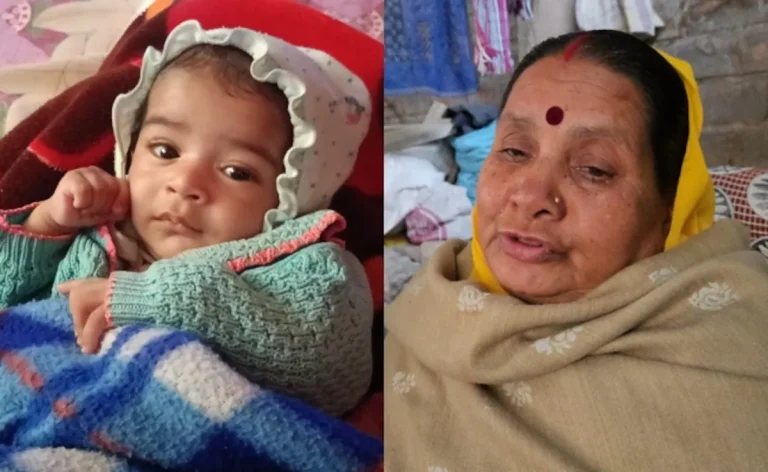
Indore – A devastating tragedy has struck the Sahu family in Indore, where a six-month-old infant died after consuming milk prepared with contaminated municipal tap water. The child, named Avyan, was born after his family waited and prayed for ten years, only to lose him to the Indore water contamination crisis that has gripped the city’s Bhagirathpura area.

Avyan died on December 29, becoming the youngest victim of the water crisis that has affected more than 1,400 people over the past nine days. The Indore water contamination has exposed critical failures in the city’s water supply system and raised urgent questions about public health infrastructure.

A Family’s Decade-Long Wait Ends in Tragedy

The Sahu family’s joy at Avyan’s birth after ten years of prayers and waiting has transformed into profound grief. The family had made a sacred vow at Hussain Tekri Dargah, and their prayers were finally answered with the infant’s arrival. However, the celebration was cut short when the Indore water contamination claimed the child’s life just six months later.

Avyan’s grandmother, Krishna Sahu, spoke about the family’s loss, stating that the entire family had prayed for the baby’s birth. She expressed her disbelief that the child they had waited so long for would leave them so suddenly, becoming a victim of circumstances entirely beyond their control.

Family Refuses Government Compensation

In a poignant statement reflecting their grief, Krishna Sahu revealed that the family has not accepted any compensation from the state government. The Madhya Pradesh government announced an ex-gratia payment of ₹2 lakh to families of deceased victims of the Indore water contamination crisis.

“We have not taken any compensation from the state government so far. Our child is gone. Will the compensation bring him back to life? Money is not greater than a child,” Krishna Sahu said, articulating the pain that no amount of financial assistance can heal.

Healthy Child Falls Victim to Contaminated Water

According to Krishna Sahu, Avyan was a healthy infant who had gained five kilograms and played happily in his mother’s lap. The tragedy began when he suddenly started suffering from diarrhoea. Initially, the family administered medicines at home following a doctor’s advice, but the child’s condition rapidly deteriorated.

When Avyan was taken to the hospital, doctors declared him dead upon arrival. The Indore water contamination had already caused irreversible damage to the infant’s system. Krishna Sahu explained that due to insufficient breast milk, the baby was being fed packaged milk and milk powder mixed with water from the municipal tap, which proved fatal for the child.

Crisis Spreads Fear Among Residents

The Indore water contamination has created widespread panic in the Bhagirathpura area. Anita Sen, a neighbor of the Sahu family, expressed the terror that has gripped local families. She mentioned having three children herself—a month-old girl, a four-year-old, and a ten-year-old—and demanded that the government ensure no other mother loses a child to contaminated water.

Also Read: Shocking Crime: Woman Gang-Raped In Moving Van In Faridabad For 2 Hours, Thrown Out On Road

The incident has highlighted the vulnerability of infants and young children to the Indore water contamination, as their developing immune systems cannot combat the pathogens present in the polluted water supply.

Scale of the Health Crisis

More than 1,400 people have been affected by vomiting and diarrhoea in Bhagirathpura over the past nine days, making the Indore water contamination one of the most serious public health emergencies in recent times. According to health department data, 272 patients had been admitted to hospitals in the area by Thursday, with 71 already discharged.

However, the situation remains critical, with at least 32 patients currently undergoing treatment in intensive care units. The severity of the Indore water contamination is evident in the number of people requiring intensive medical intervention.

Disputed Death Toll

Residents have claimed that 15 people have died due to the vomiting-diarrhoea outbreak caused by the Indore water contamination. However, the health department has not confirmed this claim and stated that only four deaths have occurred. This discrepancy has raised concerns about transparency in reporting the true impact of the crisis.

Government Response and Accountability

The Indore water contamination has prompted the Madhya Pradesh Chief Minister, Mohan Yadav to take action against top officials responsible for the water supply system. The crisis has also drawn attention from political leaders, with calls for accountability and immediate measures to prevent such tragedies in the future.

Urgent Need for Safe Water Infrastructure

The death of Avyan underscores the critical importance of ensuring safe drinking water for all citizens. The Indore water contamination has revealed systemic failures that must be addressed immediately to prevent further loss of life. Families like the Sahus should not have to fear that basic necessities like water could claim their children’s lives.

The tragedy serves as a stark reminder that access to clean, safe drinking water is not a luxury but a fundamental right that governments must guarantee to protect their citizens, especially the most vulnerable members of society.