Monday, May 4, 2026
Home Blog Page 203

J.P. Nadda Proudly Lays Foundation for PPP-Model Medical Colleges in Madhya Pradesh, Expanding Healthcare to the Last Mile: 2025

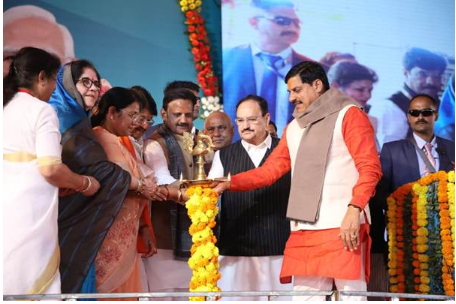
Union Minister for Health and Family Welfare, J. P. Nadda, participated in the Bhumi Pujan ceremony for two new Public–Private Partnership (PPP) model medical colleges in Dhar and Betul districts of Madhya Pradesh on December 23, 2025. The initiative marks a significant step toward strengthening medical education and healthcare delivery in remote and underserved regions, aligning with the vision of inclusive and equitable healthcare access.


PPP-Model Medical Colleges to Strengthen District Healthcare

The new medical colleges in Dhar and Betul are part of a broader plan to establish four PPP-based medical colleges in the state—Dhar, Betul, Katni, and Panna—integrated with existing district hospitals.

Under the PPP framework:

  • The State Government provides up to 25 acres of land on lease

  • Private partners construct academic and clinical infrastructure, including college buildings, hostels, laboratories, and residential facilities

  • District hospitals are upgraded as per National Medical Commission (NMC) norms, while remaining under state administrative control

This model ensures uninterrupted public healthcare services while rapidly expanding medical education capacity.


Paradigm Shift in India’s Healthcare System

Addressing the gathering in Dhar, Shri Nadda described the occasion as a historic milestone, highlighting that India’s healthcare system has undergone a fundamental transformation over the last 11 years under the leadership of Narendra Modi.

He noted that since 2017, healthcare policy has shifted from being curative-centric to preventive, promotive, and holistic, focusing on wellness and early intervention.


Primary Healthcare and Digital Health Initiatives

The Union Health Minister underlined the role of over 1.82 lakh Ayushman Arogya Mandirs (AAMs) in delivering comprehensive primary healthcare, particularly maternal and child health services—from pregnancy care to institutional delivery and immunisation.

He also highlighted the U-WIN digital platform, which enables real-time immunisation tracking for:

  • 2.5 crore pregnant women

  • 2.5 crore children

This system is supported by ASHA and Anganwadi workers, strengthening grassroots healthcare delivery nationwide.


Improved Health Outcomes Through Early Detection

Speaking in Betul, Shri Nadda highlighted major public health gains:

  • Institutional deliveries have increased to nearly 89%

  • India’s decline in Maternal Mortality Ratio (MMR) is more than twice the global average

  • Over 40 crore people screened for hypertension, with 6.80 crore under treatment

  • Over 40 crore screened for diabetes, with 4.60 crore receiving care

  • Large-scale cancer screening enabling early diagnosis and timely treatment

He emphasised that systematic screening and early detection are significantly improving health outcomes.


Unprecedented Expansion of Medical Education

The Union Health Minister highlighted the rapid growth in India’s medical education infrastructure:

  • Medical colleges increased from 387 (2014) to 819

  • MBBS seats more than doubled from 51,000 to over 1.28 lakh

  • 75,000 additional medical seats to be added by 2029 to strengthen the healthcare workforce

These reforms aim to address long-term human resource needs in healthcare.


Madhya Pradesh’s Vision for Healthcare and Youth Empowerment

Mohan Yadav, Chief Minister of Madhya Pradesh, thanked the Union Government for its support. He noted that linking medical colleges with district hospitals would:

  • Optimise healthcare resources

  • Expand specialist and tertiary care to underserved areas

  • Reduce patient migration to metro cities

The initiative aligns with the state’s vision of “Swastha Jeevan Samriddhi ka Aadhar”, focusing on healthcare-led prosperity, local youth empowerment, and job creation in nursing, paramedical, and allied health sectors.


Dignitaries Present

The ceremony was attended by senior leaders including:

  • Durga Das Uikley

  • Savitri Thakur

  • Rajendra Shukla

  • Kailash Vijayvargiya
    along with other senior state officials and public representatives.


Conclusion
The foundation of PPP-model medical colleges in Dhar and Betul marks a transformative step in bringing quality medical education and advanced healthcare to remote regions. By combining public oversight with private efficiency, the initiative not only expands healthcare access but also empowers rural youth and strengthens India’s healthcare workforce—advancing the national vision of a healthier, more resilient India.


For more real-time updates, visit Channel 6 Network.

Source: PIB
G. Kishan Reddy Inaugurates Centre of Excellence and Virtual Reality Mine Simulator at IIT (ISM) Dhanbad: 2025

Union Minister of Coal and Mines, G. Kishan Reddy, inaugurated a Centre of Excellence (CoE) under the National Critical Minerals Mission and a Virtual Reality Mine Simulator (VRMS) at Indian Institute of Technology (Indian School of Mines) Dhanbad on December 23, 2025. The inaugurations, held during the Minister’s two-day visit to Jharkhand, mark a significant step in strengthening India’s mining research, safety, and innovation ecosystem.


Centre of Excellence to Anchor Critical Minerals Research

The newly inaugurated CoE will serve as a national anchor for research and industry-scale solutions in critical minerals, focusing on the entire value chain—exploration, extraction, processing, recycling, reuse, and waste-to-wealth.

The CoE will collaborate with leading industry partners and international universities, including the University of Cambridge and Saint Petersburg State University, and will receive infrastructure support from Indian Institute of Technology Gandhinagar, Indian Institute of Technology (BHU) Varanasi, and Camborne School of Mines (CPI, UK). The initiative aims to translate cutting-edge research into deployable, industry-ready solutions that bolster India’s strategic autonomy in critical minerals.


India’s First VR-Based Mine Simulator for Coal Mining

Developed by IIT (ISM) Dhanbad in collaboration with Coal India Limited and its subsidiaries Northern Coalfields Limited and Eastern Coalfields Limited, the Virtual Reality Mine Simulator (VRMS) is India’s first VR-based simulator for coal mining safety and productivity.

Equipped with a 360-degree immersive virtual reality theatre, VRMS leverages real mine data and offers over 20 training modules covering heavy equipment operations and critical safety SOPs. The platform enables scenario-based assessment and certification for personnel ranging from operators to senior managers. It is expected to halve training time while significantly improving safety preparedness and operational efficiency.


Candid Engagement with Students and Young Researchers

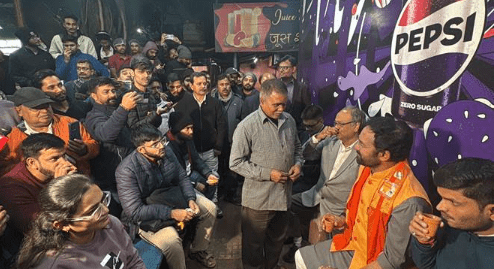
In a warm and informal interaction at RD Chowk, a historic student hub on campus, the Minister engaged with students and young researchers in an open dialogue over tea. Conversations spanned innovation in mining, opportunities in critical minerals, sustainability and clean energy, and the need for research-driven, indigenous solutions.

Encouraging students to think beyond conventional roles, Shri Reddy urged them to see themselves as problem-solvers and contributors to national development. He emphasized that India’s future in strategic sectors will be shaped by curious, confident, and innovation-driven youth, highlighting a leadership approach rooted in accessibility, dialogue, and trust.


Technology, Sustainability and Aatmanirbhar Bharat

Earlier, Shri Reddy underscored IIT (ISM) Dhanbad’s pivotal role in shaping India’s mining future through knowledge creation, research, and innovation, describing the institution as both a premier training ground and a cradle of new technological vision.

He noted that the mining sector is at a historic inflection point, where technology, critical minerals, sustainability, and national security converge to advance Aatmanirbhar Bharat. Under the leadership of Narendra Modi, the government has intensified focus on IT-enabled governance and R&D, with India emerging as the world’s sixth-highest country in patent filings and witnessing rapid growth in deep-tech innovation.

The Minister highlighted digital initiatives such as Coal SETU, the Koyla Shakti Dashboard, and Integrated Command & Control Systems, which enable real-time monitoring, improve efficiency, and enhance transparency and safety in the mining sector.


Conclusion
The inauguration of the Centre of Excellence and the Virtual Reality Mine Simulator at IIT (ISM) Dhanbad marks a decisive leap toward technology-led, safe, and sustainable mining in India. By integrating advanced research, immersive training, and close industry-academia collaboration, the initiatives reinforce India’s preparedness in critical minerals and mining innovation—placing young talent at the heart of the nation’s strategic and sustainable growth agenda. The inaugurations, held during the Minister’s two-day visit to Jharkhand, mark a significant step in strengthening India’s mining research, safety, and innovation ecosystem.


For more real-time updates, visit Channel 6 Network.

Source: PIB
Shri Shivraj Singh Chouhan Addresses Massive Farmers Conference in Rajasthan, Transfers Over Rs 3,000 Crore in Direct Benefits

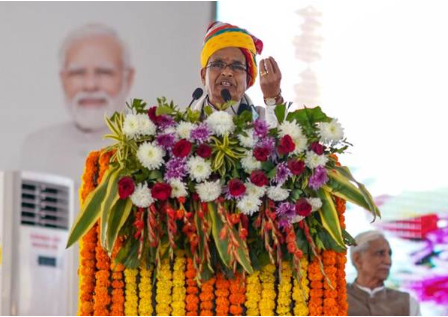
Union Minister for Agriculture & Farmers’ Welfare and Rural Development, Shivraj Singh Chouhan, participated in a large-scale Farmers’ Conference at Merta City in Nagaur district, Rajasthan, on December 23, 2025, where he transferred substantial financial assistance directly into the bank accounts of farmers and rural beneficiaries. The event highlighted the Centre’s commitment to rural transformation under the vision of Viksit Bharat and Atmanirbhar Bharat.


Major Financial Transfers and Sanctions Announced

During the conference, Shri Chouhan handed over a sanction letter of over ₹2,000 crore under the Pradhan Mantri Gram Sadak Yojana to Bhajanlal Sharma, enabling the construction of 12,600 rural roads across Rajasthan.

Key financial transfers announced included:

  • ₹100 crore allocated to 18,500 beneficiaries under Pradhan Mantri Awas Yojana (Gramin)

  • ₹187 crore transferred via Direct Benefit Transfer (DBT) to 35,800 farmers

  • ₹617 crore of agricultural input subsidy transferred to over 5 lakh farmers for disaster management and civil security

  • ₹151 crore transferred to 5 lakh milk producers of Rajasthan

  • ₹1.20 lakh financial assistance per family provided to low-income rural households for permanent housing and basic amenities


Rajasthan’s Agricultural Growth and MSP Support

Addressing farmers, Shri Chouhan said Rajasthan has created a new development milestone over the past two years. He highlighted rapid progress in:

  • Development of high-yielding, climate-resilient seed varieties

  • Reduction in cost of agricultural production

Under the Pradhan Mantri Fasal Bima Yojana, Rajasthan farmers have received significant support. The Minister noted that:

  • Farmers received ₹9,000 assistance (₹6,000 + ₹3,000 additional support by the state)

  • Rajasthan has received ₹29,000 crore under the crop insurance scheme over the last two years

  • A new provision mandates 12% interest payment to farmers if insurance claim settlements are delayed

On Minimum Support Price (MSP), Shri Chouhan said MSP has been doubled under the leadership of Narendra Modi. He confirmed:

  • Procurement of 3.05 lakh metric tonnes of moong worth ₹2,680 crore

  • Upcoming procurement of 5.54 lakh metric tonnes of groundnut

  • Ongoing procurement of 2.65 lakh metric tonnes of soybean


‘Viksit Bharat – G Ram G’ to Transform Rural India

The Union Minister strongly defended the newly enacted ‘Viksit Bharat – G Ram G’ law, stating that it will transform India’s villages. He said misinformation is being spread to intimidate workers and confuse rural communities.

Key features of the scheme include:

  • Increase in employment days from 100 to 125 days

  • Enhanced role for Gram Panchayats in village-level planning

  • Development of villages as poverty-free and employment-oriented units

  • ₹7.5 lakh per village investment over five years

  • Priority to water conservation works

  • Mandatory interest payment on delayed wages

  • Increase in administrative expenditure from 6% to 9%, with ₹13,000 crore annually allocated for timely salary payments

Shri Chouhan noted that unlike the UPA period, where large funds remained unspent, annual expenditure under MGNREGA has now reached ₹1.11 lakh crore, with a proposed allocation of ₹1.51 lakh crore for the current year.


Upcoming Reforms to Protect Farmers

Looking ahead, the Union Minister announced plans to introduce two key Bills in the next Parliament session:

  • A new Seed Act

  • A Bill to prevent fake fertilisers and spurious manure, with strict penalties for offenders

These measures aim to safeguard farmers from exploitation and strengthen trust in agricultural inputs.


Conclusion
The Farmers’ Conference in Nagaur underscored the Centre’s focus on direct financial empowerment, infrastructure expansion, and structural reforms in agriculture and rural development. With large-scale DBT transfers, strengthened MSP procurement, and the rollout of Viksit Bharat – G Ram G, Shri Shivraj Singh Chouhan reaffirmed the government’s resolve to transform villages into engines of growth and ensure dignity, security, and prosperity for India’s farmers. The event highlighted the Centre’s commitment to rural transformation under the vision of Viksit Bharat and Atmanirbhar Bharat.


For more real-time updates, visit Channel 6 Network.

Source: PIB

Indian Equity Markets End Flat on December 23: NIFTY 50 Closes Near 26,180 as Stock-Specific Volatility Dominates

Indian equity markets concluded Tuesday’s session, December 23, 2025, on a muted note, with benchmark indices ending largely flat amid selective buying and selling across counters. While the NIFTY 50 managed to hold above the 26,170 mark, the broader market witnessed sharp stock-specific moves, highlighting cautious investor sentiment ahead of the year-end.

Also Read: Indian Equity Markets Trade Flat at Midday on December 23: NIFTY 50 Holds Above 26,190 Amid Stock-Specific Action


Benchmark Indices: Range-Bound Close

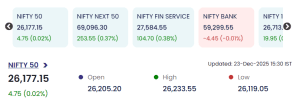
At the close of trade (15:30 IST), the NIFTY 50 settled at 26,177.15, up a marginal 4.75 points or 0.02%. The index opened at 26,205.20, moved to an intraday high of 26,233.55, and slipped to a low of 26,119.05, indicating a narrow trading range throughout the session.

Other indices showed mixed performance:

  • NIFTY Next 50 gained 0.37% to 69,096.30

  • December 23NIFTY Financial Services rose 0.38% to 27,584.55
  • NIFTY Bank edged lower by 0.01% to 59,299.55

The subdued close suggested consolidation after recent gains, with limited broad-based momentum.


Top Gainers: Strong Upper-Circuit Moves

Several stocks posted sharp gains, supported by strong volumes and momentum buying:

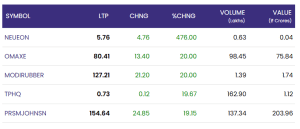
  • NEUEON surged to ₹5.76, up ₹4.76

  • OMAXE jumped 20.00% to ₹80.41, with heavy traded value

  • Screenshot 2025 12 23 224846MODIRUBBER gained 20.00% to ₹127.21

  • TPHQ advanced 19.67% to ₹0.73

  • PRSMJOHNSN rose 19.15% to ₹154.64

The sharp rallies reflected aggressive short-term interest, particularly in small- and mid-cap stocks.


Top Losers: Profit Booking in Active Counters

On the downside, several stocks saw notable corrections, some with significant volumes:

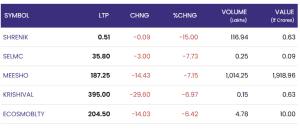
  • SHRENIK declined 15.00% to ₹0.51

  • SELMC fell 7.73% to ₹35.80

  • MEESHO slipped 7.15% to ₹187.25, remaining highly active

  • Screenshot 2025 12 23 224856KRISHIVAL dropped 6.97% to ₹395.00

  • ECOSMOBLTY eased 6.42% to ₹204.50

The declines indicated profit-taking and cautious positioning in select overextended counters.


Market Outlook: December 23

The session highlighted a consolidation phase for headline indices, with investors showing reluctance to take large directional bets. Market participation remained selective, with sharp divergences between gainers and losers underscoring a stock-driven environment rather than a sector-led rally.


Conclusion
Indian equity markets ended nearly flat on December 23, with the NIFTY 50 closing just above 26,177. While benchmarks lacked momentum, pronounced stock-specific moves dominated trading activity. As markets head into the final sessions of the year, investors are expected to remain cautious, focusing on selective opportunities and prudent risk management.


For real time stock Updates, visit NSE website.

Indian Equity Markets Trade Flat at Midday on December 23: NIFTY 50 Holds Above 26,190 Amid Stock-Specific Action

Indian equity markets were trading with a cautious and range-bound tone at midday on Tuesday, December 23, 2025, as benchmark indices consolidated after recent gains. While the NIFTY 50 hovered marginally in the green, broader markets witnessed sharp, stock-specific movements, reflecting selective investor participation and intraday volatility.

Also Read: Indian Equity Markets End Higher on December 22: NIFTY 50 Closes Near Record Levels as Stock-Specific Action Intensifies


Benchmark Indices: Consolidation Phase Continues

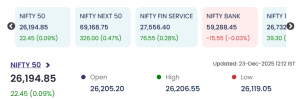
As of 12:12 IST, the NIFTY 50 was trading at 26,194.85, up 22.45 points or 0.09%. The index opened at 26,205.20, touched an intraday high of 26,206.55, and slipped to a low of 26,119.05, indicating a narrow trading range and lack of strong directional cues.

Other key indices showed mixed trends:

  • NIFTY Next 50 gained 0.47% to 69,168.75

  • December 23NIFTY Financial Services rose 0.28% to 27,556.40

  • NIFTY Bank edged lower by 0.03% to 59,288.45

The mixed performance suggested cautious sentiment, particularly in banking stocks, while select broader market segments saw buying interest.


Top Gainers: Sharp Rallies in Select Counters

Several stocks posted strong gains, supported by active volumes and momentum-driven buying:

  • NEUEON surged sharply to ₹5.76, gaining ₹4.76

  • TFL rose 17.01% to ₹16.03

  • Screenshot 2025 12 23 121351KSR advanced 14.80% to ₹17.14

  • OMAXE gained 13.39% to ₹75.98, with healthy trading volumes

  • TPHQ climbed 13.11% to ₹0.69

The rally in these stocks highlighted speculative interest and short-term buying in select small- and mid-cap names.


Top Losers: Selling Pressure in High-Volume Stocks

On the downside, a few stocks witnessed notable declines, some accompanied by heavy volumes:

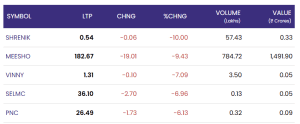
  • SHRENIK slipped 10.00% to ₹0.54

  • MEESHO declined 9.43% to ₹182.67, remaining highly active in trade

  • Screenshot 2025 12 23 121358VINNY fell 7.09% to ₹1.31

  • SELMC eased 6.96% to ₹36.10

  • PNC dropped 6.13% to ₹26.49

These declines pointed to profit booking and cautious sentiment in certain overextended counters.


Market Outlook: December 23

The midday session reflected a pause in the recent rally, with benchmark indices consolidating near record levels. Investors appeared selective, focusing on individual stock opportunities rather than broad-based buying. With the year-end approaching, markets are expected to remain volatile, driven by liquidity conditions, global cues, and sector-specific triggers.


Conclusion
Indian equity markets traded flat to mildly positive at midday on December 23, with the NIFTY 50 holding above 26,190. While headline indices lacked strong momentum, sharp moves in individual stocks underscored a highly selective market environment. Going forward, disciplined stock selection and prudent risk management are likely to remain crucial as markets navigate the final trading sessions of the year.


For real time stock Updates, visit NSE website.

West Bengal Electoral Roll Errors – Detailed Analysis of Mamata Banerjee’s Allegations on SIR, Political Fallout, and Governance Lessons for Democracy

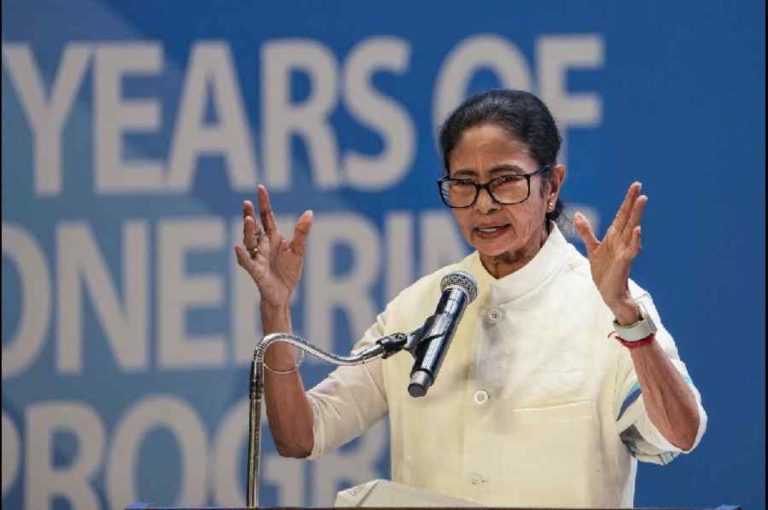
The West Bengal electoral roll errors controversy has become a major flashpoint in the state’s political discourse. On December 22, 2025, Chief Minister Mamata Banerjee accused the Election Commission of conducting a flawed Special Intensive Revision (SIR) of electoral rolls. Addressing Trinamool Congress (TMC) booth agents at Netaji Indoor Stadium, she alleged that the EC was working under BJP’s influence and that “gross errors” in voter mapping could disenfranchise thousands of citizens.


2. Mamata Banerjee’s Allegations

  • Mamata claimed the EC was appointing observers without informing the state government.
  • She alleged that central officers appointed as micro‑observers had little knowledge of local languages, making them unfit to verify voter details.
  • She accused the EC of fostering BJP’s interests by deleting names disproportionately in opposition strongholds.
  • Banerjee warned that voter deletions were larger than victory margins in many BJP‑held seats, potentially altering electoral outcomes.

3. The SIR Exercise

  • The Special Intensive Revision (SIR) is a process to update electoral rolls before elections.
  • It involves verifying voter identities, addresses, and eligibility.
  • In Bengal, the exercise has flagged millions of voters for hearings.
  • Allegations of arbitrary deletions have sparked protests across districts.

4. West Bengal Electoral Roll Errors: Political Fallout

  • Trinamool Congress (TMC): Framed the issue as an attack on democracy and accused BJP of conspiring to disenfranchise poor voters.
  • BJP: Denied allegations, claiming the EC was conducting a fair and transparent process.
  • Civil society groups: Raised concerns about the impact on marginalized communities, including Matuas and migrant workers.
  • The controversy has become a campaign issue ahead of the 2026 Assembly elections.

5. Government External Links for Assistance


6. Historical Context of Electoral Roll Controversies in Bengal

  • 2019 Lok Sabha elections: Allegations of voter deletions in North 24‑Parganas.
  • 2021 Assembly elections: Complaints of missing names in Kolkata constituencies.
  • 2025 SIR exercise: Largest controversy yet, with claims of systematic disenfranchisement.
  • Electoral roll disputes have long been a feature of Bengal’s polarized politics.

7. Governance Challenges

The controversy reflects:

  • Documentation gaps among marginalized communities.
  • Language barriers in verification processes.
  • Perceived bias in central institutions.
  • Weak communication between EC and state governments.

8. Global Comparisons

Similar disputes occur worldwide:

  • USA: Allegations of voter suppression in minority communities.
  • UK: Debates over voter ID laws and disenfranchisement.
  • Kenya: Electoral roll controversies leading to violent protests.

Bengal’s case mirrors these global struggles where electoral integrity becomes a contested issue.


9. Governance Lessons

The Bengal SIR controversy teaches:

  • Transparency in electoral processes is essential.
  • Community engagement can build trust in voter verification.
  • Language‑sensitive policies are needed in diverse states.
  • Independent oversight strengthens credibility of institutions.

10. Future Outlook – Democracy and Electoral Integrity

India must move towards:

  • Digital voter verification systems linked to Aadhaar.
  • Special provisions for refugee and migrant communities.
  • Awareness campaigns to guide citizens through hearings.
  • Judicial oversight to prevent arbitrary deletions.

11. Conclusion

The West Bengal electoral roll errors controversy is more than a technical dispute. It reflects the fragility of democratic processes in a polarized environment. Mamata Banerjee’s allegations of “gross errors” highlight the stakes of the SIR exercise, while BJP’s defense underscores the deep mistrust between parties. As hearings continue, the outcome will determine not only the future of Bengal’s voters but also the credibility of India’s electoral democracy.

Also read: Home | Channel 6 Network – Latest News, Breaking Updates: Politics, Business, Tech & More

West Bengal Winter Temperature Drop Forecast – Detailed Analysis of IMD Bulletin, Regional Variations, and Governance Lessons for Climate Preparedness

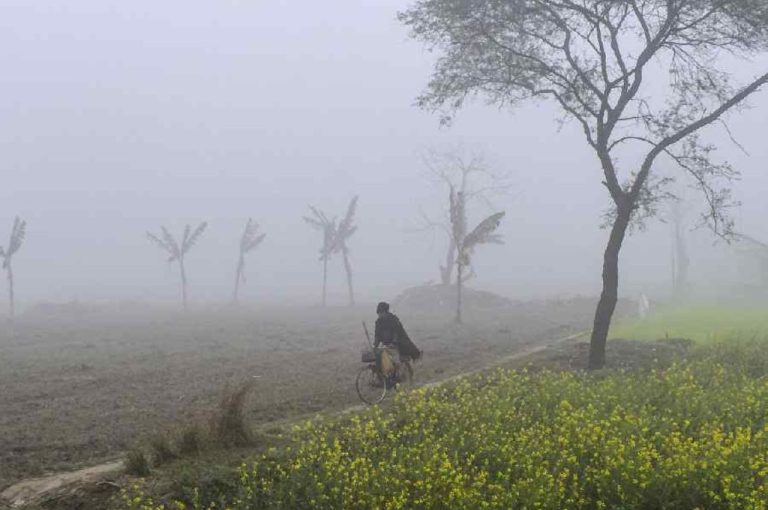
The West Bengal winter temperature drop forecast has captured public attention as the India Meteorological Department (IMD) announced that minimum temperatures across the state are likely to fall by 2–3°C from December 25, 2025. This comes after a period of steady temperatures and dry weather, with foggy mornings reducing visibility in several districts. The forecast signals the arrival of a sharper winter chill, affecting daily life, agriculture, and transport.


2. IMD’s Forecast

  • Minimum temperatures will remain steady for two days, followed by a gradual fall of 2–3°C.
  • The drop will be most noticeable in Gangetic West Bengal districts.
  • Sub‑Himalayan districts will also see a slight dip of around two notches.
  • Shallow to moderate fog will reduce visibility to less than one kilometre in some areas.
  • Dry weather will prevail across the state for at least seven days.

3. Winter Temperature Drop Forecast: Regional Variations

  • Darjeeling: Recorded the lowest minimum temperature at 6.2°C.
  • Alipurduar: Lowest in the plains at 9°C.
  • Other districts: Jalpaiguri (10.8°C), Bankura (11.2°C), Cooch Behar (11.3°C), Kalimpong (11.4°C), Raiganj (11.5°C).
  • Kolkata: Registered a relatively mild minimum of 15.2°C, reflecting the urban heat island effect.

4. Impact on Daily Life

  • Festive season: The chill coincides with Christmas and New Year celebrations, adding to the winter atmosphere.
  • Agriculture: Farmers anticipate benefits for crops like potatoes and mustard, which thrive in cooler conditions.
  • Transport: Fog may disrupt morning flights and trains, requiring caution.
  • Health: Seasonal flu, respiratory issues, and cold‑related illnesses may rise.

5. Government External Links for Assistance


6. Historical Context of Bengal Winters

  • Bengal winters are typically short and mild compared to northern India.
  • 2010–2015: Sharper dips, with Kolkata recording lows of 9–10°C.
  • 2016–2020: Winters became milder, reflecting climate change impacts.
  • 2021–2025: IMD data shows steady warming trends, with fewer cold waves.
  • The current forecast suggests a return to more traditional winter patterns.

7. Governance Challenges

The forecast highlights:

  • Urban heat islands keeping Kolkata warmer than rural districts.
  • Fog management in transport hubs.
  • Public health preparedness for seasonal illnesses.
  • Climate change adaptation in agriculture and urban planning.

8. Global Comparisons

Similar winter patterns are seen worldwide:

  • London: Mild winters with fog disrupting transport.
  • Tokyo: Short, crisp winters with occasional cold waves.
  • Sydney: Seasonal shifts marked by dry spells rather than extreme cold.

Bengal’s winter reflects a global trend of milder winters due to climate change.


9. Governance Lessons

The Bengal temperature drop teaches:

  • Accurate forecasting builds public trust in IMD.
  • Awareness campaigns help citizens prepare for fog and cold.
  • Integration of climate data into agriculture planning.
  • Urban planning reforms to mitigate heat island effects.

10. Future Outlook – Climate Preparedness in Bengal

India must move towards:

  • Smart weather monitoring systems in districts.
  • Digital alerts for fog and temperature dips.
  • Climate‑resilient crops for farmers.
  • Green urban planning to balance rising temperatures.

11. Conclusion

The West Bengal winter temperature drop forecast is more than a routine IMD bulletin. It reflects broader climate trends, governance challenges, and the need for preparedness. While residents enjoy clear skies during the festive season, the slight dip in temperatures ahead will remind Bengal of its fleeting winter. By integrating forecasting, governance, and citizen awareness, Bengal can adapt to changing climate realities while safeguarding livelihoods and celebrations.

Also read: Home | Channel 6 Network – Latest News, Breaking Updates: Politics, Business, Tech & More

Messi Statue Legal Dispute Kolkata – Detailed Analysis of Calcutta High Court Questions, Political Fallout, and Governance Lessons for Public Land Use

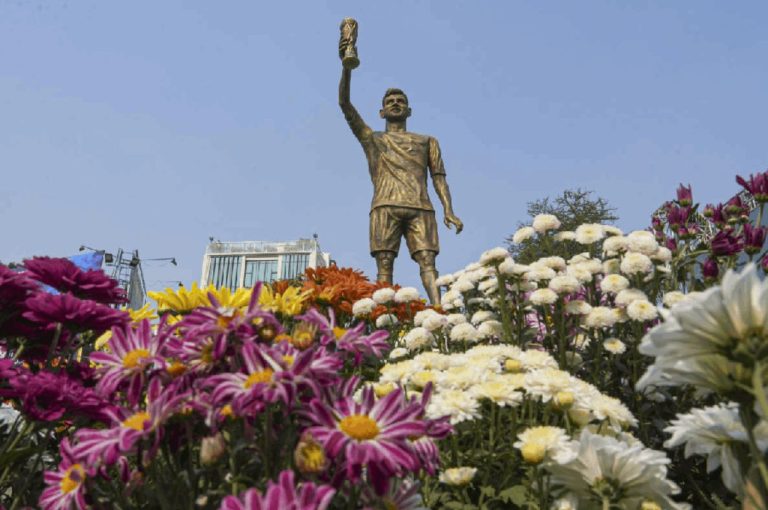
The Messi statue legal dispute Kolkata has become a fresh controversy in Bengal’s political and administrative landscape. On December 22, 2025, the Calcutta High Court raised questions about the legality of Lionel Messi’s statue installed in Lake Town. Justice Parthasarathi Sen asked whether the statue stood on government or private land, and whether such installations could be carried out without authorization. The issue adds another layer of complexity to the fallout from the chaotic Messi event at Salt Lake Stadium earlier this month.


2. Messi Statue Legal Dispute Kolkata: Background of the Statue

  • The statue was installed in Lake Town by Trinamool Congress leader Sujit Bose, reportedly in his personal capacity.
  • The installation coincided with Messi’s visit to Kolkata for the GOAT India Tour.
  • The statue quickly became a local attraction but also sparked questions about legality and propriety.
  • Petitioners alleged misuse of public land and demanded accountability.

3. High Court’s Observations

  • Justice Sen asked: “On whose land is the Messi statue? Is it government land or private land?”
  • He underlined the legal implications of erecting structures without authorization.
  • The state’s counsel, Kalyan Bandopadhyay, said Bose installed the statue personally, not as a minister.
  • An enquiry commission has been constituted to investigate the matter.

4. Political Fallout

  • The statue controversy follows the Salt Lake Stadium chaos, where mismanagement led to vandalism during Messi’s event.
  • Organiser Satadru Dutta has been arrested, and ministers Aroop Biswas and Sujit Bose face scrutiny.
  • Opposition leader Suvendu Adhikari demanded an independent enquiry headed by a sitting judge.
  • Allegations of ticket scams and financial irregularities have intensified political tensions.

5. Messi Statue Legal Dispute KolkataGovernance Challenges

The Messi statue dispute highlights:

  • Ambiguity in land ownership and usage rights.
  • Political leaders using public spaces for personal initiatives.
  • Weak enforcement of urban planning laws.
  • Public accountability in high‑profile events.

6. Government External Links for Assistance


7. Historical Context of Public Land Disputes in Bengal

  • 2010: Controversy over unauthorized statues in public parks in Kolkata.
  • 2016: Disputes over encroachment in Salt Lake plots.
  • 2022: Allegations of misuse of civic land for political rallies.
  • The Messi statue case continues this trend of contested public space usage.

8. Global Comparisons

Similar disputes occur worldwide:

  • Brazil: Unauthorized Maradona murals sparked legal debates.
  • Spain: Barcelona faced controversies over Messi murals on public buildings.
  • USA: Statues of sports icons often require municipal approval.

The Kolkata case mirrors these global challenges of balancing public enthusiasm with legal frameworks.


9. Governance Lessons

The Messi statue dispute teaches:

  • Clear land ownership records are essential.
  • Public installations must follow legal procedures.
  • Transparency in political initiatives prevents misuse of authority.
  • Independent enquiries build public trust.

10. Future Outlook – Managing Public Spaces in Bengal

India must move towards:

  • Digital land records accessible to citizens.
  • Urban planning reforms to regulate installations.
  • Community participation in decisions about public art.
  • Accountability mechanisms for political leaders using public spaces.

11. Conclusion

The Messi statue legal dispute Kolkata is more than a question of land ownership. It reflects deeper issues of governance, accountability, and political culture in Bengal. As the High Court scrutinizes the legality of the installation, the controversy underscores the need for transparent rules governing public spaces. For Bengal, the Messi saga has become a symbol of both passion for football and the pitfalls of mismanagement.

Also read: Home | Channel 6 Network – Latest News, Breaking Updates: Politics, Business, Tech & More

Modi Chopper Fog Incident Bengal – Detailed Analysis of Taherpur Helipad Abort, Virtual Rally, and Governance Lessons for Public Safety

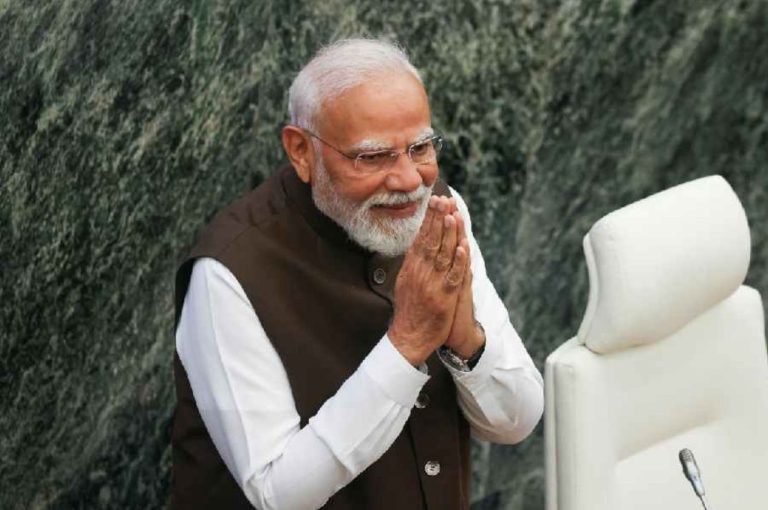
The Modi chopper fog incident Bengal has become a striking example of how weather can disrupt high‑profile political events. On December 21, 2025, Prime Minister Narendra Modi’s helicopter failed to land at the Taherpur helipad in Nadia district due to dense fog and poor visibility. The chopper hovered briefly before returning to Kolkata’s NSC Bose International Airport. Modi later addressed supporters virtually, inaugurating highway projects and delivering his speech from the airport’s VIP lounge.


2. Modi Chopper Fog Incident Bengal : The Incident

  • Modi arrived in Kolkata around 10:40 am and boarded a helicopter for Nadia.
  • The chopper attempted to land at Taherpur but visibility was too low.
  • After circling briefly, the pilot decided to return to Kolkata.
  • Officials quickly converted the airport’s VIP lounge into a virtual rally venue.
  • Modi addressed the crowd remotely, inaugurating projects worth ₹3,200 crore.

3. Political Context

  • The rally was part of BJP’s Parivartan Sankalpa Sabha campaign.
  • Modi was scheduled to inaugurate the Barajaguli–Krishnanagar section of NH‑34 and lay the foundation for the Barasat–Barajaguli section in North 24 Parganas.
  • The projects aim to improve connectivity between Kolkata and Siliguri.
  • The rally venue was strategically chosen in a Matua‑dominated region, significant for upcoming elections.

4. Impact of Weather on Political Events

  • Dense fog is common in Bengal during December and January.
  • Poor visibility often disrupts flights and train schedules.
  • Modi’s incident highlights the vulnerability of political rallies to weather conditions.
  • It also underscores the need for contingency planning in high‑profile events.

5. Government External Links for Assistance


6. Historical Context of Weather Disruptions in Politics

  • 2016: Fog disrupted Rahul Gandhi’s rally in Uttar Pradesh.
  • 2019: Modi’s helicopter diverted in Odisha due to poor visibility.
  • 2022: Several rallies in Punjab and Haryana delayed by fog.
  • Weather disruptions are not uncommon in Indian politics, especially in winter.

7. Governance Challenges

The incident reflects:

  • Need for better helipad infrastructure with advanced navigation aids.
  • Coordination between IMD and political organizers.
  • Contingency planning for virtual addresses.
  • Public safety concerns when large crowds gather in uncertain conditions.

8. Global Comparisons

Similar incidents occur worldwide:

  • USA: Presidents often switch to virtual addresses during storms.
  • UK: Fog has disrupted royal and political events.
  • Japan: Typhoons frequently force cancellations of public gatherings.

Modi’s virtual rally mirrors this global trend of adapting to weather disruptions.


9. Governance Lessons

The chopper fog incident teaches:

  • Weather forecasting must be integrated into political planning.
  • Virtual technology can ensure continuity of communication.
  • Public safety must take precedence over political optics.
  • Infrastructure upgrades can reduce risks in future.

10. Future Outlook – Weather Preparedness in Politics

India must move towards:

  • Smart helipads with Instrument Landing Systems (ILS).
  • Digital contingency protocols for rallies.
  • Public awareness campaigns on weather risks.
  • Integration of IMD alerts into political scheduling.

11. Conclusion

The Modi chopper fog incident Bengal is more than a logistical mishap. It reflects the intersection of weather, politics, and governance in India. By adapting quickly with a virtual rally, Modi ensured continuity, but the incident highlights the urgent need for better infrastructure and planning. As Bengal heads into elections, the episode will be remembered as a symbol of both vulnerability and resilience in political campaigning.

Also read: Home | Channel 6 Network – Latest News, Breaking Updates: Politics, Business, Tech & More

Nadia Train Accident BJP Rally – Detailed Analysis of Trinamool’s Attack on Modi, Political Fallout, and Governance Lessons for Public Safety in Bengal

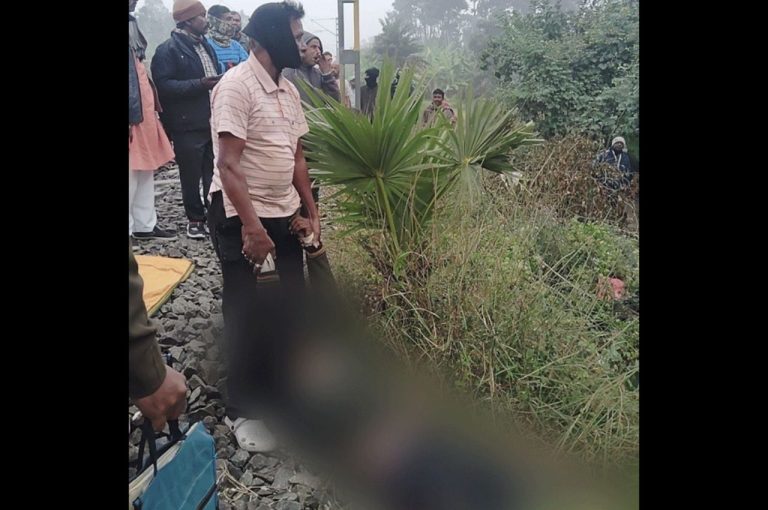
The Nadia train accident BJP rally controversy has become a flashpoint in Bengal’s political discourse. On December 21, 2025, three BJP supporters from Murshidabad district were killed and two others injured after being struck by a Sealdah‑bound local train near Taherpur railway station. They were travelling to attend Prime Minister Narendra Modi’s rally in Ranaghat. The tragedy triggered grief, political blame games, and fierce criticism from Trinamool Congress, which accused Modi of “standing on dead bodies” to hold his rally.


2. Nadia Train Accident BJP Rally: The Incident

  • Victims had travelled overnight from Murshidabad, nearly 150 km away.
  • Their bus stopped near the railway tracks in dense fog.
  • Several passengers got down to relieve themselves near the tracks.
  • The Krishnanagar–Sealdah local train (No. 31814) struck them around 4:30 am.
  • Three men died instantly, while two were critically injured and admitted to Krishnanagar hospital.
  • Another person sustained minor injuries and was released after treatment.

3. Human Impact

  • Families in Murshidabad were devastated as news reached them.
  • The victims were daily wage earners, highlighting the vulnerability of poor supporters mobilized for political rallies.
  • The tragedy underscores the intersection of poverty, politics, and public safety.

4. Political Fallout

  • Trinamool Congress (TMC): Accused BJP of insensitivity, alleging the party hushed up the incident and went ahead with Modi’s rally.
  • TMC posted on X: “Modi’s rally standing on the dead bodies of the people of Bengal!”
  • Mahua Moitra (TMC MP): Called it a “terrible tragedy hushed up at the altar of Modi’s ego.”
  • Prime Minister Modi: Expressed condolences in his virtual speech, wishing speedy recovery for the injured.
  • BJP leaders: Initially absent due to rally participation, later visited the hospital and paid tribute.
  • The incident became a flashpoint in Bengal’s polarized political climate.

5. Government External Links for Assistance


6. Governance Challenges

The tragedy reflects:

  • Poor safety awareness among rural citizens near railway tracks.
  • Inadequate facilities for long‑distance political mobilization (lack of rest stops, sanitation).
  • Weak coordination between political organizers and local authorities.
  • Delayed response in reaching bereaved families.

7. Historical Context of Railway Accidents in Bengal

  • Bengal has witnessed repeated railway tragedies:
    • 2010 Jnaneswari Express derailment in West Midnapore killed 148.
    • 2014 Santoshpur accident saw multiple fatalities near tracks.
    • 2025 Nadia incident adds to the list of preventable accidents.
  • Railway safety remains a persistent challenge in the state.

8. Global Comparisons

Similar tragedies occur worldwide:

  • Pakistan: Frequent accidents due to overcrowding and poor infrastructure.
  • Bangladesh: Train collisions and trackside accidents common in rural areas.
  • USA: Pedestrian fatalities near tracks despite advanced systems.

The Nadia case reflects a global pattern of vulnerability among marginalized communities.


9. Governance Lessons

The incident teaches:

  • Need for awareness campaigns on railway safety.
  • Provision of sanitation facilities during mass mobilizations.
  • Political accountability in ensuring safe travel for supporters.
  • Integration of rail safety with public event planning.

10. Future Outlook – Safer Political Mobilization

India must move towards:

  • Dedicated transport arrangements for political rallies.
  • Coordination between parties and district administrations.
  • Railway safety infrastructure like fencing and warning systems.
  • Compensation schemes for victims’ families.

11. Conclusion

The Nadia train accident BJP rally controversy is more than a tragic mishap. It reflects systemic failures in public safety, political mobilization, and governance. While condolences have been offered, the incident should serve as a wake‑up call for parties and authorities alike. Ensuring safe travel, sanitation, and awareness during mass events is essential to prevent future tragedies. In a democracy, citizens’ lives must never be collateral damage in political battles.

Also read: Home | Channel 6 Network – Latest News, Breaking Updates: Politics, Business, Tech & More