Saturday, May 16, 2026
Home Blog Page 345

Cyber Fraud Ring Busted: Shocking Rs. 250 Crore Money Heist-Inspired Scam Exposed

0

New Delhi – In a major breakthrough, Delhi Police have successfully busted a cyber fraud ring busted operation that allegedly defrauded hundreds of Indian investors of approximately ₹250 crore over the past eighteen months. Three Indian men who adopted aliases from the popular Netflix series Money Heist were arrested for their role in facilitating an international cybercrime syndicate allegedly masterminded by Chinese nationals operating sophisticated fake online trading investment schemes.

Money Heist Characters Come to Life

The cyber fraud ring busted by investigators revealed an elaborate operation where suspects adopted fictional identities to communicate securely and evade law enforcement detection. The arrested individuals—Arpit Mishra, 25, a lawyer from Jaipur, Rajasthan; Prabhat Vajpayee, 22, an MCA postgraduate from Ghaziabad, Uttar Pradesh; and Mohammad Abbas Khan, 24, from Imphal East, Manipur—created a WhatsApp group using screen names from the iconic heist series.

Mishra operated under the alias “Professor,” while Vajpayee and Khan used “Amanda” and “Denver” respectively. Investigators revealed that another yet-to-be-identified absconding member used the name “Berlin” within the group. This theatrical approach to criminal operations demonstrated the syndicate’s calculated efforts to romanticize their illegal activities while maintaining operational security.

Elaborate Mule Account Network

The primary function of the cyber fraud ring busted by authorities involved arranging mule bank accounts to facilitate the movement of fraudulently obtained funds. According to investigating officers, the accused collected financial credentials from economically vulnerable individuals, creating a complex network of accounts through which cheated money was routed before eventual conversion into cryptocurrency.

“Their main job was to arrange mule accounts and transfer cheated money,” explained an investigating officer requesting anonymity. The suspects allegedly received commissions for their services in cash through hawala channels, an informal money transfer system operating outside conventional banking networks, making transaction tracking significantly more difficult for law enforcement agencies.

Victim’s Ordeal Triggers Investigation

The cyber fraud ring busted operation emerged from a complaint filed by Rohit, a 32-year-old Delhi government employee from Gokalpuri who was defrauded of ₹21.77 lakh through an elaborate fake trading scheme. Deputy Commissioner of Police (Northeast) Ashish Mishra revealed that the complainant was initially added to a WhatsApp group where fraudsters posed as representatives of a reputed financial services firm offering lucrative stock market tips.

“The accused convinced him to invest in a ‘Direct Market Account.’ Later, they froze his funds and demanded more money under the threat of forfeiture,” the DCP stated, explaining the extortion component that followed the initial investment fraud. This modus operandi proved effective in extracting substantial sums from victims who feared losing their initial investments.

Systematic Investigation and Arrests

Following the registration of a case at the northeast district cyber police station, a specialized team led by Station House Officer Rahul Kumar and Sub-Inspector Nandan Singh began intensive investigations. The cyber fraud ring busted effort involved tracing bank accounts where transferred funds landed, revealing they belonged to economically disadvantaged individuals who had been exploited by the fraudsters.

Investigators tracked phone locations to Noida Sector 49, where Vajpayee and Khan were apprehended on October 9. Police recovered significant evidence including 11 mobile phones, 17 SIM cards, 32 debit cards, and other incriminating materials. Subsequently, Mishra was arrested from Siliguri, West Bengal, on October 26, with three mobile phones and SIM cards seized from his possession.

Also Read: Delhi Air Quality Crisis: “Severe” Pollution Level Imminent Today With AQI at 309

Direct Chinese Handler Connection

Interrogation of the suspects in the cyber fraud ring busted case revealed disturbing international connections. “Mishra’s interrogation revealed he was in direct contact with his handlers in China. Vajpayee and Khan lured poor people, kept them in hotels, and collected their financial credentials and OTPs, which were shared with the main fraudsters in China and Cambodia,” an officer disclosed.

This revelation exposed the transnational nature of the operation, with Indian operatives serving as ground-level facilitators for masterminds operating from Chinese and Cambodian territories. The sophisticated coordination between international handlers and local operatives demonstrated the evolving complexity of cybercrime networks.

Exploitation of Vulnerable Individuals

A particularly troubling aspect of the cyber fraud ring busted investigation was the exploitation of economically vulnerable individuals. The accused systematically targeted poor people, accommodated them in hotels, and extracted their banking credentials and one-time passwords under false pretenses. These individuals unwittingly became mule account holders, their financial identities weaponized for criminal purposes while they received minimal compensation.

Cryptocurrency Conversion Tactics

The cyber fraud ring busted case highlighted how modern cybercriminals leverage cryptocurrency to obscure money trails. Fraudulently obtained funds were moved through multiple mule accounts in a process called “layering,” designed to confuse investigators before final conversion into cryptocurrency. This digital asset conversion provided the syndicate with anonymity and made recovery of stolen funds exponentially more challenging for authorities.

Ongoing Investigation

With two accomplices still absconding, the cyber fraud ring busted investigation continues as authorities work to identify and apprehend remaining syndicate members. The case underscores the urgent need for enhanced cybersecurity awareness among potential investors and stronger international cooperation in combating transnational cybercrime operations targeting Indian citizens.
Delhi Dust Control: Massive 45-Day Campaign Launched To Combat Air Pollution

0

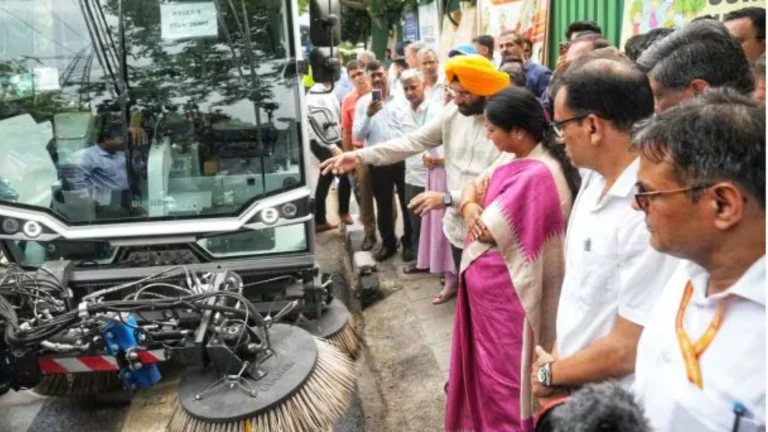
New Delhi – Chief Minister Rekha Gupta on Wednesday launched an ambitious Delhi dust control initiative, directing the Public Works Department to undertake an intensive 45-day citywide cleanup mission targeting road dust, debris, and waste accumulation. The operation covers 1,400 kilometers of arterial roads under PWD jurisdiction, with the chief minister warning that “no laxity will be tolerated” while emphasizing that accountability has been fixed for every officer involved in this critical environmental exercise.

Comprehensive Deployment of Resources

The Delhi dust control campaign involves substantial resource mobilization, with PWD deploying 200 maintenance vans to carry out round-the-clock operations including cleaning, pothole filling, debris removal, and dust suppression activities. Each van has been assigned the responsibility of deep cleaning at least 200 meters of road daily, ensuring systematic coverage of Delhi’s extensive road network under direct supervision of junior or assistant engineers.

“Our government is fully committed to improving Delhi’s air quality and will not tolerate negligence. Every officer will be held individually accountable,” Gupta stated, emphasizing that the Delhi dust control initiative specifically targets dust, which ranks among the major contributors to the capital’s elevated PM10 and PM2.5 pollution levels.

Officials confirmed that work is progressing rapidly across PWD-maintained stretches, where specialized teams are executing multiple tasks simultaneously. These include cleaning kerb channels and footpaths, removing accumulated dust layers, repairing damaged signage and malfunctioning streetlights, and coordinating closely with the Municipal Corporation of Delhi to prevent fresh waste dumping that could undermine cleanup efforts.

Weekly Reviews and Accountability Framework

To ensure the Delhi dust control mission meets its ambitious timeline, weekly reviews are being conducted to monitor progress and address any implementation challenges. This systematic oversight mechanism aims to guarantee completion within the stipulated 45-day deadline while maintaining quality standards across all cleanup activities.

Additionally, 60 specialized horticulture vans have been deployed specifically for tree pruning and greenery upkeep along roadsides. “The upkeep of roadside trees and proper management of dust and debris are essential to improve air quality. Departments have been instructed to ensure visible results within 45 days,” Gupta emphasized, highlighting the integrated approach combining infrastructure maintenance with environmental enhancement.

MCD Coordination and Waste Management

In a parallel meeting focused on the Delhi dust control initiative, Urban Development Minister Ashish Sood reviewed cleanliness and pollution control measures with MCD officials. The civic body reported collecting 14,000 metric tonnes of waste daily, underscoring the massive scale of Delhi’s waste generation and management challenges.

Sood directed faster implementation of waste segregation protocols, more effective deployment of mechanical sweepers, smog guns and sprinklers, and announced upcoming inspections at the Ghazipur and Bhalswa landfill sites next week to assess operational efficiency and environmental compliance.

“The Delhi Government’s goal is not only to clean the city but to make it green and sustainable. Technology, transparency and public participation are the three pillars of our environmental action,” Sood declared, articulating the administration’s comprehensive vision beyond immediate cleanup objectives.

Intensive Enforcement and Compliance Checks

Environment Minister Manjinder Singh Sirsa provided detailed statistics demonstrating the intensity of the Delhi dust control enforcement operations. “In the last 24 hours, our teams have inspected 387 construction and demolition sites, 79 municipal solid waste locations, 22 DG set installations, and 12 hotels and restaurants to check for fuel usage and dust control compliance. Action has been taken wherever violations were found,” he stated.

Also Read: Delhi Air Quality Crisis: “Severe” Pollution Level Imminent Today With AQI at 309

The minister revealed that more than 500 inspections were conducted citywide in the previous 24 hours by over 1,200 enforcement teams deployed from various government departments. “We have intensified dust mitigation and road-cleaning operations across all pollution hotspots. The chief minister has issued clear directions to ensure that every agency remains active on the ground,” Sirsa added.

Quantifiable Results and Swift Action

The Delhi dust control campaign has already produced measurable results demonstrating the administration’s seriousness. In a single day, enforcement teams issued 9,325 vehicular challans for violations, diverted 83 trucks carrying unauthorized loads, resolved 454 citizen complaints, and lifted 2,348 metric tonnes of construction and demolition waste—underlining the unprecedented scale of civic action being undertaken.

Furthermore, 128 inter-state buses were inspected at Delhi’s borders as part of the ongoing enforcement drive, ensuring that pollution control measures extend beyond the city’s internal boundaries to address vehicular emissions entering from neighboring states.

Technology-Driven Sustainable Approach

The Delhi dust control initiative represents a departure from previous ad-hoc cleanup efforts, incorporating technology, transparency, and public participation as foundational elements. By deploying mechanical sweepers, smog guns, and monitoring systems alongside traditional manual cleaning, the government aims to create sustainable long-term solutions rather than temporary cosmetic improvements.

The emphasis on individual officer accountability, coupled with weekly progress reviews and multi-department coordination, signals a structured approach designed to deliver tangible air quality improvements. With dust contributing significantly to PM10 and PM2.5 levels that frequently push Delhi into hazardous air quality categories, this comprehensive Delhi dust control campaign addresses a critical environmental and public health challenge facing the capital’s residents.

India South Africa Tests: Latest Squad Changes As Pant Returns, Shami Excluded

0

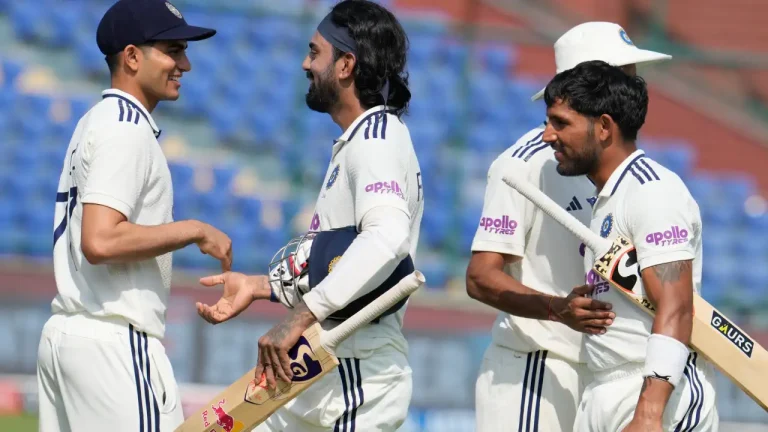
New Delhi – The Board of Control for Cricket in India announced the squad for the India South Africa Tests series on Tuesday, bringing significant changes to the red-ball lineup. The two-match series, scheduled to begin on November 14, marks the much-anticipated return of Rishabh Pant to Test cricket while notable pacer Mohammed Shami continues his extended absence from the national squad despite strong domestic performances.

Rishabh Pant’s Comeback as Vice-Captain

The headline announcement for the India South Africa Tests centered on Rishabh Pant’s return to the Test squad, where he has been named vice-captain under Shubman Gill’s leadership. The wicketkeeper-batter successfully proved his fitness during India A games against South Africa A, demonstrating his readiness for international cricket after a prolonged injury layoff.

Pant had suffered a foot fracture during the England tour, which forced him to miss crucial assignments including the Asia Cup, West Indies Tests, and the Australia series. His road to recovery culminated in an impressive performance for India A, where he scored a crucial 90-run knock in the second innings of a 275-run chase, underlining his return to form and match fitness.

The India South Africa Tests will see Pant resume his vice-captaincy duties, a role that acknowledges both his leadership potential and his importance to the team’s batting and wicketkeeping departments. His return provides India with a significant boost ahead of the crucial World Test Championship series.

Shami’s Continued Exclusion Raises Questions

Despite impressive performances in the Ranji Trophy, Mohammed Shami has been excluded from the India South Africa Tests squad, marking another setback in his quest to return to international cricket. The pacer’s omission has raised eyebrows among cricket observers, particularly given his strong domestic form.

Sources suggest that the current team management has been preferring other pace options over Shami in recent selection decisions. While his exclusion would have been considered a major surprise previously, the pattern of recent selections indicates a shift in the team’s pace bowling strategy for the India South Africa Tests.

In Shami’s absence, pacer Akash Deep has earned a recall to the Test squad, providing India with an additional pace bowling option for the important home series. Deep’s inclusion suggests the selectors’ confidence in his ability to perform in subcontinental conditions.

India A Squad Composition

Alongside the main India South Africa Tests squad announcement, the selectors also revealed the India A team for the three-match 50-over series against South Africa A. Notably, senior players Virat Kohli and Rohit Sharma have not been included in this squad, indicating their focus on preparing for the main Test series.

Tilak Varma will captain the India A one-day team, with Ruturaj Gaikwad serving as vice-captain. The wicketkeeping department features Ishan Kishan and Prabhsimran Singh, providing depth and competition for the position. This India A squad serves as an important platform for emerging players to showcase their abilities against quality opposition.

Kuldeep Yadav’s Preparation Strategy

On Sunday, India’s team management released spinner Kuldeep Yadav from the T20I squad currently in Australia, allowing him to join the India A side for their second four-day match against South Africa A. This fixture, scheduled to begin on November 6 at the Centre of Excellence in Bengaluru, forms part of Kuldeep’s preparation for the India South Africa Tests.

Also Read: India Women’s World Cup Triumph: Historic Maiden Title Victory By 52 Runs

The decision to release Kuldeep from white-ball duties underscores the importance the team management places on ensuring their key spinners are properly prepared for the Test series. This strategic move allows Kuldeep valuable match practice in longer-format cricket ahead of the main series.

South Africa’s Squad and Bavuma’s Return

For the India South Africa Tests, South Africa captain Temba Bavuma is set to return to the Test squad after recovering from a calf injury that sidelined him during the recent Pakistan tour. Bavuma will lead a 15-member squad for the two Tests scheduled in Kolkata from November 14-18 and Guwahati from November 22-26.

Bavuma’s return necessitated changes to South Africa’s squad composition. He replaces David Bedingham, who has been left out of the touring party. Additionally, spinner Prenelan Subrayen is the other omission from the squad, indicating South Africa’s strategic approach to Indian conditions.

World Test Championship Implications

The India South Africa Tests carry significant importance for India’s World Test Championship aspirations. The two-match series provides crucial opportunities to accumulate points and strengthen their position in the WTC standings. With the series beginning November 14, both teams will be eager to assert their dominance in the longest format.

Workload Management Concerns

Jasprit Bumrah’s workload remains under scrutiny as India approaches the India South Africa Tests. The management must carefully balance his participation to ensure his fitness throughout the demanding international schedule, particularly given his importance to India’s pace attack across all formats.

The squad announcements for the India South Africa Tests reflect a blend of returning stars, recalled performers, and strategic selections aimed at maximizing India’s chances in this crucial home series. As November 14 approaches, attention will focus on how these selections translate into on-field performance against a competitive South African side.

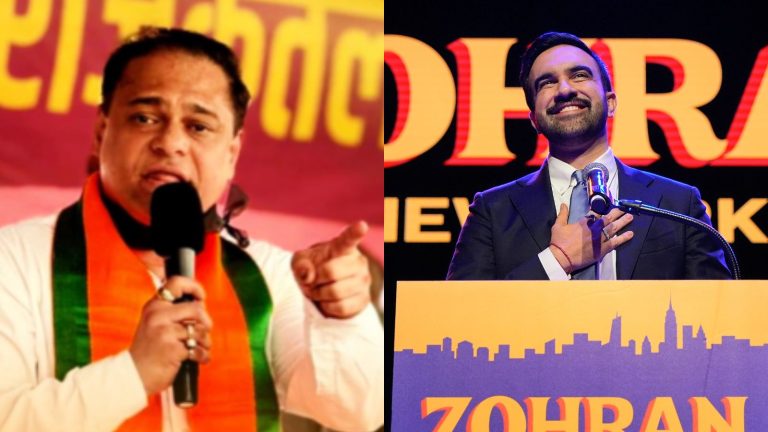
Mumbai BJP Chief Warning: Big Statement After Mamdani’s Historic NYC Victory 2025

Maharashtra – Within hours of Zohran Mamdani’s groundbreaking victory as New York City’s first Muslim and first South Asian mayor-elect, a Mumbai BJP chief warning emerged that has sparked intense political debate across India. Ameet Satam, who heads the Mumbai unit of the ruling Bharatiya Janata Party, issued a provocative statement declaring that any “Khan” attempting to lead Mumbai would not be tolerated, drawing an explicit connection between international political developments and local communal dynamics.

Direct Warning Against Muslim Leadership

The Mumbai BJP chief warning specifically targeted the possibility of Muslim leadership in India’s financial capital. “If anyone tries to impose a ‘Khan’ on Mumbai, it will not be tolerated! Wake up, Mumbaikars..!” Satam wrote in a post on social media platform X, using “Khan”—a common Muslim surname—as a religious identifier. This stark declaration came as Mamdani prepared to assume office on January 1, following his victory on Tuesday, November 4, where he secured approximately 50 percent of the vote against Donald Trump-backed Andrew Cuomo and Republican candidate Curtis Sliwa.

Satam’s Mumbai BJP chief warning extended beyond a simple statement of opposition, encompassing broader allegations about changing political demographics. “The way the political colour of some international cities is changing, after seeing the surnames of a few mayors and the ‘vote jihad’ of the Maha Vikas Aghadi, it feels necessary to stay alert regarding Mumbai..!” he wrote, explicitly linking international electoral outcomes to domestic political strategies.

Vote Jihad Allegations Against MVA

Central to the Mumbai BJP chief warning was the accusation that the opposition Maha Vikas Aghadi coalition is engaging in “vote jihad”—a controversial term suggesting organized communal voting patterns. Satam alleged that an attempt is being made to replicate New York City’s political dynamics in Mumbai, warning against what he characterized as religious-based political mobilization.

Speaking to a television channel, Satam elaborated on his Mumbai BJP chief warning: “Some people are adopting the path of appeasement to maintain political power. It is necessary to protect Mumbai from such forces that have previously tried to divide society.” He positioned his statements within a framework of protecting social harmony while simultaneously drawing explicit religious boundaries for political leadership.

The Mumbai BJP chief further clarified his position, stating he believes in religious harmony but will oppose anyone’s attempt “to divide society by adopting an anti-national stance.” This framing attempted to cast his warning as defensive rather than offensive, though critics quickly challenged this characterization.

Opposition Responds to Controversial Statement

The Mumbai BJP chief warning immediately drew sharp criticism from opposition parties. Shiv Sena (UBT) leader Anand Dubey launched a personal attack on Satam, alleging that the BJP leader’s mental state has deteriorated since assuming his position. “Ameet Satam’s mental state has deteriorated. From the day he became president, he realised he was about to be wiped out… That’s why he’s been making bizarre statements about the mayor of Mumbai from day one,” Dubey stated.

Countering the Mumbai BJP chief warning with his own communal assertion, Dubey declared: “May God give wisdom to people like Ameet Satam… I confidently say that a Marathi Hindu will become the mayor here,” effectively matching religious polarization with regional and religious identity politics.

Also Read: Trump Republicans Advice: Shocking Strategy Revealed After Democrats Sweep Elections

Mamdani’s Victory and Indian Connections

The Mumbai BJP chief warning emerged in response to the 34-year-old Mamdani’s historic achievement as a democratic socialist who defeated establishment candidates. Born in Kampala, Uganda, Mamdani moved to New York City at age seven and became a naturalized US citizen in 2018. He is the son of renowned filmmaker Mira Nair and Indian/Ugandan-origin professor Mahmood Mamdani.

In his victory speech, Mamdani pledged to “wake up each morning with a singular purpose: To make this city better for you than it was the day before,” focusing on inclusive governance that transcends religious and ethnic divisions.

Past Criticism of Modi Adds Context

The Mumbai BJP chief warning gained additional context from Mamdani’s previous criticism of Prime Minister Narendra Modi and the BJP. The mayor-elect has alleged that the BJP “only has room for certain kinds of Indians,” contrasting his vision of pluralistic India with what he perceives as the party’s exclusionary politics.

These comments have drawn fierce opposition from some Indian-American groups and prominent BJP figures. MP Kangana Ranaut publicly attacked Mamdani, claiming his views “sound more Pakistani than Indian,” reflecting the intense polarization surrounding discussions of religious identity and political leadership.

Implications for Mumbai Politics

The Mumbai BJP chief warning represents more than isolated rhetoric; it signals potential strategies for upcoming electoral contests in Maharashtra. By explicitly framing Muslim political participation as threatening and foreign-influenced, Satam’s statement seeks to mobilize voters along religious lines while portraying the BJP as defenders of Mumbai’s character against external influences.

This approach raises fundamental questions about inclusive democracy, religious freedom in political participation, and the appropriateness of using international events to fuel domestic communal tensions. As Mumbai approaches future elections, the Mumbai BJP chief warning may serve as a template for campaign messaging that prioritizes religious identity over policy platforms, potentially deepening social divisions in India’s most cosmopolitan metropolis.

Bihar Phase 1 Voting: Critical Battles Unfold As 5 Key Candidates Face Voters

Bihar – Bihar Phase 1 voting commenced Thursday morning at 7 am, marking the beginning of a crucial political contest that will determine the future governance of India’s third-most populous state. Over 3.7 crore voters across 121 constituencies in 18 districts are exercising their franchise to decide the fate of 1,314 candidates representing various political formations. This electoral phase features several high-stakes battles involving prominent political figures whose performance could significantly influence the overall election outcome.

Massive Electoral Exercise Across 18 Districts

The Bihar Phase 1 voting encompasses constituencies spread across Patna, Darbhanga, Madhepura, Saharsa, Muzaffarpur, Gopalganj, Siwan, Saran, Vaishali, Samastipur, Begusarai, Lakhisarai, Munger, Sheikhpura, Nalanda, Buxar, and Bhojpur districts. With 45,341 polling stations established—36,733 of which are located in rural areas—the Election Commission has made extensive arrangements to facilitate smooth voting. Among the 3.75 crore eligible voters, approximately 10.72 lakh are first-time voters, potentially bringing fresh perspectives to this triangular electoral contest.

The Bihar Phase 1 voting represents a three-way competition between the ruling National Democratic Alliance (comprising Janata Dal United, Bharatiya Janata Party, Lok Janshakti Party Ram Vilas, Hindustani Awam Morcha, and Rashtriya Lok Morcha), the opposition Mahagathbandhan (including Rashtriya Janata Dal, Indian National Congress, Communist Party of India, CPI Marxist-Leninist Liberation, CPI Marxist, and Vikassheel Insaan Party), and political analyst Prashant Kishor’s Jan Suraaj Party making its electoral debut.

Tejashwi Yadav: Hat-Trick Hopes in Family Bastion

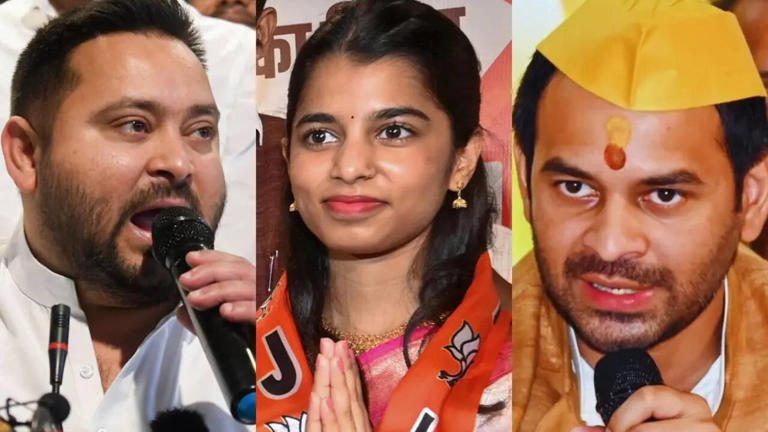
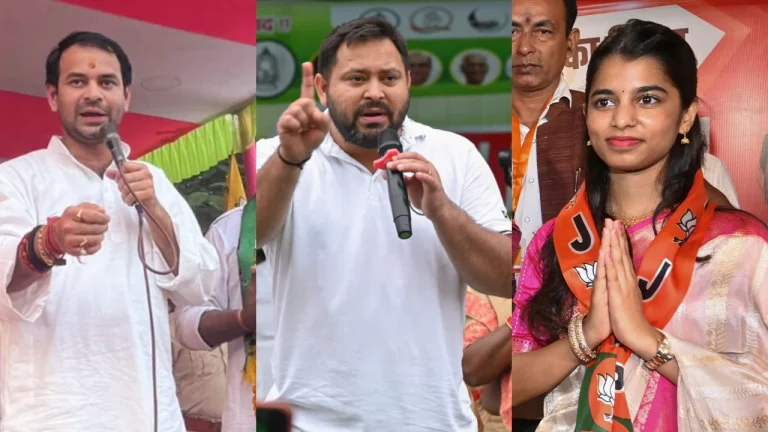
The most watched contest during Bihar Phase 1 voting involves RJD leader Tejashwi Yadav seeking a third consecutive victory from Raghopur constituency. This seat holds immense sentimental and political value for the Yadav family, having been represented by Tejashwi’s parents—former chief minister Lalu Prasad and Rabri Devi—in previous elections.

Tejashwi faces formidable opposition from BJP’s Satish Kumar, who previously dethroned Rabri Devi in 2010 while contesting on a JD(U) ticket, demonstrating his electoral strength in this constituency. Additionally, Jan Suraaj Party’s Chanchal Singh has entered the fray, potentially splitting anti-incumbency votes and adding complexity to this high-profile battle.

Samrat Chaudhary: Deputy CM Returns After 15 Years

Bihar’s deputy chief minister and BJP heavyweight Samrat Chaudhary represents another significant contest in Bihar Phase 1 voting. Competing from his home constituency of Tarapur after a 15-year gap, Chaudhary serves as second-in-command in Bihar’s NDA government and has led the BJP’s state unit since 2023.

His political pedigree runs deep—his father Shakuni Chaudhary served as MLA from Tarapur six times consecutively since 1985, while his mother Parvati Devi also won election to the Bihar Assembly. Chaudhary faces RJD’s Arun Shah, who unsuccessfully contested the 2021 bypolls, making this a test of both personal popularity and party strength.

Maithili Thakur: Folk Singer’s Political Debut

Among the most discussed candidates in Bihar Phase 1 voting is 25-year-old folk singer Maithili Thakur, contesting on a BJP ticket from Alinagar in Darbhanga district. Her candidacy represents the party’s strategy to attract young voters and leverage her popularity as a cultural figure.

Thakur faces criticism for being an “outsider” despite her fluency in the local Maithili dialect and roots in the adjoining Madhubani district. Currently settled in Delhi with her family, her transition from entertainment to politics has generated significant attention and debate about celebrity candidates entering electoral politics.

Mangal Pandey: Veteran Minister’s Assembly Debut

Bihar Phase 1 voting also features minister and former BJP state chief Mangal Pandey, who has served as MLC since 2012 but is now contesting his first assembly election from Siwan. As a seasoned political figure, Pandey’s performance will be closely monitored as an indicator of BJP’s organizational strength and his personal appeal beyond legislative council politics.

Tej Pratap Yadav: Family Rivalry in Mahua

Another dramatic battle during Bihar Phase 1 voting unfolds in Mahua, where Independent MLA and former minister Tej Pratap Yadav—elder son of RJD supremo Lalu Prasad Yadav—faces a multi-cornered contest. His opponents include RJD’s sitting MLA Mukesh Kumar Raushan, LJP’s Sanjay Singh, and Independent candidate Ashma Parveen.

This contest highlights internal tensions within the Yadav political family, with Tej Pratap choosing to contest independently rather than on his father’s party ticket, adding an element of family drama to the electoral proceedings.

Stakes and Implications

The Bihar Phase 1 voting outcomes will set the tone for subsequent phases, potentially influencing voter sentiment and campaign strategies. Victory margins and vote shares in these 121 constituencies will provide crucial insights into alliance effectiveness, voter mood, and the viability of Jan Suraaj Party as a third alternative. With polling concluding at 6 pm in most areas and 5 pm in some locations, the stage is set for a consequential democratic exercise that will shape Bihar’s political landscape for the next five years.

Jan Suraaj Candidate Defects: Shocking Betrayal Hours Before Bihar Voting 2025 Begins

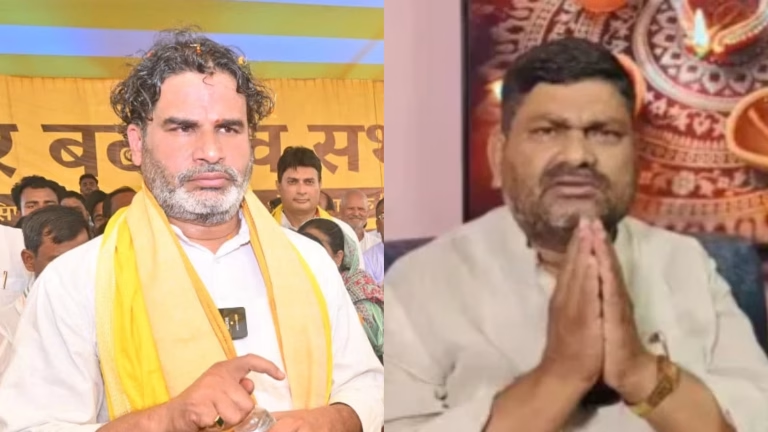
Bihar – The Prashant Kishor-led Jan Suraaj Party faced a significant embarrassment on Wednesday when its Jan Suraaj candidate defects to the Bharatiya Janata Party, merely hours before the first phase of polling in the 2025 Bihar assembly election. This stunning development has raised serious questions about the organizational strength and candidate selection process of the newly formed political outfit making its electoral debut.

Munger Candidate Switches Allegiance

Sanjay Singh, representing Jan Suraaj Party from Bihar’s Munger Assembly constituency, made the surprise switch to BJP on Wednesday evening, dealing a severe blow to Prashant Kishor’s political ambitions. The timing of this Jan Suraaj candidate defects incident proved particularly damaging, occurring just one day before voters in Munger were scheduled to cast their ballots on Thursday, November 6, as part of the first phase covering 121 constituencies across 18 districts.

Following his induction into the BJP, Sanjay Singh immediately extended his support to NDA nominee Kumar Pranay, the official BJP candidate from the Munger seat. This endorsement effectively transformed Singh from an opponent into an ally of the ruling coalition, leaving Jan Suraaj Party without representation in a constituency where it had invested campaign resources and political capital.

Praise for Modi and Nitish Kumar

After the Jan Suraaj candidate defects to BJP, Sanjay Singh offered effusive praise for both Prime Minister Narendra Modi and Bihar Chief Minister Nitish Kumar, signaling his complete ideological alignment with the National Democratic Alliance. “Bihar has witnessed tremendous growth under the leadership of Prime Minister Narendra Modi and Chief Minister Nitish Kumar. I am confident that the state will continue to develop further under the NDA rule,” Singh told reporters immediately after joining the saffron party.

Singh expressed strong confidence that the NDA would secure victory in Bihar with a substantial margin, effectively repudiating his former party’s prospects. His public statements represented not merely a party switch but a comprehensive endorsement of the ruling coalition’s governance record and development narrative, further compounding the embarrassment for Jan Suraaj Party leadership.

Silent Leadership Amid Crisis

As the Jan Suraaj candidate defects scandal unfolded, senior party leaders remained conspicuously silent, offering no immediate explanation or damage control response. This lack of prompt reaction from Prashant Kishor and other key figures raised questions about the party’s preparedness to handle such crises during its maiden electoral venture. The absence of official comment suggested either strategic silence or organizational confusion in responding to this unexpected development.

The defection highlights potential vulnerabilities in Jan Suraaj Party’s candidate vetting process and internal cohesion, particularly concerning for a political formation fielding candidates across all 243 assembly constituencies in Bihar. The incident may prompt voters to question the commitment level of other Jan Suraaj candidates and the party’s overall viability as a third alternative to established political formations.

Also Read: Bihar Election 2025: Massive Phase 1 Voting Begins Across 121 Constituencies

Cross-Party Defections Mark Campaign

Interestingly, the Jan Suraaj candidate defects incident wasn’t an isolated case of political migration during this election cycle. In a reverse movement, BJP’s sitting MLA from Pirpainti, Lalan Paswan, joined the Rashtriya Janata Dal after being denied a party ticket by the saffron party. This cross-party defection pattern suggests widespread candidate dissatisfaction and strategic repositioning ahead of the crucial assembly polls.

These movements underscore the fluid nature of Bihar’s political landscape, where ideological commitments often take a backseat to pragmatic considerations about electoral prospects and ticket distribution. The bidirectional flow of candidates between parties indicates that all formations, including established ones, face challenges in maintaining candidate loyalty and satisfaction.

Jan Suraaj Worker’s Death Casts Shadow

The Jan Suraaj candidate defects controversy emerged against the backdrop of another serious incident involving the party. Last Thursday, Jan Suraaj worker Dularchand Yadav was allegedly shot dead inside his vehicle during a campaign trail in Bihar’s Patna district, creating significant fallout for JD(U) candidate Anant Singh from the Mokama constituency.

The victim was killed in the Mokama area following reported firing between two sides during election campaigning. Patna Police arrested Anant Singh three days later in connection with the murder case, along with two associates—Manikant Thakur and Ranjeet Ram. “It was found that all this happened in the presence of the candidate, Anant Singh, who is also the main accused in the case,” stated Patna SSP Kartikeya Sharma, confirming the severity of the allegations.

This violent incident, where Jan Suraaj candidate defects had already placed Jan Suraaj Party in the spotlight for tragic reasons, and the subsequent Jan Suraaj candidate defects episode compounded the party’s difficulties during its crucial debut election campaign.

Election Timeline and Stakes

The Bihar assembly elections are scheduled across two phases on November 6 and November 11, with results to be declared on November 14. The Jan Suraaj candidate defects incident on the eve of Phase 1 polling potentially affects voter perception not only in Munger but across constituencies voting in the first phase, as it raises broader questions about the party’s organizational stability and candidate commitment during this critical three-way electoral contest.

Bihar Election 2025: Massive Phase 1 Voting Begins Across 121 Constituencies

Bihar – The Bihar election 2025 commenced today with Phase 1 voting across 121 of the state’s 243 assembly constituencies, marking a crucial triangular contest between major political alliances. Polling began at 7 am and will conclude at 6 pm in most areas, with some locations closing at 5 pm. This election represents a high-stakes battle involving the ruling National Democratic Alliance, the opposition Mahagathbandhan, and the debut of Prashant Kishor’s Jan Suraaj Party.

Major Candidates in the Spotlight

The Bihar election 2025 Phase 1 features several prominent candidates whose electoral fortunes will significantly impact the overall outcome. Rashtriya Janata Dal’s Tejashwi Yadav is seeking a hat-trick victory from the Raghopur constituency, where he faces BJP’s Satish Kumar. Kumar notably defeated Tejashwi’s mother, Rabri Devi, from this seat in 2010 while contesting on a JD(U) symbol, adding historical significance to this contest.

BJP’s rising star Maithili Thakur is making her electoral debut from the Alinagar constituency, representing fresh energy within the National Democratic Alliance. Other key candidates include Bihar Deputy Chief Minister Samrat Choudhary fighting from Tarapur, Tejashwi’s brother Tej Pratap contesting from Mahua on his own Janshakti Janata Dal ticket, and JD(U)’s Anant Singh fighting from Mokama despite being currently jailed in connection with the murder of Jan Suraaj supporter Dularchand Yadav.

Massive Voter Turnout Expected

The Bihar election 2025 first phase involves approximately 3.75 crore eligible voters who will determine the fate of 1,314 candidates across 121 constituencies. These voters will cast their ballots at 45,341 polling stations, with 36,733 located in rural areas, reflecting the predominantly agrarian character of the state’s demography.

Among the 3.75 crore voters, 10.72 lakh are classified as ‘new electors,’ representing first-time voters whose preferences could significantly influence election outcomes. This substantial number of new voters adds an element of unpredictability to the Bihar election 2025, as their voting patterns remain largely uncharted territory for political analysts and parties alike.

Eighteen Districts Cast Their Votes

The first phase of Bihar election 2025 covers eighteen districts across the state, including major urban and rural areas. The voting districts comprise Patna, Darbhanga, Madhepura, Saharsa, Muzaffarpur, Gopalganj, Siwan, Saran, Vaishali, Samastipur, Begusarai, Lakhisarai, Munger, Sheikhpura, Nalanda, Buxar, and Bhojpur. This geographic spread ensures representation from diverse regions, each with distinct socio-economic characteristics and political preferences.

The inclusion of Patna, Bihar’s capital city, makes this phase particularly significant for gauging urban voter sentiment. Meanwhile, the rural constituencies will provide insights into agrarian concerns and their impact on electoral choices in the Bihar election 2025.

National Democratic Alliance: The Ruling Coalition

The current ruling alliance in Bihar, the National Democratic Alliance, brings together multiple parties under a unified banner. Chief Minister Nitish Kumar’s Janata Dal (United) leads this coalition alongside the Bharatiya Janata Party, forming the core of the alliance. Other constituent parties include Chirag Paswan’s Lok Janshakti Party (Ram Vilas), Jitan Ram Manjhi’s Hindustani Awam Morcha, and Upendra Kushwaha’s Rashtriya Lok Morcha.

This diverse coalition aims to leverage its incumbency advantage while addressing voter concerns about governance, development, and social welfare. The NDA’s performance in Bihar election 2025 will test whether its governance record resonates with voters across different demographic segments.

Mahagathbandhan: The Opposition Grand Alliance

The opposition Mahagathbandhan, or Grand Alliance, presents a formidable challenge to the ruling NDA. Led by the Rashtriya Janata Dal and Indian National Congress, this coalition also includes the Communist Party of India, Communist Party of India (Marxist–Leninist) Liberation, Communist Party of India (Marxist), and Mukesh Sahani’s Vikassheel Insaan Party.

Tejashwi Yadav serves as the Mahagathbandhan’s chief ministerial face, positioning himself as the principal challenger to the current administration. The alliance seeks to capitalize on anti-incumbency sentiments while promising alternative governance focused on employment, education, and social justice issues.

Also Read: Mohiuddinnagar Rename Controversy: Explosive Yogi Adityanath Promise Sparks Debate Ahead of Bihar Polls 2025

Jan Suraaj Party Makes Electoral Debut

The Bihar election 2025 introduces a significant new player: political analyst Prashant Kishor’s Jan Suraaj Party. Making its political debut, this party has demonstrated ambition by fielding candidates in all 243 assembly seats across the state. This comprehensive approach transforms the traditional two-way contest into a triangular battle, potentially splitting votes and creating unpredictable outcomes.

Kishor’s entry brings additional complexity to Bihar’s political landscape, as his party aims to attract voters disillusioned with both established alliances. The Jan Suraaj Party’s performance will indicate whether there’s appetite for a third alternative in Bihar politics.

High-Stakes Contests Across the State

The Bihar election 2025 Phase 1 represents more than mere constituency battles; it sets the tone for the remaining phases and ultimately determines Bihar’s political direction for the next five years. With 121 constituencies voting today, the results will provide crucial insights into voter preferences and alliance strengths.

The triangular contest adds strategic complexity, as parties must not only defeat their traditional rivals but also counter the Jan Suraaj Party’s appeal. The outcome will shape Bihar’s governance, influence national politics, and determine whether the NDA maintains power or the Mahagathbandhan successfully mounts a comeback. As polling concludes tonight, all eyes will remain on these critical constituencies that could define Bihar’s political future.

Trump Republicans Advice: Shocking Strategy Revealed After Democrats Sweep Elections

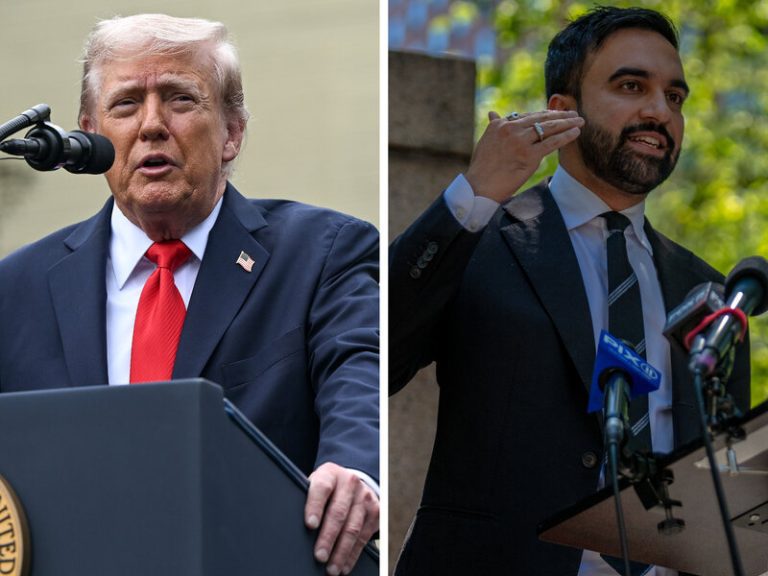
Washington D.C. – President Donald Trump delivered pointed Trump Republicans advice following a devastating electoral sweep by Democrats across New Jersey, Virginia, and New York City. Speaking at the America Business Forum in Miami, Florida on Wednesday, the president outlined what he believes is a straightforward path to victory for his party members, emphasizing the importance of communicating factual achievements to voters.

Focus on Facts: Trump’s Core Message

The centerpiece of Trump Republicans advice centered on a seemingly simple premise: listing facts makes winning elections easy. “Almost 2 million American-born workers are employed today, more than when I took office. That’s nine months ago. Can you imagine?” Trump stated, highlighting what he considers significant achievements during his administration.

The president emphasized that Republicans must actively communicate these accomplishments. “And I tell Republicans, if you want to win elections, you gotta talk about these facts. You know, it’s so easy to win elections when you talk about the facts,” he declared, suggesting that the party’s recent losses stemmed from a failure to effectively communicate their record to voters.

Trump Republicans advice included a critical warning: achievements alone don’t guarantee electoral success. “These are things you have to talk about. It doesn’t just happen, you got to tell them. It’s wonderful to do them, but if people don’t talk about them, then you can do not so well in elections,” he added, indicating that passive governance without active communication leads to electoral defeat.

Democratic Victories Across Key States

Tuesday’s elections delivered crushing blows to Republican candidates across multiple critical races. In New Jersey, Democratic candidate Mikie Sherril defeated Trump-backed Republican Jack Ciattarelli to become Governor, securing an impressive 56.3 percent of the vote. This represented a significant rejection of Trump’s endorsement in a state where Republicans had hoped to make gains.

Virginia witnessed another historic Democratic victory as Abigail Spanberger won the gubernatorial race with 57.2 percent of the vote, becoming the first woman to hold the state’s top position. This victory further demonstrated the challenges facing Republican candidates in traditionally competitive states.

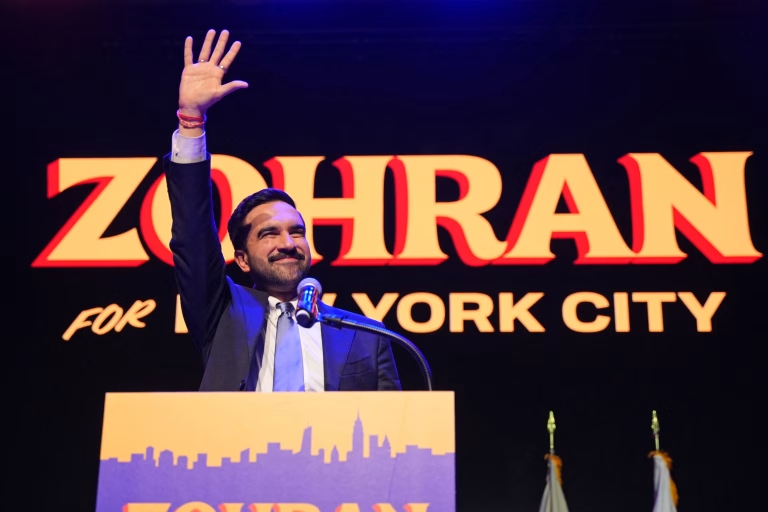
The most symbolic loss occurred in Trump’s hometown of New York City, where democratic-socialist Zohran Mamdani made history as the first Muslim, Indian-origin, and youngest mayor ever elected in the city. Mamdani defeated fellow Democrat and Trump-endorsed Andrew Cuomo, along with Republican candidate Curtis Sliwa, securing 50.4 percent of the vote. This triple loss underscored the urgency behind Trump Republicans advice about improving campaign messaging.

“Communist” Label for NYC Mayor-Elect

During the same Miami address, Trump launched sharp attacks against Mamdani, repeatedly calling him a “communist” despite the 34-year-old’s electoral victory. While expressing a desire to see New York City succeed, Trump claimed that residents had “installed a communist” in power, framing the election outcome in stark ideological terms.

“But the communists, Marxists, socialists and globalists had their chance, and they delivered nothing but disaster. And now let’s see how a communist does in New York. We’re going to see how that works out,” Trump stated, though he added he “might” help the city, leaving the door open for potential federal cooperation.

This rhetoric echoed Trump’s campaign-trail warnings during Mamdani’s run for mayor. The president had previously threatened to cut federal funding for New York and even suggested taking over the city if the young progressive candidate won election. These threats failed to prevent Mamdani’s victory, raising questions about the effectiveness of such aggressive rhetoric.

Republican Strategy Moving Forward

The Trump Republicans advice delivered in Miami reflects broader concerns within the party about messaging and voter communication. The president’s emphasis on “just listing the facts” suggests he believes Republicans possess strong policy achievements but fail to market them effectively to the electorate.

Also Read: Zohran Mamdani NYC Mayor 2025: Stunning Victory Celebrates Indian Roots Despite Modi Criticism

This communication-focused Trump Republicans advice comes at a crucial time for the party, which faces the challenge of maintaining support amid changing demographics and shifting political priorities in key states. The losses in New Jersey, Virginia, and New York City represent more than isolated defeats; they signal potential systemic issues with Republican messaging and candidate selection.

Trump’s analysis implies that Republican candidates lost not because of policy failures but due to communication breakdowns. By emphasizing employment figures and economic achievements, he suggested that voters would naturally support Republican candidates if only they heard the right information presented correctly.

Questions About Strategy Effectiveness

The Trump Republicans advice raises important questions about whether simply reciting facts will suffice in an increasingly complex political landscape. The Democratic victories suggest that voters responded to comprehensive platforms addressing diverse concerns, from economic policy to social justice issues and immigration reform.

Mamdani’s success despite Trump’s aggressive opposition and “communist” labeling indicates that ideological attacks may have diminishing returns with certain voter demographics. His victory speech directly challenged Trump Republicans advice, suggesting that progressive candidates are increasingly willing to confront rather than avoid presidential criticism.

The coming months will test whether Trump Republicans advice about focusing on factual communication proves effective, or whether the party needs more fundamental strategic reassessment. As Democrats celebrate their comprehensive sweep, Republicans face the challenge of implementing this guidance while addressing deeper questions about their platform’s appeal to diverse American voters in evolving political times.

Zohran Mamdani NYC Mayor 2025: Stunning Victory Celebrates Indian Roots Despite Modi Criticism

NYC, United States – The election of Zohran Mamdani as NYC mayor represents a progressive milestone in American politics during an era dominated by conservative rhetoric. At 34 years old, Zohran Mamdani NYC mayor-elect has become the first Muslim and first Indian-origin leader of America’s largest city, bringing a unique perspective shaped by his multicultural background and progressive values.

Indian Heritage Takes Center Stage

Zohran Mamdani NYC mayor victory celebration showcased his deep connection to Indian culture, featuring the Bollywood hit “Dhoom Machale” and references to India’s independence era. His mother, acclaimed filmmaker Mira Nair, known for works like “Monsoon Wedding,” “Mississippi Masala,” and “The Namesake,” shares his commitment to celebrating their Indian roots while maintaining critical perspectives on contemporary Indian politics.

The newly elected leader’s relationship with his desi heritage extends beyond surface-level cultural celebrations. During his campaign, Mamdani embraced South Asian culture authentically, incorporating Bollywood references and even sharing moments enjoying traditional mouth freshener. Democratic leader Ro Khanna praised this approach, noting that Mamdani created video clips featuring Amitabh Bachchan and Hindi movies, demonstrating that embracing one’s heritage doesn’t hinder success in American politics.

Contrasting Visions of India

While celebrating his Indian heritage, Zohran Mamdani NYC mayor-elect holds critical views of Prime Minister Narendra Modi and the BJP. He attributes his perspective to growing up with “a vision of an India that was pluralistic, an India where everyone belonged, no matter their religion.” In contrast, he alleges that Modi and the BJP’s Hindutva-centric vision “only has room for certain kinds of Indians.”

Mamdani has described Modi as “fascist,” grouping him with Donald Trump and Benjamin Netanyahu as leaders whose politics he fundamentally opposes. His mother shares these views, and both have accused Modi of being “anti-Muslim.” These statements have drawn fierce criticism from some Indian-American groups and sparked sharp reactions from BJP leadership in India.

BJP Mumbai unit chief Ameet Satam declared he wouldn’t tolerate any “Khan” leading the city, while Bollywood actor and BJP MP Kangana Ranaut attacked Mamdani, claiming he “sounds more Pakistani than Indian.” Despite this backlash, Zohran Mamdani NYC mayor remained steadfast in his progressive stance.

Nehru’s Legacy Resonates

In his victory speech, Zohran Mamdani NYC mayor-elect quoted from Jawaharlal Nehru’s iconic “Tryst with Destiny” speech delivered at India’s independence in 1947. “A moment comes but rarely in history when we step out from the old to the new,” he quoted, “When an age ends, and when the soul of a nation long suppressed finds utterance.”

This reference carried particular significance as Nehru is often blamed by current PM Modi for India’s problems. Congress leaders, including Nehru’s great-granddaughter Priyanka Gandhi, praised Mamdani’s gesture during her Bihar election campaign, arguing it counters BJP rhetoric by highlighting Nehru’s global respect.

Multicultural Background Shapes Policy Vision

Born in Uganda and moving to the United States at age seven, Mamdani comes from a richly diverse family. His father, academic Mahmood Mamdani of Ugandan-Indian Gujarati background, is renowned for writings on imperialism and fascism. His wife, Rama Duwaji, is a Syrian-origin artist known for political work spanning Middle East issues to immigration.

This multicultural upbringing informed Zohran Mamdani NYC mayor platform, which focused heavily on working-class concerns and immigrant rights. He advocated for rent freezes, free bus services, and government-run grocery stores, directly addressing the needs of New York’s diverse population.

Confronting Islamophobia and Trump

The Zohran Mamdani NYC mayor campaign faced significant opposition, including open attacks from Donald Trump, who labeled him a “communist” for his welfare policies and “Jew hater” over his pro-Palestine stance. Trump actively campaigned against him, making the race particularly high-profile.

Mamdani’s victory triggered anti-Muslim and anti-immigrant rhetoric from conservatives on social media. However, supporters noted that racism and Islamophobia weren’t enough to prevent his historic win. In his victory speech, he directly addressed Trump: “Donald Trump, since I know you’re watching, I have four words for you: Turn the volume up!”

A New Era for New York

The election of Zohran Mamdani NYC mayor marks a significant moment, particularly 25 years after 9/11, when many South Asian Americans questioned whether New York was still “our city too.” His victory speech emphasized inclusivity: “New York will remain a city of immigrants,” he declared, directly confronting right-wing anti-immigrant politics.

Mamdani actively engaged diverse communities throughout his campaign, visiting temples, gurdwaras, and mosques. He remained unapologetic about his identities—being relatively young, South Asian, and Muslim—demonstrating that authenticity and progressive values can triumph in American politics. His journey from a self-described mediocre rapper who once sang about chapati to leading America’s largest city symbolizes the possibilities within multicultural democracy.

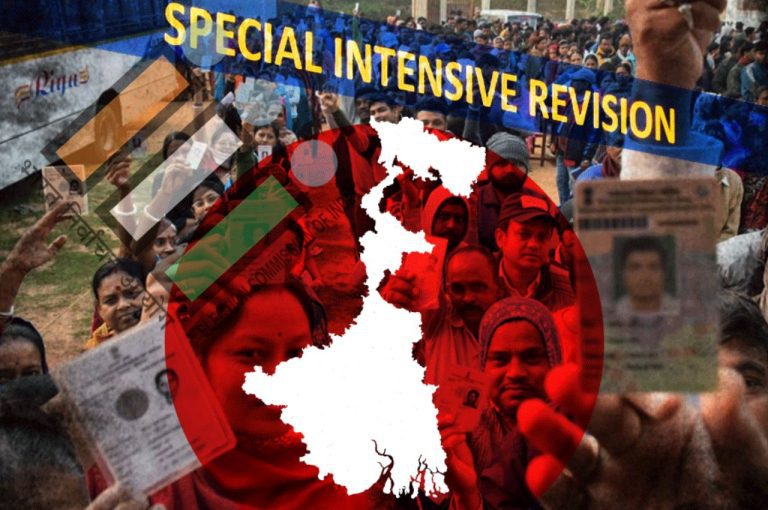
How to Contact Your BLO During Bengal’s Special Intensive Revision 2025: Complete Step-by-Step Guide for Voter Verification, Electoral Roll Updates, and Citizen Rights

How to Contact Your BLO: This massive exercise, supervised by the Election Commission of India (ECI), aims to clean, verify, and update Bengal’s voter lists ahead of the 2026 Assembly elections. From Kolkata to Cooch Behar, BLOs have begun knocking on doors to verify details, cross-check records with the 2002 base roll, and record new entries for first-time voters.

But confusion remains high — particularly about how voters can confirm who their BLO is, when they will visit, and how to ensure that their names are not deleted or wrongly marked as “ineligible.”

This article offers a complete 3,000-word citizen’s guide — explaining how to find and contact your BLO, what to do when they visit, what documents you’ll need, and why this process matters more than ever.


🔹 1. How to Contact Your BLO: What is the Special Intensive Revision (SIR)?

The SIR 2025 is part of the Election Commission’s regular nationwide voter list verification drive. However, in West Bengal, it carries extra weight this year because it follows heated debates over voter roll accuracy, citizenship verification, and alleged duplication or omissions in past lists.

Under the SIR, every district is required to:

  • Cross-verify voter data against the 2002 electoral roll,
  • Conduct door-to-door verification of all registered voters, and
  • Register new eligible citizens who turned 18 on or before January 1, 2026.

The process began on November 4, 2025, and will continue till December 4, 2025, followed by the publication of the draft roll on December 9 and the final roll on February 7, 2026.


🔹 2. Who Is a BLO and Why They Matter

The Booth Level Officer (BLO) is the link between the Election Commission and the voter. Every polling booth in West Bengal has an assigned BLO — usually a government or semi-government employee such as a teacher, clerk, or municipal worker.

Their responsibilities include:

  • Visiting households to verify voter details,
  • Distributing and collecting Form 6 (for inclusion), Form 7 (for deletion), and Form 8 (for correction),
  • Ensuring that new voters are added properly, and
  • Assisting citizens in identifying and correcting discrepancies.

In essence, your BLO is your first point of contact for any voter-related query.


🔹 3. How to Find and Contact Your BLO

You don’t have to wait for your BLO to arrive at your doorstep — you can easily find out who they are through the Chief Electoral Officer (CEO), West Bengal’s official website.

Step-by-Step Process:

  1. Visit the official website of the Chief Electoral Officer, West Bengal:
    👉 https://ceowestbengal.wb.gov.in
  2. Click on “Know Your BLO / ERO / DEO” or select the “Search Your Name in Electoral Roll” option.
  3. Enter your EPIC number (the 10-digit alphanumeric code on your Voter ID card).
  4. Choose your district, assembly constituency, and booth number if prompted.
  5. Once the search result appears, scroll down to view:
    • BLO name and contact number,
    • Electoral Registration Officer (ERO) details,
    • District Election Officer (DEO) contact.
  6. Save or note your BLO’s mobile number. You can call or send a text message if you’re unsure when they’ll visit.

💡 Tip: You can also access the same details through the Voter Helpline app, available on both Android and iOS.

👉 https://play.google.com/store/apps/details?id=com.eci.citizen


🔹 4. What to Expect When the BLO Visits

During the SIR period (Nov 4–Dec 4), your BLO will visit your home to verify every registered voter. Here’s what happens:

  1. The BLO will show their official identity card with a photograph and signature.
  2. They’ll provide a house-to-house verification form containing each voter’s details.
  3. Each eligible voter must verify or correct the information, sign the form, and return it.
  4. The BLO will countersign and provide you with a stamped acknowledgment.

If you are unavailable, the BLO will attempt up to three visits before marking the household as “not available.”

If you miss all visits, you can still reach out later using their contact number found on the CEO’s portal.


🔹 5. What Documents You Should Keep Ready

Although enumeration is based mainly on self-declaration, keeping key documents ready can make verification smoother.

Essential Documents:

  • EPIC (Voter ID) card,
  • Aadhaar card (for identity verification, if requested),
  • Proof of age (birth certificate, school certificate, passport),
  • Proof of address (ration card, electricity bill, rental agreement),
  • Two passport-size photographs (for new voters).

📘 Note: You are not required to submit physical copies of documents during the BLO’s initial visit unless specifically requested later during claim hearings.


🔹 6. Key Dates to Remember

Event Date
Start of House-to-House Verification November 4, 2025
End of Enumeration by BLOs December 4, 2025
Publication of Draft Electoral Roll December 9, 2025
Claims & Objections Period December 9, 2025 – January 8, 2026
Verification Hearings Up to January 31, 2026
Final Roll Publication February 7, 2026

During the claims and objections period, voters can visit their local election office or use online forms on the ECI portal (https://voters.eci.gov.in) to make corrections or additions.


🔹 7. How to File for Correction or New Registration

If your name is missing, or details such as spelling or address are incorrect, use the following forms:

Purpose Form Number Available At
New Voter Registration Form 6 BLO / Online
Deletion of Name (Death/Shift) Form 7 BLO / Online
Correction of Entries Form 8 BLO / Online
Transposition (Change of Address within AC) Form 8A BLO / Online

All forms are available online at the National Voters’ Services Portal (NVSP):
👉 https://voters.eci.gov.in


🔹 8. Special Focus: First-Time Voters and Migrant Workers

The SIR also emphasizes including new voters aged 18–19 years who were not on previous lists. BLOs are visiting colleges and educational institutions to distribute Form 6 among eligible youth.

For migrant workers, BLOs are instructed to coordinate with local employers and housing societies to reach temporary residents. If you are a migrant or work outside Bengal, you can:

  • Fill your voter form online at the ECI portal, or
  • Authorize a family member to submit the form on your behalf to your BLO.

🔹 9. Rights and Responsibilities of Voters During SIR

Your Rights:

  • To verify your name and details on the voter list,
  • To request corrections free of charge,
  • To be visited by an officially designated BLO (who must show valid ID),
  • To submit forms either online or in person.

Your Responsibilities:

  • Provide accurate information,
  • Sign all forms truthfully,
  • Ensure that your details are not duplicated in another constituency,
  • Check your name during the draft publication phase.

🔹 10. What If You Don’t Find Your BLO or They Haven’t Visited?

If your BLO hasn’t visited or you can’t reach them:

  1. Go to your nearest Block or Sub-Division Election Office.
  2. Provide your EPIC number to find the booth-level contact.
  3. Alternatively, use the helpline number 1950 (toll-free) to speak with election officials.

You can also send queries to the Chief Electoral Officer’s grievance email listed on https://ceowestbengal.wb.gov.in.


🔹 11. Political Significance and Context

This year’s SIR is taking place amid heightened political attention. Parties across the spectrum have voiced concerns over voter roll integrity:

  • The ruling Trinamool Congress (TMC) has urged BLOs to ensure no genuine voter is deleted.
  • The Bharatiya Janata Party (BJP) has demanded re-verification of certain districts, alleging fake entries.
  • The Left and Congress have called for transparency and citizen awareness.

Amid these claims, the ECI has reiterated that the revision aims to ensure “clean, error-free rolls,” not citizenship verification. The Commission has warned against spreading misinformation about the process.


🔹 12. Challenges on the Ground

In some rural districts such as Malda, Murshidabad, and North Dinajpur, BLOs have reported long hours and staff shortages. Teachers deployed as BLOs often manage both school duties and field verification.

To address this, district administrations have introduced digital tracking of BLO visits and QR-based attendance — allowing EROs to monitor progress in real time.

Despite logistical hurdles, officials maintain that the process is on track to meet deadlines.


🔹 13. What Happens After the SIR Ends

Once all forms are collected and verified:

  • Data is compiled at the Sub-Division Election Office,
  • Draft rolls are published publicly at every polling station,
  • Voters can view, verify, and raise objections,
  • After verification hearings, the final roll is published.

Citizens are encouraged to recheck their names on December 9, 2025, when the draft roll goes online.


🔹 14. Why Contacting Your BLO Matters Now

Your BLO is your single point of access to:

  • Know whether your name exists in the current voter list,
  • Confirm that your data matches the 2002 base roll,
  • Ensure you’re included in the final publication,
  • Avoid last-minute disqualification or clerical omissions.

By establishing early contact, you safeguard your right to vote and help maintain the integrity of the electoral process.


🔹 15. Helpful External Links for Citizens

Purpose Official Link
CEO West Bengal (BLO Contact Portal) https://ceowestbengal.wb.gov.in
Election Commission of India https://eci.gov.in
National Voters’ Services Portal https://voters.eci.gov.in
Voter Helpline App (Android) https://play.google.com/store/apps/details?id=com.eci.citizen
Form Downloads (PDFs) https://eci.gov.in/forms

🔹 16. Final Takeaway: Democracy Begins at Your Doorstep

The Special Intensive Revision 2025 is more than a technical update — it’s the foundation of free and fair elections. In a democracy as vast and diverse as India’s, accuracy in voter rolls is paramount.

So when your BLO visits — open your door, verify your data, and ask questions.
If they haven’t yet — reach out using official links, helpline numbers, or the CEO’s portal.

Because your one verified signature today could decide your right to vote tomorrow.


Official References:

Also read: Home | Channel 6 Network – Latest News, Breaking Updates: Politics, Business, Tech & More