A high-powered team of European Union (EU) negotiators arrived in New Delhi on November 3, 2025, marking a crucial phase in discussions with Indian officials on the proposed India–EU Free Trade Agreement (FTA). The week-long deliberations, scheduled until November 7, focus on resolving outstanding issues and pushing toward an equitable agreement benefitting both India and the EU.
Bilateral Commitment and Senior-Level Engagement
This visit follows Commerce Minister Shri Piyush Goyal’s recent trip to Brussels (October 27–28), where he met senior EU leaders including H.E. Maroš Šefčovič, European Commissioner for Trade and Economic Security. Both sides reaffirmed their intent to intensify negotiations for a comprehensive trade framework, covering critical areas such as trade in goods and services, rules of origin, technical standards, and institutional cooperation.
Focus Areas and Progress: Technical and Policy Matters
During the current round, negotiators are addressing complex and politically sensitive areas. These include market access for Indian exports (textiles, leather, engineering goods) and EU requests for tariff reductions on automobiles, alcoholic beverages, and high-end products. The talks also encompass associated agreements like investment protection and Geographical Indications. Virtual meetings earlier this week between Minister Goyal, EU Commissioner Šefčovič, and Commissioner Christophe Hansen highlighted shared priorities and sensitivities.
High-Level Meetings and Next Steps
Ms. Sabine Weyand, Director-General for Trade at the European Commission, is set to hold high-level talks with India’s Commerce Secretary Shri Rajesh Aggarwal on November 5–6, targeting resolution of technical and policy bottlenecks. Over 65% of FTA chapters have been finalised, with remaining issues now requiring ministerial and leadership-level decisions. Both teams view the FTA as vital for boosting bilateral trade, investment, and sustainable growth.
Vision for a Balanced and Future-Ready Agreement
The EU delegation’s presence in Delhi underscores the determination of both parties to deliver a balanced FTA that addresses mutual priorities. Once concluded, the agreement will significantly enhance two-way trade, making Indian exports more competitive in Europe and opening India to select EU products. The ongoing talks reflect commitment to innovation, investment, and economic partnership.
Conclusion: India–EU
India–EU FTA discussions in New Delhi signify an advanced stage in comprehensive trade negotiations. Both sides remain focused on achieving a mutually beneficial agreement poised to shape the future of India–EU economic relations.
Union Agriculture Minister Shri Shivraj Singh Chouhan took decisive action on November 3, 2025, addressing mounting concerns over irregularities in crop insurance claim settlements under the Pradhan Mantri Fasal Bima Yojana (PMFBY). The move comes after numerous complaints from farmers, particularly in Maharashtra and Madhya Pradesh, who reported receiving claim amounts as meager as ₹1 or ₹3 despite substantial crop losses.
High-level Meeting in Delhi: Voices of Farmers Heard
During a high-level meeting at Krishi Bhawan, Delhi, Shri Shivraj Singh Chouhan listened directly to the grievances of affected farmers via virtual connection. He expressed strong displeasure over reports of nominal claim amounts, terming such payouts a “mockery of farmers.” The minister insisted the government would not tolerate such discrepancies and ordered an immediate thorough investigation into these cases.
Strict Instructions to Insurance Companies and Officials
Shri Shivraj Singh issued strict directives to insurance firms and officials to expedite claim disbursements and ensure that settlements are processed quickly and collectively. He emphasized that accurate and scientific methods must be used for damage assessment, and any discrepancies must be resolved without delay. State officials who joined virtually, including those from Maharashtra, were tasked with investigating complaints and ensuring that no farmer is unjustly treated.
Addressing Structural Issues and Policy Gaps
The minister raised concerns about damage assessment methodologies—such as remote sensing—and questioned why some claims were so low even when losses were evident. He directed a review of guideline provisions and recommended field-level investigations. Insurance companies were told to send representatives for all survey activities to maintain transparency. States have also been warned against delaying their premium subsidies, as these delays impact claim payments to farmers, and would henceforth attract a 12% interest penalty in cases of late contributions by the states.
Ensuring Farmers’ Rights and Future Reforms
Shri Shivraj Singh Chouhan reiterated that the Central Government, under Prime Minister Shri Narendra Modi’s leadership, will not allow the PMFBY to become a symbolic gesture. Instead, it must remain a genuine safety net for farmers against natural calamities. The minister called for further suggestions from officials, insurance representatives, and farmers themselves to continue strengthening the crop insurance scheme and ensure it delivers justice and relief as intended.
Conclusion
The Union Agriculture Minister’s actions underscore the government’s commitment to safeguarding farmers’ interests. With a probe underway and policy reforms on the horizon, there is a renewed push towards restoring trust in crop insurance and ensuring timely, fair claim settlements for all affected cultivators.
The Department of Agriculture and Farmers’ Welfare (DA&FW) actively participated in Special Campaign 5.0, an initiative led by the Department of Administrative Reforms and Public Grievances (DARPG) to reduce pendency and institutionalize cleanliness and efficiency across government offices. The campaign was executed in two phases: the Preparatory Phase (16th–30th September 2025) and the Main Phase (2nd–31st October 2025), focusing especially on disposal of E-waste and public grievances.
Comprehensive Cleanliness and Waste Disposal
Under Special Campaign 5.0, extensive cleanliness drives were conducted at DA&FW headquarters, subordinate offices, and public sector undertakings nationwide. Tree plantation and cleaning of public spaces became major undertakings, promoting green and hygienic environments. A special highlight was the disposal and innovative utilization of E-waste, with Farm Machinery Training and Testing Institutes creating equipment models for farmers, including drones and tractors, all crafted from E-waste. These efforts were recognized as best practices under the campaign’s ‘Waste to Wealth’ category.
Grievance Redressal and Digital Outreach
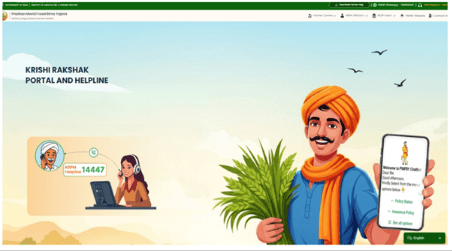
A key focus of the campaign was to address public grievances, particularly those related to flagship agricultural schemes such as PM KISAN and Pradhan Mantri Fasal Bima Yojana (PMFBY). Dedicated digital portals and CPGRAMS empowered farmers nationwide to lodge complaints and access timely resolution. During the campaign, DA&FW disposed of over 1,59,000 public grievances, a major achievement towards reducing backlog and improving governance. Notably, the Krishi Rakshak Portal provided a centralized platform for farmers to resolve issues related to crop insurance and other schemes.
Revenue Generation and Social Participation
Through the auction of scrap and condemned materials, DA&FW generated more than ₹40 lakh in revenue during the campaign. The campaign also saw active participation from all attached and subordinate offices, with enthusiastic efforts to maintain records, weed out old files, and free up administrative space. Social media was vigorously used with over 274 tweets and five PIB notes issued to showcase progress and best practices. A workshop on public grievance management and e-waste disposal was successfully organized, drawing appreciation from senior officials and highlighting the department’s commitment to service delivery and sustainable practices.
Conclusion: Department of Agriculture
Special Campaign 5.0 under DA&FW has raised benchmarks in efficient grievance handling, innovative waste management, and comprehensive cleanliness drives. These activities not only improved government office function but also set strong examples of sustainability and responsiveness for future campaigns.
On November 3, 2025, the Indian stock market finished on a strong note, with major indices climbing and several stocks showing sharp upswings as well as significant drops. The trading session was marked by robust gains in select counters and clear sector-based pressures among the day’s biggest losers.
Nifty 50 concluded the day at 25,763.35, rising by 41.25 points (0.16%). The index remained steady, opening at 25,696.85 and trading between a high of 25,803.10 and a low of 25,645.50. Other major indices, including Nifty Next 50, Nifty Financial Services, and Nifty Bank, posted healthy gains, with Nifty Next 50 jumping 0.94% and Nifty Financial Services advancing 0.62%. The broad-based green on indices reflected renewed investor confidence as the session ended.
Sector Leaders Shine
A select set of stocks led the advance, recording double-digit gains. DOLPHIN (₹446.10, +20%), THANGAMAYL (₹2,603.50, +20%), and DREDGECORP (₹889.35, +20%) posted the day’s largest percentage increases, each enjoying strong volume and turnover. LANCORHOL added 19.99%, and BLSE soared 14.24%, closing at ₹199.50 with turnover topping ₹260 crores. The gains were driven by increased buying interest in these counters, offsetting subdued activity across other segments.
Notable Losers: Selective Selling Weighs
The session also featured significant selling in some stocks. CAPTRU-REI dropped by 13.46% to ₹6.30, while PUNJABCHEM fell 10.39% to ₹1,338.00 with a value turnover topping ₹22 crores. OMAXAUTO retreated by 10% and GROBTEA decreased by 9.72%. FISCHER finished down 9.11% at ₹106.99 despite a high volume turnover. These declines reflected sectoral pressures and selective profit booking, impacting market breadth and signaling the presence of risk aversion in specific segments.
Closing Insights: Market Sentiment
November 3 saw a distinct divergence between sector leaders and laggards. While major indices and top gainers posted strong uptrends, underlying volatility and profit-taking in several stocks highlighted a dynamic trading environment. Market participants now look to upcoming domestic and global cues to set the tone for the next session.
Conclusion: Indian Stock Market
The Indian stock market’s closing bell on November 3, 2025 marked a day of strong advances and sharp declines, underscoring both investor optimism and sectoral rebalancing. With indices finishing higher and key counters notching notable moves, attention turns to overnight developments for continued momentum.
On November 3, 2025, the Indian stock market displayed minimal movement at midday, with the Nifty 50 staying nearly flat despite notable swings among several individual stocks. With indices holding steady, certain equities showed sharp trends in both directions, highlighting a day of selective momentum.
The Nifty 50 hovered around 25,719.35, posting a negligible drop of 2.75 points (-0.01%). The index opened at 25,696.85 and touched a high of 25,773.45 while remaining above a low of 25,645.50. Sectoral indices, including Nifty Next 50, Nifty Financial Services, and Nifty Bank, maintained a positive bias, signalling ongoing investor engagement across broader market spaces.
Major Losers: Sector-Specific Pressure
In today’s session, stocks such as DELPH-RE and OMAXAUTO extended their downward streak. DELPH-RE was down 10.02% to ₹8.35, and OMAXAUTO lost 10% at ₹98.72. QUADFUTURE experienced a significant slump, falling 8.66% to ₹290.75 with a high trading value at ₹34.81 crores. GROBTEA and SALZERELEC saw notable declines of 8.31% and 6.61%, respectively, showing signs of sectoral pressure and profit booking, with SALZERELEC recording a high value turnover of ₹23.97 crores.
Leading Gainers: Robust Buying in Select Counters
Gains were concentrated in several stocks as strong buying interest emerged. DREDGECORP soared 20% to ₹889.35, underpinned by the session’s highest value turnover at ₹262.91 crores. LANCORHOL jumped 19.99% to ₹32.71, while DOLPHIN advanced 19.19% to ₹443.10. SOUTHWEST climbed 14.95%, and LGBBROSLTD registered a gain of 13.20%, ending at ₹1,605.10 with a remarkable ₹281.90 crores in value. These gainers reflected renewed investor confidence and tactical accumulation in specific counters.
Market Direction: Midday Takeaways
While benchmark indices such as Nifty 50 moved within a tight range, sharp actions in individual stocks shaped the sessions’ narrative. The distinction between gainers and losers was marked by high volumes and value turnover, signifying selective momentum over broad market advance.
Conclusion: November 3, 2025 (midcap)
The midday session on November 3, 2025, illustrated a stock market day driven by targeted stock movements, with little change in index levels but significant activity in gainers and losers. Focus shifts to volume trends and post-noon developments to gauge the market’s closing trajectory.
The Indian stock market witnessed a day of cautious optimism on November 3, 2025, with benchmark indices showing marginal gains while certain stocks experienced significant movement. Early market indicators, including Nifty 50 and sectoral indices, set a mixed tone for traders and investors.
Nifty 50 opened at 25,696.85 and edged up to trade at 25,748.25, reflecting a modest gain of 26.70 points (0.10%) during the morning session. Nifty Next 50 and other major indices such as Nifty Financial Services and Nifty Bank showed similarly positive short-term trends, driven by steady investor sentiment. The high for Nifty 50 stood at 25,756.45, while the low was 25,645.50, indicating a stable trading range.
Top Losers: Sharp Declines in Select Stocks
Some stocks recorded significant losses, impacting broader market sentiment. DELPH-RE fell to ₹8.35, losing 10.02%, while OMAXAUTO dropped to ₹98.72, down by 10%. GROBTEA saw a sharp decline, losing ₹77.3 to close at ₹1,126.70, a loss of 6.42%. FCL and NAVKARURB also posted declines of 5.8% and 5.37%, respectively. These movements were accompanied by moderate trading volumes, with FCL experiencing the highest turnover among losers at 52.48 lakh shares.
Top Gainers: Strong Rebounds and Volume Surge
On the flip side, several stocks posted robust gains. DREDGECORP surged 18.79% to ₹880.40, supported by a high turnover of ₹202.75 crores. LGBBROSLTD gained 14.13%, closing at ₹1,618.30. IFBAGRO climbed 11.41% to ₹1,475.30, while DOLPHIN and LANCORHOL saw increases of 19.09% and 16.25%, respectively. These notable gains reflected renewed investor interest and strong buying sentiment across various sectors.
Market Outlook: What’s Next?
With major indices holding steady and both significant losers and gainers in focus, attention now turns to domestic policy cues and global developments. Investors remain watchful of sectoral rotation and volume trends as the market looks for direction in the next sessions.
Conclusion: November 3, 2025 (opening)
November 3, 2025, showcased a balanced session in the Indian stock market, with select stocks driving movement in both directions. Major indices exhibited resilience while participants navigated through winners and losers, setting the tone for upcoming trading days.
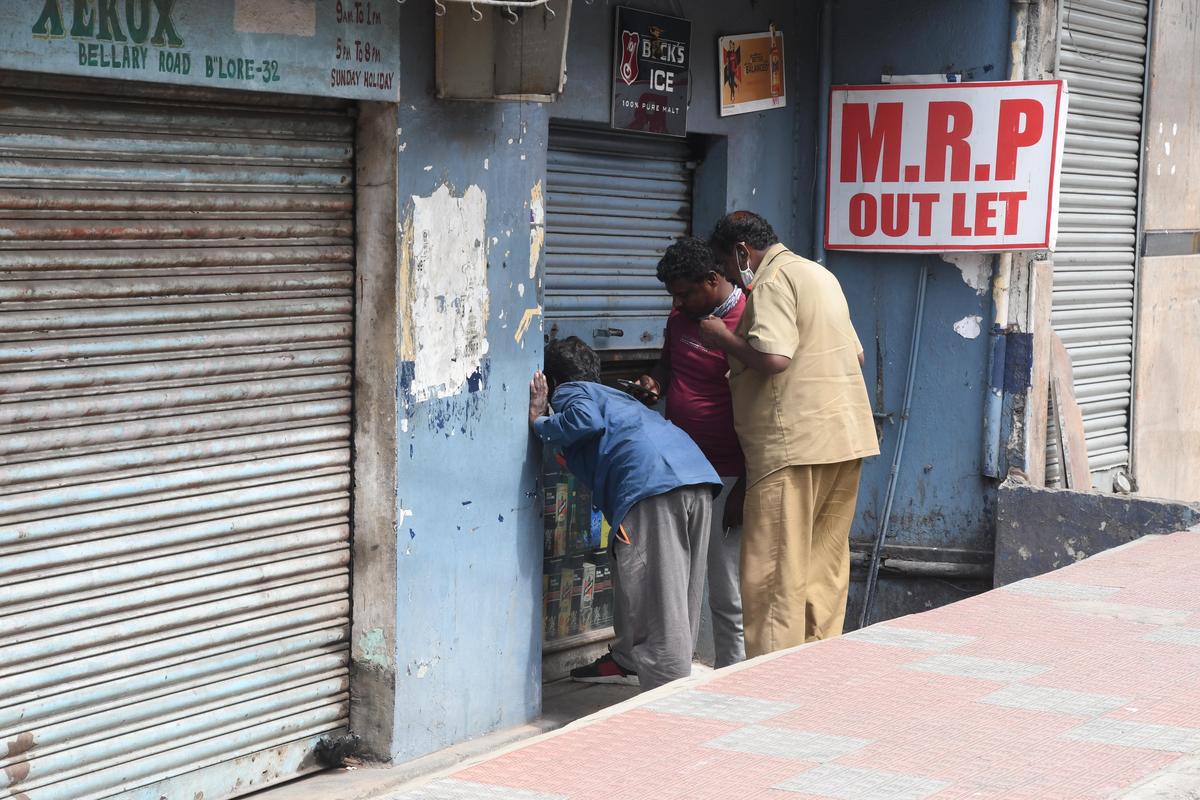
If you walk through the bustling lanes of Bengaluru at dusk, there’s a telling silence at the city’s beloved pubs and restaurants: tables are emptier, conversation softer, and the clink of beer mugs less frequent than in years past. Across Karnataka, beer sales have taken a historic tumble. Yet, in a twist that has industry insiders scratching their heads, the state’s excise revenue—the sum government collects from liquor sales—has surged by 11.34%. The result is a paradoxical triumph, one that reveals how fiscal strategy can reshape consumer habits, ripple through rural economies, and leave a bitter aftertaste in the wake of public policy.
The effects of Karnataka’s steep excise policies ripple far beyond the cash registers at liquor outlets and city pubs. The state is home to eleven breweries—more than any other state in India—employing thousands in direct jobs and supporting many more through allied supply chains, logistics, and hospitality. Industry representatives warn that sustained declines in beer sales threaten not just annual profits but the long-term viability of these breweries. Massive investments, estimated at over ₹5,000 crore in the sector, are now perceived as “at risk,” with some players considering relocating expansion efforts to neighboring states with more stable tax regimes.
For manufacturers, the paradox is especially painful. Karnataka’s beer sector accounts for only about 8 percent of the total alcoholic beverage market in terms of volume, yet it contributes around 16 percent of the state’s liquor tax revenue—a share that has steadily grown from 11 percent over the past five years. This disproportionate impact means that any policy change affecting beer is felt acutely in state coffers and equally so in boardrooms, production units, and farms supplying raw materials.
The latest round of excise duty hikes has prompted the Brewers’ Association of India to sound alarms about investor confidence. Repeated tax increases over the past two years—four times since July 2023—have led to what the association calls “growth stagnation.” Where Karnataka’s beer industry saw robust expansion in 2022–23, growth slowed sharply through 2024 and now stands at a near standstill in 2025. Leaders argue that tax uncertainty creates hesitation for both local and global investors, ultimately curtailing innovation, brand launches, and job creation throughout the sector.
These challenging market conditions have a visible social impact. In city centers, the once-thriving beer culture—a source of community, leisure, and even creative enterprise—faces an existential threat. Lower sales have led many small breweries and taprooms to scale down operations, lay off staff, or pivot toward food-centric business models. For regular consumers, especially among young professionals and working classes, the rising cost of their favorite beverage has turned social outings into rare indulgences rather than routine escapes, subtly reshaping patterns of urban sociability.
Finally, there is mounting pressure on policymakers to recognize these impacts and recalibrate excise strategies to sustain both revenue and cultural vitality. Advocacy groups and economists increasingly call for consultation-based policy making, urging the state to hold dialogues with industry, consumer representatives, and civil society before rolling out new rules. The debate has moved beyond immediate fiscal priorities to a broader argument about the future of leisure, employment, and investment in Karnataka—a future whose rhythm, stakeholders warn, cannot survive if policy remains out of sync with economic and social realities.
The numbers behind this paradox speak volumes. In the first half of 2025, Karnataka sold about 195 lakh boxes of beer (each containing 7.8 litres), down from 242 lakh boxes last year—a nearly 20% drop in consumption. Month-wise data highlights the consistency of the slump: January fell by 30.6%, April and May dipped by over 16% and 26%, and every month in the April–September period showed double-digit declines. Even peak summer failed to revive the market, confirming that the downturn isn’t merely seasonal.
For drinkers, these numbers reflect an everyday reality: a bottle that once cost ₹130 now often retails at ₹160 or more—enough to discourage four out of ten regular buyers. Small-town shops have seen regulars halve their purchases, even as Bengaluru’s pub owners admit their traditional summer bump is lost to price shocks and policy uncertainty.
Over the past two years, the Karnataka government has revised excise duties and license fees four times, each cycle pushing retail prices higher. May 2025 marked the latest twist, as policymakers implemented a hike in Additional Excise Duty (AED) from 195% to 200% of the production cost for beer, increasing bottle prices for premium and mid-range brands by ₹10–₹15. Low-end Indian Made Liquor (IML)—including cheaper brands of rum, whisky, and gin—also saw similar hikes, driving consumers to explore cheaper substitutes or, in some cases, cut back entirely.
In response to public criticism, the government streamlined the AED structure to ease the burden on lower-cost beers, aiming for a fairer approach. Yet, the steeper rates meant that even as fewer cartons were sold, each unit generated more tax—and so, while drinkers drank less, the state earned more. Total excise collections climbed from ₹17,702 crore in 2024 to ₹19,571 crore in 2025, a jump that officials hailed as proof of a “successful tax strategy.”
The Consumer’s Crossroads: Price, Policy, and Pain
(The following section describes the human impact, market shifts, and adaptation among beer consumers and retailers.)
Rising retail prices have aggravated long-simmering tension between policymakers, drinkers, and retailers. A Bangalore pub owner explained, “We can’t even raise food prices anymore—people just stop showing up.” In smaller towns, especially in North Karnataka and coastal belts, regular buyers have cut their purchases dramatically, sometimes buying only one bottle instead of four.
Industry insiders lay the blame squarely on repeated tax hikes. The steep fall in sales is not seasonal, but structural—mirrored across months and districts, from sweltering summer in Belagavi to late monsoon in Shivamogga. Unlike previous years, when peaks and troughs matched festival cycles or weather shifts, 2025 has brought uninterrupted decline across the board. Urban drinkers, once a bulwark for beer brands, have turned cautious or shifted to low-alcohol alternatives.
Retailers, meanwhile, keep watch for a “floor effect”—the point at which further price hikes could push buyers to the black market. While excise officials argue that higher duties prevent binge drinking and boost public revenues, shopkeepers warn that long-term strain could undermine the legal beer trade, stifle bar culture, and even increase illicit sales. To cope, the government recently revised AED calculation, attempting to balance public earnings against market sustainability.
But not all are convinced by arguments of public benefit. “People think drinking is a luxury, but for the working class, even a mild beer is escape from stress,” says Upendra, a regular drinker now limiting himself to special occasions. Widespread pushback has prompted political parties to raise the issue ahead of state budget debates, lobbying for fairer excise policy and more nuanced consumer protections.
The wider liquor industry mirrors the beer trend, albeit less dramatically. While beer sales plummeted nearly 20%, IML sales dipped by a modest 2.8%, showing that hard liquor remains relatively less sensitive to price hikes. Yet, overall, the sector faces what retailers dub “consumer fatigue,” as drinkers adjust habits and cut consumption in the face of relentless markups.
The State’s Windfall and the Road Ahead
Paradoxically, the sharp decline in beer sales has coincided with a windfall in state excise revenue, lifting Karnataka’s collections by over ₹1,869 crore in the first half of 2025. Officials tout this as a sign of economic vitality and smart tax policy, asserting that even if volume falls, higher margins per bottle offset the shortfall. Beer and liquor remain among the state’s top five revenue sources, funding essential infrastructure, welfare schemes, and rural health initiatives.
Excise department spokespersons stress that the new AED structure—195% duty plus flat ₹130 per bulk litre—was replaced with a flat 200% AED with the express intent of creating a more predictable, less punitive system. Venkatesh Kumar R, Commissioner of State Excise, stated that the previous system disproportionately increased MRP for low-cost beers, pricing them out of reach for casual drinkers. The revised structure, he claimed, would “ease the burden” for the lower segment and help stabilize market sentiment.
In real terms, however, the government’s gamble on pricing policy remains a mixed blessing. While it meets fiscal targets, industry leaders warn that sustained decline in beer consumption could hurt allied sectors—production, distribution, retail, hospitality—and threaten long-term job creation. Distributors point to festive demand and year-end sales as the key factors that will determine whether the industry rebounds in 2026, or settles into a new equilibrium at reduced volumes.
The lesson for policymakers may be simple: while excise hikes bring short-term gains, they risk eroding the very market that sustains future revenue. Manufacturers have responded by lobbying for moderate pricing and greater transparency, seeking structured dialogue with state officials to avoid a repeat of this year’s turbulence. Some have suggested differentiated tax rates tied to product category, geographic market, and buyer profile, mirroring international best practices.
Looking forward, Karnataka faces a crossroads. Should government strategy prioritize fiscal returns over cultural and economic value attached to beer and its role in leisure and community? Or should the excise department recognize the signals consumers and retailers are sending, and recalibrate rates to foster sustainable growth?
As the dust settles on 2025’s paradox, one thing is clear: the state’s tax windfall has come at the cost of shrinking mugs and altered habits. The very heart of Karnataka’s conviviality—its beer culture—now stands at a delicate threshold, waiting for policy to find its balance between revenue and resilience.
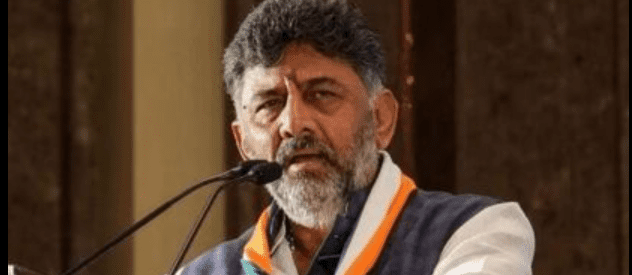
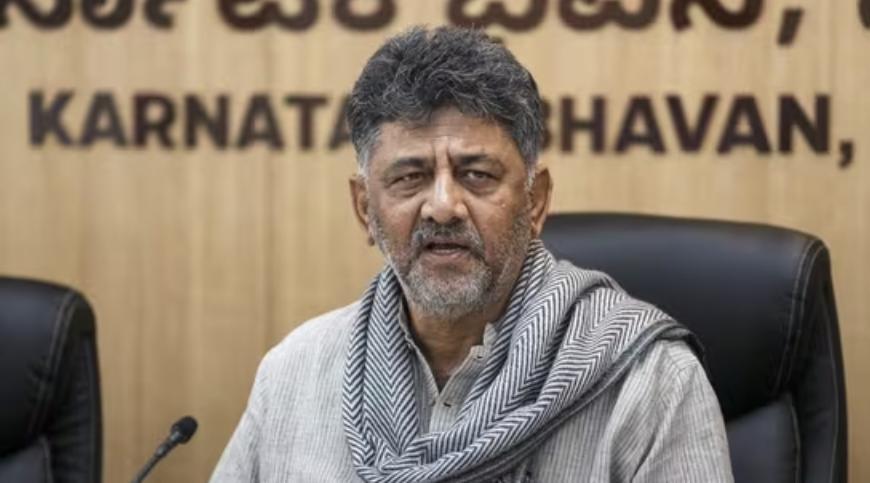
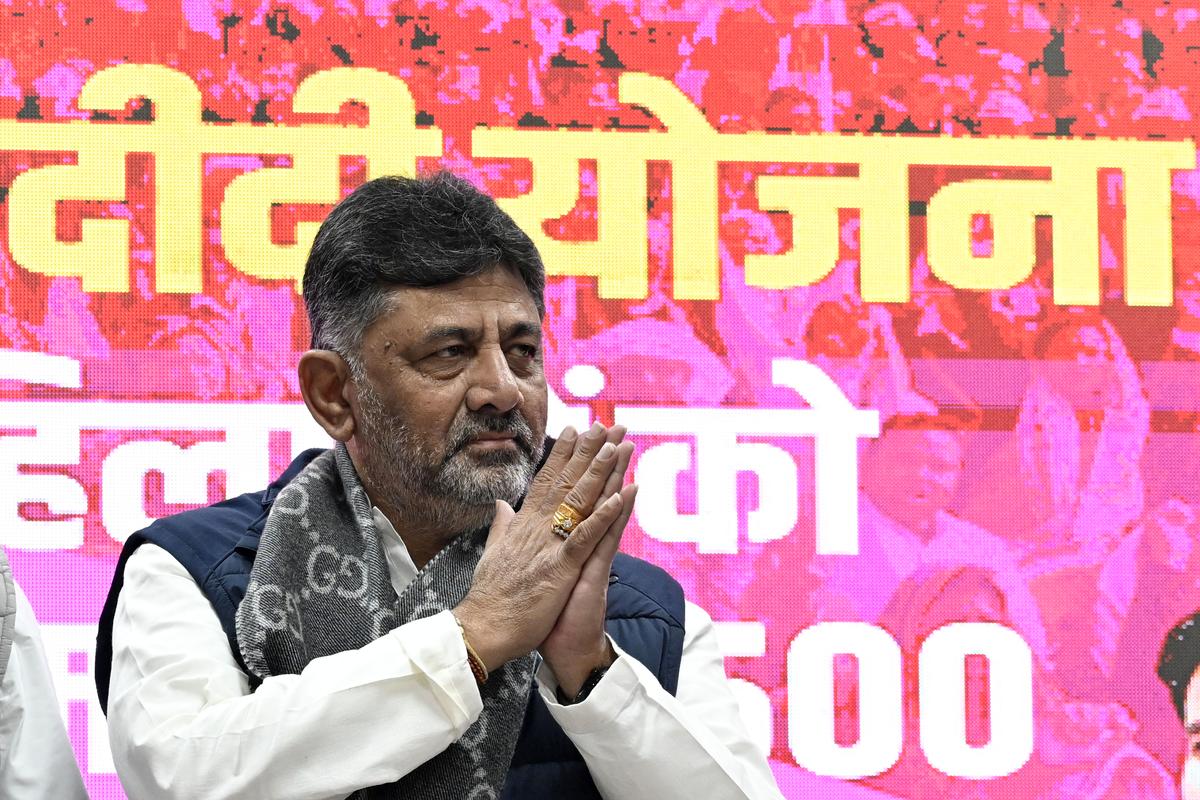
A single social media post by Deputy Chief Minister D.K. Shivakumar this week has reignited debate, speculation, and cautious optimism across Bengaluru — a city whose patience with Metro construction has worn thin from years of shattered timelines and traffic chaos. The post, seemingly celebratory, claimed that the entire Pink Line of Namma Metro would be operational by May 2026. But just as the excitement spread online, confusion quickly followed. Was this official confirmation of a revised deadline, or yet another optimistic projection in a history littered with delayed promises?
The Pink Line, officially known as the Kalena Agrahara–Nagawara corridor, has long been pitched as Bengaluru’s north-south connector, cutting a swath through the city’s most congested arteries — JP Nagar, Dairy Circle, MG Road, Shivajinagar, Pottery Town, and beyond. Once completed, the 21.3-kilometre stretch will link the southern suburbs to the tech-heavy northern corridors, reducing commute time for thousands of daily travelers. More crucially, it will serve as a lifeline for the city’s choking road network, which now records one of the worst average traffic speeds in India.
However, what should have been a straightforward announcement turned contentious within hours. Senior officials from the Bangalore Metro Rail Corporation Limited (BMRCL) declined to publicly endorse the May 2026 deadline, noting that several civil and systems contracts are still awaiting full integration. Internal progress reports, meanwhile, indicate varying stages of completion: while tunnelling in some stretches stands above 90 percent, work in others, especially around Shivajinagar and Cantonment, remains at least eight months behind schedule.
As the confusion deepens, one thing is certain — Bengaluru’s urban consciousness has reached a point where every Metro milestone is met with both hope and skepticism. The Pink Line, painted in promise but clouded by uncertainty, now embodies the city’s eternal wait for movement amid motionlessness.
Cracks Beneath the Concrete: Where Deadlines Falter
For nearly two decades, the idea of a seamless Metro system has captured Bengaluru’s imagination — envisioned as the city’s redemption from gridlock. But translating that idea into dependable timelines has proven elusive. First conceptualized under Phase 2 of Namma Metro in 2014, the Pink Line was touted as the engineering jewel of the project — its twin tunnels winding through some of the busiest and geologically challenging zones in south India. The original completion target, set for December 2024, has already slipped twice due to delays ranging from land acquisition to technical alignment shifts.
D.K. Shivakumar’s announcement of a May 2026 launch reignited long-dormant debates about transparency and accountability. While the Deputy Chief Minister, who also holds the Bengaluru development portfolio, insists progress is on track, project engineers and urban planners remain divided. Insiders suggest that though much of the tunnelling between Lakkasandra and Nagawara is advancing steadily, completing systems integration — ventilation, signaling, track-laying, and safety certifications — will require sustained coordination and uninterrupted funding.
“Building tunnels is just half the story,” said a senior BMRCL engineer. “Installing and testing signaling systems, electrification, track welding, and final runs take almost as long. The rest of the work cannot be rushed merely to meet political optics.”
Of the 21 stations along the corridor, only six elevated ones — including Kalena Agrahara, Tavarekere, and Dairy Circle — are approaching structural completion. The underground network, particularly between Shivajinagar and Pottery Town, remains the most technically demanding, located beneath densely packed neighborhoods where subsoil conditions complicate boring operations. One tunnel-boring machine (TBM) named Rudra had reportedly encountered hard rock layers last month, forcing sequential delays.
What differentiates this project from earlier Metro lines is the sheer complexity of urban coexistence: ancient utilities, markets layered over narrow roads, and shifting foundations have forced engineers to innovate on the fly. “There’s no straight line in this line,” one planner quipped grimly. “Every inch comes with negotiation — between rock, pipes, and politics.”
Meanwhile, commuters navigating the mess above ground experience little empathy for such obstacles. Roads around Langford Town and Vellara Junction remain bottlenecked and dusty, while local businesses complain of falling footfall. “They said two years,” said shop owner Razia Begum, gesturing at barricades flanking her grocery store. “It’s already been three. Now they promise one more. We just want them to finish before our patience runs out.”
The confusion over deadlines also threatens political credibility. Ministers aim to showcase the Pink Line’s progress as a sign of urban revival under the current government, especially in the lead-up to the 2026 Budget year. However, experts caution that compressing construction timelines for political announcements could risk safety compromises. Chief engineers contend that despite challenges, the team remains committed to delivering “the city’s safest, most advanced underground corridor.”
Between Politics and Patience: Bengaluru’s Test of Trust
Transportation sociologist and city researcher Dr. Preethi Ramaswamy notes that the debate over Metro deadlines reveals something deeper than administrative miscommunication — it reflects Bengaluru’s fraying relationship with promises. “Every infrastructure project here begins as celebration and ends as argument,” she observed. “Citizens have become unconsciously conditioned to doubt official dates, not because they are cynical by nature but because they have witnessed consistent slippages.”
If completed as newly claimed, the Pink Line would add an estimated 9 lakh passengers daily to the Metro network — nearly doubling current ridership — drastically improving east-west and north-south connectivity through intersections with the Purple and Green Lines. But for that to happen, synchronizing completion of all 21 stations is critical. “If even a single underground hub lags, full operations cannot begin,” explained a systems planner familiar with Phase 2 timelines. “Partial inaugurations may create headlines, but long-term reliability depends on full functional integration.”
Adding to uncertainty is the challenge of funding continuity. Although the project is financed through a combination of state, central, and Japan International Cooperation Agency (JICA) assistance, minor delays in disbursement can affect imported components such as electrical systems and platform screen doors. BMRCL’s expenditure charts suggest that less than 60 percent of total sanctioned funding has been released for the current fiscal year — a signal that completion by mid-2026 may require accelerated fiscal decisions.
Deputy Chief Minister Shivakumar has chosen optimism as his strategy, emphasizing his determination to “gift Bengaluru its most beautiful Metro line” before his term ends. His recent post showcased visuals of completed tunnels and station designs under a caption celebrating progress. “Work is in full swing, and every possible milestone will be achieved for public benefit,” he wrote. Yet, behind the succinct promise lies the bureaucratic painstaking reality of multi-agency coordination — construction units, contractors, civic bodies, and utilities must all move in perfect rhythm.
BMRCL, while refraining from contradicting Shivakumar publicly, issued internal clarifications that “deadlines remain under technical evaluation.” Project Director Anil Kumar reiterated to the press that timelines would be finalized only after the final tunnelling breakthroughs, expected by early 2025. He maintained that “any statement on operational readiness before the end of system testing would be premature.”
The ensuing irony has not escaped observers — a transport project meant to unify the city has become a metaphor for its communication disconnect. Citizens’ online reactions captured that duality succinctly: memes celebrated the fantasy of 2026, while others lamented that Bengaluru’s Metro projects have perpetually stretched “beyond schedule, budget, and belief.”
Still, amid the skepticism, the anticipation is palpable. Few urban infrastructures stir as much emotional investment as Namma Metro, which despite delays, has transformed how millions commute daily. The evolving skyline, dotted with viaducts, stations, and cranes, stands as both testament and torment — evidence of a city in transition, straddling aspiration and hindrance.
Urban architect Rohit Subramaniam views the Pink Line’s importance as symbolic. “It’s not just another corridor. It’s the thread intended to stitch together Bengaluru’s north and south fractures,” he said. “Every missed month is another inch widened in that divide. But once the line opens, even a minute saved per citizen multiplies into lifetimes of regained time.”
At a larger scale, urban planners argue that Bengaluru’s future depends on how swiftly the Metro network scales up. With private vehicle ownership accelerating and road congestion unrelenting, the difference between a 2026 inauguration and a delayed rollout could alter the city’s next decade. Forecasters predict that if the Pink Line commences operations by mid-decade, traffic volumes on core routes like Hosur Road and MG Road could reduce by nearly 15 percent within a year.
As deadlines blur and optimism flickers, what remains constant is the city’s faith — bruised, yet unbroken. For thousands of citizens, timelines matter less than trust. “We’ve waited this long,” said a college student waiting at Majestic station. “If they can really give us this line by 2026, it’ll be worth every pause we’ve endured.”
By evening, D.K. Shivakumar’s post had amassed thousands of likes, hundreds of comments, and a torrent of questions. Officials, policy experts, and everyday citizens all seemed to be reading between the lines—literally and figuratively. In a city where transport promises often arrive ahead of trains, the date May 2026 now sparkles with both promise and pressure.
Whether it will become a turning point or another entry in Bengaluru’s long ledger of infrastructural hesitations remains to be seen. The Pink Line stretches silently under layers of rock and rhetoric, its tunnels holding more than concrete; they hold expectation, impatience, and perhaps, redemption.
And as night blankets the gridlocked roads above, undercurrents of machinery continue their relentless churn—each rotation drilling not just through stone, but through the weight of a city’s waiting.
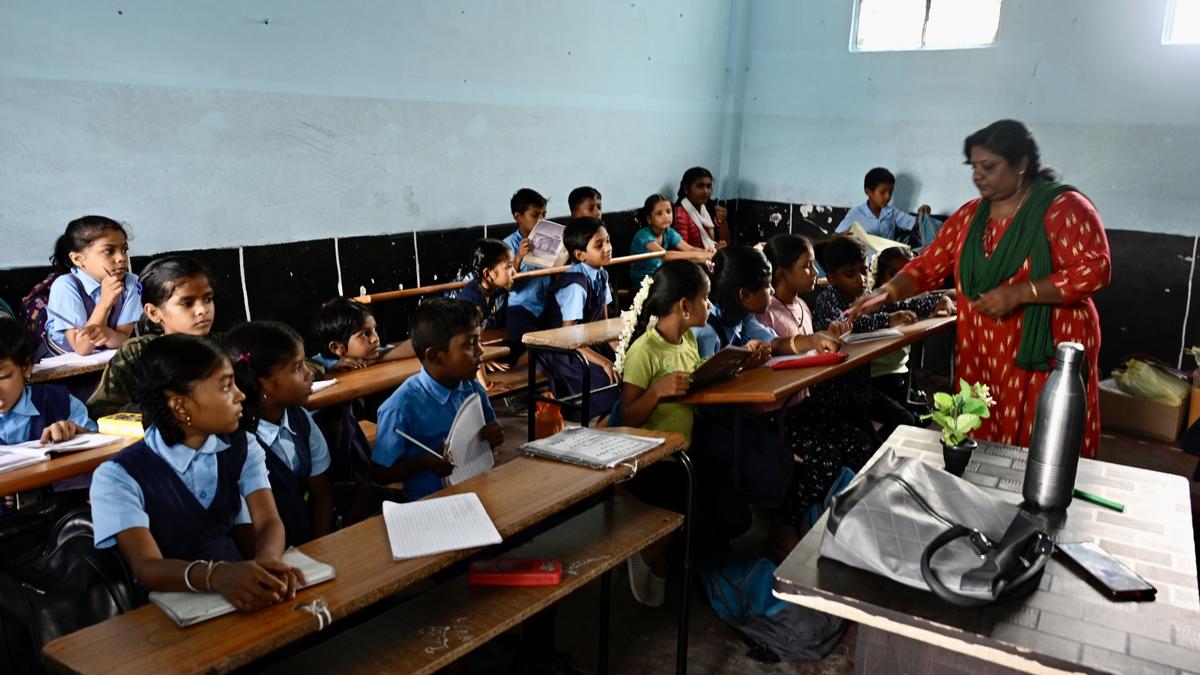
On a crisp Monday morning in Bengaluru, the hum of innovation filled the state education department headquarters as Chief Minister Siddaramaiah unveiled “Kalika Deepa,” an ambitious artificial intelligence-powered learning platform designed to revolutionize classroom learning across Karnataka. Blending technology with inclusivity, the initiative marks one of the state’s most significant education reforms in recent years, aimed at strengthening proficiency in mathematics, English, and Kannada—the three pillars of foundational learning.
Kalika Deepa, literally translating to “Lamp of Learning,” has been conceptualized as both a digital teacher and an empathetic learning companion. Using adaptive algorithms, the platform diagnoses each student’s strengths and weaknesses and tailors lessons accordingly. It can switch from teaching fractions in mathematics to grammar correction in English or vocabulary building in Kannada—all with an intuitive interface accessible even in rural schools with limited resources.
“This is not just a program; it’s a leap into the future of equitable education,” Siddaramaiah declared, as ministers, teachers, and student representatives gathered to witness the launch. “Every child, regardless of background, deserves an equal opportunity to understand and excel. Kalika Deepa will bridge that gap.”
The Chief Minister’s emphasis on inclusion was deliberate. Karnataka, with over 77 lakh students in government and aided schools, has faced persistent challenges in post-pandemic learning recovery. While the Kalika Chetarike initiative bridged classroom gaps temporarily, educators struggled to maintain uniform progress across regions. The new AI-powered model, they believe, could transform how learning continuity is managed—turning what was once manual remediation into personalized digital engagement.
From Chalkboards to Code: A Classroom Transformation in Motion
At the heart of Kalika Deepa lies a simple principle—that technology can adapt where the human system often cannot. Built through collaboration between the Department of School Education and private AI partners, the platform uses real-time analytics to monitor student comprehension. Teachers receive individual learning dashboards showing which students struggled with certain concepts and how much time they spent revisiting each unit.
For instance, if a class of seventh graders in Hubballi shows collective difficulty in handling fractions, Kalika Deepa triggers reinforcement content—animations, interactive quizzes, and voice explanations—in both English and Kannada. When similar confusion arises in language studies, the system reads student responses aloud, identifies pronunciation errors, and provides instant feedback. The AI’s multilingual recognition module allows even first-generation learners to engage without language barriers.
Officials claim the tool will initially cover 1,500 schools across 14 districts before expanding statewide. Tablets and smartboards are being distributed under phase one to ensure that infrastructure bottlenecks do not undermine intent. The state has earmarked a dedicated technical fund, drawing partly from CSR partnerships with technology firms.
Within classrooms, reactions to early trials have been encouraging. At a pilot session conducted in Hassan district, teachers observed a 23 percent increase in participation when AI-driven modules replaced conventional worksheet drills. “Students get excited about the avatars and games. But behind the fun, actual learning happens faster,” said mathematics teacher Nalini M., smiling as her pupils competed to solve digital puzzles. “AI doesn’t get tired or impatient—it repeats as often as a student needs.”
Children, too, appear smitten. Eleven-year-old Manvitha from Shivamogga chuckled as she recounted her favorite feature: “Kalika Deepa talks to me like a friend. It even helps me find the right Kannada words when I forget them.” For educators long battling uneven attention spans and absenteeism, this spark of curiosity promises the return of joy to classrooms.
Yet, officials caution that the platform does not aim to replace teachers but to empower them. “The soul of education is still human,” said Primary and Secondary Education Minister Madhu Bangarappa. “AI is here to supplement—not supplant—the art of teaching. It provides insights no one teacher could gather across hundreds of students daily.”
Beyond classroom convenience, Kalika Deepa also plays a governance role. Policymakers can use aggregated anonymized data to identify learning trends, evaluate curriculum relevance, and detect regional disparities. For the first time, education data will guide reforms bottom-up instead of through guesswork or isolated examinations.
Equal Light for Unequal Realities: The Human Impact
While Bengaluru celebrates technological progress, the real test of Kalika Deepa lies deep within Karnataka’s hinterlands. In places like Raichur, Chamarajanagar, and Vijayapura, where digital literacy remains minimal and connectivity unreliable, teachers are cautiously optimistic. For them, this initiative represents a promise long delayed—a bridge between rural classrooms and quality education once confined to private institutions.
District Education Officer N. Ravi, overseeing operations in Bagalkot, described the program as “perhaps the first time children in government schools will get tools as advanced as those in elite city schools.” The device kits being shipped include pre-installed offline modes allowing interactive features even without internet access. Once connected, student progress automatically syncs to central servers, ensuring continuous monitoring.
AI designers behind the platform say that inclusivity was their foremost challenge. “Our team had to think beyond English or tech-affluent users,” explained project lead Savitha Ramesh from the design consortium. “All interfaces exist in Kannada, and voice commands work in mixed dialects so that children from rural households—where accents vary—can still communicate effectively with the system.”
To strengthen language proficiency, Kalika Deepa employs a voice-based tutor for Kannada reading and comprehension improvement. It reads out stories, poems, and lessons aloud and encourages students to repeat them, identifying phonetic accuracy through speech analysis. For English, the software uses gamified modules emphasizing grammar correction and vocabulary expansion through storytelling. Mathematics lessons, often the most intimidating for students, turn into visual challenges using everyday objects—like mangoes or ragi units—to simplify fractions and ratios.
One of the program’s most impactful features lies in its empathy engine. If a student repeatedly struggles, the AI’s tone modulation becomes calming, offering motivational cues instead of standard alerts. “That empathetic design philosophy comes from research showing children learn faster in emotionally safe environments,” said Savitha. “It’s machine intelligence shaped by human understanding.”
The emotional resonance of the initiative was palpable during the launch event itself. Teachers from government schools across districts were invited to share testimonials. Many confessed that digital technology once frightened them, but training sessions had given them newfound confidence. A teacher from Koppal recalled, “When I joined teaching 20 years ago, I never imagined an AI tool would speak Kannada better than me,” eliciting laughter and applause from the audience.
Yet for all its promise, experts caution against complacency. Educational psychologist Dr. Sriram K. warns, “Technology enhances learning but cannot substitute the teacher’s intuition. Children need empathy, social interaction, and community—all of which no algorithm can replace.” He recommended that the program embed parental engagement modules to sustain learning beyond classrooms.
Karnataka’s education department has addressed such concerns by introducing blended learning models. Regular lessons will continue under teacher supervision, with Kalika Deepa integrated as an after-class reinforcement or home-learning tool. Students can log in from home through parents’ smartphones, while teachers monitor progress remotely. “It’s hybrid education tailored for the public system,” said an official briefing.
From a Digital Dream to a Human Revolution
By evening, as the launch drew to a close, Chief Minister Siddaramaiah lit a symbolic lamp beside the stage, signifying how both innovation and empathy must illuminate the same path. “Kalika Deepa is a reflection of Karnataka’s faith in human capital,” he said softly. “Education is the flame that burns away inequality. Technology is only the oil that sustains it.”
Behind the poetic sentiment lies a vision of structural transformation. Karnataka has long prioritized educational inclusion, pioneering mid-day meals and textbook reforms in earlier decades. Now, by embracing AI, the state aspires to leapfrog limitations of geography, language, and income. The government’s five-year roadmap predicts that every student from grade one to ten in government schools will receive access to Kalika Deepa’s ecosystem through shared devices or mobile applications.
Policy analysts view the move as both forward-thinking and politically astute. By combining progressivism with social equity, the initiative places Karnataka in the national spotlight as a model for digital learning democracies. Other states, including Kerala and Maharashtra, have already expressed interest in similar frameworks.
At the ground level, however, what stands out most is not policy but hope. Teachers describe newfound purpose in witnessing their classrooms evolve from rote repetition to curiosity-driven dialogue. Parents share relief at their children reclaiming enthusiasm once lost to pandemic disruptions. And students—those who are the true north of all educational reform—speak in simple pride: “I can learn on my own now.”
As dusk settled over Bengaluru’s skyline, the Kalika Deepa logo shimmered on a digital screen behind the stage—a softly glowing lamp forming the shape of a child’s face, half-coded, half-human. It captured everything the day had promised: that the future of learning will not be a battle between technology and tradition but a partnership between curiosity and compassion.
Kalika Deepa, in many ways, reignites what Karnataka’s education system has always stood for—not mechanized instruction, but enlightened understanding. In classrooms now brightened by pixels and empathy alike, a new generation of learners is discovering the joy of mastery not through fear of failure, but through the light of empowerment.
And somewhere in those glowing screens, amidst laughter and wonder, burns the promise that no child in Karnataka shall ever learn in darkness again.
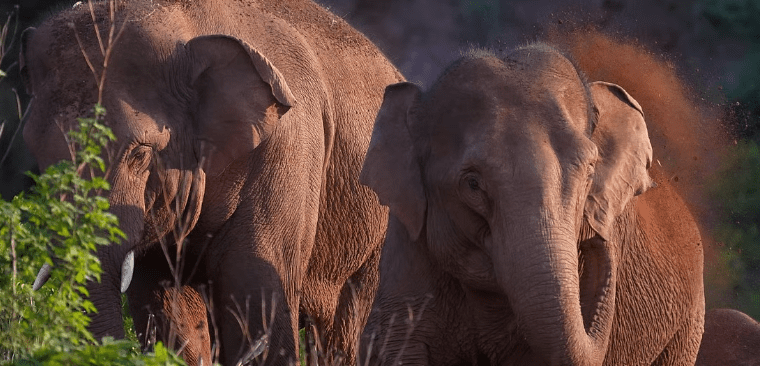
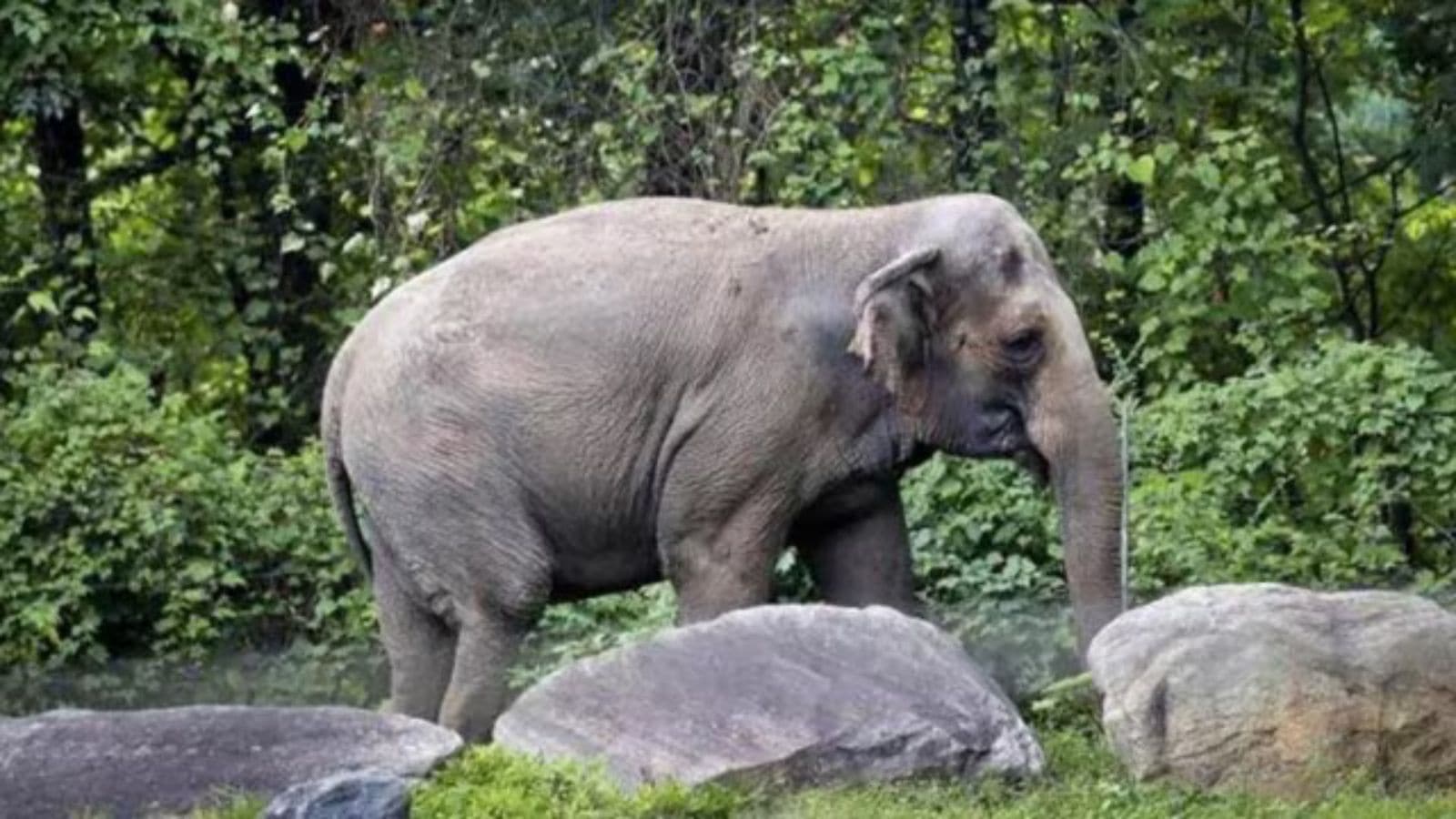
Dawn broke heavy and somber over the paddy fields of Belagavi district on Sunday, where two wild elephants lay lifeless near a sagging electric fence, their massive forms still and their trunks outstretched as if frozen in motion. The morning silence carried the weight of sorrow, a haunting reminder of how fragile the coexistence between man and nature has become across Karnataka’s diminishing wild frontiers.
The tragic deaths occurred near Khanapur taluk, a region known for its dense forests and frequent elephant movement corridors. According to forest officials, the elephants—an adult female and a younger male, believed to be her calf—died instantly after coming into contact with a high-voltage wire meant to protect agricultural fields from crop-raiding animals. The wire, investigators revealed, had been illegally drawn from a nearby power line by local farmers without consent or safety regulation, converting it into a death trap for any creature that strayed close.
For the villagers who woke to the sight of the fallen giants, the scene was unbearable. “They had been visiting these fields often for bananas and jackfruit,” said a local resident, staring hollow-eyed at the clearing where smoke from the short-circuited wires still lingered. “Last night they came again, and did not return to the forest.”
News of the deaths quickly reached district headquarters. Forest and police officials cordoned off the area, and veterinarians conducted postmortems on-site before the bodies were cremated with full forest department protocol. The incident has sparked widespread outrage among conservationists, wildlife officers, and citizens alike, highlighting not only negligence but also the growing desperation of farmers living in constant fear of wildlife raids.
Conflict, Fear, and the Burning Line Between Life and Death
Belagavi district, nestled along Karnataka’s northern corridor and bordering Goa, has increasingly become a chronic hotspot for human-elephant conflict. The forested tracts around Khanapur and Bhimgad Wildlife Sanctuary serve as important migration routes for elephants moving seasonally between the Western Ghats ranges. Over the years, however, rampant expansion of plantations, village settlements, and infrastructure has fragmented these traditional routes, forcing elephants to navigate through croplands and power lines instead of shaded forest canopies.
Officials confirm that herds often enter farmlands seeking nourishment—maize, sugarcane, and plantain offer easy food compared to fast-depleting wild vegetation. While most encounters end without injury, the economic losses to farmers remain heavy. In response, many locals have resorted to improvising makeshift deterrents: chilli fences, digging trenches, installing sirens, and, in extreme cases, connecting fencing wires illegally to high-tension power lines in the hope of scaring elephants away. These illegal electrification practices, banned under state wildlife laws, continue to claim both animal and human lives every year.
In Sunday’s incident, forest enforcement teams discovered that the live wire connection lacked any insulation protection and carried 11 kV of current—enough to kill instantly upon contact. “It was a crude and dangerous setup,” said Range Forest Officer Shankar Gowda. “The elephants must have approached at night and brushed the wire unknowingly. They died within seconds.” The incident has led to the filing of a case under the Wildlife Protection Act, while authorities launched legal proceedings against two local farmers suspected of installing the connection.
For villagers, though, the fear runs deep. They argue that compensation offered after crop destruction barely covers their losses, pushing some toward desperate acts. “We don’t hate elephants,” said a resident of nearby Alnavar, surrounded by half-trampled sugarcane stalks. “But what do we do when they come every week? Government officials promise help but rarely act fast. People lose patience, then tragedies follow.”
Forest officers, acknowledging these frustrations, urge patience and awareness instead of retaliation. “Electric fencing connected to live power lines is not just illegal—it’s inhumane,” said Deputy Conservator of Forests Meena Patil. “Every such death is a failure of communication between communities and the department. To save wildlife, we must first rebuild trust.”
However, systemic fragility runs deeper. Most rural areas adjoining elephant corridors lack effective power regulation and surveillance infrastructure. Farmers often rig connections at night, away from patrol routes, making control difficult. Experts suggest adopting solar-powered fences or low-voltage controlled circuits that deter animals safely without harm. Yet, high costs and bureaucratic delays often derail these solutions before they reach the ground.
Lessons from Loss and the Road to Coexistence
The electrocution of two elephants in Belagavi is not an isolated tragedy—it is part of a grim pattern that has plagued Karnataka for years. According to wildlife records, electrocution ranks among the top three causes of unnatural elephant deaths statewide, alongside train collisions and poaching. Between 2018 and 2024, more than 70 elephants reportedly perished due to power-line incidents across Karnataka, each revealing how the grid of human existence increasingly cuts through the fabric of the wild.
Environmentalists argue that prevention demands more decisive structural reform than reactive punishment. “We cannot continue to treat such deaths as accidents,” said conservationist and former Wildlife Board member Arvind Kumar. “When high-tension lines run through known elephant pathways, the risk is predictable. The responsibility must therefore be shared—between power utilities, forest departments, and local administrations.”
Experts advocate insulating live wires up to a height safe for animal movement and installing ground earthing mechanisms along forest margins. In neighbouring Kerala and Tamil Nadu, small-scale pilot projects using alarm systems triggered by elephant movement have reduced fatalities. Karnataka’s energy department has proposed similar pilot corridors in Hassan and Kodagu, but scaling them to remote northern districts like Belagavi remains a challenge.
Meanwhile, the emotional aftermath remains unmistakable. Forest guards who participated in the investigation described an atmosphere heavy with guilt. “We reached just after sunrise,” one of them said. “The elephants had fallen side by side—perhaps the calf followed its mother in distress. It’s a sight that breaks you.” He added that temple priests from nearby villages performed a symbolic funeral prayer, an act reflecting how deeply elephants are intertwined with cultural identity in southern India.
Chief Minister Siddaramaiah, briefed on the incident Sunday evening, expressed anguish and directed an immediate review of preventive measures. He instructed officials from the Energy Department to ensure insulation of transmission lines across high-risk corridors and to explore subsidies for farmers installing legal fencing alternatives. “Coexistence requires compassion backed by accountability,” the Chief Minister said. “These deaths are preventable if all departments act with urgency.”
For conservation advocates, this intervention must go beyond symbolic statements. They stress that the wider human-elephant conflict is less about direct confrontation and more about fragmented governance. “Each elephant represents centuries of ecological memory,” remarked wildlife ecologist Dr. Neha Ramesh. “Losing them to such negligence isn’t just a crime—it’s the erasure of cultural and biological heritage.”
The Belagavi tragedy also echoes a moral dilemma that rural India wrestles with daily. Farmers, torn between desperation and conscience, watch helplessly as elephants destroy harvests they depend upon for survival. Their frustration is real, their actions often reactions to systemic neglect. As one villager lamented, “We don’t want to kill them; we only want to save our crops. But what choice do we have when no one listens?” The story thus exposes not villains but victims on both sides—humans trapped in vulnerable economies and elephants in collapsing ecosystems.
Forest officials are now mapping new warning zones across the district, using satellite data to track elephant movement routes. Plans are underway to deploy additional rapid response units in Belagavi and increase awareness drives about safe fencing practices. Meanwhile, conservation NGOs have volunteered to organize training sessions for farmers on coexistence models that integrate technology, early alerts, and compensation programs. Yet, as activists caution, measures will bear fruit only if consistently implemented.
Beyond policy, the tragedy underscores a deeper truth: that empathy must guide the interface between progress and preservation. Karnataka’s heritage has long celebrated elephants not merely as wildlife but as living testaments of nature’s wisdom—from temple rituals to forest folklore. Their loss, therefore, strikes not only ecological balance but cultural continuity.
At the Belagavi cremation site that evening, forest rangers laid flowers atop the pyres before lighting them. Flames rose slowly against fading light, and villagers gathered quietly around, many weeping. A symbolic silence followed—the crackle of wood mingling with the drone of distant cicadas. For a moment, the line between guilt and grief blurred completely.
As darkness enveloped the valley, the forest returned to stillness, yet the air bore an unspoken promise: that change would follow this sorrow. Whether that change will come swiftly enough to save future herds remains uncertain. What endures, though, is the lesson left burning in the hearts of those who witnessed that terrible morning— that human safety and wildlife survival can no longer exist in opposition but must learn, urgently, to walk together.
In the fading embers of Belagavi’s fields lie more than two elephants—they lie an entire state’s struggle between fear and empathy, survival and stewardship. Two lives reduced to ash, yet echoing through the hills as a call for reflection and reform. Because in the end, every spark that kills a creature of the wild reminds humanity of its own fragile balance—a balance as delicate as the wire that took them away.



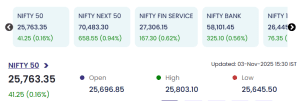 Nifty 50 concluded the day at 25,763.35, rising by 41.25 points (0.16%). The index remained steady, opening at 25,696.85 and trading between a high of 25,803.10 and a low of 25,645.50. Other major indices, including Nifty Next 50, Nifty Financial Services, and Nifty Bank, posted healthy gains, with Nifty Next 50 jumping 0.94% and Nifty Financial Services advancing 0.62%. The broad-based green on indices reflected renewed investor confidence as the session ended.
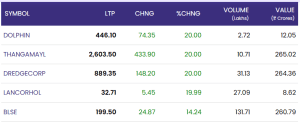 A select set of stocks led the advance, recording double-digit gains. DOLPHIN (₹446.10, +20%), THANGAMAYL (₹2,603.50, +20%), and DREDGECORP (₹889.35, +20%) posted the day’s largest percentage increases, each enjoying strong volume and turnover. LANCORHOL added 19.99%, and BLSE soared 14.24%, closing at ₹199.50 with turnover topping ₹260 crores. The gains were driven by increased buying interest in these counters, offsetting subdued activity across other segments.
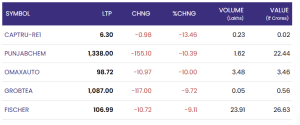 The session also featured significant selling in some stocks. CAPTRU-REI dropped by 13.46% to ₹6.30, while PUNJABCHEM fell 10.39% to ₹1,338.00 with a value turnover topping ₹22 crores. OMAXAUTO retreated by 10% and GROBTEA decreased by 9.72%. FISCHER finished down 9.11% at ₹106.99 despite a high volume turnover. These declines reflected sectoral pressures and selective profit booking, impacting market breadth and signaling the presence of risk aversion in specific segments.
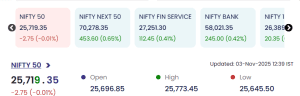 The Nifty 50 hovered around 25,719.35, posting a negligible drop of 2.75 points (-0.01%). The index opened at 25,696.85 and touched a high of 25,773.45 while remaining above a low of 25,645.50. Sectoral indices, including Nifty Next 50, Nifty Financial Services, and Nifty Bank, maintained a positive bias, signalling ongoing investor engagement across broader market spaces.
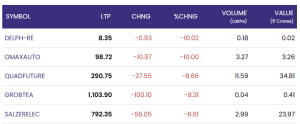 In today’s session, stocks such as DELPH-RE and OMAXAUTO extended their downward streak. DELPH-RE was down 10.02% to ₹8.35, and OMAXAUTO lost 10% at ₹98.72. QUADFUTURE experienced a significant slump, falling 8.66% to ₹290.75 with a high trading value at ₹34.81 crores. GROBTEA and SALZERELEC saw notable declines of 8.31% and 6.61%, respectively, showing signs of sectoral pressure and profit booking, with SALZERELEC recording a high value turnover of ₹23.97 crores.
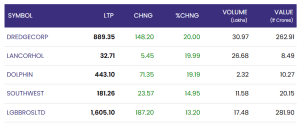 Gains were concentrated in several stocks as strong buying interest emerged. DREDGECORP soared 20% to ₹889.35, underpinned by the session’s highest value turnover at ₹262.91 crores. LANCORHOL jumped 19.99% to ₹32.71, while DOLPHIN advanced 19.19% to ₹443.10. SOUTHWEST climbed 14.95%, and LGBBROSLTD registered a gain of 13.20%, ending at ₹1,605.10 with a remarkable ₹281.90 crores in value. These gainers reflected renewed investor confidence and tactical accumulation in specific counters.
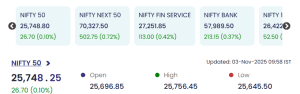 Nifty 50 opened at 25,696.85 and edged up to trade at 25,748.25, reflecting a modest gain of 26.70 points (0.10%) during the morning session. Nifty Next 50 and other major indices such as Nifty Financial Services and Nifty Bank showed similarly positive short-term trends, driven by steady investor sentiment. The high for Nifty 50 stood at 25,756.45, while the low was 25,645.50, indicating a stable trading range.
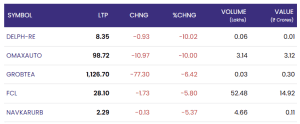 Some stocks recorded significant losses, impacting broader market sentiment. DELPH-RE fell to ₹8.35, losing 10.02%, while OMAXAUTO dropped to ₹98.72, down by 10%. GROBTEA saw a sharp decline, losing ₹77.3 to close at ₹1,126.70, a loss of 6.42%. FCL and NAVKARURB also posted declines of 5.8% and 5.37%, respectively. These movements were accompanied by moderate trading volumes, with FCL experiencing the highest turnover among losers at 52.48 lakh shares.
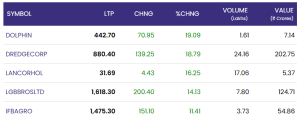 On the flip side, several stocks posted robust gains. DREDGECORP surged 18.79% to ₹880.40, supported by a high turnover of ₹202.75 crores. LGBBROSLTD gained 14.13%, closing at ₹1,618.30. IFBAGRO climbed 11.41% to ₹1,475.30, while DOLPHIN and LANCORHOL saw increases of 19.09% and 16.25%, respectively. These notable gains reflected renewed investor interest and strong buying sentiment across various sectors.