Sunday, May 17, 2026
Home Blog Page 368

October 30, 2025 (Opening): Indian Stock Markets Witness Mixed Trends Amid Nifty 50 Decline

India’s stock markets displayed highly mixed movements on October 30, 2025, as the benchmark Nifty 50 index slipped marginally and several small-cap companies posted dramatic price swings. Data from morning trade revealed significant losses in select stocks, juxtaposed against notable gains in others.

Also Read: Nifty 50 Surges as Blue Dart, PASUPTAC Hit Upper Circuit – Market Recap, October 29, 2025 (Closing)

Nifty 50 Sees Modest Decline

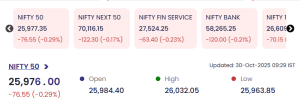
October 30, 2025 (Opening)The Nifty 50 began trading at 25,984.40 and fell to 25,976.00 by 9:29 AM, recording a loss of 76.55 points or 0.29%. The index touched a high of 26,032.05 during the session before dipping to a low of 25,963.85. This mild downward movement was echoed across other prominent indices such as Nifty Next 50, Nifty Fin Service, and Nifty Bank, all reflecting marginal losses at the open.​


Volatile Moves in Small-Cap Stocks

Screenshot 2025 10 30 092939Several smaller companies registered sharp losses, with IXIGO plunging 14.77% to ₹276.80 on a volume of 57.38 lakh shares, and Shaily dropping 5.71% to ₹2,408.20. Delph-RE, TCI Finance, and Zimlab also ended the morning trade with declines exceeding 5%, indicating cautious sentiment among investors in select counters. The steep corrections in these stocks contributed to a largely risk-averse environment in the broader market.​

Strong Advances Led by Eurotexind, Southwest, Megastar

Screenshot 2025 10 30 092929In contrast, certain stocks posted strong rallies. Eurotexind and Southwest both gained 20%, while Megastar was up 11.67%. Trading volumes surged for Essentia (8.47 lakh shares) and HBSL (6.50 lakh shares), with increases exceeding 9% and 10% respectively. These gains suggested targeted buying in companies showing resilience or reporting positive developments, as participants rotated out of underperforming segments.​

Conclusion: October 30, 2025 (Opening)

Overall, the trading session on October 30, 2025, highlighted a fragmented performance in Indian equities. The Nifty 50’s mild decline reflected broader caution, while certain small caps saw wild fluctuations. Investors are likely to remain selective, preferring companies with robust growth outlooks and avoiding names plagued by volatility.

For real time stock Updates, visit NSE website.

Widespread Panic in Bengal: Elderly Man Attempts Suicide in Cooch Behar Over Voter List Error as Election Commission Faces Mounting Criticism

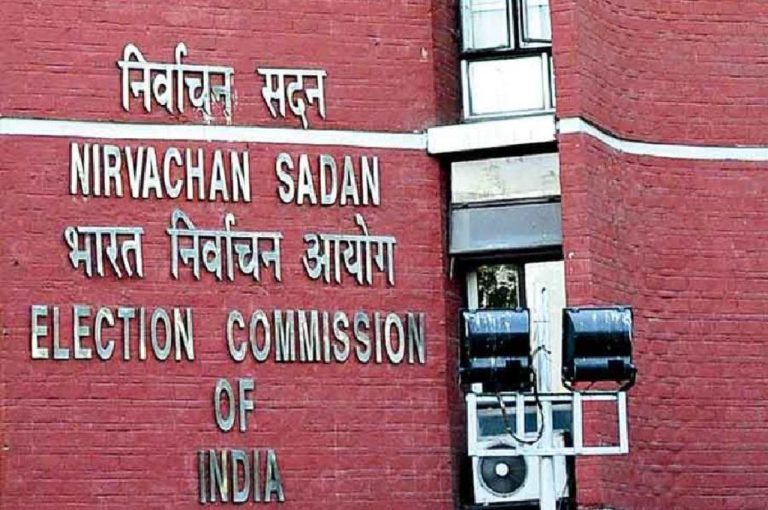
Widespread Panic in Bengal: In a deeply distressing incident highlighting the ongoing chaos surrounding the revision of Bengal’s voter lists, an elderly man from Cooch Behar allegedly attempted suicide after finding his name missing from the updated electoral roll. The episode has stirred outrage across political and civic circles, further intensifying debates over transparency, bureaucratic lapses, and accountability in the voter verification process conducted by the Election Commission of India (ECI).

Widespread Panic in Bengal: The Shocking Incident in Cooch Behar

According to local sources, the 68-year-old resident of Cooch Behar’s Tufanganj area consumed poison upon learning that his name had been struck off the voter list during the ongoing revision exercise. His family members rushed him to a nearby hospital where he is currently undergoing treatment. Doctors have confirmed that his condition remains critical.

The incident has sent shockwaves throughout the district, triggering panic among thousands of voters who fear that their names too might have been erroneously deleted from the rolls. Local residents have since gathered at administrative offices demanding explanations and immediate rectification of what they call “unjust and politically motivated removals.”

Election Commission’s Roll Revision Under Fire

The Election Commission of India, which is overseeing the state-wide revision of electoral rolls, had earlier announced that booth-level officers (BLOs) were tasked with conducting door-to-door verification. However, several reports have surfaced alleging inconsistencies and negligence in the verification process.

Political observers note that errors in voter lists have historically led to serious consequences, particularly in regions with politically sensitive dynamics such as North Bengal. This time, the scale of omissions appears unusually high, with thousands of voters reportedly missing from the lists across multiple districts.

According to the Commission’s official data, Bengal has over 7.9 crore registered voters, and a revision process was undertaken ahead of the 2026 Assembly elections. The ECI had instructed BLOs to ensure that no eligible citizen was excluded. However, lapses in implementation have drawn public ire.

(For more details about the Election Commission’s voter roll revision guidelines, visit the official site of the Election Commission of India: https://eci.gov.in)

Family’s Allegations and Emotional Outcry

The family of the victim alleged that despite repeated visits to local offices, no assistance was provided. “He was extremely distressed for days. Voting was his right, and when he realized his name was not there, he felt helpless. He believed he had lost his voice,” said the man’s daughter in tears.

Local residents added that the man had been a registered voter for over 40 years and had never missed casting his vote. His sudden omission, therefore, felt like an erasure of identity — a symbolic exclusion that pushed him into despair.

Political Reactions: Opposition Seeks Accountability

The incident has sparked a political storm in Bengal. The Trinamool Congress (TMC) accused the Election Commission of “gross negligence” and alleged that the error reflects an attempt to manipulate the democratic process. “This tragic event shows the devastating effects of bureaucratic mismanagement. The Election Commission must take moral responsibility,” stated TMC spokesperson Kunal Ghosh.

On the other hand, the Bharatiya Janata Party (BJP) maintained that the revision drive was necessary to weed out fake voters and ensure fairness in the electoral process. However, the party expressed condolences to the victim’s family and demanded a “transparent investigation.”

The Communist Party of India (Marxist) leader Md. Salim also condemned the incident, stating that “administrative insensitivity has reached its peak.” He added that the voter list errors were becoming a “humanitarian crisis,” urging the ECI to halt the ongoing revision until a full audit is completed.

Mounting Cases of Voter Deletions Across Districts

Reports similar to the Cooch Behar incident have emerged from Nadia, Murshidabad, and South 24 Parganas, where residents discovered their names missing despite having valid voter ID cards. In some cases, even deceased individuals were found listed as active voters, while living citizens were mysteriously struck off.

Several district administrations have now set up grievance cells where affected citizens can submit complaints. Yet, locals allege that the response has been slow and uncoordinated, with many facing long queues and unclear procedures.

For reference, citizens can check their voter details or file complaints directly through the National Voters’ Service Portal (NVSP): https://www.nvsp.in/

Election Commission’s Response

In an official statement released by the Chief Electoral Officer (CEO) of West Bengal, the Commission acknowledged that isolated cases of errors had been reported but denied any large-scale malfunction. “We take such incidents seriously. Instructions have been issued to all district officials to re-verify the deleted names and provide immediate relief to genuine voters,” the statement read.

Officials have also reminded citizens that the special summary revision period allows for corrections, deletions, and additions, which can be requested via Form 6, 7, or 8 under the Representation of the People Act, 1950.

(To access voter correction forms, visit the Election Commission’s portal: https://eci.gov.in/forms/)

Public Reaction and Civil Society Concerns

Civil rights organizations have expressed concern over the psychological impact of disenfranchisement. “For many elderly citizens, voting is a symbol of dignity. Losing that right without explanation can lead to deep emotional distress,” said sociologist Dr. Ananya Chatterjee of Jadavpur University.

Several NGOs have also started awareness campaigns in rural areas, teaching people how to check their electoral status and file corrections. The Association for Democratic Reforms (ADR) has called for third-party monitoring to ensure the credibility of Bengal’s voter roll revision.

A Broader Pattern of Institutional Challenges

This tragic episode also points to deeper structural problems within India’s electoral management system. In recent years, the Election Commission has faced criticism for its handling of sensitive political environments and alleged inconsistencies in monitoring officers at the grassroots level.

Political analysts say that Bengal, given its history of high voter turnout and political polarization, requires more careful supervision than other states. “The ECI must not treat this as a clerical issue. It’s about the very foundation of democracy — the right to vote,” said veteran political commentator Biswanath Chakraborty.

Way Forward: Need for Transparency and Sensitivity

Experts have called for a transparent audit mechanism involving representatives from all major political parties and civil society groups. There are also demands to digitize voter verification using biometric authentication to prevent human errors.

Moreover, the Commission is being urged to launch a statewide helpline and grievance redressal portal specifically for Bengal’s voters to handle emergency cases, especially before upcoming elections.

(You can read the Election Commission’s handbook on voter registration processes here: https://eci.gov.in/handbooks/)

Conclusion: A Wake-Up Call for Democracy

The attempted suicide in Cooch Behar stands as a tragic reminder that administrative inefficiency can have devastating human costs. It is not merely a question of names on a list—it is about identity, dignity, and the sanctity of democracy.

As Bengal gears up for crucial electoral exercises, both the Election Commission and political stakeholders must prioritize people over politics. Every name on that list represents a voice — and losing even one due to negligence undermines the democratic essence that India proudly upholds.

External References:

Also read: Home | Channel 6 Network – Latest News, Breaking Updates: Politics, Business, Tech & More

Election Commission Warns Bengal BLOs of Suspension for Neglecting Voter Roll Duties Amid Statewide Verification Drive — EC Reaffirms Commitment to Clean and Transparent Electoral Process

Election Commission Warns Bengal BLOs: In a significant move underscoring its resolve to ensure the integrity of West Bengal’s electoral rolls, the Election Commission of India (ECI) has issued a stern warning to Booth Level Officers (BLOs) across the state for skipping mandatory voter roll verification duties. The commission has stated that non-compliance with assigned tasks during the special summary revision (SSR) process could lead to immediate suspension or disciplinary action, reinforcing its zero-tolerance stance toward administrative negligence in election-related operations.

According to reports, the warning follows growing concerns about lapses in voter verification activities, especially after instances of absenteeism among BLOs were recorded during field visits. The commission emphasized that the smooth conduct of the voter list revision exercise, a critical pre-election process, relies heavily on the timely and diligent work of BLOs — who are responsible for verifying voter identities, addresses, and eligibility within their respective polling areas.


Election Commission Warns Bengal BLOs:  EC’s Warning and Its Context

The Election Commission’s directive, circulated through the office of the Chief Electoral Officer (CEO), West Bengal, reiterates that every BLO is required to conduct door-to-door verification of voter details as part of the ongoing 2025 electoral roll revision. The exercise is meant to correct inaccuracies, delete names of deceased or migrated voters, and add eligible new voters — especially those turning 18 before the next election cycle.

However, sources in the commission revealed that several BLOs, many of whom are schoolteachers assigned temporary election duties, have failed to attend verification drives, citing reasons such as personal inconvenience, workload, or lack of logistical support. The EC, in its latest advisory, made it clear that such excuses would not be tolerated.

“All BLOs are duty-bound under the Representation of the People Act, 1950. Neglecting these responsibilities will invite departmental proceedings and potential suspension,” the circular reportedly stated.

This warning follows previous incidents in which certain BLOs were pulled up by district election officers for poor attendance during the revision schedule. The EC’s message, therefore, aims to reinforce accountability at the grassroots level — ensuring that the voter list revision remains free from manipulation, duplication, or negligence.


🔹 Importance of BLOs in Electoral Management

Booth Level Officers play a pivotal role in the electoral framework of India. They are the commission’s field-level representatives tasked with maintaining transparency in voter registration and preventing fraudulent entries. From verifying address proofs to assisting citizens in filling Form 6 (for new registrations) or Form 8 (for corrections), BLOs ensure that every eligible voter is counted — and that every false or duplicate entry is removed.

Their duties include:

  • Conducting door-to-door verification of voter details.
  • Updating and submitting periodic reports on discrepancies found.
  • Facilitating voter awareness programs and public grievance redressal.
  • Coordinating with local election offices for continuous updates.

Given their integral role, even minor lapses can have serious electoral implications, particularly in politically sensitive regions like West Bengal, where voter roll manipulation has often been a subject of controversy and political debate.


🔹 Background: EC’s Increased Vigilance in Bengal

The Election Commission’s latest warning comes amid heightened scrutiny of electoral processes in West Bengal — a state where allegations of voter roll irregularities, fake entries, and politically motivated omissions have surfaced repeatedly. Following several public complaints and political allegations, the EC had earlier directed all district magistrates to monitor BLO attendance closely.

Political parties in Bengal, especially both ruling and opposition fronts, have accused each other of attempting to influence the voter rolls to gain electoral advantage ahead of upcoming polls. In this context, the ECI’s message carries both administrative and symbolic weight — sending a clear signal that it will not tolerate any dereliction of duty.

An EC official, quoted anonymously, said that ensuring a credible voter database was the “foundation of free and fair elections.” The officer added that while logistical challenges exist, BLOs must prioritize their election duties during the revision period.


🔹 Bengal Government’s Response and Challenges

Sources within the West Bengal education department, which deploys a large number of teachers as BLOs, acknowledged the challenges faced by field officers but assured full cooperation with the Election Commission. Several teachers’ associations, however, have expressed concerns about the workload and inadequate travel allowances for BLOs working in remote or rural areas.

“Teachers are willing to cooperate with the Commission, but the process must be more organized. Many BLOs face difficulties managing school duties alongside election responsibilities,” said a representative from a state teachers’ union.

Despite these concerns, the EC has maintained that constitutional duties cannot be compromised, and that every state government department must extend full administrative support during election preparations.


🔹 Digital Voter List Verification and Transparency Initiatives

In recent years, the Election Commission has been pushing for digitized and transparent verification mechanisms to improve voter list accuracy. The Garuda App, launched by the EC, allows BLOs to upload voter details directly from the field — including photographs and geotagged data. The commission believes that such tools will reduce human error and increase accountability.

Citizens can also check their names on the National Voters’ Service Portal (NVSP) or through the Voter Helpline App, ensuring that corrections or additions are made promptly. These measures align with the EC’s goal of “One Nation, One Voter ID,” which aims to unify and clean electoral rolls across states.


🔹 Broader Implications for Electoral Integrity

Analysts view the EC’s warning as part of a broader effort to restore public trust in the electoral machinery, particularly after several controversies in recent years over booth-level irregularities and partisan accusations against administrative staff. By emphasizing strict adherence to duties, the Commission is signaling that neutrality and diligence are non-negotiable.

Clean and updated electoral rolls are fundamental to democratic fairness. Errors in the voter list can disenfranchise citizens or enable malpractice. Thus, holding BLOs accountable is essential to preventing the systemic decay of electoral trust.


🔹 What Happens Next

The special summary revision process in Bengal will continue until November 25, 2025, followed by a public display of the updated draft electoral rolls. Citizens will then have time to raise objections or file correction requests before the final publication.

District election officers have been instructed to submit weekly compliance reports on BLO attendance and performance. Any official found guilty of negligence will face disciplinary action under state service rules.

Furthermore, the EC plans to deploy micro-observers and flying squads in sensitive constituencies to ensure that the SSR is conducted with integrity. This proactive monitoring is expected to reduce errors and ensure uniformity across districts.


🔹 Public Participation and Awareness

The EC has urged citizens to actively participate in the verification process by checking their voter details through official platforms and reporting discrepancies. Awareness campaigns through local media, radio, and social media platforms are being intensified to encourage voter engagement.

External Links for Public Access:


🔹 Conclusion

The Election Commission’s latest directive serves as both a warning and a reminder — that India’s electoral integrity depends on the dedication of those who manage it on the ground. In a politically dynamic state like West Bengal, where every vote counts and public trust in the system is crucial, the role of BLOs becomes even more critical.

By threatening suspension and disciplinary action against errant officials, the Commission seeks to ensure that the voter list remains accurate, transparent, and tamper-proof. As the SSR progresses, Bengal’s BLOs now stand at the frontline of one of the most important democratic exercises — safeguarding the sanctity of every citizen’s right to vote.

Also read: Home | Channel 6 Network – Latest News, Breaking Updates: Politics, Business, Tech & More

West Bengal Voter List Controversy: Md Salim Slams Election Commission of India Over RG Kar Doctor’s Name Still on Electoral Roll During Special Revision Drive

West Bengal Voter List Controversy — A fresh political storm has erupted in West Bengal as Communist Party of India (Marxist) [CPI(M)] state secretary Md Salim has publicly lambasted the Election Commission of India (ECI) for its alleged negligence after the name of a deceased doctor from R.G. Kar Medical College & Hospital was found to still exist on the state’s official voter list.

The revelation has renewed debate over the integrity of electoral rolls, transparency in the Special Intensive Revision (SIR) process, and the broader state of electoral accountability in India.


West Bengal Voter List Controversy Unfolds

On October 30, 2025, Salim led a CPI(M) delegation to the Chief Electoral Officer’s office in Kolkata, demanding immediate corrective measures and a public explanation from the ECI.

He pointed out that the name of a woman doctor — the same young physician whose rape and murder at R.G. Kar Medical College & Hospital in August 2024 had triggered nationwide outrage — was still visible on the official voter list of her constituency more than a year after her tragic death.

“The entire country was shaken by her brutal death. There were protests, candle marches, and demands for justice. Yet, even after a full year, her name remains on the voters’ list,” said Salim, addressing the media during the protest.

This discovery, Salim argued, reflects the ECI’s “inefficiency, apathy, and failure to modernise its data-verification system,” adding that “if such errors persist in high-profile cases, what can we expect for ordinary citizens?”


Election Commission’s Explanation

An official from the Election Commission of India responded, clarifying that names of deceased voters are removed only upon formal application or complaint from family members or concerned citizens. Once such a request is made, a Booth-Level Officer (BLO) verifies the claim, and the name is then deleted.

The official stated, “We need to check whether any family member or third-party complaint was submitted after the doctor’s death seeking deletion of her name. Without such an application, the process cannot begin.”

However, Salim countered this as “unacceptable in today’s digital India.” He argued that with digitised death records, Aadhaar-linked databases, and electronic governance systems, the ECI can — and must — automatically verify and remove names of the deceased without waiting for manual complaints.

“This is not the 1980s. All government departments are digitally connected. The Election Commission cannot hide behind outdated procedures,” Salim declared.


Systemic Weakness in Voter Roll Management

The ECI’s current rulebook indeed makes voter deletion a complaint-based process. However, experts say this method often causes discrepancies, especially in urban areas where deaths, relocations, and data mismatches occur frequently.

In this case, the continued presence of a deceased voter’s name has exposed the flaws in the system:

  • Lack of integration between the death-registration database and the electoral roll.
  • Over-reliance on manual verification by BLOs.
  • Delays in inter-departmental communication between municipal bodies and election offices.

According to a senior election official (on condition of anonymity), West Bengal has thousands of pending cases where deceased voters’ names are yet to be removed, mainly due to “lack of communication between civic and election offices.”


Md Salim’s Allegations Against ECI and BJP

Salim accused both the Election Commission and the Bharatiya Janata Party (BJP) of attempting to manipulate the Special Intensive Revision (SIR) process. He alleged that the BJP was using the pretext of “voter list clean-up” to selectively target certain sections of voters.

“The BJP is trying to use SIR to remove genuine voters — minorities, the poor, and marginalised communities — while the Election Commission is acting like a silent spectator,” he said.

He also announced that CPI(M) and Left allies would launch “Voter Adhikar Raksha Kendras” (Voter Rights Protection Centres) across the state to help citizens check and protect their voter registrations.


The Left’s Memorandum to the Election Commission

The CPI(M) delegation submitted a detailed memorandum to the Chief Electoral Officer outlining four key demands:

  1. Immediate removal of deceased and duplicate voters from the rolls.
  2. Guarantee that no genuine or eligible voter is wrongly deleted.
  3. Greater transparency and public access to the SIR process.
  4. Awareness campaigns to educate citizens on verifying and correcting their voter details.

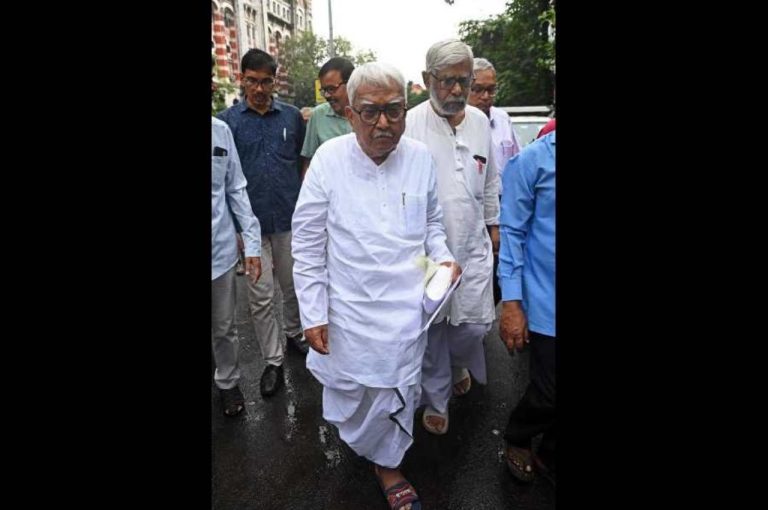
Veteran Left leader Biman Bose, who led the demonstration along with Salim, said:

“People are being misled and frightened by the SIR process. The Commission must ensure that no citizen’s name is deleted unfairly.”


Broader Context: Why This Matters

The presence of deceased or duplicate names on voter lists is not a new problem in India. Multiple reports by the Election Commission of India and civil-society watchdogs have flagged this recurring issue across several states.

A clean electoral roll is essential for free and fair elections. When errors persist, it leads to:

  • Inflated voter counts, affecting poll booth planning and turnout percentages.
  • Possibility of impersonation or bogus voting.
  • Reduced faith in democratic institutions, particularly among first-time voters.

In a state like West Bengal — where political rivalry is intense and margins of victory are often narrow — even minor roll inaccuracies can cause significant political implications.


Expert Analysis: Technology vs Execution

Electoral experts suggest that the ECI should integrate data from municipal death registers, civil registration systems, and Aadhaar databases for proactive removal of deceased voters.

Professor Rajat Roy, a political analyst, notes:

“Digitisation alone doesn’t solve the problem. What’s missing is the administrative will to connect systems and share data efficiently.”

India’s Chief Electoral Roll Management System (ERMS) already supports such cross-verification, but implementation at the state level remains inconsistent.


R.G. Kar Case as a Symbol of Neglect

The doctor’s murder at R.G. Kar Medical College & Hospital was one of the most disturbing crimes in Bengal in recent years. It triggered massive protests across Kolkata, involving students, health workers, and women’s rights organisations.

That her name still appears on the electoral list — despite national attention and official confirmation of her death — symbolises, for many, the institutional failure to update even the most obvious data.

“If the system cannot delete the name of a woman whose death was on every front page, how will it handle the countless unreported deaths across Bengal’s villages?” asked a CPI(M) spokesperson.


The Road Ahead: What the ECI Must Do

As public pressure mounts, the Election Commission of India is expected to:

  • Review all pending deceased-voter entries in Kolkata and other districts.
  • Link death-registration data with the electoral database using the National Population Register (NPR).
  • Enhance citizen outreach through online portals where voters can check, update, or delete names with proper authentication.
  • Issue public reports on the progress of the SIR in Bengal for transparency.

Without these steps, political parties warn that voter confidence could plummet before the 2026 Bengal Assembly elections.


Conclusion: A Test of Democratic Integrity

The controversy surrounding the RG Kar doctor’s voter-list entry has become more than a clerical error — it’s a test of institutional responsiveness, digital governance, and public trust.

Md Salim’s accusations against the ECI have reignited public discourse on whether India’s election system is evolving fast enough to match its digital ambitions.

For now, the ECI faces a simple but symbolic challenge:
To prove that it can uphold accuracy and fairness — the twin pillars of democracy — not just during elections, but in the maintenance of the very list that defines who gets to participate in them.


External Reference Links

Also read: Home | Channel 6 Network – Latest News, Breaking Updates: Politics, Business, Tech & More
Abhishek Banerjee Challenges BJP Over SIR: Questions Amit Shah’s Family Documents, Escalates Electoral Roll Row in West Bengal

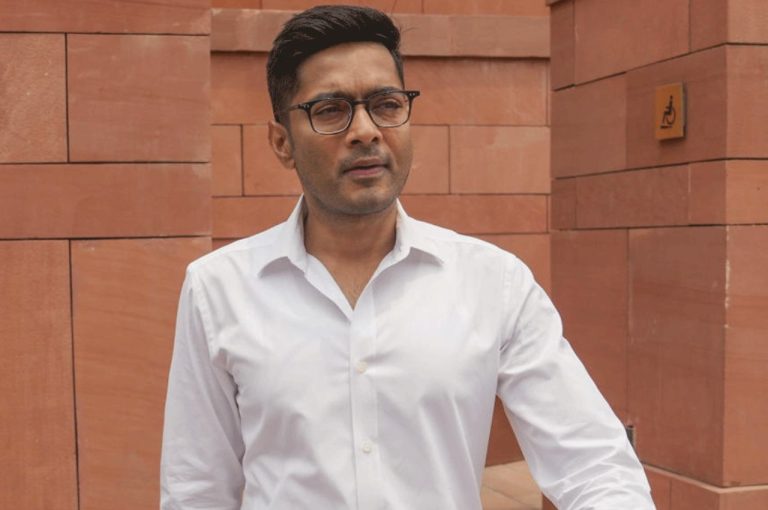
Abhishek Banerjee Challenges BJP: In what is fast becoming a fierce frontline in the political battle of West Bengal, the national general secretary of the All India Trinamool Congress (TMC), Abhishek Banerjee, has ramped up his rhetoric against the Bharatiya Janata Party (BJP) and the Election Commission of India (ECI), accusing them of orchestrating a citizenship/identification exercise that threatens the legitimate voting rights of ordinary people. At the heart of the dispute is the ECI’s roll-revision exercise, known as the “Special Intensive Revision” (SIR), and the demand (per Banerjee) that BJP campaigners must first prove the birth-certificates of their fathers and grandfathers before entering localities.

By publicly daring local BJP leaders to present the documentation his party says the government demands from others, Banerjee has effectively turned the document-verification process into a broader question of identity, citizenship, power and trust. As West Bengal prepares for its next Assembly elections, this clash between TMC and BJP over SIR, voter rights and institutional trust is amplifying.


The Key Statement & Provocative Call

On 29 October 2025, Abhishek Banerjee addressed a public gathering and made the following pointed remarks:

  • He asked that if local BJP leaders come into a locality for campaigning, they be asked to “bring the birth-certificates of their fathers and grandfathers first before they start campaigning.”
  • Underscoring the demand, he suggested the crowd “gherao” (surround) the BJP campaigners until the documents are produced. Banerjee clarified: “Tie them to a tree or a post – but don’t assault them, as we believe in peace.”
  • Further, he questioned whether Union Home Minister Amit Shah himself could produce the birth certificate of his father — insinuating that the requirement imposed on ordinary citizens should first apply to those in power.

The upshot: A local campaign tactic has been reframed as a challenge to power structures and documented citizenship—and a direct gesture to cast doubt on the fairness of the SIR process.


What is the SIR and Why Does It Matter?

The SIR (Special Intensive Revision) of electoral rolls is a procedure by the Election Commission to update and verify voter lists, identifying duplicate, deceased or ineligible names, and ensuring accuracy ahead of major elections. Typically, a variety of documents may be required — one among them being a person’s birth certificate, or in some cases, a parent’s birth certificate before certain cut-offs.

In West Bengal, TMC has been warning that the SIR process risks being used as a covert form of the National Register of Citizens (NRC) — a controversial exercise implemented in Assam — potentially disenfranchising Bengali-speaking citizens and vulnerable communities.

Banerjee’s attacks situate the SIR not just as administrative housekeeping but as a political instrument of fear and control — especially in a State where the next Assembly polls are approaching and the BJP is seeking inroads.


TMC’s Argument: Citizenship Under Threat

The TMC leadership, including Banerjee and Chief Minister Mamata Banerjee, argue that:

  • Many ordinary voters, especially older citizens, those born at home, or from marginalised communities, may not have birth certificates or ancestral documents—they fear being excluded from the electoral roll.
  • The requirement of parent-birth certificates is unrealistic for those born decades ago. Banerjee invoked this as a test for the BJP: “If you ask us for our documents, first produce yours.”
  • The SIR process is being framed as neutral—but its timing and document requirements give it a discriminatory edge against certain demographics (e.g., Bengali-speaking migrants or long-resident populations with informal registration).
  • Therefore, the challenge to BJP campaigners’ documentation is symbolic: “If you enforce these rules on us, first show you meet them.”

By doing so, TMC is attempting both to mobilise its base around a fear of disenfranchisement, and to position itself as the defender of voting rights and Bengali identity.


BJP’s Response and Institutional Push-back

The BJP and its state leadership have responded to Banerjee’s remarks with caution and criticism:

  • The BJP’s West Bengal state president, Samik Bhattacharya, said the party was not concerned about Banerjee’s statements, and emphasised that ensuring democratic rights is the constitutional responsibility of the Election Commission or the Governor’s office — not something that reduces to personal document-wars.
  • The BJP has also demanded that the ECI act upon Banerjee’s call to tie up political workers until documents are produced, terming it incitement or at least highly irresponsible.
  • While the BJP defends the SIR process as routine administrative exercise, its critics say the timing and emphasis on certain documents, in a politically charged state, render it far more than that.

Thus, the institutional clash involves not just two parties but the Election Commission, document-policy, and citizenship verification regimes.


The Incident Trigger: Suicide & SIR Anxiety

A crucial flashpoint for the crisis was the alleged suicide of a 57-year-old man, Pradeep Kar, in the North 24 Parganas district of West Bengal. Kar’s death was linked by TMC to his anxiety over the SIR process. Banerjee visited his family and demanded an FIR against Amit Shah and ECI Chief Gyanesh Kumar for what he called “creating a climate of panic”.

For TMC, the case provides a human story around their fear narrative. For the BJP, it raises questions over how voter-roll exercises are perceived and managed, and whether procedural detail translates into anxiety for certain communities.


Abhishek Banerjee Challenges BJP: Political Stakes in West Bengal

West Bengal is scheduled for Assembly elections in 2026. The BJP has set its sights on the state, while TMC is aiming to consolidate its dominance. In this context:

  • The SIR exercise is seen by TMC as a political instrument to reshape voter rolls in a way favourable to the BJP.
  • For BJP, it is a legitimate administrative exercise to clean up the voter list and assert accountability.
  • The documentation-demand, mobilised by Banerjee, becomes a litmus test: do you ask ordinary voters for proof and yet campaign without disclosing your own?
  • The identity politics of Bengal — Bengali language, migrant communities, border districts, historical demography — all intersect with document-verification, making this more than mere electoral housekeeping.

Citizenship, Identity and Document Politics

Several deeper themes emerge from this clash:

1. Document Verification as Power
The demand for birth certificates of parents and grandparents translates into a verification of lineage, ancestry, and territorial belonging. For people born decades ago, or from marginalised backgrounds, this may be a barrier.

2. Identity Politics of Bengal
Bengali-speaking, sometimes migrant, populations often have informal registration histories. The fear, as expressed by TMC, is that rigorous verification may exclude them from the roll — thus from political voice. The BJP, on other hand, emphasises legal citizenship and registration.

3. Trust in Institutions
When political parties question whether the ECI is acting neutrally, and whether document-requirements are applied uniformly, institutional trust is challenged. Banerjee’s phrasing “If you ask us, first ask yourself” is a direct attack on that trust.

4. Contestation over Victimhood & Agency
TMC is positioning itself as the protector of the ‘ordinary voter’ under threat. BJP peers may say this is fear-mongering. The battle is not just about numbers but about who is perceived as vulnerable or empowered.


Regional and National Implications

While this controversy is geographically situated in West Bengal, its implications ripple beyond:

  • The SIR model has been deployed in multiple states; its translation into Bengal may serve as a precedent for other states with high stakes in border/migrant populations.
  • The challenge of obtaining birth certificates for older citizens or those born at home is nationwide; the Bengal dispute may underscore systemic documentation gaps.
  • The inter-play between central power (through ECI or Home Ministry) and state-identity (through TMC’s narrative) becomes a template for other states where identity politics, citizenship verification and electoral rolls intersect.
  • The language and migrant identity issues raised (e.g., Bengali-speaking populations, banter over “Bangladeshi language”) connect to broader themes of assimilation, exclusion and voting rights across India.

Potential Scenarios Ahead

From the existing standoff, several scenarios may unfold:

  • Escalation: The TMC may mobilise mass protests, legal petitions, and workshops to assist people in “document gathering,” thereby turning SIR into a larger movement.
  • Institutional Push-Back: The ECI or state labour may clarify the document requirements, adjust them temporarily, or issue clarifications to reduce fear—thereby diffusing the situation.
  • Co-option: The BJP may offer document-aid camps, reassure populations, and emphasise fairness to undercut TMC’s narrative of fear.
  • Polarisation: The documentation question becomes an electoral issue — communities feel targeted or empowered — and the Assembly elections become partly about citizenship and rights rather than just development.

Deeper Questions & Challenges

• Why treat birth certificates of ancestors as campaign prerequisites?
Banerjee’s challenge is rhetorically aimed at flipping the logic of the document demand: if they ask us for proof, we ask them for theirs first. But it raises a question: Should campaigners and political agents be subject to documentation demands? The normative argument would say no; the underlying point is symbolic rather than legal.

• How many voters can actually produce parent/grandparent certificates?
Many older citizens in rural India may not have official birth records, particularly if born at home or in remote areas. The ECI’s requirement may thus impose a hardship disproportionally on marginalised populations. TMC leverages this as evidence of exclusion risk.

• Is the SIR process inherently discriminatory?
That depends on how it’s implemented. If it’s a neutral administrative update, then yes, it is standard. If it disproportionately impacts certain demographics, then it may have discriminatory effect. Banerjee is arguing the latter.

• What does this mean for democracy and voting rights?
If legitimate voters are fearful of being removed from rolls due to lack of documents, that undermines democratic participation. The counterside: inaccurate rolls undermine the integrity of elections. The balance is critical.

• Where is identity, language and regional belonging in all of this?
For Bengal, Bengali language, migrant communities, home-births and informal registration are part of the social reality. Document demands intersect with these realities in complex ways, making the controversy about more than just papers—it’s about belonging.


Conclusion

As West Bengal marches towards its next Assembly election, the confrontation between Abhishek Banerjee (TMC) and the BJP regarding the SIR and document demands is emblematic of the larger battle over identity, citizenship, voter rights and institutional trust. Banerjee’s provocative call to demand birth-certificates from BJP campaigners before allowing them to campaign is both rhetorical strategy and protest symbol, meant to turn the documentation regime back on its originators.

For millions of ordinary Bengalis, especially those born before 2002, marginalised, rural, or with informal birth registration, the stakes are deep. If document-proof becomes central to electoral inclusion, the fear of exclusion becomes political currency. And if political parties themselves are challenged to produce documentation, the power dynamic is inverted.

In the end, the controversy forces us to ask: Who gets to ask for whom’s documents? And in a democracy where the vote is the crucial tool of citizenship, how do we ensure that document-verification does not become a new form of exclusion? West Bengal’s unfolding narrative may offer lessons—and warnings—for the country at large.

Also read: Home | Channel 6 Network – Latest News, Breaking Updates: Politics, Business, Tech & More

Starlink Mumbai Demonstration: A Game-Changing Milestone for India’s Satellite Broadband Future

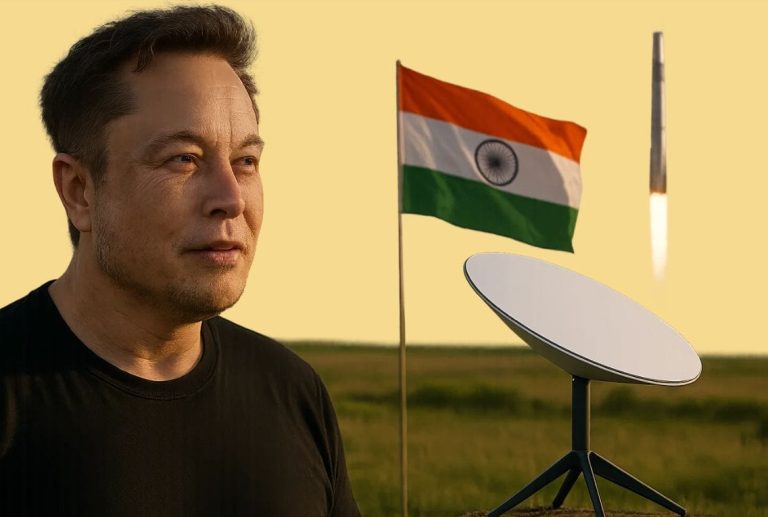
The highly anticipated Starlink Mumbai demonstration represents a watershed moment in India’s telecommunications landscape. As Elon Musk’s satellite internet venture prepares to showcase its capabilities on October 30-31, 2025, the Indian market stands on the cusp of a revolutionary transformation in internet connectivity. This critical testing phase will determine whether Starlink can meet the stringent security and technical requirements necessary for commercial operations in one of the world’s most populous nations.

Starlink Mumbai demonstrationAlso Read: Starlink Mumbai Demonstration: Revolutionary Satellite Internet Launch Unveiled.

Other: President Murmu Raffale Pilot

Understanding the Significance of the Starlink Mumbai Demonstration

The Starlink Mumbai demonstration is far more than a routine technical exercise. Scheduled to take place before designated law enforcement agencies, this two-day event will utilise the provisional spectrum allocated to Starlink by India’s Department of Telecommunications. The demonstration aims to verify compliance with Global Mobile Personal Communication by Satellite (GMPCS) authorisation requirements, including critical security protocols such as Lawful Interception System and Lawful Interception Monitoring.

This compliance verification process is essential for Starlink to secure the final regulatory clearances needed before launching commercial satellite broadband services across India. The Starlink Mumbai demonstration will be conducted at the company’s gateway location in Mumbai, one of three gateway sites approved by the telecom department, alongside facilities in Noida and Chennai.

Technical Capabilities and Infrastructure

During the Starlink Mumbai demonstration, the company will showcase its impressive technical infrastructure. Starlink currently operates the world’s largest satellite constellation, with 7,578 satellites orbiting Earth. The company is targeting a capacity of 600 gigabits per second based on its Generation 1 constellation, which could theoretically support approximately 100,000 connections in India.

The satellite internet service operates through satellites positioned in both Geostationary Orbits (GSO) and Non-Geostationary Orbits (NGSO), enabling high-speed connectivity even in areas where traditional broadband infrastructure is limited or non-existent. This technological approach positions Starlink as a complementary solution to existing terrestrial networks, particularly crucial for a country where internet penetration remains limited in several regions.

The Starlink Mumbai demonstration will highlight the service’s entry-level plans offering 25 Mbps speeds and premium options delivering up to 225 Mbps. These performance capabilities could revolutionise internet access for millions of Indians, particularly those in rural and remote areas who have long been underserved by conventional broadband providers.

Pricing Structure and Market Positioning

Understanding the economic aspects of Starlink’s India entry is crucial for assessing its potential market impact. Following the Starlink Mumbai demonstration, the company is expected to finalise its commercial pricing strategy. Current projections indicate a one-time setup cost of approximately ₹30,000 or more, with monthly subscription prices starting around ₹3,300.

This pricing structure positions Starlink as a premium service compared to traditional broadband options, but the value proposition lies in its ability to deliver reliable high-speed internet to locations where alternatives are either unavailable or inadequate. For businesses, educational institutions, and individuals in remote areas, the Starlink Mumbai demonstration could represent the first glimpse of truly transformative connectivity solutions.

starlink satellite dish with sunset behind source Mariusz Burcz Alamy Stock PhotoRegulatory Framework and Security Requirements
The Starlink Mumbai demonstration occurs within a complex regulatory environment that prioritises national security and data sovereignty. In August 2025, the Indian government established clear guidelines requiring that all data, traffic, and other details accumulated by Starlink must be stored within India. Furthermore, domestic user traffic cannot be mirrored to any system or server located abroad, ensuring data sovereignty remains protected.

These security requirements underscore why the Starlink Mumbai demonstration is so critical. The company must prove its technical capability to implement robust security measures, including lawful interception systems that enable government agencies to monitor communications when legally authorised. This demonstration before law enforcement agencies will validate Starlink’s commitment to operating within India’s regulatory framework while maintaining service quality and user privacy.

Competitive Landscape and Market Dynamics

The Starlink Mumbai demonstration takes place against a backdrop of intensifying competition in India’s satellite broadband sector. The market, currently valued at approximately $4 billion, is projected to triple to nearly $15 billion by 2033, according to Communications Minister Jyotiraditya Scindia. This explosive growth potential has attracted multiple players, with over ten satellite operators having entered the Indian market.

Starlink faces competition from Bharti-backed Eutelsat OneWeb and the Reliance Jio-SES joint venture, both of which have also obtained GMPCS licenses. However, all three companies remain in the testing stage, awaiting final spectrum allocation for full-scale commercial operations. The Starlink Mumbai demonstration could potentially give Elon Musk’s company a strategic advantage in this race, depending on how effectively it showcases compliance with regulatory requirements.

The competitive dynamics have also sparked debate regarding spectrum allocation methodology, with domestic telecom giants Reliance Jio and Bharti Airtel previously advocating for auction-based allocation rather than administrative assignment. These discussions continue to shape the regulatory environment within which the Starlink Mumbai demonstration and subsequent commercial launch will occur.

Impact on Rural and Underserved Communities

Perhaps the most transformative aspect of the Starlink Mumbai demonstration is its potential impact on rural connectivity. Starlink’s India market access director, Parnil Urdhwareshe, emphasised at the India Mobile Congress 2025 that serving rural users represents a fundamental component of Starlink’s mission. A significant percentage of global Starlink users are residential customers in rural areas, where the service often represents the first viable option for high-quality broadband.

This focus aligns perfectly with India’s Digital India initiative, which seeks to ensure technology-driven inclusive growth. The Starlink Mumbai demonstration could validate a solution that brings meaningful connectivity to villages, remote schools, healthcare facilities, and businesses that have historically struggled with inadequate internet infrastructure. By enabling access to educational resources, telemedicine services, e-commerce platforms, and remote work opportunities, satellite broadband catalyses economic development in previously marginalised communities.

spacex india starlink satellites 1024x577 1Timeline and Commercial Launch Prospects


Following the successful completion of the Starlink Mumbai demonstration, the company will finalise its roadmap for commercial launch in India. This timeline remains subject to receiving necessary government permissions and final spectrum clearance. The demonstration represents a crucial checkpoint in a journey that began when Starlink received its GMPCS license in June 2025, becoming the third company after Reliance Jio and Bharti Airtel to obtain authorisation for satellite communications services.

The provisional spectrum allocation that enables the Starlink Mumbai demonstration provides a foundation for testing, but full commercial operations will require permanent spectrum assignment. The government’s decision-making body has sought clarification from the Telecom Regulatory Authority of India (TRAI) on various aspects of satellite spectrum recommendations, including fees for urban customers and annual minimum spectrum charges. Resolution of these regulatory matters will significantly influence the timeline between the Starlink Mumbai demonstration and actual service availability to Indian consumers.

Future Implications and Technological Innovation

The Starlink Mumbai demonstration represents more than just one company’s market entry; it symbolises India’s embrace of next-generation connectivity solutions. The opening of direct-to-cell communications service, which enables signals from satellites to be es directly to mobile phones, has further strengthened the growing satellite communications market. This technological convergence could lead to innovative applications beyond traditional broadband, including emergency communications, maritime connectivity, and Internet of Things (IoT) deployments across vast geographical areas.

As India positions itself as a global technology hub, the success of initiatives like the Starlink Mumbai demonstration will influence international perceptions of the country’s regulatory environment and market accessibility. The demonstrations will be closely watched by other satellite operators consideriIndia’sdia expansion, potentially accelerating innovation and investment in the sector.

Japan Father Runs 42 km Marathon in Memory of His Lost Family, A Heartbreaking Tribute That Moved Millions

Japan Father’s Emotional Marathon for His Late Family

A 42-year-old Japan father, Keisuke Oma, has gone viral for his deeply moving act of love and remembrance. He completed the Kanazawa Marathon, not for fame or record, but to honor the memory of his wife and three children who tragically lost their lives in the devastating Noto earthquake. His emotional journey across the 42 km race captured the hearts of millions worldwide.Man runs marathon to honor lost family members

As Keisuke crossed the finish line, he wasn’t just completing a marathon he was carrying the memories of his family with every step. On his running shirt, he had printed the smiling faces of his wife and children, symbolizing that they were running beside him in spirit.

Japan Father’s Strength Amid Deep Loss

For Keisuke, the marathon wasn’t merely a race it was a message of strength, endurance, and love that transcends loss. After losing his entire family in the Noto earthquake earlier this year, he found running to be both an escape and a tribute. Each kilometer represented a memory, a promise, and a silent prayer.

Locals who witnessed him run said the moment he crossed the finish line brought tears to many eyes. Some runners even joined him for the last stretch, offering silent support as he raised his hands in the air, clutching a photo of his family.

The image of a father running for his lost loved ones spread rapidly on Japanese and international social media platforms, symbolizing courage through unimaginable pain.

Japan Father Turns Grief Into Inspiration

The story of the Japan father has inspired thousands of people around the world to see grief not as an end, but as a form of love that continues to live on. In interviews with local media, Keisuke shared that running helped him process his emotions and stay connected to his family’s memory.Japan man loses wife, 3 kids in quake, honours memory by running marathon with their photo | South China Morning Post

“I wanted to show that even when everything is gone, love still gives us the strength to move forward,” he said. His story resonated deeply with many who have experienced personal loss, reminding them that resilience often grows out of heartbreak.

Communities in Noto and Kanazawa have since come forward to honor Keisuke’s act, calling him “a symbol of hope” for those who lost loved ones in the earthquake. His run was not about speed, but about love a message that reached far beyond the marathon grounds. Also Read: Unfair Advantage: 7 Timeless Laws That Quietly Shape Success and Power

Japan Father’s Tribute Echoes Beyond the Finish Line

The Japan father’s tribute did not end when he crossed the finish line. In the days following the marathon, messages of support poured in from around the world. People shared artwork, letters, and posts celebrating his strength and dedication to his family’s memory.Japan man loses wife, 3 kids in quake, honours memory by running marathon with their photo

Keisuke’s act has also sparked renewed conversations about emotional healing after tragedy in Japan. Many have called his story a reminder that grief, when channeled with purpose, can inspire others to cherish their loved ones more deeply.


View this post on Instagram


A post shared by AsianFeed (@asianfeed)

Even though his home is now quiet and empty, Keisuke continues to visit the places his family once loved, often bringing flowers and running shoes saying that running helps him feel close to them again.

Conclusion

The story of this Japan father is not one of sorrow alone, but of powerful love that endures even after loss. Keisuke Oma’s marathon was more than a race; it was a journey through grief, faith, and remembrance. His emotional tribute touched millions, reminding the world that true love never fades it only finds new ways to keep running.

Actor Chris Evans Welcomes First Child With Wife Alba Baptista in a Joyful New Chapter

0

Actor Chris Evans Embraces Fatherhood With Alba Baptista

Actor Chris Evans, widely loved for his iconic portrayal of Captain America, has entered a new phase in life fatherhood. The actor and his wife, Alba Baptista, have welcomed their first child together, reportedly born on Saturday in Massachusetts. The news has brought immense joy to fans worldwide, who flooded social media with congratulatory messages and warm wishes for the couple.Chris Evans and Alba Baptista welcome their first child: Reports | Onmanorama

Chris Evans, known for maintaining a private personal life, has always expressed his admiration for family values and stability. Those close to him describe this moment as something he had long looked forward to a shift from the spotlight of Hollywood to a quieter, more fulfilling life centered around love and family.

While the couple has yet to make an official announcement, sources close to them confirmed that both mother and baby are healthy and doing well.

Actor Chris Evans and Alba Baptista’s Quiet Yet Beautiful Journey

The relationship between Actor Chris Evans and Portuguese actress Alba Baptista has been one of quiet affection and mutual respect. The pair first sparked dating rumors in late 2022 and later confirmed their relationship through subtle public appearances. Their low-key wedding, held in September 2023, reflected their preference for intimacy over attention.Chris Evans And Alba Baptista Welcome Their First Child: Heres Everything We Know So Far

Friends describe them as deeply supportive of one another’s careers while keeping their private life away from media noise. Evans has often spoken about his desire for a stable family life, saying in an earlier interview that “nothing compares to the peace of having a home and people to love.”

Their decision to welcome their first child in Massachusetts, away from Hollywood’s constant buzz, reflects their grounded lifestyle. Sources close to the couple say they wanted the birth to happen in a familiar, peaceful environment surrounded by close family and friends.

Actor Chris Evans’s Transition From Hollywood Icon to Family Man

Over the years, Actor Chris Evans has evolved from being one of Hollywood’s most sought-after action stars to a reflective, grounded individual focused on life beyond the big screen. After his successful run in the Marvel Cinematic Universe, Evans has chosen projects that align more closely with his artistic values and personal priorities.

This new milestone becoming a father is seen by many as a natural progression in his life. Insiders reveal that Evans has been eagerly preparing for fatherhood, taking time off from major film schedules to support Alba during her pregnancy. His friends describe him as “hands-on and deeply involved,” ensuring that the journey into parenthood is as comfortable as possible for his wife.Chris Evans, Alba Baptista marry with Marvel guests on hand - Los Angeles Times

Alba Baptista, known for her roles in Warrior Nun and other European films, has also taken a step back from acting commitments to embrace motherhood fully. The couple’s shared approach to life rooted in love, privacy, and mindfulness continues to endear them to fans worldwide. Also Read: Unfair Advantage: 7 Timeless Laws That Quietly Shape Success and Power

The Couple’s Future Plans and Life Beyond the Spotlight

With this new addition to their family, Actor Chris Evans and Alba Baptista are expected to spend more time in Boston, balancing personal life with selective professional projects. Close associates say Evans plans to stay close to home for the next few months, focusing on his family rather than rushing into new film commitments.Chris Evans Shares Thoughts on Having a Family With Wife Alba Baptista

While the actor has not made a public statement yet, his past remarks about family life provide a glimpse into his mindset. “When you look back at your life, it’s not the movies or fame that matter the most,” he once said. “It’s the moments with the people you love.”

Fans across the globe are celebrating this new chapter in Evans’s life, not just as the birth of his child but as a symbol of growth and fulfillment beyond fame.


View this post on Instagram


A post shared by Pubity (@pubity)

Conclusion

Actor Chris Evans and Alba Baptista’s quiet journey into parenthood is a reflection of their grounded love story one built on privacy, respect, and deep emotional connection. Their new beginning as parents marks a beautiful phase in their lives, far from the glamour of Hollywood and closer to the warmth of home. As Evans embraces fatherhood with the same sincerity he brings to his craft, the world looks on with admiration and heartfelt congratulations for the couple.

Chinese Wu Lei’s Grand Return: Inside the 42 Million USD Fantasy Epic “The One”

0

Chinese Wu Lei Steps Into “The One” With Intense Dedication

Chinese Wu Lei has officially returned to the historical fantasy genre with The One, a massive $42 million production that blends mythology, war, and human emotion. Known for his deep commitment to every role, Wu Lei reportedly trained in swordsmanship for six months and lost nearly seven kilograms to bring his character to life with realism and intensity.Burberry Taps Chinese Actor Wu Lei as Latest Brand Ambassador

The actor, who rose to fame through period dramas, is taking his passion to a new level in this ambitious project. Sources close to the production reveal that The One is not just a fantasy epic it’s a visually stunning story about courage, loyalty, and destiny. The series aims to set new standards for Chinese television with its large-scale sets, costume design, and cinematic visuals that rival international productions.

Chinese Wu Lei and the Making of a Massive Fantasy World

The production of The One is already creating excitement among fans and critics alike. With an investment of over $42 million, the drama combines traditional Chinese culture with elements of fantasy storytelling. Every detail from the design of ancient kingdoms to the choreography of battle scenes reflects months of preparation.About Wu Lei – Wu Lei Galaxy

Chinese Wu Lei, known for his discipline and humility, was deeply involved in the creative process. Reports suggest he underwent continuous physical training, sword combat rehearsals, and emotional workshops to understand his character’s inner struggles. The director described his performance as “powerful yet restrained,” adding that Wu Lei’s transformation made the role feel completely authentic.

The team behind The One includes renowned cinematographers, costume designers, and VFX artists who previously worked on globally recognized Chinese blockbusters. The series promises to showcase the grandeur of ancient China while introducing themes of sacrifice, leadership, and self-discovery.

Chinese Wu Lei’s Transformation Journey for the Role

For Chinese Wu Lei, preparation went far beyond acting. He adjusted his entire lifestyle following a rigorous training routine and a clean diet to lose 7 kg safely before filming began. He practiced swordsmanship for hours daily, focusing on technique, posture, and agility to perfect the art of historical combat.

The actor has shared in interviews that the process was both mentally and physically challenging. However, he emphasized that embodying such a complex character required complete immersion. His commitment reflects the growing professionalism of young Chinese actors who treat every project as an opportunity to represent their nation’s cinematic potential on a global scale.Wu lei/ Leo Wu : r/CDrama

Wu Lei’s transformation also mirrors the evolution of Chinese television itself shifting from simple historical dramas to large-scale productions that blend storytelling depth with world-class visuals.

What Makes “The One” a Landmark Project for Chinese Entertainment

The One is more than just another fantasy drama. It’s a reflection of how Chinese storytelling continues to evolve with technology and creativity. The show’s high production value, intricate set designs, and emotional narrative mark a major step forward for the country’s entertainment industry.Wu Lei: From Child Star to Leading Man – The Drama Dojo

Chinese Wu Lei’s role in the project highlights how young talents are shaping the future of drama production balancing artistry with discipline. Fans are eagerly waiting for its release, anticipating not just the grandeur of the visuals but also the emotional depth Wu Lei brings to the screen.


View this post on Instagram


A post shared by Layar Hijau (@layarhijau)

As the series nears completion, industry watchers expect The One to make waves across Asia and possibly beyond. It represents a new era of storytelling where traditional legends meet modern filmmaking excellence. Also Read: Unfair Advantage: 7 Timeless Laws That Quietly Shape Success and Power

Conclusion

Chinese Wu Lei continues to prove that dedication and hard work define true stardom. His return through The One isn’t just another acting milestone it’s a statement of artistic growth and cinematic ambition. With a $42 million budget, intense preparation, and a team of top-tier creators, The One is shaping up to be one of the most anticipated historical fantasy dramas of the year and Wu Lei stands at its heart, stronger than ever.

Unfair Advantage: 7 Timeless Laws That Quietly Shape Success and Power

Unfair Advantage and the Power of Everyday Discipline

Unfair Advantage a phrase often associated with luck or privilege isn’t always about external benefits. Sometimes, it’s built through discipline, awareness, and small consistent habits that most people overlook. The recent buzz around the “Seven Laws of Unfair Advantage” has caught the attention of entrepreneurs, students, and professionals who believe true success lies in mastering self-control rather than chasing instant results.Sydney Sweeney: Euphoria Season 3 Will Be Bittersweet, All of Her 20s

The concept explains that while everyone has access to the same 24 hours, only a few turn time into transformation. The difference lies in how people think, react, and sustain focus even when motivation fades. This practical approach to success is gaining attention because it moves away from motivational hype and focuses on grounded, repeatable actions.

Unfair Advantage and the Laws That Build Silent Strength

The “Seven Laws of Unfair Advantage” highlight the mindset patterns that separate achievers from dreamers. Each law focuses on understanding human nature and using it wisely.Who is Sydney Sweeney and what are her best roles?

Law One focuses on consistency over intensity. It’s not about doing big things once but doing small things daily. Success grows through habits that look ordinary on the surface but create extraordinary results over time.

Law Two reminds that discipline beats motivation. Motivation fades with mood swings, but discipline survives even on hard days. People with discipline don’t wait for the right time they create it.

Law Three points to emotional control. Staying calm when everything feels uncertain is what gives individuals an edge. Those who react less, decide better.

Law Four speaks about energy management rather than time management. It suggests that one’s focus, rest, and clarity matter more than a full to-do list. A mind at peace produces better results than a restless one.

Law Five highlights adaptability. Those who evolve with situations gain silent power the ability to adjust quickly without losing direction.

Law Six reflects the power of environment. The people and surroundings one chooses can either nurture or destroy progress. Building a strong circle becomes part of the unfair advantage itself.

Law Seven reveals the principle of compound progress. Every small step, when repeated, builds invisible momentum that later shows visible success.

These laws are being discussed widely because they shift focus from competition to self-mastery. Instead of looking at what others have, they urge individuals to maximize what they can control thoughts, habits, and decisions.

Unfair Advantage and the Hidden Side of Success

What makes this concept powerful is its silence. The unfair advantage isn’t loud or showy. It operates quietly in people who wake up early, keep promises to themselves, and stay focused when others get distracted. In a world filled with shortcuts and comparisons, this mindset feels refreshingly real.Sydney Sweeney (Actor)

Many industry leaders and professionals now describe this as the “invisible engine” behind consistent growth. The modern work culture rewards visibility, but the unfair advantage works backstage in the form of habits built away from attention. It is not about competing harder but understanding how life rewards patience and persistence differently.

The growing interest in this idea shows that people are beginning to value inner discipline as much as outer achievement. The shift is subtle but powerful success is no longer just about winning; it’s about lasting. Also Read: Priya Sachdev Kapur’s 1 Powerful Step to Continue Sunjay Kapur’s Legacy at Sona Comstar

Why Unfair Advantage Matters in Today’s World

In an era of information overload, the real strength lies in clarity. People who stay grounded and consistent automatically move ahead of those who constantly restart. The unfair advantage isn’t given; it’s earned through actions that others skip because they look too simple.

This idea resonates strongly with those who are tired of temporary motivation. It offers a structure that works in real life whether it’s studying for exams, leading a business, or maintaining health. When followed steadily, these laws not only improve productivity but also bring a sense of peace that amplifies performance.

Conclusion

Unfair Advantage is no longer just a phrase it’s becoming a principle. The seven laws behind it show that real progress doesn’t depend on privilege or luck. It depends on quiet consistency, mental strength, and emotional clarity. Those who understand and apply these timeless truths create their own advantage one that no one can take away.