Sunday, May 17, 2026
Home Blog Page 374

West Bengal Health Department Reform Crisis: Chief Minister Flags Lapses and Mandates Identity Cards, Roll-Calls & Police Verification for Hospital Staff Amid Governance Breakdown

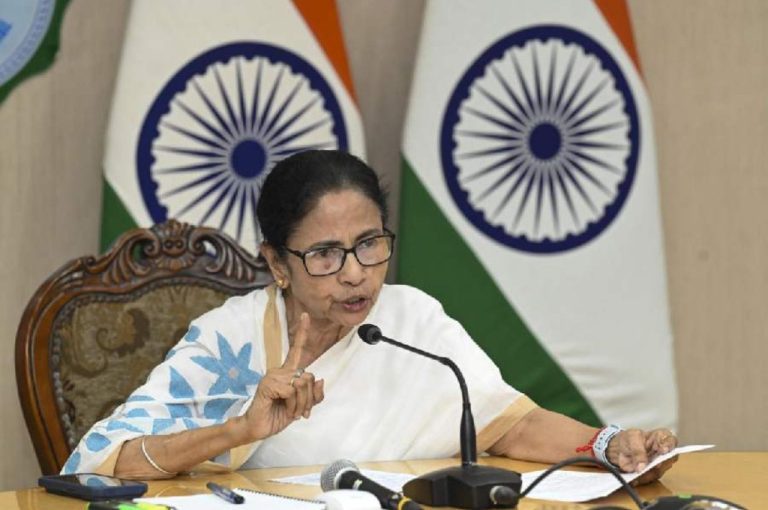
West Bengal Health Department Reform Crisis — In a rare and striking public intervention, Chief Minister Mamata Banerjee has triggered high-alert governance reforms within her own portfolio, the state Health & Family Welfare Department, after a sequence of security lapses in public hospitals. At a high-level meeting convened on Saturday, she instructed all state-run hospitals to enforce mandatory identity cards, institute daily roll-calls of staff, and ensure police verification before appointment of contractual and outsourced personnel. Her pointed question to officials — “Why have so many incidents been happening in only one department — the one headed by me?” — underscored the urgency and political stakes of the health-department crisis.

With the state preparing for the 2026 Assembly elections, the public visibility of these directives marks both a governance shift and a potential campaign pivot. The once-routine domain of hospital administration is now under the glare of accountability, with implications for staffing policy, contract labour, security protocols and institutional oversight across West Bengal’s extensive public-health infrastructure.


The Incident That Sparked the Crisis

The immediate trigger for the CM’s intervention was a troubling incident at SSKM Hospital (Seth Sushil Kumar Medical Hospital), Kolkata. A minor patient in the outpatient department was allegedly accosted by a uniformed male worker whose identity appeared forged. Investigations revealed that the individual had previously been employed at another government institution and had entered SSKM under false credentials. Hospital staff, shocked by his audacity and the apparent breakdown in gate-security, alerted authorities.

This episode came on the heels of other security failures in state-run hospitals — including the widely reported murder and rape of a junior doctor at R.G. Kar Medical College & Hospital last year — raising the alarm that the department may lack sufficient control over non-medical staff, contract workers and access protocols.

In her meeting, Chief Minister Banerjee directly asked:

“Why have so many such incidents been happening in only one department ­– the one under my direct oversight? This must be investigated.”

Her manner and tone conveyed more than administrative direction — they revealed exasperation and a willingness to place the burden of accountability squarely on the department’s leadership.


The New Directives: Scope and Strategy

From the meeting transcripts and official communiqués, the following major directives emerged:

  1. Mandatory Identity Cards for All Hospital Staff
    Every person working inside a state-run hospital — from senior doctors to cleaning staff and outsourced security guards — must wear an identity card permanently while on duty. Gate-keepers are instructed to visually verify IDs at point of entry and deny access to unverified personnel.
  2. Roll-Calls at Shift Start and End Times
    Each hospital must implement digital or manual roll-call procedures at the beginning and conclusion of each shift or duty period. This measure is intended to prevent proxy attendance, unauthorised staff substitution or entry of unregistered persons into hospital premises.
  3. Policing and Agency Verification for Contract/Outsourced Staff
    No contractual appointment (Group D, casual staff, outsourced agency personnel) will be valid without police verification of the candidate’s identity. Agencies supplying staff must submit verified rosters and updated credentials before deployment. Hospitals are required to re-verify any long-standing outsourced staff whose credentials were previously unchecked.
  4. Security Infrastructure Audit & Upgrade
    Hospitals will be audited for CCTV coverage, access-control systems, perimeter fencing, restricted-entry zones (especially paediatric, maternity, ICU), visitor-management systems, and emergency security protocols. New contracts for surveillance and security hardware must be initiated forth­with.
  5. Enhanced Gate-Keeper Protocols and Visitor Screening
    Entry points must be streamlined to ensure that only authorised staff and registered visitors gain access. Vehicles, goods and equipment entering hospital grounds must be logged, and security personnel must check IDs, vehicles and visitor credentials.
  6. Accountability Dashboards and Monthly Reporting
    The Health Department will publish monthly performance dashboards for each hospital, showing compliance metrics: percentage staff with valid IDs, number of roll-calls done, number of security incidents, outsourced-agency verification status. District health officers are held responsible for non-compliance.

The chief minister’s tone made clear that these measures are non-negotiable: the department is expected to report progress within weeks, and further meetings are imminent to assess implementation.


Why This Department and Why Now?

Ownership of the Health Portfolio

It is highly unusual in West Bengal for the chief minister to hold key departments like health and home affairs simultaneously. While this signalises priority, it also places a heavy administrative load on one office. Observers believe Banerjee’s direct charge of the Health & Family Welfare Department means she is both politically and operationally responsible for all major reforms and failures in that space.

Recurrence of Security Failures

Hospitals are inherently vulnerable environments — public entry, high patient volumes, wide range of staff categories and high-stress operations. That these security failures (assaults, unauthorised entries) have occurred repeatedly suggests systemic weak­nesses rather than isolated lapses. Contract-staff loopholes, gate-control failures and inadequate oversight have been identified in multiple reports.

Contract Labour & Outsourcing Vulnerability

One root issue that the CM clearly flagged is the dependence on contract and outsourced labour for non-medical hospital roles. Many such workers previously entered service without rigorous verification or identity-control. In the recent incident at SSKM, the accused was from a third-party staffing agency and used a forged identity while operating inside the hospital.

Election-Year Governance Pressure

With the 2026 West Bengal Assembly elections approaching, hospital-service delivery, patient safety and institutional reliability have become politically salient. The health sector has been a frequent topic of criticism, and visible failures can carry electoral costs. In this light, Banerjee’s intervention can be both a governance move and a strategic repositioning.

Administrative Accountability Clarified

By publicly asking why incidents are concentrated in a department under her control, the CM is signaling central accountability. The move places pressure on the Health Department’s top leadership and hospital bureaucracies to deliver visible change rather than internal dictum.


Stakeholder Reactions and Implementation Friction

Hospital Administrators and District Health Officers

While supportive of the new directives, administrators raise real-world challenges:

  • Hospitals across the state have hundreds or even thousands of contract workers with varied lengths of service; verifying all existing records may take weeks.
  • Issuing new identity cards, training staff, installing roll-call systems and upgrading gate security represent logistic and financial burdens.
  • Some administrators caution that without additional manpower or funds, roll-call and verification mandates may slow operations rather than streamline them.

Medical-Staff Unions and Nursing-Associations

Doctors and nurses welcomed the focus on staff verification and visitor security, but emphasised broader issues: crowd management, patient-to-staff ratios, infrastructure and non-medical support. One senior doctor said:

“Identity cards are a must, but unless we fix staffing ratios, reduce visitor-overcrowding, and free up doctors and nurses from administrative load, security protocols will still struggle.”

Outsourcing Agencies & Contract Employees

Staffing-agencies now face higher compliance burdens: verifying candidates, coordinating police clearance, supplying approved staff rosters. Some agencies may pass on costs or seek renegotiated contracts. For existing contract workers whose verification was lax, the transition may cause job-security anxiety.

Patients, Visitors and Civil-Society Groups

Advocacy groups welcomed the reforms but emphasised that public accountability must follow. One patient rights organisation stated:

“The directives are good signals, but what matters is how soon a child or senior citizen in a government hospital feels safe. We will watch dashboards, not just announcements.”

Opposition Political Parties

Opposition voices seized on the crisis and directives. They framed Banerjee’s remarks as a tacit acknowledgment of systemic failure. One opposition spokesperson commented:

“When the CM publicly questions her own department, the electorate hears not reform but admission of negligence.”


Institutional and Budgetary Challenges

Large Scale and Time Sensitivity

West Bengal’s public-hospital network spans multiple tertiary institutions, district hospitals and rural sub-centres. Implementing identity-card issuance, roll-calls, and verification across all units is a massive undertaking. Furthermore, overlapping tasks such as recruitment, contract renewal, new infrastructure and security audits add to the timeline pressure.

Verification Backlog

Many contract staff have been in service for years without proper police verification or identity cards. Clearing them systematically may require collaboration with district police units, state crime-record bureaus and outsourcing agencies. Each verification may take time and risk temporary manpower gaps.

Infrastructure & Cost Implications

Upgrading surveillance systems (CCTV, access-control), installing roll-call hardware/software, training staff, printing cards and managing visitor entry systems all incur cost. In resource-constrained public-hospital budgets, additional inflows of funds may be required. Officials will need to reallocate or request budget increments.

Resistance and Change Management

Change evokes resistance. Permanent hospital staff may resist new identity-card mandates or roll-call monitoring if seen as intrusive. Contract workers may feel insecure if verification reveals irregularities. Administrators must manage morale, union concerns and staff turnover while implementing these reforms.

Monitoring and Compliance

Issuing directives is the easier part; ensuring compliance is harder. The proposed dashboards and monthly reports will require dedicated monitoring offices, possibly at state and district level, persistent auditing, and consequences for non-compliance. Without such mechanisms, the reforms risk remaining paper-based.


Strategic Implications for West Bengal’s Health Governance

Raising Institutional Standards

The move to mandatory identity-cards and roll-calls could mark a functional shift in how public hospitals operate. If properly implemented, these could become baseline institutional standards, aligning with national and global norms of patient safety and staff accountability.

Linking Security and Quality of Care

Security is no longer a peripheral issue — it is integral to health-service delivery. Patient trust, staff protection and institutional credibility are now visibly linked to operational governance. The public perception of hospital safety matters nearly as much as bed counts or equipment.

Precedent for Other States and Agencies

West Bengal’s proactive directives may serve as a model for other states encountering similar issues of contract staffing, hospital security and credentialing. While each state differs, the policy-framework laid out may inform future national guidelines.

Political Capital and Reputation

For the ruling party and the Chief Minister personally, visible progress in hospital administration, safety and staffing could become a performance credential ahead of elections. Conversely, delay or failure in implementation could become a political liability.

Governance & Administrative Balance

By holding herself visibly accountable, Banerjee signals a shift toward top-level oversight of hospital systems. The challenge, however, is balancing that oversight with effective delegation and avoiding micro-management that dilutes local administrative capacity.


What Must Happen: A Roadmap for Implementation

  1. Immediate Hospital-level Audit
    Hospitals should undertake a 14-day audit of all staff, permanent and contract, checking ID-card issuance, verification records and visitor-entry systems.
  2. Fast-track Police Verification
    State and district police must set up dedicated verification cells for hospitals, with target timelines for existing contract staff and new recruits.
  3. Standardised Identity Card System
    A uniform card design, with photo, employee number, department, expiry date, photo-ID tamper-proof elements. Hospitals must issue visible ID cards and enforce wear-policy.
  4. Roll-Call & Shift-Log Implementation
    Digital or manual registers should be used at start and end of shifts. Supervisors must verify attendance and presence in duty record. Periodic random checks should be instituted.
  5. Vendor & Agency Compliance Requirements
    Outsourcing agencies must register with the health department, produce staff rosters, verification certificates and indemnity clauses. Hospitals should terminate contracts with agencies failing compliance.
  6. Security Infrastructure Upgrade
    Hospitals must phase in upgraded CCTV, access-control, visitor-badging systems, perimeter control, security guards trained in healthcare-environment protocol, and visitor management systems.
  7. Staff Training & Culture Change
    All hospital employees (including contract staff) must undergo training on safety protocols, identity verification, reporting of suspicious activity, labour-law rights and institutional rules.
  8. Transparent Public Reporting
    The Health Department should publish monthly dashboards: % of staff verified, % with ID cards, # of roll-calls completed, # of security incidents. Reports should be district-wise and hospital-specific to encourage accountability.
  9. Escalation Mechanisms
    When incidents occur, hospitals must report to district health officers, who in turn escalate to a special review panel headed by the Health Secretary. Delays or non-compliance should trigger internal disciplinary or administrative action.
  10. Budget Allocation and Oversight
    The state budget must allocate separate funds for ID-card printing, verification logistics, IT systems for roll-calls, security infrastructure and training. Regular audits by the Accountant General’s office or external oversight may ensure transparency.

Conclusion: A Critical Juncture for Public Healthcare in West Bengal

The directives issued by Chief Minister Mamata Banerjee signal a critical juncture in how public hospitals in West Bengal are perceived and governed. Hospitals have long been centres of treatment—but now they must convincingly become bastions of safety, credentialed staffing and operational accountability.

The health-department crisis triggered by recurring security lapses is not just a matter of administrational embarrassment; it risks eroding public trust in the state’s healthcare system and undermining the credibility of governance at a time when public services face intensified scrutiny.

If the state can implement these reforms swiftly — issuing identity cards to tens of thousands of staff, verifying contractual personnel, enforcing roll-calls, upgrading infrastructure, monitoring performance — then this may mark a turning point. Public hospitals could become safer, more professionalised and more trusted.

If the reforms stall, however, the risk looms of further incidents, reputational damage, legal liability and political loss. For now, the spotlight is firmly on the health department, the contractors who supply its workforce and the institutional systems that enforce compliance. The question is no longer what went wrong—it’s how fast and how effectively the system can fix it.


External Links (Government / Official)

  1. Government of West Bengal – Department of Health & Family Welfare
    https://wbhealth.gov.in/
  2. West Bengal Finance Department – Memorandum on Identity Cards for Government Employees
    https://finance.wb.gov.in/writereaddata/6.2%20Memorandum%20No.%203474-F%2C%20dt.%2011-05-2009.pdf
  3. Government of West Bengal – Photo Identity Card Guidelines for Employees
    https://comsdh.org.in/pdf/photo-identity-card-holder-emp.pdf
  4. Government of West Bengal Portal “WBXPress” – Issue of Laminated Identity Cards to State Government Employees
    https://wbxpress.com/subject/identity-card/
  5. Government of India – Service Portal for Government Employee Identity Cards
    https://services.india.gov.in/service/detail/apply-to-ministry-of-home-affairs-for-government-employee-id-card

Also read: Home | Channel 6 Network – Latest News, Breaking Updates: Politics, Business, Tech & More

Nifty 50 Registers Mild Decline as CarTrade, Newgen Lead Gainers on October 28, 2025

The Indian equity market closed a subdued session on October 28, 2025, with the Nifty 50 index posting a modest decline. While the broader indices remained under pressure, select stocks witnessed robust upward momentum, balancing sharp corrections in others.

Also Read: October 28, 2025 (Mid-cap): Nifty 50 Edges Lower; TTK Prestige, CarTrade Among Top Gainers

Market Overview

nifty 50Nifty 50 ended the day at 25,936.20, down by 29.85 points or 0.11%. The index opened at 25,939.95, hit an intraday high of 26,041.70, and slipped to a low of 25,810.05. Most segmental indices followed a similar pattern, with the Nifty Bank standing out by gaining 99.85 points (0.17%) signifying some sectoral resilience.​


Top Gainers

Highlighting the day’s positive momentum, several counters outperformed the market:

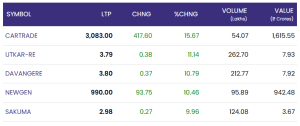
  • CARTRADE emerged as the leading gainer, surging 15.67% to an LTP of ₹3,083.00 on notable volumes of 54.07 lakh shares and a remarkable traded value of ₹1,615.55 crores.​

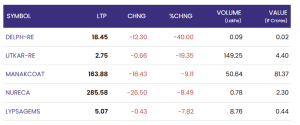
  • Screenshot 2025 10 28 235322UTKAR-RE moved up 11.14% to ₹3.79, supported by heavy trading activity.

  • DAVANGERE rose 10.79%, closing at ₹3.80, while NEWGEN soared over 10% to ₹990.00, with substantial market interest reflected in a traded value of ₹942.48 crores.

  • SAKUMA was up by just under 10%, finishing at ₹2.98 with healthy volumes.​

Top Losers

The market also recorded steep declines in several stocks:

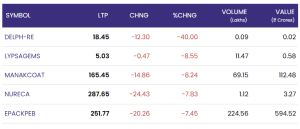
  • DELPH-RE faced the largest loss, dropping 40.00% to ₹18.45 on low trading volumes.​

  • Screenshot 2025 10 28 235330LYPSAGEMS closed down 8.55% at ₹5.03, followed by MANAKCOAT and NURECA, which declined by 8.24% and 7.83% respectively.

  • EPACKPEB lost 7.45%, ending at ₹251.77 amid significant activity and a notable traded value of ₹594.52 crores.​

Sectoral and Investor Sentiment

Sluggish performance in the Nifty and most sectoral indices was offset by standout stocks, where high volumes indicated decisive investor action. The mixed trend underscores persistent caution due to global cues and periodic earnings reports. Financial and mid-cap names received selective buying, contrasting with aggressive profit-booking in weaker counters.

Conclusion

Despite a generally downbeat day for Indian equities, leading gainers like CarTrade and Newgen drew strong interest, helping to mitigate sharp declines elsewhere. The session reflected a nuanced investor approach as market participants balanced opportunity with caution amid steady volatility.

For real time stock Updates, visit NSE website.

October 28, 2025 (Mid-cap): Nifty 50 Edges Lower; TTK Prestige, CarTrade Among Top Gainers

On October 28, 2025, the Indian stock market ended a mixed session with the benchmark Nifty 50 closing slightly in the red. Despite tepid broader indices, a few stocks stood out with substantial gains, while several counters faced sharp declines.

Also Read: October 28, 2025 (Opening): Nifty 50 Slides Amidst Market Volatility; Key Gainers and Losers

Market Overview

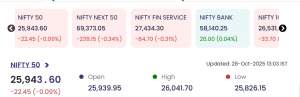
october 28The Nifty 50 index closed at 25,943.60, down 22.45 points or 0.09%. The day’s trading saw the index open at 25,939.95, touch a high of 26,041.70, and fall to a low of 25,826.15. Other indices, including Nifty Next 50 and Nifty Fin Service, also posted losses, while Nifty Bank managed a small gain of 26.00 points for the day.​


Top Gainers

Amidst limited upside in the wider market, these stocks achieved notable advances:

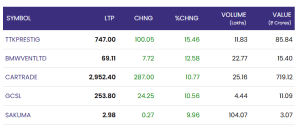
  • TTKPRESTIG soared 15.46% to an LTP of ₹747.00, up by ₹100.05, supported by healthy volume of 11.83 lakh shares.​

  • Screenshot 2025 10 28 130331BMWVENTLTD climbed 12.58% to ₹69.11, aided by solid trading volumes.

  • CARTRADE witnessed a surge of 10.77%, closing at ₹2,952.40, with significant volumes of 25.16 lakh shares.​

  • GCSL and SAKUMA also advanced by over 9%, marking resilient performance versus the broader indices.

Top Losers

The session saw sharp corrections in several stocks:

  • DELPH-RE suffered a steep fall of 40.00%, closing at ₹18.45, on subdued volumes.​

  • Screenshot 2025 10 28 130339UTKAR-RE dropped 19.35% to ₹2.75 amid considerable volume of 149.25 lakh shares.

  • MANAKCOATNURECA, and LYPSAGEMS lost between 7.82% and 9.11%, reflecting pressure in smaller segments.

Sectoral and Investor Sentiment

A marginal decline in the Nifty 50 and related indices was offset by strong profit-taking in select stocks. The resilience of leading gainers highlighted selective investor interest, while weaker performers indicated an undertone of caution. Trading action suggests participants are closely tracking earnings and external factors.

Conclusion: October 28, 2025 (Mid-cap)

Indian equities witnessed a steady yet cautious trading session with the Nifty 50 closing marginally lower. Robust showings by counters like TTK Prestige and CarTrade balanced sharp declines among select stocks. The mixed trend underscores the need for vigilance as market participants navigate ongoing volatility.

For real time stock Updates, visit NSE website.

October 28, 2025 (Opening): Nifty 50 Slides Amidst Market Volatility; Key Gainers and Losers

The Indian stock market experienced a volatile session on October 28, 2025, with major indices trading in the red. The Nifty 50 index closed lower as investors weighed mixed sectoral trends and shifting sentiment. Significant movements were observed among leading gainers and losers, offering insight into prevailing market dynamics.

Also Read: 27th October 2025: Nifty 50 Ends Session on a High: Final Tally of Top Gainers and Losers

Market Overview

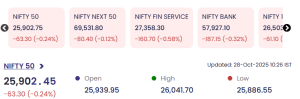
october 28The Nifty 50 settled at 25,902.45, registering a decline of 63.30 points or 0.24%. The index opened at 25,939.95 and reached an intraday high of 26,041.70 before falling to a low of 25,886.55. Broader indices like Nifty Next 50, Nifty Fin Service, and Nifty Bank also ended in negative territory, reflecting cautious investor sentiment.


Top Gainers

Despite the weak overall market, select stocks outperformed, posting impressive gains:

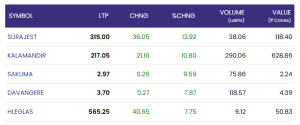
  • SURAJEST led the pack with an LTP of ₹315.00, climbing by 36.05 points or 12.92%, on volumes of 38.06 lakh shares.

  • KALAMANDIR surged 10.80% to an LTP of ₹217.05, backed by significant trading activity of 290.06 lakh shares.

  • Screenshot 2025 10 28 102652SAKUMA and DAVANGERE posted strong percentage gains of 9.59% and 7.87%, respectively.

  • HLEGLAS recorded a 7.75% rise, closing at ₹565.25, highlighting investor interest despite subdued indices.

Top Losers

Several stocks saw sharp declines, reflecting the broader market’s risk-off mood:

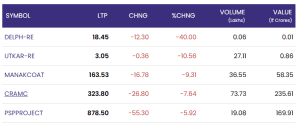
  • DELPH-RE emerged as the worst performer, plummeting by 40.00% to an LTP of ₹18.45.

  • Screenshot 2025 10 28 102708UTKAR-RE and MANAKCOAT fell over 10% and 9%, respectively, indicating pressure in select segments.

  • CRAMC and PSPPROJECT also saw notable drops of 7.64% and 5.92%, as profit booking and weak sentiment weighed on these counters.

Sectoral and Investor Sentiment

The downward trend in Nifty indices and predominant losses in financial and mid-cap stocks suggest a cautious undertone, possibly driven by global cues and domestic earnings commentary. While high-volume gainers indicated selective buying, the breadth of declines points towards prevailing uncertainty and profit-taking.

Conclusion: October 28, 2025 (Opening)

October 28, 2025, marked a challenging trading day for Indian equities, with benchmark indices closing in the red. Although pockets of strength emerged among certain gainers, the dominant narrative was cautious, driven by global volatility and mixed domestic signals. Investors are advised to keep a close watch on market triggers as volatility persists.

For real time stock Updates, visit NSE website.

State-run Firm Rejects Polling Booth Setup Role, Citing Practical Constraints: A Sign of Electoral Preparedness Strain in West Bengal

State-run Firm Rejects Polling Booth Setup: A significant development in pre-poll preparations in West Bengal has emerged: a state-owned engineering company, Mackintosh Burn Ltd (MBL), has formally declined the task of conducting assured minimum facilities (AMF) work across some 81,000 polling booths, citing “practical considerations” and infrastructure inadequacy. The refusal — addressed in a letter dated October 24 to the office of the Chief Electoral Officer of West Bengal — has raised concerns about the logistical readiness of the state ahead of the upcoming Assembly elections.

In its communication, the company stressed that it had “no disregard for the Election Commission” but claimed that its infrastructure did not permit it to perform the work of detailed field surveys and holistic assessment required under time-bound constraints.

Officials in the CEO’s office responded by stating that since MBL had flagged its inability in good faith and did not challenge the authority of the poll panel, the task will now revert to the Public Works Department, West Bengal (PWD) — which must identify alternate agencies to carry out the job. One source called the lead time already lost “costly”.

This episode brings into focus not only the readiness of key government contractors for crucial election work but also the broader institutional challenges of electoral infrastructure, contracting, coordination and accountability in West Bengal’s fast-approaching 2026 Assembly polls.


State-run Firm Rejects Polling Booth Setup: What exactly is AMF work?

The assured minimum facilities (AMF) constitute a set of baseline amenities mandated for every polling station so that voters can cast their ballots in a safe, accessible and dignified manner. Facilities typically include: shade or shelter, drinking water, sanitation, seating for elderly/vulnerable electors, ramps or barrier-free access for differently-abled voters, adequate lighting, signage, security barricades, first-aid kit, and a functional communication line for the returning officer.

Over 80,000 booths in West Bengal are already in the register; with scheduled major reorganisations of booth boundaries and possible additions ahead of the next Assembly election, the volume of work is heavy. MBL’s refusal touches on the first critical step: survey and assessment of existing gaps, followed by contract mobilisation, execution and monitoring.


How this refusal unfolded

The sequence of events is as follows:

  • In July 2025, PWD entrusted MBL with the job of AMF execution across polling booths.
  • On Friday, October 24, the firm submitted a formal letter to the West Bengal CEO’s office requesting relief from the assignment, citing infrastructure insufficiency and practical considerations.
  • The CEO, Manoj Agarwal, had earlier written to MBL warning that failure to take up the job could lead to criminal proceedings against the company’s board of directors.
  • After receiving MBL’s letter, the CEO’s office said it would not immediately proceed with penal action given that MBL accepted its inability; instead, PWD must now find alternative agencies without further delay.
  • Sources told The Telegraph that the government did not check the company’s capacity before entrusting the nationwide task — a four-month delay that “could have been avoided” per one official comment.

Why this matters – The stakes ahead of 2026

Logistical scale and time pressure

With the state heading towards its Assembly elections in 2026, a large part of the electoral machinery is being updated: voter roll revisions (including the Special Intensive Revision, SIR), booth bifurcations, re-deployment of personnel, and readiness of infrastructure at booths. Ensuring all booths meet AMF standards is therefore not a mere formality but central to the credibility of the election process. A contractor pulling out at this stage raises red flags about preparedness.

Institutional accountability and contracting risks

MBL’s refusal highlights vulnerabilities in contracting elections-related work via state-run agencies. When a scheduled contractor says upfront they cannot handle the work, it triggers two issues: trust in the contracting process and the ability of supervising agencies to foresee capacity constraints. The PWD’s decision to award the job in July and then the contractor’s letter in October suggest a breakdown in the capacity-assessment and monitoring mechanism.

Voter confidence & inclusive access

The AMF work is about more than bricks and mortar: it is about ensuring that all eligible voters — including elderly, differently-abled, rural and marginalised groups — can access voting facilities without hindrance. Any lag in ensuring these minimum facilities threatens both access and the perception of fairness. The refusal therefore carries an electoral integrity implication.

Political optics for parties

In a politically charged state like West Bengal, where booth strength, polling station access and the legitimacy of elections are intensely scrutinised, such an institutional lapse can become ammunition for opposition parties. They may highlight the administration’s lack of preparedness as a sign of governance weakness.


Deeper institutional challenges exposed

Capacity mismatch in state-owned firms

MBL is a state-run unit under PWD. Its inability to execute the contract raises the question: are public sector agencies always best placed to handle large-scale, time-bound election infrastructure contracts? Some analysts suggest that while they offer transparency and oversight, their procurement and decision-making mechanisms may lack agility compared to specialised private contractors.

One source within the CEO’s office noted:

“The task of detailed survey and carrying out AMF to fill the gap of facilities in the booths would have to be taken up… Now it is the sole responsibility of PWD to appoint agencies to take up the job and complete those on time.”

Monitoring and supervision gaps

If a contractor is appointed without a full check of capability, important months may be lost in reallocation. The official quoted above said:

“The government did not check with the company whether it was capable of doing the work. If the PWD had tried to find out sooner, alternative agencies could have been hired earlier. It would have saved four valuable months.”

Delayed action at this stage may compress the timeline for booth readiness, giving less margin for quality assurance or last-minute fixes.

Contracting vs accountability tension

MBL’s letter requested relief from “penal, financial or other adverse actions” since its inability stemmed “entirely from practical considerations”. Such framing places the firm in a defensive posture, suggesting that the contractual expectations were unrealistic given their internal capacity. This raises issues about how contracts are drafted, what penalty clauses exist, and what due diligence was performed pre-award.


What happens next – Key actions and deadlines

PWD’s alternative agency mobilisation

With MBL out of the picture, PWD must now appoint alternate agencies to conduct the AMF survey and subsequent infrastructure work for the 81,000 or more booths across the state. Time is already of the essence.

CEO and electoral readiness

The CEO’s office will monitor whether the new contractors complete the survey and AMF work within the specified timeline. Given that booth-reorganisation, SIR and roll revision are underway, delays may cascade.

Transparent progress reporting

Given the scale and public importance of this work, one recommendation is that the CEO’s office publish progress dashboards: number of booths surveyed, percentage of AMF facilities installed, and number of pending booths. This would enhance transparency and build public confidence.

Risk of escalation into legal or electoral dispute

While MBL’s cooperative approach may have spared immediate legal action, the wider question remains: will other contractors or staff show similar hesitance? Any broader refusal or delay could prompt the CEO’s office to invoke penal provisions under election laws for failure of essential booth readiness.


Broader electoral system implications

Booth bifurcation and increase

Recent reports indicate that polling booths in West Bengal may increase significantly ahead of the 2026 elections to manage voter crowding and adhere to norms (e.g., limiting number of voters per booth). The larger the booth count, the greater the AMF task becomes. Failure to keep up could mean sub-standard facilities or delayed polling station readiness.

Voter roll revision overlap

Simultaneously, the state is engaged in the Special Intensive Revision (SIR) of electoral rolls – a complex exercise of enumeration, verification and inclusion/exclusion. The pre-work for AMF must align with the roll revision schedule; any delay heightens risk of logistical mis-match.

Perception of state capacity and fairness

When administrative machinery appears to be unable to meet fundamental election infrastructure obligations, opposition parties may portray this as an erosion of institutional capacity. For citizens, the experience of malfunctioning voting booths may reduce trust in election fairness or in being able to cast their vote comfortably.


Expert commentary

Dr. Ananya Sen, a political scientist at the University of Calcutta, commented:

“Election administration in India is as much about infrastructure as it is about people. The refusal of a state-run contractor adds to the emerging narrative that election machinery is under strain. We are seeing simultaneous tasks — roll revisions, booth reorganisation, increased booth numbers, AMF upgrades — and delay in one will ripple into others.”

A former senior official in the Election Commission of India (ECI), requesting anonymity, added:

“Contracting at large scale is rarely smooth. What matters is: are the supervising organisations monitoring risks? Are alternative agencies ready? Did you hire one contractor or build in buffer? Four months lost in survey means two months less for rectification. That gap may show up on polling day.”


Political reactions and future risk

Although MBL’s action is not overtly political, it has political ramifications. Opposition parties may highlight this as governance failure; ruling party machineries will have to reassure ground-level workers and voters that booths will be ready.

Any perceived shortfall in booth-facility readiness may affect not just turnout but also security and logistics (for example, disabled voter access, elderly seating, sanitation facilities). This may become a campaign issue or ground-level grievance.


Case study: A booth journey

Consider a hypothetical booth in a rural district: It needs a shade structure (if outdoors), seating for 50+ elderly voters, drinking-water unit, ramp for wheelchair, barricade for vehicle traffic, signboards, a first-aid kit and communication link to returning officer. If the survey is delayed by two months and contract by one month, the team overseeing the booth has only a short window for erecting shade, procurement of water station, installing ramp and conducting rehearsal. If any input is delayed, the booth may open with a make-shift shade or no drinking water. Multiply this by thousands of booths and the scale of risk becomes clear.


What goes wrong when deadlines are missed

  • Poorly maintained booths crushing turnout among elderly or differently-abled voters.
  • Complaints of inadequate drinking water or sanitation, leading to negative media or party critique.
  • Security hazards when barricades or signboards are absent.
  • Administrative cascade: returning officers may request extensions, delaying official notices, budget disbursements may get stalled, last-minute hiring may be required.

In a politically charged state like West Bengal, where turnout and booth-level organisation are heavily contested, such omissions can assume critical importance.


Recommendations

Pre-qualification of contractors

Before assigning AMF work, agencies (PWD/CEO) should pre-qualify contractors based on prior performance, capacity, manpower and regional footprint.

Built-in buffer time

Given the scale and overlapping electoral tasks (SIR, booth reorganisation, voter list printing), buffer time should be built in. Delays should trigger escalation protocols.

Transparent contract management

Contract terms should include performance milestones, penalties for delay, progress monitoring dashboards, and regular field audits.

Regular public-dashboard updates

CEO’s office could release weekly progress reports: number of booths surveyed, number of AMF tasks awarded, number completed, number pending. This increases accountability and sight of deadlines.

Contingency planning

When a large contractor signals inability (as MBL did), backup plans should be immediately triggered — alternate agencies, reallocation of tasks by district, modular contracting (multiple contractors rather than one statewide).


Conclusion

The refusal by Mackintosh Burn Ltd to undertake assured minimum facilities work ahead of the 2026 Assembly elections shines a stark light on the logistical and institutional pressures of India’s electoral administration. While the company’s candid letter helped avert immediate penal measures, the delay it represents puts additional strain on the already compressed timeline of roll revision, booth restructuring and infrastructural readiness. For West Bengal’s electoral authorities, the task ahead is daunting: appointing new contractors, fast-tracking survey and installation, constantly monitoring progress and ensuring that every polling station can deliver the minimum standard of facilities when voters arrive.

At a time when election integrity, access and turnout are under close scrutiny, any perceived shortcoming in polling station readiness may have both administrative and political consequences. The matter is no longer simply about election infrastructure — it is about trust, access and institutional competence. West Bengal is now being tested on whether it can meet these fundamental standards under significant time and scale pressure.


External Links (Government / Official)

  1. Office of the Chief Electoral Officer, West Bengal – Booth Information & Statutory Requirements
    https://ceowestbengal.nic.in/ (Scroll to Polling-Station Infrastructure section)
  2. Public Works Department, Government of West Bengal – Contracting Guidelines and Works Portal
    https://pwdwb.gov.in/
  3. Election Commission of India – Polling Station Guidelines for General Elections
    https://eci.gov.in/files/file/Guidelines-for-Polling-Station-Management/
  4. Election Commission of India – Special Intensive Revision (SIR) of Electoral Rolls: Guidelines
    https://eci.gov.in/files/file/SIR-guidlines/
  5. Government of West Bengal – Administrative Reforms Department: State Owned Enterprises (SOE) Oversight
    https://ard.wb.gov.in/

Also read: Home | Channel 6 Network – Latest News, Breaking Updates: Politics, Business, Tech & More
India Maritime Week 2025: Revolutionary Shipbuilding Financing Model to Transform Maritime Sector

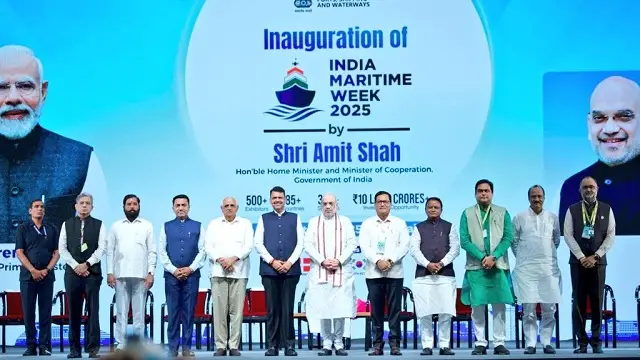
The India Maritime Week 2025, held at NESCO Grounds in Mumbai from October 27 to 31, has emerged as a watershed moment for the nation’s maritime ambitions. Union Minister for Road Transport and Highways Nitin Gadkari unveiled a groundbreaking proposal for innovative financial mechanisms to accelerate shipbuilding capacity, directly linking these efforts to India’s aspiration of achieving top-five maritime nation status by 2047. The five-day event, inaugurated by Home Minister Amit Shah, brought together over 350 international speakers, delegates from more than 100 countries, and industry leaders to chart a transformative course for India’s maritime sector.

India Maritime Week 2025Also Read: India Maritime Week 2025

Other: Energy Trade Constricted

During his address at the India Maritime Week 2025, Gadkari emphasised that the maritime sector, valued at approximately USD 1 trillion (₹84 lakh crore), represents an enormous opportunity for investment across ports, shipping, and logistics infrastructure. His call for revolutionary financing models stems from successful precedents established in highway development, where the Ministry of Road Transport and Highways mobilised ₹1.4 lakh crore through Transfer of Title (ToT), Infrastructure Investment Trusts (InvITs), and Public-Private Partnership (PPP) arrangements.

Innovative Shipbuilding Financing Framework

The cornerstone of discussions at the India Maritime Week 2025 centred on creating investor-friendly financial instruments specifically tailored for shipbuilding and maritime infrastructure development. Gadkari articulated the urgent need for creative funding strategies that could attract both domestic and international capital while ensuring sustainable returns. The minister drew parallels with the road transport sector, where private participation increased dramatically from 10 per cent to 35 per cent through innovative funding mechanisms, demonstrating the potential for a similar transformation in maritime infrastructure.

The proposed financing models focus on transparent governance, time-bound execution, and private sector innovation to reduce the financial burden on government coffers while accelerating project delivery. These mechanisms aim to build enduring global confidence in India’s maritime leadership and competitiveness. Foreign investors have shown keen interest in India’s maritime opportunities, particularly given the strong return on investment potential, though Gadkari stressed that credibility remains paramount for attracting international finance, including investments in stronger currencies like the Japanese yen.

Port-Hinterland Connectivity: The ₹80,000 Crore Game-Changer

A critical announcement made during the India Maritime Week 2025 concerned the massive ₹80,000 crore investment in port-hinterland connectivity infrastructure. Gadkari revealed that approximately 60 to 70 per cent of this ambitious road connectivity program linking ports to their hinterlands has already been completed. This infrastructure development represents a fundamental pillar for enhancing India’s export-import capabilities and overall economic competitiveness.

The minister expressed confidence that these connectivity improvements would revolutionise the Indian economy by dramatically reducing transportation time and costs for goods moving between ports and inland destinations. The port connectivity initiative forms an integral component of the broader Sagarmala 2.0 vision, which encompasses shipbuilding, ship repair and recycling, port efficiency enhancement, coastal economy strengthening, and inland waterways revival as sustainable transport corridors.

Addressing Logistics Cost Challenges

One of the most significant economic challenges highlighted at the India Maritime Week 2025 was India’s logistics cost burden, which currently stands at approximately 16 per cent of GDP. Gadkari acknowledged this substantial figure while noting progress made through recent infrastructure investments. According to joint studies conducted by IIT Chennai, IIT Kanpur, and IIM Bangalore, logistics costs have already decreased to 10 per cent of GDP, representing a remarkable 1 per cent reduction from previous levels.

The minister set an ambitious target to reduce logistics costs to single digits—specifically, cent off GDP—by December 2025, which would significantly enhance the competitiveness of Indian industries and exports. For comparative context, logistics costs hover around 12 per cent in the United States and Europe, and between 8 to 10 per cent in China. The reduction strategy encompasses massive investments in expressways, economic corridors, digital infrastructure, including FASTag and fully digital tolling systems, all of which contribute to cutting travel time, reducing fuel consumption, and streamlining freight movement.

1 1Sagarmala 2.0 and Comprehensive Maritime Development

The India Maritime Week 2025 served as a platform to showcase progress under the Sagarmala 2.0 initiative championed by Union Minister of Ports, Shipping and Waterways Sarbananda Sonowal. This comprehensive program aims to position India among the world’s top five shipbuilding nations by 2047, marking a defining moment for the country’s blue economy and maritime future. The initiative encompasses multiple dimensions, including modernisation of shipyards, enhancement of ship repair capabilities, recycling infrastructure development, and optimisation of port operations.

Sonowal emphasised that India’s goal extends beyond infrastructure development to tripling the nation’s global trade share by 2047 through policy reforms, digitalisation initiatives, and capacity expansion. The event witnessed the signing of over 600 Memorandums of Understanding valued at more than ₹10 lakh crore in investment commitments, with Day 1 alone securing landmark MoUs worth ₹55,000 crore. These partnerships focus on port expansion, shipyard infrastructure, skill development programs, and green shipbuilding initiatives involving domestic companies and international partners from Norway, the Netherlands, Saudi Arabia, and other nations.

India Maritime Report 2025-26 Launch

A significant highlight of the India Maritime Week 2025 was the launch of the CMEG (RIS) – India Maritime Report 2025-26, titled “Uniting Oceans, One Maritime Vision: India’s Maritime Strides.” This comprehensive document outlines India’s recent achievements in maritime development and provides a detailed roadmap for becoming a global leader in the blue economy. The report emphasises the importance of private innovation, transparent governance frameworks, and time-bound project execution as key drivers for establishing India as a trusted global maritime hub.

The report’s release underscores the government’s commitment to systematic planning and measurable outcomes in the maritime sector. It provides stakeholders with clear benchmarks and strategic priorities aligned with India’s 2047 vision, ensuring coordinated efforts across government agencies, private sector entities, and international partners.

Economic Impact and Investment Potential

The economic implications discussed at the India Maritime Week 2025 extend far beyond the maritime sector itself. With India’s maritime economy valued at nearly USD 1 trillion, the sector presents vast opportunities across multiple dimensions, including port infrastructure development, shipping fleet expansion, logistics optimisation, shipbuilding capacity enhancement, and coastal economy strengthening. The comprehensive exhibition featuring over 400 exhibitors alongside an expansive conference schedule demonstrated the breadth of business opportunities available.

The event’s structure included four country-specific sessions featuring Norway, the Netherlands, Denmark, and Sweden, along with 11 state and union territory sessions covering Gujarat, Maharashtra, Goa, Karnataka, Kerala, Tamil Nadu, Andhra Pradesh, Odisha, Uttar Pradesh, Assam, and Andaman & Nicobar Islands. This multi-stakeholder approach ensures that maritime development benefits are distributed across India’s coastline while leveraging regional strengths and capabilities.

1760590131Strategic Vision for 2047

The India Maritime Week 2025 culminated in reinforcing India’s ambitious vision to achieve top-five maritime nation status by 2047, coinciding with the centenary of Indian independence. This goal encompasses multiple parameters, including shipbuilding capacity, cargo handling volumes, port efficiency metrics, coastal shipping growth, and global trade share. Home Minister Amit Shah emphasised India’s strategic maritime position, democratic stability, and naval capabilities as instrumental factors in bridging the Indo-Pacific region with the Global South, promoting security, connectivity, and sustainable development.

The maritime sector has demonstrated robust growth indicators, with coastal shipping increasing by 118 per cent and cargo handling growing by 150 per cent over the past decade. Turnaround times at Indian ports are being reduced to match global standards through efficiency improvements and digitalisation initiatives. Prime Minister Narendra Modi’s scheduled address during a special plenary session and his chairmanship of a high-level global CEO forum further underscore the government’s commitment to maritime sector transformation.

Conclusion

The India Maritime Week 2025 in Mumbai has established a comprehensive framework for revolutionising India’s maritime sector through innovative financing mechanisms, substantial infrastructure investments, and strategic policy initiatives. Nitin Gadkari’s proposal for shipbuilding financing models, combined with the ₹80,000 crore port-hinterland connectivity investment and focused efforts to reduce logistics costs from 16 per cent of GDP, demonstrates a holistic approach to maritime development. With over ₹10 lakh crore in investment commitments and clear pathways outlined through Sagarmala 2.0, India is poised to realise its ambition of becoming a top-five maritime nation by 2047, transforming its blue economy and global trade competitiveness.

3 Arrested Including Food Delivery Executives in ₹15-Lakh Mobile Store Loot Shocking Case

In a startling revelation that has shaken Bengaluru’s commercial hubs, the city police have arrested three individuals, including two food delivery executives, for allegedly looting a mobile phone showroom in the early hours of last week. The incident, which took place in the bustling Rajajinagar area, involved the theft of high-end smartphones worth nearly ₹15 lakh. What has left investigators and residents stunned is the involvement of food delivery agents—individuals often associated with convenience and reliability—now accused of orchestrating a daring burglary under the cover of night.


The Incident: A Midnight Break-In

According to police reports, the break-in occurred between 2 a.m. and 3 a.m. on Monday when the suspects allegedly used a crowbar to force open the shutter of a popular mobile phone outlet. CCTV footage captured two men entering the showroom while another stood guard outside. Within minutes, the suspects cleared several display shelves, targeting premium brands such as Apple, Samsung, and OnePlus, before escaping in a rented two-wheeler.

The crime went unnoticed until the store owner, Ramesh Kumar, opened the shop the following morning and found the shutter broken and several phones missing. A complaint was immediately filed with the Rajajinagar Police Station, prompting the deployment of a special investigation team. “The precision and speed with which they operated indicated prior planning,” said a senior officer. “They seemed to know exactly where the high-value models were kept.”


Investigation and Breakthrough

Police teams examined hours of CCTV footage from surrounding streets and quickly identified one of the suspects as a delivery executive working for a major food delivery platform. Tracing his movements through digital payment records and GPS logs, the police zeroed in on his residence in Vijayanagar, leading to the arrest of all three accused within 48 hours of the crime.

During interrogation, the accused reportedly confessed to having planned the robbery for weeks. They claimed that the idea originated during conversations at delivery pick-up points, where they frequently discussed the financial pressures of rising fuel costs, rent, and debts. Police officials recovered 30 stolen smartphones, along with duplicate IMEI stickers, suggesting an attempt to alter the phones’ identities before reselling them through the grey market.Food delivery executives among three arrested for looting mobile phone  showroom - The Hindu


Behind the Crime: Financial Struggles and Desperation

The suspects, identified as Rohit (28), Arjun (27), and Suresh (30), had all been employed as food delivery agents for over three years. According to investigators, the trio struggled to make ends meet, particularly after recent fluctuations in delivery incentives and rising living costs in Bengaluru. “They were earning around ₹18,000–₹22,000 per month, but high fuel prices and penalties left them with very little savings,” said an officer involved in the probe.

Their confessions paint a grim picture of urban survival among gig economy workers—individuals who often operate without job security or social benefits. Police sources revealed that one of the accused had a loan default notice pending, while another had recently been evicted from his rented house. Their decision to commit theft, investigators believe, stemmed from a dangerous mix of financial despair and opportunity, as they were familiar with the layout of local commercial complexes due to frequent deliveries.


Community Reaction: Shock and Concern

The revelation that food delivery executives were involved in the crime has triggered widespread concern across Bengaluru. Shop owners in Rajajinagar expressed both relief at the quick arrests and anxiety about growing insider crimes. “We see delivery people every day—trusting them has become second nature. This case is unsettling,” said a local electronics dealer.

Residents also voiced empathy for the financial hardships that may have driven the accused, but many insisted that desperation cannot justify criminal acts. “It’s heartbreaking to see young workers caught in such situations. But the solution should be better working conditions, not theft,” remarked Anita Rao, a local resident.


Broader Issues: The Precarious Life of Gig Workers

This incident has reignited debates about the economic vulnerability of gig workers in India’s rapidly growing digital economy. Food delivery agents, cab drivers, and online service providers often work under informal contracts with fluctuating income and limited protection against exploitation. Labour experts note that long working hours, lack of insurance, and irregular pay cycles have created a cycle of financial instability among urban delivery staff.

According to a 2024 labour study, nearly 68% of gig economy workers in metropolitan cities like Bengaluru and Hyderabad earn below ₹25,000 per month, with 40% reporting debt burdens. Analysts argue that such conditions make workers susceptible to mental distress and occasional criminal temptations, especially when coupled with social stigma and lack of institutional support. “When survival becomes a daily challenge, moral boundaries blur,” explained sociologist Dr. Meenakshi Nair, adding that stronger labour protections are crucial to prevent such tragedies.Food delivery executives among three arrested for looting mobile phone  showroom - The Hindu


Police Measures and Preventive Action

Following the arrests, Bengaluru City Police Commissioner B. Dayananda directed all station heads to intensify night patrols in commercial zones and ensure that CCTV networks remain operational. The police have also requested local business associations to install shutter alarms and sensor locks in vulnerable areas.

Officers further advised delivery companies to conduct background verification of their employees, including checks on criminal records and financial liabilities. “These individuals had no prior criminal history, but background checks could help flag potential risks in the future,” an official stated. Police are also coordinating with mobile service providers to track any resale attempts of the stolen devices using IMEI numbers.


Legal Proceedings and Charges

All three accused have been booked under sections 457 (Lurking house-trespass or house-breaking by night) and 380 (Theft in dwelling house, etc.) of the Indian Penal Code (IPC). They were produced before the Bengaluru Magistrate Court, which remanded them to judicial custody for 14 days pending investigation.

Investigators are exploring the possibility of linking the accused to other unsolved thefts in the region, as their modus operandi suggests prior experience. Police sources said the gang may have sold smaller quantities of electronics through online classifieds in the past, though those claims are still being verified. Meanwhile, the recovered phones have been handed over to forensic teams for data examination.3 Loot Food Delivery Agent Of Phone Worth ₹10,000 At Knifepoint | Pune News  - Times of India


The Human Angle: Dreams Derailed by Debt

Family members of the accused have described the arrests as a tragic consequence of financial hardship and social pressure. Rohit’s mother, who works as a domestic help, broke down when reporters visited her home. “He wanted to quit delivery work and join a driving school. He said he just needed a few more months to save. I don’t know what went wrong,” she said tearfully.

Neighbours recall the men as hardworking and polite, often seen making deliveries late into the night. “They were always on their bikes, rushing between orders. None of us thought they could be involved in something like this,” said Narasimha Gowda, a local resident. The incident, while shocking, has sparked deeper conversations about mental health, dignity, and the invisible struggles of the working poor.


Retail Security and Rising Urban Crime

This case also underscores Bengaluru’s growing concerns about urban property crimes, particularly in commercial zones housing electronics, jewellery, and high-end goods. Data from the city police shows a 12% rise in night-time burglaries over the past year, with small businesses and chain stores being prime targets.

Experts attribute this increase to the combination of economic distress, unemployment, and weak security infrastructure. Many small retailers still rely on traditional shutter locks and minimal surveillance systems, making them easy targets. Police have urged store owners to invest in digital security tools and maintain updated footage archives for at least 30 days.

Delivery Companies Under Pressure

Following the arrests, major delivery platforms have come under scrutiny for their employee verification and welfare policies. While the companies maintain that all delivery partners undergo mandatory background checks, industry insiders admit that the rapid growth of the gig economy has made comprehensive oversight difficult.

A spokesperson from one leading delivery company said, “We are cooperating fully with the investigation. This is an isolated incident and does not reflect our values. We are also reviewing our vetting and support systems.” The statement, however, has not quelled public criticism over low pay rates and the absence of grievance mechanisms for workers. Activists argue that without institutional support, the pressures of gig work will continue to push vulnerable individuals toward dangerous choices.


Judicial Outlook and Public Sentiment

Legal experts anticipate a strong case against the accused, given the weight of digital and forensic evidence. “CCTV footage, GPS trails, and recovered materials establish a clear chain of evidence,” said criminal lawyer S. Pradeep. However, he also pointed out that the judiciary may consider socio-economic factors while determining sentencing. “Rehabilitation, not merely punishment, should be the goal—especially when the offenders are first-timers driven by distress rather than greed,” he added.

Public opinion remains divided. While many demand stringent punishment to deter similar crimes, others advocate for systemic reform to prevent economic exploitation. “We must look beyond the crime to the conditions that caused it,” said urban activist Kavita Menon. “Otherwise, we’re just punishing symptoms, not solving problems.”


The Larger Message

As the investigation continues, the Rajajinagar loot case has evolved from a local burglary into a symbol of modern economic contradictions—where individuals facilitating the comfort of others are themselves trapped in cycles of precarity. The incident raises uncomfortable questions about the price of convenience, the invisibility of gig workers, and the silent erosion of urban empathy.

For now, justice will proceed through courts and police files, but the broader lesson remains clear: a society that values service must also secure the dignity of those who serve. Until then, the story of three young men who traded their uniforms for a crime of desperation will continue to haunt Bengaluru’s conscience—an unsettling reflection of what happens when hope runs dry in the city of opportunities.

Follow: Karnataka Government

Also read: Home | Channel 6 Network – Latest News, Breaking Updates: Politics, Business, Tech & More

OBC Doctors Losing Out on PG Medical Quota: 8 Shocking Realities

A simmering debate has emerged in Karnataka’s medical education system as the income ceiling for the Other Backward Classes (OBC) quota continues to exclude most in-service doctors from claiming reserved postgraduate (PG) seats. While the reservation system is designed to ensure social equity, stringent income criteria—currently capped at ₹8 lakh per annum under the creamy layer rule—have made the majority of government-employed doctors ineligible. This contradiction has sparked outrage among medical professionals and policy analysts, who argue that the existing norms fail to consider the unique economic realities of government service and the spirit of social justice the quota was meant to uphold.


Background: Understanding the OBC Quota and Income Ceiling

The OBC reservation policy, rooted in the Mandal Commission’s recommendations, seeks to uplift socially and educationally disadvantaged groups through access to education and employment. However, the “creamy layer” provision was introduced to ensure that economically advanced individuals within these groups do not monopolise benefits. Under current regulations, any family with a gross annual income above ₹8 lakh is excluded from availing OBC reservation benefits.

While this rule works for most sectors, experts point out that it becomes problematic in the case of in-service government doctors, whose official salaries automatically exceed the income ceiling even at entry-level positions. The unintended outcome is that doctors belonging to OBC categories are technically disqualified from claiming the very seats reserved for their social group in PG medical admissions, despite being socially eligible.With income ceiling, most in-service doctors remain ineligible for OBC  quota PG medical seats - The Hindu


The Current Conflict in Karnataka

In Karnataka, the issue came to the fore during recent postgraduate medical admissions conducted by the Karnataka Examinations Authority (KEA). Several in-service doctors—particularly those working in rural health centres—found themselves barred from applying under the OBC quota. The ₹8 lakh limit effectively excluded nearly all doctors who draw salaries under the government pay scale, regardless of where they serve.

Medical associations, including the Karnataka Government Medical Officers’ Association (KGMOA), have raised strong objections. They argue that the system unfairly penalises government doctors, while private candidates from similar social backgrounds continue to avail reservation benefits. The result, they claim, is systemic discrimination against those who have chosen public service over private practice.


Voices from the Field: In-Service Doctors Speak Out

Many in-service doctors describe the policy as both unfair and demotivating. Dr. Priya Hegde, a government physician from Shivamogga, says, “Our gross salary may cross ₹8 lakh, but we don’t have the same economic comfort as corporate doctors. Rural postings come with hardships and limited facilities. It’s unjust to treat us as ‘creamy layer’ merely based on pay slips.”

Another doctor, Dr. Manjunath N, who has served in a taluk hospital for seven years, echoes similar frustration. “I belong to a socially backward OBC group. My parents are still agricultural workers. But because I earn a government salary, I lose my quota eligibility. How is that social justice?” he asks.

The sense of betrayal runs deep among many who joined the government health sector with hopes of advancing through the in-service PG route. They say the system now effectively blocks career growth, creating disillusionment among young doctors who serve in remote and challenging regions.


Government’s Stance and Policy Justification

The Department of Backward Classes Welfare and the Ministry of Health have defended the existing rules, citing Supreme Court directives that uphold the ₹8 lakh ceiling as a benchmark for identifying the creamy layer. Officials argue that altering this limit specifically for one profession could create inconsistencies across sectors. “The income cap applies equally to all professions under OBC reservation. Exemptions cannot be made without policy revision at the national level,” said a senior official.

The state government, however, acknowledges the discontent brewing among medical staff. Karnataka’s Health Minister recently confirmed that the issue had been referred to the Law Department for legal opinion, suggesting that the state may consider recommending a special relaxation for in-service doctors to the Centre. Yet, no formal notification or policy amendment has been issued so far.With income ceiling, most in-service doctors remain ineligible for OBC  quota PG medical seats - The Hindu


The Legal and Constitutional Dimensions

The controversy touches upon deeper constitutional questions regarding economic versus social criteria for determining backwardness. The Supreme Court, in several landmark judgments, including Indra Sawhney vs Union of India (1992), upheld the concept of the creamy layer to prevent elite capture within OBC groups. However, it also emphasised that social and educational backwardness cannot be overridden by mere economic metrics.

Legal experts argue that in-service doctors represent a special category within the OBC framework. “Government salaries are not indicators of inherited privilege,” says constitutional lawyer K. S. Rajendra. “They are compensation for skilled service. The creamy layer concept was meant to exclude the affluent, not public servants performing state duties.”

Several states, including Tamil Nadu and Maharashtra, have previously sought sector-specific relaxation for similar cases. If Karnataka follows suit, it could reignite a nationwide debate about redefining creamy layer parameters in the context of professional employment.


The Emotional Cost of Policy Blind Spots

Beyond policy papers and pay scales lies a story of emotional exhaustion. Many doctors express a deep sense of alienation, feeling that their social identity has been erased by their salary slip. For doctors from humble OBC backgrounds, the denial of reservation is not merely about seat allocation—it’s about being seen and acknowledged.

“I grew up in a small village where no one had ever become a doctor before,” says Dr. Kavitha D, who belongs to the Vokkaliga community classified under OBC. “My parents took loans for my education. Today, I serve in a government hospital, but I am told I’m ‘too rich’ for the quota meant for people like me. That hurts more than rejection.”

Such testimonies underline how the rigid interpretation of income thresholds can undermine the spirit of affirmative action. By equating economic income with social advancement, experts warn, policymakers risk erasing the very inequities the quota system was designed to correct.


Economic Reality vs. Social Context

The ₹8 lakh ceiling, fixed years ago, does not account for inflation, cost of living, or sectoral differences. A junior doctor earning ₹70,000 a month in a government hospital may exceed the limit on paper but still struggle with student loans, transfer costs, and family responsibilities.

Economists point out that the creamy layer test, while well-intentioned, cannot be uniformly applied across professions. “A salaried doctor in a public hospital does not enjoy the same privileges as a business executive with equal income,” explains policy researcher Dr. Latha Narayan. “We need a nuanced approach that distinguishes between income from inherited assets and income from state service.”

Experts have proposed a graded evaluation system, where the income ceiling is indexed to professional category and region. Such flexibility, they argue, would restore fairness without undermining the principle of merit.With income ceiling, most in-service doctors remain ineligible for OBC  quota PG medical seats - The Hindu


Impact on Rural Health and Service Motivation

The policy’s ripple effects extend far beyond admissions. In-service doctors form the backbone of Karnataka’s rural healthcare system, working under strenuous conditions and with limited infrastructure. Many joined with the assurance that dedicated service would guarantee access to postgraduate education through the in-service quota.

Now, that motivation is waning. “We were told rural service would earn us PG eligibility,” says Dr. Prakash N, serving in Chamarajanagar. “But when we apply, we are disqualified for earning a basic government salary. It’s a breach of trust.”

Health activists warn that this discontent could worsen the already severe doctor shortage in rural Karnataka, as more professionals opt for private practice or leave government service altogether. “Policy inconsistency is pushing talent away from the public sector,” says Dr. Shashank R, a senior health administrator. “If this continues, the entire primary healthcare network will suffer.”


Policy Alternatives Under Discussion

The Karnataka government is exploring several potential remedies. Among the proposals discussed are:

  1. Raising the income ceiling for in-service professionals to ₹12 lakh or ₹15 lakh.

  2. Exempting government salary from the creamy layer calculation, considering it a functional income.

  3. Creating a separate sub-quota within the OBC category for in-service doctors.

  4. Requesting the Union Government for a nationwide policy revision specific to public service roles.

While these ideas remain under consideration, bureaucratic hurdles and political caution have slowed progress. A senior official hinted that the final decision may depend on central approval, given the constitutional nature of reservation norms.


The Role of Medical Associations

The Karnataka Medical Association (KMA) and KGMOA have been at the forefront of advocacy efforts. They have submitted multiple representations to both the Chief Minister and the Union Health Ministry, urging immediate policy revision. In a recent memorandum, the associations argued that the “income ceiling has become an exclusion tool rather than an inclusion mechanism.”

Protests and petitions are gaining traction, with doctors demanding an independent review committee to assess how creamy layer criteria affect public service professionals. Medical unions have also hinted at legal action if the issue remains unresolved before the next academic year’s PG admissions.


Wider Social and Political Implications

The controversy carries significant political weight in Karnataka, where OBC groups form a major voting bloc. The Congress government, led by Chief Minister Siddaramaiah, has traditionally championed OBC rights. However, the current impasse puts the government in a delicate position—balancing compliance with national policy against pressure from its support base.

Political observers believe the issue could influence upcoming state and national elections, as OBC representation in professional education remains a deeply emotive issue. Opposition parties, including the BJP and JD(S), have already accused the government of neglecting backward-class welfare. Meanwhile, national policymakers are wary of setting a precedent that could invite similar demands from other sectors like engineering and civil services.

Follow: Karnataka Government

Also read: Home | Channel 6 Network – Latest News, Breaking Updates: Politics, Business, Tech & More

Ajaneesh Loknath’s Music for ‘Kantara: Chapter 1’: 5 Bold Emotional Layers Behind

When Ajaneesh Loknath walks into the studio, there’s an energy that feels ancient yet fresh—like a whisper from the forests of Tulunadu carried into a modern recording booth. After the thunderous success of Kantara, expectations for its prequel, Kantara: Chapter 1, have soared beyond imagination. In an exclusive conversation, the acclaimed composer opens up about how he approached the daunting task of crafting music for a story that delves even deeper into myth, faith, and human connection.

For Ajaneesh, this isn’t just another project—it’s a journey back to the roots of his musical philosophy. “Kantara: Chapter 1 is not about recreating what we did before,” he begins with quiet conviction. “It’s about understanding what existed before sound itself—what silence meant in that era, what rhythm meant to the people who lived with nature as their god.”


The Spiritual Core of the Soundtrack

Ajaneesh describes Kantara: Chapter 1 as “a sonic pilgrimage.” The first film, which was set in the 1990s, resonated deeply because it wove divine folklore into a visceral cinematic experience. The prequel, however, travels further back in time, exploring the origins of the legend. “This time,” he says, “the story is not just about man and divinity, but about how the first drumbeat became a prayer.”

To achieve this, he immersed himself in the ancient soundscape of coastal Karnataka—listening to temple processions, ritual chants, and the rhythm of Bhootha Kola. The result is a sound design that feels both primal and transcendent. “We wanted the audience to feel as if they were hearing the forest breathe,” he explains. “Each instrument—whether it’s the chende, kombu, or nadaswara—is treated like a character with its own emotion and backstory.”Ajaneesh Loknath interview: A deep-dive into the music of Rishab Shetty's ' Kantara: Chapter 1' - The Hindu


Crafting an Ancestral Sound: Instruments of the Earth

Ajaneesh and his team undertook extensive research to build a sound palette authentic to the period portrayed in Kantara: Chapter 1. He recounts travelling to remote villages in Dakshina Kannada and Udupi to study traditional percussion techniques. “We didn’t want modern drums or electronic layers,” he says. “We wanted raw textures—wood, leather, metal—that echoed the heartbeat of that world.”

In the recording process, they avoided synthetic reverbs, relying instead on natural acoustics. Certain tracks were recorded in open fields and temple corridors, where ambient sounds—wind, birds, even footsteps—became part of the composition. “When you hear the score, you’ll sense that nothing is isolated,” he adds. “It’s all one living, breathing organism.”

Ajaneesh’s approach was to let nature dictate rhythm. “The rustling of leaves could become a rhythm. The sea waves, a bassline. Even silence has a tone.” This organic style reflects his philosophy that music should serve emotion, not dominate it—a principle that has become his signature across projects.


Rishab Shetty’s Vision and Creative Collaboration

Working with Rishab Shetty again was, in Ajaneesh’s words, “like continuing a prayer from the previous life.” The two share a synergy that goes beyond professional partnership. “Rishab gives me the freedom to explore sound as storytelling,” Ajaneesh says. “He never says, ‘Make it grand.’ He says, ‘Make it truthful.’ That’s a very rare kind of direction.”

The duo spent weeks discussing not just scenes but philosophies—about the nature of divinity, the essence of fear, and the sound of faith. “Rishab believes that divinity is not separate from chaos,” Ajaneesh reflects. “That idea shaped the tonal structure of the entire album.”

Each major theme in Kantara: Chapter 1 carries an emotional duality—devotion intertwined with dread, peace emerging from turmoil. “Our goal was not to make the music beautiful, but to make it truthful. If it’s haunting, it’s because the story itself haunts the soul,” he says.


Decoding the Layers of Emotion in the Score

The film’s soundtrack, as Ajaneesh reveals, is structured around five emotional layers, each symbolising a stage in the human relationship with the divine.

  1. Origin – The primal heartbeat of nature, expressed through rhythmic percussion and chants.

  2. Conflict – The rise of ego and struggle, mirrored through dissonant tones and irregular beats.

  3. Reverence – The surrender to higher power, marked by the use of the flute and human voice.

  4. Rage – The unleashing of divine energy, built through layered percussion crescendos.

  5. Silence – The ultimate return to peace, where all sound dissolves into breath.

Ajaneesh elaborates, “These stages are not just part of the soundtrack—they are part of human evolution. Music, to me, is the language of transformation. Every note carries a story of becoming.”

To ensure emotional authenticity, he worked with traditional folk artists from Karnataka, some of whom had never entered a professional studio before. “Their voices carried centuries of emotion,” he says with reverence. “You can’t replicate that with technology.”


The Challenge of Creating Mythic Music

Composing for a mythological drama that straddles realism and spirituality came with unique challenges. Unlike the first Kantara, which balanced folklore with modern storytelling, Chapter 1 dives completely into the realm of myth and legend.

“How do you score something that is beyond time?” Ajaneesh asks rhetorically. “You can’t rely on cinematic tricks. You have to build emotion from elemental sounds—fire, water, wind, and breath.” He experimented with unconventional recording methods—using the resonance of earthen pots, shell horns, and even bamboo flutes tuned to ancient scales.

The background score, he says, won’t be loud or ornamental but immersive and atmospheric. “You’ll feel like you’re walking into a temple, not watching a movie scene,” he smiles. “It’s about respect—for sound, for silence, and for the sacredness of art.”Ajaneesh Loknath interview: A deep-dive into the music of Rishab Shetty's ' Kantara: Chapter 1' - The Hindu


Reimagining the Divine Sound

Ajaneesh speaks passionately about redefining how divine music is represented in Indian cinema. “Often, film scores treat divinity as something loud and golden,” he says. “But what if divinity is quiet? What if it sounds like a mother’s heartbeat or a forest at dawn?”

He reveals that one of his favourite pieces in the score is a lullaby sung by a temple priestess, composed in an ancient Tulu dialect. The lullaby, layered with gentle percussion, transitions into a haunting orchestral motif that represents both creation and destruction. “It’s one of those pieces that made even the technicians emotional,” he recalls. “You could feel the energy in the room shift.”

This sensitivity towards spiritual music has made Ajaneesh one of the most respected voices in contemporary Indian cinema. His work blurs boundaries between folklore and philosophy, elevating background music into an experience of devotion.


Technical Experimentation and Sound Design

While rooted in tradition, Ajaneesh didn’t shy away from using modern tools creatively. He experimented with microtonal layering, where slight pitch variations created an ancient feel. He also collaborated with international sound engineers to fine-tune ambient effects that preserved the rawness of field recordings.

“The challenge was to make high-quality sound that still feels imperfect,” he laughs. “Because perfection is not divine—imperfection is. That’s what makes it human.” He also used binaural sound mixing techniques, allowing listeners to experience a three-dimensional auditory world through headphones. “If you close your eyes, you’ll feel the forest surround you,” he promises.

This balance of ancient and modern defines his approach: blending the soul of folklore with the precision of technology. “My goal is not to impress the audience,” he says. “It’s to make them remember something they’ve forgotten—their connection to the world around them.”


The Emotional Impact on the Team

According to crew members, the music recording sessions for Kantara: Chapter 1 often felt like rituals. Many described moments when the studio atmosphere turned deeply spiritual. Ajaneesh himself confesses that certain compositions moved him to tears. “Sometimes, while listening to the playback, I felt like the music wasn’t coming from me—it was coming through me,” he says softly.

Rishab Shetty reportedly called one of the background pieces “a conversation with God.” That emotional intensity, Ajaneesh believes, is what makes Kantara different from other films. “We are not creating entertainment,” he insists. “We are creating an experience of remembrance—of our roots, our myths, our truths.”Ajaneesh Loknath interview: A deep-dive into the music of Rishab Shetty's ' Kantara: Chapter 1' - The Hindu


Carrying Forward a Cultural Legacy

For Ajaneesh, Kantara: Chapter 1 is more than just a sequel—it’s a cultural responsibility. “We are custodians of an ancient story,” he says. “Our duty is to honour it, not embellish it.” The composer hopes that young musicians will see projects like this as proof that traditional sounds can coexist with modern storytelling.

He believes Indian cinema is entering a renaissance where regional identity becomes global artistry. “When people abroad hear our folk drums or temple chants in Kantara, they’re not just hearing music—they’re hearing India’s heartbeat.” He smiles as he adds, “That’s the true power of sound. It transcends language.”


The Power of Sound and Silence

Before wrapping up, Ajaneesh reflects on the spiritual dimension of his work. “We live in a world full of noise,” he says. “But in Kantara, silence speaks. The spaces between notes carry more truth than the notes themselves.”

He pauses for a long moment before continuing. “When the final frame fades and the last sound dies, I want the audience to sit in that silence—and feel something ancient awaken inside them.”

That, he believes, is the true essence of music. Not applause. Not recognition. But connection. “If even one person feels that connection, my work is complete.”

Follow: Karnataka Government

Also read: Home | Channel 6 Network – Latest News, Breaking Updates: Politics, Business, Tech & More

Karnataka’s Coffee Dreams: 1 Powerful Acknowledgment Revives

Karnataka’s coffee planters have expressed appreciation for Prime Minister Narendra Modi’s recent praise of the state’s coffee industry, which he hailed as one of India’s finest agricultural success stories. The Prime Minister’s remarks, made during his recent address on rural entrepreneurship, have been welcomed across the Kodagu, Chikkamagaluru, and Hassan districts—the heart of India’s  belt. Farmers and planters said that such recognition from the nation’s highest office gives their community a much-needed morale boost after years of battling volatile prices, climate disruptions, and policy delays. However, while gratitude runs deep, growers have also urged the Centre to translate words into tangible action by addressing long-pending issues that threaten the sector’s sustainability.


Background: Karnataka’s Coffee Legacy

Karnataka accounts for nearly 70 percent of India’s coffee production, making it the largest producer in the country and a key contributor to India’s agricultural exports. The lush hills of Kodagu, Chikkamagaluru, and Hassan are home to thousands of small and medium-scale coffee growers, many of whom have been cultivating coffee for generations. The region produces both Arabica and Robusta varieties, with Arabica being prized for its aroma and Robusta for its strength and yield.

Coffee cultivation in Karnataka has deep historical roots, tracing back to the 17th century when the Sufi saint Baba Budan is believed to have brought the first coffee seeds from Yemen to Chikkamagaluru. Over time, the state developed a thriving ecosystem that combined traditional cultivation techniques with modern processing. Today, Karnataka’s coffee is exported to over 80 countries, earning foreign exchange and providing employment to over seven lakh people, directly and indirectly. Yet, beneath this success lies a complex web of challenges—ranging from labour shortages and pest attacks to global price instability and policy inertia.Karnataka coffee growers welcome Modi's praise, seek action on long-pending  challenges - The Hindu


Modi’s Praise and the Farmers’ Reaction

In his address, Prime Minister Modi lauded the hard work of Karnataka’s coffee growers, noting how their efforts have helped position Indian coffee on the global map. He praised the blend of “tradition, innovation, and entrepreneurship” that defines the state’s coffee sector. His remarks particularly highlighted the success of local cooperatives and self-help groups that have brought rural women into the value chain.

For farmers, this recognition was both validating and emotional. “When the Prime Minister acknowledges our efforts, it gives us a sense of pride that our struggles are not invisible,” said Ramesh Bhat, a grower from Chikkamagaluru. Others echoed similar sentiments, noting that such national attention could reignite policy focus on long-ignored agricultural sectors like coffee. However, they were quick to add that beyond appreciation, the community needs direct intervention, policy reform, and infrastructure support to survive mounting economic pressures.


The Longstanding Challenges Brewing Beneath

Despite the optimism sparked by Modi’s remarks, Karnataka’s sector has been grappling with deep-rooted issues. Chief among them is the sharp fluctuation in global prices, which has left farmers vulnerable to market volatility. Prices are heavily influenced by international demand and climatic events in major producing countries such as Brazil and Vietnam.

Over the last decade, inconsistent rainfall, prolonged droughts, and erratic weather patterns have severely affected yields. The spread of diseases like white stem borer and leaf rust has compounded losses. Many small-scale growers have fallen into debt due to rising input costs, unremunerative prices, and lack of access to institutional credit. Farmers complain that despite multiple memorandums to both the Union and State governments, relief measures have remained minimal or delayed.Not Chai, PM Modi Throws Spotlight On India's Coffee; Highlights Odisha's  Koraput, Chikmagalur, Wayanad & More | Curly Tales


Labour Shortages and Cost Escalation

Another major concern for growers is the acute shortage of labour during harvest and pruning seasons. Traditionally, coffee estates in Karnataka have depended on migrant workers from neighbouring states like Tamil Nadu and Kerala. However, the post-pandemic migration patterns and rising wage demands have disrupted this workforce supply.

Planters now face rising operational costs without corresponding increases in returns. “The cost of labour has gone up by nearly 40 percent in the last five years,” said Ashwini Kaveri, a small planter from Kodagu. “At the same time, international coffee prices have remained stagnant, leaving us with almost no profit margin.” Many farmers have started diversifying their plantations with pepper and areca nut to offset coffee-related risks, but such shifts have affected coffee acreage and overall quality output.


Infrastructure and Market Access Gaps

Farmers and exporters also point to the lack of adequate infrastructure and marketing support. Many plantations are located in remote hilly areas with poor road connectivity, making transportation of produce costly and cumbersome. Despite being one of India’s key export commodities, post-harvest infrastructure such as curing works, grading facilities, and storage units remain insufficient in most -growing regions.

Growers have also sought the revival of Coffee Board marketing initiatives, which they say have weakened over the years due to bureaucratic delays and reduced funding. The absence of a robust procurement mechanism has left farmers at the mercy of middlemen, who often dictate prices. “We need government-backed platforms for direct trade and transparent pricing,” said Manoj Kumar, an exporter from Hassan. “The current system benefits intermediaries, not producers.”Karnataka coffee growers seek relief from Centre


Climate Change and the Future of Coffee

Climate scientists have repeatedly warned that rising temperatures and erratic monsoon patterns pose an existential threat to Karnataka’s coffee belt. Studies by the Indian Institute of Plantation Management predict that by 2050, nearly 40 percent of current coffee-growing areas may become unsuitable for cultivation due to changing rainfall and temperature patterns.

Farmers have already observed early signs of distress—prolonged dry spells, pest proliferation, and irregular flowering cycles. Experts recommend urgent adaptation measures such as promoting shade-grown , intercropping with native species, and investing in climate-resilient varieties. However, these efforts require both financial support and technical training, which small farmers find difficult to access. Without timely intervention, the very regions that once defined India’s identity could face irreversible decline.


Policy Demands from Growers

Following Modi’s remarks, several coffee associations have renewed their appeals to the Centre and the State for a comprehensive policy overhaul. Their key demands include:

  1. Debt Relief and Loan Restructuring – Immediate waiver or rescheduling of outstanding loans to help small planters recover from consecutive crop losses.

  2. Price Stabilisation Mechanism – Creation of a Coffee Price Stabilisation Fund to protect growers from international market fluctuations.

  3. Infrastructure Development – Improved road access, warehousing, and cold storage facilities in major coffee zones.

  4. Reform of Coffee Board – Greater autonomy and funding for the Coffee Board to ensure faster policy implementation.

  5. Export Incentives and Branding – Support for marketing Indian globally under distinct origin labels like “Coorg Coffee” and “Baba Budan Hills Coffee.”

Growers argue that such steps would not only safeguard livelihoods but also strengthen India’s position as a sustainable coffee-producing nation.


Government’s Response and Current Initiatives

In response to the renewed demands, officials from the Coffee Board of India have assured that multiple policy measures are being reviewed. According to the Board, plans are underway to modernise curing infrastructure, streamline e-auction systems, and introduce digital traceability tools that allow international buyers to verify coffee origins.

The Union Ministry of Commerce has also initiated discussions on expanding India’s coffee footprint in non-traditional markets such as Japan, South Korea, and the Middle East. Meanwhile, Karnataka’s Agriculture Department has proposed a State Development Mission to promote value addition, mechanisation, and farmer training. However, planters argue that implementation remains slow and that coordination between state and central agencies needs to improve significantly.


Voices from the Hills: Farmers Speak Out

Among growers, a mix of optimism and frustration prevails. Lakshmi Gowda, a third-generation planter from Somwarpet, said, “We are grateful that the Prime Minister mentioned us. But we need better crop insurance, not just appreciation. Our lands are suffering due to erratic rains, and one bad season can wipe out our savings.”

Similarly, Mohan Reddy from Mudigere pointed out that farmers face a unique challenge of dual taxation, paying both agricultural levies and service-related charges due to the nature of exports. “We are neither fully treated as farmers nor as entrepreneurs. This identity crisis hurts us,” he added. Many farmers hope the government will address these specific anomalies through tailored policy interventions.


The Role of Cooperatives and Women Entrepreneurs

One of the silent revolutions in Karnataka’s coffee industry has been the rise of women-led cooperatives and small-scale entrepreneurs. Across Kodagu and Chikkamagaluru, several women’s self-help groups have entered roasting, packaging, and retail. Brands like Hallimane and Coorgi Brews have carved out niche markets by promoting organic, single-origin blends.

These ventures not only empower women economically but also bring innovation to traditional supply chains. However, entrepreneurs face hurdles such as limited access to credit, inadequate market exposure, and competition from corporate brands. Many have called for government incubation support and financial incentives to encourage more rural women to participate in coffee entrepreneurship.


Export Market Challenges

While Indian coffee enjoys global recognition for its unique flavour profile, exporters have raised concerns about stiff competition from Latin American and African producers. The lack of a comprehensive export promotion strategy, combined with inconsistent quality control, has limited India’s ability to command premium prices in global markets.

Industry experts suggest that India must aggressively market its coffee as a specialty product, capitalising on traceability and sustainability. “European buyers now demand ethical sourcing and zero-deforestation certification,” said Nitin Rao, a coffee exporter from Mangaluru. “Without government-backed certification and branding efforts, Indian coffee risks losing ground to other producing nations.”


Environmental Sustainability and Certification Gaps

Environmentalists argue that Karnataka’s sector, while rich in biodiversity, needs stronger sustainability practices. The Western Ghats, where most plantations are located, are ecologically sensitive zones. Excessive chemical use and deforestation for estate expansion have raised concerns about soil degradation and water scarcity.

Sustainability certifications such as Rainforest Alliance and Fair Trade can help improve environmental compliance and fetch better prices for growers. However, only a fraction of Karnataka’s estates currently meet these standards. Planters have requested financial incentives for certification processes, as they often involve high costs and complex documentation. Integrating sustainability into mainstream policy, they believe, would benefit both farmers and the environment.

Follow: Karnataka Government

Also read: Home | Channel 6 Network – Latest News, Breaking Updates: Politics, Business, Tech & More