Maharashtra – A tragic Satara doctor suicide case has shocked Maharashtra after a 29-year-old medical officer at a government-run hospital died by suicide, leaving behind serious allegations against a police sub-inspector and another man. The victim was found hanging inside a hotel room in Phaltan town on Thursday night, prompting immediate police action and widespread concern about harassment of medical professionals.
The Satara doctor suicide incident has led to the booking of two accused individuals and the suspension of a police officer. According to authorities, the victim was posted as a medical officer in a government hospital in Satara’s Phaltan area on a contractual basis, where she had been serving the community before this tragic incident occurred.
Serious Allegations in Handwritten Note
The Satara doctor suicide case took a disturbing turn when investigators discovered a note written on the victim’s palm in Marathi. The note contained grave allegations that Phaltan City police station sub-inspector Gopal Badane had raped her four times, and that her landlord’s son Prashant Bankar had physically and mentally harassed her for five months.
An officer involved in the investigation revealed that the probe has uncovered that the victim and the suspended PSI are from Beed district and are relatives, adding another complex dimension to the Satara doctor suicide case. This relationship aspect has raised questions about the abuse of trust and authority in the alleged crimes.
Swift Police Action and FIR Registration
Based on the complaint lodged by the victim’s family following the Satara doctor suicide, authorities registered an FIR against PSI Badane and Prashant Bankar on charges of rape and abetment to suicide. Satara superintendent of police Tushar Doshi confirmed the registration and stated that the body has been sent for post-mortem examination to gather forensic evidence.
Special IGP (Kolhapur) Sunil Phulari announced the formation of two special teams to track down the absconding accused. “We have formed two special teams and search is on for the absconding accused. PSI involved in this case has been suspended,” Phulari stated, indicating the seriousness with which authorities are treating the Satara doctor suicide investigation.
Family Alleges Professional Pressure and Coercion
The Satara doctor suicide case has exposed troubling allegations of professional misconduct and pressure on medical professionals. A cousin of the deceased doctor made serious claims that the victim had been facing pressure from both police and political figures after she refused to issue “medically fit” certificates to certain arrested people.
“There was a lot of police and political pressure on her to make wrong post-mortem reports. She tried to complain about it to senior police officers but nothing happened,” the cousin alleged. He further claimed that authorities were pressuring the victim to prepare fit/unfit reports of patients without even bringing patients to the hospital, highlighting systemic issues that may have contributed to the Satara doctor suicide.
Earlier Complaint to Senior Officers
The family’s allegations in the Satara doctor suicide case include claims that the deceased had lodged a complaint with the local Sub-Divisional Police Officer (SDPO) in June-July, naming three police officials, including Badane. This suggests the victim had attempted to seek help through official channels before the tragic outcome.
However, a Satara Police official denied these allegations, stating that “a complaint was received from her in June but which was related to a different thing.” This discrepancy between the family’s account and official statements has raised concerns about how the earlier complaint was handled.
Another police officer aware of the Satara doctor suicide investigation revealed that the victim had called Bankar, who works in Pune, over phone before ending her life. The two had also exchanged chat messages on mobile phones, providing digital evidence that investigators are currently examining to build a comprehensive understanding of the events leading to the tragedy.
High-Level Government Response
Taking cognizance of the Satara doctor suicide case, Chief Minister Devendra Fadnavis on Friday directed Superintendent Doshi to take strict action against the accused and initiate departmental proceedings against any police personnel found involved in the case. This directive from the highest level of state government demonstrates the gravity of the situation.
Dr. Yuvraj Karpe, the Civil Surgeon of Satara, stated that the Deputy Director of Health, Pune, will form a three-member committee to conduct an internal inquiry into the incident, ensuring that medical administrative aspects are thoroughly investigated.
National Commission for Women Intervention
The Satara doctor suicide case has also attracted attention at the national level. NCW chairperson Vijaya Rahatkar has sought an Action Taken Report from the police within five days, indicating that women’s rights organizations are closely monitoring the investigation and demanding accountability.
Implications for Medical Professional Safety
The Satara doctor suicide case raises critical questions about the safety and protection of medical professionals, particularly women doctors working in government hospitals. The allegations of professional coercion to falsify medical reports, combined with personal harassment and alleged sexual assault, paint a disturbing picture of the challenges faced by healthcare workers.
This tragedy underscores the urgent need for robust grievance redressal mechanisms, protection protocols for medical staff, and swift action against those who abuse positions of authority. As the investigation continues, the case serves as a stark reminder of the importance of creating safe working environments for all medical professionals.
The Satara doctor suicide investigation remains ongoing, with authorities working to ensure justice for the victim and accountability for those responsible for this tragedy.
Punjab – The Central Bureau of Investigation conducted an extensive CBI raid Bhullar operation on Friday at the 55-acre farmhouse of suspended deputy inspector general Harcharan Singh Bhullar at Mand Sherian village, near Machhiwara in Ludhiana. The operation forms part of the agency’s ongoing probe into serious bribery and corruption allegations against the senior police officer from the Ropar range.
According to officials familiar with the investigation, the CBI raid Bhullar farmhouse began early in the morning and continued until late evening. During this comprehensive search, CBI officials thoroughly examined the entire property, inspected each room meticulously, and scrutinized various documents found on the premises. Some locks were reportedly broken during the operation to access all areas of the expansive property.
Systematic Investigation Approach
A specialized team comprising 7 to 10 officials led by CBI officer Sanjeev Kumar supervised the entire CBI raid Bhullar operation. “A search was conducted today at the 55-acre farmland and farmhouse belonging to suspended DIG Harcharan Singh Bhullar,” Kumar confirmed to the media.
The farmhouse search represents the latest development in the expanding investigation into Bhullar’s alleged financial irregularities. Local residents revealed that Bhullar purchased the land approximately five to six years ago and would occasionally visit the property to oversee agricultural activities conducted there.
The magnitude of the CBI raid Bhullar operations became evident from the seizures made during earlier searches. Investigators recovered an astounding ₹7.5 crore in cash, 2.5 kilograms of gold, 26 luxury watches, and papers linked to over 50 properties across various locations. These discoveries have raised serious questions about the source of such wealth accumulated by a government servant.
Original Bribery Allegations
The CBI raid Bhullar investigation was triggered when the officer was arrested by the agency on October 16 for allegedly demanding an ₹8-lakh bribe from a scrap dealer from Mandi Gobindgarh. This arrest set in motion a series of investigations that have since revealed an extensive network of alleged corruption and disproportionate wealth accumulation.
Following the arrest, the Punjab government took swift action and suspended Bhullar on October 18 under the All India Services (Discipline & Appeal) Rules. This suspension removed him from his position as deputy inspector general of the Ropar range, allowing the investigation to proceed without interference.
Additional Criminal Case
Compounding his legal troubles, a separate case emerged during the CBI raid Bhullar investigation. The Samrala police registered an FIR against Bhullar for allegedly storing liquor illegally at his Virasaat Locations Mahal Farm near village Bondli, Samrala.
The FIR stated that during the CBI raid Bhullar properties, investigators recovered 108 bottles of liquor valued at ₹2.89 lakh and 17 live bullets from the property. This discovery added another dimension to the allegations against the suspended officer, raising questions about illegal activities beyond financial corruption.
Continued Searches at Chandigarh Residence
On Thursday, just a day before the farmhouse operation, the CBI carried out a second round of searches at Bhullar’s residence in Sector 40, Chandigarh, to collect additional evidence linked to the ongoing probe. This demonstrates the agency’s methodical approach in building a comprehensive case.
During the CBI raid Bhullar Chandigarh residence, officials focused on preparing a detailed inventory and valuation report of all household items as part of the property assessment exercise. Investigators also searched for CCTV camera footage from the house, which could provide crucial evidence about the officer’s activities and visitors.
Asset Verification Process Underway
The CBI raid Bhullar operations have now entered the crucial phase of document verification and asset assessment. The agency is meticulously examining recovered property papers to establish ownership patterns, timing of acquisitions, and sources of funds used for these purchases.
Officials involved in the investigation indicated that the farmhouse search was essential to understanding the full extent of Bhullar’s alleged disproportionate assets. The 55-acre property itself represents a significant investment that requires explanation regarding the source of funds, especially given the officer’s known income and service record.
Implications for Police Accountability
The CBI raid Bhullar case has sent shockwaves through the Punjab Police establishment, highlighting concerns about corruption at senior levels. The case of a deputy inspector general allegedly involved in such extensive corruption raises serious questions about oversight mechanisms and accountability within the force.
The investigation has also drawn attention to how senior officers might accumulate wealth through corrupt practices while evading detection for years. The recovery of such massive amounts of cash, gold, and property papers suggests a systematic approach to corruption rather than isolated incidents.
Ongoing Investigation and Future Actions
As the CBI raid Bhullar investigation continues, the agency is expected to conduct further searches if additional properties or assets are discovered. Officials have indicated that the verification of documents recovered from various locations could lead to more revelations about the extent of alleged corruption.
The case serves as a significant test of India’s anti-corruption mechanisms and the determination of investigative agencies to pursue cases against senior government officials, regardless of their rank or position. The outcome of this investigation will likely have far-reaching implications for how corruption cases involving senior police officers are handled in Punjab and beyond.
New Delhi – The Nirav Modi extradition case has taken a controversial turn with Justice (retired) Deepak Verma, a former Supreme Court judge, providing an expert opinion on behalf of the fugitive businessman. This development comes as Nirav Modi recently sought to reopen his extradition proceedings in London, raising significant concerns among Indian authorities.
According to sources familiar with the matter, Verma’s expert testimony supports Modi’s plea that claims the jailed diamantaire would face interrogation by multiple agencies and would not receive a fair trial if returned to India. The Nirav Modi extradition proceedings, which appeared to have reached finality, now face renewed scrutiny due to this expert intervention.
Expert Witness Questions Indian Judicial System
Justice Verma, who also served as Chief Justice of the Rajasthan High Court, has previously appeared as an expert witness in high-profile cases. Notably, he testified for Vijay Mallya in a bankruptcy case in London filed by Indian banks led by the State Bank of India, though the former liquor baron ultimately lost those proceedings in April this year.
“The expert witness has questioned our jails and judicial system to back fugitive Modi’s case,” stated an officer involved in the Nirav Modi extradition matter, speaking on condition of anonymity. This testimony forms the basis of Modi’s attempt to challenge the extradition order that has already been upheld by UK courts.
When contacted for comment, Justice Verma declined to discuss the matter, stating he does not comment on ongoing cases.
Westminster Court Accepts Reopening Plea
The Nirav Modi extradition case saw a significant development in August this year when a Westminster court accepted Modi’s plea to reopen the proceedings. The court has scheduled a hearing for November 23, providing the fugitive businessman another opportunity to contest his return to India.
This acceptance represents a critical juncture in the Nirav Modi extradition saga, as Indian authorities believed the matter had reached its conclusion after exhausting all legal avenues in the UK judicial system.
India’s Strong Opposition and Assurances
Seeking dismissal of the proceedings at the initial stage, the Indian government has already sent a letter of assurance—essentially a sovereign guarantee—to Britain. This letter explicitly states that if the Nirav Modi extradition proceeds, the fugitive diamantaire “will only face trial” in India and “won’t be interrogated or taken into custody by any other agency.”
India maintains that the Nirav Modi extradition has already reached finality and should not be reopened. A second officer involved in the case emphasized their determination to “vehemently oppose the expert testimony,” describing it as “part of Nirav Modi’s last minute attempts to save himself because he has no legal options left.”
The Punjab National Bank Fraud Case
The Nirav Modi extradition case stems from allegations of defrauding Punjab National Bank of ₹6,498 crore, part of a massive ₹13,578 crore fraud. Approximately ₹7,000 crore of this fraud is linked to his uncle, Mehul Choksi. Modi has been lodged at Wandsworth Prison on the outskirts of London since March 19, 2019, following his arrest by Scotland Yard based on India’s extradition request.
Previous Court Rulings on Extradition
The Nirav Modi extradition order was first issued on February 25, 2021, when Sam Gooze, a district judge at Westminster magistrates’ court, ordered his return to India. The UK High Court upheld this decision on November 9, 2022, and also rejected his plea to appeal to the UK Supreme Court, effectively exhausting his legal options at that time.
Earlier Expert Witness Deemed Unreliable
During earlier Nirav Modi extradition proceedings, Modi utilized expert evidence from Justice Markandey Katju, another retired Supreme Court judge. However, Judge Gooze dismissed this testimony as “not reliable.”
“I attach little weight to Justice Katju’s expert opinion. Despite having been a former Supreme Court judge in India until his retirement in 2011, his evidence was in my assessment less than objective and reliable,” Gooze stated in the extradition judgment. He noted that Katju’s testimony “appeared tinged with resentment towards former senior judicial colleagues” and had “the hallmarks of an outspoken critic with his own personal agenda.”
Assets Attached and Recovery Efforts
Modi was declared a fugitive economic offender under the FEO Act, 2018. The Enforcement Directorate has attached his assets worth ₹2,598 crore under the Prevention of Money Laundering Act (PMLA), with ₹981 crore already restored to the defrauded banks.
Indian agencies are also pursuing legal proceedings in the UK to transfer overseas assets worth ₹130 crore linked to Modi to India, demonstrating the government’s multi-pronged approach to the Nirav Modi extradition and asset recovery case.
Related Development: Mehul Choksi Extradition
Last week, Modi’s uncle and co-accused in the Punjab National Bank fraud, Mehul Choksi, had his extradition ordered by an Antwerp court of appeals. The Belgian court ruled that Choksi is neither the subject of a “political trial” nor does he face risk of torture or denial of justice in India.
The court also dismissed Choksi’s argument that he was kidnapped in Antigua and Barbuda at the behest of Indian authorities in May 2021, providing a contrasting outcome to the ongoing Nirav Modi extradition proceedings.
Implications for November Hearing
As the November 23 hearing approaches, the Nirav Modi extradition case remains a test of Indo-UK judicial cooperation on economic offenders. The outcome will have significant implications for future extradition proceedings involving Indian fugitives seeking refuge in the United Kingdom.
Bihar – The opposition manifesto Bihar is set to address the persistent allegations of “jungle raj” that have dominated electoral discourse in the state for years. The Mahagathbandhan, comprising the Rashtriya Janata Dal, Congress, Left parties, and Vikassheel Insaan Party, claims to have developed a comprehensive plan to counter the BJP-led NDA’s narrative around law and order.
According to senior leaders within the alliance, the opposition manifesto Bihar will prioritize police reforms and introduce a more balanced approach to police recruitment. The joint poll promises are expected to be released on October 28, following Chhath Puja festivities.
Historical Context of Jungle Raj Debate
The terms “sushasan” (good governance) and “jungle raj” have become integral to Bihar’s election campaigns over the years. The Janata Dal (United) under Nitish Kumar has consistently promoted good governance as its achievement, while positioning the RJD’s tenure under Lalu Prasad as the antithesis—characterized by lawlessness and disorder.
This narrative has proven challenging for the RJD and the broader Mahagathbandhan to overcome. However, the opposition manifesto Bihar represents a strategic attempt to directly address these concerns rather than deflect them. Official central government data indicates that between 1990 and 2005, Bihar witnessed 18,136 murders, at least 32,000 kidnappings, and 59 cases of caste-related violence—statistics frequently cited by the NDA.
Comprehensive Police Reforms at Core
The opposition manifesto Bihar will feature detailed proposals for police reforms as a centerpiece of its law and order strategy. Senior alliance leaders have emphasized that ground-level police recruitment will adopt a balanced approach, enabling aspirants from different castes to join the force more equitably.
This focus on inclusive recruitment represents a significant element of the opposition manifesto Bihar, addressing both governance concerns and social justice objectives. The reforms aim to create a more representative police force that better serves all communities across the state.
Beyond law and order, the opposition manifesto Bihar will concentrate on three critical areas: education, jobs, and labor migration. A Mahagathbandhan leader involved in the manifesto drafting exercise confirmed that increased funding for education and robust job creation would constitute key themes.
The opposition manifesto Bihar recognizes that employment opportunities and educational advancement are fundamental to Bihar’s progress. By addressing labor migration—a persistent challenge that sees thousands of Biharis seeking opportunities outside the state—the alliance hopes to demonstrate a comprehensive understanding of the state’s developmental needs.
Healthcare improvement is set to emerge as another major theme in the opposition manifesto Bihar. Enhanced health services would complement the education and employment focus, creating a holistic developmental framework.
Individual Party Manifestos Supplement Joint Vision
While the opposition manifesto Bihar represents a unified platform, some constituent parties plan to release separate manifestos targeting their specific vote bases. The CPI-ML (Liberation), scheduled to release its manifesto on October 26, will emphasize increased spending on public health, common schooling, secure livelihoods, improved living standards, and job creation.
Additionally, the Congress intends to develop mini manifestos for the 61 seats where its candidates are contesting. This multi-layered approach allows the opposition manifesto Bihar to maintain alliance cohesion while permitting individual parties to address their constituencies’ particular concerns.
NDA’s Sustained Attack on Jungle Raj Issue
The opposition manifesto Bihar emerges against a backdrop of intensified NDA criticism. Prime Minister Narendra Modi recently stated that Bihar’s people would “never forget the misdeeds of jungle raj for another 100 years,” asserting that no amount of concealment would earn the opposition forgiveness.
Union Home Minister Amit Shah credited Chief Minister Nitish Kumar with freeing Bihar from jungle raj over the past 20 years, claiming the 15-year RJD era pushed Bihar back by half a century. Notably, the RJD served as Nitish Kumar’s coalition partner during 2015-17 and 2022-24, complicating the narrative somewhat.
Tejashwi Yadav’s Counter-Narrative
Alliance chief ministerial candidate Tejashwi Yadav has mounted a vigorous defense against jungle raj allegations. He questioned the selective application of the term, pointing out that when road rage incidents occur in Bihar, they’re labeled jungle raj, yet Delhi experiences the highest road rage cases nationally.
“So is there a jungle raj in Delhi?” Yadav challenged, attempting to reframe the debate around the opposition manifesto Bihar’s substantive proposals rather than historical grievances.
Focus on Substantive Governance Solutions
The opposition manifesto Bihar represents a calculated shift in strategy—from defensive positioning to proactive policy presentation. By directly addressing law and order concerns through concrete reform proposals, the Mahagathbandhan seeks to demonstrate it has learned from past governance challenges.
The manifesto’s emphasis on police reforms, balanced recruitment, education funding, job creation, and healthcare improvements reflects an attempt to present a governance vision that transcends historical narratives. Whether this approach succeeds in convincing voters remains to be seen as Bihar’s electoral campaign intensifies.
The opposition manifesto Bihar ultimately seeks to redefine the conversation from past controversies to future possibilities, offering voters a comprehensive alternative vision for the state’s development and security.
Bihar – Prime Minister Narendra Modi officially launched the National Democratic Alliance’s Bihar election campaign on Friday with consecutive rallies in Samastipur and Begusarai districts. The Bihar election campaign witnessed Modi delivering scathing criticism of the opposition while projecting confidence about the NDA’s performance in the upcoming assembly polls.
During the Bihar election campaign rallies, Modi characterized the opposition as a coalition of thugs led by individuals out on bail, setting an aggressive tone for the electoral contest ahead. The Prime Minister’s strategic choice of venues underscored the cultural and political significance of the Bihar election campaign.
Karpoorigram Rally Honors Socialist Icon
The first stop of the Bihar election campaign was Karpoorigram in Samastipur, the ancestral home of Bharat Ratna recipient and socialist icon Karpoori Thakur. Modi became the first Prime Minister to visit this historic location, paying tributes to Thakur and interacting with his family members.
Addressing the gathering during the Bihar election campaign, Modi drew a historical parallel by reminding young voters about their parents’ role in ending “Jungle Raj” in October 2005. He emphasized that exactly 20 years later, the youth carry the responsibility of facilitating prosperity through good governance.
“The candidates fielded by ‘lathbandhan’ clearly indicate their desire to bring back the old days,” Modi stated during the Bihar election campaign, using wordplay to mock the opposition alliance. He referenced campaign songs featuring country-made pistols and double-barrel guns as evidence of the opposition’s intentions.
NDA Unity and Leadership Clarity
A significant aspect of the Bihar election campaign was Modi’s emphatic assertion that the alliance was fighting under Nitish Kumar’s leadership. This statement directly addressed opposition allegations that the BJP planned to replace the 75-year-old JD(U) president after the elections.
Modi praised Nitish Kumar’s transformation of Bihar from the “dark age” of Jungle Raj, crediting him with establishing rule of law as the foundation for development. The Bihar election campaign messaging consistently portrayed Kumar as the architect of Bihar’s developmental journey over the past two decades.
Sharp Criticism of Congress and RJD
Throughout the Bihar election campaign rallies, Modi launched aggressive attacks on the Rashtriya Janata Dal and Congress, accusing them of wasting Bihar’s money and precious time. He blamed the Congress-led UPA government for creating obstacles in Bihar’s development path between 2005 and 2014.
“Development and Jungle Raj of the RJD cannot coexist,” Modi declared during the Bihar election campaign, warning voters about the consequences of opposition victory. He alleged that during RJD rule, extortion, murder, ransom, and kidnapping flourished while land was seized in lieu of jobs.
The Prime Minister’s Bihar election campaign rhetoric specifically targeted the RJD’s first family, calling them “the most corrupt family in the state” while labeling the Congress first family as “the most corrupt in the country.”
Industrial Corridor and Development Focus
In Begusarai, the Bihar election campaign address focused on the region’s once-flourishing industrial corridor that Modi blamed the RJD for destroying. He emphasized his personal understanding of poverty, stating he wasn’t born with a silver spoon and prioritized poverty eradication over mere speeches.
Modi highlighted that Bihar had received three times more funds under NDA rule compared to the Congress regime. The Bihar election campaign message stressed that electricity had reached all corners of the state, symbolically declaring no space remained for the lantern—the RJD’s poll symbol.
Maoist Terror and Law and Order
The Bihar election campaign also addressed security concerns, with Modi claiming to have broken the backbone of Maoist terror since 2014. He reminded voters that during RJD rule, police station doors were closed to Dalits and extremely backward classes while Maoist activities made life difficult.
Opposition Responds to Campaign Attacks
Tejashwi Yadav, the opposition’s chief ministerial face, responded to Modi’s Bihar election campaign attacks by referencing the Prime Minister’s earlier mention of 55 scams in the Nitish Kumar government. He questioned what action had been taken and redefined “Jungle Raj” as a situation where criminals roam free without appropriate action against corruption.
NDA Leadership Presence
The Bihar election campaign rallies witnessed strong NDA representation with all 10 candidates from Samastipur present on the dais alongside leaders including Samrat Choudhary, Jitan Ram Manjhi, Chirag Paswan, Upendra Kushwaha, Nityanand Rai, and Sanjay Jha.
Nitish Kumar thanked Modi for focusing on Bihar’s development, acknowledging that the previous government had nothing while the NDA started development by first restoring rule of law.
The Bihar election campaign’s opening salvos indicate an intense electoral battle ahead, with development, governance, and historical legacies emerging as central themes in the contest for Bihar’s political future.
On October 24, 2025, London became the epicentre of coordinated international action as the Coalition of the Willing convened for a pivotal summit addressing the protracted conflict in Ukraine. British Prime Minister Keir Starmer hosted Ukrainian President Volodymyr Zelenskyy alongside NATO Secretary-General Mark Rutte, Danish Prime Minister Mette Frederiksen, and Dutch Prime Minister Dick Schoof at the Foreign Office, while approximately twenty additional world leaders participated via videolink. This gathering of the Coalition of the Willing represented a watershed moment in Western strategy, as participating nations committed to dramatically escalating economic and military pressure on Russia while fortifying Ukraine’s defensive capabilities ahead of another punishing winter.
The meeting’s political-administrative significance extends far beyond symbolic diplomacy, establishing concrete mechanisms to remove Russian oil and gas from global markets, unlock frozen Russian assets worth hundreds of billions for Ukraine support, and accelerate delivery of long-range weaponry capable of striking strategic targets deep inside Russian territory. These initiatives collectively represent the most comprehensive coordinated response since the invasion began, reflecting European determination to maintain momentum despite geopolitical uncertainties.
Strategic Objectives and Maximum Pressure Doctrine
Starmer articulated the summit’s guiding principle with unambiguous clarity, declaring that this represents “the time of maximum pressure, because it is the only way to change Putin’s mind, bring him to the table, and stop the killing.” This maximum pressure doctrine encompasses multiple coordinated dimensions designed to simultaneously constrain Russia’s capacity to sustain military operations while strengthening Ukraine’s defensive posture and offensive capabilities.
The Coalition of the Willing identified four primary strategic objectives that would guide coordinated action through the remainder of 2025 and into 2026. First, systematically removing Russian oil and gas from global energy markets through expanded sanctions and third-country diplomatic pressure. Second, completing work on mechanisms to utilise frozen Russian sovereign assets, potentially unlocking billions of euros to finance Ukrainian defence infrastructure. Third, substantially upgrading Ukraine’s air defence systems to protect critical infrastructure from relentless Russian missile and drone attacks. Fourth, accelerating the provision of long-range weapons systems that enable Ukrainian forces to conduct precision strikes against military targets, logistics hubs, and energy infrastructure within Russian territory.
Starmer emphasised the interconnected nature of Ukrainian and European security, stating unequivocally that “Ukraine’s future is our future. What happens in the weeks and months ahead is pivotal for the security of the United Kingdom and all our allies across NATO and beyond.” This framing positions continued Ukraine support not as charitable assistance but as a strategic imperative directly affecting European territorial integrity.
Unprecedented Energy Sanctions Coordination
The Coalition of the Willing meeting occurred against the backdrop of dramatic developments in energy sanctions enforcement. Just days before the London summit, United States President Donald Trump announced sweeping sanctions targeting Russia’s two largest oil producers, Rosneft and Lukoil, marking the first significant sanctions against Russian energy companies under his administration. This unexpected American action provided crucial momentum for European coordination efforts.
The United Kingdom had already positioned itself as the most aggressive Western nation on energy sanctions, becoming the first country to sanction all of Russia’s oil majors, including Rosneft and Lukoil, before the American announcement. Starmer leveraged this leadership position at the Coalition of the Willing summit, urging additional nations to implement comparable measures and calling on countries to “go further, to reduce their dependencies and incentivise third countries to stop buying these tainted resources.”
The European Union complemented these bilateral actions by adopting its nineteenth sanctions package on October 23, introducing a comprehensive transaction ban on Rosneft and halting imports of Russian liquefied natural gas beginning January 2027 for long-term contracts and within six months for short-term contracts. Dutch Prime Minister Schoof pledged the Netherlands’ participation in dismantling shadow fleet systems operating in the North Sea, acknowledging that Russia had established elaborate circumvention mechanisms to evade existing sanctions regimes.
The Coalition of the Willing emphasised that the combined impact of American, British, and European sanctions would fundamentally reshape global energy markets while simultaneously demonstrating unprecedented coordination among Western allies. However, implementation challenges remain significant, particularly regarding Hungarian Prime Minister Viktor Orbán’s stated intention to identify “ways to circumvent” American energy sanctions, highlighting persistent divisions within European unity.
Frozen Assets and Financial Innovation
The deployment of frozen Russian assets emerged as perhaps the most controversial yet potentially transformative element discussed at the Coalition of the Willing summit. Following the 2022 invasion, Western nations froze approximately three hundred billion dollars in Russian sovereign assets, with roughly two hundred ten billion euros held within European jurisdictions, predominantly through the Brussels-based Euroclear financial institution.
Starmer explicitly called for unfreezing Russian assets to provide direct financial support to Ukraine, a position that generated considerable political controversy given legal complexities and potential precedent-setting implications for international financial systems. The European Commission had proposed a so-called “reparations loan” mechanism that would utilize frozen Russian assets as collateral for a one hundred forty billion euro loan to Ukraine, covering funding requirements for 2026 and 2027.
However, the Coalition of the Willing confronted significant obstacles to implementing this ambitious financial mechanism. Belgium, where Euroclear operates, requested legally binding guarantees ensuring other European Union members would share litigation risks if Russia successfully challenged asset seizures through international courts. At the European Council summit held just one day before the Coalition of the Willing meeting, leaders agreed in principle to support Ukrainian funding but stopped short of approving the specific reparations loan mechanism due to Belgian objections.
The Coalition of the Willing is committed to providing a clear pathway forward for reparation loans by Christmas 2025, establishing a firm deadline to resolve outstanding legal and risk-sharing concerns. Zelenskyy emphasised the urgency of these decisions, warning that “anyone who delays the decision on the full use of frozen Russian assets is not only limiting our defence, but also slowing down the EU’s own progress.”
Long-Range Weapons and Strategic Capability Enhancement
The provision of long-range weapons systems capable of striking targets deep within Russian territory constituted a central focus of the Coalition of the Willing deliberations. Zelenskyy has consistently advocated for access to American-made Tomahawk missiles and European-equivalent systems to enable precision strikes against oil facilities, energy infrastructure, military logistics hubs, and ammunition depots located hundreds of kilometres inside Russia.
The Ukrainian president framed long-range capabilities as essential components of effective diplomacy, arguing that “diplomacy matters only when it can lead to real decisions. And when it comes to Russia, that dish has many ingredients. The essential ones are real forms of pressure on Russia, sanctions, our long-range capabilities, political pressure, accountability for war crimes, and real actions regarding Russian assets.”
Recent Ukrainian drone operations have demonstrated both the strategic value and operational feasibility of long-range strikes, with Ukrainian forces conducting more than sixty attacks against Russian energy facilities since August 2025, causing substantial damage and disrupting oil flow through Russia’s extensive pipeline systems. These operations reflect Ukraine’s strategic assessment that degrading the energy infrastructure fueling Russia’s vast military apparatus represents the most effective leverage mechanism available.
The Coalition of the Willing meeting occurred just days after Zelenskyy travelled to Washington seeking American approval for Tomahawk missile transfers, a request that Trump denied during tense bilateral discussions. Rebuffed by Washington, Zelenskyy pivoted to European partners, urging the European Council and the Coalition of the Willing to provide comparable long-range weaponry from European arsenals.
Starmer announced that the United Kingdom had accelerated its missile production program to deliver more than one hundred additional air defence missiles to Kyiv ahead of schedule, demonstrating a tangible commitment beyond rhetorical support. The British prime minister urged Coalition of the Willing members to “step up the pressure to supply long-range capabilities to Ukraine,” acknowledging that enhanced offensive capabilities would fundamentally alter battlefield dynamics.
Infrastructure Protection and Winter Preparedness
The Coalition of the Willing devoted substantial attention to protecting Ukraine’s civilian infrastructure from Russian attacks as winter approaches. Russia has systematically targeted Ukrainian power generation facilities, electrical substations, and heating infrastructure through near-daily drone and missile attacks, creating conditions for a potential humanitarian catastrophe as temperatures decline.
Zelenskyy warned coalition members that Russia intends to engineer a deliberate humanitarian disaster during the winter months, stating that Putin’s strategy involves attacks that “will lead us to a humanitarian disaster.” Ukrainian officials estimate that Russian strikes have already destroyed or damaged substantial portions of Ukraine’s electrical generation capacity, requiring massive international assistance to prevent widespread power outages during freezing temperatures.
Implementation Challenges and Political Realities
Despite the Coalition of the Willing’s ambitious agenda, implementation faces formidable challenges rooted in divergent national interests, legal complexities, and geopolitical uncertainties. The coalition must navigate Hungarian opposition to energy sanctions, Belgian concerns regarding frozen asset litigation risks, and broader questions about long-term Western commitment as the conflict approaches its fourth anniversary.
Starmer acknowledged Russian President Vladimir Putin’s unwillingness to engage in good-faith negotiations, noting that “time and again we offer Putin the chance to end his needless invasion, to stop the killing and recall his troops, but he repeatedly rejects those proposals and any chance of peace.” This diplomatic stalemate reinforces the Coalition of the Willing’s strategic calculation that only maximum pressure can eventually compel Russian concessions.
Conclusion: Coordinated Action and Strategic Resolve
The Coalition of the Willing summit in London on October 24, 2025, represented a defining moment in international response to Russian aggression. By uniting key European leaders, NATO leadership, and Ukrainian government representatives behind a comprehensive strategy encompassing energy sanctions, frozen asset utilisation, and long-range weapons provision, the coalition demonstrated renewed commitment to supporting Ukraine’s territorial integrity and European security architecture.
The ultimate effectiveness of the Coalition of the Willing depends on translating political declarations into concrete actions. Energy sanctions must be rigorously enforced across jurisdictions, frozen assets must be legally mobilised despite complex international law considerations, and long-range weapons systems must be delivered in sufficient quantities to meaningfully impact battlefield dynamics. As winter approaches and diplomatic solutions remain elusive, the Coalition of the Willing has established a framework for sustained, coordinated pressure that may ultimately reshape the conflict’s trajectory and demonstrate Western resolve in defending fundamental principles of international order.
In a decisive legal development that marks a significant milestone in India’s pursuit of financial fugitives, the Antwerp Court of Appeal ruled on October 17, 2025, that Indian businessman Mehul Choksi faces no real or serious risk of torture, inhuman or degrading treatment, or flagrant denial of fair trial rights if extradited to India. The Mehul Choksi extradition case has been closely watched as a test of international cooperation in combating white-collar crime. The Belgian Chamber of Accusation at the Court of Appeals confirmed that all offences listed in India’s extradition request, except “causing disappearance of evidence,” are recognised as criminal offences under Belgian law. This comprehensive ruling dismantles the defence strategy employed by Choksi, who attempted to portray himself as a victim of political persecution and alleged state-sponsored kidnapping.
Mehul Choksi, wanted along with his nephew Nirav Modi for allegedly defrauding Punjab National Bank of over ₹13,000 crore through fraudulent letters of undertaking in connivance with some officials at the PNB’s Brady House branch in Mumbai, represents one of India’s most high-profile financial fraud cases. The Mehul Choksi extradition proceedings stem from arrest warrants issued by the Special Judge for CBI Cases, Greater Mumbai, in connection with charges of criminal conspiracy, criminal breach of trust by a banker, cheating, forgery, corruption and misconduct by a public official between December 2016 and January 2019. Choksi fled India in January 2018, just days before the massive fraud was detected, obtaining citizenship in Antigua and Barbuda through their Citizenship by Investment Program. His movements across Caribbean nations and eventual arrival in Belgium for purported medical treatment set the stage for the current extradition battle.
The Belgian Court’s Comprehensive Analysis
A Bench of President D Thys and Judges K Lenaers and I Arnauts dismissed Choksi’s appeal and upheld the November 2024 order of the Antwerp trial court that had declared two Indian arrest warrants executable. The Mehul Choksi extradition ruling thoroughly examined multiple legal dimensions. The Antwerp Court of Appeal found that the offences attributed to Choksi are extraditable under both Indian and Belgian law, with the offences punishable under Indian law by virtue of Sections 120-B read with 201, 409, 420, and 477-A of the Indian Penal Code, and Sections 7 and 13(2) read with 13(1)(c) and (d) of the Prevention of Corruption Act, 1988, each carrying a sentence of more than one year. The court further established that the alleged conduct constituting criminal organisation, swindling, embezzlement, and forgery is also punishable under Belgian law, satisfying the principle of dual criminality required for extradition under the Belgian Extradition Acts of 1833 and 1874 and the 1901 Anglo-Belgian Extradition Treaty extended to India in 1954.
Rejection of Kidnapping Allegations
Central to the defence strategy was Choksi’s claim regarding an alleged kidnapping from Antigua in May 2021. The Mehul Choksi extradition proceedings featured extensive documentation submitted by his legal team. Choksi, represented by Advocates John Maes, Simon Bekaert and Christophe Marchand, had argued that his extradition was politically motivated and that there was a risk of torture or unfair trial in India, and also contended that the Belgian prosecutor failed to disclose a 2022 decision by INTERPOL’s Commission for the Control of Files (CCF), which had raised concerns about his alleged abduction from Antigua. However, the court firmly rejected these contentions. The Court rejected these arguments, observing that it could not be inferred that Choksi was kidnapped in Antigua on the orders of the Indian authorities, and the judges further held that the CCF decision was not part of the official extradition dossier and that the omission by the prosecution did not amount to a procedural defect.
The court’s examination revealed that Choksi submitted multiple documents spanning from 2018 to 2022, including INTERPOL Files Control Commission submissions, to substantiate his kidnapping allegations. The Court of Appeals said the CCF’s October 12, 2022, decision provides no clarity on the matter and is formulated cautiously and conditionally. This assessment effectively neutralised one of the primary defence arguments in the Mehul Choksi extradition case.
Dismissal of Political Persecution Claims
Beyond kidnapping allegations, Choksi’s legal team attempted to portray the prosecution as politically motivated, arguing he would not receive a fair trial in India. The court stated that the alleged offences “cannot be considered political, military or non-extraditable tax offences,” and that “there are no grounds to believe that the request was made with the intention of prosecuting or punishing a person on the grounds of his race, religion, nationality, or political affiliation”. The Mehul Choksi extradition ruling found no concrete evidence supporting claims of political bias or systematic denial of justice. Claims of a politically motivated trial or violation of his right to a fair trial in India were also found unsubstantiated, with references to media coverage and NGO reports considered irrelevant to his specific case. The court emphasised that generalised concerns about judicial systems cannot override specific extradition treaty obligations when individual risk cannot be demonstrated with concrete, credible evidence.
Custody Assurances and Human Rights Safeguards
India’s commitment to humane treatment played a crucial role in securing a favourable judgment in the Mehul Choksi extradition proceedings. The Ministry of Home Affairs furnished a comprehensive letter of assurance to the Kingdom of Belgium’s Ministry of Justice detailing specific material, medical, and procedural safeguards that would govern Choksi’s custody in India, stating that Choksi would be detained in Barrack No. 12 at Arthur Road Jail in Mumbai, a section reserved for non-violent and white-collar offenders, equipped with adequate personal space, ventilated cells, 24×7 medical care, attached sanitation facilities, and CCTV monitoring. These detailed assurances addressed Belgian concerns regarding detention conditions and demonstrated India’s adherence to international human rights standards. The provisions include three meals daily, access to exercise yards, recreation facilities, and unrestricted legal consultations, with specialised medical care available at nearby Sir J J Group of Hospitals.
Legal Implications and Precedent Value
The successful Mehul Choksi extradition ruling establishes a significant precedent for India’s efforts to repatriate economic offenders who have fled abroad. The comprehensive nature of the Belgian court’s examination and its systematic rejection of defence arguments strengthen India’s position in similar future cases. The ruling demonstrates that well-documented extradition requests accompanied by credible assurances regarding detention conditions and fair trial guarantees can overcome defence strategies based on generalised allegations of systemic inadequacies. This precedent reinforces accountability frameworks for white-collar criminals who attempt to evade justice by relocating to foreign jurisdictions.
Arrest and Detention Timeline
Choksi was arrested by Antwerp police on April 11, 2025, following a formal request from Indian authorities, and since his detention, he has remained lodged in a Belgian prison, with multiple bail pleas rejected because he posed a flight risk. The Mehul Choksi extradition process moved systematically through Belgian judicial channels, with the lower court ruling in November 2024 being upheld by the Court of Appeals in October 2025. Throughout this period, Indian authorities coordinated closely with Belgian prosecutors, providing comprehensive documentation and legal arguments supporting the extradition request. The rejection of multiple bail applications underscored judicial concerns about Choksi’s history of evading legal proceedings across multiple jurisdictions.
The Broader Context of Financial Fugitives
The Mehul Choksi extradition case forms part of India’s comprehensive strategy to pursue financial fugitives who have caused massive losses to public sector banks and fled abroad. Choksi’s nephew, Nirav Modi, remains incarcerated in London, fighting his own extradition proceedings. The success in securing the Belgian court’s approval for Choksi’s extradition sends a powerful message that fleeing India does not provide immunity from accountability. It demonstrates India’s enhanced capability in pursuing complex international legal proceedings and its commitment to cooperation with foreign jurisdictions in combating transnational economic crimes.
Procedural Rights and Appeal Options
While granting the extradition request, the Antwerp court clarified that Choksi would not be immediately sent back, as he retains the right to appeal the decision before a higher court. This preservation of procedural rights ensures the Mehul Choksi extradition process adheres to Belgian legal standards while moving toward ultimate resolution. The Belgian Supreme Court represents Choksi’s final avenue for challenging the extradition order, though the comprehensive nature of the appellate court’s ruling significantly diminishes prospects for reversal on appeal.
Conclusion: Justice Delayed, But Not Denied
The Belgian Court’s decisive ruling in favour of the Mehul Choksi extradition represents a watershed moment in India’s pursuit of financial accountability. By systematically dismantling defence arguments regarding kidnapping allegations, political persecution, and unfair trial risks, the court has validated India’s legal framework and commitment to human rights standards. The comprehensive assurances provided regarding detention conditions, medical care, and fair trial procedures demonstrate India’s maturity in handling high-profile extradition cases according to international standards. As the case potentially moves to final appellate review, the strength of the current ruling provides confidence that Choksi will ultimately face Indian courts to answer charges in one of the nation’s largest banking frauds. This successful Mehul Choksi extradition proceeding reinforces the principle that geographical distance cannot shield economic offenders from legal consequences, strengthening global cooperation in combating financial crimes and protecting public financial institutions from massive fraudulent schemes.
The BMC elections controversy has emerged as a flashpoint in Mumbai’s political landscape, with accusations surrounding door-to-door distribution of sweets and snacks creating significant turbulence ahead of the Brihanmumbai Municipal Corporation elections. The opposition has levelled serious charges of vote polarisation against the Bharatiya Janata Party, transforming what should be a straightforward civic body election into a contentious battleground marked by allegations of electoral impropriety. This BMC elections controversy holds particular significance given that the municipal corporation governs India’s financial capital and operates with an annual budget exceeding that of several smaller Indian states. The upcoming polls for India’s richest municipal corporation have thus become entangled in accusations that threaten to undermine the electoral process even before voting commences.
Understanding the Brihanmumbai Municipal Corporation’s Significance
The Brihanmumbai Municipal Corporation represents far more than a typical municipal corporation. Established under the Bombay Municipal Corporation Act of 1888, the BMC manages Mumbai’s civic infrastructure and governs a metropolis with over twelve million residents. The corporation’s annual budget regularly surpasses forty thousand crore rupees, making it financially more powerful than many state governments in India. Control over this massive civic body translates into substantial political capital, administrative influence, and access to significant financial resources for urban development projects spanning water supply, road construction, waste management, public health services, and numerous welfare initiatives.
The political stakes in BMC elections have historically been enormous. The electoral outcome determines which political coalition controls Mumbai’s civic administration, influences urban planning decisions affecting millions of residents, and shapes the city’s developmental trajectory. Victory in BMC elections provides the winning alliance with tremendous leverage in Maharashtra’s broader political landscape. The last BMC elections were conducted in 2017, when Shiv Sena secured 84 seats while BJP won 82 seats in the 227-member corporation. However, the political landscape has transformed dramatically since then, with major party realignments including the Shiv Sena split, creating factions aligned with different coalitions.
The Core Allegations: Distribution Activities Under Scrutiny
The current BMC elections controversy centres on allegations that BJP workers have been conducting systematic door-to-door distribution of sweets and snacks across multiple Mumbai constituencies ahead of the civic polls. Opposition parties have characterised these activities as blatant attempts at voter inducement designed to create favourable impressions among potential voters through material offerings. The accusations suggest that such distributions constitute violations of electoral laws prohibiting the distribution of gratifications intended to influence voting behaviour, particularly when conducted by candidates or political parties during election periods.
The controversy extends beyond mere distribution activities to encompass broader concerns about vote-polarisation strategies. Opposition leaders allege that the timing, scale, and systematic nature of these distribution activities indicate a coordinated campaign strategy rather than spontaneous community outreach. They argue that such practices create an uneven playing field where parties with superior financial resources can effectively purchase electoral advantage through strategic distribution of goods to voters, particularly in economically vulnerable communities where such offerings may carry disproportionate influence.
Electoral Laws and Distribution of Inducements
Indian electoral law maintains strict provisions governing the distribution of gratifications during election periods. The Representation of the People Act, 1951, explicitly prohibits corrupt practices, including bribery, which encompasses any gift, offering, or provision of gratification with the intention of inducing voters to vote or refrain from voting for any candidate. Section 123 of the Act defines electoral offences broadly to capture various forms of undue influence, while Section 171B of the Indian Penal Code criminalises giving or offering any gratification to any person with the intention of inducing them to exercise their electoral right in any particular manner.
However, the practical application of these provisions involves considerable complexity. Political parties often argue that community outreach activities, welfare distribution programs, and cultural celebrations involving food distribution constitute legitimate political engagement rather than corrupt electoral practices. The legal distinction hinges on whether such activities demonstrate specific intent to influence voting behaviour as opposed to general community welfare initiatives or cultural traditions. This BMC elections controversy highlights the persistent challenge of distinguishing between permissible political activities and prohibited electoral inducements, particularly when distributions occur during pre-election periods but before formal election notifications.
Political Motivations and Strategic Calculations
The BMC elections controversy must be understood within the broader context of Maharashtra’s intensely competitive political environment. Following the 2024 state assembly elections, where the BJP-led Mahayuti alliance secured a landslide victory, the party seeks to consolidate its dominance by capturing control of Mumbai’s civic administration. Success in BMC elections would provide the ruling coalition with comprehensive control over Maharashtra’s political and administrative machinery, from the state government to the metropolitan corporation governing the state capital.
For the BJP, winning the BMC represents both symbolic and substantive political objectives. Symbolically, controlling India’s financial capital would reinforce the party’s narrative of urban governance capability and metropolitan political dominance. Substantively, BMC control offers access to vast financial resources, influence over crucial urban infrastructure projects, and the ability to shape Mumbai’s developmental priorities. The party’s door-to-door outreach efforts, whether involving distribution activities or conventional campaigning, reflect strategic investments in building grassroots connections with Mumbai’s diverse electorate ahead of crucial civic polls.
Opposition parties perceive the current controversy as an opportunity to challenge the BJP’s electoral momentum and raise questions about the fairness of electoral competition. By highlighting alleged improprieties in campaign conduct, they seek to undermine the ruling party’s credibility while energising their own support bases around themes of electoral justice and level playing fields. The BMC elections controversy thus serves multiple political purposes beyond its immediate factual basis.
Historical Context of Campaign Practices in Mumbai
Mumbai’s political history reveals that various parties have employed diverse campaign strategies during civic elections, including community outreach programs involving food distribution, cultural events, and welfare initiatives. The Shiv Sena historically built its political base through neighbourhood-level shakhas where food sharing and community meals formed integral components of political mobilisation. The Congress party’s traditional approach involved patronage networks where local leaders distributed benefits to community members, creating reciprocal political obligations.
What distinguishes the current BMC elections controversy is the systematic nature of alleged distribution activities, the proximity to anticipated election announcements, and the explicit framing by opposition parties as vote-polarisation tactics rather than routine political engagement. The controversy also reflects heightened political competition in Mumbai, where traditional power structures have been disrupted by party realignments, creating uncertainty about electoral outcomes and incentivising aggressive campaign strategies from all political players.
The role of technology and social media in amplifying such controversies cannot be overlooked. Instances that might previously have remained localised complaints now achieve widespread visibility through viral videos, social media posts, and instant news coverage. This amplification effect transforms localised distribution activities into major political controversies requiring responses from party leadership and potentially attracting regulatory scrutiny from election authorities.
Implications for Electoral Integrity and Democratic Practice
The BMC elections controversy raises fundamental questions about electoral integrity and the boundaries of permissible political activity in democratic systems. If the allegations prove substantiated, they would indicate serious violations of electoral law requiring action from the State Election Commission and potentially disqualification of candidates involved in corrupt practices. Such outcomes would vindicate opposition concerns about unfair electoral competition and establish important precedents regarding the limits of campaign activities.
Conversely, if the allegations lack sufficient evidence or if the activities fall within permissible political engagement, the controversy might be dismissed as political opportunism aimed at manufacturing electoral issues where substantive governance concerns are lacking. This outcome would validate the accused party’s characterisation of the controversy as politically motivated harassment rather than legitimate electoral oversight.
Regardless of the controversy’s resolution, it highlights the necessity for clearer regulatory guidance regarding campaign practices, particularly concerning community outreach activities that involve material distributions. The State Election Commission faces the challenge of distinguishing between legitimate political engagement, cultural practices involving food sharing, and corrupt electoral inducements designed to purchase votes through material offerings.
The Election Commission’s Role and Regulatory Challenges
The State Election Commission of Maharashtra bears primary responsibility for conducting BMC elections and enforcing electoral laws governing campaign conduct. The commission possesses extensive powers to investigate complaints, issue notices to candidates and parties, and impose penalties for violations, including the disqualification of candidates found guilty of corrupt practices. However, the commission faces significant practical constraints in monitoring campaign activities across Mumbai’s vast geographic expanse, covering multiple wards and constituencies.
The BMC elections controversy tests the commission’s capacity to respond swiftly to allegations while maintaining impartiality between competing political interests. The commission must balance the need to investigate credible complaints against the risk of appearing to target particular parties based on politically motivated accusations. This balancing act becomes particularly delicate in highly charged electoral environments where all parties scrutinise commission actions for evidence of bias or favouritism.
The commission’s handling of this controversy will establish important precedents for regulating campaign practices in future Mumbai civic elections. A vigorous investigation and appropriate enforcement action would demonstrate commitment to electoral integrity and deter future violations. Conversely, failure to adequately address substantiated violations would undermine confidence in electoral regulation and embolden parties to test legal boundaries in future elections.
Opposition Parties’ Strategic Response
Opposition parties have seized upon the BMC elections controversy to frame broader narratives about the ruling party’s approach to democratic competition. Characterise the alleged distribution activities as symptomatic of the BJP’s reliance on financial resources and organisational muscle to overwhelm opponents rather than competing on programmatic platforms or governance records. This framing serves to mobilise opposition supporters around themes of defending democratic integrity against powerful establishment interests.
The controversy also provides opposition parties with concrete campaign issues beyond abstract policy debates. Allegations of vote-buying through sweet distribution create visceral, easily understood narratives that resonate with voters concerned about electoral fairness. Opposition leaders have amplified these concerns through press conferences, social media campaigns, and formal complaints to election authorities, seeking to maintain public attention on the controversy throughout the pre-election period.
However, opposition parties face the challenge of translating controversy-driven attention into electoral support. While allegations may generate headlines and social media engagement, converting that awareness into votes requires demonstrating concrete alternatives and convincing voters that opposition parties would govern BMC more effectively than the ruling alliance. The BMC elections controversy thus represents one component of a broader opposition strategy rather than a standalone path to electoral success.
The Role of Media and Public Perception
Media coverage plays a crucial role in shaping public understanding of the BMC elections controversy and influencing its political impact. Extensive media attention to distribution allegations amplifies their political salience, forcing the accused party to respond publicly and potentially deterring similar activities by other political actors. However, media narratives also reflect editorial perspectives and competitive dynamics within Mumbai’s diverse media landscape, where different outlets may frame the controversy differently based on their political orientations.
Social media platforms have transformed how such controversies develop and spread. Videos purporting to show distribution activities circulate rapidly through WhatsApp groups, Twitter threads, and Facebook posts, reaching voters directly without traditional media gatekeeping. This unmediated communication creates both opportunities and challenges—enabling citizen documentation of potential violations while also facilitating the spread of unverified claims and manipulated content that may misrepresent actual events.
Public perception of the controversy ultimately depends on voters’ prior political predispositions, trust in different information sources, and judgments about the credibility of competing narratives. Voters already sceptical of the BJP may view distribution allegations as confirming their concerns about the party’s ethical standards, while BJP supporters may dismiss them as politically motivated fabrications. Persuadable voters in the middle may be influenced by the accumulation of evidence, responses from party leadership, and action taken by election authorities.
Legal Precedents and Potential Consequences
Indian electoral jurisprudence provides numerous precedents regarding the distribution of gratifications during election periods. Courts have consistently held that the distribution of money, goods, or other material benefits with the intention of influencing voting behaviour constitutes a corrupt practice under electoral law. The Supreme Court has emphasised that the test is whether a reasonable person would conclude that the distribution was intended to influence electoral choices rather than the stated motives of distributors.
If this BMC elections controversy results in legal proceedings, prosecutors would need to establish that distributions occurred, that they were conducted by or on behalf of candidates or parties, and that they were intended to influence voting behaviour. This evidentiary burden can be challenging, particularly when distributions might be characterised as cultural practices, community welfare activities, or routine political engagement. Defence arguments typically emphasise the absence of explicit vote-seeking statements accompanying distributions and the longstanding tradition of political parties engaging with communities through various forms of material exchange.
Potential consequences for substantiated violations include candidate disqualification, voiding of election results in affected constituencies, and criminal penalties, including imprisonment and fines. These serious consequences underscore the gravity with which electoral law treats corrupt practices, while their rarity in actual application highlights the practical difficulties of prosecution and the political sensitivities surrounding such cases.
Looking Forward: Reform Possibilities and Systemic Changes
The BMC elections controversy highlights the need for potential electoral reforms addressing campaign finance regulation, enforcement mechanisms for electoral law, and clearer guidance regarding permissible political activities. Some analysts advocate for comprehensive campaign finance reform, including caps on party spending, mandatory disclosure requirements, and public funding for campaigns to reduce the advantages of wealth in electoral competitioOthers emphasise strengthening the Election Commission’s capacity through additional personnel, enhanced monitoring technology, and faster complaint adjudication processes.
However, meaningful reform faces significant political obstacles. Incumbent parties that benefit from existing regulatory ambiguities have limited incentive to support reforms that would constrain their campaign strategies. The complexity of distinguishing between legitimate political engagement and corrupt inducements makes bright-line rules difficult to formulate and enforce. Cultural practices involving food distribution during festivals, celebrations, and community gatherings further complicate efforts to prohibit politically motivated distributions without suppressing broader social traditions.
Technological solutions, including enhanced surveillance, social media monitoring, and digital complaint systems, offer some promise but raise privacy concerns and implementation challenges. Ultimately, electoral integrity depends not only on formal rules and enforcement mechanisms but also on political culture, media scrutiny, and citizen vigilance in holding parties accountable for ethical campaign conduct.
Conclusion: Democracy Under Scrutiny
The BMC elections controversy represents more than a localised dispute about campaign practices in Mumbai; it embodies broader tensions regarding electoral integrity, political ethics, and democratic competition in contemporary India. Whether the allegations prove substantiated or not, the controversy has focused attention on the boundaries of permissible political activity and the challenges of regulating campaign conduct in complex urban environments. The State Election Commission’s response, media coverage, and eventual electoral outcomes will all contribute to establishing norms and expectations for future civic elections in Mumbai and potentially other metropolitan centres.
For Mumbai residents, the controversy serves as a reminder that civic elections involve high stakes extending far beyond routine administrative matters. Control of the BMC means control over critical urban services, massive financial resources, and the developmental future of India’s commercial capital. Ensuring that these consequential elections occur through fair, transparent processes that honour democratic principles rather than reducing to competitions in distributing material inducements remains essential for Mumbai’s governance quality and democratic legitimacy. The resolution of this BMC elections controversy will thus carry implications extending well beyond the immediate electoral cycle.
In a deeply troubling incident that exposes the persistence of modern slavery in Maharashtra, Wada police in Palghar district have registered a bonded labour case against a woman accused of exploiting a vulnerable 10-year-old tribal girl. This bonded labour case, filed on October 23, 2025, reveals how a child from the marginalised Katkari tribal community was allegedly taken under false pretences during the Ganesh festival in 2024 and subsequently forced into domestic servitude for nearly nine months. The accused, identified as Juliana Patil from Uttan in Bhayander, stands charged under multiple stringent laws, including provisions related to bonded labour, child labour, and atrocities against Scheduled Castes and Scheduled Tribes. This harrowing bonded labour case not only highlights the exploitation of vulnerable tribal children but also underscores systemic failures in protecting India’s most marginalised communities from contemporary forms of enslavement.
The survivor at the centre of this bonded labour case belongs to the Katkari tribal community, officially recognised as a Particularly Vulnerable Tribal Group facing severe socio-economic marginalisation. Residing in Wada taluka of Palghar district, the child had already experienced profound loss and abandonment before falling victim to exploitation. Following her father’s death, the girl was living with her paternal grandparents after her mother reportedly abandoned the family years earlier. This background of familial instability and economic deprivation created conditions of extreme vulnerability that predators exploit. The Katkari community, historically subjected to discrimination and economic exclusion, faces disproportionate risks of trafficking and forced labour. Children from such communities often lack access to education, social protection mechanisms, and awareness about their rights, making them easy targets for exploitation. This bonded labour case exemplifies how intersecting vulnerabilities of poverty, tribal identity, orphanhood, and gender create pathways to modern slavery.
The Deception: False Promises and Betrayal
According to the First Information Report lodged at Wada Police Station, the accused woman approached the child’s family during the Ganesh festival celebrations in 2024, promising to provide food and proper care for the girl. Such festivals, which bring together communities in celebration, ironically become hunting grounds for traffickers who exploit trust and desperation. The grandmother, as the primary guardian, reportedly agreed to send the child with the accused, believing assurances of better living conditions and care. However, once the girl arrived at the accused’s residence in Bhayander, the promises evaporated, and the grim reality of forced domestic servitude began. This pattern of deception through false promises is characteristic of trafficking and bonded labour cases, where perpetrators exploit the economic desperation of vulnerable families by offering illusory opportunities for better livelihoods. The betrayal of trust during a religious festival adds another dimension to the exploitation, demonstrating how traffickers cynically manipulate cultural contexts and community bonds.
The Exploitation: Nine Months of Forced Servitude
The bonded labour case details reveal that the child was subjected to relentless domestic work for approximately nine months, from September 2024 until her return in June 2025. In her complaint to the police, the grandmother stated that the accused forced her granddaughter to perform various household chores, including washing clothes and dishes, wiping floors, and drying and collecting fish. The workload imposed on a 10-year-old child clearly violated both labour laws and basic human dignity. Beyond the exploitative labour conditions, the child allegedly faced physical violence and verbal abuse whenever she refused to work or failed to meet the accused’s expectations. Such physical and psychological abuse represents a systematic mechanism of control used to ensure compliance in bonded labour situations. The complaint specifically mentions that the accused “abused and beat her when she refused to work,” indicating patterns of coercion and violence characteristic of forced labour relationships. For nine critical months during which the child should have been attending school and enjoying childhood, she was instead trapped in conditions amounting to domestic slavery.
Continued Harassment After Escape
Even after the girl managed to return to her grandparents’ home in June 2025, the ordeal did not end, as documented in this bonded labour case. The accused allegedly continued harassment by sending advance payments ranging between ₹5,000 and ₹6,000, attempting to reclaim the child for further exploitation. This practice of providing advance payments creates debt bondage, a form of forced labour where individuals are compelled to work to repay loans under exploitative conditions where the terms are manipulated to ensure perpetual indebtedness. The accused reportedly threatened to file a police complaint over the advance payment, using legal intimidation to pressure the family into surrendering the child again. This continued harassment demonstrates the psychological control exercised by perpetrators even after physical escape and highlights how economic vulnerability can be weaponised. The grandmother’s decision to finally approach the police came after enduring months of such pressure, reflecting the courage required for marginalised communities to seek justice against more powerful actors.
Legal Framework and Charges Filed
The bonded labour case has been registered under a comprehensive legal framework designed to address multiple dimensions of the exploitation. Under the Bharatiya Nyaya Sanhita, charges include provisions related to unlawful compulsory labour, voluntarily causing hurt, and criminal intimidation, addressing the coercion, violence, and threats involved. The Bonded Labour System (Abolition) Act, 1976, a landmark legislation that declares bonded labour illegal and provides for the prosecution of those who compel others into such servitude, forms the foundation of this case. The Child Labour (Prohibition and Regulation) Act, 1986, which prohibits employment of children below 14 years in certain occupations, including domestic work, applies directly to this exploitation of a 10-year-old. Additionally, the Scheduled Castes and the Scheduled Tribes (Prevention of Atrocities) Act, 1989, recognises the particular vulnerability of tribal communities and provides enhanced penalties for offences committed against them. This multi-layered legal approach in the bonded labour case acknowledges that the exploitation intersected issues of forced labour, child rights violations, and caste-based discrimination, requiring comprehensive legal remedies.
Systemic Issues Revealed
This bonded labour case exposes deeper systemic failures in protecting vulnerable tribal children. Despite extensive legal frameworks prohibiting child labour and bonded labour, enforcement remains inadequate, particularly in protecting marginalised communities. The nine-month duration of exploitation before intervention suggests gaps in monitoring mechanisms and community awareness. Tribal communities in Palghar district face historical marginalisation, limited access to education, and economic vulnerability that create conditions conducive to exploitation. The Katkari community specifically has been documented in various studies as facing severe poverty, displacement, and social exclusion. Economic desperation forces families to consider sending children away with promises of better care, creating opportunities for traffickers. Furthermore, the delayed reporting in this bonded labour case reflects barriers marginalised communities face in accessing justice, including fear of retaliation, lack of awareness about legal rights, and distrust of law enforcement institutions.
Investigation Status and Challenges
As confirmed by senior police officials, the investigation into this bonded labour case is currently underway, though no arrests have been made at the time of reporting. The delay in arrests despite a registered FIR raises questions about investigative priorities and resource allocation. Successful prosecution of bonded labour cases requires thorough evidence collection, including witness statements, documentation of working conditions, medical examination of the victim for evidence of physical abuse, and financial transaction records related to any payments made. The victim’s young age necessitates sensitive handling during investigation and trial processes, requiring trained personnel and supportive environments. Challenges in such cases often include the reluctance of witnesses from marginalised communities to testify due to fear, difficulty in proving the element of coercion central to bonded labour charges, and limited forensic resources in rural police stations. The intersection of child protection issues with bonded labour and atrocities against scheduled tribes demands a coordinated investigation involving multiple specialised units.
Broader Context: Child Labour and Tribal Exploitation
This bonded labour case is unfortunately not an isolated incident but represents a broader pattern of exploitation affecting tribal children in Maharashtra. Palghar district has witnessed multiple cases involving forced labour of tribal communities, including incidents of entire families being confined to brick kilns and children being trafficked to distant locations for agricultural work. National data reveal that tribal children face disproportionately high rates of child labour, with many working in hazardous conditions. The isolation of tribal settlements, limited government outreach, and weak implementation of child protection mechanisms create environments where such exploitation flourishes. Economic migration from tribal areas, often driven by distress, further exposes children to trafficking risks. The persistence of such cases despite legal prohibitions indicates the need for comprehensive interventions addressing root causes, including poverty, lack of access, and social discrimination.
Path Forward: Protection and Prevention
Addressing the issues highlighted by this bonded labour case requires multi-faceted interventions. Strengthening the implementation of existing labour and child protection laws through regular inspections, particularly of domestic work settings that remain largely invisible, is essential. Awareness campaigns specifically targeting vulnerable tribal communities about legal rights, danger signs of trafficking, and available support mechanisms can empower families to resist exploitation. Economic support programs providing livelihood opportunities and social security to marginalised tribal families can reduce desperation-driven decisions that expose children to risk. Educational initiatives ensuring tribal children’s enrollment and retention in schools provide protective environments and reduce vulnerability to labour exploitation. Establishing accessible complaint mechanisms and victim support services that address the specific barriers marginalised communities face in accessing justice is crucial. Furthermore, this bonded labour case underscores the need for community-based monitoring systems where trained local volunteers can identify and report instances of child labour and exploitation early.
Conclusion: Justice and Systemic Reform
The bonded labour case registered by Wada police against the accused woman for exploiting a 10-year-old Katkari tribal girl represents both the persistence of modern slavery and the possibility of accountability through legal action. While the filing of charges under comprehensive legislation provides hope for justice, the nine months of exploitation the child endured before intervention reveal systemic inadequacies. This bonded labour case should serve as a catalyst for examining and strengthening protection mechanisms for India’s most vulnerable children, particularly those from marginalised tribal communities facing intersecting vulnerabilities. As the investigation proceeds, ensuring swift prosecution, adequate support for the survivor, and preventive measures to protect other vulnerable children must remain priorities. The courage of the grandmother in coming forward despite intimidation and the responsiveness of the Wada police in registering a comprehensive case provide foundations for justice, but meaningful change requires sustained commitment to protecting the rights and dignity of every child, regardless of their community or economic status.
The Ministry of Ayush, through the Central Council for Research in Ayurvedic Sciences (CCRAS) and its Central Ayurveda Research Institute (CARI), Bhubaneswar, along with the Indian Council of Medical Research (ICMR) and its Regional Medical Research Centre (RMRC), Bhubaneswar, is set to host a two-day National Seminar titled “Hepatobiliary Wellness through Ayurveda: Bridging Traditional Wisdom with Contemporary Science” from 25th to 26th October 2025 in Bhubaneswar.
Bridging Ayurveda and Modern Research
The seminar, under the theme “Yakrut Suraksha, Jiveeta Raksha” (Protect the Liver, Preserve Life), symbolizes a significant initiative to advance integrative and research-backed approaches for liver and biliary health. It aims to integrate Ayurveda’s holistic traditions with modern biomedical science for enhanced public health outcomes.
Prof. Rabinarayan Acharya, Director General of CCRAS, highlighted Ayurveda’s holistic framework promoting prevention, balance, and sustainable healthcare in hepatobiliary wellness. He emphasized the importance of scientifically validating Ayurvedic principles and formulations to uncover their mechanisms and clinical relevance.
Dr. Sanghamitra Pati, Additional Director General of ICMR and Director of RMRC Bhubaneswar, underlined the complexity of hepatobiliary disorders and the need for cross-disciplinary innovation. Collaborative research blending Ayurveda and biomedicine promises safer therapies, personalized care, and preventive health solutions.
Seminar Themes and Research Focus
The event will cover five main themes:
Holistic preventive and therapeutic approaches, including Ayurveda dietetics, Dinacharya, Rutucharya, Panchakarma, and detoxification therapies.
Scientific validation and disease-specific management of conditions such as NAFLD, Hepatitis, and Liver Cirrhosis.
Evidence-based integration of Ayurveda with modern hospital practices.
Experimental research on the safety, efficacy, and mechanisms of Ayurveda formulations.
Innovations like the Gut-Liver Axis and an ethnomedicine session featuring 20 tribal healers from Odisha, demonstrating an inclusive approach.
Eminent Participants and Scientific Forum
The seminar will feature 58 scientific presentations (22 oral, 36 posters) showcasing clinical and translational research outcomes. Key participants include Prof. Ashutosh Biswas (AIIMS Bhubaneswar), Prof. Subrat Kumar Acharya (KIIMS Bhubaneswar), Dr. Sarada Ota (CARI Bhubaneswar), and other distinguished scientists and clinicians.
Pioneering Research and Evidence-Based Ayurveda
The Ministry has been actively pursuing scientific validation of Ayurvedic interventions for liver health, focusing on diseases like MASLD and hepatitis. Promising results have emerged from pre-clinical studies on Picrorhiza kurroa (Kutaki) and Ayush-PTK formulations, alongside clinical trials assessing hepatoprotective efficacy for patients on ATT therapy.
Conclusion: Ministry of Ayush & ICMR
The National Seminar “Hepatobiliary Wellness through Ayurveda” exemplifies the Ministry of Ayush’s commitment to scientific rigor, integrative research, and advancing Ayurveda’s global stature. By linking traditional wisdom with contemporary science, the event aims to foster innovative and evidence-backed approaches for liver and biliary health.


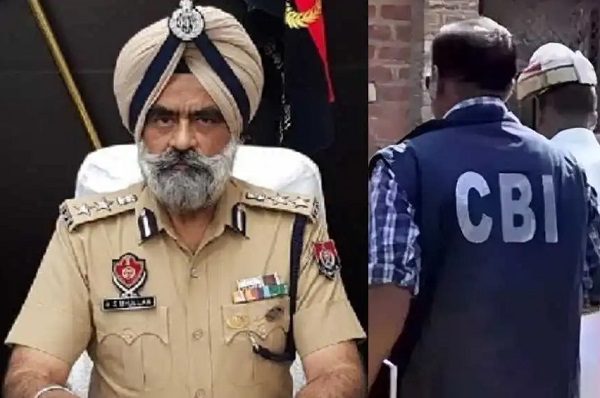
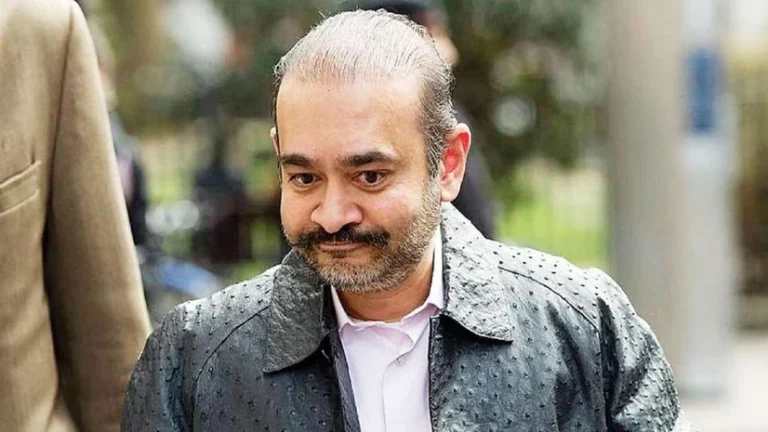
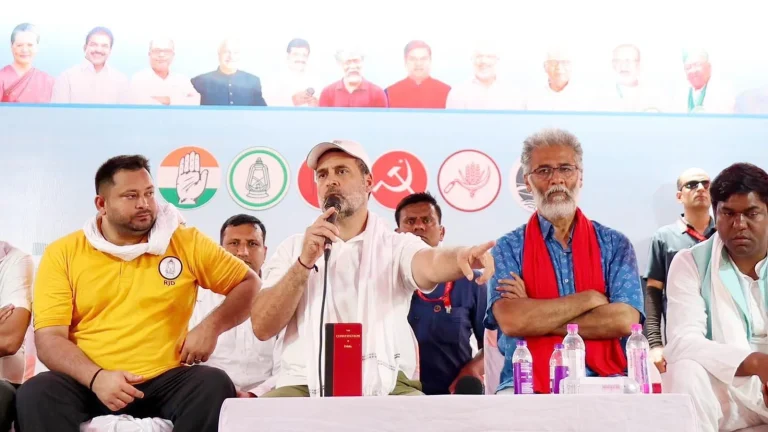
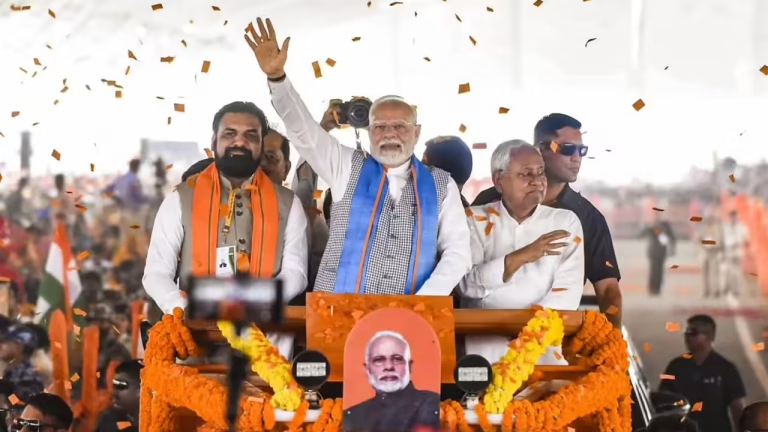
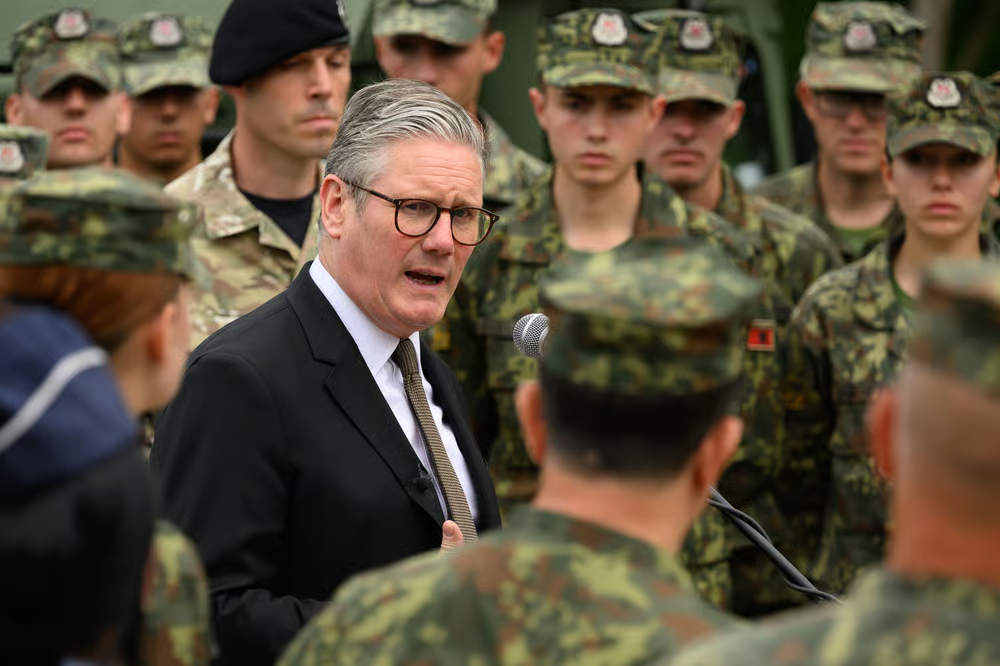
 Also read:
  Unprecedented Energy Sanctions Coordination
 Frozen Assets and Financial Innovation
 The Coalition of the Willing meeting occurred just days after Zelenskyy travelled to Washington seeking American approval for Tomahawk missile transfers, a request that Trump denied during tense bilateral discussions. Rebuffed by Washington, Zelenskyy pivoted to European partners, urging the European Council and the Coalition of the Willing to provide comparable long-range weaponry from European arsenals.
 Conclusion: Coordinated Action and Strategic Resolve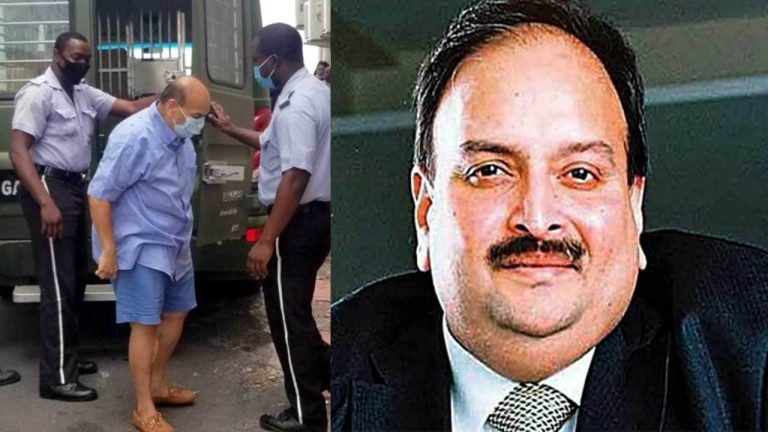
 Also Read:
  The court’s examination revealed that Choksi submitted multiple documents spanning from 2018 to 2022, including INTERPOL Files Control Commission submissions, to substantiate his kidnapping allegations. The Court of Appeals said the CCF’s October 12, 2022, decision provides no clarity on the matter and is formulated cautiously and conditionally. This assessment effectively neutralised one of the primary defence arguments in the Mehul Choksi extradition case.
 Arrest and Detention Timeline
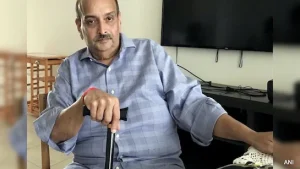 Conclusion: Justice Delayed, But Not Denied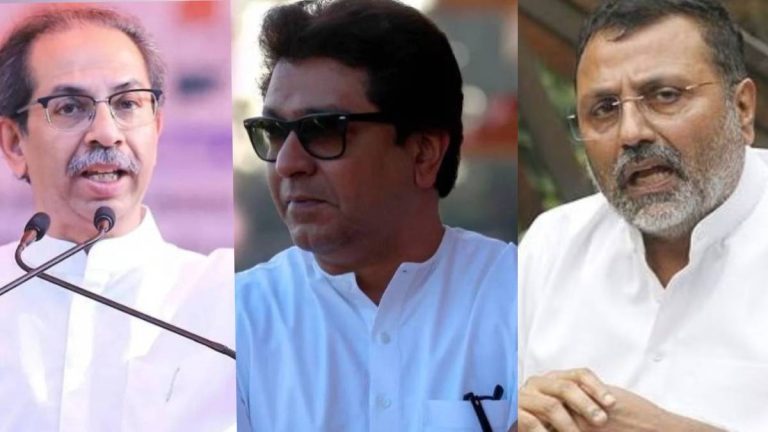
 Also Read:
  However, the practical application of these provisions involves considerable complexity. Political parties often argue that community outreach activities, welfare distribution programs, and cultural celebrations involving food distribution constitute legitimate political engagement rather than corrupt electoral practices. The legal distinction hinges on whether such activities demonstrate specific intent to influence voting behaviour as opposed to general community welfare initiatives or cultural traditions. This BMC elections controversy highlights the persistent challenge of distinguishing between permissible political activities and prohibited electoral inducements, particularly when distributions occur during pre-election periods but before formal election notifications.
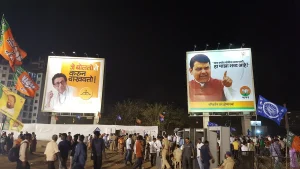 The role of technology and social media in amplifying such controversies cannot be overlooked. Instances that might previously have remained localised complaints now achieve widespread visibility through viral videos, social media posts, and instant news coverage. This amplification effect transforms localised distribution activities into major political controversies requiring responses from party leadership and potentially attracting regulatory scrutiny from election authorities.
 The Role of Media and Public Perception
 Looking Forward: Reform Possibilities and Systemic Changes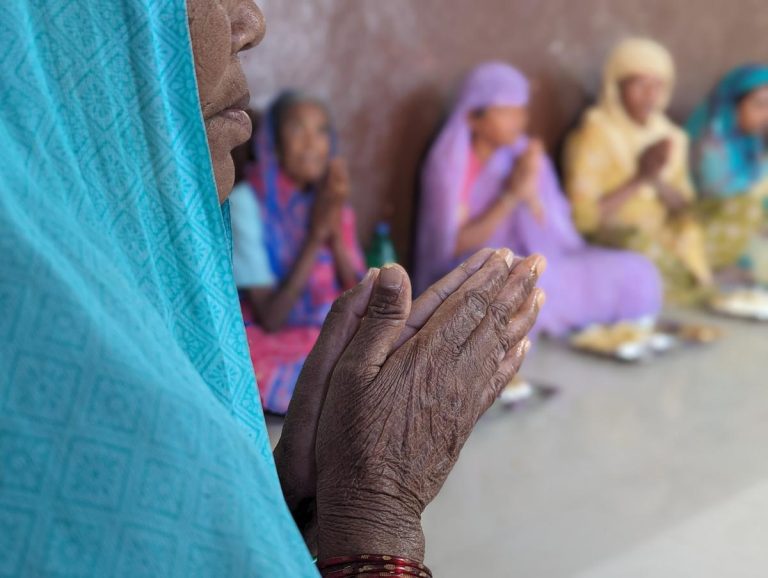
 Also Read:
  Continued Harassment After Escape
 Investigation Status and Challenges
 Path Forward: Protection and Prevention